Over the past several years, cryptocurrency has become a pillar of modern finance. When the digitized currency first garnered such attention and prominence in early 2020, many were quick to dismiss it as little more than a passing fad aided by the unusual circumstances surrounding this time period, including COVID-19 lockdowns. However, in the years since then, while crypto’s overall value has consistently ebbed and flowed, it has remained, demonstrating a kind of resilience and longevity that many doubted it would be able to.
While it’s undeniable that the increased reliance on digital tools and platforms during the COVID lockdowns played a huge role in helping cryptocurrency break through, having spent over a decade with middling levels of success since the founding of Bitcoin in 2008, it has now long outlived that era. Like other technological innovations of the time, such as AI or even social media platforms like TikTok, cryptocurrency has remained an essential element of modern life.
To this end, as many people experience new waves of stress amidst inflation and a struggling economy, crypto lending has become an increasingly popular potential solution. In a time where making ends meet can seem infeasible, crypto lending can provide a viable alternative to traditional loan services. This only leaves one question: is crypto lending right for you?
What Is Crypto Lending?
Crypto lending is highly similar to traditional lending services, but entirely digitized and reliant solely upon cryptocurrency or digital assets. This process allows users to borrow fiat or digital assets by providing crypto as collateral (known as borrowers) or, on the other side of things, to lend out crypto to earn interest (known as lenders).
From the outset, cryptocurrency was designed to operate as a decentralized commodity, positioning it in stark opposition to traditional banking systems. After all, a large part of what inspired Satoshi Nakamoto to create the first kind of cryptocurrency back in 2008 was the US economic recession of 2007. In this way, crypto lending similarly stands in opposition to traditional lending methods through decentralized methodology, but is also offered on centralized crypto platforms, through popular types of coins such as Bitcoin, Ethereum, and stablecoins.
How Crypto Lending Works
Step-by-step process:
Deposit crypto assets
Earn interest
Borrow against crypto collateral
Overcollateralization is part of crypto lending that requires borrowers to deposit assets that ultimately exceed the value of the loan itself. This is done to provide a more worthwhile collateral, which protects lenders from crypto’s high volatility.
Use Cases: Who Should Consider Crypto Lending?
Long-term crypto holders
Investors seeking passive income
Risk-tolerant individuals
Who should avoid it (beginners, risk-averse investors)
Is Crypto Lending Right for You?
Now that you have a better understanding of what crypto lending is and how it works, there are some important considerations to keep in mind that can help you determine if it is a viable solution for you. By considering your risk tolerance, your investment goals, and the overall potential volatility of crypto markets, you can take on a balanced perspective of the opportunities afforded by crypto lending, as well as the potential risks, and make a decision that is right for you.
FAQ Section
What is crypto lending in simple terms?
A way to earn interest by lending your cryptocurrency or borrowing funds using crypto as collateral.
Is crypto lending safe?
It carries risks, including market volatility and platform reliability.
How much can you earn from crypto lending?
Returns vary widely depending on the platform and asset, often higher than traditional savings.
Do you lose your crypto when lending it?
You temporarily give control to a platform, but you retain ownership unless liquidation occurs.
Taurus has secured MiFID investment firm license. It will enble the Swiss digital asset infrastructure company a regulated base to expand services tied to tokenized financial instruments across the EU.
The license was granted by the Cyprus Securities and Exchange Commission to Taurus (Europe) Ltd, the company’s Cyprus-based subsidiary.
Taurus said the Nicosia office will serve as its hub for investment services in EU markets.
Subject to notification and passporting procedures, the authorization allows the unit to serve clients across the bloc’s 27 member states. That gives Taurus a formal EU foothold at a time when banks, asset managers and market infrastructure firms are testing tokenized securities under clearer rules.
The development builds on Taurus SA’s Swiss regulatory status.
The company is already authorized and regulated by Switzerland’s Financial Market Supervisory Authority (FINMA). Taurus’ TDX platform is described by the company as an organized trading facility operated by Taurus SA, not a stock exchange.
“The MiFID license is an important step in our European strategy. It allows us to support EU-based entities within a clear regulatory framework as they scale their digital and tokenized asset activities,” Taurus Co-founder and Managing Partner, Sébastien Dessimoz, said in a statement shared with AlexaBlockchain.
The licensing plays a crucial role because tokenized securities sit closer to traditional capital markets than to crypto trading.
Under EU rules, some crypto-assets are treated as financial instruments rather than MiCA-regulated crypto-assets. The EU’s DLT Pilot Regime, which began applying in March 2023, provides a framework for trading and settlement of crypto-assets that qualify as financial instruments under MiFID II.
That distinction is important.
MiCA created a broad regime for crypto-asset service providers and stablecoin issuers. But tokenized shares, bonds, funds and other DLT-based securities can fall under securities-market rules, including MiFID II and related market infrastructure regulation. MiCA became applicable to stablecoin issuers from June 2024 and to crypto-asset service providers from December 2024.
The CySEC license strengthens Taurus’ ability to combine two lines of business.
The first is technology infrastructure for custody, tokenization and blockchain connectivity. The second is regulated investment services tied to financial instruments, including tokenized DLT financial instruments.
That combination is becoming more relevant as large financial institutions move from pilots to production use cases.
State Street, one of the world’s largest custody banks, announced an agreement with Taurus in 2024 to use its custody, tokenization and node-management technology for institutional digital asset services. The partnership was designed to support issuance and servicing of digital assets, including digital securities and fund vehicles, subject to regulatory approvals.
Deutsche Bank has also been a prominent Taurus backer and partner.
Taurus raised $65 million in a 2023 Series B round led by Credit Suisse, with participation from Deutsche Bank, Pictet Group, Cedar Mundi Ventures, Arab Bank Switzerland and Investis. Deutsche Bank later signed a global partnership with Taurus for digital asset custody and tokenization technology.
The EU license therefore comes at a strategic moment.
Digital asset firms are increasingly seeking regulated status in Europe as institutional clients demand clearer safeguards around governance, cybersecurity, custody and market conduct. For banks, a technology provider’s license does not remove their own compliance obligations, but it can reduce counterparty and operational risk when building tokenized asset programs.
MiFID II is central to that institutional comfort.
The framework requires authorization for investment firms and sets rules around operating conditions, management bodies, conduct and investor protection. EU policy describes MiFID II as part of the bloc’s effort to create a single market for investment services while maintaining harmonized protection for investors in financial instruments.
The passporting element is also commercially significant.
MiFID allows authorized investment firms to provide certain services across member states after completing the required notification process. That makes the Cyprus license more than a local authorization, provided Taurus completes the relevant cross-border procedures.
Taurus said the new license complements its existing custody and tokenization platforms.
The company said it will use Taurus (Europe) Ltd to support banks and financial institutions across Europe as they design and scale digital asset strategies. The firm also said the authorization adds another layer of assurance around governance, risk management and cybersecurity.
The company has also expanded its European governance structure.
Taurus said Taurus (Europe) Ltd has established a new board with company representatives and independent directors. The board includes Lino Finini, former chief operating officer and executive committee member at Swissquote, and George Psomas.
The move reflects a broader institutional shift in digital assets.
The first phase of crypto adoption was led by exchanges and retail access. The current phase is being shaped more by regulated custody, tokenized securities, stablecoin compliance and market infrastructure.
Europe is trying to place that activity inside existing financial rules.
Taurus’ new EU license gives it a clearer path to compete for regulated institutional mandates.
It also shows how digital asset infrastructure is moving closer to the legal architecture of traditional finance, where licenses, governance and cross-border authorization matter as much as blockchain technology itself.
The article “Taurus Secures EU MiFID License to Expand Tokenized Asset Services” was first published on AlexaBlockchain. Read the complete article here: https://alexablockchain.com/taurus-secures-eu-mifid-investment-firm-license/
Read Also: MoneyGram, Pairpoint and eToro Back Midnight’s Privacy Blockchain Before Mainnet
Disclaimer: The information provided on AlexaBlockchain is for informational purposes only and does not constitute financial advice. Read complete disclaimer here.
Image Credits: Taurus, Shutterstock, Canva, Wiki Commons
A Republican US House of Representatives member running for reelection has won his party’s primary after crypto-affiliated groups contributed more than $500,000 in supportive media buys.
Representative James Baird won Tuesday’s Republican primary for Indiana House District 4 with more than 60% of the vote, beating challenger Craig Haggard and others.
Beginning with his first term, in January 2019, Baird consistently supported legislation considered favorable to the crypto industry, including the GENIUS stablecoin act and the market structure bill, the CLARITY Act.
Source: NBC News
According to filings with the US Federal Election Commission (FEC), the Defend American Jobs political action committee (PAC) spent about $514,000 on media to support Baird. The PAC is affiliated with Fairshake, a committee backed by crypto companies including Coinbase and Ripple Labs that spent more than $130 million to influence the 2024 US elections.
“Representative Baird has been a proven leader for pro-job, pro-consumer, and pro-innovation policies in Congress,“ a Fairshake spokesperson told Cointelegraph before the primary. “We’re proud to support leaders committed to responsible regulation that ensures the US remains the global leader in innovation.”
Baird, who also received an endorsement from Donald Trump, reportedly thanked the US President following his primary win. Trump’s ties to the crypto industry have come under increased scrutiny as lawmakers in the Senate consider the CLARITY Act, with many calling for ethics provisions on digital assets before a potential vote.
Related: Americans distrust crypto, AI as industry super PACs flood midterms, poll finds
Fairshake, which reported holding $193 million as of January, is expected to spend millions of dollars in support of candidates it considers “pro-crypto” in the 2026 US midterm elections, as well as “oppose anti-crypto politicians” through media and ads. As of Wednesday, the PAC and its affiliates have spent about $10 million for races in Illinois and Texas in 2026.
Stablecoin yield compromise could advance market structure bill
Last week, US Senators Thom Tillis and Angela Alsobrooks announced that they had finalized the text of the CLARITY Act to include a compromise on stablecoin yield, one of the provisions at issue for the banking and crypto industries.
Although the Senate Banking Committee had not scheduled a markup on the bill as of Wednesday, many expect the stablecoin deal to advance the market structure legislation, which had been stalled in the chamber for months.
Magazine: Guide to the top and emerging global crypto hubs: Mid-2026
Cointelegraph is committed to independent, transparent journalism. This news article is produced in accordance with Cointelegraph’s Editorial Policy and aims to provide accurate and timely information. Readers are encouraged to verify information independently.
Bitcoin is expected to face selling at $84,000, but a shallow pullback increases the likelihood of an upside breakout.
Several major altcoins are showing strength at lower levels, but the bears are expected to pose substantial challenges at the resistance level.
Bitcoin (BTC) rallied above $82,800 on Wednesday, but bulls were unable to hold the higher levels. However, a positive sign for the bulls is that BTC exchange-traded funds recorded $1.63 billion in net inflows in May, according to SoSoValue data. That suggests investors are building positions as they anticipate the uptrend to continue.
Analyst PlanC said in a post on X that BTC was about to enter its first supercycle, which began at the bear-market low of $16,000 in Nov. 2022. He expects BTC to rise above $250,000 in the second half of 2027 to the first half of 2028.
Crypto market data daily view. Source: TradingView
Not everyone is convinced that the bear market is over. Crypto investment company TradingShot said in a post on X that BTC’s rejection at the 200-day simple moving average ($83,313), which coincides with the previous low acting as target objective of $50,000.
Could BTC and the major altcoins break above their overhead resistance levels? Let’s analyze the charts of the top 10 cryptocurrencies to find out.
Bitcoin price prediction
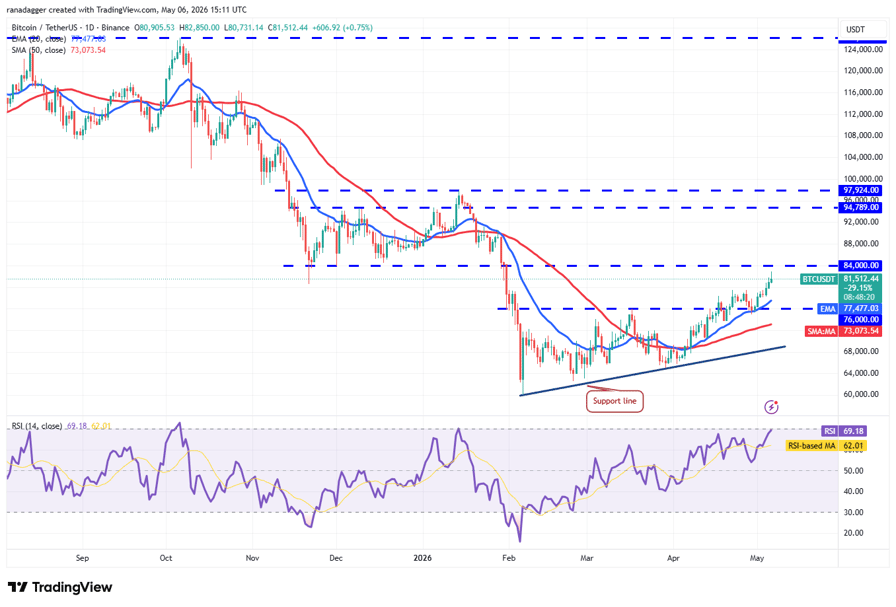
BTC has been gradually rising toward the $84,000 level, indicating sustained buying by the bulls.
Sellers are expected to fiercely defend the $84,000 level, which could trigger a pullback toward the 20-day exponential moving average ($77,477). If the BTC price rebounds off the 20-day EMA with force, it signals a positive sentiment. That improves the prospects of a break above the $84,000 level. If that happens, the BTC/USDT pair may ascend to $92,000.
This bullish view will be invalidated in the near term if the price turns down and breaks below the $74,937 level. The pair may then decline to the 50-day SMA ($73,073) and later to the support line.
Ether price prediction
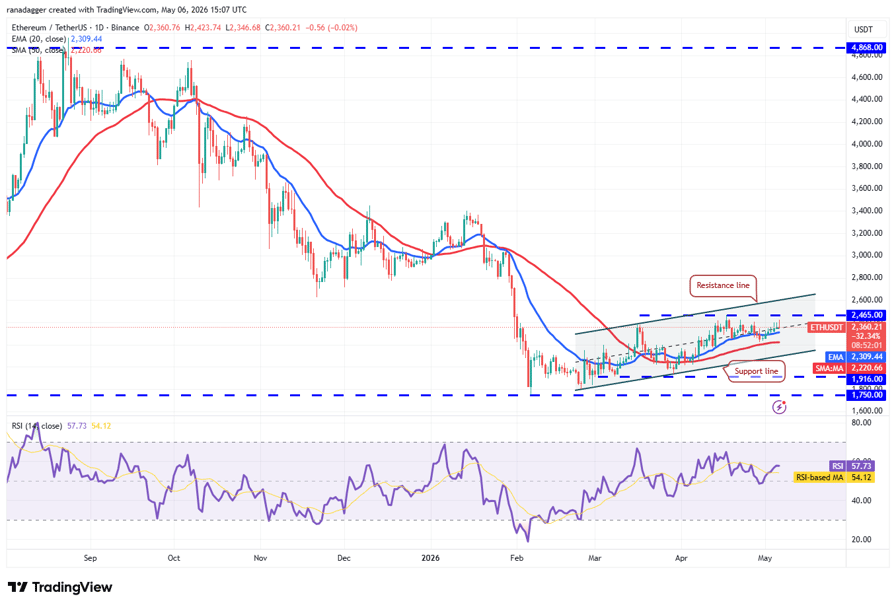
Ether (ETH) has been trading above its moving averages, but the bulls have failed to break $2,465 resistance.
That suggests hesitation to buy aggressively at higher levels. Sellers will attempt to seize control by pulling the price below the moving averages. If they do that, the ETH/USDT pair may descend to the support line.
Buyers are likely to have other plans. They will attempt to maintain the ETH price above the 20-day EMA ($2,309) and overcome the resistance at that level. If they succeed, the pair may rally to $3,050.
XRP price prediction
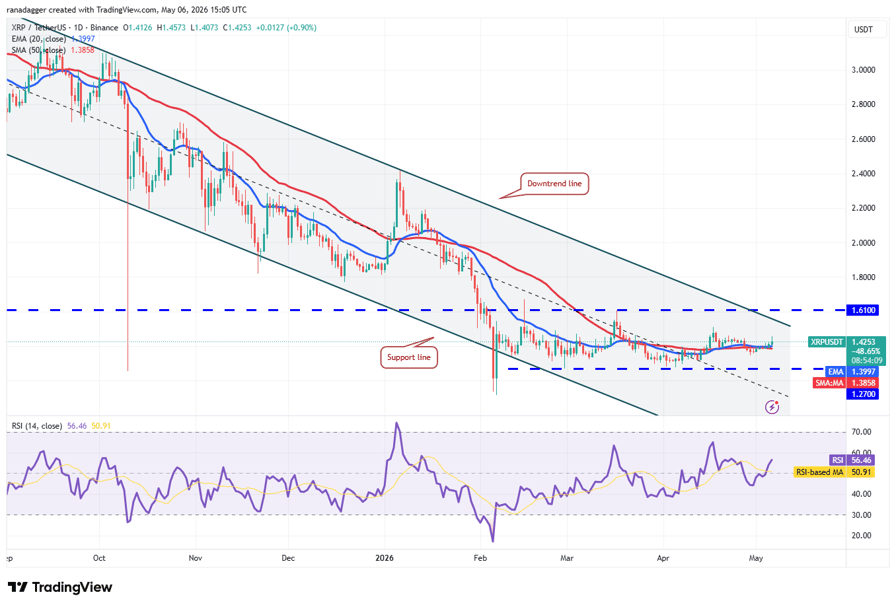
XRP (XRP) closed above the moving averages on Tuesday, opening the gates for a rally to the downtrend line of the descending channel pattern.
The downtrend line has acted as a stiff obstacle during previous recovery attempts and may do so again. If the price reverses from the downtrend line and breaks below the $1.27 level, it suggests the XRP/USDT pair may remain within the channel for a few more days.
On the other hand, a close above the downtrend line and the $1.61 resistance signal a potential trend change. The XRP price may then skyrocket to $2 and then to $2.40.
BNB price prediction
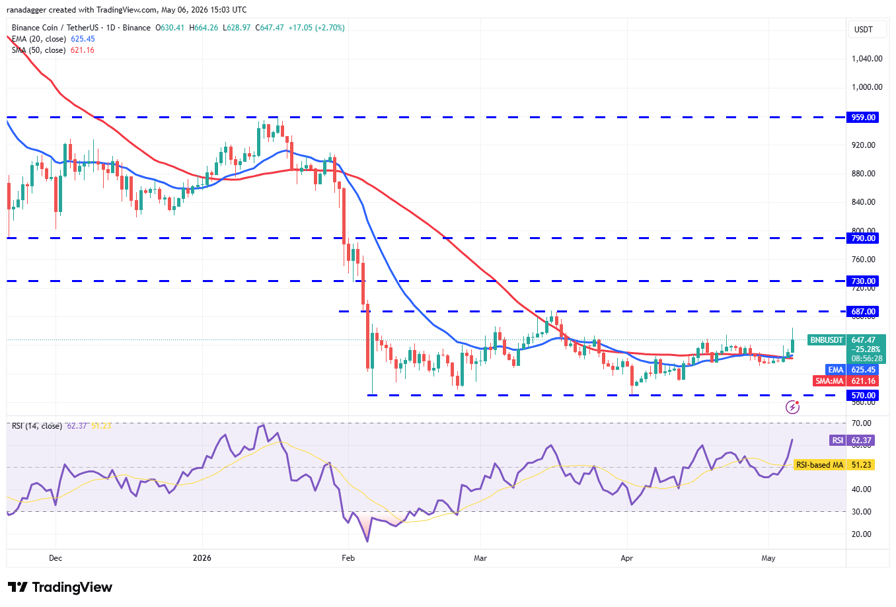
BNB (BNB) closed above the moving averages on Tuesday, indicating that the bulls are back in the game.
Buyers are attempting to overcome the minor resistance at $654. If they can pull it off, the BNB/USDT pair may reach $687. Sellers are expected to defend the $687 level with all their might, as a close above it could clear the path for a rally to $730 and, subsequently, to $790.
Conversely, if the BNB price turns sharply lower from the overhead resistance and breaks below the moving averages, it signals that the pair may continue its range-bound action between $570 and $687 for some time.
Solana price prediction
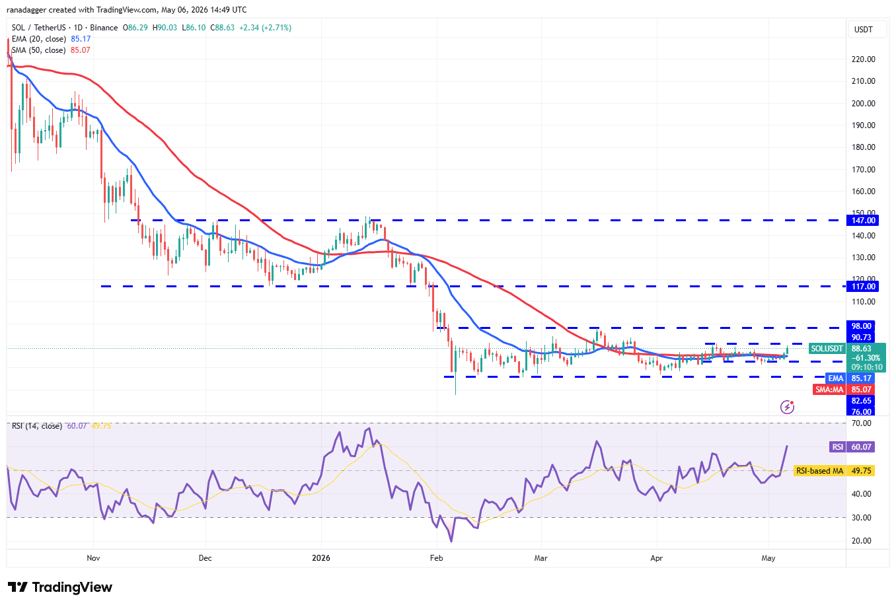
Solana (SOL) broke above the moving averages on Tuesday and rallied close to the $90.73 overhead resistance on Wednesday.
The flattish moving averages and the RSI in the positive territory indicate a slight edge to the bulls. If the $90.73 level is scaled, the SOL/USDT pair may rally to the stiff overhead resistance at $98. Sellers are expected to vigorously defend the $98 level, as a close above it may propel the SOL price to $117.
Instead, if the price turns down and breaks below the moving averages, it suggests the pair may remain within the $76 to $98 range for a few more days.
Dogecoin price prediction
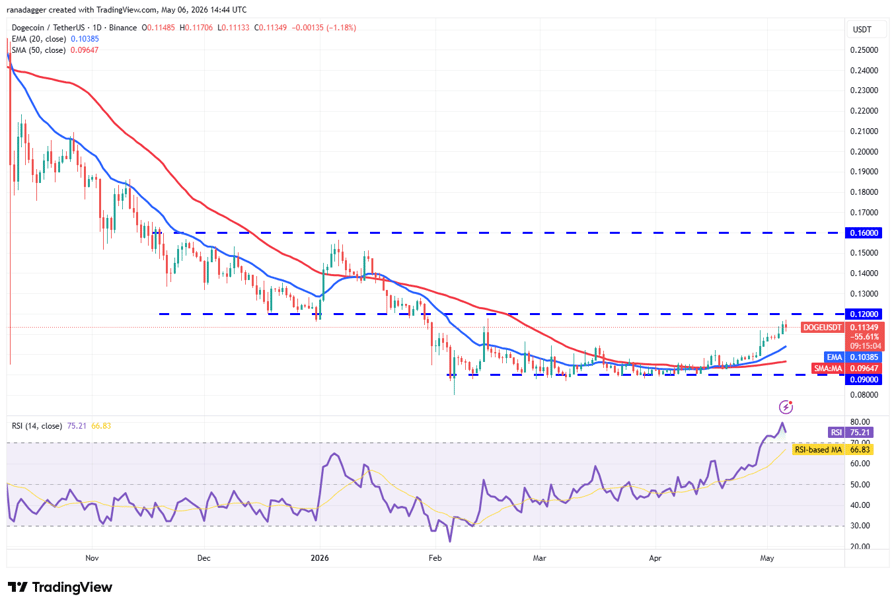
Dogecoin (DOGE) continued its march toward the $0.12 resistance level, where sellers are expected to step in.
A shallow pullback from the $0.12 level suggests that the bulls are not hurrying to close their positions. That increases the possibility of an upside breakout. If the $0.12 resistance level is broken, the DOGE/USDT pair may jump to $0.14 and then to $0.16.
Alternatively, if the DOGE price turns sharply lower and breaks below the 20-day EMA ($0.10), it suggests that bears are aggressively defending the $0.12 level. That may retain the pair inside the $0.09 to $0.12 range for a while.
Hyperliquid price prediction
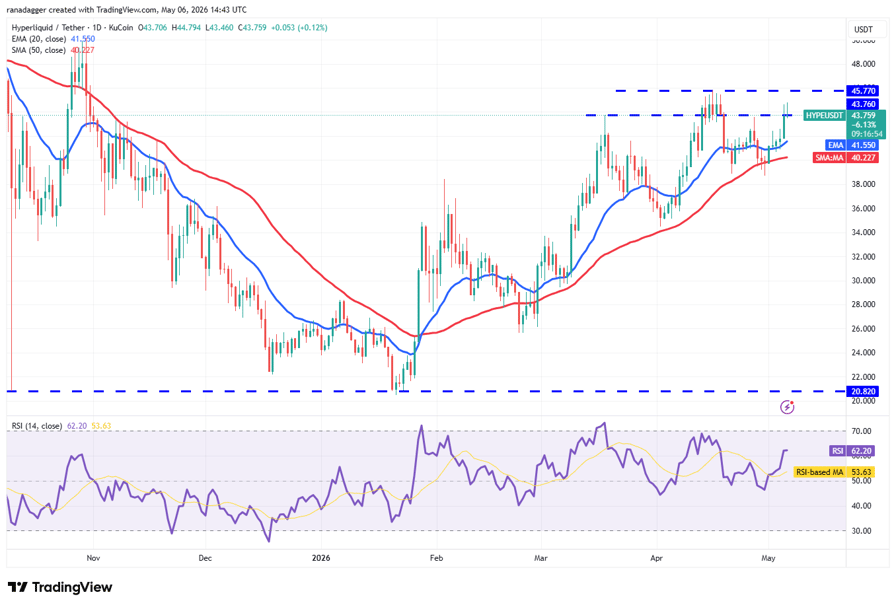
Hyperliquid (HYPE) charged higher on Tuesday, but the up move is facing resistance in the $43.76 to $45.77 zone.
The 20-day EMA ($41.55) has started to turn higher, and the RSI is in positive territory, indicating that the path of least resistance is higher. If buyers pierce the $45.77 level, the HYPE/USDT pair may soar to $50.
The 50-day SMA ($40.22) is the critical support to watch out for on the downside. A break and close below the 50-day SMA suggests that the bulls have given up. The HYPE price may then tumble to $34.45.
Related: Zcash price may hit $800 as $2.7B hedge fund reveals ‘significant position’ in ZEC
Cardano price prediction
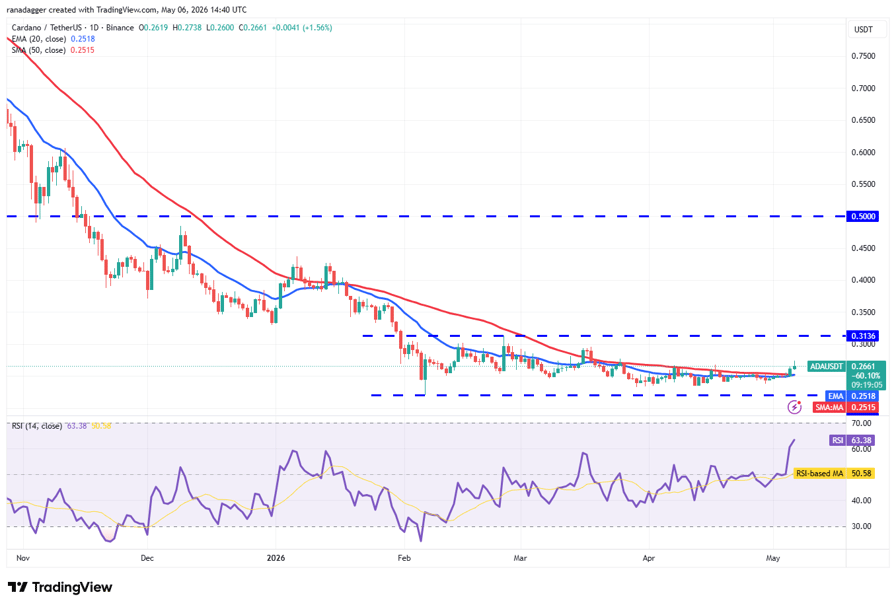
Cardano (ADA) cleared the 50-day SMA ($0.25) hurdle on Tuesday, indicating that the bulls are attempting a comeback.
The recovery attempt is expected to face selling pressure at $0.28, then at $0.30. If both levels are breached, the next target is likely $0.31, a critical resistance to watch. A break above $0.31 signals the start of a potential new up move.
This positive view will be negated in the near term if the ADA price turns down and breaks below the moving averages. That suggests the bears continue to sell on rallies. The ADA/USDT pair may then slump to the solid support at $0.22.
Bitcoin Cash price prediction
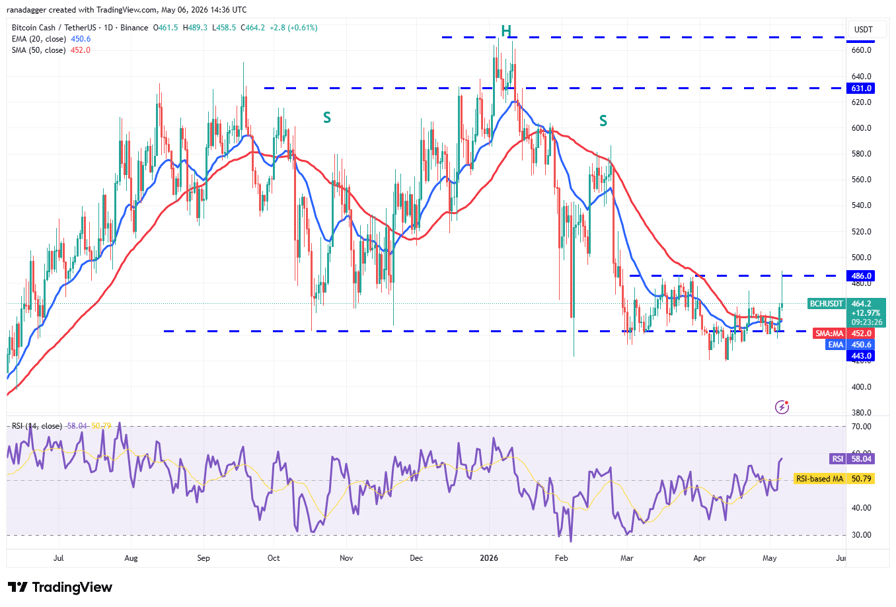
Bitcoin Cash (BCH) turned up from the $443 support on Tuesday and broke above the moving averages.
Buyers continued their buying and pushed the BCH price to $486 on Wednesday. However, the long wick on the candlestick shows that the bears are active at higher levels. That suggests the BCH/USDT pair may remain inside the large $486 to $419 range for a few more days.
Buyers will be back in the driver’s seat if they push the price above the $486 resistance and sustain it. That opens the gates for a rally to $520.
Zcash price prediction
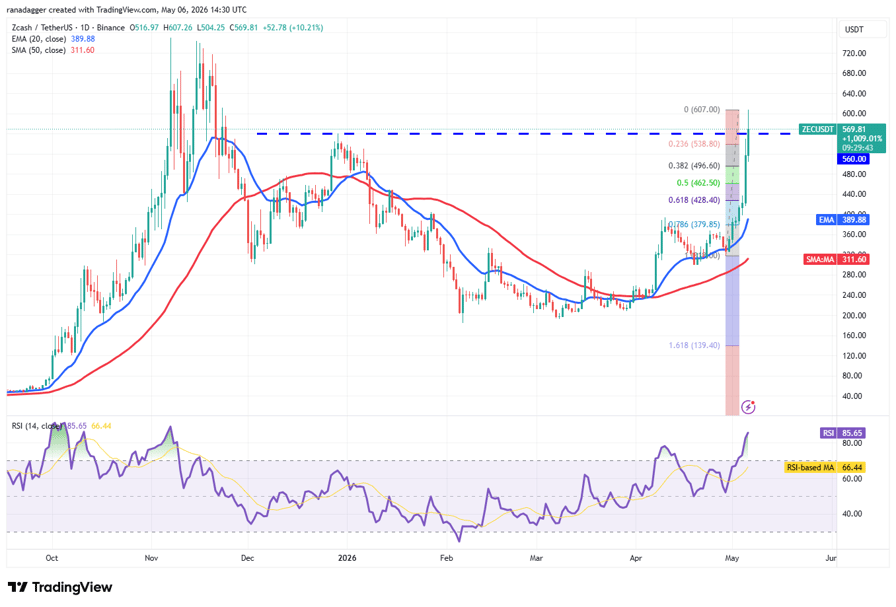
Zcash (ZEC) turned up from the 20-day EMA ($389) on Thursday and rose above the $560 resistance on Wednesday.
The sharp rally over the past few days has pushed the RSI into overbought territory, signaling the possibility of a near-term consolidation or pullback. A shallow pullback from the current level suggests that the bulls are holding their positions as they anticipate the uptrend continuing. That increases the likelihood of a rally to the formidable resistance at $750.
A risk to the continuation of the up move is that sharp rallies are followed by equally sharp pullbacks. If the ZEC price maintains below $560, the ZEC/USDT pair may drop to the 38.2% Fibonacci retracement level of $496 and then to the 50% retracement level of $462.
Linea Consortium has joined Linux Foundation Decentralized Trust (LFDT) as a premier member and contributed the open-source zero-knowledge (ZK) rollup stack powering Linea as a new code project called Lineth.
The contribution places Linea’s core layer-2 technology under LFDT’s open-source governance framework, rather than the control of any single company, Linea Consortium said in a release on Tuesday, positioning the move as a step toward decentralization. However, the contribution concerns governance of Linea’s open-source technology stack, not necessarily the decentralization of the Linea network itself.
Linea Consortium board director Declan Fox will join the LFDT governing board alongside representatives from companies like Consensys, Hedera, Kaleido, OpenAssets and Shielded Technologies.
Linea Consortium is a nonprofit that guides Linea’s ecosystem growth, protocol strategy and decentralization, while LFDT is the Linux Foundation’s open-source organization for blockchain, ledger, identity and related decentralized technologies.
Lineth includes Linea’s core ZK rollup components, including its execution, consensus and proof systems, as well as L1 and L2 smart contracts. Linea said the project aims to expand its maintainer base, attract enterprise and institutional users, and support long-term sustainability beyond any single company.
Cointelegraph reached out to Linea Consortium for additional information, but did not receive a response by publication.
Open-source move does not decentralize Linea network
The move gives Linea’s ZK rollup stack a foundation-governed home for maintainers, contributors and potential enterprise adopters. However, key parts of the network remain centralized, including its sequencer, prover, upgrade controls and validator participation.
In the announcement, Fox highlighted one of Ethereum’s core value propositions: credible neutrality. He said that joining LFDT and contributing Lineth are “deliberate steps in Linea’s progressive decentralization.” He added that the move gives the technology powering the L2 ecosystem a “neutral home that no single company controls.”
Related: DeFi can freeze stolen funds, but not everyone agrees it should
According to Linea’s risk disclosures, its Mainnet Beta still includes centralized components such as the sequencer, prover and Security Council, which are maintained by the team. The sequencer can also postpone transaction inclusion and reorder transactions.
Linea’s information page at L2Beat. Source: L2Beat
L2 analytics tracker L2Beat classifies Linea as a Stage 0 rollup, a category used for networks that still rely heavily on operators or other trusted actors.
The distinction comes amid a broader Ethereum debate over the role of L2 networks. Ethereum co-founder Vitalik Buterin said in February that L2 progress toward Stage 2, where networks are mostly controlled by smart contracts and permissionless mechanisms rather than by the core team, had been slower and harder than expected.
Magazine: AI-driven hacks could kill DeFi — unless projects act now
Cointelegraph is committed to independent, transparent journalism. This news article is produced in accordance with Cointelegraph’s Editorial Policy and aims to provide accurate and timely information. Readers are encouraged to verify information independently.
MIAMI — Eric Trump, the son of President Donald Trump and the co-founder of American Bitcoin (ABTC), said that bitcoin BTC$81,314.89 has reached a sharp influx of traditional financial giants, name-checking Bank of America Corp.’s Merrill division, Charles Schwab Corp. and JPMorgan Chase & Co.
“JPMorgan, who was crapping all over bitcoin 18 months ago, saying it was a joke asset,” Trump said on Wednesday at Consensus Miami 2026. “It’s really interesting — now they’re allowing people to take down home mortgages against their bitcoin holdings at JPMorgan, this happened in a period of 18 months, my friends.”
JPMorgan CEO Jamie Dimon had been a longtime critic of cryptocurrencies, though his bank has since been among those embracing blockchain technology and associated advances, including tokenization of assets.
Trump, whose father has pursued aggressive pro-crypto policies from the White House, said the crypto industry has “broken the banks” that had once turned away the Trump family, rejecting their business.
“The financial institutions all realize that they’ve lost and they can no longer push back,” he said. “And so instead of actually fighting against the tide, you know what they’re doing, they’re swimming with it for the first time.”
American Bitcoin, a mining company that is ranked as the 16th largest public holder of bitcoin, is mining bitcoin at 50 cents on the dollar, said Trump, the company’s chief strategy officer. He said the company is trying to establish the cheapest bitcoin acquisition in the sector. And he said bitcoin is “seeing a new torque” in the asset.
“It’s truly become one of the great stores of value ever,” he said, repeating his frequent claim that the asset will eventually top a million dollars.
Privacy-focused blockchain infrastructure startup Arcium is moving beyond backend cryptography tools and into live consumer-facing applications, as projects built on its encrypted computing network begin launching products for fundraising, information markets and private finance on Solana.
The company said its ecosystem now includes more than a dozen projects that have collectively raised over $7.5 million, while applications built on its encrypted execution layer are beginning to process live user activity.
The latest launches include Bench, an encrypted “opportunity market” for investment and hiring intelligence, and Crafts, a sealed-bid token auction platform designed to reduce front-running and price manipulation in token sales.
The expansion marks a shift for Arcium from infrastructure provider to a network supporting production-grade applications. The company’s technology uses Multi-Party Computation, or MPC, allowing multiple nodes to process encrypted data without exposing the information to any single participant.
The push comes as privacy infrastructure gains renewed attention across crypto markets.
Developers and institutional investors have increasingly argued that fully transparent blockchains create risks for trading, fundraising and enterprise adoption because transaction data, bids and wallet activity can be monitored in real time.
Bench is attempting to address that issue through encrypted information markets.
The platform allows users, referred to as scouts, to privately stake on opportunities such as startup investments or potential hires. Market creators receive the submissions after the bidding period closes, while Arcium’s encrypted infrastructure prevents competitors from viewing activity during the process.
“There’s a significant gap between the people who hold valuable information and the decision-makers who need it,” Erik Plaumann, co-founder of Bench, said in a statement shared with AlexaBlockchain. “Encrypted staking on Arcium lets us close that gap.”
Arcium said Bench attracted more than 4,000 signups during its first week on Solana Devnet.
Crafts is targeting another long-standing crypto market issue: token launch manipulation.
The platform introduces sealed-bid token auctions on Solana, where bids remain encrypted until the auction window closes. The model is designed to limit front-running and coordinated pricing strategies that have historically affected token sales across decentralized markets.
ReFiHub, a real-world energy asset platform with a reported $35 million asset pipeline, is the first project using the Crafts launchpad. Arcium said the launch generated more than 1,000 waitlist signups, while over 140 companies have joined the broader Crafts discovery platform.
“Token launches today are coordination games dressed up as price discovery,” Philipp Fock, co-founder of Crafts, said. “Sealed bids fix that at the architectural level.”
The broader Arcium ecosystem now spans encrypted wallets, confidential OTC trading, private prediction markets, peer-to-peer payments and privacy-focused DeFi infrastructure.
The company has positioned itself as part of a wider movement toward “confidential computing” in blockchain networks, where sensitive data can remain encrypted while still being processed onchain.
That market has drawn increasing investor interest over the past two years, particularly as AI applications and institutional finance require privacy-preserving computation tools.
Arcium raised a $5.5 million strategic funding round led by Greenfield Capital in 2025, bringing total funding at the time to $9 million. Investors included Coinbase Ventures and several Solana ecosystem backers.
The company was originally developed from Solana privacy project Elusiv before evolving into a broader encrypted computing platform.
Industry competition in the sector has intensified as projects explore alternatives to public blockchain transparency.
Several blockchain teams are working on technologies combining MPC, fully homomorphic encryption and zero-knowledge proofs to support confidential trading, AI model training and private financial infrastructure.
Arcium’s infrastructure currently operates with four independent node operators on Solana Mainnet Alpha, according to the company.
The firm is also expanding into AI-focused encrypted computation through its Manticore protocol, which aims to support encrypted inference, federated learning and collaborative machine learning applications.
“No other project in the industry is making encrypted compute a reality at the pace the Arcium ecosystem is,” Arcium Chief Executive Yannik Schrade said.
The developments reflect a broader shift in crypto infrastructure from speculative consumer applications toward institutional-grade tooling around privacy, execution and data protection.
While public blockchains were originally designed around transparency, developers increasingly view selective privacy as necessary for capital markets, fundraising and enterprise adoption.
The article “Arcium Ecosystem Surpasses $7.5M Raised as Bench and Crafts Go Live, Bringing Private Opportunity Markets and Sealed-Bid Auctions to Solana” was first published on AlexaBlockchain. Read the complete article here: https://alexablockchain.com/arcium-ecosystem-surpasses-7-5m-raised-as-bench-and-crafts-go-live/
Read Also: MoneyGram, Pairpoint and eToro Back Midnight’s Privacy Blockchain Before Mainnet
Disclaimer: The information provided on AlexaBlockchain is for informational purposes only and does not constitute financial advice. Read complete disclaimer here.
Image Credits: Arcium, Shutterstock, Canva, Wiki Commons
Anthropic just made Elon Musk’s SpaceX a key supplier to its AI ambitions, and the timing is hard to miss.
The Claude maker said Wednesday it had signed a deal to tap all of the compute capacity at SpaceX’s Colossus 1 data center, locking in access to more than 220,000 NVIDIA GPUs within the month.
The agreement directly expands what Anthropic can serve to Claude Pro and Claude Max subscribers, with Claude Opus API rate limits raised significantly and Claude Code’s five-hour rate limits doubled for Pro, Max, Team and Enterprise plans, all effective Wednesday.
The Colossus 1 deal is the latest in a growing stack of Anthropic compute partnerships.
The company has previously signed an up to 5 gigawatt agreement with Amazon that includes nearly 1 gigawatt of new capacity by year-end, a 5 gigawatt deal with Google and Broadcom that comes online in 2027, a Microsoft-NVIDIA strategic partnership covering $30 billion of Azure capacity, and a $50 billion U.S. AI infrastructure investment with Fluidstack.
Anthropic also flagged interest in partnering with SpaceX on orbital AI compute capacity, expanding the relationship beyond terrestrial data centers. The timing matters because SpaceX is weeks away from going public.
The Musk-led firm filed confidentially with the SEC on April 1 for an IPO targeting a $1.75 trillion to $2 trillion valuation, with the public S-1 expected by late May and the roadshow set for the week of June 8.
Adding Anthropic as a named compute customer ahead of the listing strengthens SpaceX’s pitch as more than a launch and Starlink business, with AI infrastructure now a disclosed revenue line.
The deal also lands as Anthropic continues international expansion to meet data residency requirements in regulated industries.
BTC hit an intraday high of $82,800, even as Strategy’s chairman opened the door to selling Bitcoin to fund preferred dividends.
Crypto markets rallied for a third day as Middle East de-escalation and accelerating ETF inflows pushed Bitcoin to its highest level in three months.
Bitcoin is changing hands at $81,696, up 6.4% for the week, while the total crypto market capitalization is 0.6% higher at $2.79 trillion, according to CoinGecko.
BTC Chart
Among large caps, Solana (SOL) is the standout at $89, up 4% over 24 hours. BNB added 2.7% to $648.5, and XRP is 1.3% higher at $1.43. Ether (ETH) is the sole laggard among the top six, slipping 0.9% to $2,358.
Hyperliquid’s HYPE token, trading at $43.52, leads the seven-day tape among majors with a 9.6% rally.
ETF Flows
Spot Bitcoin exchange-traded funds added another $467 million on Tuesday, extending a three-session streak that has pulled in roughly $1.63 billion, per SoSoValue data. Cumulative net inflows since the January 2024 launch now stand at $59.72 billion, with total net assets across the 11 funds at $109 billion.
Spot Ether ETFs have joined in after a stretch of outflows through late April, taking in $260 million across the same three trading days and lifting cumulative net inflows to $12.17 billion.
Saylor Curveball
The rally’s most notable speed bump arrived from the company that built its identity on never selling a satoshi. On Monday’s Q1 earnings call, Strategy executive chairman Michael Saylor told investors the firm will probably sell a portion of its Bitcoin to fund preferred dividends, framing the move as designed to “inoculate the market.”
Strategy reported a $12.54 billion net loss for the quarter, driven entirely by mark-to-market accounting on its 818,334 BTC stack. The company faces roughly $1.5 billion in annual preferred-dividend obligations across its STRK and STRC instruments and has about 18 months of dividend coverage from existing USD reserves.
LexisNexis Regulatory Compliance has released a new whitepaper examining how evolving anti-money laundering standards are reshaping compliance expectations across the United Kingdom and European Union, as regulators increasingly focus not only on whether policies exist, but whether controls are embedded, tested and effective in practice.
Global organisations are being urged to transform legal obligations into robust operational controls, as the whitepaper explains that recent legislative reforms and supervisory intensification are turning AML compliance into an exercise in demonstrable control effectiveness. The report delineates how, while the UK continues to adopt a risk-based, yet increasingly prescriptive framework anchored in the Proceeds of Crime Act 2002 and the Money Laundering Regulations 2017, the EU is moving toward a single rulebook that centralises supervision under its 2024 AML package.
“Regulators expect that controls not only exist on paper but are operationally embedded and resilient against emerging risk,” the whitepaper states. This emphasis on practical evidence of control effectiveness is driven by the surge in digital on-boarding, embedded finance, and cross-border payment challenges. The whitepaper highlights that UK supervisory measures, exemplified by the introduction of the SPSS model and enhanced guidance on digital identities, are set to transform compliance from a regulatory checkbox exercise into a strategic, evidence-based program.
According to the whitepaper, the EU’s approach seeks to harmonise customer due diligence and internal controls, with its AMLA set to directly supervise high-risk financial institutions from 2028. This strategic move is expected to make supervisory practices more consistent and reduce the divergence in compliance evidence across different Member States. Meanwhile, both regimes are challenged by dynamic risks posed by cryptoasset activity, which now demands closer scrutiny and more rigorous internal protocols.
A crucial theme of the whitepaper is that “organisations must now ensure that controls are proportionate, timely and — crucially — supported by verifiable governance,”. With the rapid modernization of financial services, regulatory enforcement has increasingly scrutinised whether screening engines, risk assessments, and escalation protocols are not only documented but demonstrably effective in real-time operations.
The whitepaper concludes that the frontier AML risk does not arise from a lack of legal understanding but from the failure to operationalise legal change into clear obligations and accountable oversight. For institutions operating in both the UK and the EU, this regulatory shift signals a pressing need to build common control taxonomies, robust data frameworks, and shared documentation standards that can dynamically keep pace with evolving supervisory expectations.
To download the full whitepaper, Evolving AML Standards: UK flexibility vs EU centralisation in an era of heightened enforcement, click here.