Lloyds Banking Group has launched Envoy, a new internal platform designed to provide a secure and governed environment for building and running AI agents across the massive organisation.
Built in collaboration with Google Cloud, the platform actively supports the Group’s ambition to responsibly scale agentic AI. By empowering colleagues to work more efficiently, the initiative aims to fundamentally improve both customer and colleague experiences.
Reimagining workflows with AI
Ron van Kemenade, group chief operating officer at Lloyds Banking Group
Envoy is specifically designed to offer teams at Lloyds a straightforward, reliable, and secure way to build and share AI tools. A core feature of the platform is the provision of ready-to-use templates. These templates significantly reduce the need for developers to build from scratch, allowing teams to focus directly on solving real business and customer problems.
Because the platform is built to scale, AI agents can be actively reused and shared across the organisation. According to the bank, this approach helps prevent operational duplication and strongly encourages a more joined-up use of AI throughout Lloyds Banking Group.
Ron van Kemenade, chief operating officer at Lloyds Banking Group, emphasized the potential impact on internal operations.
“Envoy helps our employees become more productive, improve customer journeys, and launch potentially disruptive business models,” van Kemenade stated.
Built for safety, control, and confidence
Given the heavily regulated nature of the banking sector, Envoy has strong operational controls built in from its inception. The platform connects directly to Lloyds’ existing Large Language Model infrastructure. This connection is critical, as it keeps AI models safe and ensures they strictly follow set rules, guaranteeing that the resulting AI agents act responsibly and reliably.
The platform is designed to make the entire process of getting AI agents up and running both simple and secure. It features built-in checks for safety and risk, purposely retaining human oversight in key decisions to ensure all agents consistently meet required standards before wider deployment.
Once agents are live, Envoy provides teams with the capability to continually monitor behaviour and performance. The platform offers full visibility and a complete audit trail of activity, ensuring transparency, accountability, and ongoing confidence in how AI is being deployed.
An internal ‘Agent Marketplace’
To foster collaboration, Envoy allows completed, proven agents to be published to an internal ‘Agent Marketplace’. Within this marketplace, other teams across the bank can easily find, reuse, and build upon existing solutions.
A key functional benefit of Envoy is its ability to let agents “remember” important details during conversations, all while strictly following rules regarding data privacy and retention limits. This conversational memory is designed to support customer journeys, ensuring that customers won’t need to frustratingly repeat information when returning to a previous enquiry.
Envoy forms a central pillar of the Group’s wider AI ecosystem. Functionality is set to continuously evolve throughout 2026 as the bank seeks to further support its colleagues and customers.
Amazon Web Services (AWS) rolled out a new payments infrastructure for AI agents on Thursday which is built in partnership with Coinbase and Stripe.
AWS explained that autonomous software agents will be allowed to buy APIs, web content, MCP servers and other online services in real time using stablecoins. It added, however, that future versions would eventually support larger purchases such as hotel bookings, travel reservations and merchant payments.
“Amazon Bedrock AgentCore Payments” is designed for AWS described as the emerging “agentic economy”, where AI agents transact independently inside a single execution loop.
The first version of the system focuses on micropayments, allowing agents to instantly pay for APIs, data feeds, paywalled content and other digital services, often for fractions of a cent, AWS said.
Bedrock is built on Coinbase’s x402, the HTTP-native payment protocol for powering agent-to-agent transactions with stablecoins, while Stripe’s Privy wallet is being used as a payment connection.
“There will soon be more AI agents transacting than humans, and they need money that’s built for the internet – programmable, always on, and global,” said Brian Foster, Coinbase’s head of infrastructure growth.
Foster’s words echo those of Coinbase founder Brian Armstrong, Binance founder Changpeng Zhao and of Cardano Founder Charles Hoskinson, who agree that shortly all activity on the internet will be conducted by AI agents.
Stripe said this roll-out is part of a broader push to build financial infrastructure for autonomous AI commerce. “For agents to become meaningful economic actors, they need a way to hold and spend money,” said Henri Stern, CEO of Privy, a Stripe company.
AWS added that the platform is protocol-agnostic, though x402 is the first supported standard at launch. The broader goal is to create infrastructure for autonomous software agents capable of completing commercial transactions on behalf of users.
Warner Bros. Discovery, which is already testing Amazon’s Bedrock AgentCore, said it sees potential for agent-driven transactions involving premium content, including live sports and major entertainment releases.
At the Retail Technology Show, the conversation around the point of sale shifted from simple speed to the total quality of the interaction. Simon Fairbairn, Head of Solutions Engineering (EMEA) at Ingenico, joined the discussion to explain how the company is reimagining the checkout process to be more than just a necessary hurdle for consumers. Fairbairn highlighted that while the past decade was defined by efficiency and getting people through the queue as quickly as possible, the current focus is on creating a richer, more personal, and interactive experience.
To simplify the checkout while expanding choice, Ingenico has introduced a new range of terminals designed to provide a “trust handshake” through enhanced sensory feedback. These devices feature secondary screens so customers can track their own transactions, haptic feedback, and a “halo” of light that turns green for successful payments or red for errors. This interactivity allows the terminal to deliver added value directly at the point of sale, such as offering “pay later” options, supporting alternative payment methods, and managing loyalty programs that can recognize returning customers and apply discounts instantly.
The next major shift identified by Fairbairn is the embedding of AI into both cloud solutions and the terminals themselves to solve real-world problems. One innovative use case involves using the terminal’s camera to monitor the customer’s surroundings and provide warnings if someone is “shoulder surfing” or leaning in too close to view private details. By capitalizing on the immense processing power and cloud services behind these devices, Ingenico is helping retailers move toward a future where the checkout is not just frictionless and fast, but a secure and pleasurable experience that brings more value to both the merchant and the shopper.
Key Highlights from Simon Fairbairn:
The Experience-First Model: Fairbairn discusses why the focus in payments is shifting from pure efficiency to creating a richer, more interactive customer experience.
Sensory Feedback and Trust: How the use of haptics, secondary screens, and color-coded lighting creates a better “trust handshake” during the transaction.
Added Value at the Point of Sale: A look at how terminals are becoming hubs for loyalty programs, alternative payment methods, and flexible financing options like “pay later”.
AI-Powered Security: Insights into how embedded AI can use terminal cameras to protect customer privacy and warn against potential threats during the payment process.
The Stratum v2 Working Group announces today that ANTPOOL, Block Inc, F2Pool, Foundry, Spiderpool, MARA Foundation, and DMND have joined the working group to advance the adoption of the Stratum v2 protocol.
The working group was founded in 2022 by Braiins and Spiral to develop and maintain the Stratum v2 protocol as an open and vendor-neutral specification usable by the Bitcoin mining ecosystem. The protocol is an upgrade to the original Stratum mining protocol, bringing massive efficiency gains, privacy, security, and functionality that can be used to improve overall mining decentralization.
The onboarding of the new members, all substantial players in the mining ecosystem, represents a big leap forward for the working group’s progress in ensuring proper functioning and compatibility across real-world mining operations at scale. It also shows a growing consensus in the mining ecosystem that Stratum v2 is the direction to take going into the future.
“We’re proud to support the broader adoption of Stratum V2. Aligning around an open, interoperable standard enables the industry to collaborate more effectively and drive improvements in efficiency, security and decentralization,” said Andy Zhou, CEO of ANTPOOL.
Stratum v2 supports mechanisms for more efficient management of large fleets of miners, is end-to-end encrypted, and allows individual miners to produce their own block templates with supporting pools (among other features).
Kenway Wang, CTO of Spiderpool had this to say: “Decentralization is core to our mission. Stratum V2 supports this by enabling miner-constructed templates, while also improving efficiency, especially for miners in bandwidth-constrained environments.”
About the Stratum V2 Working Group
The Stratum V2 Working Group is an open collaboration initiative dedicated to advancing the development, adoption, and interoperability of the Stratum V2 mining protocol. It maintains a public specification and provides a coordination layer between developers and industry stakeholders.
XRP gave back ground after failing to hold above $1.45, with the pullback coming even as Ripple pushed deeper into institutional finance through a cross-border tokenized Treasury settlement alongside JPMorgan and Mastercard. The move lower matters because XRP is now sitting back near the same breakout zone traders had been watching for confirmation only days earlier.
News Background
• Ripple, JPMorgan, Mastercard and Ondo Finance completed a near-real-time cross-border redemption of tokenized U.S. Treasuries on the XRP Ledger, with settlement finalized in under five seconds.
• The transaction routed through Mastercard’s Multi-Token Network before JPMorgan’s Kinexys platform delivered dollars to Ripple’s Singapore banking partner outside traditional banking hours.
• The pilot adds to growing institutional focus on tokenized finance infrastructure, with DTCC also preparing to launch its own tokenization platform later this year.
Price Action Summary
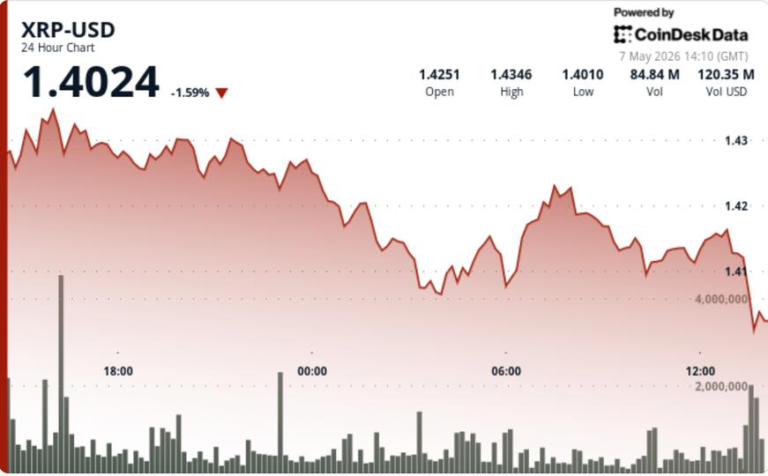
• XRP slipped from $1.4534 to $1.4137 over the 24-hour session, reversing after an earlier push toward $1.45. • Heavy selling hit during the May 6 13:00 UTC session, when 131.28M in volume drove price through support at $1.4460. • Price later stabilized around the $1.41 area after a sharp intraday recovery from session lows near $1.409.
Technical Analysis
• The rejection near $1.45 matters because that level has repeatedly capped upside attempts during the broader consolidation range. • XRP is still holding above the broader $1.40 breakout zone, but momentum cooled sharply after the failed push higher. • The market is now compressing between support near $1.41 and resistance between $1.45-$1.47, a range that increasingly looks unstable given thinning liquidity conditions. • Analysts continue pointing to a larger bull flag structure on higher timeframes, though shorter-term charts still show distribution pressure on rallies.
What traders should watch
• $1.40-$1.41 is now the key support zone. Losing it would weaken the recent breakout structure. • $1.45-$1.47 remains the level bulls need to reclaim to reopen momentum toward $1.60 and higher. • Liquidity conditions remain thin, which raises the odds of sharper-than-normal moves once the range finally breaks.
Solv Protocol has said it’s moving more than $700 million of tokenized bitcoin BTC$80,233.10 assets to Chainlink’s Cross-Chain Interoperability Protocol (CCIP) and deprecating LayerZero bridge support across Corn, Berachain, Rootstock and TAC.
The migration covers SolvBTC and xSolvBTC, Solv’s wrapped bitcoin assets used across DeFi and BTCfi markets. Solv said it made the decision after an updated security review and recent cross-chain hacks, pointing to CCIP as its standard bridge infrastructure.
Chainlink’s CCIP is a bridge that connect blockchains, enabling transfers of tokens, messgages and data between different decentralized networks.
Solv’s move follows Kelp DAO’s shift from LayerZero to Chainlink after an April exploit drained 116,500 rsETH, worth roughly $292 million, from its LayerZero-powered bridge.
Kelp and LayerZero have since traded blame over the setup behind the exploit. LayerZero said Kelp used a single-verifier configuration despite recommendations to adopt a multi-DVN model, while Kelp says LayerZero personnel reviewed and approved the configuration it later blamed for the attack.
The dispute has turned verifier design into a live security issue for high-value cross-chain assets as Kelp says the 1-of-1 setup was not an edge case. LayerZero says it was an application-level configuration choice and has since said it will no longer sign messages for applications using that model.
Solv’s migration gives Chainlink a second post-hack win in cross-chain infrastructure. Kelp is moving liquid restaked ETH to it, while Solv is moving tokenized bitcoin.
Together, Kelp and Solv represent more than $2 billion in protocol asset value moving toward Chainlink’s cross-chain infrastructure.
“We are speaking to many teams across the industry and there is a clear and accelerating trend where protocols like Solv are migrating to Chainlink in a flight to quality reminiscent of the rapid shifts during DeFi summer,” Johann Eid, chief business officer at Chainlink, told CoinDesk.
“The industry’s largest protocols are realizing they can no longer rely on cross-chain and oracle infrastructure that push liability onto users and blame them for systemic failures,” Eid added. “By choosing CCIP, Solv gets cross-chain infrastructure that is “secure and decentralized by default.”
Solv already had already worked with Chainlink to offer real-time collateral verification for SolvBTC pricing.
EU lawmakers on Thursday closed a deal to loosen laws under the EU’s Artificial Intelligence Act.
Details of the changes include postponing restrictions on high-risk uses of AI until December 2027 and exempting industrial applications of AI from legal scrutiny.
AI tools designed to assist users will also not be considered under high-risk obligations, provided their malfunction doesn’t cause health and safety risks.
Companies will also be granted a three-month grace period on meeting new requirements to watermark AI-generated content.
Other stipulations include banning AI systems that create sexual abuse material, including those relating to children or non-consensual depictions of people engaged in sexual acts.
“With this agreement, we show that politics can move just as quickly as technology. We now make the AI rules more workable in practice, remove overlaps and pause the high-risk requirements,” Arba Kokalari of the EU’s Internal Market and Consumer Protection committee, said in a statement.
Related:OpenAI Addresses AI’s Effects and Poses Possible Answers in New Doc
Commission President Ursula von der Leyen posted on X that the loosening of restrictions “provides a simple, innovation-friendly environment” for AI in Europe.
“At the same time, we are strengthening protections for our citizens. For safe and simple AI governance in Europe,” she said.
The rollback comes as countries vie to move ahead in the AI race, with the EU following the lead of the Trump administration’s ongoing pushback against restrictions on the technology.
“In order for Europe to become an AI continent, we need to promote innovation, support startups and scaleups and make it easier to build AI in Europe,” Kokalari said.
The deal is still awaiting formal approval from EU lawmakers before it can become law, though it is expected to be adopted before August.
Enacted in 2024, the EU’s AI Act was the first large legal framework on AI and was part of a wider package of measures designed to support safe, sustainable uptake of the tech.
In today’s newsletter, Andy Baehr from GSR examines how, beneath the stalled market, advisors are quietly building durable crypto allocations, moving beyond BTC and gaining more comfort in this asset class.
Then, in “Ask an Expert,” Patrick Velleman of Valdora offers commentary on how financial advisors can navigate the growing trend of durable crypto allocations.
– Sarah Morton
Summer is coming. Build your core.
Crypto markets feel low-energy and ambivalent. But, beneath the surface, investors are searching for the right long-term home in crypto. It’s time to position for the next change of the season.
The question finds every crypto person, eventually. A friend, a relative, a client asks: ”I want to add some crypto. What should I actually own?”
Before answering, let’s be honest about the current environment.
Rallies with no booster rocket
The good news: crypto prices are drifting higher. The less-good news: they’re only drifting. Bitcoin BTC$80,172.67 has moved from the mid-$60,000s to the high $70,000s, ether (ETH) from around $1,800 toward $2,300, and Solana (SOL) in the mid-$80s. Movement without momentum. Progress without pulse — and more than a few sad-trombone rallies that faded before they could build on themselves.
The feeling of … ambivalence ... was so palpable, we developed a Conviction/Ambivalence gauge. In Q1 2026, we hit maximum ambivalence. Other signals point the same way. Funding rates on perpetual futures, a clean read on leveraged appetite, have been persistently low or negative. DeFi borrow rates on Aave drifted toward 3% ahead of a recent exploit, versus 20%+ in the weeks after the 2024 election and 5–7% in more typical conditions. The fast money is elsewhere: oil, equities, prediction markets. Volatility is both a magnet and a product of hot markets, and right now, crypto has a shortage of both.
The Conviction Gauge measures an average ratio of weekly returns to daily returns. Source: GSR
That stands in stark contrast to last year’s Q2 and Q3 rally, which had velocity, power, and breadth. ETH led. SOL pushed hard in August and September. The GENIUS Act added fuel. That was a market with real conviction.
The slower shift that matters more
And yet beneath the surface, something more durable is happening: longer-term investors and their advisors are quietly getting more comfortable allocating to crypto. That shift doesn’t flood X the way a funding rate spike does. Nobody is posting charts about advisors quietly building allocations, but it’s the iceberg that matters. Over time, the effects will be felt, and they will be durable.
And for those allocators, BTC alone is no longer the answer. Its role has been clarified as the macro asset, something that may even behave defensively when markets contract. But advisors are being asked to go further. Clients want exposure to the blockchain growth story: tokenization, stablecoins, the layer-one infrastructure that’s now top-of-fold business news.
So what should the core actually be?
Our answer is straightforward: BTC, ETH and SOL. The power trio. The cycle survivors. Two distinct themes across three assets: BTC as the major macro asset, with ETH and SOL as the layer-ones on which blockchain’s growth story settles. Neck and neck, genuinely competing and we believe, likely to both win.
A solid core holding though, should do more than just sit there. Proof-of-stake assets like ETH and SOL can generate yield through staking, a return stream that passive holders often leave on the table. And you want a product that tilts toward the market: one that reads different environments and adjusts weights to seek excess return, rather than holding fixed weights through every regime.
That’s a lot to ask. So we launched an ETF to make it easy.
The GSR Crypto Core3 ETF (BESO) packages the core BTC, ETH and SOL, with staking rewards on ETH and SOL, and active, research-driven weekly rebalancing. Over time, investors will seek satellite holdings — sectors, themes and factors. But Core3 is designed to do the first job well: core crypto market beta, with staking and active management built in.
gsretps.io/etf/beso
– Andy Baehr, managing director, Asset Management at GSR *
Ask an Expert
Q. How is digital asset investing and trading different from traditional assets?
The biggest practical difference is that everything happens on the blockchain. Holdings, transactions, strategies, even the behaviour of a protocol over time, all of it is visible. Anyone with a wallet address and a block explorer can see what you own and what you have done. That is a level of transparency traditional markets simply do not offer. This changes the information environment clients/users are operating in.
The second difference is that price discovery runs 24/7, which means volatility never takes a break either. Then there is self-custody. In traditional finance, custody is someone else’s problem and quite often insured. In digital assets, it’s going to be your problem whether you want it or not. That is empowering, because you genuinely own the asset and no intermediary can gate your access to it. It is also more dangerous because the responsibility for keys, backup and operational security falls on the holder. A lost phrase is a permanent loss and it’s one of the reasons people like CZ (Changpeng Zhao, former CEO of Binance) vouch for storing assets on centralized exchanges.
For advisors this means the conversation with clients is broader than allocation because it also covers custody setup, key management and operational risk in a way it never has before.
Q. How do vaults and onchain finance change the investing vs trading debate?
It is no longer a question of invest versus trade, what I see the market actually debating is which yields are real and which are not. After a few cycles of degen farming, triple-digit APYs and protocols that collapsed, most serious participants have moved on from the question of “how much can I earn” to “how durable is this.”
This is why vaults have been increasing in popularity. A well-designed vault lets capital stay in the market with less manual rotation. So if you deposit into a strategy, and the strategy runs, there is less movement, less clicking, less emotional decision-making. For someone who does not want to trade, that is a clear improvement over what was previously available on-chain, which was mostly either passive holding or active yield farming.
The other important piece is liquidity. A lot of traditional yield products lock your capital up. Private credit funds for example, have redemption windows that run anywhere from a week to a quarter. A vault that issues a liquid token against your deposit gives you something different. Your capital is earning, but you can still move if you need to. That is a real change in how long-term allocations can be structured.
The path this sets up is yield that is perhaps a bit more boring than what crypto has historically offered, but more sustainable. But at least boring doesn’t get you REKT.
Q. As automated vaults handle the technical ‘trading’ (rebalancing, compounding, liquidating), does an advisor’s value-add shift from ‘picking winners’ to ‘curating risk profiles’?
Yes, and a good one at that.
When the mechanics of a strategy are handled by a smart contract, the execution work is no longer where the advisor adds value. Rebalancing happens automatically and compounding happens automatically. Liquidation triggers run on their own logic where none of it needs a human in the loop.
What it does need is a human in the loop as the judgment layer on top. Someone has to look at what is actually available in the market, vet it and decide what is worth putting client capital into. That is more of a due diligence question. Who built this vault? What is the strategy doing underneath? What are the custody arrangements? How has it performed in stress? Is the team credible? Is the audit credible? What happens if a dependency breaks?
You then take the risk appetite of the client and adapt it to the risks the available vaults actually carry. A conservative client might want a tokenized Treasury vault and a stablecoin yield vault. A more adventurous client might accept a DeFi yield vault or an FX strategy vault. Curating risk is human in the loop work.
– Patrick Velleman, chief marketing officer, Valdora CMO
Keep Reading
* Risk Disclosure
Investors should consider the investment objectives, risks, charges and expenses carefully before investing. For a prospectus or summary prospectus with this and other information about the Fund, please call 888-999-5958 or visit our website at gsretps.io/etf/beso. Read the prospectus or summary prospectus carefully before investing.Investments involve risk. Principal loss is possible.
Crypto Currency Risk (Bitcoin (“BTC”), Ether (“ETH”), and Solana (“SOL”) (together, the “Reference Assets”)). The Reference Assets are relatively new innovations and are subject to unique and substantial risks. Crypto currencies are a subset of digital assets, representing blockchain-based tokens that function primarily as mediums of exchange, stores of value, or units of account, whereas digital assets more broadly include any electronically represented asset with economic value, such as tokens, stablecoins, and other distributed-ledger-based instruments.Digital Assets/Cryptocurrency Market Volatility Risk. The prices of the Reference Assets have historically been highly volatile. The value of the Fund’s exposure to the Reference Assets—and therefore the value of an investment in the Fund—could decline significantly and without warning, including to zero.
Market Beta Risk. The Fund seeks to provide core exposure to the cryptocurrency market (‘market beta’) through allocations to BTC, ETH, and SOL. As a result, the Fund’s performance may be significantly influenced by overall digital asset market movements, and the Fund may decline in value when the broader cryptocurrency market declines. The cryptocurrency market is highly volatile and subject to rapid changes.Staking and Validator Risk. When the Fund stakes Reference Assets that utilize proof-of-stake consensus (currently, Ethereum and Solana), the assets are subject to risks attendant to staking generally, such as illiquidity, reliance on third-party service providers, slashing, missed rewards, validator problems, and errors. Staking is the process of putting digital assets to work on a blockchain network to receive rewards and enhance protocol security. By helping the blockchain run more smoothly and securely, rewards are earned in the native blockchain token. Potential staking rewards are earned by the Trust and not issued directly to investors. Liquidity Risk. Unbonding periods for staked Reference Assets may range from several days to several weeks depending on network conditions. Concentration Risk. The Fund’s assets will be concentrated in the sector or sectors or industry or group of industries that are assigned to the Reference Assets, which will subject the Fund to the risk that economic, political or other conditions that have a negative effect on those sectors and/or industries may negatively impact the Fund to a greater extent than if the Fund’s assets were invested in a wider variety of sectors or industries. Foreign Securities Risk. To the extent the Fund invests in foreign securities they may be subject to additional risks not typically associated with investments in domestic securities.Indirect Investment Risk. None of the Reference ETFs or the Reference Assets are affiliated with the Trust, the Adviser, or any affiliates thereof and is not involved with this offering in any way, and has no obligation to consider the Fund in taking any corporate actions that might affect the value of the Fund.New Fund Risk. The Fund is a recently organized management investment company with no operating history. As a result, prospective investors do not have a track record or history on which to base their investment decisions.Non-Diversification Risk. Because the Fund is non-diversified, it may invest a greater percentage of its assets in the securities of a single issuer or a smaller number of issuers than if it was a diversified fund.
Prediction market platform Kalshi said it raised $1 billion in fresh funding at a $22 billion valuation, as institutional investors increasingly turn to event contracts for trading and hedging.
The Series F round was led by Coatue and included Sequoia Capital, Andreessen Horowitz (a16z), Paradigm, IVP, Morgan Stanley and ARK Invest, according to a Thursday press release. The news confirmed a Bloomberg report in March about the investment round and valuation.
The firm said it plans to use the capital to expand institutional services, including block trading tools, broker integrations and new risk products aimed at asset managers and insurance firms.
The fundraising comes as prediction markets have gained momentum in crypto and traditional finance alike as firms look for alternative ways to gauge probabilities and manage risk. Hedge funds and proprietary trading firms increasingly use event contracts alongside conventional derivatives to hedge exposure or express macroeconomic views.
The company operates a regulated marketplace where users trade contracts tied to real-world outcomes, from elections and economic data to sports and weather events. Traders buy contracts that pay out if a specific event occurs, turning forecasts into tradable markets.
Kalshi said institutional trading volume on the platform jumped 800% over the past six months, while annualized trading volume more than tripled to $178 billion during the same period.
Kalshi’s reported trading volume (Kalshi)
Amid staggering growth, prediction markets have also drawn growing scrutiny from U.S. regulators and state authorities. Nevada, New Jersey, Illinois and several other states have issued cease-and-desist orders or launched legal challenges against Kalshi, arguing that some event contracts resemble unlicensed sports betting products. Kalshi has pushed back, saying its federally regulated exchange falls under the oversight of the Commodity Futures Trading Commission (CFTC) rather than state gambling regulators.
The deal is payable in cash and stock and values Payward at $20 billion.
Payward Inc., the parent company of U.S. crypto exchange Kraken, has agreed to acquire Reap Technologies — a stablecoin-native card issuing and payments infrastructure company — for up to $600 million in cash and stock.
The deal, which values Payward at $20 billion, is expected to close in the second half of 2026, pending regulatory approval.
According to the announcement, the acquisition expands Payward Services, the company’s B2B infrastructure platform, adding card issuance, cross-border payments, and stablecoin treasury services to its existing suite of crypto trading, custody, and derivatives offerings.
Within the Payward ecosystem, Reap will continue operating as a standalone platform under its existing brand and leadership, the announcement notes.
“Reap is the payments layer for what comes next. Card networks, banking rails, and blockchains on a single API, settling in stablecoins,” said Payward co-CEO Arjun Sethi. Reap CEO and co-founder Daren Guo noted the company nearly tripled revenue and volumes in 2025, and expanded its regulated business from Asia to South America.
The deal is the latest in a string of aggressive moves by Payward. Last month, the company closed its $550 million acquisition of CFTC-licensed derivatives exchange Bitnomial. Rival Coinbase has also been active in M&As, acquiring options giant Deribit for $2.9 billion last year, one of the largest crypto M&A deals on record.
This article was written with the assistance of AI workflows. All our stories are curated, edited and fact-checked by a human.