“DeFi is a remarkable innovation; however, it has achieved limited institutional adoption,” Schnarch said in a statement. “Current product offerings fall short of meeting the traditional finance bar, especially as it pertains to compliance and technical requirements.”
The move is a logical response to the shift in DeFi’s user base, according to Ran Hammer, chief business officer at Orbs.
“Retail participation is a fraction of what it was, and the chain has quietly become a venue for settlement, execution and interaction between financial institutions,” Hammer said. “Since DeFi summer, the space has turned into something completely different, essentially a new financial layer for institutions. So bringing in leadership that speaks that language is exactly the right direction.”
The size of the allocated budget, the largest approved by Compound’s decentralized autonomous organization (DAO), may help underline its commitment.
“The $52 million and a bench with that much institutional experience is a serious move, and it should improve its execution,” said Himanshu Sahay, co-founder and chief technology officer of crypto lending firm Arch Lending, but institutions will want more than credentials. They “aren’t underwriting teams, they’re underwriting structures.”
tl;dr: Meet Platåberget: Glamsterdam’s (Gloas + Amsterdam) early testing ground open to public participation. This upgrade comes with breaking changes for application developers. Notably, any tool that relies on a hardcapped maximum gas limit (think wallets, indexers and gas estimators) will break and needs to be updated. Please use this early opportunity to test!
Platåberget is a short-term testnet aimed for testing changes by the community. Unlike the short-lived devnets before it, Platåberget is intended to run for a few months, giving the community a stable place to experiment with post-Glamsterdam Ethereum, and an opportunity to test and break things before Glamsterdam goes live on Ethereum’s longer-lived testnets, Sepolia and Hoodi.
What’s in the Glamsterdam fork
The Glamsterdam upgrade brings significant changes to both the consensus and execution layers. Highlights include:
Enshrined Proposer-Builder Separation: a major change to how blocks are built, proposed and validated, including a new builder API flow and PTC (payload-timeliness) checks. Infrastructure which depends on the block production and validation pipeline should expect to be affected.
Block-Level Access Lists: introduces enforced block-level access lists that record accessed state locations and post-transaction changes. BALs are stored separately from the block body and can be exchanged between execution-layer peers through eth/71.
Gas repricings: a coordinated bundle of gas cost changes aimed at a ~200M gas floor. Any tooling that hardcodes a maximum gas limit will be affected.
Larger contracts and initcode: increases the maximum deployed contract size from 24KiB to 64KiB and the maximum initcode size from 48KiB to 128KiB.
Forward-compatible consensus data structures
Platåberget has a relatively small but publically joinable validator set. This allows anyone to deposit a new
validator and test out their validator and builder deposit workflows. ePBS is a major change to the consensus
layer and we want to ensure that all the solo stakers, DVT projects, custom software and large scale operators have
ample chances to test their infrastructure. The Glamsterdam fork on the testnet is scheduled for 20th August, allowing ample time to make deposits and prepare for the fork transition.
Another major change in Glamsterdam is the gas repricings. These changes will affect a far larger group, since they touch every wallet, indexer, and gas estimator on the network. Please use this opportunity to understand what tooling or assumptions break in your system before the fork goes live in Mainnet.
The full list of included EIPs is tracked in the Glamsterdam meta EIP-7773.
Using Platåberget
Check out the Platåberget resources page for a summary of the included EIPs, client support and launch status, and the devnet-8 specification for network settings, config values, bootnodes and client release information.
The Platåberget page offers a one-click Add Network flow
to configure your EL and CL clients, and a faucet provides testnet ETH to cover deposits and gas.
A few things to keep in mind when running a node:
The public will be able to submit validator or builder deposits via the Dora explorer
Rather than pre-allocating automatic stake to a handful of entities, the genesis validator set will be bootstrapped from public deposits, with some ETH allocated at genesis to help get things started.
Client releases: releases for each client are optional, please check your client of choice if they have
included it
Client images
For the time being, use our ethPandaOps container images below while client teams prepare tagged releases.
If you identify bugs or issues with the specification, the best place to raise these is in the Ethereum R&D Discord server. If you’d rather not use Discord, other venues to raise such issues are the specification repositories: consensus, execution, execution-apis, builder-specs and beacon-APIs.
Next Steps
Platåberget gives the community an opportunity to experiment with post-Glamsterdam Ethereum and begin identifying issues.
The gas repricing is especially important for application developers: any tool that relies on a hardcapped maximum gas limit (think wallets, indexers and gas estimators) will break and needs to be updated. We’d love to see dApp and wallet developers testing against Platåberget alongside infra operators — this is the class of change most likely to catch downstream tooling off guard.
The repricing is not only about the block gas limit: individual operations change price too, and EIP-8037 introduces a separate state gas dimension for operations that create new state. Creating an account, deploying code or writing a fresh storage slot is now metered at a fixed cost per state byte (CPSB), charged at runtime rather than up front. The practical consequence is that a plain ETH transfer is no longer always flat 21,000 gas: transfers to an account that already exists still cost 21,000 (now decomposed into TX_BASE_COST + COLD_ACCOUNT_ACCESS + TX_VALUE_COST), but sending funds to an account that does not exist yet additionally incurs STATE_BYTES_PER_NEW_ACCOUNT × CPSB state gas at runtime. Anything that assumes 21,000 covers every transfer, or assumes a single gas dimension when estimating, needs revisiting — see EIP-2780 for the decomposed intrinsic cost and EIP-8038 for the state-access increases.
Once feedback has been incorporated into client software and the specifications, a non-finality devnet will follow within the month to test pathological consensus scenarios.
After these devnets have been stable for some time, the existing long-lived testnets (Sepolia, Hoodi) will run through the Glamsterdam fork. Once those have upgraded and are stable, next up is Ethereum mainnet’s transition to Glamsterdam 🎊.
For those eager to follow the progress at a more granular level, the best venues are the Ethereum R&D Discord server, the All Core Dev calls, the Glamsterdam upgrade tracker, or the EthPandaOps Glamsterdam devnets Github repo.
Austria’s Financial Market Authority fined Bitpanda GmbH 70,000 euros ($81,150) for breaches of the European Union’s Markets in Crypto-Assets (MiCA) regulation in the regulator’s first penalty over the rules.
The FMA said Bitpanda failed to submit a cryptocurrency white paper at least 20 working days before publishing it. The regulator did not identify the cryptocurrency involved.
Bitpanda also circulated a marketing communication before publishing the required white paper. Another communication omitted a statement that regulators had not reviewed or approved the document and that the provider was solely responsible for its contents, as well as a telephone number and email address.
The firm told CoinDesk in an emailed statement the regulator’s findings “related exclusively to timing and formal specifications surrounding the publication of the whitepaper and an accompanying information document.”
“For the token launch in question, we prepared a comprehensive whitepaper in accordance with MiCAR requirements, submitted it to the FMA, and continuously coordinated the entire process with the authority,” Bitpanda said. “The points cited related exclusively to timing and formal specifications surrounding the publication of the whitepaper and an accompanying information document.”
The white paper was submitted early last year, the firm told CoinDesk.
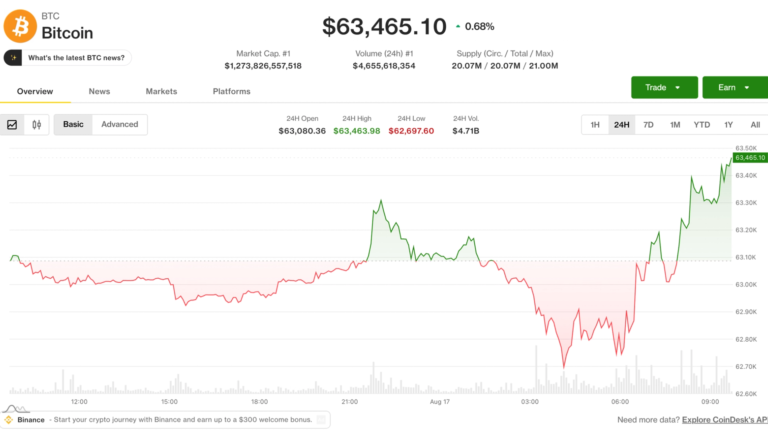
Bitcoin neared the $64,000 mark in Asian morning hours Monday, up half a percent on the day but down almost 3% over the week, as a softer dollar and fading rate-hike bets failed to lift crypto out of its recent range.
Hyperliquid’s HYPE was the standout, up over 3% to $59 and almost 9% on the week, the only major with a meaningful weekly gain. Ether rose over 1% to just under $1,900 but is down 1% over seven days.
Dogecoin added almost 1% to 7 cents, tron under half a percent to just over 33 cents and XRP marginally to $1, though XRP is down 3% on the week. Solana edged up to just over $75 and is down almost 2% over seven days. BNB slipped marginally to just over $604 and was flat on the week.
The macro backdrop turned friendlier without moving crypto. A Bloomberg gauge of the dollar slipped 0.1% toward a third straight decline and levels last seen in May, while MSCI’s emerging-market currency index hit an intraday record, led by the Taiwanese dollar and Thai baht.
Volume, meanwhile, is dead simple as it measures the number of contracts that changed hands during a given period. Think of it as measuring how many times the front door of that exclusive club opened and closed over a given period, regardless of who stayed. It thus represents the degree of churn or liquidity available to manage positions.
So, the latest case of volume falling far behind OI is like a large club with a tiny exit door. What happens if a large number of people try to rush out?
Because overall investor positioning is massive, a sudden catalyst could trigger a wave of contract closures, such as forced liquidations due to margin shortages. Without the underlying daily volume to provide liquidity, the market may not be able to absorb the rush smoothly, leading to volatile, exaggerated price swings.
“The risk is mechanical. When open interest towers over daily volume, liquidations meet little resting flow to absorb them, and adverse moves extend further than they otherwise would. Traders have added substantial risk, most of it long, into a market that shows no matching demand,” blockchain analytics firm Glassnode said in a report.
The risk of an exaggerated move is particularly likely to the downside because of weakening demand and a lack of resting bids or buy orders at lower price levels.
The scale of the positioning is easier to see measured in tokens. About 2.77 billion XRP now sits in futures positions, up from closer to 2 billion earlier this summer and nearing the levels last seen when the token was worth several times more.
The ledger is getting busier too. Nearly 50,000 addresses were active over one 24-hour stretch, the most in more than two months, per Santiment, after activity slid close to its 2026 lows in July.
An active address is a wallet that sent or received anything during the period. It shows more wallets are using the ledger, but not whether the people behind them are buying, selling or shuffling tokens between their own accounts.
CoinGlass data shows the long-to-short ratio across all venues at about 0.93 over 24 hours, meaning positioning market-wide is close to balanced. The heavy long bias sits on Binance, OKX and among their bigger accounts.
Watch what happens if XRP breaks below $1, as leveraged longs that run out of collateral get closed by the exchange, which could mean selling into the market.
XRP trades around $1 in Asia morning hours Monday, with bitcoin topping $64,000.
“The old ‘long bitcoin, short the bankers’ trade is over: banks have moved from resisting digital assets to building and enabling or distributing them through custody, tokenization and regulated trading,” Dori said.
He attributed the shift to client demand and clearer rules, calling it structural rather than cyclical.
Early bank entrants included Swissquote, which added bitcoin trading in 2017, DBS in 2020 and BBVA in 2021. BNY Mellon started institutional crypto custody in 2022, the same year Nubank launched bitcoin and ether trading and LGT added crypto services.
St.Galler Kantonalbank and Santander followed in 2023, while Zürcher Kantonalbank added retail trading in 2024, before other major financial industry players including Standard Chartered, Charles Schwab, SoFi and Morgan Stanley entered the space.
Anchorage Digital CEO Nathan McCauley, meanwhile, said its client roster has increasingly reflected the convergence of traditional and decentralized finance over the past two years.
Large financial firms are partnering with specialist providers rather than building their own infrastructure, he said. Still, real-world assets coming onchain and crypto wrappers being created by large asset managers is showing two worlds are increasingly becoming one.
“We’re quickly headed towards a world where there isn’t ‘traditional finance’ and ‘decentralized finance.’ There’s just ‘finance,” McCauley told CoinDesk. “
The battle is likely to be finished one way or another next month, when the Clarity Act gets its final three weeks of Senate action before the midterm elections, and the stakes will test the old-guard strength of bank lobbyists against the high-spending political powers of crypto advocates.
The banks have made an appeal that what they’re doing represents the public good: Their business model requires that people keep their money in deposits, which don’t pay enough interest to compete with what crypto firms would pay in stablecoin yield, if given the chance. People can’t be allowed to make money off their holdings of stablecoins, the banks contend, because if customers abandon low-interest bank deposits, the institutions won’t be able to reuse their money to support bank lending.
One of their standard bearers, JPMorgan Chase & Co. CEO Jamie Dimon, says banks aren’t being treated fairly, contending that stablecoins don’t carry the same government scrutiny, regulations and requirements to track the identity of users.
“It should be fair and equal, period,” Dimon, whose bank is the largest in the U.S., said in a June Fox Business interview, saying the Clarity Act had “almost no legal protections” to prevent money laundering and other illicit finance.
Earlier this month, as it became clear that the Digital Asset Market Clarity Act would not receive a vote prior to the Senate’s August recess, industry participants suggested that if Congress didn’t act, regulators could. It wouldn’t be exactly the same; regulators’ actions could be challenged in court and will be easier to undo by a subsequent administration than legislation would be, but the argument is that entrenched regulations would be difficult to undo.
Breaking it down
That argument above presupposes that the SEC and CFTC are actually able to finalize proposed rules in time for them to kick around for a bit prior to a future SEC changing its mind.
But that isn’t guaranteed. The SEC announced late Thursday it was canceling its planned meeting and would reschedule at a later date.
CoinDesk and others also reported on Thursday that the SEC was holding off on rolling out its innovation exemption indefinitely.
Individuals familiar with the situation told CoinDesk that concerns about the Clarity Act led to the SEC’s postponement. The White House and lawmakers are specifically concerned that any SEC action could further complicate ongoing negotiations over the Clarity Act ahead of the Senate’s first vote on the legislation next month.