Home Blog Page 349

The Three Major Trends Fueling the Embedded Payments Era

0

Colm Lyon, the Founder and CEO of FIRE, an embedded payments business, shared his insights on how the sector has evolved into the “hot topic” it is today. Lyon explained that FIRE has been a regulated business in the UK and Ireland since 2010, specialising in delivering customized payment processing solutions to approximately 1,500 businesses, helping them automate and streamline their processes to save time and money. For some customers, this means providing thousands of accounts or debit cards based on their specific business model.

Fire sees three major trends that have converged over the last decade to create the new era of embedded payments:

Regulation: Changes like the European Payment Services Directive and, about ten years ago in the UK, central banks opening up settlement accounts to non-bank financial service providers. This regulatory shift allowed non-banks, such as payment service providers like FIRE, to access payment systems in a way they previously could not.

Technology: The advancements of technology means people can carry multiple bank accounts in their pockets and pay without a physical card. For businesses, this translates to being able to access their accounts and data without having to log into a financial institution’s portal.

Changing Expectations: Driven by the instant nature of modern communication, there is now a growing need for instant payments. Businesses and individuals expect to send money and have the recipient instantly receive the funds and an accompanying notification, whether that’s a phone alert or an update to a business’s ledger system.

When businesses attempt to embed payments into their own systems, Lyon noted that the biggest challenge is not a technology hurdle, but a fundamental change in operations, specifically, how they realize they have been paid and how they will pay out.

The primary obstacle they face is that their existing banks often can’t provide the necessary services. Traditional banks may lack the required API to integrate directly, or they may be unable to open thousands of accounts in real-time, forcing businesses to rely on manual forms. Ultimately, businesses are seeking to incorporate the functionality of a third-party product into their systems to achieve the automation, savings, and efficiency they need.

Tech giants double down on AI as earnings reveal growth gains and rising costs

0

Four of the Magnificent Seven (Mag 7) tech giants are still on track to meet their massive artificial intelligence (AI) spending targets this year, according to their earnings report.

The companies that have reported quarterly earnings post-market on Wednesday are Microsoft (MSFT), Alphabet (GOOG), Meta (META) and Amazon (AMZ), with a combined market cap of approximately $12 trillion.

Previously, an analysis by Bridgewater Associates flagged that the four companies are expected to spend roughly $650 billion together on AI infrastructure in 2026. While most of them didn’t break out their AI spending in their latest earnings, they seem on track to continue their spending spree in the sector.

The investment has significant implications for the digital asset sector, particularly for bitcoin miners, who are increasingly pivoting away from mining toward hosting computers for AI as part of their revenue diversification strategy. The bitcoin miners already have data centers ready and powered up to host a massive amount of machines that are needed for AI computing. Facing a margin squeeze from lower bitcoin prices and increased competition, miners have started lending their data centers to AI firms to diversify their revenue streams.

AI-linked bitcoin mining stocks with exposure to hyperscaler infrastructure deals include IREN (IREN), which was down about 0.3%, TeraWulf (WULF) and Cipher Digital (CIFR), which fell 0.5%. Meanwhile, following the results, Microsoft was down over about 2.4% in after-hours trading, Alphabet up 6%, Meta down 6.6% and Amazon down 3.7%. Bitcoin was down about 0.9% in the last 24 hours.

The next big test of overall market sentiment and miners will come when chipmaker Nvidia reports earnings on May 20.

Here is what the tech giants reported and said during their earnings.

Microsoft

Microsoft reported fiscal Q3 2026 revenue of $82.9 billion, beating the $81.4 billion consensus, with EPS of $4.27 against the $4.06 estimate, according to FactSet data.

“We are focused on delivering cloud and AI infrastructure and solutions that empower every business to eval-max their outcomes in the agentic computing era,” said Satya Nadella, chairman and chief executive officer of Microsoft, noting that the firm’s AI business brought in $37 billion, up 123% year-over-year.

Alphabet

Alphabet pointed to AI as a core driver of growth and reported capital expenditures of $35.67 billion for the quarter, slightly below estimates of $36.39 billion.

“Our AI investments and full stack approach are lighting up every part of the business,” Alphabet CEO Sundar Pichai said, linking gains in Search and Cloud to AI-driven demand. Google Cloud revenue rose 63% to $20 billion, fueled in part by “enterprise AI Solutions and enterprise AI Infrastructure,” showing how AI is shaping both product usage and enterprise adoption.

Alphabet reported Q1 2026 revenue of $109.9 billion, beating the $107 billion consensus, with EPS of $2.81 against the $2.63 estimate.

Amazon

Amazon reported Q1 2026 revenue of $181.5 billion, beating the $177.2 billion consensus, with EPS of $2.78 against the $1.63 estimate. AWS revenue came in at $37.6 billion against the $36.92 billion estimate.

Amazon said free cash flow fell sharply over the past year, pointing to a surge in infrastructure spending. The company noted the drop was “driven primarily by a year-over-year increase of $59.3 billion in purchases of property and equipment,” adding that “this increase primarily reflects investments in artificial intelligence.” The shift shows how heavily Amazon is leaning into AI, even as it weighs on near-term cash generation.

Meta

Meta pointed to rising AI infrastructure costs as a key driver of spending, reporting $19.84 billion in capital expenditures for the quarter and raising its full-year outlook to $125–145 billion, up from its prior guidance of $115–$135 billion. The increase reflects “higher component pricing this year and, to a lesser extent, additional data center costs to support future year capacity,” the company said, underscoring how AI buildout is driving investment.

CEO Mark Zuckerberg framed the push more directly, calling it a “milestone quarter” tied to AI progress and adding, “We’re on track to deliver personal superintelligence to billions of people.”

Meta reported Q1 2026 revenue of $56.31 billion, beating the $55.5 billion consensus, with EPS of $10.44 against the $6.67 estimate.

Bitcoin Dips Under $76K as Fed Holds Rates in Rare 8-4 Split

0

ETH is down 7% on the week as the Fed signals the bar for rate cuts has risen, and ETF outflows top $350 million over two days.

Bitcoin is trading at $75,282 as of Wednesday afternoon, down 1.2% over 24 hours and 4.4% on the week, as crypto markets extended losses following the Federal Reserve’s decision to leave interest rates unchanged.

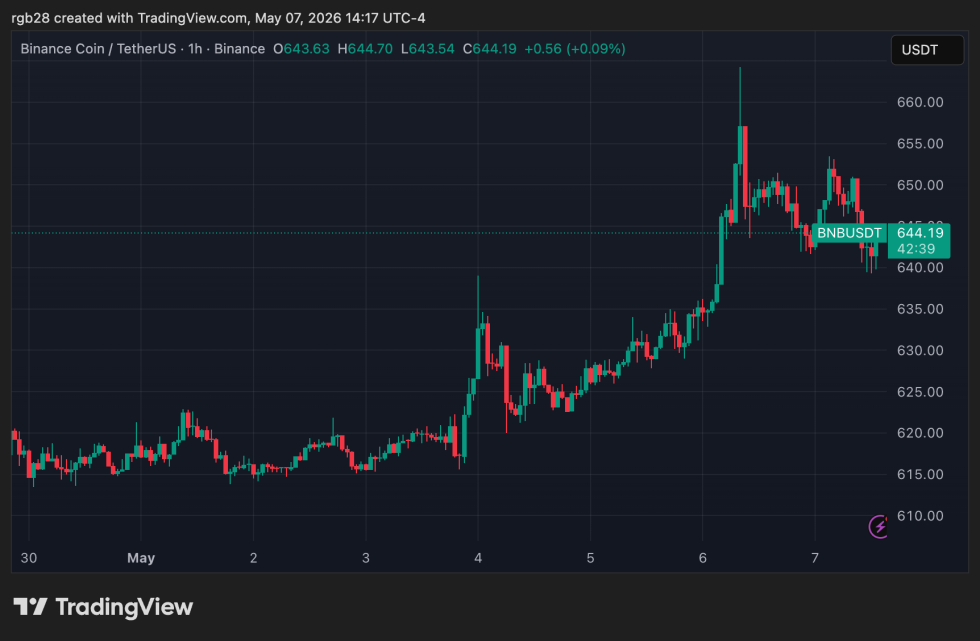
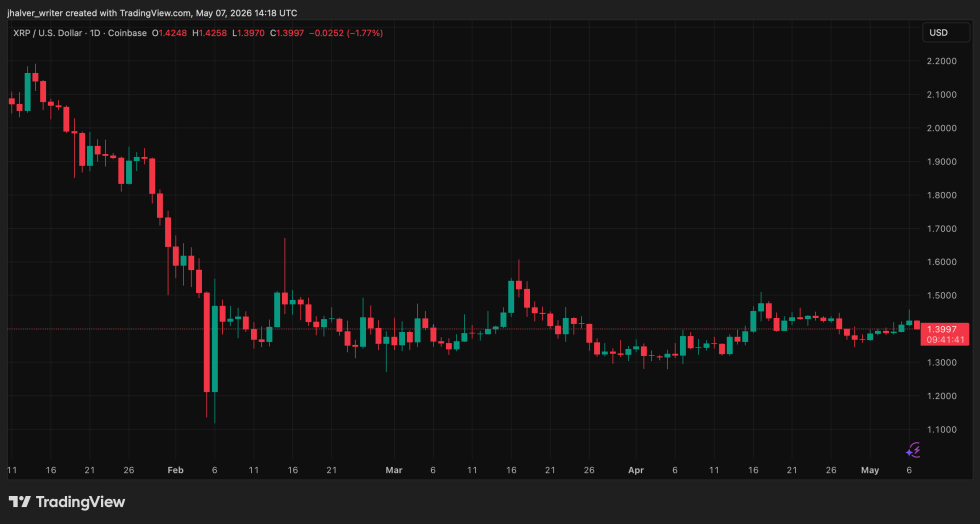
Ether fell harder, changing hands at $2,225 after a 2.8% daily drop and 7.3% weekly loss. Solana dropped 2.1% to $82, XRP fell 2% to $1.35, and BNB shed 1.8% to $612. Dogecoin was the lone green name in the top 10, up 2.2%.

BTC Chart

The total crypto market cap fell to $2.6 trillion, down 1.4% on the day, with Bitcoin dominance at 58%, according to CoinGecko.

Contentious Decision

The FOMC kept the federal funds target range at 3.50% to 3.75%, but the vote split 8-4, the most contested decision since October 1992. Governor Stephen Miran dissented in favor of a 25 basis point cut, while regional presidents Beth Hammack, Neel Kashkari, and Lorie Logan opposed the easing-bias language in the statement, per CNBC.

In their post-meeting statement, the committee acknowledged that “Inflation is elevated, in part reflecting the recent increase in global energy prices.” CME FedWatch is now pricing no further cuts through the rest of 2026, a hawkish repricing from the dot plot delivered in March.

The meeting was widely viewed as Chair Jerome Powell’s last, with the Senate Banking Committee earlier in the day advancing Kevin Warsh’s nomination as next chair on a party-line vote. JPMorgan Asset Management chief global strategist David Kelly told CNBC that the pattern of dissent amounted to “a renewed declaration of independence” and “a shot across the bow at Kevin Warsh.”

ETF Flows

U.S. spot Bitcoin ETFs logged $89.68 million in net outflows on Tuesday, bringing the two-day total to roughly $353 million, according to SoSoValue data.

The reversal snapped a nine-session inflow streak that had pulled in over $2.1 billion for the Bitcoin ETF complex.

Spot Ether ETFs extended their own losing streak with $21.8 million in net outflows on Tuesday. Their two-day total now exceeds $36 million in outflows after a 10-day inflow streak that delivered more than $633 million.

Strategy Keeps Buying

Despite the ETF reversal, Strategy continues to accumulate. Michael Saylor’s firm disclosed in an April 27 8-K that it bought 3,273 BTC for $255 million between April 20 and April 26 at an average price of $77,906, lifting total holdings to 818,334 BTC. The purchase was funded entirely through the company’s at-the-market common stock program, with no preferred issuance during the period.

With BTC now under $76,000, Strategy’s $75,537 average cost basis is once again within striking distance of unrealized losses.

Nigel Farage faces standards probe over $6.7 million gift from Tether billionaire Christopher Harborne

0

Reform UK leader Nigel Farage received about £5 million (around $6.7 million) from crypto billionaire Christopher Harborne before announcing his run for the Clacton seat in 2024, The Guardian reported Wednesday.

The Conservatives have referred him to the Parliamentary Standards Commissioner, while Labour has also accused him of breaking House of Commons rules.

Farage confirmed the gift in an interview with the Daily Telegraph, saying it was meant to keep him “safe and secure for the rest of my life” after a milkshake was thrown at him in 2019 and a firebomb attack on his home last year.

Harborne, a Thailand-based businessman with a 12% stake in stablecoin issuer Tether, made the payment in 2024. Farage announced his Clacton candidacy in early June last year and won the seat in July.

A Reform UK spokesman called the payment a “personal unconditional gift” given before Farage was elected and said his decision to stand as an MP was “entirely unrelated.”

The spokesman, the report added, said “We are confident everything has been declared in accordance with the rules.”

The Commons code of conduct requires new MPs to register benefits received in the 12 months before their election, and says any benefit should be registered if there is doubt. Reform says the gift falls under the exemption for purely personal gifts.

The country’s main opposition Conservative Party wrote to Parliamentary Standards Commissioner Daniel Greenberg asking him to examine whether any of the funds were used to support political activity rather than security. Labour chair Anna Turley said Farage “appears to have broken the rules again.”

U.K. crypto donations

Harborne gave Reform £9 million, then worth around $12 million, late last year in the largest single donation to a U.K. political party from a living person on record.

Earlier this month, BitMEX co-founder Ben Delo said in an op-ed he had given Reform £4 million ($5.1 million) since the start of the year.

The U.K. government imposed an immediate moratorium on crypto donations to political parties in March, citing the Rycroft review’s warning that digital assets could be used to channel foreign money into U.K. politics.

The ban covers donations of any size and will be written into the Representation of the People Bill, with criminal penalties for non-compliance.

That same month, Farage invested £215,000 ($286,000) in Stack BTC, a London-listed bitcoin treasury company chaired by former Chancellor Kwasi Kwarteng, taking a 6.31% stake through his investment vehicle Thorn In The Side.

Fed stays on hold as expected as Kevin Warsh moves closer to confirmation

0

As fully expected by markets, the U.S. Federal Reserve held its benchmark fed funds rate range steady at 3.50%-3.75% on Wednesday, marking the fourth straight meeting without a change as officials weigh persistent inflation risks against signs of slowing economic growth.

“In considering the extent and timing of additional adjustments to the target range for the federal funds rate, the Committee will carefully assess incoming data, the evolving outlook, and the balance of risks,” said the Fed in its policy statement.

There were four dissents to the rate decision, one dovish and three hawkish. Fed Governor Stephen Mirran preferred trimming rates by 25 basis points, while Beth Hammack, Neel Kashkari, and Lorie Logan wanted to hold rates steady while removing any easing bias.

Under pressure ahead of the news, bitcoin remained about 0.5% lower over the past 24 hours, trading just below $76,000. U.S. stocks continued with modest declines, the Nasdaq down 0.35%. Yields are shooting higher, the two-year Treasury up 9 basis points to 3.93% and the 10-year up 5 basis points to 4.40%.

Today’s central bank meeting is likely to be the last to be presided over by Jerome Powell, whose term as chairman ends on May 15. His replacement, Kevin Warsh, passed a Senate Banking Committee vote earlier Wednesday, putting him on track to take over as Powell steps down. The three hawkish dissents suggest that Warsh will have a difficult task to push through rate cuts even if that is the direction he would like to go.

Attention will next turn to Powell’s post-meeting press conference as traders look for clues on the path forward for monetary policy.

After pulling back sharply earlier this month amid hopes for a lasting peace between the U.S. and Iran, oil prices have rebounded to near their post-war highs, with WTI crude trading just shy of $105 per barrel.

Higher energy costs naturally feed through to headline inflation numbers, but they can also slow economic activity. It puts the U.S. central bank in a difficult position: which of its mandates — prices or economic growth — should it prioritize?

Bitcoin’s (BTC) greatest days are here, says Eric Trump

0

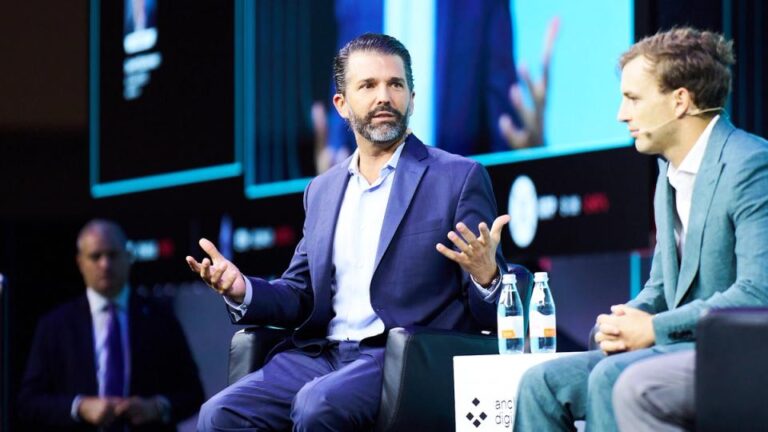
Las Vegas — Eric Trump took the stage at Bitcoin 2026 in Las Vegas with a message: the asset’s best days aren’t ahead, they’re already here.

The American Bitcoin (ABTC) co-founder and chief strategy officer declared that the convergence of institutional adoption, corporate treasuries, and mainstream financial access has made this bitcoin’s most important moment to date.

“What bitcoin has done in the last six months relative to the previous three years is transformational,” said Trump. “We are in the greatest period I’ve ever seen.”

Trump pointed to major banks now offering bitcoin-backed mortgages and custody services as evidence of a Wall Street reversal. “People are not selling it. People are holding it. Bitcoin is becoming sticky,” Trump said, adding that limited supply and growing demand from both institutions and sovereign governments are compressing the market structurally.

Moderator Eric Balchunas, Bloomberg’s senior ETF analyst, framed the shift through the lens of the ETF market, noting that bitcoin ETFs have been among the most successful product launches in the instrument’s history, democratizing access for everyday investors in a way previously reserved for institutions.

“I’ll ride out the volatility,” said Trump. “We’ll see who wins in a 10-year period of time.”

U.S. senator holding cards on Clarity Act’s next move says it’s ready to get to hearing

0

The latest holding pattern for the bill to fully insert the crypto sector into the U.S. financial system was centered on Senator Thom Tillis’ request that bankers get more time to negotiate the Digital Asset Market Clarity Act’s approach on the contentious topic of stablecoin rewards. That may be over.

Tillis told reporters on Wednesday that the work on the Clarity Act — the industry’s top objective in Washington — has “addressed a lot of the concerns” of the banking lobbyists who have been defending the turf of interest-bearing deposits they argued could be threatened by stablecoin yield. The Republican lawmaker said, “I’m going to encourage the chair to move forward with the markup,” according to a Fox Business transcript of the remarks.

That could throw open the chance for a mid-May hearing of the Senate Banking Committee, which needs to advance the legislation before a final version can be hashed out for a vote of the overall Senate. If anything else gets in the way of that timing, it could be fatal for the 2026 Clarity Act, because the remaining Senate schedule has little room for flexibility.

The legislation faces several hurdles before it can hit President Donald Trump’s desk to be signed into law. First is a so-called markup hearing that gives lawmakers a chance to pursue amendments to the language. Tillis said he intends to give stakeholders a chance to see the compromise text on stablecoin yield days before the hearing, and he welcomed bankers to stay in negotiations if there are other points they want to get across.

“There may be a few more that we can get there, if they want to come and work in good faith,” Tillis said.

Crypto insiders have been critical of the banking industry’s apparent reticence to embrace compromises, as has Trump himself, who said over the weekend that he wouldn’t let bankers ruin the Clarity Act. The industry is taking Tillis’ latest remarks as a positive sign for movement.

“There is more momentum than ever for a markup in May,” said Cody Carbone, CEO of the Digital Chamber that advocates for crypto policy in Washington. “We support getting this bill on the committee calendar as soon as possible, and we are hopeful it will move imminently.”

Other sticky provisions remain to work out, potentially most notably a Democrat-driven section banning government officials from personal business interests in crypto — an effort targeted primarily at Trump and his family, who are heavily engaged in the industry. Tillis has reportedly said he agrees that the bill needs such an ethics requirement, though this issue wouldn’t come up in the Banking Committee’s work.

Another potential hangup that crypto advocates are eyeing is the push from Senator Chuck Grassley, the chairman of the Judiciary Committee, that some aspects of the legislation — including legal protections for decentralized finance (DeFi) developers — ought to pass through his committee.

Any additional delay to the bill will jeopardize its chances to get off the ground, with about 11 weeks remaining open in the Senate calendar before the lawmakers fully disperse for midterm election demands. A Senate passage would then land in the hands of the U.S. House of Representatives, which already passed its own version of the Clarity Act last year. Any uprising among House Republicans could add further issues to the bill’s chances, but advocates are so far counting on the House to approve the Senate’s final product.

The House has recently struggled to reach alignment with Senate efforts, such as over the funding of the Department of Homeland Security.

Read More: Crypto’s great hope in Senate’s Clarity Act still has a path to survive tight calendar

AWS Launches Managed Agents with OpenAI Partnership

0

AWS’s new managed agent service, powered by OpenAI, offers a glimpse of how AI vendors could restructure the process enterprises use to start building agents.

The tech giant and AI lab on April 28 unveiled an extended partnership, with OpenAI’s GPT-5.5 and GPT-5.4 models now available in a limited preview on Amazon Bedrock, the tech giant’s generative AI platform. OpenAI’s specialized coding agent, Codex, is now integrated into Bedrock as well. Also, the two vendors introduced a new service called Amazon Bedrock Managed Agents, powered by OpenAI.

The service enables vendors to deploy production-ready OpenAI-powered agents on AWS in a straightforward way, AWS said. The service is built with the OpenAI agent harness, the software infrastructure and control layer that enable a generative AI model to function as an agent. Every agent operates with its own identity and runs in an enterprise environment, with all model inference running on Amazon Bedrock.

Related:Meta Scales AI Infrastructure With AWS Chip Deal

The managed service and expanded partnership come a few months after the two vendors signed a multi-year agreement worth $38 billion and a few months after Amazon said it would invest $50 billion in OpenAI. It also comes as agentic AI continues to grow dramatically, with a host of vendors trying to make it easier for enterprises to create and deploy agents.

While many enterprises are dabbling in agentic AI, they have met challenges that could be detrimental to their overall business structure, such as out-of-control agents.

“Increasingly agentic AI is a minefield,” said David Nicholson, an analyst at Futurum Group. 

The service is a way for AWS and OpenAI to help enterprises streamline the process of creating and building their agents, said Mark Beccue, an analyst at Omdia, a division of Informa TechTarget.

“It eliminates one step, which is ‘what’s my underlying model?’” Beccue said.

He added that, with Amazon Bedrock Managed Agents, customers no longer have to decide which model to use or how to use it; the choice has already been made, so they do not have to worry about the preferred model when building their agents

Amazon Bedrock Managed Agents is also a way for enterprises interested in safety and guardrails to experiment with agents, Nicholson said.

“This is going to be another relatively safe haven for people who are being asked to pursue an agentic AI strategy, but who have been confused and concerned up to this point,” he said. “This is more about giving someone a safe and secure option.”

“This sort of collaboration is imperative if any of them wants to get any of the market share in AI from people who are terrified of the negative consequences that we are starting to hear about,” Nicholson continued, referencing a couple of incidents in which agents have gone out of control and taken their own, unauthorized initiative. 

Related:Nvidia Nemotron 3 Nano Omni Powers Enterprise AI Agents

A recent instance of this agent misbehavior involved the automotive rental and sales platform PocketoS. The vendor’s Cursor coding agent, powered by Anthropic’s Claude model, reportedly deleted a database and the backup of the database

“Increasingly, the headlines are going to be horror stories of agents gone wrong, so this helps,” Nicholson said.

He added that OpenAI and AWS will likely not be the only vendors to have partnerships like these.

The type of agent platforms enterprises are drawn to, though, will depend on how much they cost, Beccue said.

“The way they price these things is a deciding factor in whether somebody is going to use it,” he said.

Fed chair Jerome Powell says he will stay on as Govenor after term amid legal pressure

0

Current Federal Reserve chair Jerome Powell will continue to stay on the central bank’s board as Governor after his term ends in May.

Speaking at a press conference following the central bank’s decision to hold interest rates steady at 3.5%-3.75% on Wednesday, Powell voiced concerns about the legal action against the central bank, saying it is causing him to stay, even though he plans to keep a “low profile.”

“I worry that these attacks are battering the institution and putting at risk the thing that really matters to the public, which is the ability to conduct monetary policy without taking into consideration political factors,” Powell said.

When the administration of President Donald Trump closed its criminal investigation into Powell, it left room to revisit the case. Jeanine Pirro, the U.S. attorney for the District of Columbia, said the matter would stay under review by the Fed’s inspector general and warned prosecutors could reopen it if new facts emerged.

That statement, along with later remarks from President Donald Trump and his aides, raised concern that Powell could still face legal pressure. Powell said even though he wanted to leave, he had “no choice” but to stay.

Fed leave rates unchanged

The Fed’s rate hold came as expected, but the dissent from three Governors stood out, according to 21shares macro analyst Matt Mena. “The Fed’s decision to keep rates steady wasn’t the shocker, but those three dissenters calling for a strike on any easing guidance threw a bucket of ice on the market’s pivot party,” Mena said. The hawkish tone weighed on risk assets, with bitcoin slipping under the $75,000 support mark as traders brace for a retest of the $73,000 level.

Focus has also shifted to potential policy changes ahead. “Markets may begin to price a [Kevin] Warsh pivot that favors rate cuts, and more importantly, the imminent passage of the CLARITY Act,” Mena said, adding that if momentum returns, “the path to $85,000–$90,000 looks like a clear shot.”

Meta (META) starts stablecoin payout to creators in Circle’s USDC on Polygon, Solana via Stripe

0

Meta (META), the social media giant behind Facebook and Instagram, has started to offer stablecoin payout to creators, signaling a return to crypto-powered payments years after shelving its Libra project.

The feature is currently available to a limited group of creators in Colombia and the Philippines, according to a Meta website. Eligible users can link a crypto wallet and receive payouts in Circle’s USDC token on the Solana or Polygon blockchain networks.

The service is supported by payments firm Stripe, which will provide crypto-related reporting for users. Creators may receive tax documents from both Meta and Stripe tied to their earnings and digital asset transactions. A Stripe spokesperson confirmed the company’s involvement.

The news comes after Meta sought the help of third-party vendors to administer stablecoin payments on its platforms, with Stripe among the leading contenders for the integration, CoinDesk reported in February.

The move puts Meta, with over 3 billion users across its social media platforms globally, among the largest tech firms experimenting with stablecoins for real-world payments, using blockchain rails to move money globally to users without relying on traditional banking systems. Stablecoins — cryptocurrencies whose prices are tied to fiat currencies — are increasingly viewed as a faster and cheaper payment method. Visa, for example, reported that it’s stablecoin settlement network hit $7 billion in annualized transaction volume, growing 50% in a quarter.

The initiative marks Meta’s return to stablecoins after it attempted to introduce the Libra token, later renamed Diem, only to shut down the project amid regulatory scrutiny in 2022.

Read more: Stripe doubles down on blockchain and stablecoins, aiming to become ‘AWS for money’