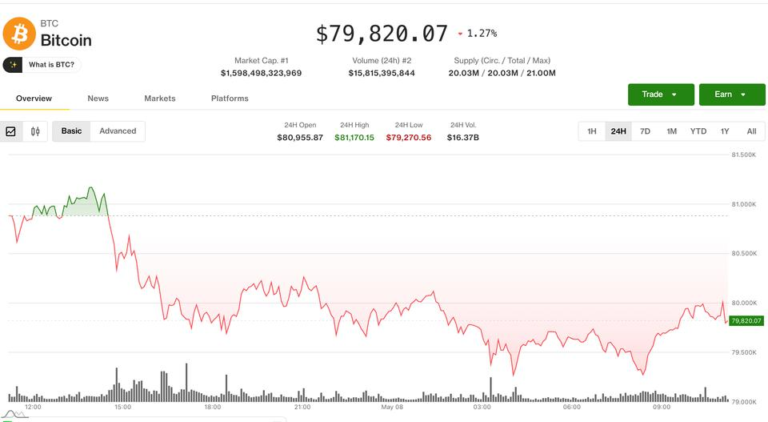
Bitcoin BTC$79,891.46 tumbled back below $80,000 late Thursday after the U.S. launched fresh airstrikes in Iran, causing brent crude oil to briefly top $100 per barrel before giving back a portion of gains during Asia and European hours.
The crypto market was already slightly jittery after Strategy chairman Michael Saylor said that the company would consider selling bitcoin to cover dividend payments from its STRC, a u-turn from its previous “never sell” strategy.
Ether (ETH) is trading at $2,280 having lost 0.2% since midnight UTC and around 2% over the past 24 hours, with other altcoins like monero (XMR) and dash (DASH) losing between 4% and 5%.
The broader crypto recovery remains intact with bitcoin having rallied from $65,000 in late March, although it’s worth noting that a drop below $75,000 would negate the recent string of higher lows and would signal a reversion to the pervious trading range.
Derivatives positioning
The crypto futures market has cooled for the second-straight day, with cumulative industry notional open interest down over 1.5% at $131.5 billion and trading volume down over 12% at $191 billion. Investors are clearly deleveraging in the wake of bitcoin’s overnight drop below $80,000.
Exchanges have liquidated nearly $300 million in bets in 24 hours, with longs accounting for most of the tally. It shows that traders were positioned for continued price rises into the weekend, only to take the brunt of the unexpected market weakness.
Open interest (OI) has declined in most major tokens, including bitcoin and ether. Meme token DOGE’s OI has dropped by over 4%, the most among top 10 coins. TON is the standout, with OI rising by 6%.
For the second straight day, OI-adjusted cumulative volume delta for most majors remains negative, a sign of traders aggressively shorting using market orders rather than passive limit orders.
On Deribit, the most actively traded contract over the past 24 hours was a BTC $105,000 call option expiring June 26. Market positioning has also shifted, with the top five most traded contracts now including put options at $80,000, $75,000, and $60,000 strikes. This marks a clear change from the previous three sessions, when calls dominated trading activity.
Bitcoin’s annualized 30-day implied volatility index, BVIV, remains near 40%, the lowest since late January, a sign of market calm ahead of the pivotal U.S. nonfarm payrolls report.
Token talk
Despite relative weakness across crypto majors and privacy coins, CoinDesk’s DeFi Select Index (DFX) surged by more than 3% since midnight UTC, buoyed by an 8.2% gain in the price of ONDO.
Ondo Finance is a real-world asset (RWA) project that on Thursday completed its first cross-border cross-bank redemption of U.S. treasuries having worked with JP Morgan, Mastercard and Ripple, driving price appreciation over the past 24 hours into Friday.
The CoinDesk Memecoin Select Index (CDMEME) lost ground on Friday, posting a 0.1% swing to the downside to make it the only CoinDesk benchmark in the red.
CoinMarketCap’s “altcoin season” indicator is at 42/100, significantly higher than in April when it was as low as 31/100. The total market cap of altcoins during that period has risen from below $1 trillion to $1.05 trillion.
The programme – already live in a host of markets – is designed to help the Canadian payments ecosystem prepare for a world where AI agents may act on behalf of consumers to initiate and complete transactions.
Participants can test agent-initiated payments in controlled, real-world environments using live cards and real merchants; validate core payment flows; and assess trust and security mechanisms.
Canada’s Big 5 – BMO, CIBC, RBC, Scotiabank, and TD – are all signed up as issuing partners, with additional firms expected to follow.
“Visa Agentic Ready gives Canadian issuers a meaningful head start in preparing for agent-initiated commerce,” says Michiel Wielhouwer, president and country manager, Visa Canada.
Separately, the Agentic Ready programme is also live in Malaysia, with Alliance Bank, CIMB and Maybank onboard.
Previn Pillay, country manager, Visa Malaysia, says: “Visa Agentic Ready gives Malaysian issuers a practical and structured way to better understand how agent-initiated payments could work on the Visa network — before these experiences scale.”
Nearly half of US voters are willing to cross party lines to get clear crypto regulation off the ground, while public support for the CLARITY Act could bring an electoral benefit for politicians, according to a new survey from HarrisX.
The poll included responses from 2,008 registered voters from May 1-4. It found that 52% of respondents support the CLARITY Act, with just 11% opposed.
About half, or 47%, said they would consider voting for a candidate outside their preferred party if that candidate backed the bill and their own party did not. Among crypto users, that number jumped to 72%.
“Passing the CLARITY Act is a bipartisan, winning issue,” Coinbase CEO Brian Armstrong said on X on Thursday. Robinhood CEO Vlad Tenev added: “There’s real momentum now to finally get CLARITY across the finish line. One more small push and we establish the legislative foundation to ensure American dominance in digital finance.”
Source: HarrisX
The crypto industry has been waiting for the CLARITY Act to move through the US legislative process. It is expected to provide long-awaited regulatory clarity for crypto and could help the country become a major hub for crypto and digital finance.
The HarrisX poll also highlighted strong bipartisan support for the bill, with 55% of Democrats, 58% of Republicans and 42% of independents supporting it. Public support for the bill could also give senators a 20-point electoral advantage, it said
Related: Bitmine’s Tom Lee says ‘crypto spring’ has already begun
Some predict the CLARITY Act will receive additional markups as soon as next week.
Speaking at the Consensus 2026 crypto industry conference in Miami on Wednesday, Coinbase’s vice president of US policy, Kara Calvert, said her “prediction is that we have a markup next week” from the Senate Banking Committee.
Calvert stressed that bipartisan support will get the bill across the line, saying it needs at least 60 votes to pass the Senate, but she is unsure how things will unfold in the coming days.
“That means you need Democrats. You need a bipartisan bill, and we have all been working really hard to make sure that bipartisanship holds. I think the big question is, how do these votes shape up over the next few days?”
The timeline for a vote may still be months away, however. US Sen. Kirsten Gillibrand recently suggested additional markups are required before the bill can progress, predicting a Senate vote in August.
Magazine:Guide to the top and emerging global crypto hubs — Mid-2026
Cointelegraph is committed to independent, transparent journalism. This news article is produced in accordance with Cointelegraph’s Editorial Policy and aims to provide accurate and timely information. Readers are encouraged to verify information independently.
The U.S. stock market is heating up in a way that suggests speculative mania. It matters to bitcoin as analysts have linked the cryptocurrency’s recent rally to increased risk-taking on Wall Street.
The overheating signals come from options tied to the S&P 500. These are derivative contracts that let traders bet on or hedge against moves in the index. A call option is a bet that the index will rise above a certain price within a set time. A put option does the opposite, offering protection from declines in the index.
On Wednesday, U.S. equity derivative exchanges registered a notional volume of $2.6 trillion in S&P 500 call options, according to data tracked by Zero Hedge. That amounted to 60% of total S&P 500 options activity. To put it into context, the notional amount nearly matched the total crypto market valuation of $2.73 trillion, which represents the combined capitalization of thousands of cryptocurrencies, with bitcoin leading the way.
In essence, the majority of market participants were positioned for upside through calls or bullish exposure.
On the surface, the implication for bitcoin is straightforward: it is bullish. A speculative surge in the S&P 500 could spill over into crypto, driving valuations higher. After all, double-digit gains in the S&P 500 and Nasdaq since early April played a big role in lifting bitcoin to $80,000 from under $70,000 a few weeks ago.
QCP Capital put it best early this week when BTC broke above $80,000: “After a solid April, BTC has begun May on firm footing, breaking above $80k for the first time since January 31. The move appears aligned with equities, reinforcing a broader trend as BTC’s correlation with U.S. stocks climbing back toward 2023 levels, signaling a renewed linkage with risk assets broadly.”
Call options volume in the S&P 500. (ZeroHedge)
That said, the outsized investor bias for bullish exposure in the S&P 500 has raised alarm on social media, with several handles calling it a sign of an overcrowded trade. When too many investors lean in the same direction, in this case, heavily bullish, it leaves the market more vulnerable to sharp reversals in sentiment and positioning if price momentum stalls.
It’s not just social chatter either. Media reports have also cited Goldman Sachs analysts describing the market as being in a “semi-irrational chasing mode,” a phrase widely read as a play on the semiconductor-driven surge in equities.
If that’s not enough, the bullish momentum in the Nasdaq-listed PHLX Semiconductor Sector index (SOX), as measured by the 14-week relative strength index, is strongest since 1999, according to data source TradingView.
All of that is hinting at speculative frenzy. If it unwinds just as quickly, downside volatility could spill over into bitcoin and the broader crypto market, given their positive correlation. Let’s see how things unfold…
Some Revolut users saw bitcoin briefly display far below market prices on Friday, with app charts showing a sudden plunge before snapping back near prevailing levels, in what appeared to be either a pricing display issue or a liquidity-related dislocation.
Revolut’s official bitcoin page shows BTC briefly marked around £29,414 on Revolut’s one-day chart before returning near £58,600. Other social media posts claimed the app showed even lower prints, including near-zero prices as low as 2-cents, though CoinDesk could not independently verify those levels or confirm whether any trades were actually executed there.
The issue seemed isolated as no exchange on lists tracked by CoinGecko and CoinMarketCap showed any bitcoin price anomaly. It trades just over $79,000 as of Asian afternoon hours Friday.
Revolut had not responded to a CoinDesk request for comment by publication time.
Some users on X claimed buy orders executed during the disruption, but those reports remain unconfirmed. If trades were filled, Revolut would likely have to determine whether the prints reflected legitimate liquidity, stale quotes, a routing issue or a platform-side pricing error.
Flash moves in crypto apps can happen for several reasons. A display glitch can show an incorrect price without actual market execution. Thin liquidity on a specific venue or internal pricing rail can also produce sharp wicks if an order sweeps through a shallow book.
In other cases, market makers briefly pull quotes, spreads widen, and apps relying on aggregated feeds may display prices that do not match deeper global markets.
Crypto has seen similar isolated dislocations before. Bitcoin briefly printed far below market on Binance’s USD1 pair in December in a move tied to a thinly traded pair rather than broader selling. South Korean exchanges also saw sharp local wicks during the country’s martial-law shock in 2024 as activity surged and local order books briefly broke from global prices.
Nvidia is allying with glassmaker Corning to construct three new optical fiber production plants.
The companies are positioning the factories — to be built in North Carolina and Texas — as advancing U.S. AI supply chains. Under the agreement, Corning will increase its U.S.-based optical connectivity manufacturing capacity tenfold and expand its U.S. fiber production capacity by more than 50%.
Financial terms of the deal, which gives Nvidia the option to invest up to $2.7 billion in Corning, were not disclosed.
“AI is driving the largest infrastructure buildout of our time — and a once-in-a-generation opportunity to reinvigorate American manufacturing and supply chains,” Jensen Huang, founder and CEO of Nvidia, said in a release. “We are … building the foundation for AI infrastructure where intelligence moves at the speed of light while advancing the proud tradition of Made in America.”
Related:Anthropic and SpaceX Agree to Major Compute Capacity Deal
Optical connectivity is a central component of AI infrastructure, used to move data at ever-expanding speed and scale as companies ramp up deployment of the technology.
Within this, fiber-optic cables (thin, flexible strands of glass) transmit data as photons, offering faster speeds and lower energy consumption than traditional copper wires. They also reduce signal loss, improving reliability and enabling tighter clustering of the hundreds of thousands of GPUs inside modern data centers.
“This partnership is proof that AI is not just a technology story. It is a manufacturing story, and it is happening here in the United States,” Wendell P. Weeks, CEO and president of New York state-based Corning, said in the release. “We are ensuring the critical technologies powering AI are invented, engineered and built in America.”
The development is the latest in a spate of deals from Nvidia, with the AI chip giant striking billions of dollars’ worth of deals across the AI industry as it pushes market expansion.
On Wednesday, Nvidia bought $500 million in rights to Corning shares, Bloomberg reported, and Corning shares rose sharply. Earlier this year, Nvidia agreed to $4 billion in deals with optical technology companies Lumentum and Coherent, which manufacture components that convert data between light and electrical signals.
Zcash will roll out quantum-recoverable wallets within a month and reach full post-quantum status within 12 to 18 months, Zcash Open Development Lab founder and CEO Josh Swihart told a Consensus Miami audience on Thursday in a session moderated by Solana infra firm Helius’s founder Mert Mumtaz.
A separate scaling track is targeting MasterCard- and Visa-scale throughput on a similar horizon.
The roadmap arrived during a ZEC rally that has lifted the token more than 110% over the past 30 days as prominent crypto fund Multicoin Capital disclosed a sizable ZEC investment and the privacy narrative caught on among investors, sentiment daata shows.
Swihart’s pitch was that Bitcoin no longer holds up as the cypherpunk-grade money it was meant to be. The asset works as an ETF wrapper and a store of value, he said, but as a peer-to-peer private payment system “it’s just fundamentally broken.”
Visible balances on a transparent ledger let governments seize what they can see, he argued, the same wealth-visibility critique Multicoin’s Tushar Jain leaned on this week when disclosing the fund’s purchases.
The user-side traction is running through the Electric Coin Company’s mobile wallet after an October integration with Near Intents opened cross-chain swaps from assets like BTC, SOL and USDC directly into shielded ZEC.
Near Intents lets a user state what they want, like turning USDC into ZEC, while specialized routers handle the multi-step trade across different blockchains in the background.
Roughly $600 million to $700 million has flowed through that route since launch, mostly to and from USD and USDC, Swihart said. Near’s broader intent-based system has processed close to $800 million in volume over the past 30 days alone, per Near Protocol data, with Ethereum, Solana and Zcash dominating the chain side.
A separate proposal to cut Zcash’s target block time from 75 seconds to 25 seconds is in active discussion on the project’s community forum, with bridges to Solana and Hyperliquid already live, Mumtaz noted.
Token-holder voting through Zashi is also slated, Swihart said, less as formal governance and more as an opinion layer feeding the project’s existing rough-consensus model.
For traders, the cleanest near-term test is whether quantum recoverability actually ships within Swihart’s stated month. The fail-safe is the shielded pool, which now sits at roughly 30% of circulating ZEC, an all-time high. If it keeps growing alongside price, the rally is being underwritten by adoption rather than speculation
Anthropic has agreed to a deal to use all of the compute capacity at SpaceX’s Colossus 1 data center in Tennessee.
The partnership will enable the company to gain access to more than 300 megawatts of new capacity produced by more than 220,000 Nvidia GPUs.
And it will result in changes, Anthropic said, that will improve the experience of using its Claude AI model for its biggest customers.
First, Anthropic doubled Claude Code’s five-hour usage window limits for Pro, Max, Team and Enterprise subscribers.
In addition, the vendor removed the peak-hour limit reduction for Claude Code on Pro and Max accounts.
And Anthropic raised API rates for Claude Opus models. These changes were detailed in a table published with a blog post about the compute deal with SpaceX.
Anthropic has been public in its need to acquire more capacity for Claude, and the SpaceX tie-up is the latest in a series of deals designed to address this, with the company acknowledging in April that “unprecedented consumer growth, in particular, has impacted reliability and performance for free, Pro, Max, and Team users.”
Related:OpenAI Launches Training Spec to Boost Large-Scale AI
These deals include securing of up to 5 gigawatts from Amazon, with 1 gigawatt expected to be available by the end of the year. This followed an agreement for 5 gigawatts from Google and Broadcom, which is slated to start coming online next year.
Anthropic also forged a strategic partnership with Nvidia and Microsoft for $30 billion of Azure capacity and invested $50 billion in U.S. infrastructure with Fluidstack.
Nevertheless, the deal with SpaceX might be unusual, given that the company’s biggest shareholder, Elon Musk, said that Anthropic “hates Western civilization” following SpaceX’s dispute with the Trump administration earlier this year.
However, Musk struck a more conciliatory tone this week on his X social platform.
But the deal could also raise questions about the ability of Musk’s own xAI company, which merged with SpaceX earlier this year, to compete with Anthropic.
Anthropic, meanwhile, said it will continue to investigate opportunities to bring additional capacity online and expressed interest in partnering with SpaceX to develop space-based orbiting AI data centers.
Musk has long been an advocate of data centers in space.
Bitcoin (BTC) reserves on major crypto exchanges have dropped to their lowest level since 2023, with nearly 100,000 BTC withdrawn from Binance, OKX and Gemini in less than three months.
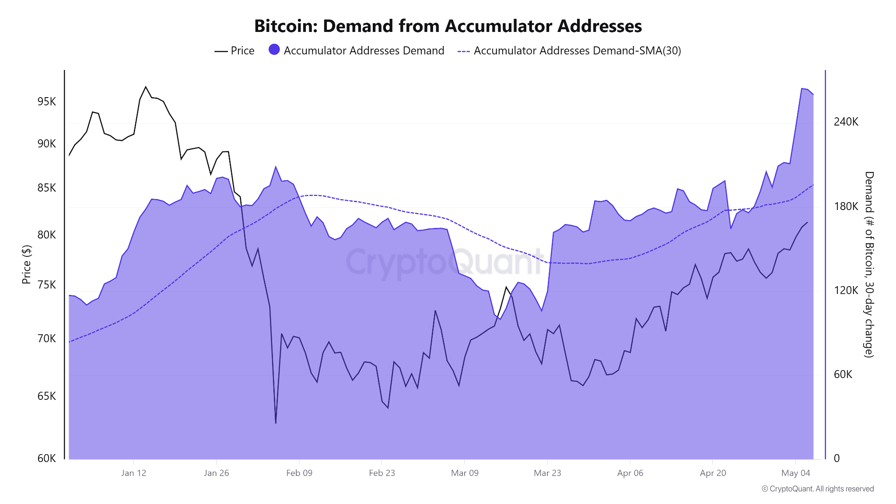
The outflows coincided with stronger demand from accumulator addresses, as the cohorts’ holdings have increased by 60.5% over the past two weeks.
Bitcoin exchange reserves fall to two-year low
Crypto analyst Amr Taha noted that Bitcoin reserves on Binance, OKX and Gemini have declined sharply since February. Binance recorded the largest drawdown, with reserves dropping to nearly 620,000 BTC on May 7, down from roughly 670,000 BTC on Feb. 21. The decline pushed Binance’s holdings below levels last seen in December 2023.
OKX followed the same trend. Its Bitcoin reserve fell to around 102,000 BTC this week, from nearly 132,000 BTC on March 2. Gemini also posted steady outflows, sliding to 95,000 BTC from 114,800 BTC in early February.
BTC multi-exchange reserves. Source: CryptoQuant
Combined, the three exchanges recorded an outflow of nearly 100,000 BTC, valued at over $8 billion at current prices.
Taha noted that a synchronized decline across multiple exchanges carries more weight than isolated outflows from a single exchange. Fewer coins on trading platforms can amplify the price reaction when strong spot demand returns.
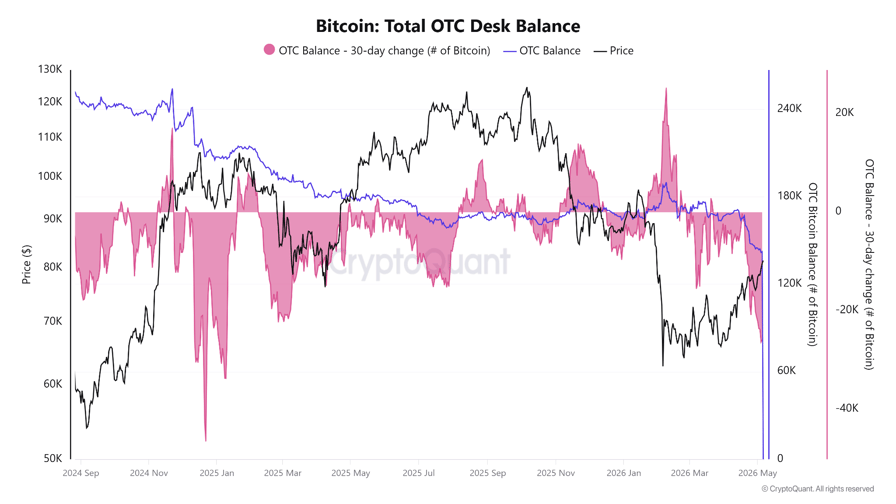
The move coincides with a shrinking OTC balance. Lower OTC balances can reduce the amount of Bitcoin available for large private transactions outside exchanges.
The latest 30-day OTC balance change showed a net decline of 24,940 BTC, while the same metric had risen to nearly 25,300 BTC on Feb. 8 after Bitcoin’s drop toward $60,000. The reversal shows that OTC supply inflows have slowed significantly since the February sell-off.
Bitcoin total OTC desk balance. Source: CryptoQuant
Related: Bitcoin Bollinger Bands push key breakout as creator acts on positive signal
“Accumulator” demand rises as Binance buyers turn positive
Long-term participants increased their Bitcoin accumulation during the latest recovery phase. CryptoQuant data shows demand from accumulator addresses climbed to 264,000 BTC on May 6, up from 164,440 BTC on April 23. The same metric fell to nearly 100,000 BTC on March 15, after peaking above 205,000 BTC on Feb. 5.
Bitcoin demand from accumulator addresses. Source: CryptoQuant
The increase in accumulation coincided with Bitcoin’s recovery toward $82,800, indicating stronger buying activity by long-term holders during the recent price advance.
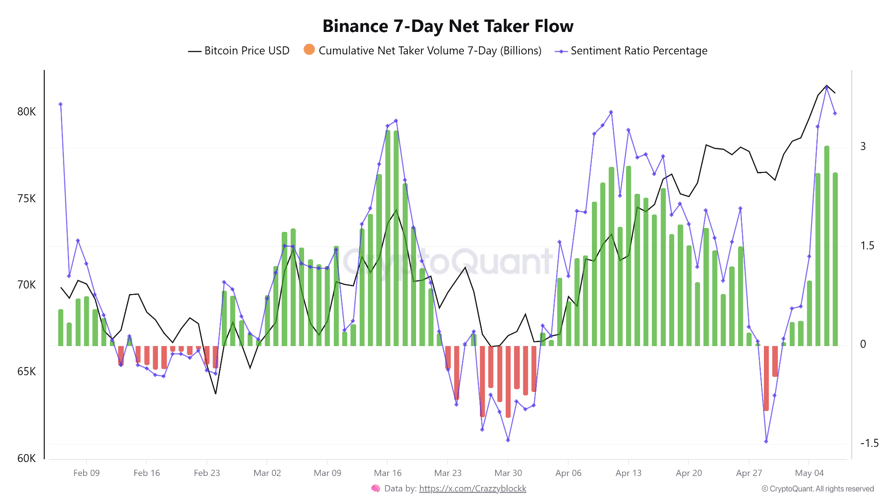
Derivatives activity also strengthened during the recent rally. Binance’s seven-day net taker volume moved from approximately -$1 billion (seller-dominated) in late March to +$2.63 billion (buyer-dominated) on Thursday.
Binance’s seven-day net taker volume for BTC. Source: CryptoQuant
Related: VanEck’s Sigel sees Bitcoin reaching $1M within five years
This article is produced in accordance with Cointelegraph’s Editorial Policy and is intended for informational purposes only. It does not constitute investment advice or recommendations. All investments and trades carry risk; readers are encouraged to conduct independent research.
What have been the developments of the fintech, digital and wider economic development that is driving the economy and society of the African nation of Mauritius?
Mauritius has long positioned itself differently from many African peers. Rather than scale, it has pursued sophistication – building a reputation as a financial services hub bridging Africa and global capital. As noted in previous research I’ve written before, Mauritius’s fintech ecosystem was already relatively advanced, underpinned by a strong offshore financial sector, regulatory clarity, and international connectivity. Today, that positioning has sharpened further, with Mauritius increasingly competing not just regionally, but globally, as a gateway for fintech, digital assets, and cross-border finance.
The macroeconomic context remains a key anchor. It has a population of over 1.27 million people. Mauritius’s economy is estimated at approximately $16 billion gross domestic product (GDP), with a GDP per capita of around $12,000. It is one of the highest in Africa and reflects its upper-middle-income status.
Unlike many African economies, Mauritius is highly diversified, with financial services, tourism, ICT, and manufacturing all playing central roles. Port Louis remains the financial hub, home to major institutions such as Mauritius Commercial Bank (MCB), one of the largest and most technologically advanced banks in the region.
Mauritius and its strong fintech ecosystem
Exposure of Port Louis at Sunrise, taken from a Cruise Ship, showing the city center and the port, hub port on the Indian Ocean island of Mauritius IMAGE SOURCE GETTY
That economic structure has enabled Mauritius to develop one of Africa’s more mature fintech ecosystems. It was even ranked high as a higher-end tier-two fintech hub in the African continent per my previous study. At present, the country is estimated to host around 100 fintech-related firms spanning payments, wealth management, regtech, and digital assets.
Unlike many emerging markets such as its African peers, the ecosystem is not dominated solely by mobile money, but by a broader mix of financial infrastructure providers, cross-border platforms, and digital asset firms. This reflects Mauritius’s role as an international financial centre. Examples include: Flash, offering app-based money management and wallet services; Limit Markets, a versatile multi-asset trading platform; and Learnleapology, an innovative online investment trading platform.
The sector’s most visible catalyst is the Mauritius African Fintech Hub (MAFH). Officially registered as the Mauritius Fintech Association, MAFH was launched in 2018 with the objective to promote Mauritius as the fintech innovation hub for the African continent.
What has evolved most significantly, between 2024 when I last researched about the island nation and 2026, is not just the number of firms, but the regulatory architecture supporting them. The Financial Services Commission (FSC) has introduced new frameworks to streamline fintech licensing and improve clarity around digital assets, including the 2026 Known to the Commission (KTC) initiative designed to attract international players while maintaining regulatory oversight. This reflects a deliberate strategy: to position Mauritius alongside jurisdictions such as neighbouring Dubai and Singapore in the global fintech landscape.
At the same time, domestic digital financial infrastructure has continued to deepen. The Mauritius Central Automated Switch (MauCAS) and its Instant Payment System have seen growing adoption, enabling real-time, 24/7 transfers across banks and non-banks. Last year, digital payments through MauCAS had expanded rapidly, with some sectors seeing usage rise to around 18 per cent, signaling a meaningful shift towards instant, interoperable payments. This places Mauritius among the more advanced payment ecosystems on the continent.
The Central Bank of Mauritius (BoM) has played a pivotal role in enabling this transition. Between 2024 and 2026, the central bank has focused on strengthening payment infrastructure, enhancing regulatory frameworks for fintech and digital banking, and supporting innovation through controlled regulatory environments. While open banking is still evolving, there is increasing movement towards data-sharing frameworks and API-driven financial services, aligning Mauritius with broader global trends.
Financial inclusion in Mauritius is relatively high compared to many African markets. Estimates suggest that over 90 per cent of adults now have access to formal financial services, supported by strong banking penetration and digital infrastructure. The challenge is less about access and more about deepening usage. This is notable with small and medium enterprises (SMEs) and underserved segments where fintech solutions can still play a transformative role.
Boost towards wider digital inclusion in Mauritius
Beyond financial services, Mauritius’s broader digital transformation agenda has accelerated. This year, the government launched a National Artificial Intelligence Strategy alongside FAIR (Fairness, Accountability, Inclusiveness and Responsibility) guidelines, aimed at building an ethical and innovation-driven digital economy. This reflects a wider ambition: to position Mauritius not just as a financial hub, but as a knowledge and technology-driven economy.
Institutionally, Mauritius benefits from a more developed ecosystem than many peers. The Economic Development Board (EDB), fintech-focused conferences, and industry initiatives continue to play a catalytic role in attracting investment and fostering collaboration. Events such as the 2026 Fintech Conference on Payments, FX, and Digital Assets highlight the country’s growing prominence as a convening hub for fintech dialogue.
Yet, challenges remain. Mauritius’s relatively small domestic market limits scale, meaning that many fintech firms must adopt international or cross-border business models from the outset. Additionally, global competition among financial centres is intensifying, requiring continuous regulatory innovation and talent development to maintain competitiveness.
Nonetheless, Mauritius represents a distinct model within Africa’s fintech landscape. It is one built not on scale, but on connectivity, credibility, and strategic positioning. Today, Mauritius’s fintech ecosystem is no longer simply emerging. It is positioning itself as a bridge. It is linking African growth opportunities with global capital and digital innovation. The next phase will depend on sustaining innovation, attracting global talent, and ensuring that its ecosystem continues to evolve in an increasingly competitive international landscape.