Macro investor and former hedge fund manager Jordi Visser said he recently bought Ether as he sees the “tokenization reality” starting this year, with tokenized assets powering agentic AI payments.
“I don’t think enough people are talking about tokenization and what’s happening,” Visser told Anthony Pompliano on a podcast on Saturday, predicting that tokenization and AI will be intertwined.
AI agents cannot access banking services or credit, so their primary method of transacting online autonomously will be digital assets such as Ether or stablecoins, which do not require bank accounts, logins or human approval.
“AI agents are with us,” he said. “They need food, and that food is not physical food. It is tokens,” he added. “There’s been a shortage,” which could lead to a supply and demand issue, he continued.
Autonomous online payments have surged this year, recording more than $24 million in transaction volume over the past month on the Coinbase x402 standard, according to x402.org.
Meanwhile, crypto protocols are racing to implement agentic AI payment protocols into their blockchains. The Algorand Foundation is one of the more recent, announcing on Saturday support for agentic commerce via a partnership with Google on the AP2 Agentic Payments Protocol.
Tokenization is needed for price discovery
Ethereum is a major blockchain for real-world asset tokenization, commanding more than 60% market share of tokenized assets, including layer-2 networks, according to RWA.xyz.
He also connected tokenization to a broader need for price discovery in illiquid assets, arguing that tokenization isn’t just a crypto story but a structural necessity for unlocking capital trapped in dormant assets such as private credit, private equity and venture capital.
Related: Agentic AI commerce may spell the end of internet ads: a16z Crypto
He argued that markets are entering a period where transparency and liquidity are “becoming critical” because a lot of money is stuck in these dormant assets.
“So tokenization is actually needed for no other reason than price discovery for a lot of these things that they’re trapped in.”
Source: YouTube
The head AI macro at 22V Research and a former hedge fund manager, however, cautioned about rising inflation, stating that he wanted to be in gold and silver and has also bought Bitcoin (BTC) as a hedge.
Magazine: Strategy reveals why they would sell BTC, Trump Media posts loss: Hodler’s Digest
The Abu Dhabi Global Market (ADGM) confirmed that Rokos Capital Management (RCM) has officially opened a new office in the UAE capital. The launch follows the global multi-asset investment firm successfully receiving its Financial Services Permission (FSP) from the Financial Services Regulatory Authority (FSRA).
Located in the Sky Tower within ADGM’s jurisdiction, the new office significantly expands RCM’s international footprint. Prior to this Middle Eastern expansion, the firm’s existing presence included offices in major global financial hubs such as London, New York, and Singapore.
Deepening regional engagement
Chris Irish, head of Middle East and head of finance at Rokos Capital Management
RCM operates as a global multi-asset investment firm focused entirely on the pursuit of high, durable risk-adjusted returns for its investors. The firm’s deep expertise spans active strategies across all major asset classes and draws heavily on its foundations in global macro trading.
Chris Irish, head of Middle East and head of finance at Rokos Capital Management, highlighted the strategic importance of the new regulatory standing.
“Securing our full regulatory licence in ADGM is a significant milestone in RCM’s development in the region. We look forward to building on this as we expand our team and deepen our engagement with local investors and partners.”
A growing destination for global capital
Established in 2015, ADGM has rapidly grown into the fastest-growing financial centre in the region. It provides global firms with a robust legal framework aligned with international standards, offering certainty, confidence, and connectivity with opportunities across the broader Middle East.
Supported by Abu Dhabi’s economic stability, pro-business environment, and long-term diversification agenda, the financial district continues to attract a growing range of international institutions seeking access to regional and global markets.
Arvind Ramamurthy, chief market development officer at ADGM, welcomed the firm’s entry into the ecosystem.
“We congratulate Rokos Capital Management on receiving its FSP and on establishing its Abu Dhabi office. RCM’s entry further strengthens ADGM’s growing ecosystem of leading global financial institutions, underpinned by a transparent, outcomes-focused regulatory framework and a compelling ecosystem for managers to serve regional and international clients.”
Ramamurthy added that the ADGM continues to see strong momentum in firms choosing to set up within its jurisdiction, reflecting Abu Dhabi’s growing position as a destination of choice for global investors and a key gateway to opportunities across the region.
Major financial assets and the American consumer are moving in opposite directions, telling two very different stories about the U.S. economy.
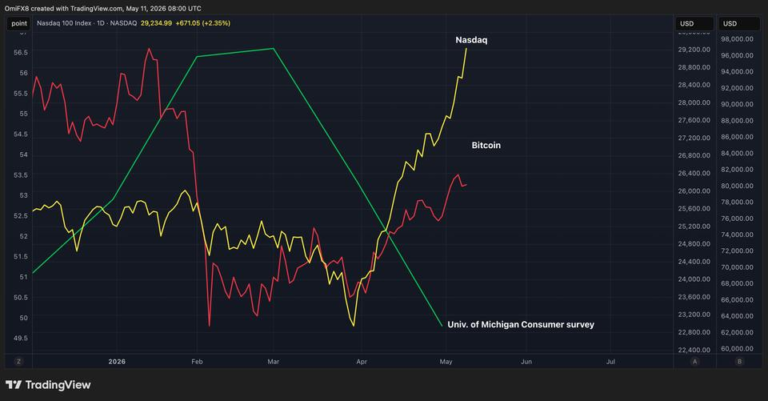
Bitcoin, the leading cryptocurrency by market value and a macro asset, jumped 11.8% last month, the largest gain since April 2025 and has since extended the rally by nearly 6% to $80,700, CoinDesk data show.
This upswing has come alongside record risk-taking on Wall Street, as the tech-heavy Nasdaq index has jumped 22% since April 1, hitting a lifetime high of 23,235 points. The broader index, S&P 500, has rallied over 12% to 7,398 points, according to data source TradingView.
The combined rally in stocks and crypto is normally expected to lift the spirits of the American consumer, who is known to invest in both assets. Reports suggest approximately 30% of American adults, or 70.4 million people, own cryptocurrency. Further, on average, 62% of adults have owned stocks since 2023.
But that’s not the case, as highlighted by the University of Michigan’s closely watched survey of consumers released Friday. The survey posted a preliminary record-low reading of 48.2 points, down 7.7% from a year ago and extending the decline from April’s reading of 49.8 points.
In simple terms, the American consumer is more downbeat than ever, and it’s mainly due to inflation fears. One-third of respondents cited gas prices as the biggest concern, and another one-third cited tariffs.
The growing disconnect between Wall Street and Main Street reflects two very different economic realities, according to Alvin Kan, COO at Bitget Wallet.
“Institutional capital continues flowing into AI, semiconductors, and digital assets, pushing the Nasdaq and Bitcoin higher as markets price in long-term productivity growth and technological transformation. At the same time, consumer confidence remains weak as households continue dealing with inflation, high living costs, and economic uncertainty. In effect, markets are trading the future while consumers are still focused on present-day financial pressure,” Kan told CoinDesk.
An AI capex boom and strong corporate earnings from mega-cap tech companies have driven the Nasdaq rally, stoking demand for other emerging technologies such as bitcoin. The U.S.-listed spot ETFs have pulled in billions in recent weeks amid the Nasdaq rally.
“This divergence is being driven by strong tech earnings, sustained ETF and institutional inflows into Bitcoin, and the growing role of digital assets as both growth and diversification plays. It also shows how crypto is increasingly tied to macro liquidity and innovation cycles instead of purely retail sentiment,” Kan said.
Bitcoin and Nasdaq are known to share a strong positive correlation. The crypto market began as a grassroots movement, often moving independently of Wall Street and traditional financial markets. But the rapid institutionalization following the launch of spot ETFs two years ago has made its price action increasingly correlated with broader equity markets.
That shift in how investors view BTC, decoupling it from Main Street sentiment, is evidence of the fading promise of financial democratization, according to Markus Thielen, founder of 10x Research.
“The democratization of finance was once one of crypto’s defining promises, yet reality has moved in the opposite direction. Wealth remains heavily concentrated in the hands of a small minority, a trend that is even more pronounced in the US stock market, where gains have increasingly accrued to the wealthiest participants,” Thielen told CoinDesk.
What next?
When rising costs squeeze households, it may seem natural to expect markets to align with the dour sentiment on Main Street. But that’s not necessarily promised.
“This gap is expected to persist,” Gracy Chen, CEO of Bitget, said.
She added that digital assets are increasingly diverging from traditional cycles and attracting fresh capital seeking asymmetric returns, suggesting promising long-term structural growth.
“While risks such as monetary policy tightening, geopolitical macro events, or regulatory shifts could add near-term pressure. However, the emerging ecosystem is maturing and becoming a core tool for diversification and active risk management in volatile markets,” she noted.
Trusted Editorial content, reviewed by leading industry experts and seasoned editors. Ad Disclosure
Michael Saylor defended Strategy’s Bitcoin-backed credit model after critics argued that the company’s STRC dividend structure resembled a Ponzi scheme, saying the business is built around monetizing Bitcoin capital gains rather than relying on perpetual equity issuance.
Speaking in an interview shared via X on May 9, Saylor addressed the market reaction to Strategy’s recent earnings call, where the company said it was prepared to sell Bitcoin, if needed, to fund dividends on its STRC preferred instrument. The remark drew attention because Saylor has long been associated with the phrase “never sell your Bitcoin.”
According to Saylor, the more precise formulation is that Strategy does not intend to be a “net seller” of Bitcoin.
“I’m very famous for saying, never sell your Bitcoin. And that’s why the internet went crazy when we said we might sell it,” Saylor said. “But if I was being more precise, I’d say never be a net seller of Bitcoin. It just wouldn’t have been so viral or so catchy to say never be a net seller of Bitcoin.”
Why Strategy Is Not A Bitcoin Ponzi Scheme
The issue became a point of contention after Peter Schiff and other critics suggested that Strategy’s willingness to sell Bitcoin to support STRC dividends exposed weakness in the model. Saylor rejected that framing, saying the company’s balance sheet should not be treated as if its Bitcoin holdings were unusable or worth zero.
“If you had $65 billion worth of something and people wanted to value it at zero, it’s not very good,” he said. “We don’t want the credit rating agencies to think the company has $0 of assets. We want the credit rating agencies to think we have $65 billion of assets.”
Saylor said the core model is straightforward: Strategy issues credit, uses the proceeds to buy Bitcoin, and expects the asset’s long-term appreciation to exceed the cost of the dividend. He compared the structure to a real estate development company raising capital through credit, acquiring land, improving it, and later monetizing the appreciation through sales, rent, or refinancing.
“What we wanna do is we wanna reinforce the business model is we sell credit to make a capital investment in an asset, Bitcoin, digital capital,” Saylor said. “The capital investment accretes over time faster than the dividend. We then monetize the capital gain and we pay the dividend.”
That distinction is central to Saylor’s response to Ponzi allegations. In his view, critics conflate selling common equity to fund dividends with the broader economic structure of the business. He said Strategy historically used MSTR equity, which he described as a derivative of Bitcoin that typically trades at a premium to Bitcoin, to fund dividends. But the company now wants the market to understand it could also use appreciated Bitcoin directly.
Saylor said that does not mean Strategy expects to shrink its Bitcoin position. He argued that even if the company sold Bitcoin for dividend payments, its credit issuance would allow it to buy substantially more Bitcoin than it sells.
“If we sell Stretch, if we issue Stretch credit equal to 2.3% of our Bitcoin holdings, then that means we will be a net buyer of Bitcoin forever, even if we sell Bitcoin to pay the dividend,” he said. “Another point is that if Bitcoin appreciates 2.3% a year, we can pay the dividends forever, right? And continue to grow value, right? And we can do it without selling any common equity.”
He added that Strategy sold $3.2 billion of STRC in April, while the monthly dividend requirement was roughly $80 million to $90 million. In that scenario, he said, the company would effectively be “buying 30 Bitcoin and selling one Bitcoin,” leaving it a net accumulator.
The interview also directly addressed Schiff’s criticism. Saylor said Schiff’s objection begins with a rejection of BTC itself, making it unlikely that he would accept a credit instrument built on top of it.
“Peter thinks Bitcoin’s a Ponzi scheme. Peter is not really a lover of anything in this space,” Saylor said. “Bitcoin is digital capital and we’ve created a digital treasury company by selling equity and credit instruments to buy capital. I think that Bitcoin is going to continue because it represents economic wealth in tokenized form with full property rights for the world.”
Saylor described STRC as a form of “digital credit” designed to strip out some Bitcoin volatility while producing a defined yield. He said Strategy overcollateralizes the instrument, with “for every $5 of Bitcoin” the company selling “$1 of credit.”
“If you don’t acknowledge Bitcoin as legitimate, you’ll never acknowledge any derivative on top of it as legitimate,” he said. “But for those people that believe that Bitcoin is digital capital, as a store of economic wealth in tokenized form, then what we’re doing is very straightforward.”
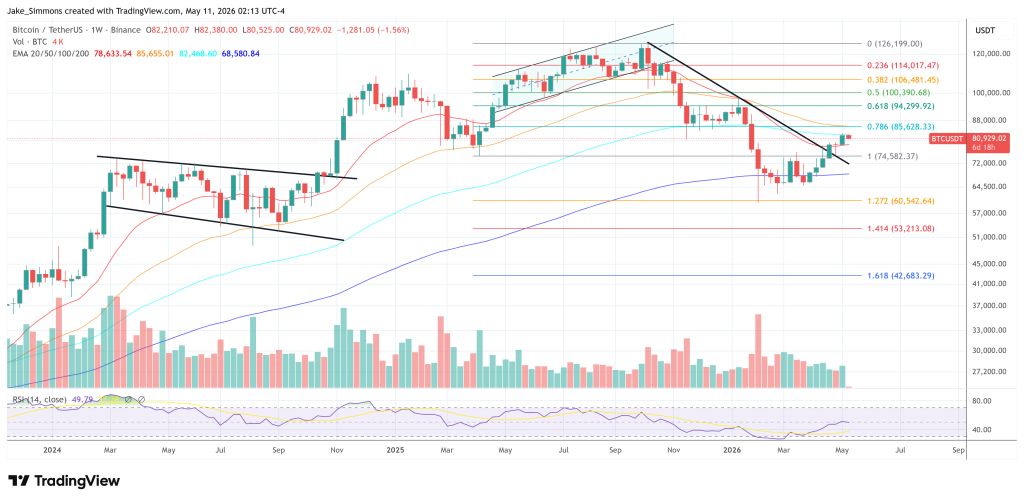
At press time, BTC traded at $80,929.
BTC bulls eye the 0.786 Fib, 1-week chart | Source: BTCUSDT on TradingView.com
Featured image from YouTube, chart from TradingView.com
Editorial Process for bitcoinist is centered on delivering thoroughly researched, accurate, and unbiased content. We uphold strict sourcing standards, and each page undergoes diligent review by our team of top technology experts and seasoned editors. This process ensures the integrity, relevance, and value of our content for our readers.
The team behind the Renegade.fi protocol said a whitehat hacker returned about $190,000 after exploiting one of its Arbitrum-based decentralized dark pools and later complying with instructions in an onchain message to return 90% of the funds.
Renegade confirmed the return of funds on Sunday after blockchain analytics platform Blockaid flagged the $209,000 exploit at 8:27 am UTC. The hacker injected malicious logic into a faulty function tied to its V1 Arbitrum dark pool to steal 27 ERC-20 tokens.
Data from Arbitrum block explorer Arbiscan shows that the whitehat returned about $190,000 to the Arbitrum wallet address “0xE4A…5CFBE,” which includes $84,370 worth of USDC (USDC), $27,885 in wrapped Bitcoin and $23,950 in wrapped Ether.
Source: Renegade
Whitehat hackers have come to play a crucial role in the fight against bad actors who continue to exploit crypto protocols despite strengthened security measures in recent years.
Industry initiatives like the crypto security nonprofit Security Alliance’s Safe Harbor framework have been set up to enable white hats to steal funds for temporary safekeeping while being legally protected.
In an onchain message, Renegade asked the hacker to return 90% of the funds and keep the remaining 10% as a “whitehat bounty” to avoid facing potential “civil or criminal action.”
The onchain message that Renegade sent to the hacker. Source: Arbiscan
The whitehat hacker sent more than 90% of the stolen funds back within 45 minutes and said in response to the onchain message that the action was taken to protect DeFi users:
“I’ve seen a lot of contempt toward my actions. Although I understand that what I did was not ethical, in the current DeFi cybersecurity, I believe this was the best solution to protect users’ funds and ensure their safety.”
The whitehat hacker also hinted that Renegade should tighten up its security measures, stating that the vulnerability exploited was “tooooo simple and bad.”
Related: Crypto hackers stole $17B over past 10 years: DefiLlama
North Korean state-backed hackers “would never come to negotiate,” they added.
Renegade said the exploit appeared to have resulted from the deployment code failing to assign an explicit owner and from a faulty migration in an April 2025 software update, enabling anyone to rewrite the smart contract tied to its V1 Arbitrum dark pool.
Dark pools are private trading platforms that allow large trades to occur without exposing their intentions to, or impacting, the broader market.
Renegade added that it would publish a post-mortem with a “full root-cause analysis” explaining the security incident.
Renegade said it would fully compensate affected users, and that only 7% of its trading volume was channeled through the V1 Arbitrum dark pool and that it would contact the “small number of affected users directly.”
Magazine: AI-driven hacks could kill DeFi — unless projects act now
The biggest decentralization move bitcoin mining has seen in years just happened quietly, with seven of the largest pools agreeing to back the same open standard.
Foundry, AntPool, F2Pool, SpiderPool, MARA Pool, Block Inc, and DMND have all joined the Stratum V2 working group, the group announced last week.
Stratum V2 is an open-source protocol governing how mining pools communicate with the individual miners in those pools. The biggest practical change it introduces is letting individual miners construct their own block templates, meaning the choice of which transactions get included in each new block sits with the miner rather than whoever operates the pool.
Foundry alone controls 34.2% of global bitcoin hashrate, AntPool another 14.2%, F2Pool 11.3%, and SpiderPool 10.5%, with MARA Pool adding 4.7%, per Hashrate Index data. Together with the rest of the Stratum V2 signatories, the seven pools now backing the standard represent close to 75% of all bitcoin hashrate.
Under the current Stratum V1 standard, the transaction selection for nearly every new block sits with the pool operators rather than the individual miners actually doing the work. That concentration has been the loudest structural concern about modern mining for the past two years.
Stratum V2 does not change hashrate concentration, but it does change who decides what goes into each block, which is the part the Bitcoin community actually worries about.
A single pool controlling more than 30% of hashrate is less than ideal, as the same pool deciding the transaction order for that share of blocks is the actual risk people point to.
The protocol has existed since 2022, when Braiins and Spiral co-founded the working group. Until now it had been treated as a niche side project with limited adoption. Foundry and AntPool joining gives it real reach, with the working group framing the move as the start of a new phase of accelerated deployment.
The timing also matches what the broader mining cohort is dealing with. CoinShares estimates up to 20% of miners are currently unprofitable, with hashprice (the revenue a miner earns per unit of computing power) sitting at $38.57 per petahash per second per day, at or near breakeven for operators running mid-generation hardware.
Difficulty is set to rise again on May 15 from 132.47T to 135.64T, per CoinWarz. Network hashrate now sits at 998 exahash per second.
Trusted Editorial content, reviewed by leading industry experts and seasoned editors. Ad Disclosure
Bitcoin has recently touched the $81,000 zone in the last few hours, as bullish sentiment continues to grow stronger. Data from CoinMarketCap shows a 12% monthly gain, suggesting significant capital inflows into the leading cryptocurrency since early April. However, on-chain data paints a parallel picture of a brewing shift in market dominance.
Increasing Altcoin Volume Coincides With MACD Signal As Bitcoin Dominance Falls
In a QuickTake post on May 9, crypto analytics group XWIN Research Japan reports an ongoing decline in Bitcoin Dominance (BTC.D), despite the recent substantial price gains. According to market experts, BTC.D initially posted a strong uptrend in 2026, rising to around 60%. This move was fueled by an unrivaled interest in Bitcoin, highlighted by rising inflows into Spot Bitcoin ETFs, institutional accumulation, and macro uncertainty.
However, the Bitcoin Dominance has been declining in recent days, suggesting a rotation of capital toward altcoins. Interestingly, XWIN Research highlights an update shared by fellow analyst CryptoOnChain, who recently posted on the occurrence of “Altcoin Volume Increasing Trend”, a signal that appears when 30-day altcoin trading crosses above the 365-day average in the CEX Volume Ratio (Others vs Top 5).
Source: CryptoQuant
This observed rotation is also well reflected in price movements. While Ethereum (ETH) has shown little price change, assets such as SUI and SOL have registered respective substantial gains of 15.83% and 10.53% in the last week alone. Furthermore, XWIN Research Japan reports that these developments have coincided with a recent bearish MACD crossover on the Bitcoin Dominance chart, which the analysts now say may represent a shift in market structure rather than a mere technical signal.
BTC Dominance Drop May Signal Crypto Market’s Next Bull Leg
In other developments shared by XWIN Research, on-chain indicators suggest the broader Bitcoin market remains in the initial phase of a bull cycle. Metrics such as the Profit/Loss Margin and Market Value to Realized Value (MVRV) ratio are yet to reach previous cycle tops, while long-term Bitcoin holders continue to exhibit relatively low selling pressure.
Notably, previous declines in Bitcoin Dominance have marked pivotal moments for the broader market, leading to explosive altcoin rallies, as observed in 2017 and 2021. Therefore, a sustained decline in Bitcoin Dominance or a resumption of its uptrend will have a significant impact on market direction from these early bull stages.
At press time, Bitcoin trades at $80,724. Meanwhile, the total altcoin market cap is valued at $1.04 trillion.
Total altcoin market valued at $1.04 trillion on the daily chart | Source: TOTAL chart on Tradingview.com
Featured image from BusinessDay, chart from Tradingview
Editorial Process for bitcoinist is centered on delivering thoroughly researched, accurate, and unbiased content. We uphold strict sourcing standards, and each page undergoes diligent review by our team of top technology experts and seasoned editors. This process ensures the integrity, relevance, and value of our content for our readers.
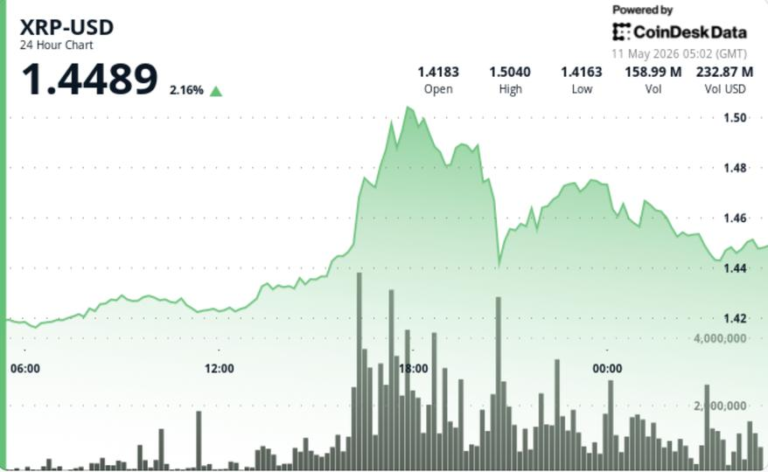
XRP finally forced its way through the $1.45 area that had capped rallies for weeks, and the move came fast. Volume arrived all at once during the breakout, which usually points to larger positioning rather than retail chasing, though the rally started losing momentum as price approached the psychological $1.50 level.
News Background
• Traders had been watching XRP’s tightening range for days as multiple analysts pointed to bull flag and triangle formations building beneath resistance.
• Thin liquidity conditions across major exchanges added to expectations that any confirmed breakout could produce exaggerated moves in either direction.
Price Action Summary
• XRP climbed from $1.4176 to $1.4524 during the 24-hour session, trading within a 6.5% range. • The breakout accelerated during the May 10 16:00–17:00 window, when volume surged above 169M and pushed price through $1.4450. • XRP later reached a session high of $1.5073 before pulling back toward the $1.45 area as traders locked in profits.
Technical Analysis
• The move above $1.45 matters because that level had repeatedly rejected upside attempts since April. • Breakout volume was unusually strong, suggesting real participation behind the rally rather than a thin squeeze higher. • Momentum cooled quickly near $1.50, where sellers stepped back in and triggered short-term liquidation pressure. • Despite the pullback, XRP is still holding above the prior breakout zone, keeping the broader bullish structure intact for now.
What traders should watch
• $1.44-$1.45 is now the key support area. Holding above it keeps the breakout structure alive. • $1.50 remains the immediate resistance level after the sharp rejection from session highs. • A sustained move above $1.50 could reopen momentum toward $1.56 and potentially the $1.80 area highlighted by several analysts. • Failure back below $1.44 would increase the risk of a retracement toward the $1.38-$1.40 range.
SC Ventures, the fintech innovation and investment arm of Standard Chartered, has made a strategic investment in GSR, a leading crypto capital markets and liquidity partner. The landmark deal makes SC Ventures the first external strategic shareholder to invest in GSR since the crypto firm was founded in 2013.
The investment is part of a broader, sustained push by SC Ventures to build out the institutional digital asset ecosystem. The move follows a highly active first quarter for the venture arm, which recently led Keyrock’s Series C funding round in March 2026 and made a strategic investment into onchain yield platform TruFin in February 2026.
Bridging traditional finance and digital assets
Xin Song, CEO of GSR
The new partnership between SC Ventures and GSR is designed to directly bridge traditional finance and the crypto ecosystem, with a specific focus on expanding institutional access to tokenisation. For GSR, the backing of a major traditional banking arm reinforces its central role in providing advisory, liquidity, and asset management capabilities to both crypto-native firms and leading global financial institutions.
Xin Song, CEO of GSR, highlighted the importance of merging these two financial worlds as the industry rapidly evolves. He noted that institutional digital asset markets are maturing at a rapid pace, and the firms best positioned to lead this next phase will be those capable of combining deep capital markets expertise with trusted banking infrastructure. Song added that the new partnership brings those exact strengths together, utilizing tokenisation as a key starting point for their collaborative efforts.
Building scalable market infrastructure
Alex Manson, CEO of SC Ventures
Beyond tokenisation, the two firms plan to co-develop robust, compliant, and scalable market infrastructure designed to support the next major wave of institutional adoption across digital assets. By focusing heavily on regulatory compliance and deep liquidity, the partnership aims to contribute to a more globally integrated and resilient financial ecosystem.
Alex Manson, CEO of SC Ventures, emphasized that the foundational architecture of the market will dictate the future of institutional crypto adoption. Manson explained that the next phase of the digital asset evolution will be defined entirely by the strength of its underlying infrastructure. He stated that the investment in GSR fundamentally reinforces SC Ventures’ focus on building institutional ecosystems capable of supporting deeper liquidity and far more resilient market activity in the years to come.
A bitcoin whale came back to life Sunday, moving coins worth $40 billion to a new address after more than a decade of inactivity.
The transfer took place at around 19:16 UTC, according to blockchain tracking service Whale Alert. The coins were moved from address “1KAA8GGhVjjUjVTz1HKAjCyGNzAKQd882j” to “bc1qm6m6d33d02edr0k8yj9jgt027zl6dvx6thjrxy.”
The wallet had remained inactive since November 2013, when BTC was originally acquired and subsequently held untouched for more than a decade.
The reason behind the latest transfer remains unclear. Large holders often move coins between wallets for address management or security purposes, though such activity can also precede sales or transfers to exchanges. In this case, the destination address does not appear to be linked to a known exchange wallet.
Dormant bitcoin wallets have increasingly resurfaced since BTC first crossed the $100,000 mark in late 2024. Several early investors and miners have moved long-held coins over the past year, with some ultimately taking profits after bitcoin’s massive rally.
The trend was most intense in July last year, when blockchain analytics firms flagged eight Satoshi-era wallets, each holding 10,000 BTC, moving their coins for the first time in 14 years. Those transfers came as bitcoin traded above $100,000 and hovered near all-time highs.
As of writing, bitcoin changed hands near $80,700, down over 1% since midnight UTC, according to CoinDesk’s market data.