Home Blog Page 333

Aave Deposits on MegaETH Cross $575M as Post-TGE Liquidity Pours In

0

MegaETH’s DeFi TVL has doubled since Thursday’s MEGA token launch, with USDM and Terminal Points farming pulling in fresh capital.

Aave’s deposits on MegaETH crossed $575 million on Friday as capital continued flowing into the Ethereum Layer 2 network a day after its long-awaited MEGA token launch.

The figure represents a sharp jump from the roughly $355 million in total DeFi deposits MegaETH hosted at the time of the TGE on Thursday, when Aave already accounted for the bulk of the network’s total value locked (TVL).

MegaETH, which markets itself as a “real-time” blockchain capable of more than 100,000 transactions per second with sub-10 millisecond block times, launched its mainnet on Feb. 9 with Aave deployed on day one. As part of that arrangement, MegaETH committed to a five-year revenue guarantee of at least $10 million to the Aave DAO.

The Aave market on MegaETH revolves primarily around USDM, the network’s native stablecoin built with Ethena and backed by USDtb. Yield generated on USDM flows back to the MegaETH Foundation, which uses it to buy back MEGA, tying lending activity directly to the token’s economics.

Capital inflows have accelerated alongside MegaETH’s Terminal Points season, an eight-week campaign that opened on April 28 and runs through June 23, rewarding users for depositing into and using ecosystem apps.

MEGA opened trading at around $0.22 on Thursday before falling roughly 30% to $0.15 in early price discovery, well below the $6 billion fully diluted valuation its pre-market perpetuals notched on Hyperliquid last October.

This article was written with the assistance of AI workflows. All our stories are curated, edited and fact-checked by a human.

KnowBe4 Taps Flywire to Transform Global Invoice-to-Cash Operations

0

Global payments enablement and software company Flywire Corporation has entered into a new strategic partnership with KnowBe4, the provider of the world’s largest security awareness training and simulated phishing platform. KnowBe4 has selected Flywire as its preferred partner for global accounts receivable (A/R) and international payments.

The newly signed three-year agreement will provide KnowBe4 with an invoicing and payments solution tailored for enterprise-scale needs. The cybersecurity firm, which currently serves over 70,000 organizations worldwide, has committed millions of dollars in annual payment volume through the Flywire platform.

Scaling operations and ditching legacy providers

As KnowBe4 continues its rapid global expansion, the company required a robust, scalable solution to replace legacy payment providers and streamline its complex cross-border workflows. By combining Flywire’s invoice-to-cash software with its proprietary global payments network, KnowBe4 can now automate its entire invoice-to-cash lifecycle for customers across hundreds of countries.

The integrated offering is expected to provide the cybersecurity platform with several core operational upgrades:

  • End-to-End A/R Automation: The integration will streamline billing, collections, and payment processing within a single platform. This automation is expected to drive significant back-office efficiency gains, reducing the time spent on manual reconciliation by approximately 95 per cent.
  • Global Reach and Reduced Transaction Costs: KnowBe4 will gain the ability to accept and settle payments in over 140 local currencies across more than 240 countries and territories. By utilizing local processing capabilities, KnowBe4 expects to capture millions of dollars in potential savings by optimizing exchange rates and reducing global transaction fees.
  • Accelerated Revenue: A single, robust integration into KnowBe4’s system of record will eliminate the technical burden of maintaining multiple different payment providers. This “future-proof” approach is designed to reduce Days Sales Outstanding (DSO), improve cash flow predictability, and deliver significant IT resource savings.
Transforming payments into a growth enabler
Vlad Kaplunsky, VP of tax & treasury at KnowBe4

Vlad Kaplunsky, VP of tax & treasury at KnowBe4, emphasized the importance of modernizing the back office to fuel long-term expansion.

“As KnowBe4 continues to expand its footprint around the world, we required a sophisticated payments partner that could scale alongside our global operations,” Kaplunsky stated. “By integrating with Flywire, we are not only providing our international customers with a more seamless and localized payment experience, we are also driving significant value by automating complex back-office workflows. This partnership allows our teams to move away from manual reconciliation and focus on the strategic initiatives that will fuel our long-term growth.”

Ryan Frere, EVP and GM of B2B at Flywire

Yuneeb Khan, chief financial officer at KnowBe4, echoed this sentiment, calling the partnership a “critical milestone in strengthening our international finance operations as we expand our global footprint”.

Ryan Frere, EVP and GM of B2B at Flywire, noted that KnowBe4 represents the exact kind of high-growth technology leader that Flywire’s infrastructure was built to support.

“Their finance team was managing an increasingly complex web of cross-border payments, manual reconciliation, and disparate systems – all while trying to scale rapidly across new markets,” Frere explained. “We’re giving KnowBe4 the infrastructure to get paid faster, reduce operational drag, and deliver a better experience to their customers worldwide. This is what it looks like when payments stop being a bottleneck and start being a growth enabler.”

Bitcoin Demand, Spot And Institutional Flows Increase As Bulls Chase $80K

0

Several Bitcoin (BTC) data points suggest that $80,000 is the next destination for the cryptocurrency. Bitcoin gained 2.52% to trade above $78,800 on Friday after holding support at the 100-day exponential moving average. Spot market buy volumes also strengthened while the cumulative volume delta (CVD) reached 11,500 BTC, its highest level since Feb. 17. 

BTC futures activity is picking up, with the open interest rising 6.64% to 257,000 BTC, indicating fresh positioning.

Bitcoin’s daily trend recovery shows fresh positioning

Bitcoin rebounded from its 100-day exponential moving average (100-EMA) after retesting the daily trend over the past two days. The move lifted the price by 2.52% to $78,800 on Friday, holding the short-term uptrend intact.

The 100-day EMA, currently acting as dynamic support on the daily chart, suggests that the higher time-frame chart remains bullish. 

BTC/USDT on the one-day chart. Source: Cointelegraph/TradingView

The spot demand is strengthening at the same time. The spot cumulative volume delta (CVD), which tracks net buying versus selling, reached 11,500 BTC, a new high since Feb. 17. This indicates buyers are absorbing the supply during the recent dip. 

Derivatives positioning is expanding in tandem with price, pointing to fresh participation. The aggregated open interest has risen 6.64% to 257,000 BTC over the past 24 hours, indicating new positions are being added as Bitcoin consolidates below $80,000. 

BTC price, spot, and futures CVD. Source: Velo

This follows a recent leverage flush of roughly 9,000 BTC, suggesting that excess positioning has been cleared as the leveraged market rebuilds. 

The futures CVD adds further context. Futures volume has recovered to 98,300 BTC, signaling a return of net buying pressure. However, it remains below the levels seen during the April 27 correction, suggesting trader positioning is still developing. 

At the same time, liquidity continues to cluster in the $78,000–$80,000 range, with $2.1 billion in short positions at risk, which could lead to a short squeeze near the key level.

Bitcoin liquidation heatmap. Source: CoinGlass

Related: Bitcoin ETFs draw $2B in April for highest monthly inflows this year

BTC demand from institutions tightens the available supply

BTC institutional activity continues to lean supportive. The 30-day change in OTC desk balances has fallen to around -20,700 BTC, matching levels last seen in March 2025. The lower balances indicate BTC moving off desks, reducing the immediately available supply.

Bitcoin: Total OTC desk balance. Source: CryptoQuant

The exchange-traded fund (ETF) flows show a similar pattern. With ETF flows reaching $1.97 billion in April. Bitcoin research newsletter Ecoinometrics noted a nine-day streak of inflows, the longest in 2026.

Ecoinometrics explained that while the pace of inflows is moderate, the consistency has improved, adding, 

“The last time flows showed this kind of persistence was right before the October 2025 peak. Not saying we’re there yet, but it tells you the direction is improving.”

The near-term focus is on how long flows sustain themselves and whether liquidity above $80,000 thins as spot, futures, and institutional participation increase.

ETF inflow streak improves for Bitcoin. Source: Ecoinometrics/X

Related: Bitcoin’s $75K cost basis emerges as key support zone for current bull trend

This article is produced in accordance with Cointelegraph’s Editorial Policy and is intended for informational purposes only. It does not constitute investment advice or recommendations. All investments and trades carry risk; readers are encouraged to conduct independent research.

Regional Openness and the Shift to Cloud Processing

0

At the Money 20/20 Asia event in Bangkok, the focus on the evolving APAC financial landscape centered on the increasing “opening up” of the region. Suresh Vaghjiani, CEO and Founder of CLOWD9, discussed how governments that were historically inward-facing and protective of their banking industries are now embracing a more open approach. This shift is exemplified by countries like Thailand, which has become one of the first in the area to offer new banking licenses, triggering a competitive race for entry and a newfound willingness to learn from other global regions.

However, this transition presents a unique economic challenge, as European financial solutions can often be too costly for the APAC market, where operations run on very low margins. Vaghjiani highlighted that in this region, success is driven by volume and extreme operational efficiency. To address this, CLOWD9 provides cloud-based processing that operates on a pay-as-you-use model, similar to a pay-as-you-go phone. This approach allows clients to avoid the high costs associated with expensive peak times, ensuring that their processing remains highly cost-efficient.

For banks and fintechs adopting these cloud-native solutions, the impact over the next 12 months is significant. By moving away from traditional, high-cost infrastructure, institutions can launch new services at a 90% reduction in cost compared to other regions. This efficiency allows firms to respond to the region’s openness quickly and competitively, turning the challenge of low-margin environments into an opportunity for high-volume growth.

Key Highlights from Suresh Vaghjiani:

  • The Opening of APAC: Vaghjiani discusses the shift from protective government policies to a more open, competitive banking environment in regions like Thailand.

  • Overcoming High-Cost Barriers: Why traditional European financial solutions are often economically unviable in the low-margin, high-volume APAC market.

  • Pay-As-You-Go Processing: How CLOWD9 utilizes cloud technology to offer a flexible payment model that eliminates the burden of expensive peak-time costs.

  • Massive Cost Reductions: A look at how firms can achieve up to a 90% reduction in launch costs by utilizing efficient, cloud-native processing.

Exodus (EXOD) Announces Official UFC Deal And Exodus Pay

0

JP Richardson, co-founder and CEO of Exodus Movement (NYSE American: EXOD), opened part of the Exodus Summit today in Omaha, Nebraska, with an announcement about where he thinks the company’s customers already are.

Exodus is becoming the official payments partner of the UFC, Richardson said, with the partnership going live June 1. 

This launch coincides with the UFC staging its “Freedom 250” fight event on the White House lawn to mark the 250th anniversary of the United States, making it the first UFC event held on those grounds. Branding will appear inside the octagon, in broadcast spots, and through activation footprints at the venue itself.

“As the fans walk through the gates, you’re gonna see Exodus activation footprints everywhere at the White House,” Richardson said.

Richardson framed the deal in two dimensions: brand exposure and trust. For a financial application, trust is not a marketing metric but rather a result of a solid product. 

Consumers do not experiment with unrecognized brands when their money is involved, and Richardson argued that the UFC’s reach, 700 million fans across 165 countries, provides the kind of repeated, high-stakes visibility that accelerates that trust-building at a scale few media properties can match.

The deal is multi-year. Richardson described the target demographic as crypto-curious, young and digitally native — one that already aligns with what Exodus has spent over a decade building toward. 

A deep dive into Exodus Pay

Later in the day, Ain Sonayen, Chief Product Officer, delivered what amounted to a formal retirement notice for the wallet category, at least as Exodus defines it.

Sonayen’s argument was precise: a wallet is a starting point, not a destination. Exodus began as a wallet because that was the primary entry point for people getting into Bitcoin and crypto in 2014. That era, he said plainly, is over. 

The company is repositioning as a money platform — what Sonayen called a “money OS,” or operating system for money — built around three core experiences: stablecoin cash for everyday spending, crypto for ownership, and expanded utility for more sophisticated users.

Exodus Pay is the first layer of that platform. It ships now, available across all 50 states, with global expansion planned later in 2026. Users can fund the app via Apple Pay, bank transfer, or existing crypto balances. 

Spending works anywhere Visa is accepted. Peer-to-peer sends are free and instant, requiring only a phone number — including to recipients who have not yet installed Exodus, who receive the funds upon signup.

The self-custody distinction matters here more than it might appear. Competing payments products hold user balances on their own balance sheets. If a company freezes an account, the money stops. Exodus Pay keeps private keys on the user’s device; the company never takes custody of the funds. 

In a post-GENIUS Act regulatory environment, that architecture carries both compliance and competitive weight. The stablecoin market exceeded $300 billion in circulation earlier this year, and Exodus Pay said it is among the first consumer products to launch within that framework.

Sonayen also outlined the revenue logic. Payments businesses do not win on transaction volume alone; they win on balances. 

Exodus Pay is engineered to keep money inside the ecosystem — users add funds, earn rewards in any asset including Bitcoin, spend with their card, and earn again. The revenue stack includes stablecoin balances, card interchange, foreign exchange, on-ramps, and utility expansion over time.

CFO James Gernetzke, quoted in the company’s press release, called Exodus Pay “recurring, scalable, and fully ours” following record Q4 earnings — language that signals the company views this launch as the beginning of a fundamentally different business model, not a feature release.

Strategy keeps STRC payout unchanged for May as shares rebound after prolonged slump

0

Strategy (MSTR), the largest publicly traded bitcoin holder, has maintained an 11.5% dividend rate for May on its perpetual preferred stock, Stretch (STRC), marking a third consecutive month at that dividend rate.

The volume weighted average price (VWAP) during April came in at $99.76, which was close enough to its $100 par value to justify holding the rate unchanged.

STRC has seen a series of increases since listing in July 2025 with a 9% dividend as the company aims to reduce volatility and keep the price anchored near its $100 par value.

Strategy markets STRC as a short-duration, high-yield savings alternative, paying monthly cash distributions.

STRC is currently trading at $99.75 and has remained below par since April 15. Based on historical patterns, a return to $100 for STRC is expected next week.

MSTR common stock has also shown signs of recovery, closing April at $165, up 33%, its first positive month in nine.

The stock fell fell 75% across eight consecutive losing months from August 2025 to March 2026, according to TradingView data.

Bitcoin also rose 12% in April, its best monthly performance since April 2025.

In addition, Strategy is considering a shift to semi-monthly dividend payments for STRC, moving away from its current monthly distribution structure to further reduce volatility.

Read More: Why Michael Saylor’s Strategy decided to make STRC’s dividend bi-monthly

Clarity Act text lets crypto firms offer stablecoin rewards while shielding bank yield

0

Stablecoin yield would be prohibited under the newly released agreement between U.S. Senators Thom Tillis (R-N.C.) and Angela Alsobrooks (D-Md.) addressing that contentious part of the crypto market structure legislation in a compromise that’s broadly similar to what’s been discussed since the start of the year.

The text released Friday would ban stablecoin issuers from offering yield based on just holding stablecoin reserves, saying that “depository institutions provide financial services that are integral to the strength of the American economy,” and stablecoin issuers offering similar services “may inhibit” these institutions.

“No covered party shall, directly or indirectly, pay any form of interest on yield (whether in cash, tokens, or other consideration) to a restricted recipient — (A) solely in connection with the holding of such restricted recipient’s payment stablecoins; or (B) on a payment stablecoin balance in a manner that is economically or functionally equivalent to the payment of interest or yield on an interest-bearing bank deposit,” the text said.

This restriction does not apply to incentives “based on bona fide activities or bona fide transactions” that are different from yield generated by interest-bearing bank deposits, the text said, maintaining an approach to rewards that’s similar to what financial firms offer on credit card activity. The restriction does apply to loyalty programs or similar efforts.

Senators Alsobrooks and Tillis have been negotiating on the text for the last few months, after a Senate Banking Committee markup on the overall Clarity Act was postponed last-minute in January. In March, they presented an agreement that blocked crypto firms from offering yield that looked like deposit interest but did allow them to structure rewards programs that didn’t rival banks’ core products.

In a statement, Digital Chamber CEO Cody Carbone said the trade association “welcomes the public release of stablecoin yield language as an important step toward resolving one of the final issues standing between the Committee and a markup. We are encouraged to see this process moving forward and will continue advocating for the power of rewards to drive consumer utility, competition, and innovation across the digital asset ecosystem.”

Carbone also called for a committee markup.

Riot’s stock rises after AMD boosts data center capacity to a potential 150 megawatts power

0

Riot Platforms (RIOT) shares jumped about 8% on Friday after Advanced Micro Devices (AMD) expanded its capacity at the company’s Rockdale, Texas campus, highlighting Riot’s continued pivot from bitcoin mining into AI and high-performance computing.

According to the Q1 financial results, AMD exercised an option to double its contracted capacity to 50 megawatts (MW), with the potential to upsize to 150MW. According to the earnings transcript, Riot said the agreement could generate roughly $636 million over a 10-year term.

Riot also secured improved terms on its $200 million bitcoin-backed credit facility with Coinbase, lowering the rate to a fixed 6.15% from 8.3% and releasing 1,544 of pledged collateral bitcoin, signaling growing lender confidence in its expanding data center business.

Together with the AMD deal and improved credit terms, investors are paying a premium for the stock. “Market pricing in lower cost of capital as the expanded AMD deal drives lender confidence,” said Matthew Sigel, head of digital assets research at VanEck.

Riot was one of the last few ‘pure play’ mining companies left that didn’t get into hosting AI computing, while others opened up their data centers to move away from mining. Until recently, activist investor Starboard started to urge the management to accelerate its transition from bitcoin mining to an AI infrastructure provider.

The move to expand its data center business to host AI computers appears to be paying off for the Castle Rock, Colorado-based company.

The firm reported total revenue of $167.2 million for the quarter ended March 31, up from $161.4 million a year earlier, supported by $33.2 million in initial data center revenue. However, bitcoin mining revenue fell to $111.9 million from $142.9 million, mainly due to lower bitcoin prices and increased mining competition. The mining company’s shares are up about 147% over the last 12 months, while bitcoin fell nearly 17%.

The company, which previously held onto all its mined bitcoin, is also accelerating its bitcoin sales. According to Bitcoin Treasuries data, the company sold 3,688 BTC during Q1. The company ended March with 15,679 BTC and $282.5 million in cash.

Read more: The bitcoin treasury boom is unwinding as some companies and governments sell holdings

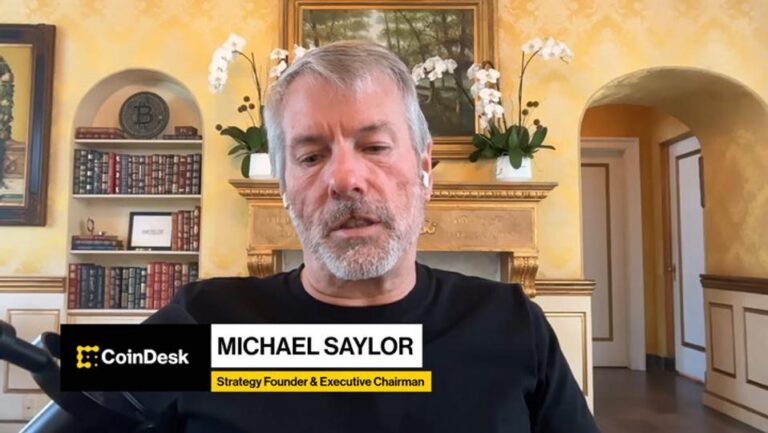
Strategy (MSTR) Pops 9% As Bitcoin Price Gets Back To $78k

0

Shares of Strategy (NASDAQ: MSTR) surged roughly 9% on Friday as Bitcoin clawed back to the $78,000 level.

This movement comes just days after Executive Chairman Michael Saylor delivered a headline-grabbing keynote at the Bitcoin 2026 conference in Las Vegas.

MSTR climbed above $180 per share during Friday’s session, building on a prior close near $165. The move tracked Bitcoin’s intraday advance, which pushed BTC to $78,961 as of Friday afternoon, according to Bitcoin Magazine Pro data.

The rally is building up a welcome reprieve for MSTR investors who have endured a brutal stretch — the stock remains down more than 70% from its November 2024 all-time high above $457.

The price action comes amid a broader recovery in Bitcoin that has been grinding higher since a sharp pullback to the mid-$60,000s earlier this year. Bitcoin surged past the $78,000 mark last week as well, propelled by short liquidations and improving macro sentiment following reports of progress in U.S.-Iran diplomatic negotiations. 

Polymarket contracts on May 1 BTC pricing showed 100% confidence the asset would finish in the $78,000–$80,000 range.

As a leveraged proxy for Bitcoin, MSTR tends to amplify BTC’s moves in both directions. Strategy currently holds approximately 818,334 Bitcoin on its balance sheet — roughly 3.9% of all Bitcoin that will ever exist — acquired at an average cost of around $66,385 per coin.

Saylor: Strategy’s STRC is booming

The stock pop also comes on the heels of fresh enthusiasm generated by Saylor’s keynote at the Bitcoin 2026 conference in Las Vegas last week.

Rather than focusing on Bitcoin price targets or more Bitcoin purchases, Saylor’s pitch centered on STRC — Strategy’s Bitcoin-backed preferred stock — and a sweeping thesis that digital credit is poised to cannibalize trillions of dollars in the legacy credit market.

“The world’s $300 trillion credit market is a much bigger opportunity than the world’s roughly $2 trillion Bitcoin market, and Strategy has built the first product to bridge the two,” Saylor argued during the keynote.

STRC, which pays an 11.5% monthly variable dividend and trades on Nasdaq, has grown to approximately $8.5 billion in notional value in under nine months — larger, Saylor claimed, than the entire existing universe of monthly-paying preferred securities combined. 

“This is going viral,” he told the audience.

BlackRock’s iShares Preferred & Income Securities ETF has already taken a roughly $210 million position in STRC.

Saylor said STRC has financed the acquisition of approximately 77,000 BTC year-to-date in 2026, roughly ten times the net inflow of all U.S. spot Bitcoin ETFs combined over the same period. 

BTC price holds gains, but lacks conviction as derivatives signal caution

0

The crypto market ticked higher on Friday. Bitcoin rose 1.25% since midnight UTC to trade at $77,250, and the CoinDesk 20 Index (CD20) added 0.7% with 14 members in the green.

The increase comes after bitcoin found support at $75,000, a price it had earlier found difficult to climb above, on Wednesday. It has now been trapped between $75,000 and $80,000 since April 19. Negative funding rates on futures exchanges indicate that traders are generally positioned for a decline.

U.S. equity index futures were little changed. Nasdaq 100 futures cooled after the week’s Big Tech earnings, while S&P 500 futures are marginally in the black, up 5 points.

Precious metals fell, with gold and silver losing 1% and 0.7%, respectively, and the altcoin market is a mixed bag; AXS and HYPE rose by around 3%, but DeFi tokens MORPHO and AAVE are both in the red.

Derivatives positioning

  • Open interest in bitcoin futures holds at $19 billion, roughly unchanged week-over-week, with speculative activity showing little conviction.
  • Funding rates are broadly negative across multiple venues at around -2% annualized, except on Deribit, which saw a spike to 37%. The three-month annualized basis sits at 1.5%, also flat on the week, pointing to continued institutional caution.
  • Options sentiment leans bullish: put/call volume over the past 24 hours is 58% in favor of calls, and the one-week delta skew has eased to 8.6% from 9.5%, indicating moderating demand for downside protection.
  • The implied volatility term structure is in contango, with the front-end around 29% rising to ~45% at the March ’27 tenor, suggesting the market is pricing longer-dated uncertainty rather than immediate tail risk.
  • CoinGlass data shows $149 million in 24-hour liquidations, with a 30-70 split between longs and shorts. BTC ($50 million) and ETH ($29 million) led in terms of notional liquidations.
  • The Binance liquidation heatmap indicates $75,400 as a core liquidation level to monitor in the event of a price drop.

Token talk

  • The CoinDesk Memecoin Index (CDMEME) was the best-performing benchmark, surging by 1.8%, followed by the CoinDesk Computing Select Index (CPUS), which added 1.4%.
  • CoinDesk’s DeFi Select Index (DFX) lagged its peers, and was recently unchanged despite broader market optimism.
  • Monad (MON) led the altcoin market on Friday, rallying by 6.7% over 24 hours. There were also notable gains for PENDLE, RAY and TAO, all up between 4.2% and 5.35%.
  • The same can’t be said for , the DeFi token linked to President Donald Trump’s family. That dropped by more than 2.6% since midnight following a governance vote on token lock-ups. It has now lost more than 77% since it was introduced in September.
  • CoinDesk’s Overnight Rate (CDOR), which tracks lending and borrowing rates on Aave, has returned to normal market conditions after the KelpDAO hack, a sign of strength in the DeFi sector.