Home Blog Page 328

Figure’s $1 billion month signals breakout moment for tokenized credit

0

Mike Cagney has been here before, just not with blockchain.

In the early 2010s, he helped reshape consumer lending with SoFi by connecting borrowers directly with capital. Now, at Figure Technology Solutions (FIGR), he said he’s trying to do something similar on a much larger scale: rebuild the infrastructure of credit markets themselves.

The plan may be working. Figure crossed $1 billion in monthly loan originations for the first time in March, part of a $2.9 billion first quarter that puts the firm on roughly $12 billion in annualized volume.

Cagney, who is speaking at Consensus Miami conference next week, told CoinDesk that the goal is to build new plumbing for these markets.

“We’re building a marketplace where credit can move efficiently, without all the traditional layers,” he said.

Three levers of value

Cagney broke Figure’s model into three core advantages.

The first is cost. Tokenizing loans reduces the friction and expense of securitization, cutting out intermediaries that have historically taken significant fees.

The second is liquidity. Figure has built what it describes as one of the only continuously updating marketplaces for consumer credit outside of government-backed mortgage systems like Fannie Mae and Freddie Mac.

“The loans update in real time, which creates a different kind of market,” Cagney said.

The third is access. By bringing these assets onchain, Figure can plug them into decentralized finance (DeFi), allowing a broader range of investors to gain exposure, or borrow against them.

That’s where the model starts to blur the line between traditional finance and crypto, Cagney said.

Figure’s latest push is into what Cagney calls “democratized prime,” essentially opening up prime brokerage-style lending to a wider audience.

Through products like its Forge platform, loans are pooled into standardized vaults and converted into tokens that can be used as collateral in DeFi protocols. That standardization is key.

“DeFi only works if the collateral is liquid and transparent,” he said.

Figure has launched related initiatives on networks like Solana, with plans to expand to Ethereum, allowing users to invest in tokenized credit pools or borrow against them.

The company is also experimenting beyond loans.

It has introduced a yield-bearing stablecoin, YLDS, backed by traditional assets like Treasurys, with roughly $600 million in balances, and is exploring tokenized equities, issuing its own stock onchain in a way that allows investors to lend against it directly.

Cagney pointed to a stark inefficiency in traditional markets. Stock lending can carry borrow rates of 30% or more, while investors often receive only a fraction of that yield.

“We can put that value back in the hands of the asset owner,” he said.

Pragmatic blockchain

For all the ambition, Cagney is quick to draw boundaries.

Not everything belongs onchain, he said. Tokenizing property itself, for instance, may not be an efficient use of capital. But financial abstraction, meaning loans, securities and equity are a different story.

That pragmatism reflects a broader critique of the crypto industry, which he said has often chased ideas without clear economic grounding.

“A lot of things were done just for the sake of it,” he said. “What matters is, does this actually improve the system?”

Figure’s growth suggests, at least in one corner of the market, the answer may be yes. The company is profitable, scaling, and approaching $30 billion in cumulative originations. That’s still small relative to traditional finance, but it’s large enough to be noticed.

Cagney said he sees much more room to run.

“Blockchain is the most transformative technology, and it will reallocate more public market cap than any technology ever has,” he said. “There are whole industries that are going to disappear when it becomes ubiquitous. Someone has to do the work to get there, and that’s exactly what we’re doing.”

Read more: Private credit may be the breakout use case for tokenization: Maple’s Sidney Powell

NY Forces Uphold to Pay $5M Over Fraudulent Crypto Product

New York Attorney General Letitia James has secured more than $5 million from cryptocurrency platform Uphold over its role in promoting a fraudulent investment product.

The settlement centers around Uphold’s promotion of CredEarn, a product offered by Cred, LLC and its CEO Daniel Schatt. Between January 2019 and October 2020, the platform marketed CredEarn to users on its platform and mobile app as a safe, reliable savings product with attractive annual interest payments.

However, Uphold didn’t tell customers that Cred was generating those returns by making microloans to low-income video game players in China, who are typically borrowers with no credit histories and no access to traditional financial institutions, the Attorney General’s office said in an announcement.  

Source: NY AG James

Uphold also told customers that Cred carried “comprehensive insurance,” a claim the Attorney General’s office found to be false. No such insurance protecting retail investors from digital asset losses existed in the industry at the time. On top of the misleading promotion, Uphold was operating without the required broker or commodity broker-dealer registration.

Related: Canada Proposes Crypto ATM Ban to Tackle Scams, Money Laundering

Cred collapse hits Uphold users

Cred began racking up losses from its risky lending practices in March 2020 and filed for bankruptcy eight months later, leaving thousands of Uphold customers around the world holding the bag, according to the announcement.

Under the settlement, Uphold will pay $5 million directly to affected customers, more than five times the fees it collected from the arrangement. Any funds Uphold recovers from Cred’s ongoing bankruptcy proceedings, where it is owed $545,189, will also be passed on to harmed investors. Affected users will be notified by email when the funds hit their accounts.

“Investors should be able to trust the industry advice they receive,” James said, “and my office will always work to ensure bad actors are held accountable for endangering their customers’ financial security.”

Related: US Gov’t Sues Four States, RWAs Cross $30 billion

New York’s legal run-up with CFTC

Last month, New York sued Coinbase and Gemini, claiming their prediction market offerings violated state gambling laws.

The CFTC fired back by suing New York in federal court, arguing that federal law gives it sole authority over prediction markets and asking for a permanent injunction to block the state’s enforcement actions.

Magazine: AI-driven hacks could kill DeFi — unless projects act now

Cointelegraph is committed to independent, transparent journalism. This news article is produced in accordance with Cointelegraph’s Editorial Policy and aims to provide accurate and timely information. Readers are encouraged to verify information independently.

Bitcoin Posts Strongest Monthly Gain In 12 months In April

0

Bitcoin has posted its best-performing month in a year, prompting analysts to forecast what could lie ahead for May, which has historically delivered returns of about 8%.

“Long way to go back to ATHs, but good to see some green,” Coin Bureau founder Nic Puckrin said in an X post on Friday, referring to Bitcoin’s (BTC) performance during the month of April, which saw a monthly return of 11.87%.

It marked Bitcoin’s best-performing month since April 2025, when it returned 14.08%. However, it still came in slightly below its historical April average of 12.98%, according to CoinGlass.

Bitcoin has historically delivered an average return of 7.78% in May. Source: CoinGlass

“April is done. May is here. After 5 consecutive red monthly candles, Bitcoin has now closed 2 in the green, causing some relief in the market,” crypto trader Daan Crypto Trades said in an X post on Friday.

Market participants hold the belief that history repeats

Market participants often compare current monthly performance with previous months and look ahead, as many believe Bitcoin’s history tends to repeat itself.

Bitcoin is trading at $78,190, about 38% down from its October all-time high of $125,100, according to CoinMarketCap. Crypto analyst Jelle said, “We hit the ground running again next week.”

Bitcoin started April at around $66,000. Source: CoinMarketCap

Market participants appear uncertain about the crypto market, according to the Crypto Fear & Greed Index, which posted a “Fear” reading of 39 on Friday, suggesting investors are still cautious.

Bitcoin analysts are divided on what comes next

Analysts are divided on Bitcoin’s near-term outlook. Crypto analytics firm CryptoQuant warned that Bitcoin could be setting up for a multi-month price decline after a rally in April driven mainly by futures traders.

Related: Bitcoin rally extends, yet BTC options price only 25% chance of $84K in May

Others are more bullish. MN Trading Capital founder Michael van de Poppe recently said that Bitcoin may not need a new story or catalyst to push back above the psychological $100,000 level, which it has not traded above in nearly five months. 

“There doesn’t need to be a narrative that pushes the price upwards,” van de Poppe said in an X post on Friday, after asking, “What narrative will bring Bitcoin to $100K?”

The last time Bitcoin traded at $100,000 was Nov. 13, just a month after the Oct. 10 $19 billion crypto market liquidation event.

Magazine: Why is Ethereum Foundation selling? BTC futures warning signs: Market Moves

Cointelegraph is committed to independent, transparent journalism. This news article is produced in accordance with Cointelegraph’s Editorial Policy and aims to provide accurate and timely information. Readers are encouraged to verify information independently.

The Fintech Ecosystem of Mali in 2026

0

What has been the wider digital and fintech ecosystem like in the African nation of Mali? 

Mali, a landlocked West African nation shaped by centuries of trade across the Sahara, has long balanced economic fragility with cultural and commercial resilience. The fintech ecosystem has remained nascent compared to other parts of Africa. This has been due to constrains in terms of its economic development. Saying that, much has seen the ecosystem grow, in particular with the rise of mobile money. By 2026, that trajectory has continued – less a story of rapid disruption and more one of gradual, necessity-driven digital adoption.

At a macro level, Mali’s economy is estimated at approximately $22 billion gross domestic product (GDP), with its GDP per capita around $1,000 in 2026. The country’s economic base is heavily reliant on gold mining, which Mali is one of Africa’s largest gold producers. The economy also produces agriculture, particularly cotton and livestock.

Fintech and the rise of mobile money

Much like in 2024, Mali’s fintech ecosystem in 2026 remains relatively small but functional, supported largely by telecom-led financial services. Estimates suggest there are around 25 fintech-related players operating across mobile payments, remittances, and microfinance platforms. The ecosystem is heavily influenced by regional West African dynamics, particularly through the West African Economic and Monetary Union (WAEMU), which provides a shared monetary and regulatory framework.

Key players in the fintech ecosystem include Orange Money Mali (A leading mobile money platform), Moov Money Mali (Providing digital financial services across urban and rural areas), Wave Mobile Money (Low-cost digital payments), and

In addition, organisations such as Association Professionnelle des Banques et Établissements Financiers (APBEF Mali) play a role in coordinating industry stakeholders and supporting financial sector development.

These entities highlight a key feature of Mali’s fintech landscape: telecom-led innovation supported by regional integration, rather than a large domestic startup ecosystem.

In many respects, Mali’s fintech evolution is inseparable from the growth of mobile money. With limited access to traditional banking infrastructure, especially outside urban centres, mobile network operators have become the primary drivers of financial inclusion. Services linked to regional telecom providers have enabled millions of Malians to access basic financial tools, from peer-to-peer transfers to bill payments.

Bamako is the country’s capital and financial hub. It hosts key institutions such as Banque de Développement du Mali (BDM), one of the country’s prominent banks with growing digital capabilities.

Central Bank of West African States and financial inclusion

A busy and colourful market scene in front of the great mud Mosque in the Saharan town of Djenne IMAGE SOURCE GETTY

The Central Bank of West African States (BCEAO), which serves as the central bank for WAEMU member states, has played a central role in shaping the regulatory environment. The past few years, the BCEAO has continued to advance regional payment system modernisation, promote interoperability, and strengthen oversight of electronic money institutions. These efforts have supported the expansion of digital financial services while maintaining financial stability across the union.

Financial inclusion remains both a challenge and an area of measurable progress. As of last year, approximately 35 per cent of adults in Mali have access to formal financial services, though this figure rises significantly when mobile money accounts are included, according to the World Bank. This underscores the importance of digital channels in extending financial access in a country where physical banking infrastructure is limited.

Digital economic transformation in Mali is being shaped not only by domestic policy but also by regional frameworks and international support. Government initiatives, often backed by institutions such as the World Bank and the African Development Bank, have focused on expanding digital infrastructure, improving connectivity, and supporting e-government services. These efforts are critical in laying the groundwork for a more robust fintech ecosystem.

From a payments perspective, Mali has seen steady growth in mobile-based transactions, though it has not yet reached the scale of some East African markets. Interoperability initiatives within WAEMU are gradually improving the efficiency of cross-border and domestic payments, supporting trade and remittance flows within the region.

Institutionally, Mali does not yet have a dedicated fintech association or a deeply developed startup ecosystem focused on financial technology. However, regional innovation hubs and development programmes are beginning to nurture entrepreneurial activity, particularly in areas such as agritech finance and small and medium enterprise (SME) lending.

Significant structural challenges remain. Political instability, security concerns, and infrastructure deficits continue to weigh on economic development and investor confidence. Additionally, low levels of digital literacy and limited access to reliable electricity in rural areas present ongoing barriers to fintech adoption.

Yet, markets like Mali illustrate that fintech growth does not always follow a linear or conventional path. Instead, it is often shaped by local realities. This is where mobile-first solutions, informal networks, and regional cooperation play defining roles.

The Malian fintech ecosystem in 2026 remains in its early stages, but it is not static. It is evolving within a complex environment. This is one where challenges are significant, but so too is the potential for inclusive digital financial growth.

Crypto Industry Will Be ‘Just Fine’ If CLARITY Act Doesn’t Pass: Chris Perkins

0

The US crypto industry’s momentum won’t be derailed in the long term even if the much-anticipated CLARITY Act, aimed at bringing more regulatory clarity to the crypto industry, doesn’t make it through Congress, according to 250 Digital Asset Management CEO Chris Perkins.

“If not, we’re going to be just fine,” Perkins said on Cointelegraph’s Chain Reaction podcast on Friday, emphasizing that the two major financial regulators are already building workable frameworks.

Perkins pointed to ongoing efforts by US Securities and Exchange Commission (SEC) Chair Paul Atkins and Commodities and Futures Trading Commission (CFTC) Chair Michael Selig, following the agencies’ joint interpretation released in March on how federal securities laws apply to crypto assets.

Being labeled a security was once a “death sentence” for crypto

“These guys are creating policy and precedent every single day, and they are giving us the one thing we’ve needed for a very long time, that certainty, that stability, and ultimately, a taxonomy,” Perkins said.

“In the past, being a security was a death sentence; there was nowhere to go with it, and it just didn’t reconcile…now it is awesome to be a security,” he said.

During the Joe Biden administration, under former SEC chair Gary Gensler, crypto tokens classified as securities typically faced enforcement action, delistings from major platforms, and had no clear pathway for compliance in the US market.

Chris Perkins spoke to Cointelegraph journalist Ciaran Lyons on Chain Reaction on Friday. Source: Cointelegraph

While Perkins said he’s not worried about the industry’s long-term outlook if the CLARITY Act doesn’t pass, he added that if it does become law, it would make it much harder for future administrations to roll back the regulatory clarity.

“What you’ve done is you’ve essentially enshrined policy for a very long time, as hard as it is to pass a law, it is even harder to unwind a law,” Perkins said. “There is a reason why we say it takes an act of Congress to do something,” he added.

CLARITY Act hopes rise

Many industry participants have raised expectations that the CLARITY Act could pass soon after the publication of new stablecoin yield provisions on Friday.

Related: Riot posts $167M in Q1 revenue as data center arm pulls in $33M in first quarter

“It’s time to get CLARITY done,” Coinbase chief legal officer Faryar Shirzad said in an X post on Friday, after US Senator Thom Tillis and US Senator Angela Alsobrooks published the final text aimed at settling the stablecoin yield dispute between the banking and crypto industries.

US Senator Bernie Moreno recently said that he anticipates the CLARITY Act to “get done” by the end of May. On April 11, US Senator Cynthia Lummis said, “It’s now or never.”

Magazine: AI-driven hacks could kill DeFi — unless projects act now

Cointelegraph is committed to independent, transparent journalism. This news article is produced in accordance with Cointelegraph’s Editorial Policy and aims to provide accurate and timely information. Readers are encouraged to verify information independently.

Top fintech trends this quarter

0

A recent published report from McKinsey highlights that Fintechs are now generating $650 billion in revenue, and the most successful ones are balancing scale, profitability, and new-found regulatory maturity.

Top fintech trends this quarter

In 2025, the global fintech market generated approximately $650 billion in revenues, representing a growth rate of about 21 percent year over year from 2024, and around 23 percent annually over the past four years. This materially outpaced the broader $15 trillion financial-services industry, which has expanded more modestly at a 6 percent annual rate. Despite this growth, fintechs have captured only about 4 percent of total financial-services revenues, underscoring both the progress and the substantial room for growth that remains.

Key findings

—$650 billion: total fintech revenues in 2025, representing 4 percent penetration of wider financial-services revenue pools

—Approximately $2 trillion: projected fintech market size by 2030 if recent top-line growth rates are sustained

—More than 40 percent increase in annual capital deployed to fintech since 2023

—Five fintechs approaching “centicorn” valuations ($100 billion)

—More than 50 percent of fintech acquisitions were made by fintechs rather than incumbents or sponsors

—$35 trillion in stablecoin transaction value in 2025, with just 1 percent related to “true payment” activity

—21 applications received for US banking charters in 2025, more than in the previous four years combined

—13 percent of fintech revenue generated by “horizontal” players—software firms that help digitize incumbents from the inside out.

Four trends that will shape the future of fintech

Looking ahead, McKinsey analysis suggests four trends will shape this fifth age of fintech.

The first and most consequential force is artificial intelligence. It is the accelerant behind most trends in this report. AI is supercharging structural trends that have been eroding incumbent advantages for years— but the pace has changed. Fintechs are deploying AI to build products in weeks that once took years, to serve customer segments that were previously not economically viable, and to compress cost structures so that legacy operating models cannot compete on price. Early-adopter incumbents are seeing real returns. But for those that have not yet moved decisively, the competitive gap is widening. For many midsize incumbents, the strategic pressure is increasingly acute: invest for scale or risk progressive irrelevance. For scaled fintechs, AI is a doubleedged sword—it powers their current advantage while simultaneously lowering the barriers that once protected them from the next wave of insurgents.

Second is the rise of digital assets such as stablecoins and tokenized deposits. With instant, near-free settlement, the promise of stablecoins for cross-border payments and remittances is clear. However, of the $35 trillion reported annual stablecoin transaction volume, only about 1 percent, or $390 billion, represents true end user payments, such as paying suppliers or sending remittances. The remainder is trading, arbitrage, and crypto-native activity. A range of industry estimates suggests that by 2030, the market value of stablecoins will be between $2 trillion and $4 trillion, implying a compounded annual growth rate of about 40 percent, with a broader range of on-chain tokenized assets potentially even higher.

Third, fintechs are increasingly viewing banking licenses not as constraints but as strategic tools to unlock cheaper funding, enable expansion opportunities, enhance trust with customers, and reinforce their moats. In 2025, 21 fintechs applied for banking charters in the United States, more than in the previous four years combined. This could further reinforce the market bifurcation between the largest-scaled fintechs with licenses and the rest, and potentially reduce a key moat for incumbent financial institutions.

Finally, a new form of fintech is gathering momentum and attracting a disproportionate share of investment. These are “horizontal” fintechs— software firms that help digitize incumbents from the inside out. They are ecosystem enablers that improve the efficiency of parts of the financialservices value chain. Today, these horizontal fintechs represent about 13 percent of industry revenues and have grown 25 percent faster than those directly competing with financial-services players over the past four years. They pose little direct competition to incumbents and, in fact, help them modernize and survive, particularly those without the scale, cash, or appetite to build similar solutions themselves. In some pockets—for example, UK insurtech—they have received 90 percent of all investment over the past five years.

Raed the full report here.

The SEC Just Elevated XRP To A Status Previously Reserved For Bitcoin And Ethereum

0

Trusted Editorial content, reviewed by leading industry experts and seasoned editors. Ad Disclosure

The U.S. SEC recently highlighted an NYSE proposal that places XRP alongside Bitcoin and Ethereum as eligible assets under the generic listing standards. This is a positive for the altcoin, which was once considered a security by the SEC under Gary Gensler. 

XRP Named as Eligible Asset Alongside Bitcoin and Ethereum In SEC Filing

The SEC published a notice seeking comments on the NYSE’s proposed rule change for crypto ETFs to hold 80% of their net asset value (NAV) in eligible assets under the generic listing standard. The Exchange had mentioned XRP alongside Bitcoin and Ethereum as eligible crypto assets to which this proposed rule change will apply. 

This notably reemphasizes the generic listing standard for crypto ETFs, which the SEC approved last year, under which it classified the token as an eligible asset for faster ETF approvals. This marked a significant shift from the previous SEC administration under Gary Gensler, when the Commission signaled that it could only approve Bitcoin and Ethereum ETFs because they were the only two assets that it considered non-securities. 

XRP has also received much-needed clarity under this SEC administration, with the Commission issuing joint Token Taxonomy guidance with the U.S. CFTC, under which XRP, Bitcoin, Ethereum, and other major tokens were classified as commodities. This position is also expected to be codified through the CLARITY Act. 

This regulatory clarity from the SEC and the proposed CLARITY Act provides a boost for the altcoin, which already secured regulatory clarity when Judge Analisa Torres declared that the token wasn’t a security in the SEC’s lawsuit against Ripple. The ruling had notably played a key role in the SEC’s approval of the XRP ETFs, as the Commission could not reject these applications on the ground that they were securities. 

Ripple CEO Praises SEC For CLARITY

While speaking at the XRP Las Vegas Conference, Ripple CEO Brad Garlinghouse praised the SEC for its efforts towards providing regulatory clarity. He noted that the current administration under Paul Atkins had provided more clarity to the crypto industry in a year than Gary Gensler’s administration did in four years. 

The Ripple CEO also reiterated that they are still all in on the altcoin, noting that they are the largest holder in the world and are the most interested party in seeing the token successful. Meanwhile, he addressed Cardano founder Charles Hoskinson’s criticism that Ripple’s businesses don’t benefit holders in any way. Garlinghouse stated that they are not prioritizing going public at the moment, but teased a special package for the community when they decide to do so.

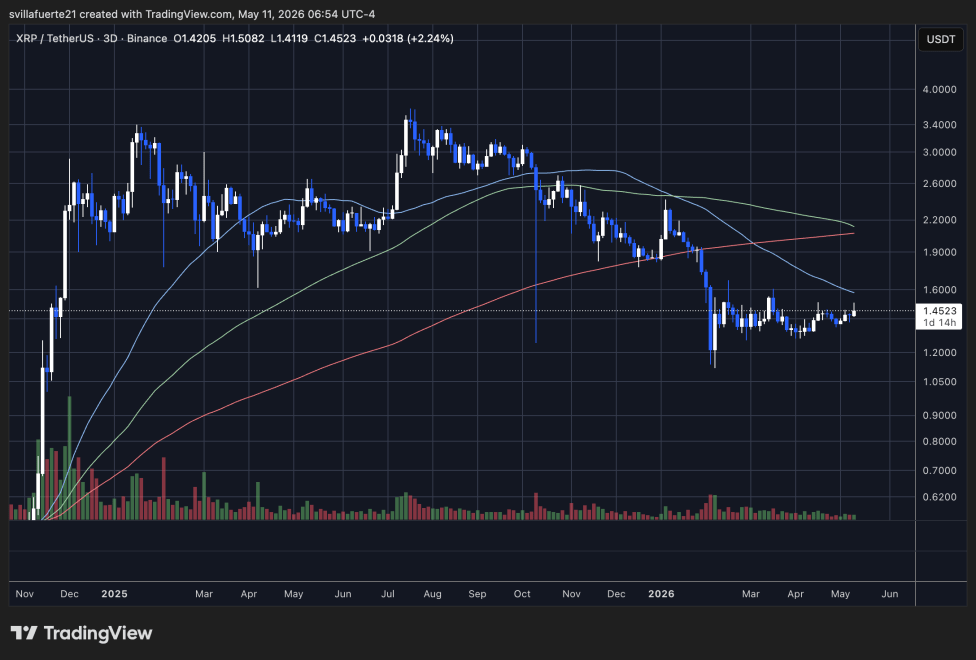
At the time of writing, the XRP price is trading at around $1.38, up in the last 24 hours, according to data from CoinMarketCap.

XRP
XRP trading at $1.38 on the 1D chart | Source: XRPUSDT on Tradingview.com

Featured image from Freepik, chart from Tradingview.com

Editorial Process for bitcoinist is centered on delivering thoroughly researched, accurate, and unbiased content. We uphold strict sourcing standards, and each page undergoes diligent review by our team of top technology experts and seasoned editors. This process ensures the integrity, relevance, and value of our content for our readers.

Top Developments That Could Signal A New Era

0

Trusted Editorial content, reviewed by leading industry experts and seasoned editors. Ad Disclosure

Bitcoin entered May trading above $78,000, a price level that, while modest compared to last year’s peak, carries a weight relative to its price action in the previous two months. 

Not only is Bitcoin entering May with some sort of bullish momentum, but there are notable developments that happened this week that point to something larger than a price recovery. 

Institutional Capital Returns With Force

The first major bullish development for Bitcoin this week came from the ETF market. Spot Bitcoin ETFs have turned into one of the clearest windows into institutional appetite, and the latest numbers show demand returning after a difficult stretch. 

US Spot Bitcoin ETFs drew $1.97 billion in net inflows during April 2026, the strongest monthly performance of the year and an improvement to the $1.32 billion net inflows recorded in March.

That matters because it changes the tone of the market. ETF redemptions in the first three months of the year added pressure to Bitcoin’s correction, leading to the idea that institutions were stepping away. This week’s data suggests the opposite, showing that institutional capital is starting to move back in.

Also speaking of institutional capital, the second development is also institutional money moving in, but from an adoption perspective. Canadian government-owned Alberta Investment Management Corporation, which oversees about $195 billion in assets, disclosed a $219 million stake in Strategy Inc., buying 1.38 million MSTR shares.

This is not a direct Bitcoin purchase, but that is exactly what makes it interesting. Strategy is known for its Bitcoin-centric approach, and a Bitcoin proxy can provide exposure without forcing the fund to hold BTC directly.

BTCUSD now trading at $78,238. Chart: TradingView

AIMCo is also not moving alone. Other Canadian institutions have already taken positions in Strategy, including National Bank of Canada, Canada Pension Plan Investment Board, Royal Bank of Canada, and Healthcare of Ontario Pension Plan.

Bitcoin Entering Its Credit Era

The third development came from the Bitcoin 2026 conference in Las Vegas, where Strategy CEO Phong Le and Blockstream CEO Adam Back discussed a vision for Bitcoin’s financial future. The conversation went beyond price and treasury accumulation. It touched on Bitcoin credit products, tokenized markets, and the growing overlap between cypherpunk ideas and institutional finance.

Le noted that Strategy now sits behind only one entity in Bitcoin ownership: Satoshi Nakamoto. The company now holds 818,334 BTC and is on pace to reach 1 million BTC in the coming months. 

The most interesting part of the discussion was about digital credit. Strategy’s STRC, also called Stretch, is a perpetual preferred stock that pays an 11.5% annual dividend, with proceeds used to purchase Bitcoin. Le described the product as a key bridge between Bitcoin and credit markets, especially for investors who want exposure to Bitcoin-linked yield structures without directly buying BTC

Both executives also saw tokenization as the next important frontier, with Le describing it as the digitalization of markets. Bitcoin still needs to clear resistance at $80,000, and ETF demand can reverse quickly. However, the larger structure is signaling a new era.

Featured image from Unsplash, chart from TradingView

Editorial Process for bitcoinist is centered on delivering thoroughly researched, accurate, and unbiased content. We uphold strict sourcing standards, and each page undergoes diligent review by our team of top technology experts and seasoned editors. This process ensures the integrity, relevance, and value of our content for our readers.

Atos Selected by LCH SA to Migrate its Financial Information Systems to the Cloud

0

WHY THIS MATTERS

The partnership between Atos and LCH SA represents a critical turning point for European market infrastructure, signaling that even the most “too-big-to-fail” institutions are finally moving core financial systems to the cloud. LCH SA, as a leading global clearing house, sits at the heart of the derivatives market, managing trillions in risk. Historically, these systems remained on-premise due to extreme security and regulatory concerns. By utilizing a SecNumCloud-qualified infrastructure the highest security certification from France’s ANSSI this project proves that cloud adoption is now compatible with the “sovereign” and “resilient” requirements of the European financial market.

For the broader industry, this migration serves as a benchmark for operational resilience under the Digital Operational Resilience Act (DORA), which mandates that financial firms maintain strict oversight of their third-party tech providers. Atos’ ability to guarantee “full continuity of operations” during the move is essential; in clearing, even a few seconds of downtime could trigger systemic liquidity issues. This deal cements the transition of cloud technology from a cost-saving experimental tool to the definitive standard for mission-critical financial plumbing.

Atos, a global leader of AI-powered digital transformation, announces it has signed a three-year contract with LCH SA, the global clearing house based in Paris, to assist LCH SA with the migration of its financial information systems on a highly secure, SecNumCloud-qualified cloud infrastructure, while guaranteeing full continuity of operations.

A strategic project for Atos and the industry

This contract confirms Atos’ position as a leading player in cloud transformation for highly regulated market infrastructures. Atos is looking forward to providing international market participants with a new, concrete example of a secure migration in compliance with applicable regulatory frameworks. Atos stands out in the market through its expertise, industry knowledge, and ability to deliver strategic projects whose success relies on the skills and commitment of its teams throughout the entire transformation journey.

“This project perfectly illustrates Atos’ ability to support financial institutions in their digital transformation while guaranteeing the security and compliance of their information systems. Our expertise, our industry knowledge, and our commitment are key to the success of LCH SA’s migration to the cloud. We are proud to contribute to the modernization and migration of such a strategic infrastructure for the European financial market” –  Franck Chartier, head of France, Atos.

“This project with Atos supports the modernisation of our information systems and helps ensure we continue to meet the expectations of our customers and regulators, while strengthening our operational resilience as we move to the cloud” – Corentine Poilvet-Clédière, CEO, LCH SA and country head, France, LSEG.

FF NEWS TAKE

Atos securing a three-year contract with an LSEG-owned entity like LCH SA is a major validation of its specialized “sovereign cloud” strategy. While hyperscalers dominate the general market, Atos is successfully carving out a niche in the high-stakes, highly regulated French and European sectors where data residency and SecNumCloud compliance are non-negotiable. For Atos, this isn’t just a contract; it’s a high-profile demonstration of its relevance as an orchestrator for the “legacy-to-cloud” journey that many European banks have yet to fully undertake.

However, the execution risk remains high. Moving a clearing house’s information systems is akin to “changing the engines on a plane while it’s in flight.” LCH SA’s CEO, Corentine Poilvet-Clédière, is banking on this modernization to meet increasingly aggressive regulatory expectations for real-time risk management and transparency. If Atos can deliver this transition without a single hitch in clearing cycles, it will likely trigger a wave of similar migrations across other European clearing houses and exchanges that have been hesitant to leave their legacy data centers.

XRP Power Play: SBI Holdings Submits LOI To Acquire Bitbank In Major Asia Move

0

Trusted Editorial content, reviewed by leading industry experts and seasoned editors. Ad Disclosure

The SBI Holdings is making a decisive move that could reshape the crypto landscape in Asia. With a letter of intent submitted to acquire Bitbank, the firm is signaling a deeper push into digital asset infrastructure. This development represents a strategic expansion by one of the region’s most influential financial players with deep ties to XRP and its broader ecosystem.

XRP Integration Could Accelerate With Exchange Ownership

SBI Holdings, a long-time Ripple partner via SBI Ripple Asia, has just made a massive strategic move that could reshape the XRP landscape across Asia. Crypto analyst Archie revealed on X that the firm has formally submitted a letter of intent to acquire shares in Bitbank, one of Japan’s top regulated exchanges, to turn it into a consolidated subsidiary.

This isn’t speculation, it’s an official step. The deal is still in stages, but it comes after SBI’s earlier absorption of Bitpoint Japan and further positions SBI to dominate Japan’s crypto hub. It also goes far beyond expansion as SBI has long been one of the strongest institutional backers of XRP, largely through its deep involvement with SBI Ripple Asia. 

From early partnerships focused on on-demand liquidity to real-world applications in cross-border payment, remittances, and finance, Asia, especially Japan, has played a central role in XRP’s adoption, doubling down to acquire a major exchange.

Furthermore, by consolidating platforms such as SBI VC Trades, Bitpoint, and potentially Bitbank, this move will bring more liquidity and supercharge the altcoin’s utility in the heart of Asia’s crypto hub. Meanwhile, Japan is already known for its pro-crypto stance, and SBI, which will deepen Ripple ties, is institutional fuel for the token.

A major signal just came out of XRP Las Vegas as Zebec officially confirms its partnership with Ripple. The founder of House of Cauliman, Mrcauliman, has stated that the partnership will bring enterprise-grade real-time payroll and streaming payments to the XRP Ledger using XRP and RLUSD rails.

This means salaries, payouts, and remittances will move through the Ledger with utility behind them. The Ledger isn’t being positioned as a speculative vehicle waiting on price action. Instead, it’s being built out as a financial rail.

A Move Into Post-Quantum Identity Security

The XRP Ledger is stepping into a completely new role, one centered on securing identity in a post-quantum world. According to analyst Pumpius, the altcoin has now unlocked port-quantum identity security. That means identities anchored directly on the Ledger with unbreakable zero-knowledge proofs and cryptographic systems designed to withstand supercomputers’ future quantum-level threats. 

At the center of this narrative is XDNA. Positioned as a next-generation identity layer, which introduces a model where verification becomes immutable. Once your identity is anchored on the ledger, there’s no need to resubmit documents or re-verify credentials across platforms.

XRP
XRP trading at $1.38 on the 1D chart | Source: XRPUSDT on Tradingview.com

Featured image from Adobe Stock, chart from Tradingview.com

Editorial Process for bitcoinist is centered on delivering thoroughly researched, accurate, and unbiased content. We uphold strict sourcing standards, and each page undergoes diligent review by our team of top technology experts and seasoned editors. This process ensures the integrity, relevance, and value of our content for our readers.