Home Blog Page 326

Payment News – Acceleration of Tokenized Deposit Network Development: Cari Forms Strategic Partnership with Tassat

0

The Cari Network is the first tokenized deposit network connecting chartered banks and decentralized finance on a shared ledger, delivering instant, 24/7/365 settlement without leaving the regulatory perimeter. Built on a permissioned Layer-2 blockchain anchored to Ethereum, it brings commercial deposits on-chain while preserving the safety and benefits of traditional bank money. The result is an interoperable payment rail that pairs blockchain speed and programmability with the trust and scale of the banking system. Led by banking, financial regulation, and digital asset experts—and co-developed and governed with banks—the Cari Network is powering the next shift of institutional money movement: one that’s instant, trusted, and always-on.

Last 30rd of April, it announced it has entered into a strategic partnership with Tassat, the pioneer behind the first blockchain-based tokenized deposit network successfully deployed in a live U.S. banking environment, as it advances its approach to bank-led digital money movement.

Tassat Group, Inc. delivers institutional-grade blockchain solutions that enable regulated financial institutions to transact in real time with greater efficiency, speed, and transparency. Having settled more than $2.5 trillion to date, Tassat’s infrastructure operates within regulatory perimeters across global markets, supporting instantaneous transaction and settlement capabilities across financial services, digital assets, and capital markets. Tassat was honored with a 2021 Google Cloud Customer Award for Financial Services Innovation and named U.S. FinTech Award winner for Payments Technology in 2023.

Through this agreement, Cari will acquire and incorporate select Tassat technologies and technical expertise—validated in live banking environments—into its platform, accelerating the development of Cari’s tokenized deposit network and the delivery of always-on, programmable payments for U.S. banks.

This announcement follows the successful launch of Cari’s MVP in March, developed alongside a powerhouse group of design partner banks, including First Horizon Corp., Huntington Bancshares Inc., KeyCorp, M&T Bank Corp., Old National Bancorp, and SouthState Bank. In parallel, Cari has expanded its Network to include eight additional banks that have committed to join ahead of production launch later this year, with a broader pipeline of hundreds of institutions in active discussions to participate.

This momentum is supported in part by the endorsement of the Mid-Size Bank Coalition of America, signaling a critical industry shift toward modernizing payment infrastructure in a way that preserves deposits within the banking system and ensures the long-term competitiveness of U.S. financial institutions.

Through this partnership, Cari is advancing a purpose-built model for real-time money movement that is bank-led, production-proven, and built to scale within the U.S. financial system.

Keefe, Bruyette & Woods, A Stifel Company, served as the exclusive financial advisor to Cari on this transaction.

CFTC Gets Mixed Responses to Prediction Market Rulemaking

The US Commodity Futures Trading Commission received more than 1,500 responses to a proposed rule tied to prediction markets, with some backing the regulator while others called for a tougher crackdown on the platforms.

The CFTC’s request for public comments on a rule it proposed in March that would allow it to amend or issue new regulations for event contracts on prediction markets ended on Thursday, drawing responses from prediction markets, crypto firms and consumer advocacy groups.

Kalshi co-founder and chief operating officer Luana Lopes Lara backed the CFTC in a letter on Thursday, saying its existing regulations were “well-designed and effective,” urging it to give guidance to ensure “that the universe of event contracts can continue to be listed, traded, and overseen by the Commission.”

The CFTC’s proposed rule comes as it looks to cement its authority over prediction markets, which have faced legal challenges from multiple US states that accuse the platforms of offering unlicensed sports gambling.

Kalshi, Polymarket and Coinbase are among the companies that have been sued over their sports prediction market offerings and have argued they are under the CFTC’s sole authority, a position the regulator has backed by suing at least five state governments that took legal action against prediction markets.

Polymarket US CEO Justin Hertzberg applauded CFTC Chair Mike Selig in his letter for “asserting the CFTC’s longstanding exclusive jurisdiction over prediction markets,” adding the company believes the regulator “should continue to exercise its exclusive jurisdiction over prediction markets.”

Mike Selig, pictured on a podcast in March, has threatened to sue any state that takes action against prediction markets. Source: YouTube

Venture capital firm Andreessen Horowitz also supported the CFTC, arguing in its letter that “state actions to regulate or ban prediction markets impose a serious barrier to impartial access,” a key rule for CFTC-regulated firms.

Meanwhile, gambling regulators in Tennessee, Missouri and Pennsylvania, among others, blasted the CFTC over its defense of sports event contracts, urging the regulator to drop its support.

Pennsylvania Gaming Control Board Executive Director Kevin O’Toole said the CFTC was allowing prediction markets “to masquerade as unregulated sportsbooks,” while Tennessee Sports Wagering Council Executive Director Mary Beth Thomas said the council disputes “that sports event contracts offered on prediction markets fall within the jurisdiction of the CFTC at all.”

Related: Polymarket pushes for broader US relaunch with CFTC talks: Report

Missouri Gaming Commission executive director Michael Leara said that Congress “did not intend futures markets to encompass gambling activities,” and urged the CFTC to “properly reserve jurisdiction over sports event contracts for the states.” 

Prediction markets have also come under scrutiny from some federal lawmakers, who are concerned about the platforms’ offering markets tied to geopolitical events and their possible use by those with insider knowledge after well-timed bets on the Iran war.

Dennis Kelleher, the CEO and co-founder of the consumer advocacy group Better Markets, and 12 other consumer groups, told the CFTC in a joint letter that it should “prohibit event contracts that involve elections or geopolitical events,” arguing such contracts could influence government actions.

Kalshi and Polymarket said last week, after the US Senate passed a ban on its members and staff using prediction markets, that they have cracked down on insider trading and ban or prohibit some users, such as politicians, from using their platforms.

Magazine: Should users be allowed to bet on war and death in prediction markets?

Cointelegraph is committed to independent, transparent journalism. This news article is produced in accordance with Cointelegraph’s Editorial Policy and aims to provide accurate and timely information. Readers are encouraged to verify information independently.

Bitcoin In Buy Zone As Analyst Sets Next Bull Target At $400,000 – Details

0

Trusted Editorial content, reviewed by leading industry experts and seasoned editors. Ad Disclosure

Following its April rally, Bitcoin has settled into a tight range between $75,000 and $78,000. According to crypto analyst Kabuki, this movement may represent a familiar phase seen in previous market cycles that have preceded explosive gains.

Base Formation Signals Familiar Cycle Pattern

In an X post on May 2, Kabuki draws attention to a recurring structure observed in past bull cycles, specifically in 2021 and 2025. In these cases, Bitcoin spent a prolonged period moving sideways after an initial rally. This phase, often dismissed as indecisive, served as a base-formation zone where strong hands accumulated positions before the next leg up.

In 2018, Bitcoin consolidated for months before breaking out into a parabolic run that culminated in its then-all-time high at $69,000 in 2021. A similar structure appeared in 2022, where a range-bound phase preceded the surge to new highs around $126,100. Fast forward to 2026, and the same pattern appears to be unfolding. 

Bitcoin’s current range between $75,000 and $78,000 appears to be an accumulation phase, in which market participants absorb supply at relatively stable prices. However, what appears to be stagnation may actually be preparation for a price rally.

Bitcoin Target: $400,000 

Building on this cyclical framework, Kabuki projects a long-term target of $400,000 for Bitcoin. While that figure may seem aggressive at first glance, it is based on the scale of previous expansions following similar base formations.

In 2018, Bitcoin exited its accumulation range, producing a 1,831.46% price increase that peaked at $69,000 in 2021. After leaving the buy zone in 2022, price acceleration was also exponential, resulting in a 651.63% gain that established the current all-time high. If the current range near $75,000–$78,000 serves as the foundation, Kabuki projects another 775.12% gain, which should result in a $400,000 price valuation by 2029

This projection is strongly supported by a broader market outlook, including asset maturity, institutional participation as reflected in ETF inflows, and broader adoption, likely encouraged by regulations such as the GENIUS Act and the highly anticipated CLARITY Act. 

At the time of writing, Bitcoin trades at $78,379, reflecting a 0.43% gain in the last seven days. According to analysts at CoinCodex, general market sentiment has turned bullish, with the Fear & Greed Index moving into the neutral zone. These analysts expect Bitcoin to sustain its current rally, with price projections of $84,219 over the next five days. 

Bitcoin
BTC trading at $78,440 on the daily chart | Source: BTCUSDT chart on Tradingview.com

Featured image from Unsplash, chart from Tradingview

Editorial Process for bitcoinist is centered on delivering thoroughly researched, accurate, and unbiased content. We uphold strict sourcing standards, and each page undergoes diligent review by our team of top technology experts and seasoned editors. This process ensures the integrity, relevance, and value of our content for our readers.

Strategy pauses bitcoin (BTC) buys before Tuesday earnings

0

Strategy is taking a breather from buying bitcoin.

Michael Saylor said Sunday the company would not add to its bitcoin holdings this week, pausing its regular purchase program ahead of Tuesday’s first-quarter earnings release.

“No buys this week. Back to work next week,” Saylor wrote on X.

The pause is only the second this year for Strategy, formerly MicroStrategy, which has turned itself into the largest publicly traded bitcoin treasury company and one of the most closely watched proxies for institutional BTC exposure. The company last skipped a weekly purchase during the week of March 23 to March 29.

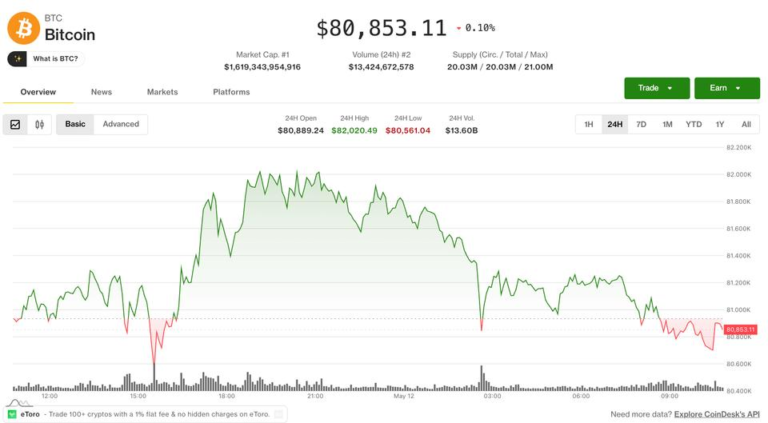
Strategy currently holds 818,334 BTC, equal to nearly 3.9% of bitcoin’s fixed 21 million supply. Its most recent purchase added 3,273 BTC at an average price of $77,906 per bitcoin. BTC was trading near $80,100 in Asian morning hours Monday, up about 20% over the past month.

The pause may seem a non-event but comes ahead of Strategy’s first-quarter results Tuesday, with some Wall Street analysts expecting a loss of $18.98 per share.

Strategy is expected to report first-quarter revenue of about $125 million, according to Yahoo Finance data from six analysts, up roughly 12.6% from $111.1 million a year earlier. That would mark an improvement from the same quarter last year, when sales fell 3.6%, and suggests the underlying software business is still grinding higher even as the company’s identity is now almost entirely tied to bitcoin.

Earnings are expected to be lower, however. Yahoo Finance’s shows an average estimate for a loss of $27.33 per share for the March quarter, while Zacks Research data points to an expected loss of $3.41 per share for the upcoming release.

Strategy is no longer valued as a software company with a bitcoin position, but as a bitcoin financing vehicle that happens to provide business intelligence software. That means Tuesday’s report may be judged more on the durability of Saylor’s capital-raising machine and less for true operating performance.

One product drawing attention is STRC, a perpetual preferred share designed to trade near $100 while paying a variable monthly dividend, currently around 11.5% annualized.

The pitch is yield backed by Strategy’s balance sheet and bitcoin-heavy capital strategy, but a going concern is that the product can start to look less like stable income and more like credit risk if market sentiment turns.

Higher bitcoin prices support Strategy’s valuation which improves its ability to raise capital, which funds more bitcoin purchases. However, when sentiment weakens, the same structure gets more fragile.

Saylor says the buying resumes next week, but Tuesday’s earnings will show how much confidence investors still have in the machinery that makes that possible.

Veteran trader Peter Brandt sees bitcoin hitting $250,000, but only after a bottom later this year

0

Veteran trader Peter Brandt sees bitcoin rallying to $250,000 in 2029, but only after the market finishes a long drawn-out bottoming process that could last into September 2026.

That forecast makes sense in the context of bitcoin’s four-year mining reward halving cycle, which has been consistent enough to shape traders’ projections.

Historically, bitcoin bull runs have peaked roughly 16 to 18 months after the quadrennial mining reward halving, before sliding into year-long bear markets. New uptrends then tend to begin 12 to 18 months ahead of the next halving.

That pattern held in the most recent cycle, with bitcoin peaking in October 2025, roughly 18 months after the April 2024 halving, which cut the per-block BTC issued as reward to miners to 3.125 from 6.25.

If the cycle holds, the bear market that began then should bottom about a year later, around October 2026 and then a new uptrend should begin that could take top out at $250,000 in late 2029, again roughly 18 months after the April 2028 halving.

“I am not calling for a low until Sep/Oct 2026. It is not necessary for the recent low to be penetrated. We could get a rally and then chop sideways to down. Worst case would be a move back into the lower green banana peel which would be into the 50s, maybe high 40s. Then blast off for $250k and a high in late 2029,” Brandt told CoinDesk in an email.

Peter Brandt is a veteran commodities trader whose career spans nearly five decades, beginning in the 1970s in the futures markets. He started out trading traditional assets such as agricultural commodities, metals, and currencies, long before the rise of modern electronic trading or digital assets.

Brandt’s view contrasts with the consensus among crypto analysts, who argue that the downtrend that began with the October peak near $126,000 ended in early February around $60,000, and that the rally since then marks the start of a new uptrend.

Bitcoin has rallied over 25% to $80,300 since early February, CoinDesk data show.

Note that Brandt’s forecast of no bottom until later this year does not necessarily imply a deeper downtrend that pushes prices below the February low. As he has noted, prices could instead move in a choppy pattern of rallies and pullbacks before eventually forming a bottom.

Brandt, however, stressed that his projection depends entirely on the market continuing to follow its historical rhythm. If price action deviates, he’s prepared to reassess rather than defend a broken thesis.

“As long as the market follows the script I will stay with my projections. If at some point the price discovery moves off script I will be forced to revise all my thinking. I will NOT be dogmatic about it as some are,” he said.

Crypto Platform Uphold Faces $5M Blow From New York Regulators

0

Trusted Editorial content, reviewed by leading industry experts and seasoned editors. Ad Disclosure

Uphold will hand over more than $5 million to customers it helped deceive — a payout that amounts to over five times what the company actually earned from the deal.

A Settlement With Real Teeth

New York Attorney General Letitia James announced the settlement this week, closing the book on Uphold’s role in promoting CredEarn, a crypto savings product run by Cred, LLC and its CEO Daniel Schatt.

From January 2019 through October 2020, Uphold pushed CredEarn to users through its platform and mobile app, billing it as a safe place to park money and earn solid annual returns. What users weren’t told was how those returns were actually being generated.

Cred was funding them through microloans to low-income video game players in China — borrowers who had no credit histories and no access to traditional banks. That detail never made it into Uphold’s pitch to customers.

The Insurance Claim That Wasn’t True

The misleading promotion didn’t stop at vague language. According to the AG’s office, Uphold told customers that Cred carried comprehensive insurance. That claim was false. No such insurance protecting retail investors from crypto losses existed in the industry at the time. On top of that, Uphold was operating without the required broker or commodity broker-dealer registration.

The risks caught up with everyone. Cred began racking up losses from its lending practices in March 2020. Eight months later, the company filed for bankruptcy. Thousands of Uphold customers worldwide were left with nothing to show for their deposits.

BTCUSD trading at $78,612 on the 24-hour chart: TradingView

Under the terms of the settlement, affected users will be paid directly from the $5 million fund. Uphold is also owed $545,189 from Cred’s ongoing bankruptcy proceedings — and any money recovered from that process will be passed along to harmed investors as well. Customers can expect an email notification when funds reach their accounts.

“Investors should be able to trust the industry advice they receive,” James said in a statement, adding that her office would continue holding bad actors accountable for putting customers’ finances at risk.

Featured image from Finder, chart from TradingView

Editorial Process for bitcoinist is centered on delivering thoroughly researched, accurate, and unbiased content. We uphold strict sourcing standards, and each page undergoes diligent review by our team of top technology experts and seasoned editors. This process ensures the integrity, relevance, and value of our content for our readers.

Ledger Brings Hardware Wallet Security to Crypto Perpetual Trading

0

Crypto wallet maker Ledger is moving beyond cold storage and deeper into active crypto trading.

The Paris-based hardware wallet company has begun rolling out Perpetual Trading inside Ledger Wallet to an initial 20% of users in select regions, according to the announcement shared with AlexaBlockchain. The feature is provided by Yield.xyz and connects users to Hyperliquid, the decentralized perpetual futures venue.

The rollout is limited for now. Ledger said broader availability will follow, while the service will not be available in restricted jurisdictions including the US, UK, Ontario in Canada, France and Belgium.

The move gives Ledger users access to leveraged perpetual futures without moving assets away from their hardware-secured wallet environment.

That is the central pitch.

Perpetual futures, or “perps,” are among crypto’s most active trading products. They let traders take leveraged long or short positions without an expiry date, but they also expose users to liquidation risk and large losses when markets move sharply.

The market is large enough to attract a new wave of infrastructure competition.

Reuters reported in April that crypto exchanges are preparing for a broader push into US perpetual futures as regulators consider how to clarify rules around the product. The same report said perpetual futures volume reached $61.7 trillion in 2025, far above spot crypto trading.

Ledger’s bet is that the next phase of this market will not only be about leverage, liquidity and listings.

It will also be about safer access.

“With the launch of Perpetual Trading in Ledger Wallet, we’re bringing hardware-grade security to one of crypto’s fastest-growing segments,” said JF Rochet, Executive Vice President of Consumer Services at Ledger.

“Ledger ensures that users who choose to trade in these markets can do so directly using their self-custodial wallets, without compromising control of their assets,” Rochet added.

The feature uses Ledger Wallet as the interface and signing layer.

That means users can access on-chain liquidity while deposits, withdrawals and related transactions are clear-signed and verified through Ledger’s hardware, according to the company.

Ledger has framed clear signing as a response to a long-running weakness in crypto security: users often approve transactions without being able to read what they are authorizing. Its developer documentation says blind signing can leave users facing unreadable transaction hashes or encoded data instead of human-readable transaction details.

The distinction matters because hardware wallets traditionally solve one problem but not all of them.

They protect private keys from being exposed online. But if a user connects a wallet to a risky application, signs a malicious transaction, or uses a browser workflow that hides transaction intent, the hardware device alone may not prevent loss.

Ledger says its setup reduces that risk by removing the need to move assets out of secure hardware custody simply to participate in perpetual markets.

It does not remove trading risk.

Perpetual futures remain speculative products, especially when leverage is involved. Ledger also states that it does not provide financial advice and that crypto transaction services are provided by third-party service providers.

Hyperliquid is the underlying platform for the new feature.

The exchange has become one of the most closely watched decentralized derivatives platforms. Ledger described Hyperliquid as processing more than $8 billion in daily volume in early 2026.

CoinGecko data shows Hyperliquid Futures with billions of dollars in reported 24-hour volume and open interest, though these figures fluctuate sharply with market conditions.

Hyperliquid’s growth has made it a key test case for on-chain derivatives.

What is Hyperliquid? Hyperliquid is a decentralized exchange focused on perpetual futures and built on its own high-performance Layer-1 blockchain.

The integration also fits a broader industry trend.

Wallets, exchanges and infrastructure providers are trying to collapse the distance between custody and trading. Centralized exchanges still dominate much of derivatives activity, but decentralized venues are gaining attention from users who want on-chain execution without giving up control of private keys.

That market structure is now pulling hardware wallets into a more active role.

Historically, Ledger’s core value proposition was secure storage. Its devices store private keys offline using Secure Element chips and proprietary wallet software, according to Ledger.

The new perpetuals feature extends that model into a faster, riskier part of crypto.

That could broaden Ledger’s commercial opportunity if users increasingly expect wallets to function as trading gateways, not just vaults.

Ledger has already been expanding around the wallet experience. In November 2025, the company announced support for sending, receiving and swapping Hyperliquid’s HYPE token inside Ledger Wallet, with clear-signed transactions through its interface.

The perpetual trading rollout builds on that earlier Hyperliquid support.

It also arrives as Ledger’s own corporate profile has been rising. The company was valued at about $1.5 billion in a 2023 funding round, and media reports in early 2026 said it was exploring a US listing that could value the hardware wallet maker above $4 billion.

The competitive landscape is changing quickly.

Kraken agreed to acquire Bitnomial to support its US derivatives strategy, while Coinbase has launched “perpetual-style” futures with five-year terms. Robinhood and Gemini have also been exploring similar products.

Those efforts are largely about bringing perpetual-style exposure into more regulated or exchange-controlled environments.

Ledger’s approach is different.

It is not trying to become the exchange. Instead, it is positioning the wallet as the secure access layer for users who want exposure to on-chain perpetual markets without moving assets into less secure workflows.

That could appeal to experienced traders who already understand leverage but remain concerned about browser wallets, phishing attacks and opaque transaction approvals.

It may also create a new risk boundary for consumer wallets.

As wallet apps add swaps, staking, tokenized assets and now leveraged derivatives, they become more useful. They also become closer to full-service financial interfaces, which may invite deeper regulatory scrutiny and higher user-protection expectations.

That is why the jurisdiction limits matter.

Ledger’s exclusion of the US, UK, Ontario, France and Belgium suggests the company is moving cautiously around markets where derivatives rules, retail investor protections and crypto licensing regimes remain sensitive.

The launch is a larger signal for the broader crypto market. Perpetual trading is no longer just an exchange feature. It is becoming part of the wallet layer, where custody, identity, transaction transparency and execution are starting to converge.

That convergence could shape the next phase of crypto market infrastructure.

But it also raises the stakes for wallet providers.

The more wallets become trading terminals, the more they will need to prove that self-custody can support sophisticated activity without recreating the same security failures that pushed users toward hardware wallets in the first place.

The article “Ledger Brings Hardware Wallet Security to Crypto Perpetual Trading” was first published on AlexaBlockchain. Read the complete article here: https://alexablockchain.com/ledger-brings-hardware-wallet-security-to-crypto-perpetual-trading/

Read Also: MoneyGram, Pairpoint and eToro Back Midnight’s Privacy Blockchain Before Mainnet

Disclaimer: The information provided on AlexaBlockchain is for informational purposes only and does not constitute financial advice. Read complete disclaimer here.

Image Credits: Ledger, Shutterstock, Canva, Wiki Commons

Bitcoin on U.S. bank balance sheets is coming, just not yet

0

Morgan Stanley expects bitcoin to reach U.S. bank balance sheets, though key hurdles remain, according to Amy Oldenburg, the bank’s head of digital asset strategy.

Speaking at the Bitcoin Conference in Las Vegas, Oldenburg, who was appointed new head of digital-asset strategy this year, outlined how the firm is laying the groundwork for the expansion of its digital asset business as client demand builds.

“It’s been many years that we’ve been involved in the broader digital asset space the regulatory environment has been more supportive for us doing that”, Oldenburg said.

Oldenburg, who will be speaking at CoinDesk’s Consensus Miami conference this week, also said that U.S. banks may eventually hold bitcoin on their own balance sheets. However, she pointed to several barriers, such as the Federal Reserve, Basel rules and the need for multiple global regulators, before a bank of Morgan Stanley’s scale could start putting bitcoin on its balance sheet.

This isn’t the first time a banking giant has said that banks will eventually push further into the digital asset sector. BNY CEO Robin Vince said in March that large financial institutions will drive the next phase of crypto adoption by serving as a bridge between traditional finance and digital assets. Although the banks first need regulatory clarity before going all-in on the sector.

However, Morgan Stanley isn’t standing still and has already started its push into the digital asset space, Oldenburg said. The banking giant recently launched MSBT, a bitcoin-backed exchange-traded product and the first of its kind from a U.S.-chartered bank. The product drew more than $100 million in its first six days of trading.

What made those inflows particularly striking is that they came entirely from self-directed clients, Morgan Stanley’s own financial advisors hadn’t even begun offering the product yet, Oldenburg said.

“All of that was self-directed, it was not even available in advisory on the wealth platform,” she said. This dynamic shows that there is significant demand for such products from clients.

Oldenburg said that there is a significant gap between what the advisors are offering clients and where demand lies. While Morgan Stanley recommends 2%-4% bitcoin allocation to clients, the slow adoption among advisors is due to an education problem, Oldenburg said. She also noted that 80% of ETP exposure on the wealth platform is self-directed and that the bank has launched internal training programs to bring financial advisors up to speed.

The appetite for regulated bitcoin exposure is well established, BlackRock’s IBIT has amassed over $61 billion in assets, becoming the fastest-growing ETF in history since launching in January 2024.

Additionally, Oldenburg said that Morgan Stanley is pursuing an OCC digital trust charter, which would allow the bank to custody crypto directly and offer spot crypto trading on its wealth platform. The MSBT product itself uses Coinbase and BNY Mellon as dual custodians.

Read more: Wall Street’s crypto push has been years in the making, says Morgan Stanley

Coinbase Calls the Battle Over. The CLARITY Act’s Biggest Obstacle Has Fallen.

0

Trusted Editorial content, reviewed by leading industry experts and seasoned editors. Ad Disclosure

The CLARITY Act has cleared one of its biggest political bottlenecks after the final rewards language in the bill was made public, giving the crypto industry a compromise it can live with and lawmakers a clearer path to move the broader market structure bill forward.

The compromise matters especially for crypto exchange Coinbase, with Coinbase Chief Policy Officer Faryar Shirzad noting that it is time for the bill to move forward.

The Rewards Fight Now Behind The Industry

Coinbase officials have expressed support for the newest version of the final rewards text in the CLARITY Act that was recently made public. Coinbase CEO Brian Armstrong said on Friday, “Mark it up,” in response to a post made on X by Faryar Shirzad, Coinbase’s Chief Policy Officer. 

Interestingly, the most important part of Shirzad’s statement is not just that the final rewards text is public, but that Coinbase is treating the issue as settled enough for the bill to move forward. Much of the debate on the CLARITY Act has been based on how crypto firms can offer yield on stablecoin deposits; however, there seems to be a compromise now.

Although the compromise still prohibits crypto exchanges from offering yield on stablecoin deposits if that yield is equivalent to what banks offer on interest-bearing deposits, Shirzad noted that they were able to protect what matters the most, which is the ability for Americans to earn rewards, based on real usage of crypto platforms and networks.

BTCUSD currently trading at $78,756. Chart: TradingView

Basically, rewards tied to what the bill calls “bona fide activities,” which are actual use of crypto platforms or networks, remain permitted. This is why Shirzad described the outcome as a case where banks secured restrictions on rewards, but the industry protected what mattered most.

Coinbase Chief Legal Officer Paul Grewal also reinforced the point, noting that the new language in the bill preserves activity-based rewards relating to real platform participation, which is precisely what the banking lobby had said it wanted.

Where Does The CLARITY Act Go From Here?

The CLARITY Act is a market structure bill designed to answer the biggest legal question hanging over the US crypto industry: when is a digital asset a security, when is it a commodity, and which regulator has authority over the trading platforms? 

The major issue in the previous wordings of the CLARITY Act raised by banks was that allowing crypto firms to offer rewards on stablecoin balances would drain deposits from traditional banks and destabilize the lending system. 

Now with the yield language settled, the next focus is the remaining provisions that will determine the bill’s final shape. This involves the clarity between the jurisdictions of the SEC and CFTC, staking protections, and capital formation rules.

Galaxy Digital’s head of research Alex Thorn has estimated the earliest the Senate Banking Committee could schedule a markup is the week of May 11, following the Senate’s recess. According to Polymarket odds, there is now a 59% chance that the CLARITY Act will be signed into law this year.

Featured image from Unsplash, chart from TradingView

Editorial Process for bitcoinist is centered on delivering thoroughly researched, accurate, and unbiased content. We uphold strict sourcing standards, and each page undergoes diligent review by our team of top technology experts and seasoned editors. This process ensures the integrity, relevance, and value of our content for our readers.

OFAC Said Seized Wallets Were Iranian; Analysis Finds Other State Actors More Likely

Multiple wallet addresses recently sanctioned by the US Treasury ‌Department for their ties to Iran may not be linked to the Islamic Republic, but to other state actors instead, analysis published Sunday suggests.

That analysis, by blockchain intelligence firm Nominis, said that while the recent seizing of wallets holding more than $340 million by Treasury’s Office of Foreign Assets Control (OFAC) was a significant crypto enforcement event, some of those wallets’ characteristics lack a similarity to previously seized wallets linked Tehran.

“While the use of cryptocurrency by the Islamic Revolutionary Guard Corps (IRGC) is well established, this case presents structural and behavioral characteristics that diverge meaningfully from previously observed patterns,” said Nominis CEO Snir Levi.

He said that IRGC-linked wallets have shown some consistency in their operations, including that the funds are distributed across multiple wallets, individual wallet balances are kept relatively low — typically a few million US dollars, holdings aren’t retained for extended periods and activity is structured to minimize exposure to seizure or freezing mechanisms.

“The behavioral divergence observed in this case raises a critical question: To what extent does the frozen $340 million reflect direct IRGC control, versus infrastructure that overlaps with broader, potentially foreign, financial networks,” Levi said.

June 2025 FinCEN Advisory on Iranian Shadow Banking Networks. Source: US Department of the Treasury’s Financial Crimes Enforcement Network

He said the implications for compliance teams could be that static typologies are no longer sufficient and behavioral analysis and clustering are critical for identifying risk.

“Most importantly, this case highlights that even well-documented actors such as the IRGC and potentially Chinese state-actors are continuing to evolve their use of blockchain infrastructure,” the Nominis founder said.

Related: Iran views BTC as strategic asset, but USDt still dominates oil tolls: BPI

Operation Epic Fury targets crypto for maximum US economic pressure

The United States has seized nearly $500 million in Iranian cryptocurrency assets as part of Operation Epic Fury, a sweeping economic pressure campaign against Tehran, Treasury Secretary Scott Bessent said last Wednesday.

“We are freezing bank accounts everywhere. More importantly, we are making people less willing to deal with the regime,” Bessent said during an appearance on Fox Business’s “Kudlow,” adding that retirement funds and overseas real estate held by Iranian officials are also being targeted.

Source: Treasury Secretary Scott Bessent, verified X account

The $500 million figure cited is much higher than the $344 million in seized crypto assets previously disclosed. A week earlier, Bessent announced that OFAC had sanctioned several crypto wallets tied to Iran, with stablecoin issuer Tether confirming it had frozen more than $344 million in USDt (USDT) at the request of US authorities.

Bessent said Operation Economic Fury has taken a toll on Iran’s economy. One of the country’s largest banks collapsed in December, and its currency has fallen 60 to 70% against the US dollar. “They’re in the middle of a currency crisis,” he said.

Magazine: Will the CLARITY Act be good — or bad — for DeFi?

Cointelegraph is committed to independent, transparent journalism. This news article is produced in accordance with Cointelegraph’s Editorial Policy and aims to provide accurate and timely information. Readers are encouraged to verify information independently.