Metaplanet (3350), Japan’s largest corporate bitcoin holder and the world’s third-largest bitcoin treasury company holding 40,177 BTC on its balance sheet, has confirmed a delay in its planned preferred share listing.
CEO Simon Gerovich discussed the complexity of navigating Japan’s underdeveloped preferred equity market as the primary reason for the hold-up. The company’s planned instrument would be only the seventh listed preferred in Japan, Gerovich said, and, notably, the first-ever perpetual preferred share in the market.
Metaplanet announced back in November a two-tier listed preferred share class, Mars and Mercury. The move came after Strategy launched its own preferred shares, with Stretch (STRC) among the most popular.
Two key obstacles have stood in the way of Metaplanet’s listing of preferred shares.
First, Japanese exchange rules require preferred dividends to be backed by sustainable, recurring cash flows assessed across multiple market conditions. Metaplanet must demonstrate that its Bitcoin Income Generation Business can produce stable returns even in adverse bitcoin environments, and has just a six-quarter operating track record.
Second, the company’s ambition to pay monthly dividends is far more frequent than Japan’s typical once or twice-yearly cadence, which requires building entirely new dividend infrastructure around record dates.
Gerovich concluded that the company is committed to delivering preferred shares to the market and highlighted Japan’s status as one of the world’s most yield-starved major capital markets.
On the earnings, the company delivered net sales of $19.5 million (¥3.08 billion, up 251% year-on-year) and operating income of $14.4 million (¥2.27 billion, up 283%). Meanwhile, bitcoin yield came in at 2.8% quarter-to-date.
Consensys, the Ethereum development firm led by Joe Lubin, has pushed back its potential U.S. public offering until fall at the earliest due to poor market conditions, according to two people familiar with the situation.
The MetaMask wallet builder had reportedly engaged bankers from JPMorgan and Goldman Sachs last year to lead the process.
Consensys had been aiming to file a draft S-1 registration statement with the Securities and Exchange Commission (SEC) around the end of February this year, according to a third person. A confidential filing is typically the first formal step in the IPO process.
Crypto markets turned sharply lower in February 2026 as investors pulled back from risk assets amid macroeconomic uncertainty, tariff concerns, slowing expectations for interest-rate cuts and heavy outflows from bitcoin BTC$80,949.32 exchange-traded funds (ETFs), triggering a wave of leveraged liquidations across digital assets. Against that backdrop, Consensys’ decision to delay its IPO plans was hardly surprising.
A spokeswoman for Consensys said: “As a matter of policy, we don’t comment on market speculation.”
Improved regulatory clarity in the U.S. prompted several crypto firms to outline plans for going public this year. But a prolonged market downturn has seen large companies such as exchange giant Kraken and crypto wallet maker Ledger pause their IPO plans.
BitGo (BTGO), the only crypto-native company to go public in 2026, raised about $213 million in its January IPO, pricing shares above the marketed range at $18 and jumping more than 20% in its New York Stock Exchange (NYSE) debut.
But the rally quickly faded, highlighting volatile investor sentiment toward crypto listings, with the stock now trading about 36% below its IPO price.
In early 2022, Consensys raised a hefty $450 million Series D round, valuing the company at $7 billion.
Read more: Crypto wallet provider Ledger puts U.S. IPO plans on hold due to market conditions
Bitcoin Suisse (International) Ltd., an affiliate of the Switzerland-based Bitcoin Suisse Group, has obtained dual regulatory approvals from the Bermuda Monetary Authority, according to a note shared with Bitcoin Magazine.
The Bermuda Monetary Authority (BMA) granted the entity a Class F license under Bermuda’s Digital Asset Business Act (DABA) and a Class B registration under the Investment Business Act 2003.
The approvals, granted on a pre-operational basis, authorize Bitcoin Suisse to provide regulated digital asset management and investment advisory services to professional and institutional clients. The entity is domiciled in Hamilton, Bermuda, and is a subsidiary of BTCS Holding Ltd., the group’s parent holding company.
The DABA license covers the provision of regulated digital asset business services, while the IBA registration permits investment advisory and discretionary portfolio management.
Clients may fund mandates in Bitcoin, stablecoins, or fiat currency, the company said. The entity operates on a non-custodial basis, relying on regulated custodial providers and partner banks for institutional-grade security.
Andrej Majcen, Co-Founder and Group CEO of Bitcoin Suisse, framed the approvals as a turning point for the firm’s global ambitions.
“Institutional investors recognize digital assets as a permanent part of their portfolios. What they need is a partner who combines deep crypto-native expertise with the governance and regulatory standards they expect from traditional financial services,” Majcen said. “The BMA approvals mark an important step in Bitcoin Suisse’s transition towards a global wealth management platform.”
Multi-region bitcoin expansion strategy
Investment decisions will draw on Bitcoin Suisse’s proprietary Crypto Analysis Framework and its Global Crypto Taxonomy — a classification system covering approximately 600 digital assets across six sectors, developed over more than a decade of research. An experienced CIO Office and dedicated research function will underpin all client mandates.
Bermuda has positioned itself as a global hub for digital asset regulation since introducing the Digital Asset Business Act in 2018, one of the first comprehensive frameworks of its kind in the world. The jurisdiction’s regulatory architecture has attracted crypto-native firms seeking institutional credibility and offshore reach.
The Bermuda approvals build on Bitcoin Suisse’s existing international presence. The group holds an In-Principle Approval from the Financial Services Regulatory Authority of the Abu Dhabi Global Market, establishing a regulated footprint in the Middle East. Together, the two jurisdictions form the foundation of a multi-region expansion strategy targeting ultra-high-net-worth individuals, family offices, external asset managers, and corporate counterparties.
Roni Cohen-Pavon, the former chief revenue officer of defunct cryptocurrency lending platform Celsius, will likely turn over more than $1 million as part of a forfeiture order by US authorities ahead of his sentencing hearing.
In a Tuesday court filing, US Attorney for the Southern District of New York Jay Clayton said that Cohen-Pavon had consented to a $1,070,000 judgment “representing the amount of proceeds traceable” to the former Celsius executive’s crimes. Clayton said that Cohen-Pavon would receive credit for any funds, in cash or crypto that he had on Celsius, paid as part of the platform’s bankruptcy case.
Source: PACER
Cohen-Pavon pleaded guilty to fraud and conspiracy to commit price manipulation related to Celsius’s CEL token in September 2023. Clayton did not recommend a specific sentence for the Celsius executive, instead asking the judge to consider the guidelines for an “appropriate sentencing reduction for a defendant who has rendered substantial assistance.” He is scheduled to appear for sentencing in the US District Court for the Southern District of New York on Thursday.
The collapse of Celsius was one of the most significant bankruptcies in the crypto industry in 2022, possibly precipitated by the downfall of the Terra ecosystem and leading to large exchanges including FTX filing for Chapter 11 in the US. Former Celsius CEO Alex Mashinsky was sentenced to 12 years in prison in May 2025 after pleading guilty to commodities and securities fraud and agreed to a forfeiture of more than $48 million.
Related: Celsius founder Alex Mashinsky settles FTC case with $10M payment
In April, Cohen-Pavon’s lawyers asked that he be sentenced to time served, citing his cooperation agreement with the government and potential role in Mashinsky’s guilty plea. They said that the Celsius executive took “full responsibility for his conduct.”
“I pleaded guilty because I am guilty,” said Cohen-Pavon in a letter to Judge John Koeltl. “I participated in the manipulation of the CEL token. I did not stop it when I should have, and I did not leave when I could have. I take full responsibility for that.”
Judge orders $10 million added to judgment of former FTX CEO
On Thursday, SDNY Judge Lewis Kaplan ordered that $10 million in assets connected to Sam “SBF” Bankman-Fried be used toward the former FTX CEO’s forfeiture agreement. Bankman-Fried was sentenced to 25 years in prison and ordered to pay more than $11 billion as part of his role in defrauding FTX users and investors.
In April, Kaplan denied Bankman-Fried’s motion for a new trial, with the former CEO claiming that the judge showed “manifest prejudice” during his time in court in 2023. His appeal to overturn his conviction and sentence with the Second Circuit was still pending as of Wednesday.
Magazine: eToro founder timed Bitcoin top perfectly due to belief in 4 year cycles
Trusted Editorial content, reviewed by leading industry experts and seasoned editors. Ad Disclosure
A new analysis from crypto expert Sykodelic suggests that Ethereum (ETH) could experience a parabolic rally to new highs this year, but only if Bitcoin (BTC) makes a key move. According to the analyst, ETH is already laying the groundwork for this potential surge, with recurring historical patterns backing its bullish structure. Once Ethereum begins a bull run, Sykodelic believes that the cryptocurrency could gain enough momentum to trigger the long-anticipated altcoin season.
Ethereum Price Rally Contingent On Bitcoin Breakout
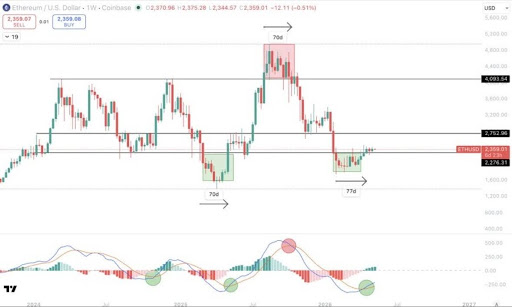
Sykodelic believes that Ethereum is setting the stage for a new bull run that could push its price back toward the $4,000 range. In an X post dated May 11, the analyst shared a detailed analysis and an accompanying chart outlining conditions that could drive ETH to that level, and why Bitcoin’s next movements will be the critical trigger.
According to the analyst, Ethereum’s price surge has yet to begin precisely because Bitcoin continues to lead the crypto market. He noted that only after BTC completes its “structure changing move,” will ETH have a real opportunity to rally.
That context matters, given Bitcoin’s recent market performance. Since early April, BTC has been on a steady upward rally, with its latest surge pushing its price to around $82,000. The flagship cryptocurrency has been outperforming the broader market for months, driven by strong demand from derivative traders, easing macroeconomic conditions, and sustained accumulation from institutions like Strategy.
With that in mind, once Bitcoin concludes its current breakout phase or undergoes a meaningful trend shift, money and momentum will likely rotate into Ethereum, allowing ETH to begin its own major rally. Sykodelic reinforced this view by pointing to a chart pattern he has tracked over the past five years.
According to him, during that period, Ethereum has consistently traded within a well-defined range marked by repeated deviations and reclaims. Notably, each of these range cycles took 70-77 days to complete.
Source: X
The analyst explained that each time Ethereum broke out of this range and reclaimed its structure, the cryptocurrency staged a strong rally back toward the range highs or lows. Given the current chart structure, Sykodelic believes ETH may once again be mirroring this historical pattern and, if so, another move toward range highs could now be in play.
ETH’s Surge To $4,000 Could Ignite The Next Altcoin Run
In his analysis, Sykodelic pointed to Ethereum’s weekly Moving Average Convergence Divergence (MACD) as further confirmation of the repeating historical chart structure. He noted that ETH is now back within the same range that led to new highs in past cycles and has been solidifying its position over the past 77 days as it prepares to move higher.
Should Ethereum push back toward range highs around $4,093, Sykodelic believes that surge could serve as the catalyst for the next altcoin run. He stated that this long-awaited altcoin season could last anywhere from 12 to 18 months. He also acknowledged that the rally may be slow, but expressed confidence that it will inevitably begin.
ETH begins another recovery rally | Source: ETHUSDT on Tradingview.com
Featured image created with Dall.E, chart from Tradingview.com
Editorial Process for bitcoinist is centered on delivering thoroughly researched, accurate, and unbiased content. We uphold strict sourcing standards, and each page undergoes diligent review by our team of top technology experts and seasoned editors. This process ensures the integrity, relevance, and value of our content for our readers.
Market analysts said Ether (ETH) was ready to continue its uptrend following moves by JPMorgan and BlackRock to launch tokenized funds on the Ethereum network.
Key takeaways:
Institutional adoption is underway as JPMorgan and BlackRock plan to launch tokenized funds on Ethereum.
Strong technical structures in multiple time frames suggest ETH price is bottoming out.
ETH traders anticipate the price to “outperform”
Data from TradingView showed ETH/USD trading at $2,320, up 2% over the last 24 hours.
The pair failed to crack through resistance at $2,400 last week, as spot Ether exchange-traded fund (ETF) outflows and rising balance on Binance derailed Ether’s recovery.
As such, bulls must push and hold the ETH/USD pair above $2,400 to continue the uptrend.
In a Wednesday post on X, analyst CryptoJack said ETH is “getting ready for a pump” as it consolidates inside a symmetrical triangle on lower time frames.
“A breakout could lead to a strong move soon.”
ETH/USD chart. Source: X/CryptoJack
Crypto Patel’s chart shows ETH trading inside an ascending triangle that has guided its price action since 2020. ETH is bouncing off the triangle’s lower trendline around $1,800, a zone that previously acted as a launchpad for large upside moves.
The analyst sets the upside target for Ether at $10,000-$15,000, saying:
“$ETH will outperform this cycle.”
ETH/USD two-week chart. Source: X/Crypto Patel
Fellow crypto analyst Celal Kucuker also shared a bullish argument, laying out a long-term roadmap that places ETH on course for a possible move above $24,000.
ETH/USD one-month chart. Source: X/Celal Kucuker
Momentum indicators support the rebound thesis. Ether’s monthly relative strength index (RSI) has cooled toward a historical support area near 42-455, similar to levels that preceded past rallies.
As Cointelegraph reported, buyers will be back in control once the ETH/USD pair breaks above the $2,450-$2,600, confirming a trend shift.
Institutional adoption fuels Ether’s bullishness
As Cointelegraph reported, JPMorgan is set to launch a tokenized money market fund on Ethereum, allowing stablecoin issuers to hold reserves backing their stablecoins while earning interest.
Related: Bitmine slows Ethereum buys, targets December to own 5% of supply
BlackRock, the world’s largest asset manager, has also filed for tokenized versions of its Treasury liquidity funds, where official ownership records will be maintained on Ethereum using ERC-20 token standards.
Source: Cointelegraph
“Institutional adoption just hit another level,” analysts at Ethereum Daily said in a post on X on Wednesday.
“This is the most bullish news for Ethereum,” X user Borovik said in a reaction to the news on Wednesday.
Tokenized funds on Ethereum, bulls argue, will drive onchain activity, increase gas demand and total value locked (TVL). This will, in turn, boost the blockchain’s legitimacy, making ETH the preferred settlement layer for trillions in TradFi capital.
Data from RWA.xyz shows that global tokenized funds already exceed $31 billion, with Ethereum dominating approximately 55% of the space.
Total global RWA value. Source: RWA.xyz
These were not the only bullish news for Ethereum. MN Capital founder Michael van de Poppe said that the approval of the CLARITY Act, which is scheduled for markup on Thursday, would be a “massive trigger for the markets.”
Market analyst Ethprofit.eth said the CLARITY Act “looks extremely bullish for Ethereum,” while Bitcoin Mami said “institutional demand is going insane post CLARITY Act,” pushing ETH price to $10,000.
Polymarket bettors are pricing in a 60% chance that the CLARITY Act will be signed into law in 2026, down 5% over the last 24 hours.
Odds of the CLARITY Act being signed into law in 2026. Source: Polymarket
If the CLARITY Act becomes law, Ether is expected to rally, as seen in July 2025, when the signing of the GENIUS Act into law preceded a 65% ETH price rise to its current all-time high of $4,950 from $3,000.
Cryptocurrency platform Paybis has received two licences from Latvia’s central bank, including one for crypto-asset services under the European Union’s Markets in Crypto-Assets Regulation (MiCA) and another for payment institution operations under Payment Services Directive 2 (PSD2).
The licences were issued by the Supervision Committee of Latvijas Banka on May 12 to SIA Paybis Europe, the company’s EU entity, according to an announcement from the central bank. Paybis is the third company in Latvia to receive a MiCA CASP licence, the central bank said.
The MiCA licence covers custody and administration of crypto assets on behalf of clients, exchange of crypto-assets for funds or other crypto assets, execution of orders, transfer services and crypto asset advisory, Latvijas Banka said. The central bank added that the PSD2 payment institution licence enables Paybis’s EU entity to execute payments and make transfers to payment accounts.
Paybis CEO and co-founder Innokenty Isers said the dual licensing allows the firm “to make a broad, future-focused offering, including working with stablecoins.”
Related: MiCA has made euro stablecoins safe but weak, new report argues
Paybis eyes B2B crypto infrastructure push
Konstantins Vasilenko, co-founder and chief business development officer of Paybis, told Cointelegraph that Paybis is targeting business clients with a white-label crypto infrastructure stack, covering on/off-ramps, buy/sell/swap, payment acceptance and stablecoin payouts. These services would be delivered through a single API, allowing companies to offer crypto services to their own customers without building their own regulated setup.
“This is where the combination of MiCA CASP authorisation and PSD2 PI licensing is particularly important, because it allows us to connect crypto asset services with regulated payment rails,” he added.
Source: Viktors Valainis, Minister of Economics of Latvia
Founded in 2014, Paybis supports 90 cryptocurrencies and serves seven million users across 180 countries. It also holds money services business licences in the US and Canada.
Related: MiCA-licensed Banking Circle joins bank stablecoin settlement race in Europe
EU weighs “MiCA 2” amid rising scrutiny
In April, a European Commission adviser said the EU’s MiCA crypto regulation is likely to evolve over time, with the Commission planning a public consultation to assess whether the rules are working for market participants. Speaking at Paris Blockchain Week 2026, Peter Kerstens said it would be “rather unusual” if there were no “MiCA 2” at some point, noting that EU financial legislation typically develops in stages.
The comments came amid growing scrutiny and opposition from the crypto industry. Stablecoin issuer Circle has pushed back on euro stablecoin thresholds, while policymakers debate whether supervision of major crypto firms should be centralized under the European Securities and Markets Authority.
Magazine: Singapore isn’t a ‘crypto hub’ — it’s something better: StraitsX CEO
A long-stalled crypto market structure bill is moving through Congress with new momentum — and Coinbase’s top executive says it could reshape the American financial system.
Coinbase CEO Brian Armstrong declared his company’s support for the Digital Asset Market Clarity Act on Wednesday, calling the legislation a “true compromise” that balances the demands of the crypto industry against the interests of the traditional banking sector and signaling the bill is in the best shape he has seen since negotiations began.
The statements, via Fox News, came as the Senate Banking Committee prepared to hold its markup of the CLARITY Act on May 14, the first formal committee vote on the legislation in the Senate after months of procedural delays and two cancelled markups.
Committee Chairman Tim Scott has set a target of June or July 2026 for a full Senate floor vote, while the White House has marked July 4 as its goal for a presidential signature.
JUST IN: Coinbase CEO Brian Armstrong tells Fox Business there was a compromise on the Bitcoin & crypto market structure bill, clearing the way for it to pass the Senate 🚀
“It’s in the best place we’ve seen so far…We’re ready to support a markup later this week.” 👀 pic.twitter.com/U88UfywifU
— Bitcoin Magazine (@BitcoinMagazine) May 13, 2026
A legislative marathon is taking place
The CLARITY Act — formally H.R. 3633, the Digital Asset Market Clarity Act of 2025 — cleared the House of Representatives on July 17, 2025, in a 294–134 bipartisan vote, with all 216 House Republicans in support and 78 Democrats crossing the aisle.
Since then, the bill sat in the Senate Banking Committee through two cancelled markups, extended stablecoin negotiations, and an intensifying lobbying war between crypto firms and Wall Street banks.
At its core, the legislation draws a regulatory line between the Securities and Exchange Commission and the Commodity Futures Trading Commission.
Under the bill, the CFTC would hold exclusive jurisdiction over spot and cash markets for digital commodities while the SEC retains authority over investment contract assets and primary market fundraising. Stablecoins are carved out as a separate category under shared oversight.
The Senate version of the bill expanded beyond the House text, growing to nine titles that cover decentralized finance protections, illicit finance provisions, bankruptcy safeguards for crypto customers, and the Blockchain Regulatory Certainty Act, which creates safe harbors for software developers who publish code without controlling customer funds.
The stablecoin standoff
The bill’s most contested provision centered on stablecoin yield. Banks warned that permitting crypto platforms to pay rewards on stablecoin balances would trigger deposit flight from traditional bank accounts and threaten lending operations. Crypto firms, led by Coinbase, argued that restrictions would hand banks a competitive advantage and strip Americans of new financial tools.
The standoff produced a compromise brokered by Senators Thom Tillis (R-NC) and Angela Alsobrooks (D-MD). Under the final language in Section 404 of the bill, stablecoin issuers and affiliated digital asset service providers cannot pay yield on balances if that yield is the functional or economic equivalent of bank interest.
Activity-based rewards — cashback on payments, transaction-based incentives, and rewards tied to commerce — remain permitted. A stablecoin holder who takes no action generates no return.
Armstrong confirmed his support after the compromise text became public, with Coinbase’s Chief Policy Officer Faryar Shirzad declaring the industry “secured what is important.”
Speaking on Fox, Armstrong credited Senators Tillis, Alsobrooks, and their staffs for bringing both sides to the table. “I’ve got to give a lot of credit to Senators Brooks and Tillis and their staff who worked tirelessly on this,” he said.
Armstrong described a financial sector moving fast toward digital asset integration.
“I go around and I speak with lots of different bank CEOs, and many of them are just leaning into this as an opportunity to grow their business,” he said. “They’re integrating stablecoins as fast as they can.”
More than 100 crypto firms and industry groups, including the Crypto Council for Innovation and the Blockchain Association, wrote to the Senate Banking Committee in April urging the panel to advance the bill, warning that continued delays risk pushing innovation and capital outside the United States.
Treasury Secretary Scott Bessent reinforced that call, telling a Senate panel the legislation is essential to protecting the dollar’s status as the world’s reserve currency.
The Thursday markup is not the finish line. If the Banking Committee approves the bill, it must merge with a version passed by the Senate Agriculture Committee in a party-line 12–11 vote in January 2026.
A full Senate floor vote requires 60 votes, making Democratic support a practical requirement and leaving an ongoing fight over ethics provisions — specifically language addressing President Trump and his family’s crypto holdings — as the bill’s biggest remaining fault line.
The strategic partnership between FloQast and Forvis Mazars Germany, announced on May 12, 2026, marks a major milestone in FloQast’s aggressive DACH region expansion. By combining its AI-powered “Accounting Transformation Platform” with the deep industry expertise of Forvis Mazars, FloQast is positioning itself to tackle the unique regulatory complexities and the acute accounting talent shortage in Germany. This collaboration follows the April 2026 opening of FloQast’s Berlin hub, signaling a commitment to providing localized, high-impact automation that meets the rigorous “auditable” standards required by German finance leaders.
The partnership focuses on the Record-to-Report (R2R) cycle, utilizing FloQast AI Agents to transform traditional accounting roles. These agents allow teams to move away from being “preparers” of manual data and toward becoming “strategic reviewers.” By automating high-impact tasks like Close Management and Compliance using natural language prompts, the joint solution allows German enterprises to bypass traditional IT hurdles and achieve greater operational agility while maintaining a strict cryptographic audit trail.
FloQast, the Accounting Transformation Platform created by accountants for accountants to automate accounting and audit workflows with AI, today unveiled a strategic partnership with Forvis Mazars Germany focused on enhancing operational efficiency through the automation of key accounting processes.
The collaboration seeks to combine FloQast’s AI-powered workflows with Forvis Mazars’ expertise in designing closing processes to boost efficiency, increase accuracy, and provide deeper insights for businesses across various industries.
“Our partnership with Forvis Mazars reinforces our commitment to helping accounting teams across EMEA adapt to the evolving demands of the profession,” said Aaron O’Donoghue, Alliances Lead, EMEA, FloQast. “With increasing regulatory complexity and a shrinking talent pool, finance teams need smarter, more efficient ways to work. By combining FloQast’s AI-powered technology with Forvis Mazars’ deep industry expertise, we’re enabling organisations to improve accuracy, enhance compliance, and drive greater operational agility. Furthermore, this partnership is a critical driver for our DACH expansion strategy, allowing us to further localised, high-impact AI automation to the German markets.”
Following the April opening of its Berlin hub to meet growing demand across the DACH region, FloQast is accelerating the modernisation of essential accounting and audit workflows. By integrating seamlessly with existing systems, the platform allows teams to bypass IT complexity and immediately automate high-impact processes like Close Management and Compliance. This transformation is driven by FloQast AI Agents: a groundbreaking, auditable AI capability that enables accountants to automate complex, recurring workflows using natural language rather than code—streamlining the record-to-report process and allowing teams to better leverage data to drive organisational strategy.
FF NEWS TAKE
FloQast is successfully “exporting” its accountant-first philosophy to the German market, where precision and compliance are non-negotiable. The alliance with Forvis Mazars is a tactical masterstroke, as it provides FloQast with the local “boots on the ground” needed to navigate the complex German GAAP and tax reporting landscape. By leveraging Forvis Mazars’ consultancy excellence, FloQast is ensuring that its AI Agent Builder—launched globally in late March 2026—is tuned to the specific logic and workflows of European mid-market and enterprise businesses.
The real differentiator here is the No-Code Visual Agent Builder. In a region where IT resources are often a bottleneck, the ability for an accountant to “draw” a workflow and have an AI agent execute it is a game-changer. As DACH-based finance teams face increasing pressure to do “more with less,” the 30% reduction in time-to-close typically seen on the FloQast platform becomes a powerful economic argument. If this partnership hits its targets, we expect FloQast to quickly become the standard-bearer for ISO 42001-certified AI adoption across Central Europe.
“ALPENGLOW” UPGRADE LIVE FOR TESTING ON SOLANA: Solana developer Anza said that Alpenglow, the network’s biggest proposed consensus overhaul to date, is live on a community test cluster, marking a major step toward a potential mainnet rollout. The update means validator operators can now test software designed to move Solana from its current consensus system, which combines Proof-of-Stake with TowerBFT and Proof-of-History, toward a new architecture intended to dramatically reduce finality times and improve network responsiveness. “Alpenglow is live on the community test cluster,” Anza wrote on X. “The biggest consensus change in Solana’s history, now running on validator infrastructure ahead of mainnet.” Today, Solana relies on Proof-of-History, a cryptographic clock that timestamps transactions, alongside TowerBFT, a voting mechanism validators use to agree on the state of the blockchain. While the design has helped Solana achieve high throughput and low fees, some have pointed to outages and network instability during periods of heavy demand. — Margaux Nijkerk Read more.
LAYERZERO APOLOGY FOR KELP DAO INCIDENT: LayerZero said that it “made a mistake” allowing its own verification infrastructure to secure high-value crypto assets in a vulnerable configuration, marking a notable shift in tone after weeks of blaming developer Kelp DAO for a $292 million hack tied to North Korean attackers. The admission marks a notable shift after weeks of public finger-pointing between LayerZero and Kelp over responsibility for the April hack, which LayerZero had initially framed as an application-level configuration failure by Kelp. “First things first: an overdue apology,” LayerZero wrote in a blog. LayerZero initially blamed Kelp, arguing the protocol had chosen a risky “1-of-1” configuration in which only a single decentralized verifier network, or DVN, needed to approve cross-chain transfers, creating a single point of failure. A DVN is part of the infrastructure that verifies whether a transaction moving assets between blockchains is legitimate. “We made a mistake by allowing our DVN to act as a 1/1 DVN for high-value transactions,” the company said. “We didn’t police what our DVN was securing, which created a risk we simply didn’t see. We own that.” — Sam Reynolds Read more.
RONIN TO TRANSITION TO LAYER-2: Ronin, the gaming-centric blockchain once synonymous with the industry’s infamous $625 million exploit in 2022, is officially shedding its sidechain skin on May 12 to become an Ethereum layer 2 to improve security while maintaining throughput. Ronin, which announced the migration in April, will execute a hard fork at block 55,577,490, a process that will result in about 10 hours of downtime for users, the network said Monday on X. According to onchain data, the migration is expected to begin on Tuesday around 15:16 UTC. “Four years ago, we launched Ronin because Axie Infinity needed a faster and more efficient network,” Ronin said when announcing the migration. “It worked. Axie Infinity onboarded millions of gamers to crypto, and Pixels proved that it was possible to do it again.” The time has come to plug “back into the mothership.” While operating as an independent sidechain in mid-May 2022, Ronin suffered what is still today the largest DeFI bridge exploit in history. Layer 2 protocols benefit from tighter links to the underlying blockchain than sidechains, offering benefits that include greater security. — Olivier Acuna Read more.
ETHEREUM DEVELOPERS RELEASE “CLEAR SIGNING”: The Ethereum Foundation and a group of major crypto wallet developers are rolling out a new security standard designed to stop users from accidentally signing away their funds, a problem that has fueled some of the industry’s biggest hacks and scams. The initiative, called “Clear Signing,” aims to replace the confusing walls of code users currently see when approving Ethereum transactions with simple, human-readable explanations of what they’re actually agreeing to. The effort comes after years of phishing attacks and wallet drains that often boil down to the same issue: users unknowingly approving malicious transactions they don’t understand. The Ethereum Foundation pointed to incidents like the Bybit hack as examples of how attackers exploit “blind signing,” where users approve transactions filled with unreadable technical data. Right now, signing a crypto transaction can feel like clicking “accept” on a terms-of-service page written in another language. Wallets often display long strings of code that only highly technical users can decipher, leaving everyday traders vulnerable to fake apps, malicious links and compromised websites. — Margaux Nijkerk Read More.
In Other News
Charles Schwab, the brokerage giant that manages around $12 trillion in client assets, began the rollout of its spot cryptocurrency trading service for retail customers in the U.S. An initial group of clients can now trade bitcoin and ether (ETH) on the Schwab Crypto platform, the company posted on X.In July last year, CEO Rick Wurster said the company planned to introduce crypto trading in the near future, with a timeframe of first-half 2026 confirmed last month. The Westlake, Texas-headquartered firm already offers crypto investments through exchange-traded funds (ETFs) and futures trading. — Jamie Crawley Read more.
JPMorgan (JPM) is preparing to launch a tokenized money market fund, the latest sign that major financial institutions and Wall Street asset managers are speeding up efforts to move traditional assets onto blockchain rails. A filing with the U.S. Securities and Exchange Commission SEC) outlined plans for a blockchain-based money-market fund investing exclusively in short-term U.S. Treasuries, cash and overnight repo agreements backed by government securities. The fund, dubbed JPMorgan OnChain Liquidity-Token Money Market Fund (JLTXX), will maintain blockchain-based token balances tied to investors’ ownership records, allowing approved users to submit purchase, redemption and transfer requests through Ethereum, the filing said. The underlying blockchain infrastructure will be operated by Kinexys Digital Assets, JPMorgan’s blockchain unit formerly known as Onyx. — Kristzian Sandor Read more.
Regulatory and Policy
The legislation that could fully insert the U.S. crypto industry into the regulated financial system has emerged in its latest form, with the Senate Banking Committee unveiling the market structure bill’s text just after midnight on Tuesday in advance of this week’s hearing that’s set to push the effort forward. The latest version wasn’t expected to offer many surprises for the crypto industry that’s already had a chance to dig through it privately, but it includes still-contentious language on stablecoin yield and it maintains legal protections for decentralized finance (DeFi) developers, keeping that corner of the crypto sector happy (so far). Industry insiders waited for the release late into the night, and they’ll still have to study the language to ensure their expectations were met. “This bill reflects serious, good-faith work across the committee and delivers the certainty, safeguards, and accountability Americans deserve,” committee Chairman Tim Scott said in a statement. “It puts consumers first, combats illicit finance, cracks down on criminals and foreign adversaries and keeps the future of finance here in the United States.” — Jesse Hamilton Read more.
The Senate confirmed Kevin Warsh to the Federal Reserve Board of Governors on Tuesday, moving President Donald Trump’s pick one step closer to becoming the next chair of the U.S. central bank. Lawmakers approved Warsh in a 51-45 vote. Sen. John Fetterman (D-Pa.) was the only Democrat to support the nomination. Warsh still must win a separate Senate vote to become Fed chair, which is expected Wednesday. Governors serve 14-year terms while the chair serves a four-year term. If confirmed as chair, Warsh, 56, will replace Jerome Powell, whose eight-year term leading the Fed ends Friday. Powell, however, has said he plans to remain on the board until a federal probe into renovations at the Fed’s headquarters concludes. — Helene Braun Read more.
Calendar
June 2-3, 2026: Proof of Talk, Paris
June 4, 2026: Stable Summit, New York
June 8-10, 2026: ETHConf, New York
Sept. 29-Oct.1, 2026: Korea Blockchain Week, Seoul