

Elon Musk’s rocket and satellite company has accelerated plans for its blockbuster public offering, with trading expected to begin as early as June 12 after a faster-than-expected SEC review.
Abu Dhabi’s Mubadala Raises Bitcoin ETF Stake 16% To $566 Million In Q1 2026

Abu Dhabi’s sovereign wealth fund Mubadala Investment Company has raised its position in BlackRock’s iShares Bitcoin Trust (IBIT), reporting ownership of 14,721,917 shares valued at $565,616,051 as of March 31, 2026, according to a 13F filing released today.
That marks a 16% increase from the 12,702,323 shares the fund held at the end of Q4 2025.
The disclosure extends a now-unbroken accumulation streak that began in Q4 2024, when Mubadala first disclosed bitcoin exposure worth at least $436 million. The fund added shares through a Q1 2025 filing that showed 8,726,972 shares at $408.5 million, then surged to 12.7 million shares worth $630.6 million by December 31, 2025 — a 46% jump in a single quarter. Today’s filing adds another 2 million shares to that ledger, pushing the position past the half-billion dollar mark for the third straight quarter.
Mubadala manages a global portfolio exceeding $330 billion in assets across technology, healthcare, infrastructure, private equity, and public markets, with its mandate centered on generating returns for the Abu Dhabi government while reducing the emirate’s dependence on oil revenues. Bitcoin, accessed through the regulated IBIT structure, has become one of the fund’s most visible public market positions.
As of Q4 2024, IBIT was already Mubadala’s second-largest holding by a wide margin, trailing only a longer-term stake in Arm Holdings.
Abu Dhabi’s bitcoin investments
Abu Dhabi’s sovereign accumulation does not stop at Mubadala. Al Warda Investments, an entity tied to the Abu Dhabi Investment Council — itself operating under the Mubadala umbrella — has also been building an IBIT position, reporting 8.2 million shares worth approximately $408 million at year-end 2025. The two Abu Dhabi vehicles combined to hold more than $1 billion in IBIT as of December 31, marking a milestone for Gulf Cooperation Council sovereign participation in regulated bitcoin products.
The Q1 2026 filing arrives against a backdrop of broader institutional and governmental interest in bitcoin. Goldman Sachs disclosed approximately $2.36 billion in total crypto exposure through IBIT and other vehicles, while Jane Street reported 20.3 million IBIT shares worth $790 million at Q4 2025 year-end.
On the sovereign front, Texas became the first U.S. state to purchase bitcoin for a strategic reserve during the same period.
On a similar note, new financial disclosures show the Trump family trust bought shares of several bitcoin-linked companies — including Coinbase, MARA Holdings and Strategy — during the first quarter of 2026 as the administration advances a more crypto-friendly policy agenda.
The filings revealed thousands of trades worth between $220 million and $750 million overall.
Bitcoin Battles US Bond Nerves With BTC Price Dip Toward New May Lows

Bitcoin (BTC) fell below $80,000 at Friday’s Wall Street open as analysis tied risk-asset weakness to US bond markets.
Key points:
- Bitcoin eyes its lowest levels of May as concerns over US bond yields spark a risk-asset rout.
- US 10-year treasury yields rise above levels that sparked a US tariff pause on China last year.
- Traders wait for new local lows for BTC/USD as support stability is eroded.
Bitcoin suffers as risk-asset “euphoria” turns sour
Data from TradingView tracked 3% daily BTC price losses, with downside intensifying as the US session began. BTC/USD approached its lowest levels in May so far.
BTC/USD one-hour chart. Source: Cointelegraph/TradingView
Stocks also gave back gains after hitting new all-time highs earlier in the week.
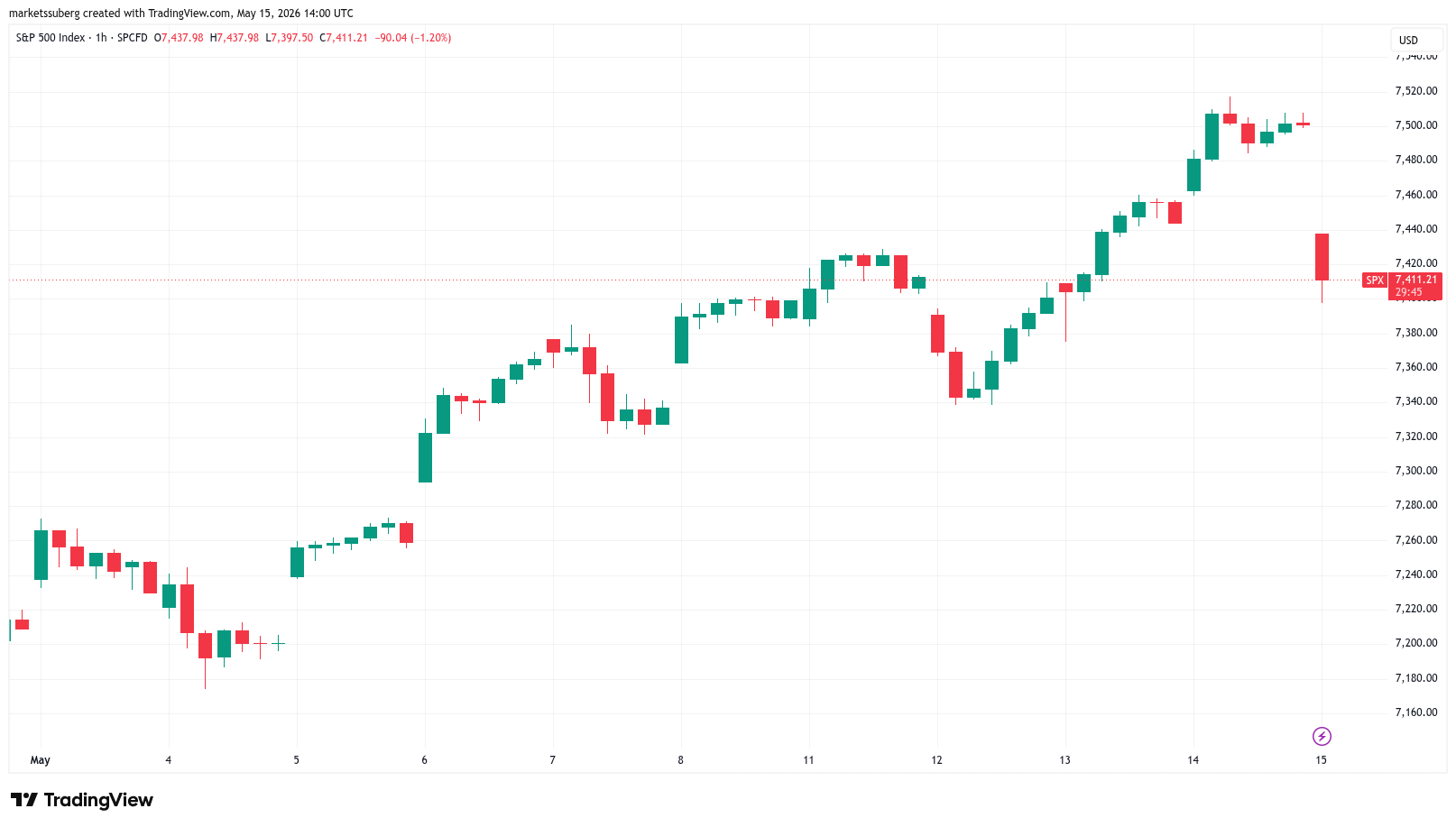
S&P 500 one-hour chart. Source: Cointelegraph/TradingView
Reacting, trading resource The Kobeissi Letter saw risk-asset “euphoria” giving way to concerns about “unsustainable” US bond yields.
“The bond market crisis is intensifying. The US 10Y Note Yield is now officially above 4.55% for the first time since May 2025,” it wrote in a post on X.
“After weeks of euphoria, the market is beginning to react today. As we have been stating for the last few weeks, the current situation in the bond market is unsustainable.”
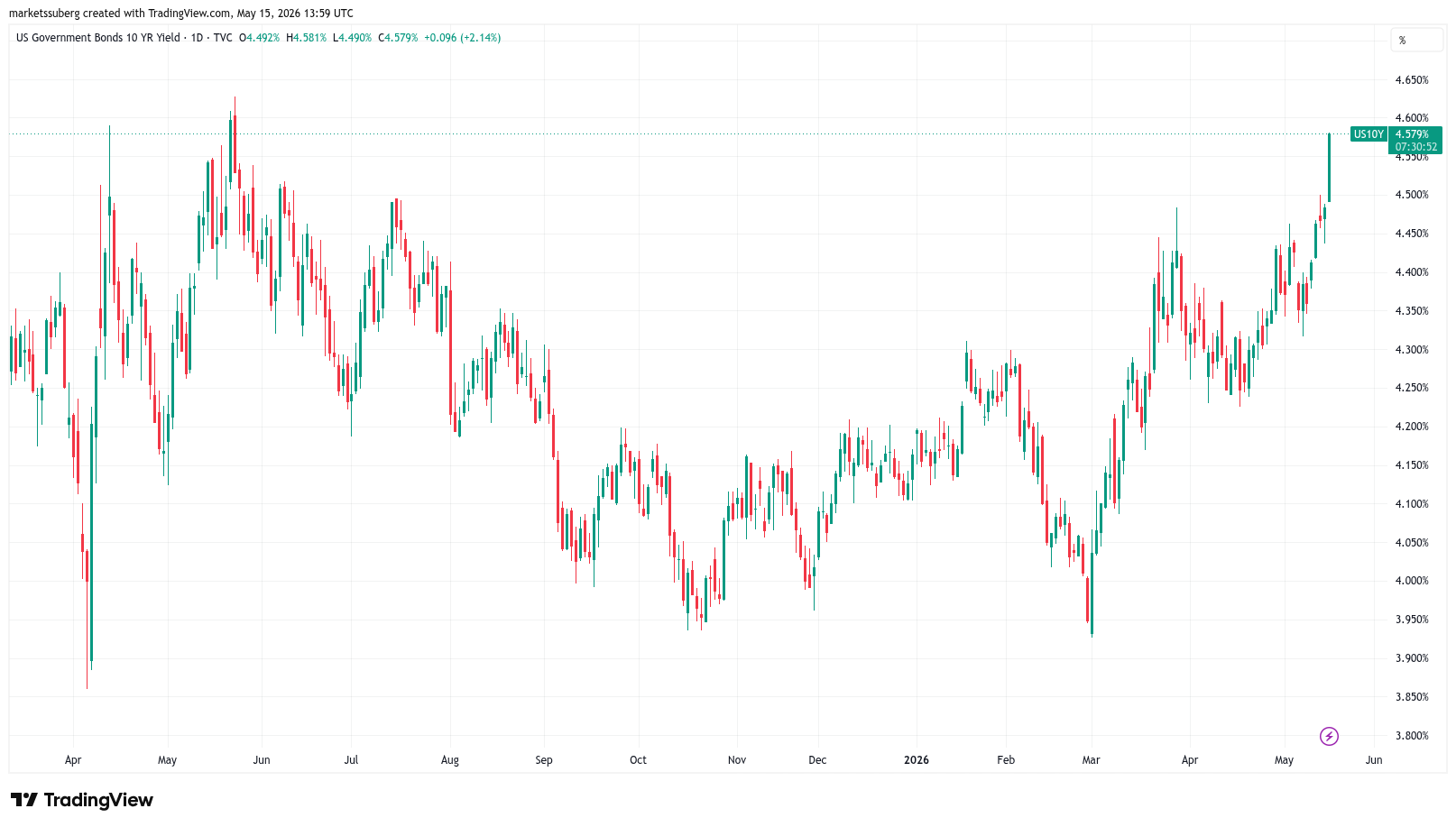
US 10-year treasury note yield one-day chart. Source: Cointelegraph/TradingView
Kobeissi noted that yields were now above levels seen in April 2025, when US President Donald Trump halted the implementation of trade tariffs on China. That move, it said, came due to “a collapsing bond market.”
“Furthermore, the market now sees a 60%+ chance that the Fed’s next move is an interest rate HIKE, with rate cuts entirely priced-out,” the post added.
“We expect to see 7%+ mortgages next, all as auto loan delinquencies have reached 32-year highs. Inflation is back and higher rates are coming.”
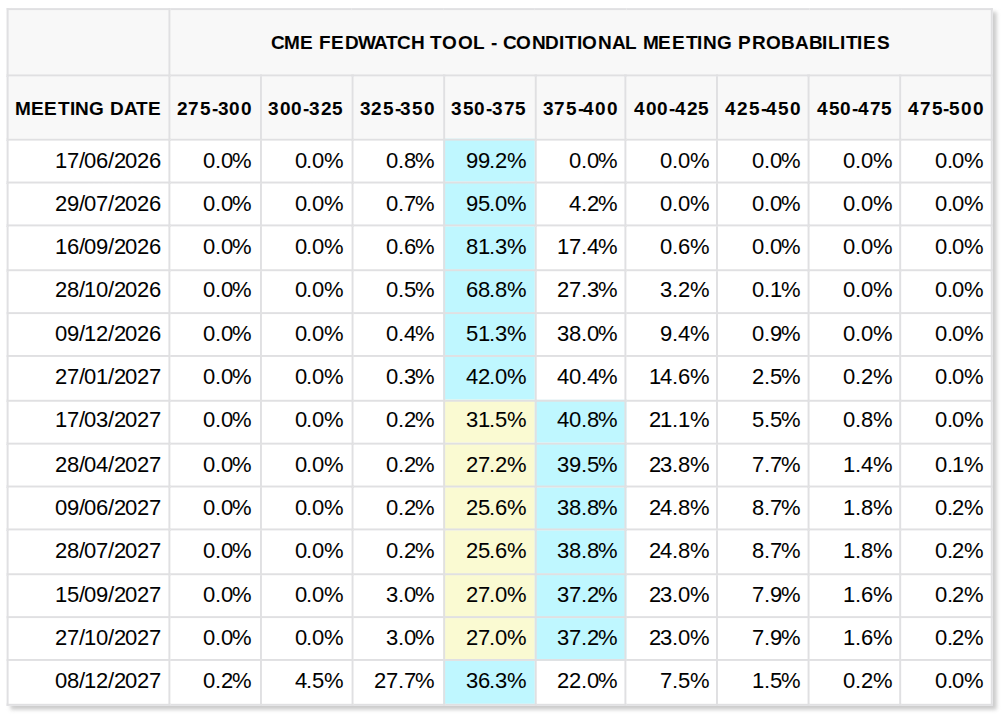
Fed target rate probabilities (screenshot). Source: CME Group
The latest data from CME Group’s FedWatch Tool showed a 0.25% interest-rate hike as the most likely outcome by March 2027.
BTC price lows back on the radar
As Cointelegraph reported, traders were already unsure about Bitcoin’s ability to climb beyond $82,000 local highs.
Related: Bitcoin price history suggests 77% odds of new all-time high within a year
A support retest was already on the cards, and targets on the day extended toward the mid-$70,000 zone.
“Honestly, not a good sign that $BTC fully retraced the move from yesterday,” trader Pat told X followers.
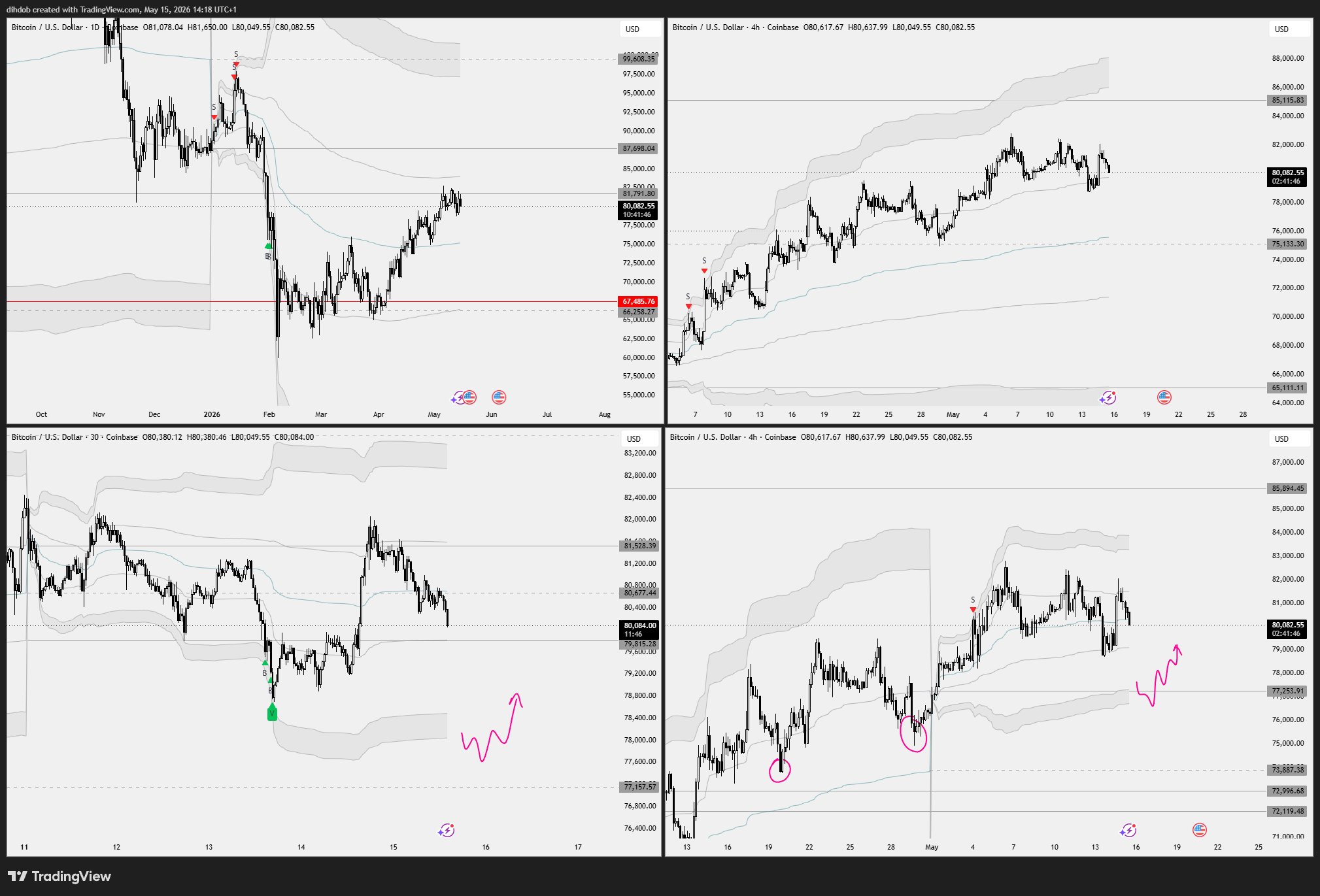
BTC/USD comparison. Source: Pat/X
Rangebound continuation was an increasingly popular option, with analyst Eric Coleman suggesting that low-time frame price action was predictable.
“BTC pumped from the marked horizontal support just as expected and again it got rejected below the trendline and the horizontal resistance,” he wrote alongside an explanatory chart.
“Further movement in between the horizontal support and resistance is expected until a solid breakout or breakdown occurs.”
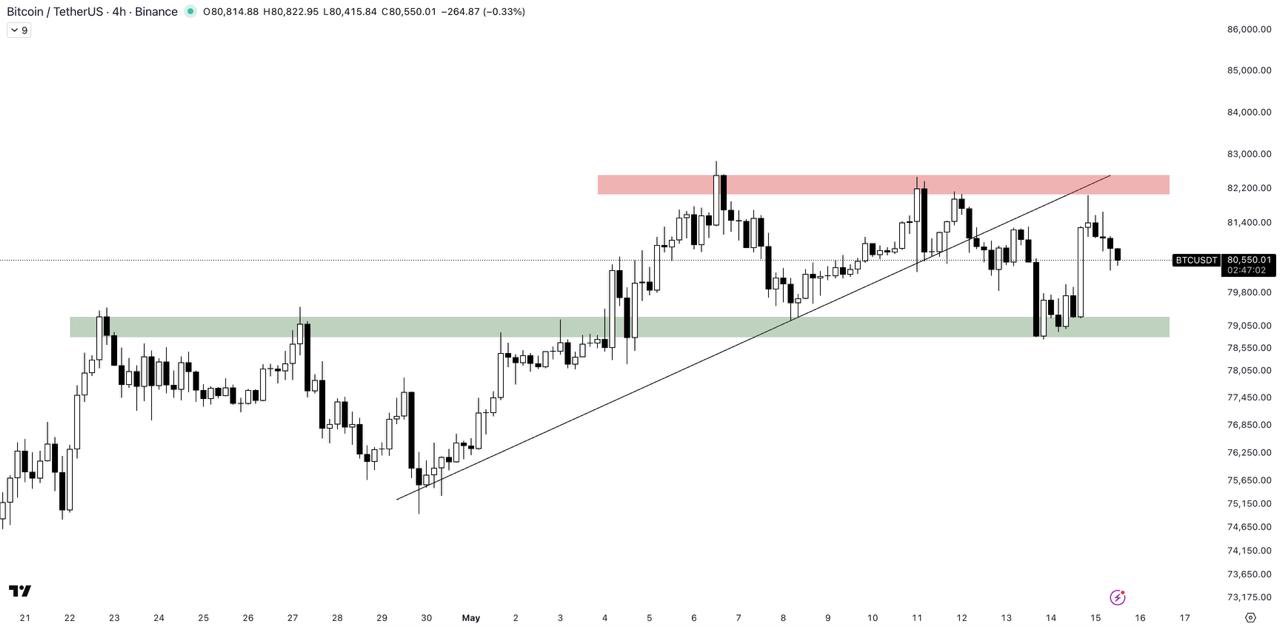
BTC/USDT four-hour chart. Source: Eric Coleman/X
CME and NYSE Owner Push U.S. Regulators to Crack Down on Hyperliquid

The Hyperliquid Policy Center disputed the framing.
CME Group and Intercontinental Exchange (ICE), the parent company of the New York Stock Exchange, are lobbying the CFTC and U.S. lawmakers to impose federal oversight on Hyperliquid, Bloomberg reported Friday.
The exchanges cited concerns that the platform’s largely offshore, lightly regulated trading environment could be vulnerable to market manipulation and sanctions evasion.
The exchanges argue that Hyperliquid’s growing trading volumes in crypto and commodity-linked markets could begin to distort price discovery in critical sectors like oil, where global benchmarks are formed, warning that anonymous trading environments may allow insiders or state-linked participants to influence prices. Their ask: registration with the CFTC, which would require the platform to implement customer identification programs and trade surveillance measures.
HYPE declined about 6% following the news, dropping from above $45 to below $43.
The lobbying push carries an obvious competitive dimension. CME is advancing plans to expand its own 24/7 crypto trading offerings, with Bitcoin Volatility Futures scheduled to begin trading June 1 and Nasdaq CME Crypto Index Futures — covering BTC, ETH, XRP, and others — launching June 8.
Hyperliquid Pushes Back
The Hyperliquid Policy Center, an advocacy group formed in February by a Hyperliquid-affiliated foundation, disputed the framing in a post on X Friday. The group called the CME/NYSE characterization inaccurate, arguing that traditional exchange operators — which match buyers and sellers and collect fees — operate fundamentally differently from Hyperliquid’s model, and that conflating the two misrepresents the platform’s structure and risk profile.
The Policy Center has already been engaging with the CFTC in meetings aimed at establishing a legal route for U.S. participation in Hyperliquid’s markets. The group argues its markets are more beneficial and present fewer risks than traditional centralized exchanges, and expects the CFTC to develop a tailored regulatory framework for on-chain derivatives platforms.
Regulatory Vulnerability
Hyperliquid’s bridge, the single point of custody for all user funds, is secured by a 3-of-4 multisig. At its April 2025 high point, Hyperliquid accounted for roughly 70% of the on-chain perpetual futures market.
That scale, combined with its relatively centralized custody structure and IP-based geo-restrictions, could heighten regulatory risk.
Anthropic and PwC in New Push to Embed Claude in Corporate World
The generative AI vendor and the global consulting firm have formed an expanded partnership aimed at embedding AI in the infrastructure of more large companies — with Claude at its core.
The Big Four firm has agreed to use Claude in key areas as it bids to ramp up AI use for clients across multiple industries.
Claude Code will be deployed to speed up agentic technology development, enabling software to be shipped more quickly than it is now.
PwC says it has a growing portfolio of clients looking to increase the use of AI agents, spanning industries as diverse as financial services, pharma and life sciences.
The partners will also focus on improving deal-making processes, with agents working alongside existing teams.
The deal includes a commitment to build AI-native, scalable operating models that cover all elements of a business.
PwC and Anthropic said several live deployments are already running. These include professional sports operations, where Claude is helping to rethink digital fan engagement and agent-led management.
The insurance sector is also seeing Claude implementations, with underwriting cycles reduced from weeks to days, as is cybersecurity, where agents are responding to exposure threats in minutes rather than hours, meaning they can be shut down before any harm is done.
In addition to trying to establish Claude as the go-to AI in corporations across the U.S and globally, PwC is moving toward providing access to hundreds of thousands of its own employees worldwide.
This will be underpinned by a Center of Excellence run jointly with Anthropic, which will devise a program to train 30,000 PwC professionals in the U.S.
Claude is already available on the firm’s internal AI assistant, ChatPwC.
Anthropic has made no secret of its desire to increase enterprise AI revenues, with CFO Krishna Rao explaining at the company’s last funding round of $30 billion in February that the investment would be used to build more enterprise-grade products.
The PwC partnership comes amid speculation, first reported by Bloomberg, that Anthropic is in talks to raise $30 billion at a valuation of $900 billion.
The Trump Family Trust Bought Bitcoin-Linked Stocks In First Quarter: Filing

Donald Trump’s family trust bought shares in several bitcoin-linked companies during the first quarter of 2026, according to a financial disclosure filed with the US Office of Government Ethics. These moves come as his administration advances a more supportive stance on digital assets.
The filing, submitted through two Form 278-T reports, shows more than 3,600 transactions between January and March with a total value ranging from $220 million to $750 million. Most of the activity focused on large-cap technology firms, banks, and index funds, yet a set of targeted purchases tied to the crypto sector has raised fresh ethics questions.
The disclosure lists nine purchases of Coinbase stock, with the largest transaction on Feb. 10 valued between $100,001 and $250,000. Coinbase stands as the largest US-based crypto exchange and plays a central role in retail and institutional trading infrastructure.
The trust reported two smaller purchases of MARA Holdings, one of the largest public Bitcoin mining firms, along with trades in Strategy, the company known for holding a large Bitcoin treasury. Strategy shares often move in line with Bitcoin price swings, which has made the stock a proxy for crypto exposure in equity markets.
The filing shows eight transactions involving Strategy Class A shares, including both purchases and sales. The largest purchase ranged between $50,001 and $100,000, while a January sale reached up to $50,000. The mix of buys and sells suggests active management rather than a passive position.
Beyond those names, the trust disclosed positions in other crypto-linked or fintech firms, including Robinhood, SoFi Technologies, and Block. These companies connect to digital assets through trading platforms, payments, or blockchain initiatives.
The Trump’s broader portfolio
Crypto-related trades represent a small share of the broader portfolio, which includes large positions in Nvidia, Microsoft, Apple, Amazon, and Boeing, with individual transactions reaching up to $5 million. The filing indicates strong gains across many of those holdings following a market rebound after a March selloff tied to geopolitical tensions.
The documents do not state whether Trump directed any trades. His assets sit in a family trust managed by his sons and external brokers. Ethics rules require disclosure of transactions but do not bar a sitting president from holding or trading stocks.
These Trump-linked purchase disclosures came as the Senate Banking Committee advanced the Digital Asset Market Clarity Act in a 15–9 vote, with Democratic Sens. Ruben Gallego and Angela Alsobrooks joined Republicans to move the sweeping crypto market structure bill forward despite fierce opposition from Elizabeth Warren and other Democrats over consumer protection, illicit finance and Trump-related ethics concerns.
The markup exposed a growing Democratic divide on crypto policy, as a bipartisan bloc backed key DeFi compromise language while progressive lawmakers warned the bill creates loopholes that could weaken anti-money-laundering enforcement and securities protections.
Here’s An Estimate Of How Much Strategy Would Make On Its Bitcoin Holdings If Price Rises 30% Each Year

Trusted Editorial content, reviewed by leading industry experts and seasoned editors. Ad Disclosure
Strategy, the world’s first and largest Bitcoin Treasury led by its founder Michael Saylor, recently resumed its weekly BTC buying spree after pausing purchases ahead of its earnings call on May 5. With the company now in buying mode, Saylor predicts Bitcoin’s price will rise 30% annually over the next 20 years. If that happens, Strategy’s staggering holdings, which is currently over 800,000 BTC, could see massive profit growth each year.
Strategy’s Bitcoin Value At 30% Yearly Growth
Saylor has said that the Bitcoin price could surge 30% each year for the next two decades, showing strong confidence in the flagship cryptocurrency’s outlook. The Strategy founder is known for his highly ambitious BTC projections. While he made his bold 30% call, he also forecasted that the digital currency could eventually reach $1 million per coin within a four to eight-year time frame.
Following its latest purchase, Strategy now holds about 818,869 BTC, valued at $66.5 billion at an average cost of $75,540 per coin. The company has bought over 56,770 BTC since the beginning of April, with its largest purchase of 34,164 BTC since 2024 made on April 20.
Now, if Bitcoin were to increase by 30% each year, that would mean that Strategy’s BTC holdings could grow at a similar pace over that period. Assuming Strategy keeps the same amount of BTC for 20 years and Bitcoin rises 30% annually, with no volatility or price swing taken into account, it could mean that by 2027, the company’s stash would have risen to $86.45 billion.
In the next 3 years, which marks 2030, Bitcoin could have risen by another 120% from the 2027 figure, meaning Strategy’s holdings would be worth around $189.82 billion by that time. Fast forward to 2035, representing about 8 years of the total two-decade timeline, the value of the company’s Bitcoin stash would have skyrocketed to $705.20 billion, reflecting a gain of about 716%.
Finally, for the full 20-year projection, which would likely be around 2046, Strategy’s Bitcoin holdings could have exploded to a whopping $16.43 trillion, representing a total increase of 18,905%. At this scale, the treasury’s growth curve becomes increasingly exponential, with most of the gains concentrated in the later years due to compounding. Given the size of this profit projection, it would make Strategy the most valuable Bitcoin holder in history.
Saylor Sells STRC Stock To Buy More BTC
New reports show that Strategy has also continued to buy more Bitcoin through its STRC preferred stock fundraising program. As of May 14, Strategy reported it had acquired an additional 10,339 BTC at an estimated cost of $847 million. According to analysts, this is more than 20 times the daily mined supply for Bitcoin, highlighting the growing scale of institutional demand for the flagship cryptocurrency.
Around the same period, Strategy also increased its BTC acquisition to 14,155 coins at an estimated cost of $1.16 billion. This means the company sold about $1.16 billion in STRC to fund the purchase.
Featured image created with Dall.E, chart from Tradingview.com

Editorial Process for bitcoinist is centered on delivering thoroughly researched, accurate, and unbiased content. We uphold strict sourcing standards, and each page undergoes diligent review by our team of top technology experts and seasoned editors. This process ensures the integrity, relevance, and value of our content for our readers.
The More Operational AI Is, the Bigger the Security Challenge

Editor’s Note: Welcome to Prompt, your weekly briefing on the shifting AI landscape. We provide an analytical look at the week’s biggest developments, paired with a curated roundup of the stories that actually matter.
AI is becoming both a cybersecurity tool and a cybersecurity threat.
The same AI systems designed to improve efficiency and automate workflows are creating new attack surfaces, governance challenges and operational risks.
That’s evident in this week’s coverage, which shows the industry has entered a new phase of securing AI. The challenge is no longer just protecting models or data. Companies are now trying to secure AI systems that can take action, interact across workflows and increasingly operate on their own inside enterprise environments.
And companies are realizing that traditional security approaches aren’t enough for operational AI systems.
This week, OpenAI launched Daybreak, a cybersecurity initiative that reflects a broader shift toward building resilience into AI systems rather than relying solely on reactive defenses.
It offers vulnerability protection as companies increasingly adopt AI systems, often faster than they can understand potential risks.
OpenAI’s Daybreak rollout also points to how AI cybersecurity is increasingly becoming an ecosystem effort, with companies including Cisco, CrowdStrike and Cloudflare participating in the initiative.
Meanwhile, the line between AI defense and AI risk is blurring.
As AI systems become more autonomous and embedded in enterprise operations, they also become harder to monitor, govern and secure. The challenge is no longer just protecting models or data. Companies are more and more trying to manage interconnected systems that can act across workflows and environments with greater autonomy.
Recent breaches involving the ed tech platform Canvas are a reminder that many organizations are already struggling to manage increasingly connected systems before adding more AI into the mix.
The challenge has moved beyond building AI systems. It’s operationalizing them safely and reliably at enterprise scale.
Google Cloud’s push to hire AI deployment engineers, alongside OpenAI’s launch of a standalone consulting business, highlights how difficult enterprise AI deployment remains in practice. Organizations are adopting AI faster than they can train employees to use it, while observability, governance and infrastructure systems struggle to keep pace with increasingly agent-rich interconnected environments.
That’s shifting the focus away from models alone and toward the operational systems required to deploy, manage and secure AI at scale.
Also in AI This Week:
Beyond cybersecurity and governance, coverage also highlighted how AI adoption is reshaping enterprise operations, workforce readiness and the next generation of infrastructure.
Why AI Is Forcing Enterprises to Rethink Observability: AI systems are becoming more complex and autonomous, forcing enterprises to rethink traditional observability tools and monitoring strategies.
Employers Take On AI Tools Faster Than They Can Train Workers to Use Them: Many organizations are adopting AI tools faster than they can train employees to use them effectively, creating new gaps in workforce readiness and productivity.
Nvidia Taps British AI Startup to Build ‘Next Frontier’ of AI: Nvidia is partnering with British startup Ineffable Intelligence to help build next-generation AI training infrastructure, underscoring continued demand for compute and model development capacity.
Anthropic Targets Small Businesses With Latest Claude Release: Anthropic is expanding its push into the small business market with a new Claude version release designed to make generative AI more accessible to smaller organizations.
US Agentic Commerce Revenue Forecast to Reach $1 Trillion by 2030: Agentic commerce revenue in the U.S. is projected to reach $1 trillion by 2030, signaling growing confidence in AI systems that can shop, recommend and complete transactions on behalf of consumers.
Why Companies Are Shifting Toward Private AI Models: Companies are increasingly exploring private AI models to gain greater control over data, security, and how AI systems are deployed within the enterprise.
Bosch, Researchers Develop AI for Humanoid Dexterity: Bosch has developed a new AI-driven “touch dreaming” system to improve the dexterity and real-world performance of humanoid robots.
Cerebras Must Overcome Obstacles to Maintain IPO Value

AI chipmaker Cerebras’ epic IPO launch this week is another example of the shift in the AI infrastructure market toward inference, and of how AI labs and vendors are diversifying beyond just Nvidia GPUs. But the current interest in inference is unlikely to be enough to sustain Cerebras’s high IPO valuation.
The 2015 startup went public on May 14 at a price as high as $386 per share, pushing the AI hardware vendor to a valuation of about 100 billion. It also raised about $5.55 billion, making its IPO the largest for a tech company so far in 2026.
While this is not the first time Cerebras has gone public (the vendor had an IPO in 2024 and pulled back in 2025), the success it has seen this time around is telling of the current market, according to Gartner. The AI inference market is seeing significant interest. Spending on inference is expected to surpass training for the first time in 2026. Moreover, many enterprises are focusing more on their inference costs and trying to manage them. AI hardware giants such as Nvidia are also paying attention to the shift. For instance, Nvidia agreed to license chipmaker startup Groq’s inference technology in December 2025, for $20 billion in cash.
“Nvidia’s acquisition of Groq and the rollout of the Vera Rubin architecture signal that the incumbent is moving aggressively to occupy the fast inference category,” said Brendan Burke, an analyst at Futurum Group.
Cerebras’ Benefits
Cerebras is also betting on AI inference “becoming the dominant AI infrastructure for large reasoning models,” said Kashyap Kompella, CEO of RPA2AI Research. “That is a narrow but plausible and defensive bet.”
For small parameter models with tens to low hundreds of billions of parameters, Cerebras has a small advantage over giants like Nvidia because its technology is proven to be able to handle those models with little latency. But it has yet to be shown if its technology is as efficient with larger models, especially if the model provider is deeply integrated within the Nvidia stack.
However, Cerebras’ recent partnerships with OpenAI and AWS have also given it footing to compete with market leader Nvidia and other big chipmakers, even though Cerebras is considerably smaller in size. While the vendor’s deal with OpenAI in January for 750 megawatts of ultra-low-latency compute capacity, the deal had expanded in May to $20 billion through 2028, with OpenAI using Cerebras’ CS-3 systems for real time inference. Meanwhile, a deal with AWS made AWS a home for Cerebras’ architecture.
Despite this advantage, the vendor has not proven that frontier model providers like OpenAI can move off Nvidia’s ecosystem completely without a large economic cost or even having some problems with engineering the whole AI stack, Kompella said.
Moreover, the vendor’s unique wafer-scale engine (WSE) system — the world’s largest computer chip, designed to keep the entire AI model on a single chip, unlike GPUs — could also prove to be a differentiator in the market compared to Nvidia in the age of agentic AI and reasoning models.
“The WSE-3 shines in real-time reasoning because it eliminates the inter-chip communication delays that cripple traditional GPU clusters during the token generation phase,” Burke said. “For the next generation of autonomous agents, the ability to think in milliseconds makes wafer-scale silicon a critical necessity for a viable user experience.”
Cost and Other Challenges
However, while the WSE architecture requires technical support on a case-by-case basis and a high price tag, which would require those interested in it to determine whether it is worth using, he continued. Moreover, the vendor’s operating costs are high, indicating that it is an “expensive, low-volume specialty product rather than a mass-market commodity,” Burke said.
“Cerebras faces increasing pressure to prove its speed leads to a premium capital expenditure,” he said. “Cerebras must dominate the high-complexity market to overcome the pricing disadvantage inherent in its massive silicon footprint.”
The vendor must also show that its system can work well with other systems, said Gaurav Gupta, an analyst at Gartner.
“It isn’t about being a better play as a standalone hardware vendor, but how it integrates into the most efficient end-to-end system,” Gupta said. He added that Cerebras faces other obstacles, such as its niche architecture, which limits scalability.
A Need for Choice
For enterprises, though, the significance of Cerebras’ entry into IPO is that it allows them to monitor the cost of inference and the need for choice outside of Nvidia, Kompella said.
“Model choice and hardware choice are increasingly linked,” he said. “Knowing which hardware runs which model best, at what cost and latency point, is becoming a core infrastructure competency.”
For many enterprises, the answer will probably be a hybrid approach in which they use Nvidia for training and broad workloads and specialist accelerators such as those from Cerebras for high-volume commodity serving, Kompella added.
“Enterprises running agentic workflows or real-time reasoning applications at scale should run a structured evaluation of Cerebras as an inference layer alongside their existing stack,” he said.
Crypto market structure bill clears key hurdle as ethics debate looms over floor vote

The Clarity Act cleared the Senate Banking Committee with bipartisan support, setting up a potential full Senate vote within weeks.