
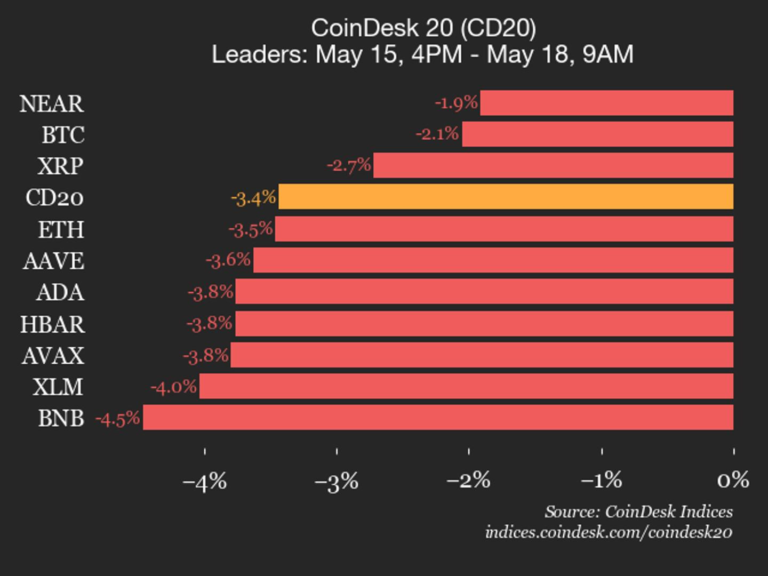
Bittensor (TAO), down 9.6% over the weekend, joined Bitcoin Cash (BCH) as an underperformer.
Bitcoin has shed $5,000 within days. The data says this selloff could worsen

Bitcoin has fallen about 6% from $82,000 to $76,800, but underlying data point to more than routine pullback.
Georgia Primary to Test Crypto PAC’s Support for Democratic Candidate

The Protect Progress, a political action committee (PAC) affiliated with the cryptocurrency company-backed Fairshake PAC, has spent more than $4 million attempting to help secure a win for a Georgia state representative running for the US House of Representatives.
On Tuesday, Georgia voters will decide on their candidate in the primary for the state’s 13th Congressional district, where state representative Jasmine Clark faces competition among Democrats. According to data from the Federal Election Commission, Clark has been the beneficiary of more than $4.2 million in spending on media by the Protect Progress PAC ahead of the primary, as crypto-aligned interest groups attempt to influence voters in key elections.
Source: FEC
Notably, Clark appeared to have deleted a social media post from March saying that “digital assets are the future and provide long-overdue financial tools for unbanked communities,” referencing the US Congress considering a crypto market structure bill. She also completed a questionnaire from the Coinbase-aligned organization Stand With Crypto, which said she was a candidate who “expressed strong support for establishing clear legislative and regulatory frameworks for digital assets in the United States.”
Protect Progress and its affiliates Fairshake and Defend American Jobs are expected to spend millions of dollars in 2026 to support candidates they consider will advance pro-crypto policies and opposing those who don’t. In 2024, Fairshake spent more than $130 million on media and ads, resulting in what Coinbase CEO Brian Armstrong called the “most pro-crypto Congress ever.” Coinbase is a backer of Fairshake.
Related: Crypto PACs spend $7.2M to support candidates in 5 US states ahead of elections
Not every election or party primary has been a winner for Fairshake or crypto interest groups seeking to influence voters. The PAC spent a reported $8 million opposing Illinois Lieutenant Governor Juliana Stratton in her US Senate primary, but in March more than 40% of voters chose her over candidates supported by Fairshake and Protect Progress-backed ads.
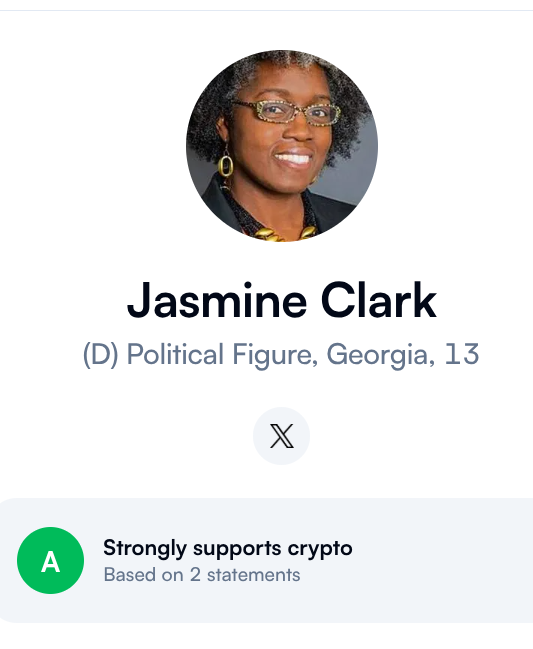
Screenshot of Stand With Crypto’s rating of Jasmine Clark. Source: Stand With Crypto
“From a Stand With Crypto perspective, we are going to do everything we can to give our advocates the tools they need to make sure that they make an informed vote and they’re able to cast their ballot on election day for the candidate that is pro-crypto they care about,” Mason Lynaugh, executive director of Stand With Crypto, told Cointelegraph on the organization’s work in 2026. “If everyone makes their voices heard […] we will have a more pro-crypto Congress than we did this past year.”
Cointelegraph sought a comment from Fairshake ahead of Tuesday’s voting but did not receive an immediate response.
Texas run-off election also getting big spending
Next week, voters in Texas’ 18th Congressional District will head to the ballot boxes to decide between Representative Al Green and Democratic candidate Christian Menefee. Protect Progress reportedly spent more than $1.5 million opposing Green in a March primary, but Menefee only secured 46% of voters compared to Green’s 44%, triggering a runoff on May 26.
FEC filings showed Protect Progress spent more than $2.8 million on media opposing Green, who while in Congress voted against legislation the industry largely supported, including the GENIUS Act and CLARITY Act. The PAC spent about the same amount supporting Menefee, who has publicly supported blockchain technology.
Magazine: The legal battle over who can claim DeFi’s stolen millions
Echo Protocol Hacked for $76.7M in Admin Key Exploit
Decentralized finance protocol Echo Protocol was exploited after an attacker minted about 1,000 unauthorized eBTC on the protocol, which is deployed on the Monad blockchain.
Blockchain security firm PeckShield and analytics platform Lookonchain both reported the incident on Tuesday, noting that a hacker minted 1,000 synthetic Bitcoin (eBTC) worth around $76.7 million.
“We are currently investigating a security incident impacting the Echo bridge on Monad. All cross-chain transactions remain suspended while the investigation is underway,” Echo Protocol said on Tuesday.
This latest exploit comes in a month that has seen at least 12 protocols compromised, including THORChain, Verus Protocol’s Ethereum bridge, Transit Finance, TrustedVolumes and Ekubo.
According to PeckShield, the attacker attempted to launder some of the loot by depositing 45 eBTC worth around $3.45 million into DeFi lending and liquidity management protocol Curvance.
The attacker then borrowed 11.3 wrapped Bitcoin (wBTC) worth $868,000 against it, bridged the tokens to Ethereum, swapped them for ETH, and sent 384 ETH worth about $822,000 to the Tornado Cash mixing service.
The attacker still holds 955 eBTC worth about $73 million, according to DeBank.
Echo Protocol is a Bitcoin DeFi platform focused on Bitcoin liquidity aggregation, liquid staking, restaking, and yield generation. It creates unified, liquid BTC assets such as eBTC for users to bridge and deploy in DeFi for additional yield. The protocol is deployed on Monad, a high-performance, layer-1, EVM-compatible blockchain.
The hacker still holds 95% of the stolen crypto. Source: DeBank
Admin private key compromised
Blockchain developer “Marioo” reported that it was not a smart contract bug, but an admin private key compromise, and the root cause was “operational, not technical.”
The eBTC contract “worked exactly as designed,” they said, adding that the vulnerabilities included a single signature for the admin role, no timelock, no minting supply cap or rate limit, and no “supply sanity check” by Curvance for the freshly minted collateral.
Related: Hackers used AI to craft zero-day attack to bypass 2FA: Google
Curvance reported that it was aware of the “anomaly” detected in the Echo eBTC market on Curvance and confirmed that there was no compromise with its own smart contracts. It paused the affected market for investigation.
Monad co-founder Keone Hon clarified on X that “the Monad network is not affected and is operating normally.”
Meanwhile, Echo Protocol said it will provide updates through its official channels as more information becomes available.
DeFi hacks surge in 2026
The year has been challenging for DeFi security, with dozens of protocols exploited for hundreds of millions in crypto and more than 20 protocols shuttering services.
Two of the largest hacks this year included the exploit of the Drift Protocol, which lost $285 million, and Kelp DAO, which was exploited for $292 million in April.
On Monday, Verus Protocol’s Ethereum bridge was exploited through a fake cross-chain transfer message that allowed a hacker to steal at least $11.6 million in crypto.
Decentralized liquidity protocol THORChain halted trading on Friday after blockchain investigator ZachXBT flagged a suspected $10 million exploit.
Meanwhile, Transit Finance suffered a deprecated smart contract exploit, resulting in the loss of $1.88 million last week.
Magazine: DeFi’s billion-dollar secret: The insiders responsible for hacks
Tom Lee says Ether Pullback was Chance for Bitmine to Buy 71K ETH

Bitmine Immersion Technologies chairman Tom Lee says the crypto treasury company took advantage of a recent Ether price drop under $2,200 to scoop up another 71,672 Ether for its stockpile.
Ether (ETH) has traded between $2,081 and $2,341 over the past seven days. It was trading at $2,128 as of Tuesday and was down 8.7% over the same period.
“Over the past week, we acquired 71,672 ETH. We view the recent pullback of ETH to below $2,200 as an attractive opportunity. Bitmine is expected to reach the alchemy of 5% sometime in 2026,” Lee said on Monday.
Bitmine is the largest Ether treasury company and has consistently bought the token, even during market downturns, in a business model similar to Michael Saylor’s Bitcoin treasury firm, Strategy.
Bitmine’s total treasury holdings stand at more than 5.2 million, with the company’s goal to hold 5% of the token’s circulating supply of 120.7 million. It bought 26,659 Ether between May 4 and May 11, breaking its three-week streak of adding more than 100,000 Ether per week.
It comes amid reports that an Ethereum whale who previously cashed out their Ether also bought the dip over the weekend, making a return to the asset.
Blockchain analytics platform Lookonchain said in an X post Saturday that a whale who bought Ether more than a decade ago and sold their holdings a year ago has started buying again.
Source: Lookonchain
The OG whale purchased 1,951 Ether at $2,182, and Lookonchain speculated “he may keep buying.”
Ether under pressure amid Middle East conflict
Lee said Monday that rising oil prices, which soared after the conflict in the Middle East escalated earlier this year, have been a consistent drag on Ether’s price. He predicted that a reversal in oil prices could lead to Ether recovering.
Ether reached an all-time high of $4,946 in August 2025 but has since fallen about 57%. Analysts have predicted the token could still rise before the end of the year.
Related: Ethereum Foundation hits ‘Glamsterdam’ milestones, names new protocol leads
Financial institution Citigroup predicted in March that Ether could reach $3,175 in the next 12 months. In a bull case, however, it could hit $4,488, driven by stablecoin and tokenization interest and usage.
Meanwhile, CoinGecko, citing prediction market data, speculated that Ether has a 48% chance of ending the year at $1,500 and a 25% chance of ending the year at $3,500.
Earlier this year, banking giant Standard Chartered had a more bullish outlook. Geoffrey Kendrick, the bank’s head of digital assets research, said in a January report that Ether could hit $7,500 by the end of the year, driven by growing adoption of blockchains and onchain products.
Magazine: Guide to the top and emerging global crypto hubs — Mid-2026
World Liberty Financial treasury company AI Financial warns in SEC filing that it may not survive the year

The former Alt5 Sigma marked its 7.28 billion WLFI tokens at $706 million, down from a roughly $1.46 billion cost basis, while disclosing that the holdings remain locked amid liquidity concerns.
Galaxy Wins New York BitLicense for Institutional Crypto Services

Galaxy Digital, a crypto-focused financial services company led by Mike Novogratz, has received a BitLicense and Money Transmission License from the New York State Department of Financial Services (NYDFS), allowing it to expand regulated digital asset services to institutional clients in the state.
The company said Monday that the approvals were granted to its subsidiary, GalaxyOne Prime NY, which provides trading and financing services to institutional investors.
The licenses extend Galaxy’s regulatory reach into New York, one of the most tightly regulated jurisdictions for cryptocurrency businesses in the United States.
In a statement, Novogratz said New York represents the “deepest pool of institutional capital in the country,” and that the approvals will help broaden institutional access to digital assets.
Introduced in 2015, New York’s BitLicense is widely considered one of the most difficult regulatory approvals for crypto companies to obtain because it requires extensive compliance controls related to anti-money laundering, cybersecurity, capital reserves and consumer protection.
Source: Galaxy
As Cointelegraph recently reported, Jack Mallers’ Strike was among the latest high-profile crypto companies to receive approval from the NYDFS, allowing the firm to offer Bitcoin services to residents and businesses in the state.
Related: Crypto funds see $1B in outflows as Iran tensions revive risk-off sentiment
Galaxy posts Q1 loss as data center business expands
The regulatory milestone comes as Galaxy continues to navigate a volatile digital asset market. The company last month reported a net loss of $216 million in the first quarter ended March 31, driven largely by lower digital asset prices, though the result was better than analyst expectations.
Gross revenue totaled $10.2 billion for the quarter, down from $12.9 billion in the same period a year earlier.
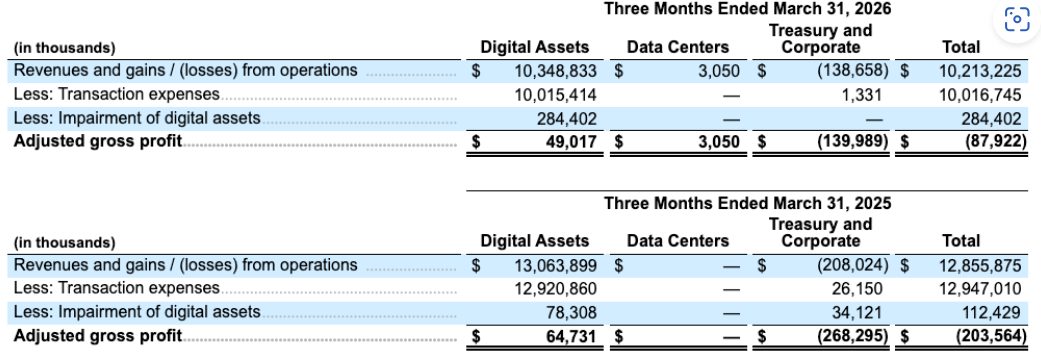
Galaxy’s Q1 2026 financial statement. Source: Galaxy
According to its Q1 earnings report, Galaxy expects growth to accelerate beginning in the current quarter as revenue from its data center business increases.
Like several other companies in the digital asset industry, Galaxy has expanded beyond cryptocurrency trading and investing into data center infrastructure. The company said future growth will be supported by its Helios Data Center campus in Texas and revenue tied to artificial intelligence and high-performance computing workloads.
Related: Galaxy, Sharplink plan $125M institutional DeFi yield fund backed by ETH treasury
XRP slips 2% as profit-taking knocks token back below $1.40
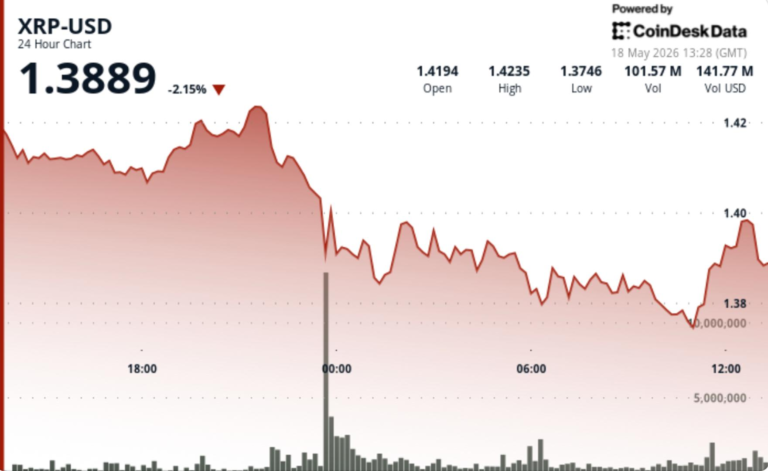
XRP gave back gains after a high-volume selloff erased the latest breakout attempt, though buyers stepped back in near support around $1.38.
Bitcoin Extends Decline Below $78,500 as Bearish Pressure Intensifies

Bitcoin has fallen below $78,500 and is consolidating near the $76,500 support level, with a bearish trend line forming resistance at $77,700 on the hourly chart.
Bitcoin extended losses on May 18, trading below $78,000 and failing to hold above the $78,500 zone. The cryptocurrency is now consolidating near the $76,500 support level, with downside pressure building as BTC trades below its 100 hourly simple moving average.
On the BTC/USD hourly chart, a bearish trend line has formed with resistance at $77,700. Analysts tracking the asset note that Bitcoin may extend further losses if it remains below both the $77,700 and $78,500 levels, signaling potential continued weakness in the near term.
This article was produced with the help of AI flows.
Kraken parent Payward's Q1 revenue climbs despite crypto market slump

Co-CEO Arjun Sethi said the firm kept investing through market weakness, leaning on acquisitions and futures growth to offset softer spot trading.