Home Blog Page 267

The battle for the digital euro is heating up as central bankers clash over how to take on Tether

0

France’s central bank deputy governor called Tuesday for the “mobilization of all relevant European players, public and private,” to develop tokenized money.

Beau’s comments are in stark contrast with European Central Bank (ECB) President Christine Lagarde’s recent speech in which she said that “the case for promoting euro-denominated stablecoins is far weaker than it appears.”

While Lagarde described the $310 billion privately-issued stablecoin market, currently dominated by Tether’s USDT and Circle’s USDC, as instruments that “risk amplifying the very vulnerabilities we are trying to overcome,” Beau told CoinDesk that private sector solutions are necessary for the region’s economic development.

The different views, however, reveal a growing concern in Europe over the “digital dollarization.” With a stablecoin sector projected to rise to the trillions of dollars in the coming years, a lack of euro-pegged currencies could force European capital into dollar-backed assets, potentially eroding the euro’s global influence and monetary sovereignty.

“To ensure a sound development of tokenized finance in Europe, its payment and settlement asset pillar should be in euro and build on the solid foundation of our current two-tier monetary system,” Beau said in an interview with CoinDesk.

The central banker outlined a “triple objective” for the region, which requires the European Union (EU) to adapt central bank money services, develop “pan-European solutions in tokenized private money issued by regulated financial institutions,” and strengthen the bloc’s Markets in Crypto-Assets Regulation (MiCA).

Beau’s stance aligns with Qivalis

Beau’s stance aligns with Qivalis, a group of 12 major European banks, including ING, BBVA, and BNP Paribas, which plans to launch a private digital euro later this year.

Qivalis CEO Jan-Oliver Sell recently told CoinDesk that without a liquid onchain euro, “the only alternative is the U.S. dollar,” which he described as a “risk to Europe’s financial and digital sovereignty.”

Lagarde agrees with the need for digital asset alternatives to dollar-pegged stablecoins, warning that USDT and USDC pose “financial stability risks” for Europe and could “transmit stress to the underlying asset markets during periods of turmoil.”

However, while Beau advocates for immediate private-sector mobilization to capture market share, Lagarde favors a central bank digital euro, which in previous statements she suggested would be ready by 2029.

Beau noted that the Eurosystem is already moving to provide native settlement options. “A first deliverable will become available by the end of this year, with the opening of our wholesale central bank money service in tokenized form,” he said, referencing projects such as Pontes.

The opposing views between Lagarde and Beau come as U.S. dollar-pegged tokens account for 98% of the stablecoin market.

While Lagarde argues that stablecoins, “do not confer the unconditional finality that central money does,” Beau maintains that public and private efforts “should complement and support each other” to ensure the euro remains a viable settlement instrument in an increasingly tokenized global economy.

Senate Confirms Bitcoin-Friendly Kevin Warsh To Fed Board, Clearing Path To Chairmanship

0

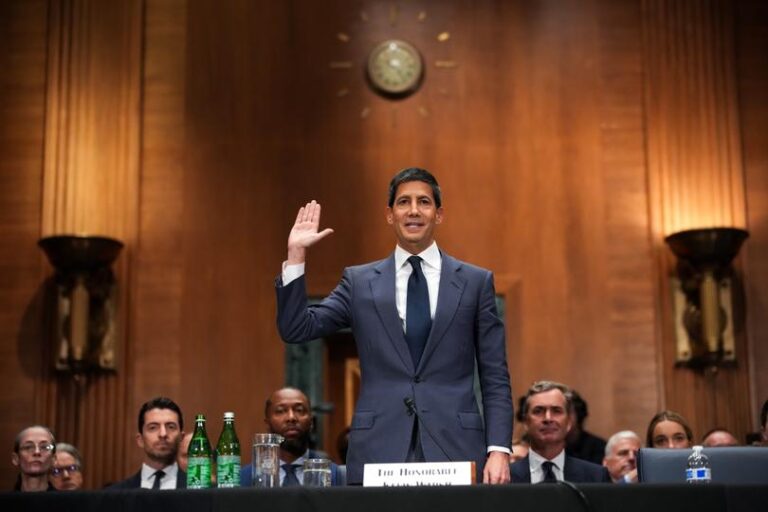
President Donald Trump’s push to install Kevin Warsh as the next chair of the Federal Reserve moved closer to completion Tuesday after the Senate confirmed him to the Fed’s Board of Governors, a step that clears the path for a final vote on the chairmanship later this week.

The Senate approved Warsh in a 51-45 vote that fell along party lines, with Sen. John Fetterman joining Republicans in support of the nominee. If confirmed as chair, Warsh would replace Jerome Powell, whose term leading the central bank ends Friday.

Warsh’s rise has drawn attention across financial markets and the Bitcoin industry because of his public support for bitcoin and his ties to crypto-related firms. 

Warsh’s consideration of bitcoin

Unlike past Fed leaders who treated digital assets with skepticism, Warsh has described bitcoin as “an important asset” and “a very good policeman for policy,” arguing that its price can reflect confidence in the Federal Reserve’s handling of inflation and monetary policy.

“Bitcoin doesn’t trouble me,” Warsh said during a Hoover Institution event last year, where he framed the asset as a signal of monetary credibility rather than a threat to the U.S. dollar.

His confirmation follows financial disclosures showing Warsh held an equity stake in Flashnet, a Bitcoin payments startup focused on lightning-style transaction infrastructure for merchants and fintech companies. The disclosure marked one of the clearest links yet between a potential Federal Reserve chair and a company tied to Bitcoin adoption.

Warsh has also maintained ties to the crypto sector through advisory work and investments connected to digital asset firms, including crypto index manager Bitwise and stablecoin project Basis.

At the same time, Warsh remains known as an inflation hawk. During his earlier tenure as a Fed governor from 2006 to 2011, he warned about inflation risks and criticized loose monetary policy following the financial crisis. 

Recent comments calling for “regime change” at the Fed and signaling openness to lower interest rates have created debate among investors over how he would balance inflation concerns with pressure from the White House.

Markets now face a Fed transition during a period of renewed inflation pressure, rising geopolitical tensions and uncertainty around future rate policy. 

Bitcoin traders and crypto investors are watching closely to see whether Warsh’s views on digital assets translate into a shift in tone from the nation’s most powerful financial institution.

Kraken Launches Flexline, Crypto-Backed Lending Product for Builders and Traders

0

Kraken introduced Flexline, a lending product that accepts cryptocurrency as collateral at 10–25% APR fixed rates, targeting crypto-native businesses and high-net-worth individuals excluded from traditional banking.

Kraken announced Flexline, a lending product designed for crypto holders who lack access to traditional credit markets. The service offers fixed APR rates between 10–25% and accepts cryptocurrency as collateral—a treatment traditional lenders do not provide. Flexline targets two use cases: working capital for operational needs and proof-of-funds verification for significant transactions.

Crypto-native businesses and high-net-worth individuals often hold substantial digital asset balances but cannot leverage them with conventional lenders, which do not recognize crypto as collateral. Flexline addresses this gap by structuring loan terms that reflect how cryptocurrency balance sheets actually function, providing speed and collateral treatment unavailable in traditional finance.

Sources: Kraken Blog | Kraken Flexline Product Page

This article was generated automatically by The Defiant’s AI news system from publicly available sources.

When Process Breaks Down, Fraud Finds a Way: Through Invoices, Expenses or Both!

0

The cost of this fraud? 1% of the subsidiary’s annual turnover (over 8 years). It could have been halted before it got started by flagging bank deposits that do not have a corresponding accounting entry.

What is Invoices/Expenses Fraud & How Does it Work?

This type of invoice/expenses fraud is a structural risk that is often underestimated. The duration of exposure is as decisive as the unit amount embezzled, which in this instance was carried out over eight financial years and cost 1% of the subsidiary’s annual turnover. In this case, the mechanism was simple but invisible to the naked eye: a customer payment deposited in the bank was never recorded in the accounts, while a fictitious expense report, validated internally, reimbursed the same amount to the accountant.

In this case study we’re entering accounting mechanics. The subsidiary had a very small accounting team, and the chief accountant had the ability to process payments himself. The Group also used an external service provider to manage expense reports.

The issue with such providers is that their role is generally limited to checking that receipts exist. They don’t know the company’s internal rules, nor can they challenge the validity or appropriateness of the expenses submitted.

Eight years of fraudulent activity

Here’s what happened: several clients were paying their invoices normally, but these payments were not recorded in the accounting system. At the same time, the chief accountant was submitting expense reports, which were approved by the external provider. He then reimbursed himself using the funds received from clients’ payments that had never been booked. The amounts appeared on the bank statements but not in the accounts.

During each monthly close, adjusting entries were posted to artificially record the client payments, then reversed the following month. This allowed the fraud to keep rolling smoothly from one month to the next. And it went on for eight years.

Why wasn’t it detected sooner?

Fraud can rumble on for many months, if not years before it’s detected. Some of the issues in this
case were:

  • There was no proper internal process to validate expense reports.
  • Bank account access was extremely restricted, and the chief accountant could authorise payments himself.
  • Bank reconciliations were performed very infrequently — and unsurprisingly, by the chief accountant himself.
  • No independent review of the accounts receivable ledger was ever performed: not by controlling, not by internal control teams, not by internal audit.
  • With all these weaknesses combined, the fraud mechanism could operate comfortably and remain unnoticed for many years.
What can organisations do to prevent this type of fraud?

One of the issues with this type of fraud is the length of time it can go on for. The company is being systematically weakened by poor processes; no expense report, restricted access to bank accounts and infrequent reconciliation. This can be caused by siloisation; the concentration of responsibility in one person. The opportunity for fraud is revealed and rationalisation follows because of a lack of oversight.

Two Ways to Prevent Invoice/Expenses Fraud:

  • Improve validation processes with proper verification
    At the heart of this fraud were two flawed manual processes: the recording of customer receipts, which was often delayed or handled inconsistently, and the validation of expense reports, which were approved by management without verification of supporting documents or reconciliation with other flows. By automating the monitoring of bank reconciliations and integrating specific controls on expense reports, the organisation could have closed both of these windows of opportunity simultaneously.
  • Making fraud untenable through traceability and transparency
    For eight years, the chief accountant was able to maintain this fraud because he was the only one with a complete view of the flows. To avoid this, organisations can use advanced technical solutions to redistribute visibility via a fully collaborative platform. In this environment, recurring monthly closing manipulations would be immediately flagged as points of attention, such as over-the-counter reversals on the 1st of the month to hide cash receipts.
How to Spot and Prevent Invoice/Expenses Fraud
  • Monitoring reversal patterns and closing manual adjustments
    Improve analyses of the recurrence and logic of various manual adjustments. A systematic reversal on the 1st of the following month, applied to the same amounts and the same accounts, may constitute an accounting anomaly that a platform immediately flags as a priority alert. This type of monthly closing manipulation should be one of the indicators covered by the organisation’s controls.
  • Cross-checks on expense reports Organisations can build customised control programmes for expense reports. For example they can choose to identify validators who systematically approve the same people or who validate their own expense reports. Analyses of the descriptions of these entries can sometimes be very useful. We have found that attempts to conceal fraud are often what make it most obvious to detect.
Stop it; before it starts

Sharing approval processes, and more generally, ensuring a proper segregation of duties whenever there is a cash output, can deter fraud. A sense of impunity is created when processes sit in silos and critical changes depend on a single individual. Strengthening controls and connecting finance, procurement and audit data flows reduces that space, where fraud thrives. With structured workflows, shared visibility and automated monitoring, fraudulent actions become detectable early and therefore far riskier for anyone tempted to act.

It’s time to improve your organisation’s controls and remove isolated decision points, to reduce both the opportunity and the rationalisation that make fraud possible. Don’t let fraud run unnoticed in your organisation for years.

  • As the UK Country Manager for SixthFin and a leader at BM&A, Olivier Cornet leverages over 20 years of B2B SaaS expertise to simplify complex regulatory landscapes like UK SOX and ECCTA. He specializes in RegTech innovation, helping international organizations transform compliance requirements into drivers of operational performance.

    View all posts


    UK Country Manager, SixthFin

Square Crosses 1 Million Bitcoin-Enabled Merchants As Real-World Adoption Continues To Grow

0

Block Inc.’s (XYZ) Square has crossed a threshold of roughly 1 million merchants now enabled to accept Bitcoin payments.

The figure, cited by a member of Block’s team, reflects a wave of auto-enrollment that began March 30, when Square automatically switched on BTC payments by default for eligible U.S. sellers.

At its peak pace, a new business was activating the feature every eight seconds. The rollout is powered by the Lightning Network, enabling near-instant settlement while merchants receive U.S. dollars by default, removing currency risk from the equation.

In other words, customers can pay in Bitcoin via Lightning while merchants still receive USD settlements, with the system handling conversion in the background and allowing sellers to opt out if needed.

Bitcoin as everyday money

At the Bitcoin Conference in Las Vegas, Block outlined an expanded push to make bitcoin usable as everyday money rather than simply a long-term investment. Speaking on the Nakamoto Stage, Bitcoin Product Lead Miles Suter said BTC “must circulate, not just sit still,” arguing that the cryptocurrency loses its transformational value if it does not function as peer-to-peer cash.

Suter highlighted Block’s growing adoption metrics, revealing at the time that there were more than 800,000 Square merchants who now have BTC payments auto-enrollment enabled. This number seems to be above According to Suter, a new business activates the feature every eight seconds. The company is also rolling out a tap-to-pay BTC feature using NFC hardware and the Lightning Network, eliminating QR codes and offering zero processing fees through 2026.

The company’s broader strategy centers on integrating bitcoin across its ecosystem. Cash App users can now automatically convert peer-to-peer payments into BTC, earn 5% Bitcoin Back rewards at Square merchants, and withdraw up to $10,000 per day and $25,000 per week. 

Block also introduced an updated Bitkey hardware wallet featuring a touchscreen and 2-of-3 multisig security model designed to simplify self-custody.

Alongside the product announcements, Block released its Q1 2026 proof-of-reserves report showing holdings of 28,355.05 BTC worth roughly $2.2 billion.

Wintermute Sounds Alarm: Bitcoin Surge A Short Squeeze, Not Sustainable Growth

0

Trusted Editorial content, reviewed by leading industry experts and seasoned editors. Ad Disclosure

Following last week’s Bitcoin (BTC) surge to $83,000, the market is now facing a tougher test: whether $80,000 can hold as real support. Market maker Wintermute, in its latest digital asset report, said the move carries a warning label—“…The way it got here tells you to be cautious rather than euphoric.”

Why Retrace Risks Remain

Wintermute pointed to indicators that, in its view, don’t align with what typically confirms a healthy breakout. The move was accompanied by a roughly $10 billion jump in open interest (OI) and the lowest spot volumes in two years—a combination the report described as the opposite of the conditions that typically validate bullish continuation in spot markets. 

The firm also argued that bull markets are generally confirmed by spot demand, not by derivatives-driven pressure. In this case, the lift came primarily from perpetual (perps) activity, which it described as a different—and more risky—mechanism.

Wintermute also cautioned that short-covering is not the same thing as conviction buying. It added that funding remains predominantly short, implying more short-squeeze dynamics could still be possible. 

Even so, the firm’s concern is that the market could give back gains unless spot buyers step in once the squeeze fades. In its framing, the longer-term picture may be steadier, but the near-term driver looks suspect—meaning a retracement could follow quickly if spot doesn’t support the higher levels.

$80,000 Is The Key For Bitcoin 

Despite the skepticism around the short-term structure, Wintermute highlighted several longer-term factors it considers more constructive. 

It pointed to Bitcoin exchange-traded fund (ETF) flows adding $623 million, and noted that Morgan Stanley’s new Bitcoin ETF pulled in $194 million in its first month without experiencing a single day of outflows. 

The report also referenced exchange reserves remaining at seven-year lows, calling it a sign that the accumulation story is still intact. Wintermute’s view, however, is that the bullish case is currently being carried more by institutional and supply-side support than by broad, organic spot participation. 

Wintermute also offered a technical and momentum warning. With Bitcoin’s relative strength index (RSI) entering overbought territory, the firm suggested that while grinding toward $85,000 is possible, the risk-reward for chasing at these levels is not attractive. 

The report also added a macro layer to the risk. It said equities are currently driving crypto, and if Consumer Price Index (CPI) prints hot or if the Warsh transition creates uncertainty, the equity-led tailwind could stall. 

In that scenario, the firm suggested that Bircoin holding above $80,000 through a macro shock would be a clearer confirmation that the move is more than just a leverage-driven squeeze. 

Bitcoin
The daily chart shows BTC’s attempt to hold $80,000 as support on Tuesday. Source: BTCUSDT on TradingView.com

At the time of writing, Bitcoin is attempting to consolidate just above the $80,800 level, while still holding onto gains of 14% over the past month despite the retrace from $83,000, according to CoinGecko data

Featured image created with OpenArt, chart from TradingView.com 

Editorial Process for bitcoinist is centered on delivering thoroughly researched, accurate, and unbiased content. We uphold strict sourcing standards, and each page undergoes diligent review by our team of top technology experts and seasoned editors. This process ensures the integrity, relevance, and value of our content for our readers.

From Listening to Launching: Inside Temenos Community Forum 2026

0

At Temenos Community Forum 2026, the conversation moved quickly from core modernisation to deterministic AI, conversational banking and whether banks can make serious use of agents without losing control.

Held at the Bella Center in Copenhagen from 5 to 7 May, this year’s TCF brought together more than 1,300 people from across Temenos’ customer base, technology partners and wider banking community.

The theme was ‘Trust. Modernise. Transcend.’, which did sound, at first, like conference language doing conference language things. But across the two days, the order of those words became the point.

Temenos wanted to talk about the bank of tomorrow. Banks still needed to know how they get there without disturbing the bank of today.

Takis Spiliopoulos, opening his first TCF as chief executive of Temenos, put that tension neatly. “Modern banking demands two things to coexist,” he said. “First, absolute stability. Second, constant evolution.”

That line sat behind much of the event. AI may have been the headline technology, but the conversations kept coming back to more familiar banking concerns: resilience, regulatory comfort, implementation risk, data quality and the cost of keeping old systems alive.

From listening to showing

Barb Morgan, chief product and technology officer at Temenos, picked up the message from last year directly. In Madrid, she had told attendees that Temenos would build less, but build it better. In Copenhagen, the company wanted to show the receipts.

Morgan told attendees they would see 22 products across the two days. “Build less” and “22 products” do not look like natural best friends, but she tackled that point in a press briefing, saying the discipline still applies, particularly around AI.

“There are a lot of tools out there,” she said. “We will go as fast as we can responsibly go. Those that were here last year may remember I said we’re going to build less, but we’re going to build it better. Same concept applies.”

On stage, Morgan made a similar point about hype and product reality.

“We aren’t going to talk about hype,” Morgan told attendees. “We will only talk about products that are real.”

By ‘real’, she meant products that are live, in private preview, or being actively co-developed with customers with a target to reach general availability within six months. It was a useful bit of stage housekeeping, because TCF 2026 had a lot to get through.

So, what launched?

Temenos announced an expansion of its SaaS offering on Amazon Web Services, adding digital banking and payments to its existing core banking SaaS on AWS. It also announced new composable retail deposits and retail lending capabilities, designed to let banks modernise specific areas of the core without taking on a full replacement programme.

There were customer announcements too. First Abu Dhabi Bank extended its collaboration with Temenos in Saudi Arabia, Reliance Bank selected Temenos SaaS for its digital transformation, and Pakistan’s HBL went live on Temenos Core Banking in the first phase of a programme that is expected to cover more than 40 million accounts once fully rolled out.

Then came the AI announcements: Conversational Studio for Digital, Temenos Copilot for Workbench, Temenos Copilot for Core for branch manager and branch officer personas, and the Temenos FCM AI Agent for Instant Payments. In plain English, Temenos is trying to put AI into the systems banks already use, rather than ask them to bolt another clever layer onto already complicated architecture.

AI grows up, slightly

AI was everywhere at TCF 2026, obviously. By this point, a banking technology conference without agents, copilots or a knowledge graph would feel almost rebellious.

But the tone was different from last year. Sai Rangachari, chief product officer at Temenos, said banks are now having more specific AI conversations than they were 12 months ago.

“People are way more educated on AI now than last year,” he said. “Last year it was just there. We had to talk about it. Everyone talked about it, but not everyone really understood what they were talking about.”

This year, he said, more banks have experimented and have a clearer idea of where AI might help.

“There are real conversations happening around: what are you doing about this problem?”

That was probably the more useful AI thread at TCF. Not AI as a glossy replacement for banking work, but AI pointed at dull, expensive, recurring problems: sanctions alerts, reconciliation, upgrades, product configuration, software delivery and customer service.

Will Moroney, chief revenue officer at Temenos, made a similar point in a press briefing. AI, he suggested, is now forcing conversations with banks that once seemed unlikely to move.

“There are certain banks you just would write off as a vendor like ours,” he said. “We’d say, well, they’re never going to change their core.”

That assumption is harder to hold now, he argued, because AI needs modern data structures, cleaner architecture and systems that can support explainable, auditable decisions. Or, as he put it more directly: “The large banks have now realised that they can’t get on the AI train unless they really do modernise.”

Data, governance and the unglamorous bits

A technology partner panel on day two made the same point from a different angle. Moderated by Rangachari, the session brought together Sebastian Weir, AI transformation leader at IBM Consulting EMEA; Dr Jochen Papenbrock, EMEA head of financial technology at Nvidia; and Shireesh Thota, corporate vice president, Azure Databases at Microsoft.

It could easily have become another ‘AI will change everything’ panel. Instead, some of the strongest comments were about the less glamorous work needed to make AI usable in banking.

Weir warned against chasing whatever frontier model happens to be fashionable that week. “It’s very easy to get distracted with the latest development, the latest frontier technology,” he said, “but that’s not where change sits.”

Thota was even blunter on data. “There’s no AI without data,” he said, adding that banks need real-time operational context, clear knowledge structures and trust in the way data is used.

Without that, he warned, “your AI is going to hallucinate, and you’re going to get lots of wrong answers – very confident but absolutely nonsensical answers.”

It was one of the better lines of the event, partly because it cut through the polished AI language. Banking does not have much room for confident nonsense.

Modernisation, but not the big-bang kind

The other major theme was progressive modernisation. That phrase appeared often enough across the event to deserve its own bingo card, but the basic idea is not complicated: banks want to change without detonating the systems they still depend on.

Morgan said Temenos is seeing more appetite for composability because large, all-in-one modernisation projects carry too much speed and complexity risk. Moroney made the same point from the commercial side, saying banks are increasingly looking at sidecars, call-outs or product-by-product migration.

“It used to be acceptable that 60 or 70 per cent of your budget went to keeping the lights on,” he said. “That’s not acceptable anymore.”

That line gets to much of the urgency. Banks want AI, better customer journeys and faster product launches, but many still spend too much money maintaining old systems. The modernisation story at TCF 2026 was not about a clean jump from old to new. It was about coexistence, sequencing and trying to avoid the kind of project that everyone fears before it has even begun.

Temenos

Around the conference floor

Away from the main stage, the event moved into The Hive, where attendees could get closer to the demos, partner stands and product teams. It was also home to the Temenos Community Kilometre Challenge, where delegates could ride stationary bikes to raise money for Hack Your Future.

The staging had a softer touch than the usual wall-of-screens tech setup too, with a fine, almost web-like backdrop made from what I was told was Choucroute. Event materials are not my specialist subject, but it felt more considered than the usual plastic-and-LED glare.

A very Copenhagen ending

TCF also had its more theatrical moments. There was also a gala dinner at Øksnehallen, a former market hall in Copenhagen’s Vesterbro district and part of the city’s Brown Meat District.

In keeping with the Danish setting, the evening leaned into full storybook staging: magical woods, canapés hanging from trees, aerial performers on silks and an amazing ballet dancer in red shoes. Let’s hope that, unlike the girl in Hans Christian Andersen’s dark fairy tale, she was not forced to dance endlessly too.

There is probably a banking transformation metaphor in there somewhere, although not one any vendor would choose too eagerly.

Temenos TCF 2026

For Temenos, TCF 2026 was a clear attempt to move on from last year’s listening message and show more evidence of delivery. The event was bigger, busier and more product-heavy. It also showed how much work sits behind the easier slogans around AI and modernisation.

The bank of tomorrow may well involve agents, copilots and conversational interfaces. But in Copenhagen, the more grounded message was that banks still need trust, control and a way to modernise without asking everyone involved to perform acrobatics.

Next stop for TCF…. Prague in 2027.

Bitcoin ETF inflows may reshape its bear market correction: Analyst

0

Bitcoin (BTC) is currently down 36% from its all-time high at $126,000, but one analyst claims that BTC’s fourth bear market has “materially decoupled” from previous bearish cycles, due to exchange-traded fund (ETF) inflows and corporate BTC accumulation.

Bitcoin ETF flows and treasury buys may limit further downside

Bitcoin Bond Company CEO Pierre Rochard compared Bitcoin’s drawdowns across previous market cycles and said the current correction looks different from the past bear markets. The 2013–2015 cycle wiped out roughly 85% of Bitcoin’s value, while the 2017–2018 and 2021–2022 cycles saw declines of nearly 77% before the price bottomed.

The current dip has been relatively smaller. Bitcoin fell to around $60,000 from its all-time high near $126,000, marking a decline of about 52%.

Bitcoin drawdown analysis across different market cycles by Pierre Rochard. Source: X

Rochard explained that Bitcoin ETFs have become a new source of demand over the past two years. US-listed spot Bitcoin ETFs have recorded cumulative net inflows of more than $59 billion since launch, including $4.5 billion since March.

Corporate Bitcoin buying has also picked up. Strategy increased its Bitcoin holdings to 818,869 BTC from 640,031 BTC in October 2025, adding nearly 179,000 BTC. The company’s average purchase price is around $75,543.

Strategy BTC holdings. Source: bitcointreasuries.net

According to Rochard, ETF investors and corporate treasury firms are now providing consistent demand that did not exist during the 2018 and 2022 bear markets.

MN Capital founder Michaël van de Poppe agreed that the current market environment no longer resembles the 2022 cycle. Van de Poppe said,

“The most overcrowded thesis right now is that Bitcoin makes a bear flag and that we’re going to bottom out in October ’26.”

Van de Poppe pointed to several factors that make this cycle different, including fresh Nasdaq highs at 29,372 on Monday, the upcoming legislative vote on the CLARITY Act, discussions around a strategic Bitcoin reserve, and the appointment of a new Federal Reserve chair.

Related: Bitcoin funding rates turn positive: Is BTC rally to $85K next?

BTC retail demand starts recovering

Crypto analyst MorenoDV noted that Bitcoin recently flashed its first “early bull” signal since March 2023 using CryptoQuant’s Bull-Bear Market Cycle indicator. The indicator tracks whether the market is shifting toward a bullish or bearish phase by analyzing price momentum and moving averages.

Bitcoin bull-bear market cycle indicator. Source: CryptoQuant

MorenoDV said similar signals appeared in 2019 and early 2023 before Bitcoin rallied 1280% and 461%, respectively. However, the latest signal still needs stronger price confirmation. MorenoDV said,

“Several other market metrics are already showing signs of exhaustion. That makes this signal less clean than a classic early-cycle confirmation.”

Onchain data also showed signs that smaller investors are returning to the market after activity dropped throughout April. Bitcoin researcher Axel Adler Jr. tracked the 30-day change in Bitcoin transaction volume from wallets holding between $0 and $10,000, which is often used to measure the retail investor participation.

Bitcoin retail investor demand. Source: Axel Adler Jr

The metric dropped to -8.2% on April 5 before recovering into positive territory later in the month. It reached 6.31% on May 6 and remained near 4.38% on May 12 while Bitcoin traded at $80,625.

The retail transfer volume increased slightly to $351 million from $336 million in mid-April. However, Adler Jr. said the activity remains below February levels, when volumes ranged from $365 million to $375 million. 

As Cointelegraph reported, there are increasing signs that the early stages of a new bull market are underway.

Related: Strategy resumes Bitcoin acquisitions with $43M BTC buy

BlackRock Files for New Tokenized Fund With SEC, Taps Securitize Again

0

BlackRock has filed for a new tokenized fund structure with the SEC, selecting Securitize infrastructure for the second time after BUIDL’s $2.3B success.

BlackRock has filed with the SEC for a new tokenized fund structure and selected Securitize to power the infrastructure for a second time. The filing comes after the success of BUIDL, BlackRock’s first tokenized fund launched with Securitize in 2024, which has grown to approximately $2.3B in assets. The new filing outlines a model where blockchain-based ownership records integrate with regulated transfer agency and investor onboarding systems.

BUIDL’s growth has accelerated institutional adoption of tokenized finance since its 2024 launch. BlackRock’s continued partnership with Securitize for this new offering signals sustained institutional momentum in on-chain asset tokenization.

Sources: Securitize | Securitize

This article was generated automatically by The Defiant’s AI news system from publicly available sources.

Visa flexible credential brings more flexible ways to pay to Zilch cardholders in the UK

0

Visa, Zilch and Thredd collaborate to help issuers deliver a simpler, more flexible card experience for users.

Visa, a world leader in digital payments, Zilch and Thredd today announced the introduction of Visa Flexible Credential (VFC) on Zilch cards in the UK, enabling more flexible ways to pay through a single, familiar card experience.

By bringing together Visa’s network capabilities, Zilch’s customer-focused proposition and Thredd’s issuer processing platform, the collaboration demonstrates the power of partnerships to deliver new experiences at scale.Share

Demand for flexible payment experiences continues to grow. Many people no longer think in fixed terms such as debit or credit, instead wanting the ability to choose what works best for a specific purchase in the moment. In the UK, 87% of people surveyed say flexible payment options support their financial or lifestyle goals1. Visa Flexible Credential is designed to support this shift, helping issuers offer more choice through one familiar card that already works at more than 150 million merchant locations worldwide.

The new capability allows different payment options to sit behind one card or digital credential, giving cardholders greater choice and control while preserving the familiarity of tapping or paying as they always have.

Visa Flexible Credential is designed to support evolving expectations while preserving the simplicity, security and trust of card payments. By bringing together Visa’s network capabilities, Zilch’s customer-focused proposition and Thredd’s issuer processing platform, the collaboration demonstrates the power of partnerships to deliver new experiences at scale.

For Zilch users, the launch supports a smoother, more unified payment experience, with options handled seamlessly in the background and no need to manage multiple cards or credentials. Thredd plays a key role in enabling Visa Flexible Credential, supporting routing and processing behind the scenes and helping issuers and fintechs bring the capability to market efficiently.

“This is exactly the kind of innovation we aim to unlock for our clients,” said Jim McCarthy, CEO at Thredd. “By partnering with Zilch and Visa, we’re pushing the boundaries of what issuer processing can enable, bringing cutting-edge capabilities to market at speed and helping our clients scale into their next phase of growth.”

“Zilch’s promise is to provide everyone with a smarter way to spend. Visa’s Flexible Credential is a major capability in fulfilling that promise,” said Sean Hederman, Chief Technology Officer at Zilch. “Our work with Thredd and Visa creates better outcomes for users and merchants by intelligently routing backend processes that enhance the Zilch experience for customers, flexibly and seamlessly, and where every purchase is financed, optimised and rewarded in real time.”

“People increasingly want more flexibility and control over how they pay – particularly as their needs and circumstances change over time,” said Mathieu Altwegg, Head of Product and Solutions, Visa Europe. “Visa Flexible Credential gives issuers a simple way to offer that choice through one familiar card, while keeping the ease, security and global acceptance people already trust Visa for.”