
A judge stayed the CFTC’s civil case against a soldier who allegedly used nonpublic information for a Polymarket bet, but the regulator is trying to weigh in on the criminal case.

A judge stayed the CFTC’s civil case against a soldier who allegedly used nonpublic information for a Polymarket bet, but the regulator is trying to weigh in on the criminal case.
Tom Lee’s Bitmine Immersion Technologies continued its accumulation of Ether last week, adding to its holdings as the cryptocurrency staged a sharp breakout following a prolonged downturn.
The company disclosed Monday that it purchased 32,447 Ether (ETH) last week, bringing its total holdings to 5,847,611 ETH, or roughly 4.8% of Ethereum’s circulating supply. Bitmine has acquired ETH every week since launching its Ethereum treasury strategy on June 30, 2025, extending its buying streak to roughly 14 months.
The company’s NYSE-traded shares were up about 8.7% to open the week, poised to extend their almost 28% gains over the past six months.
Bitmine is now 97% of the way toward its stated goal of owning 5% of the ETH supply. It has also staked 5.07 million ETH, representing about 87% of its holdings, and reported combined crypto, cash, securities and other investments of $14.9 billion.
The latest purchase coincided with a sharp rally across Ether and the broader cryptocurrency market. ETH has outperformed Bitcoin since last Wednesday, when the US Treasury announced plans to double its monthly purchases of certain longer-dated US Treasurys to $4 billion from $2 billion beginning next month.
Ether has gained more than 32% since the announcement, breaking above $2,500 for the first time since January, according to CoinMarketCap data.
Related: Crypto Biz: Treasury’s ‘Not-QE’ playbook sends Bitcoin higher
Bitmine’s aggressive Ether purchases during the market downturn left the company sitting on steep unrealized losses as ETH prices continued to fall. However, the cryptocurrency’s recent recovery has significantly narrowed that shortfall.
Bitmine has invested more than $19.5 billion in its Ether treasury, with its paper losses falling to below $5 billion from more than $8.4 billion roughly a week ago, according to DropsTab data.
Bitmine’s unrealized losses on its ETH holdings have narrowed amid the market recovery. Source: DropsTab
The sharp swings highlight the challenges of managing digital asset treasuries, whose valuations can fluctuate significantly with changing market conditions.
Related: Ethereum Foundation warns some tools may break with Glamsterdam upgrade

The company sold 18.26 million MSTR shares, increased its USD Reserve to $5.1 billion and repurchased another $136.4 million of STRC.

Przemysław Kral, the head of the collapsed cryptocurrency exchange Zondacrypto, has reportedly been charged with participating in an alleged large-scale fraud and has begun cooperating with Polish prosecutors.
Kral is seeking a reduced sentence in exchange for testimony that could include details about Zondacrypto’s funding of right-wing politicians, Polish outlet Onet reported Monday.
According to Onet, prosecutors estimate Zondacrypto customers lost at least 2.4 billion Polish zlotys ($650 million). Investigators said the exchange used only part of customer funds to buy crypto, while the rest was transferred to private accounts controlled by Zondacrypto managers.
Onet reported Friday that Kral had been negotiating the terms of possible cooperation with prosecutors for six months. He reportedly held informal meetings with prosecutors in Poland, Sicily and Persian Gulf countries to discuss a potential deal.
Kral has remained silent on X since publicly disclosing in mid-April that Zondacrypto could not access a cold wallet holding about 4,500 Bitcoin. He has denied accusations of misappropriating funds and said the wallet’s private keys were supposed to have been transferred by Zonda founder and former CEO Sylwester Suszek, who has been missing since 2022.
Zondacrypto was the main sponsor of the Conservative Political Action Conference (CPAC) held in Poland days before the second round of the presidential election won by Karol Nawrocki. The exchange spent 37 million zlotys on advertising with broadcaster Telewizja Republika in its final year, while companies owned by Kral made payments to foundations linked to politicians Zbigniew Ziobro and Przemysław Wipler.
Cointelegraph was unable to reach Kral or Zondacrypto for comment. Their email addresses have been unavailable since Kral’s April disclosure that the exchange could not access the Bitcoin wallet.
Related: Zondacrypto CEO goes off radar as Poland probe deepens

Analysts say consolidation could strengthen bitcoin’s rally, while thin trading above $80,000 may set up sharper price moves.
The crypto exchange is starting with tokenized versions of Apple, Nvidia, Meta and Alphabet, issued under its new Abu Dhabi framework.

Stand With Crypto, a member group that rates the crypto friendliness of politicians, is supporting 32 U.S. House incumbents, with more endorsements coming.

The Crypto Council for Innovation (CCI) and Blockchain Association (BA) filed a lawsuit against Illinois officials regarding the state’s 0.2% tax on cryptocurrency, expected to be enforced starting in January 2027.
In a lawsuit filed Friday in the Circuit Court of the Seventh Judicial Circuit for Sangamon County, lawyers for the two crypto advocacy groups challenged Illinois’ digital asset tax on the grounds it violated the US Constitution, the state’s constitution, federal and state due process laws and the federal Internet Tax Freedom Act. Illinois Governor JB Pritzker signed the measure into law as a “privilege tax” in June as part of the state’s fiscal year 2027 budget, requiring crypto users to be taxed as applied to transaction volume rather than income.
On the due process claim, CCI and BA argued that the tax was “unconstitutionally vague” by placing the burden on residents and brokers “under the threat of serious civil and criminal penalties” to determine what and how such assets were taxed. Notably, the crypto organizations’ arguments under the US Constitution were based on alleged violations of the Commerce Clause covering interstate commerce, claiming that the state tax “creat[ed] the specter of duplicative taxation.”
“States have an important role to play in fostering innovation, but that authority has constitutional limits,” said Summer Mersinger, CEO of the Blockchain Association and a former commissioner at the US Commodity Futures Trading Commission. “Illinois cannot impose a novel tax regime that discriminates against digital commerce, creates uncertainty for consumers and businesses, and threatens to fragment a rapidly growing national market.”
Source: Blockchain Association
The CCI and BA lawsuit followed a similar one filed by the Digital Chamber in July in which that organization argued that the Illinois tax “discriminates against people who transact in digital assets.“ The suits represented the influence of digital asset groups in opposition to laws passed by US state officials during an election year when crypto policy, laws and regulation could influence voters.
Related: Nigeria sets crypto tax collection rules for digital asset platforms
Opposition to the crypto tax came amid prediction market platform Kalshi’s lawsuit against Illinois officials over a law that went into effect on July 1. According to the company, the legislation “expressly bans sports event contracts” in violation of federal law by requiring state licensing.
Separately, Pritzker signed an executive order banning state employees from betting on the platforms in April in an effort to ”prevent insider trading amid the rapid growth of online prediction markets and event-based gambling contracts.”
Magazine: Crypto industry ties were a liability in Illinois primary

Sumsub is supplying the identity and compliance layer for Caliber’s first tokenized real estate investment, testing whether investor verification can become reusable infrastructure for private-market assets.
The compliance company will handle KYC, sanctions and AML checks for investors in PURE Pickleball & Padel. The Scottsdale, Arizona project is the first completed fund tokenization on Nasdaq-listed Caliber’s platform and forms part of an initial program covering about $100 million of managed assets.
Investors can choose to receive a tokenized digital ownership certificate or continue with a paper certificate.
The underlying investment does not change. Caliber says the token represents the investor’s existing interest in PURE Pickleball & Padel, which remains governed by the applicable offering documents.
Before issuing a token, Sumsub will verify the investor and conduct KYC, sanctions and AML screening.
That verified information is then used to publish a programmable Cross-Chain Identity, or CCID, credential through Chainlink’s Automated Compliance Engine. The infrastructure is designed to let token issuers enforce eligibility and transfer rules against the investor’s verified profile.
Chainlink describes CCID as a reusable identity framework capable of representing KYC, AML and accredited-investor credentials across different blockchains while keeping personally identifiable information off-chain.
“We are pleased to bring Sumsub’s identity verification services together with other top-tier partners for this tokenization effort, including Chainlink with its Automated Compliance Engine (ACE),” Caliber CEO Chris Loeffler said in a statement shared with AlexaBlockchain.
“Tokenizing PURE Pickleball & Padel gives us a practical first use case where we can connect the technology to a real asset, a real investor experience and a real operating business. We are not changing what investors own. We are applying better technology to make private real estate ownership more transparent, more efficient and ultimately more functional,” Chris added.
The more consequential part of the project may be what happens after an investor completes the first transaction.
The credential is designed to be reusable across future tokenized offerings. That could allow investors to prove that they have already passed required checks instead of completing essentially the same verification process for every compatible investment.
Sumsub and Chainlink announced their broader identity partnership in May. The companies said the integration would make privacy-preserving CCID credentials available across Ethereum, Arbitrum, Avalanche, Polygon and Base, creating a mechanism for verified users to access permissioned digital assets without starting onboarding from scratch each time.
PURE Pickleball & Padel extends that model from predominantly crypto and Web3 applications into a private real estate investment.
“Tokenization of regulated assets works only if the people holding the tokens are who they say they are, and that verification needs to travel with them,” said Ilya Brovin, chief growth officer at Sumsub.
“We’ve already seen reusable, on-chain identity change how people move across crypto and Web3 platforms. That’s what makes this more than a digital certificate. We are powering an investor identity that can travel with someone across other tokenized RWA opportunities, not just this one.”
Tokenizing an asset is only one part of bringing private markets on-chain.
Real estate and other private securities can carry restrictions around accreditation, jurisdiction, ownership and transfers. Recording an investment on a blockchain does not remove those obligations.
That creates a compliance problem as issuers try to automate more of the investment lifecycle.
Chainlink ACE is designed to connect identity providers, asset issuers and compliance systems with smart contracts. Its tools can enforce requirements including allowlists, denylists and investor eligibility before transactions are completed.
Caliber had already identified that infrastructure as part of its tokenization strategy before the PURE launch. In July, the company said its adoption of Chainlink infrastructure was intended to support reusable investor verification, compliance rules, auditability and distribution for tokenized private funds.
Reusable identity could remove some of the repetitive work involved in that process.
If verification credentials are accepted by multiple issuers or platforms, an investor could theoretically establish their identity and eligibility once and use cryptographic proof of those checks in subsequent transactions.
That does not mean the investor becomes automatically eligible for every offering. Individual issuers would still need to apply their own regulatory, jurisdictional and investment requirements.
Caliber’s experiment fits a wider push to use tokenization to reduce operational friction in alternative investments.
Research from JPMorgan’s Kinexys and Bain & Company has identified private equity, private credit, real estate and other alternative assets as particularly suitable targets because subscriptions, ownership administration and transfers often rely on fragmented and manual processes.
The firms estimated that broader distribution of tokenized alternatives to individual investors could eventually represent a roughly $400 billion annual revenue opportunity for asset managers and distributors. They also cautioned that tokenization alone does not resolve constraints such as liquidity.
A separate JPMorgan Kinexys study found identity among the practical obstacles facing tokenized investment funds. Fund managers and administrators surveyed for the project highlighted the need for faster onboarding and more efficient KYC and AML processes, while maintaining privacy and regulatory compliance.
That is the problem the Sumsub-Caliber integration is trying to address.
PURE Pickleball & Padel is not simply a blockchain demonstration.
Caliber and PURE are developing a roughly 196,000-square-foot indoor pickleball and padel complex near Scottsdale. The planned facility includes 40 pickleball courts, eight padel courts and a 1,200-seat arena, and received its required building permits earlier this year.
Caliber created the Pickleball at Riverwalk Fund as a single-asset offering investing in the project’s real estate, land sublease and business operations. The offering has been marketed to accredited investors and qualified opportunity zone funds.
The token therefore represents a digital layer around an existing private-market investment rather than the creation of a new economic asset.
That distinction matters as tokenization becomes more common.
Putting an ownership certificate on-chain can improve recordkeeping, automation and potentially transferability. It does not, by itself, turn a private real estate interest into a freely traded asset.
Caliber says the token remains subject to the same applicable offering documents governing the underlying investment. Any future transfer must therefore operate within the relevant securities, eligibility and contractual restrictions.
That is where reusable identity could eventually become more significant than the token itself.
A token can digitally represent ownership. A portable compliance credential could help determine whether that ownership can move between investors, platforms and future offerings without recreating the onboarding process every time.
PURE Pickleball & Padel is the first test for Caliber.
The company says it plans to extend tokenization to an initial slate of approximately $100 million in managed assets, giving the Sumsub and Chainlink infrastructure an opportunity to show whether reusable investor identity can work beyond a single real estate deal.
The above article “Caliber Tokenizes Its First Real Estate Investment With Reusable On-Chain Investor Identity” was first published on AlexaBlockchain. Read the complete article here: https://alexablockchain.com/caliber-tokenizes-its-first-real-estate-investment-with-reusable-on-chain-investor-identity/
Read Also: This is the First U.S.-Chartered Depository Bank to Offer Stablecoin Invoicing
Disclaimer: The information provided on AlexaBlockchain is for informational purposes only and does not constitute financial advice. Read complete disclaimer here.
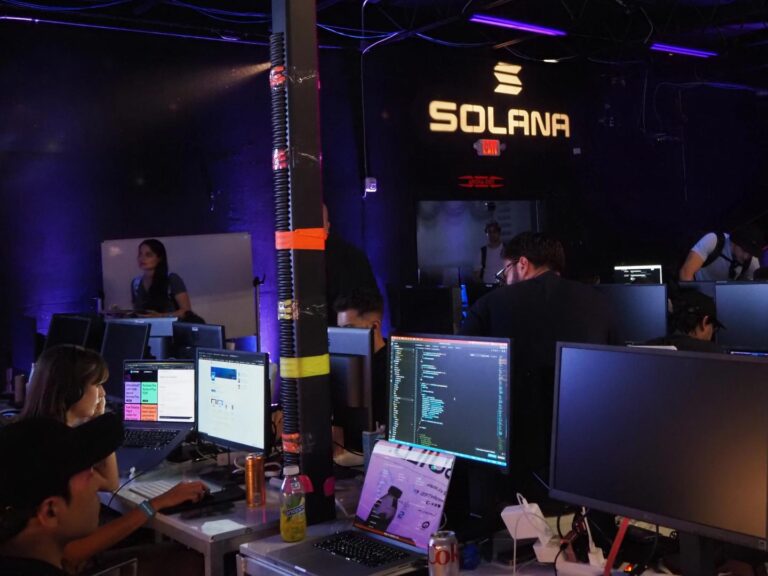
Two of the three proposals would reduce SOL supply growth by speeding up Solana’s inflation decline and raising daily fee burns from about 650 SOL to as much as 9,000 SOL.