IREN (IREN) shares rose more than 4% in pre-market trading on Wednesday after the company announced plans for an 800-megawatt data center campus in South Australia, marking its first major Australian data center project.
The agreement secures a high-voltage grid connection capable of supporting up to 800MW of power for the campus without requiring major network upgrades.
IREN said the project remains on track for initial energization beginning in 2028, subject to regulatory approvals and other conditions. The site will also benefit from submarine fiber connectivity linking it to key Asia-Pacific markets, including Singapore, Indonesia, South Korea and Japan.
Management highlighted strong regional demand for AI infrastructure, noting a widening gap between projected computing needs and available capacity across Asia-Pacific. South Australia’s push toward 100% net renewable energy by 2027 was also cited as a key competitive advantage for the development.
Co-Founder and Co-CEO Daniel Roberts said the project combines access to abundant renewable energy, international connectivity and a supportive policy environment. The campus is expected to create more than 500 construction jobs and over 200 permanent skilled positions once operational.
Recently, Daniel Roberts said the company’s long-term AI strategy is built on owning power, land and data centers.
Bitmine Immersion Technologies (BMNR), the largest corporate holder of ether (ETH), is staring at nearly $9 billion in losses as the token’s slide below $1,800 drags down the value of its massive treasury.
Shares of the Tom Lee-chaired company fell another 5.9% Wednesday, slipping below $17 and extending their decline to 28% since early May. The stock has now dropped below its February lows to its weakest level since the company announced its pivot to an Ethereum treasury strategy in May 2025.
The selloff comes as ETH retests its February lows. The second-largest cryptocurrency has lost more than 20% since early May, when Lee, Fundstrat’s co-founder and BitMine’s chairman, argued that the market’s “mini crypto winter” had likely ended and a new “crypto spring” had begun.
Under Lee’s leadership, Bitmine has amassed more than 5.4 million ETH, or roughly 4.5% of Ethereum’s circulating supply, in roughly a year. That position is worth about $10 billion at current prices.
Those holdings, however, are now deeply underwater, carrying an estimated $8.9 billion in unrealized losses, according to data collected by DropsTab.
Bitmine ether (ETH) holdings and estimated unrealized losses (DropsTab)
Digital asset treasuries under pressure
Bitmine’s drawdown highlights renewed pressure across the digital asset treasury sector, where companies seek to replicate the playbook pioneered by Michael Saylor’s MicroStrategy (MSTR): raise capital through public markets and use the proceeds to accumulate crypto.
That model has become increasingly harder to sustain as crypto prices weakened and many treasury stocks drifted below the value of their underlying assets.
Strategy itself recently disclosed its first bitcoin sale since 2022, sparking debate about how the company might fund future obligations tied to its preferred stock offerings.
Bitmine’s situation differs in some key respects. The company financed its ether purchases primarily through equity issuance rather than debt, leaving it without the leverage concerns and interest payments that some treasury peers face.
The company also generates revenue from staking its ETH and operating its staking service MAVAN. Bitmine said it has staked more than 4.7 million ETH — about 87% of its holdings — and recently estimated annualized staking revenue at roughly $276 million.
Lee calls for $250,000 ETH
The recent price action has not tempered Lee’s long-term outlook.
Speaking at the Proof of Talk conference in Paris earlier this week, he said ETH could eventually reach $250,000 as tokenization, AI-driven transactions and corporate staking reshape Ethereum’s role in the global financial system.
For now, investors appear focused on a more immediate reality. Ether is back near levels last seen during February’s selloff, leaving Bitmine’s treasury deep underwater and highlighting the gap between Lee’s long-term thesis and the market’s current view of the asset.
[Update (June 3 at 8:01 pm UTC): This article has been updated to include a response from Fairshake in the fourth paragraph.]
Democratic and Republican candidates across California, New Jersey and South Dakota won their respective primaries on Tuesday after being the beneficiaries of supportive ads purchased by cryptocurrency industry-backed political action committees (PACs).
On Tuesday, Democrats Jacqui Irwin, Ted Lieu, Zoe Lofgren, Dave Min, Mike McGuire, Hilda Solis, George Whitesides, Lou Correa and Lateefah Simon won their respective California primaries for House seats. Democrat Rob Menendez and Republican Mike Rounds also won primaries for New Jersey’s 8th congressional district and a South Dakota Senate seat, respectively.
Selection of results after Tuesday’s primaries for California House seats. Source: CalMatters
The political wins came after the Protect Progress and Defend American Jobs PACs spent about a combined $3.5 million on media to support the candidates. The groups are affiliated with Fairshake, a political action committee funded largely by cryptocurrency exchange Coinbase and Ripple Labs that reported having a war chest of $193 million in January.
“America needs members of Congress who will act to lay out responsible guardrails for the community to maintain our global leadership,” Fairshake spokesperson Geoff Vetter told Cointelegraph.
The PAC spending came on the heels of similar buys for supportive media in Texas runoff primaries last week, which resulted in Democrat Christian Menefee defeating incumbent US Representative Al Green, and four Republican candidates winning primaries in smaller House districts. Many of the candidates in the state races have supported advancing digital assets, either through voting on “pro-crypto” legislation while in office like the GENIUS Act or in public statements.
Related: PACs laud Texas primary wins, look to back more pro-crypto candidates
Maryland is shaping up to be the next focus for Fairshake and its affiliates. Federal Election Commission (FEC) filings showed Protect Progress had spent more than $3.1 million as of Wednesday to support Democratic candidate Adrian Boafo in Maryland’s 5th Congressional district, which is scheduled to hold a primary on June 23.
Crypto advocacy organizations back new developer-focused PAC
On Wednesday, industry leaders announced the launch of Defend Developers, a hybrid PAC that will support “incumbent members of Congress who actively champion developer protections and crypto builders.” According to the group, Defend Developers’ board of directors includes “CEOs, CLOs, and policy leaders at top crypto organizations, including DeFi Education Fund, Orca Creative, Solana Policy Institute, and Uniswap Labs.”
“For too long, developers building decentralized technologies have faced regulatory uncertainty and enforcement actions instead of clear rules and guidelines,” said the PAC’s founder, Gavin Zavatone. “While legislation and rulemakings are being written as we speak, for some policymakers there is limited incentive to understand the fundamental nature of software development.”
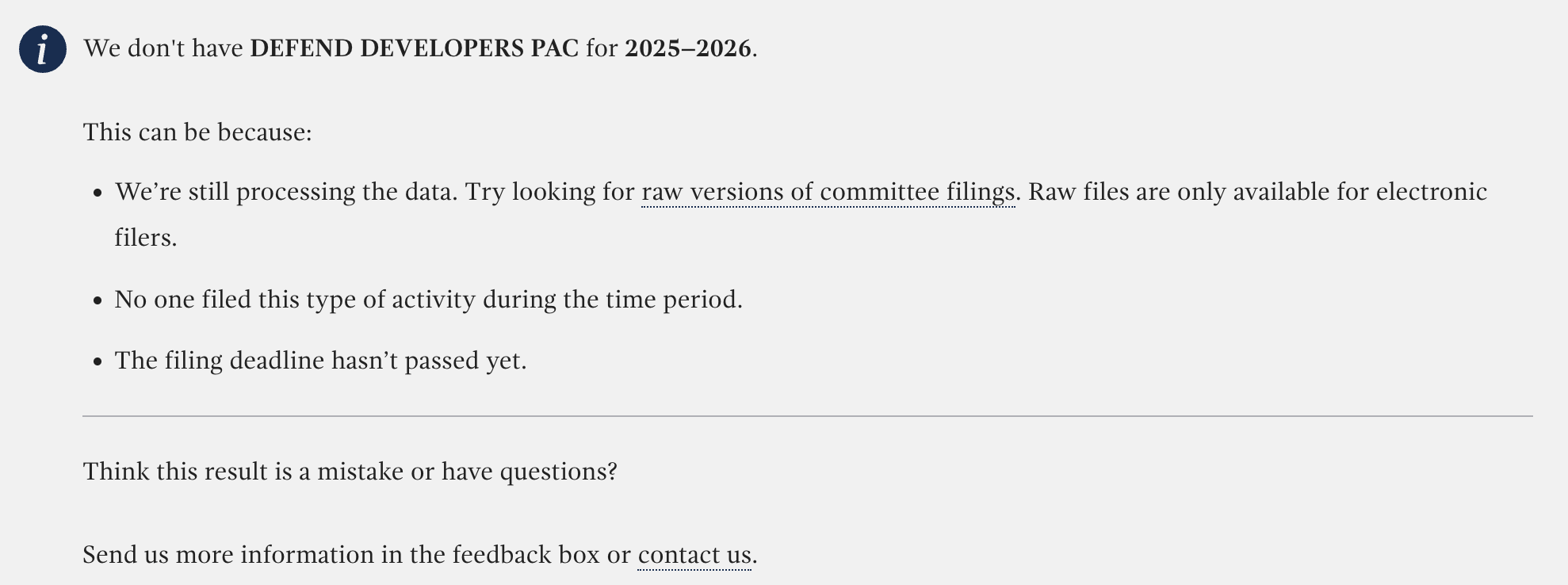
No official data available on Defend Developers as of Wednesday. Source: FEC
The FEC portal did not show any funding or expenditure activity, as of Wednesday. Nick Stoltzfus, co-CEO of on-chain student loan digital asset platform Stratofied, was listed as treasurer and custodian of records in the PAC’s statement of organization on May 15.
The PAC did not say where or how it would focus its efforts as part of the 2026 US midterms other than “key races across the country.” Cointelegraph reached out to Defend Developers for comment but did not receive an immediate response.
Magazine: Korea’s first memecoin rug-pull case, China’s crypto rules review: Asia Express
Bitcoin’s BTC$65,480.41 recent struggles to rise in tandem with U.S. stocks has sparked a wave of explanations, from concerns about Michael Saylor’s Strategy (MSTR) selling bitcoin to questions about whether institutional demand is beginning to fade.
Charles Schwab director of digital currencies research and strategy Jim Ferraioli sees a simpler explanation: Bitcoin is losing the momentum trade.
“Bitcoin has been in a bear market since October,” Ferraioli said in an interview. “Not to say it’s as simple as that, but it’s kind of simple as that.”
The comments stand in contrast to a market narrative that has remained largely focused on positive developments. Over the past year, crypto has secured spot ETF approvals, attracted billions of dollars in institutional capital and moved closer to regulatory clarity in Washington. Yet despite those developments, bitcoin has struggled to sustain the type of explosive rally many investors expected.
Instead, capital has been flowing elsewhere.
“We found a bottom in early February, and since then another large Wall Street firm had a successful ETF launch, and so you saw this kind of return to the institutional adoption narrative,” Ferraioli said.
That rebound helped bitcoin recover from its February lows. But unlike previous crypto cycles, the recovery stalled before developing into a broad speculative frenzy.
That’s because crypto investors are not fundamentally driven, but chase momentum, he said. In his view, bitcoin’s problem isn’t a lack of bullish news. It’s competition.
Historically, crypto has benefited when it becomes the market’s most compelling speculative opportunity. When prices rise, traders pile in. When another asset class begins attracting attention, capital often follows.
“Crypto investors historically just go wherever the momentum is,” Ferraioli said. “And momentum is out of crypto at the moment.”
The destinations for that capital have changed over the past year.
Some investors have gravitated toward precious metals. Gold has attracted significant inflows as investors seek alternatives to both equities and crypto. Others have become increasingly focused on artificial intelligence, which has emerged as the dominant growth narrative across financial markets.
The AI boom has created a new class of speculative opportunities that didn’t exist in previous crypto cycles. Public companies tied to AI infrastructure, data centers and advanced computing have generated strong returns, while anticipated IPOs from firms such as OpenAI and Anthropic have become focal points for investors looking for the next growth story.
According to Ferraioli, crypto investors are participating in that shift as well.
“I think people that are excited about momentum are getting excited about IPOs,” he said. “Then some of these you can actually access the private shares on these decentralized exchanges on Hyperliquid.”
That trend is significant because it highlights how crypto-native trading infrastructure is increasingly allowing investors to speculate on assets beyond cryptocurrencies themselves.
Platforms such as Hyperliquid (HYPE) have introduced perpetual contracts tied to private companies, commodities and other non-crypto assets, giving traders new places to deploy capital.
For bitcoin, that means it is no longer competing solely against other cryptocurrencies.
It is competing against every major speculative narrative in the market.
Ferraioli also downplayed concerns surrounding Strategy’s recent sale of 32 bitcoin, a transaction that sparked debate among investors because of Saylor’s long-standing reputation as one of bitcoin’s most committed advocates.
“The narrative has been that they’ll never sell,” Ferraioli said. Yet he believes the market impact of the transaction itself has been overstated. “But I don’t think [the sale] is what’s really driving it,” he said.
Instead, he views the sale as a convenient narrative attached to a broader trend that was already underway.
Part of that trend may be tied to investor cost bases and many ETF investors are still recovering from sharp swings over the past year and see the current price point as an opportunity to exit positions rather than increase them.
“I think you get to those levels and you get people that are saying, ‘Hey, I made my money back, maybe I’ll revisit it later,'” Ferraioli said.
That dynamic has contributed to a market that feels very different from the euphoric phases of previous cycles.
Ferraioli argues that institutional adoption, while real, remains smaller than many market participants assume. Bitcoin ETFs have expanded access to crypto, but much of the asset class remains dominated by retail investors and momentum-driven traders.
“Again, this is primarily a retail asset,” he said.
The distinction matters because retail investors often react differently than traditional institutional allocators. Rather than building positions based on discounted cash flow models or long-term valuation frameworks, they tend to chase trends.
That behavior helps explain why bitcoin has struggled to capitalize on positive regulatory developments.
The crypto industry is awaiting potential passage of the Clarity Act, a bill that many industry participants believe could provide a clearer framework for digital assets in the U.S. Over the longer term, Ferraioli believes such developments could support adoption.
In the short term, however, regulation alone may not be enough to reverse the current trend.
“There is still more demand for downside protection,” he noted elsewhere in Schwab’s market outlook, though that pressure has begun to ease in recent weeks.
Seasonality may also be contributing to the slowdown. Summer has historically been one of bitcoin’s weaker periods, as trading activity declines and investors shift attention elsewhere.
“People know that for bitcoin seasonally summer is the weakest time,” Ferraioli said.
That leaves the market in an awkward position.
Institutional adoption is improving. Regulatory clarity is advancing. Major financial firms continue building crypto products. Yet none of those developments guarantee higher prices if investor attention is focused elsewhere.
“There’s a lack of a reason to be buying here when there’s other things you can choose,” Ferraioli said.
For now, he argues, the biggest challenge facing bitcoin isn’t Saylor, regulation or even macroeconomics.
It’s that investors have found something else to chase.
Another crypto-focused political action committee, the Defend Developers PAC, has joined the field of campaign-funding operations that have in recent years put the industry on the political map.
The new entrant won’t rival the sector’s leading super PAC, Fairshake, nor is it expected to jump to the scale of the mid-level committees that include the Fellowship PAC linked to Tether and the Digital Freedom Fund tied to Tyler and Cameron Winklevoss at Gemini. But it’s approaching the political field differently than others, by backing incumbent lawmakers who’ve already proven to be allies to its cause: the legal protection of crypto developers and creators of decentralized finance (DeFi) projects.
“We plan to raise and contribute more than six figures across dozens of key races in the midterms, because crypto technologists deserve champions in Congress who will go to bat for them,” said Gavin Zavatone, the PAC’s founder, in a Wednesday statement announcing the effort. Zavatone is also the policy lead at the DeFi Education Fund, a trade association that lobbies for DeFi-friendly policymaking.
Defend Developers — federally registered last month — is what’s known as a hybrid PAC, meaning it can make direct contributions to candidates that follow the Federal Election Commission limits as well as channeling unlimited corporate contributions into independent ads. The bulk of the crypto sector’s high-profile political intervention has been through super PACs that have no monetary limits, though another new PAC, the Blockchain Leadership Fund established by Anchorage Digital and Chainlink, is also a hybrid.
“As a hybrid PAC, we’re building the political infrastructure to ensure the United States remains the best place in the world to build blockchain technology freely — and we’re doing it the right way, powered by individual contributions raised directly from the founders, builders, and CEOs who have the most at stake,” Zavatone said. The board of directors behind him include members from Uniswap Labs, DEF and the Solana Policy Institute, though no dollar amounts have yet been disclosed about its initial funding.
Without the tens of millions deployed by Fairshake and its affiliates, a new crypto PAC isn’t likely to make major waves. Fairshake is coming away with its latest primary election wins this week, having backed nine Democratic U.S. House of Representatives candidates in California, one in New Jersey and Republican U.S. Senate Mike Rounds in South Dakota. All of them won their primaries on Tuesday, maintaining a high win record for crypto-supporting politicians that Fairshake bought independent ads for, though the PAC didn’t expend more than $476,000 (for U.S. Representative George Whitsides) on this week’s races.
Fairshake had expended $6.5 million in its successful effort to make sure veteran House lawmaker and crypto critic Al Green lost out to Christian Menefee in their Texas primary last week. However, the super PAC — one of the largest in U.S. politics — has also seen a few misfires, such as in Illinois.
The general election in November brings extremely high stakes, with the potential to shift the party majority to Democrats in at least one chamber of Congress.
Read More: The crypto industry’s massive political war chest is starting to lean Republican ahead of midterms
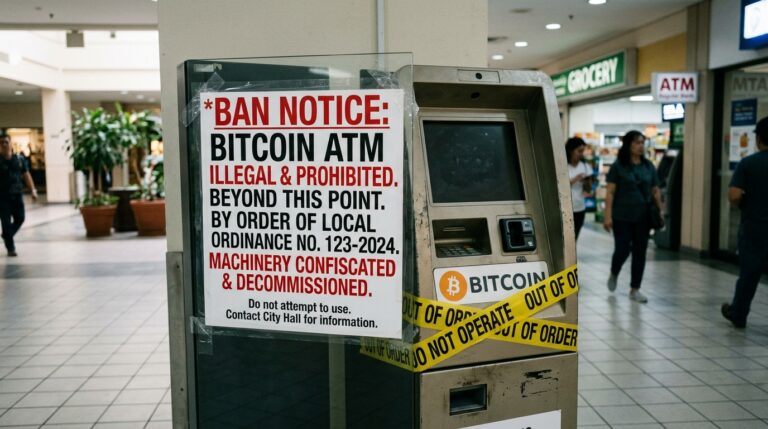
State regulators have been quietly banning Bitcoin ATMs. An entire subsection of the Bitcoin ecosystem is being deemed illegal and shut down. And since there’s not much of a cross-section between people who are chronically online and cash bitcoin buyers, it’s not getting a lot of attention. But the Bitcoin ATM ecosystem represents $3.63 billion, with a B, dollars going into bitcoin every year, and that’s just in the United States.
Beyond the financials, Bitcoin ATMs are vital to maintaining self-sovereignty in the system. A Bitcoin ATM enables something no other service in the financial industry can: it lets you walk up with cash, no bank account, no credit check, no exchange account, and walk away with bitcoin in a wallet only you control.
Perhaps it’s the self-sovereignty the regulators don’t like. Alas, they’re blaming the boogeyman, Fraud.
Total bans, making Bitcoin ATMs illegal, have already been enacted in Indiana, Tennessee and Minnesota. De facto bans are also in place, creating limits that make it impossible to operate with any net profit in California, South Dakota, Wisconsin, and Virginia.
All of the bans and regulations are, of course, done under the guise of “protecting the consumer,” but legislation is not stopping fraud. The chain of fraud is easy to track, and Bitcoin ATM operators are doing just that, joining forces to form a coalition and fight back.
No other industry is more heavily scrutinized than a fully licensed MSB (money services business) carrying MTLs (money transmission licenses) operating cash businesses subject to FinCEN’s AML KYC regulations.
The fraud argument is selectively applied to Bitcoin ATMs because it’s politically easy. It’s also caught in the crosshairs of the AARP’s two-billion-dollar operating budget. But the facts don’t support the narrative. Across the broader financial industry, the standard rate of fraud is somewhere between 3 – 5%. It’s only 1.2% at Bitcoin ATMs. In other words, 98.8% of Bitcoin ATM transactions are legitimate.
Why aren’t the states banning Western Union or Visa gift cards? Or robocalls, for that matter?
The median Bitcoin ATM transaction is $300; 80% of all transactions are under $1,000. The average ATM customer is someone putting $50, $100, or $500 at a time into an appreciating asset, the same way someone DCAs on an exchange. The repeat purchase average is every 24 days, and the average lifetime spend per customer is $12k. Per the Federal Reserve’s own research, Bitcoin ATM’s primary users are the 24.6 million unbanked and underbanked Americans who are “disproportionately Black, Hispanic, immigrant, rural, low-income.” They’re moving $20–$100 at a gas station because they don’t have a bank account. States aren’t banning speculative tools; they’re banning legitimate financial access for people who already have the fewest options.
The “fraud” is just a Trojan horse. The banning won’t stop with ATMs. “A canary in a coal mine” is a metaphor for an early warning sign of impending danger or failure. While the President tries to claim the USA as the “Bitcoin capital of the World” his own justice department has put industry developers in prison. Another trend we cannot allow.
In order for Bitcoin to succeed, we need all sections of the Bitcoin ecosystem to thrive. Similarly, in order for the industry to thrive here in the United States, we need the States to maintain their rights.
If the banning is allowed to stand, it will not stop with just ATMs. This is a test case for “ban first, ask questions never.” Both the current and previous administrations have proposed a litany of bills that would similarly ban other parts of the ecosystem, encroaching on the rights of nearly everyone interacting with the bitcoin network in one way or another.
A short list of some of the bills that came close:
S.5267 — Digital Asset Anti-Money Laundering Act of 2022: explicitly named wallet providers, miners, validators and others as MSBs (triggering KYC/AML law).
S.2669 — Digital Asset Anti-Money Laundering Act of 2023: reintroduced the same general approach of treating digital asset providers/facilitators as BSA financial institutions. S.2355 — CANSEE Act: targeted DeFi facilitators/backers and sought to apply AML/sanctions obligations to DeFi-style activity.
S.3867 — Digital Asset Sanctions Compliance Enhancement Act: targeted transaction facilitators and platforms for sanctions-related prohibitions.
And H.R.3684 — Infrastructure Act: which was enacted and sparked a debate around the definition of “exchanges and brokers” which initially included miners, node operators and software developers despite the fact that the required reporting would have been technically impossible. The Treasury and IRS eventually narrowed their scope before the bill was implemented. But how many in the industry knew how close this was to becoming law?
We cannot let them define self-custody wallets as “money laundering tools,” P2P exchanges as “unlicensed money transmission,” Lightning nodes as “unregulated payment processing,” or Bitcoin ATMs as “fraudulent activity.”
The entire promise of Bitcoin is that no one can stop you from holding and transacting with your own money. The Bitcoin ATM is where that promise meets physical reality. A person with cash and a cell phone can participate in a global, censorship-resistant financial network without asking anyone’s permission.
Let’s keep it that way.
If the state can eliminate the only way to go from cash to self-custody, then the self-custody right is theoretical. It exists only for people who already have bank accounts and exchange
relationships, which is to say, people who already have permission. The bitcoin ATM is the canary. If it dies and nobody notices, the coal mine is next.
This is a guest post by Michelle Weekley. Opinions expressed are entirely their own and do not necessarily reflect those of BTC Inc or Bitcoin Magazine.
Kraken’s parent company is bringing one of Wall Street’s most coveted opportunities to crypto investors: buying into IPOs at the same price as institutional investors.
Payward, the parent company of the crypto exchange, said Wednesday it will “soon” allow customers of Kraken and other members of its xStocks Alliance to participate in U.S.-listed initial public offerings through tokenized shares. The offering would give eligible investors a chance to receive allocations at the IPO price rather than purchasing shares after trading begins on public markets.
The first tokenized IPO offerings are expected to become available through Kraken and other xStocks Alliance members in the coming weeks, the firm said.
The launch comes as investors await a new crop of high-profile public offerings. SpaceX and AI startups Anthropic and OpenAI are among the companies widely viewed as potential IPO candidates in the coming months, fueling demand for access to deals that have traditionally been dominated by institutional investors, private banks and wealthy clients.
Under Payward’s model, investors would submit non-binding indications of interest before an IPO. The company would aggregate demand across participating exchanges and work with underwriting syndicates to secure allocations. Once a company lists, shares would be tokenized, backed one-for-one by the underlying stock held by a regulated custodian and distributed to investors through participating platforms.
The initiative is part of a broader push to use blockchain technology to expand access to capital markets.
Tokenization — the process of creating blockchain-based representations of traditional assets — has become one of the fastest-growing areas of digital assets. The sector has expanded beyond cryptocurrencies into Treasury funds, private credit, money-market products and, increasingly, equities.
Supporters argue tokenization can make assets easier to access, transfer and trade across jurisdictions. For equities, the technology could help remove some of the geographic and brokerage barriers that have historically limited access to IPOs and foreign-listed stocks.
Still, pre-IPO investing carries risks. IPO allocations are often oversubscribed and not guaranteed, offering prices can change during the book-building process and newly listed stocks frequently experience sharp price swings once public trading begins.
The firm will only offer IPOs where it has secured allocations for investors, a Payward spokesperson told CoinDesk.
Payward said its xStocks framework currently supports tokenized equities backed one-for-one by underlying shares held in custody. The company said the framework has processed more than $30 billion in transaction volume and over $6 billion in onchain settlements across more than 125,000 holders.
[Correction: In the second paragraph, the letter from lawmakers was dated Monday, June 1.]
Top Democrats on three House and Senate committees called on the US Labor Department to halt its plans to allow digital assets and “alternative assets” to be held in Americans’ retirement plans.
In a Monday letter, Senator Bernie Sanders, Senator Elizabeth Warren and Representative Bobby Scott asked acting Labor Secretary Keith Sonderling to rescind the department’s proposal to allow private equity, digital assets, private credit, and other “alternative assets” to be included in 401(k) plans.
Source: Senate Banking Committee
They said the policy would “expose retirement accounts to exceptionally volatile assets, like digital currency,” citing a “lack of regulation and safeguards” putting many cryptocurrencies at risk of fraud.
Sanders, Warren and Scott — the ranking members of the Senate Committee on Health, Education, Labor and Pensions, the Senate Banking Committee and House Committee on Education and Workforce, respectively — said that the current administration had weakened enforcement of crypto fraud at financial agencies like the Securities and Exchange Commission (SEC).
“The application of securities laws to crypto assets is rapidly evolving, and many securities law protections that investors have for public securities may not be available for crypto,” said the letter. “This lack of sufficient guardrails is likely to harm investors.”
Related: Basic adds VanEck crypto ETFs to 401(k) plans amid US retirement shift
The proposed policy, announced by the Labor Department in March, followed an August 2025 executive order from US President Donald Trump directing agencies to “democratize access to alternative assets,” including crypto. According to the Investment Company Institute, Americans held about $10.1 trillion in 401(k) plans as of Dec. 31.
Trump family conflicts of interest cloud 401(k) order and CLARITY Act
Sanders, Warren and Scott questioned whether the Labor Department policy would financially benefit anyone in the current administration, given Trump was “rife with conflicts of interest in this area,” including his family’s crypto venture, World Liberty Financial.
Lawmakers have made similar arguments in proposing amendments to a digital asset market structure bill, the CLARITY Act, expected to be addressed in the US Senate soon. Democrats in that chamber have said that they would not vote for any legislation that doesn’t contain provisions on ethics.
Magazine: HYPE chases $100 target, ETH could dump below $1800: Market Moves
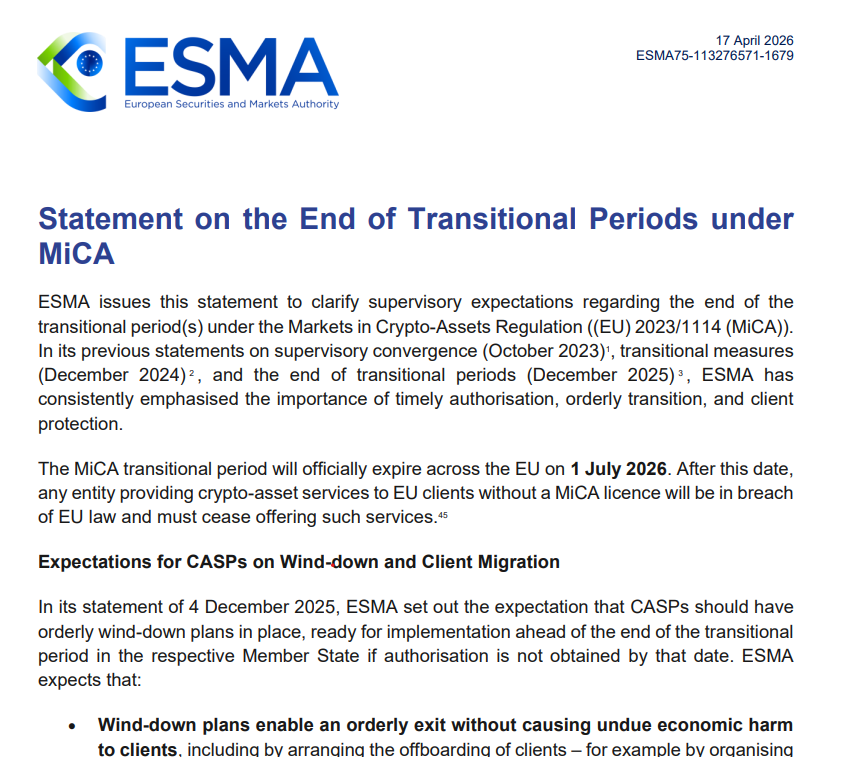
The European Union’s Markets in Crypto Assets Regulation hits a hard deadline on July 1 when the transitional period ends and in-scope crypto asset service providers operating under national regimes must either hold a MiCA licence or stop serving EU clients.
A spokesperson from the European Securities and Markets Authority (ESMA) told Cointelegraph that from that date, non-authorized entities “will not be allowed to operate within the EU” and should implement wind-down and client migration plans rather than rely on open-ended transitional status while awaiting a decision.
The deadline could force some crypto firms to suspend EU operations while their applications remain under review, potentially affecting millions of users who continue to engage with platforms that are not yet authorized under MiCA.
In France, 19 crypto asset service providers (CASPs) have been authorized so far, and roughly 25 applications remain under review, a spokesperson for the Autorité des marchés financiers (AMF) told Cointelegraph.
From July 1, providers that are not MiCA-authorized “must cease their activities,” the spokesperson said, pointing to a February AMF warning that unauthorized crypto asset services are a criminal offence punishable by up to two years in prison and a 30,000 euro (roughly $35,000) fine.
The watchdog says it can also add firms to a blacklist, issue public warnings and seek court orders to block access to the websites of unauthorized providers targeting French users.
AMF warning to unregulated crypto asset platforms. Source: AMF
Germany has set a licensing requirement under its national implementation of MiCA, requiring crypto asset service providers that were operating under prior exemptions to obtain authorization by June 30, a spokesperson from German regulator BaFin told Cointelegraph.
The country generally follows EU and national deadlines, the spokesperson said, and may apply enforcement measures “where possible and appropriate,” adding that some applications remain under review.
In contrast, Austria chose not to extend grandfathering for virtual asset service providers under its pre-MiCA regime, which ended on Dec. 31, 2025, so no exchanges are still operating without a license in the country.
A spokesperson from the Finanzmarktaufsicht (FMA) told Cointelegraph it has licensed nine CASPs so far and that MiCA application volume is “significant,” although it does not disclose how many applications are pending.
Related: France’s AMF regulator sets June 30 deadline for MiCA licensing
Lawyers warn pending applications offer no protection
Having an application in the queue will not shield CASPs from the deadline, Niall Esler, head of the regulatory and risk advisory practice at law firm Walkers, told Cointelegraph. He said that companies still serving EU clients without authorization after the transition ends will be operating unlawfully and cannot expect to continue business as usual.
MiCA requires member states to give national authorities powers to order an immediate halt to services, compel client offboarding, name firms publicly and impose administrative fines for unauthorized activity.
Statement on the end of transitional periods. Source: ESMA
That could affect a substantial number of European crypto users. According to analysis shared with Cointelegraph by OKX Europe, of 18.5 million crypto app downloads in Europe between May 2025 and May 2026, about 7.6 million (41%) were to exchanges that do not appear on the independent register of MiCA-authorized providers compiled from ESMA and national data.
ESMA declined to provide an estimate of how many EU users remain on non-authorized platforms, saying it cannot share non-public information.
OKX Europe CEO Erald Ghoos said app download figures understate the issue because they miss users who access exchanges via web browsers or installed apps earlier and remain active.
To bridge that gap, OKX says it combined App Store data with web traffic estimates and search trends to approximate active usage. Ghoos said the company believes “approximately 60% of European crypto users are actively engaging with platforms that hold no MiCA authorization,” including some of the world’s largest exchanges by trading volume.
Related: Europe’s MiCA regime puts smaller crypto firms under pressure
Some exchanges still seeking MiCA approval
Several major exchanges are still awaiting MiCA authorization as national regulators review their applications.
Bitget, for example, applied for a MiCA license in Austria in 2025. The company’s chief legal officer told Cointelegraph it expects regulatory approval in the second quarter of 2026 and will not offer services in the European Economic Area until authorization is granted.
Binance, meanwhile, applied for a MiCA licence in Greece in January through the country’s Hellenic Capital Market Commission and is not currently listed among MiCA-authorized providers in the EU. The company did not respond to a request for comment on its application status.
Magazine: Singapore isn’t a ‘crypto hub’ — it’s something better: StraitsX CEO