Gemini (GEMI), the cryptocurrency platform founded by the billionaire Winklevoss twins, unveiled “Command Center,” a new AI-powered intelligence layer built into its prediction markets platform, in a blog post Thursday.
The feature integrates SpaceXAI models directly into the Gemini app, delivering real-time market summaries, sentiment analysis and personalized signals tied to users’ portfolios, watchlists and prediction activity.
Gemini described the product as a “mission control” interface for tracking prediction markets across crypto, sports, commodities, economics and politics.
“Command Center introduces a true ‘For You’ experience to predictions markets,” the company said in the release. “Rather than forcing you to dig through news and social feeds to find what’s relevant, Command Center meets you where you are.” The feature analyzes users’ positions, watchlists and prediction activity to surface personalized market intelligence.
Prediction markets have surged in popularity over the past two year as traders increasingly turn to event-based contracts to speculate on everything from crypto prices and central bank policy to elections and sports.
Platforms such as Polymarket and Kalshi have seen record trading volumes during major political and macroeconomic events, while crypto-native prediction markets have gained traction for offering around-the-clock access and blockchain-based settlement.
The sector’s rapid growth has also drawn renewed interest from technology firms looking to layer AI-driven analytics and personalized market intelligence into the trading experience.
Gemini’s platform initially includes coverage across cryptocurrencies such as bitcoin BTC$72,729.12, ether (ETH), solana (SOL) and zcash (ZEC), alongside sports betting-style prediction markets tied to baseball, basketball, golf and hockey events.
The product also delivers updates tied to commodities including gold, silver and oil benchmarks, as well as macroeconomic and political developments.
Gemini said the underlying SpaceXAI models are designed to synthesize large volumes of fast-moving information into concise market intelligence and contextual insights.
The company described itself as the first crypto-focused predictions platform to integrate “frontier AI” powered by SpaceXAI models directly into the trading experience.
Command Center is now available through the Gemini app.
Read more: Winklevoss’ Gemini jumps 25% on $100 million bitcoin infusion despite deepening losses
The scale up of STRC and SATA has drawn in many detractors.
Recently Onramp published a paper highlighting some issues of Digital Credit. There were some errors and the paper was clearly AI-generated in most places. My favorite error actually had little to do with Digital Credit, and it appeared in the preface of the report (imagine you haven’t even started reading the actual paper and you already see a factual error, this is the level of AI we are dealing with).
Onramp writes on Page 3: “Strategy has released AI-generated advertising featuring a young, attractive model in a tropical setting”
But a quick viewing of the 30-second ad they are referencing shows that the woman worked “hard as an engineer”, not a model. This is literally 10 seconds into the ad, which is about the same amount of time it took me to spot the error in Onramp’s preface.
I just thought this anecdote was funny. Onto my main point.
Their core argument was that Digital Credit could be better replicated by combining U.S. treasury securities with BTC. (This is what Onramp calls “the simpler trade” but I also fail to see how this is simpler considering that buying digital credit involves just one single ticker while “the simpler trade” involves a dynamic re-laddering of maturing treasury bonds combined with BTC held on a separate venue.)
This conclusion is wrong. It is trivial to show that it is wrong empirically (one just has to look at the daily returns time series of Digital Credit instruments vs a portfolio of IBIT and SGOV or IEF). But this missive will present multiple economic arguments for why we can know a priori that the claim is incorrect.
Reason 1: Collateral
Digital Credit is overcollateralized by corporate bitcoin holdings. This cannot be replicated with one’s own equity because there is no committed external capital in the case of owning BTC and treasuries—it is all your own money and no one else is on the hook. Credit is different. Even though the principal is yours, there is external capital in the form of the issuer’s assets that are committed to ensuring you are made whole. This capital is “external” because it existed before you ever put your principal in and it remains well after you sell your position.
To be precise, an unencumbered bitcoin balance sheet isn’t collateral in the strict sense, but it serves as collateral in a flexible sense. For instance, a BTC-backed loan with margin call is collateralized in a strict sense because the collateral is set apart for the debt. Digital Credit gives the issuer more flexibility with collateral management, but it also gives the investor more flexibility because the security is fungible and liquid. This is an understanding that both parties agree to.
The presence of the collateral is protection for the investor. This coverage is expressed in the BTC Rating metric, which is the ratio of Bitcoin NAV to the sum of the notional value of a particular credit series and all more senior series.
A portfolio of BTC and treasuries has no external capital. This fact alone makes it impossible to economically replicate what is going on in Digital Credit with BTC and treasuries.
Before I move on, I should address treasuries. It is true these are backed by the full faith and credit of the Federal government, and this might be considered a type of collateral. Some might even call this infinite collateral coverage. However this implicitly assumes that the U.S. will not default on its debt. Onramp mentions that because the government can print money and it is constitutionally illegal to not pay the debt, the treasuries position is therefore a sure thing.
This does not account for a case where the government revises its policy and defaults on some debts but not others. Such a move should not be deemed impossible considering the growing influence of modern monetary theory, which posits that sovereign debt is a mere construct constrained only by inflation. MMT sees debt as a reallocation of society’s resources across time to generate the highest social benefit in the present. This line of thought is really the final destination of fiat finance where everything is relative and based on high time preference decision-making.
But under this logic, a move to “delete” the debt owed to some parties while honoring the debt owed to others would, assuming the parties are selected correctly, constitute a partial debt jubilee that would still allow currency stability to persist. Is the treasuries risk worth taking? Everyone must decide for themselves. If this does happen, then STRC will be fine (since the dollar would be fine, because we already said that currency stability persists) but the treasuries and BTC portfolio could see some heavy losses.
Combining BTC with treasuries therefore introduces that avenue for risk which Digital Credit, being a fully structured overcollateralized bitcoin position, does not have.
In other words, the real difference between Digital Credit and a synthetic replication is the type of risk that the investor endures. Keep this point in mind, because it is a recurring theme.
Reason 2: Correlation
Markowitz portfolio theory shows diversification as the only free lunch in finance. When multiple uncorrelated things are stacked together, they can create higher risk adjusted returns.
Digital Credit is rather uncorrelated to bitcoin and other assets. STRC is at 0.63 correlation to BTC and 0.33 correlation to SPY and a 0.33 correlation to the S&P preferred stock index.
Strategy.com’s STRC dashboard. Note the correlations in the bottom row. Other Digital Credit instruments have similar numbers.
Like everything else, it is true that it can be positively correlated during times of high stress. But the lower correlation most of the time means that Digital Credit can improve the diversification of portfolios.
In contrast, it is easy to show that bitcoin and treasuries cannot do this because it is simply a watered-down bitcoin position: bitcoin levered by some number between 0 and 1. For example, 20% BTC and 80% treasuries is really just 0.2x levered BTC. 0.2x levered BTC still has a 1.0 correlation with BTC, so it offers zero diversification benefits to a larger portfolio that already holds BTC. In finance jargon, we might say that this has a 0.2 beta but a 1.0 correlation.
The reason Digital Credit can generate lower correlation is precisely because of the capital structure behind it. The company has many different options that are unavailable to the investor that holds only BTC and treasuries. These options create idiosyncratic factors that are independent from and therefore uncorrelated with BTC.
And just to reiterate the earlier point, these idiosyncratic factors are also different risks that the Digital Credit investor accepts.
Reason 3: Tax
This is probably the biggest error from Onramp. Return of Capital is a tax benefit in the case of STRC and SATA. Onramp argues that it isn’t a benefit because the company has no earnings and so the capital really is return of principal and therefore economically similar to the return of principal in their laddered treasuries model. While this is true for many cases of ROC, it is not the case for Digital Credit.
First, understand that the ROC tax rule for negative taxable earnings and profits was designed with the assumption that companies would make their money via fiat-denominated cash flows rather than taking advantage of the fiat’s debasement to accumulate appreciating assets.
For just a moment, I want you to seriously consider why a distribution from a company without earnings would be a reduction of cost basis. Why is this rule fair and why did it come about?
The answer is that a company that doesn’t have income but pays a distribution is economically liquidating itself, which means the principal (cost basis) of all equity investors should be reduced to reflect this partial liquidation. In most cases of ROC, the entity gets smaller as the distributions occur, because the distribution was literally part of the entity. You can see this for yourself in covered call ETFs that go through brutal NAV erosion while paying out ROC distributions.
Brutal NAV erosion of QYLD, one of the largest covered call ETFs out there. These are ROC distributions.
But again, this whole dynamic assumes as a premise that companies only make money with cash flows and not by investing in appreciating assets. If in fact there existed a company that could make money by investing in appreciating assets, then it could easily take advantage of the ROC tax rule by making it look like it was partially liquidating while in reality growing larger and larger.
And if you look closely, this is exactly what Strategy is doing. Its enterprise value gets larger as it pays out more ROC distributions. This is completely the opposite of what one would expect to see with ROC when thinking from first principles, or what one actually sees in other ROC cases. When BTC starts to rally, this difference gets even clearer.
This distinction alone should make it clear that Digital Credit offers something very unique. It has ROC, which we may think of as an accounting treatment of principal erosion, without the economic reality of principal erosion being reflected by a lower share price. This is, in short, a structural arbitrage made possible by an oversight in the tax code (the oversight being that C-Corps do not make money by holding appreciating assets). This is unique to Digital Credit and cannot be replicated by BTC and treasuries.
But just like Digital Credit today benefits from this tax rule, it could also stop benefiting should the rule change. We should expect a reprice of Digital Credit in that kind of event. This is a risk that Digital Credit investors accept, and it is a risk that the BTC and treasuries portfolio does not have.
Reason 4: Value Investing
Value investing is about buying undervalued assets. Assets are undervalued when the market does not assess the risk correctly. It is possible that the risk associated with the corporate structure is not priced correctly, and therefore the Digital Credit investor earns a higher risk premium than what is justified. This could explain the double digit yields on Digital Credit instruments.
Therefore, getting a potential bargain is another benefit. It is of course true that treasuries might be a bargain. And it is of course true that BTC is a bargain. But it is also undeniable that neither can ever express the unique bargain of a misunderstood capital structure, which is what Digital Credit offers.
Conclusion
Finally, it is fair for an investor to believe that the risks of Digital Credit are not worth it. However, this would not be the point of the article, which is to demonstrate that Digital Credit offers at least four unique benefits that a BTC and treasuries portfolio cannot replicate.
The claim that such a portfolio can better replicate digital credit is false because such a portfolio does not at all replicate the underlying economics of Digital Credit.
The benefits of Digital Credit derive from a different set of risks inherent to the unique capital structure of a Bitcoin treasury company. Therefore the economic facts prove that Digital Credit cannot be replicated without a similar capital structure.
SoFiUSD, first launched in December for enterprise clients, is now live inside the SoFi app — making it the first stablecoin issued by a US national bank available directly on a consumer banking platform.
SoFi Technologies, a publicly traded US neobank, has made SoFiUSD available inside its banking app for 14.7 million members, the company said in a press release published Wednesda.
Members can now buy, sell, hold, and convert SoFiUSD directly within the SoFi app. Full availability is expected by early June as users update to the latest version.
SoFiUSD arrives at a moment when stablecoins have moved firmly into mainstream finance. The total stablecoin market supply has crossed $320 billion, with USDT holding roughly 58% market dominance at a $185 billion market cap, according to DefiLlama data.
Tether’s USDT and Circle’s USDC dwarf SoFiUSD in scale, but no U.S. national bank has previously offered a publicly redeemable stablecoin inside a consumer banking app.
How SoFiUSD Works
SoFiUSD is backed 1:1 by cash held at the Federal Reserve and issued by SoFi Bank, which is FDIC-insured. Reserves are verified through regular attestations performed by an independent US-licensed CPA, and the token runs on Ethereum and Solana, with additional networks planned.
SoFi obtained its national bank charter in 2022 via the acquisition of Golden Pacific Bancorp and approval from the Office of the Comptroller of the Currency (OCC), the federal regulator that oversees nationally chartered banks. As The Defiant reported in November, updated OCC guidance that spring enabled OCC-regulated banks to offer crypto services including custody, clearing the way for SoFi’s crypto push.
JPMorgan Chase and Société Générale have also launched stablecoins — the latter a dollar-backed token issued in June 2025 — but JPMorgan’s JPM Coin is a private, permissioned token restricted to institutional clients, and SocGen is headquartered in France, distinctions SoFi points to when making its “first” claim.
From Enterprise to Retail
SoFiUSD launched in December 2025 but was initially only available to enterprise partners such as card networks and retailers. As The Defiant reported in October 2025, CEO Anthony Noto had telegraphed the stablecoin plans at the Goldman Sachs Communacopia + Technology Conference, where he outlined ambitions to use it across payments, lending, and investing.
SoFi subsequently launched Big Business Banking on Solana in April 2026, an enterprise platform letting companies hold deposits, move money, and settle transactions at any hour through fiat or crypto inside a single federally regulated bank. Early enterprise partners include Cumberland, Bullish, BitGo, B2C2, Fireblocks, Wintermute, Galaxy, Jupiter, Mesh Payments, and Mastercard.
In March, SoFi and Mastercard announced a partnership to use SoFiUSD as a settlement currency across Mastercard’s global payments network. Under that agreement, SoFi Bank plans to settle its own credit and debit transactions on the Mastercard network in SoFiUSD, with SoFi’s technology platform Galileo, which has more than 160 million accounts, expected to offer issuing banks the option to settle card transactions using the stablecoin.
Noto said the consumer launch gives members one place to buy, hold, and pay with digital assets in the same app they use for saving, spending, borrowing, and investing.
“People no longer have to choose between blockchain technology and regulated banking products,” he said in Wednesday’s press release.
SoFi is not the only traditional financial firm moving in this direction. Wells Fargo filed a trademark for “WFUSD” in March, signaling its own potential stablecoin ambitions.
Record Quarter
The announcement comes on the back of a record quarter for the company. SofFi posted $1.1 billion in adjusted net revenue in Q1 2026, up 41% year over year, with membership hitting 14.7 million, up 35% year over year.
SOFI stock was up roughly 1% Wednesday morning following the announcement, though the stock remains down 39% year-to-date.
What Comes Next
SoFi said Wednesday’s consumer launch is the first phase of a wider roadmap. In coming weeks, the company plans to add tokenized deposits, which could let members convert SoFiUSD into deposit accounts that may earn interest and access FDIC insurance under separate terms.
SoFi also plans to add 24/7 cross-border transfers and launch SoFiUSD on institutional exchange Bullish.
The consumer rollout comes roughly 10 months after the GENIUS Act — the first comprehensive federal framework for payment stablecoins — was signed into law by President Trump on July 18, 2025, following passage in the Senate 68–30 and the House 308–122. Regulations under the Act are required to be issued by July 18, 2026.
A Miami man faces multiple felony charges after police say he stole nearly $2 million worth of Bitcoin from a former employer — a theft that went undetected for years while the cryptocurrency sat locked in a safe.
Nahum Reynaldo Castro, 40, was arrested Tuesday on charges of grand theft, money laundering, unlawful use of a communications device, and offenses against computer users, according to an arrest report obtained by NBC 6.
The case stretches back to December 2017, when the victim began purchasing Bitcoin as a long-term investment. He bought a hardware wallet to store the digital currency, and turned to Castro — a trusted employee since 2013 and an IT specialist — to handle the wallet’s setup and security, the report said.
By the end of January 2018, Castro had secured more than $217,000 worth of Bitcoin on behalf of his employer. The hardware wallet was then locked in a safe inside the victim’s home, where it remained untouched for years.
That changed in July 2025. While in the middle of a move, the victim opened the safe and accessed the wallet — only to find it empty. The Bitcoin was gone. At the time of the discovery, the stolen holdings had grown to a value of more than $1.9 million, according to the arrest report.
Investigators determined the theft had taken place in 2020, more than five years before the victim realized anything was missing. Castro continued working for the victim until 2024, the report said.
The wallets seed phrase gave away Castro
Central to the investigation was the wallet’s seed phrase — a master recovery key that grants full access to a cryptocurrency wallet. According to the report, only two people had knowledge of that phrase: the victim and Castro.
Bank records proved critical in building the case. Deposits into Castro’s accounts aligned with withdrawals from the Bitcoin wallet, providing investigators with the financial corroboration needed to connect him to the theft, NBC 6 reported.
The case highlights a risk in the cryptocurrency space that security experts have long flagged: placing complete trust in a single person during the setup of a digital asset wallet.
Because Bitcoin transactions are recorded on a public blockchain but are not reversible, stolen funds are nearly impossible to recover without law enforcement intervention.
Castro was booked into jail following his arrest and was set to appear in bond court Wednesday. He has not entered a formal plea in the case.
Bitcoin BTC$73,284.61 fell below $73,000 to the lowest level since April 13 on Thursday as renewed fighting between the U.S. and Iran rattled global markets, pushing oil higher and dimming hopes for a permanent ceasefire.
The selloff followed U.S. strikes in southern Iran. Iran’s Revolutionary Guards said they retaliated by targeting the American base used to launch the attacks, warning future responses would be “more decisive,” the New York Times reported. Kuwait, which hosts five U.S. bases, said it intercepted hostile drones and missiles.
The escalation dimmed expectations that Washington and Tehran are close to an agreement that could stabilize the Strait of Hormuz, a key global oil shipping route.
Odds of a permanent ceasefire being reached by the end of the month are now just 8% on Polymarket, down from a 70% peak over the weekend. Perceived odds of it being reached by the end of next month slid to 42% from 76%.
On Kalshi, traders are betting traffic in the strait will remain subdued. Brent crude jumped nearly 4% to around $96 per barrel, fueling concerns that higher energy prices could add to inflation pressures worldwide.
Crypto markets reacted alongside broader risk assets. According to Mercado Bitcoin’s head of research, Rony Szuster, investors remain focused on geopolitical risks and upcoming U.S. inflation data, particularly Thursday’s PCE report, the Federal Reserve’s preferred inflation gauge.
“The crypto market remains structurally resilient, supported by long-term accumulation and the strength of AI and blockchain infrastructure narratives,” Szuster said in a note shared with CoinDesk.
“In the short term, the market remains more sensitive to geopolitical developments and the return of institutional flows after the U.S. holiday, keeping bitcoin in consolidation while altcoins trade in a more selective environment,” he added. Stay alert!
Read more: For analysis of today’s activity in altcoins and derivatives, see Crypto Markets Today . For a comprehensive list of events this week, see CoinDesk’s “Crypto Week Ahead.”
What’s trending
Today’s signal
Bitcoin continues to trade below the 50-week exponential moving average of $84,000.
The absence of RSI divergences on the weekly price chart indicate there’s no clear market direction.
The next core level to monitor is the $68,000 support mark.
Decentralized finance (DeFi) protocols built for crypto assets are increasingly retooling themselves for Wall Street, and VanEck’s tokenized Treasury fund arriving on lending platform Euler is the latest example of that shift.
Securitize (CEPT), issuer and tokenization specialist behind VanEck’s VBILL Treasury fund, said Thursday that the product is now live on Euler lending markets.
The move allows investors to use tokenized U.S. Treasuries as collateral to borrow and deploy liquidity elsewhere onchain while maintaining compliance limits tied to the asset.
The move highlights how DeFi protocols are evolving as institutional investors push deeper into tokenized finance. Platforms that once centered around permissionless crypto assets are beginning to redesign their architecture for regulated products such as tokenized money market funds and private credit.
Tokenized U.S. Treasuries have become one of the fastest-growing sectors in crypto, topping $15 billion in assets swelling 150% in a year, according to RWA.xyz data. Global asset managers including BlackRock, Franklin Templeton and Janus Henderson have all launched blockchain-based Treasury and money-market products aimed at institutions seeking yield-bearing onchain collateral.
But that’s still a fraction of the potential how big asset tokenization could become. Standard Chartered projected $2 trillion in tokenized assets by 2028, while BCG and Ripple forecasted a $18.9 trillion market size by 2033.
Read more: Tokenization push could pull trillions of dollars into DeFi, StanChart says
“The really exciting thing is that there are protocols now that are excited to integrate permissioned assets,” Graham Ferguson, Securitize’s head of ecosystem, told CoinDesk. “This is something that previously had not been the case.”
Euler, which currently has over $320 million in assets on its platform, pivoted earlier this year toward institutional use cases after originally operating as a fully permissionless lending protocol. Rival platform Aave also launched Horizon, its real-world asset platform focused on institutional borrowers and tokenized collateral.
Euler integrated Securitize’s DS Protocol earlier this year, allowing tokenized securities to interact with lending markets while preserving investor eligibility requirements and transfer restrictions. Pricing data for VBILL is supplied through RedStone oracles.
The challenge for DeFi protocols, according to Securitize’s Ferguson, is balancing crypto’s open infrastructure with the compliance expectations of traditional finance firms.
“As more serious institutional investors are exploring the space, they need to have certain protections and permissions that they’re used to in traditional finance,” Ferguson said.
“DeFi Protocols are finally waking up to the fact that if they want to welcome in this capital, they’re going to have to change their ways,” he added.
Cryptocurrency markets have shed around $80 billion in value over the past 24 hours, with losses accelerating after the US reportedly carried out a new wave of military strikes on Iran.
The US military carried out new strikes late on Wednesday targeting an Iranian military site and shooting down four Iranian attack drones, which a US official told Reuters posed a threat around the Strait of Hormuz.
“These actions were measured, purely defensive, and intended to maintain the ceasefire,” the official said. Iran’s Islamic Revolutionary Guard Corps reportedly released a statement saying that it has retaliated by attacking a US airbase in Kuwait.
The strikes came during negotiations to end the war that began on Feb. 28 with US and Israeli attacks. US President Donald Trump said at a White House cabinet meeting on Wednesday that he was “not satisfied” with a deal with Iran and alluded to further military action.
The US strikes sent crypto markets tumbling to their lowest level since mid-April, after the market had climbed earlier this week after Trump hinted that a peace deal would soon be finalized.
Bitcoin has lost 3.5% on the day, falling to $72,646 on Coinbase, its lowest level since April 13.
Bitcoin fell to a six-and-a-half-week low after US strikes on Iran on Wednesday. Source: TradingView
LVRG Research director Nick Ruck told Cointelegraph on Thursday that markets sold off as investors priced in heightened geopolitical risk, potential oil supply disruptions and a flight to safety.
Related: Bitcoin falls further as BTC miners pivot to AI, pro-crypto legislation stalls
“Bitcoin and Ethereum, despite their long-term narrative as hedges, continue to behave more like high-beta risk assets during periods of uncertainty,” he said.
“Traders are now monitoring escalation risks in the Middle East, and any effects on inflation and Fed policy as crypto liquidity quickly thins, and leveraged positions get flushed out.”
Ether (ETH) also fell on news of the strikes, collapsing below the psychological $2,000 level, slumping more than 4% to $1,976 at the time of writing. The asset is at its lowest level since late March.
Crude oil prices also reacted with a 3.5% increase as WTI topped $92 while Brent climbed to $98 per barrel.
Magazine: Polymarket seeks Japan entry, Harvard dumps entire ETH position: Hodler’s Digest
Polymarket’s vice president of engineering, Josh Stevens, clarified that the prediction market platform is not adding mandatory Know Your Customer (KYC) checks to its existing service, after a report said the company had considered user verification requirements.
Stevens said in an X response that Polymarket is launching a new beta product for a select group of users and that KYC is required only to access the beta during its early test period. “No KYC is being added to any part of existing polymarket.com with this launch,” Stevens wrote. He said that once the product is out of beta, no KYC will be required to use it.
He later addressed questions about whether KYC could be added later, saying “no” and clarifying that he was “just highlighting” that identity checks are tied to early access for a new beta product rather than a broader move away from pseudonymous trading on Polymarket’s main prediction market.
The clarification followed a report from The Information that said Polymarket had considered mandatory user verification requirements amid growing pressure from regulators.
Cointelegraph reached out to Polymarket and Josh Stevens for more information but had not received a response by publication.
Polymarket’s clarification comes as the platform faces widening access restrictions across several jurisdictions.
As of Thursday, Polymarket listed dozens of restricted jurisdictions, including countries where users are blocked from placing orders and others where access is limited to closing existing positions.
Related: Monthly prediction market volume hits $25.7B as user activity shifts beyond one-off events
In April, Brazil moved to block 27 prediction market platforms, including Polymarket and Kalshi, after authorities said the services operated outside the country’s legal framework.
In May, Spain’s gambling regulator also blocked local users from Polymarket and Kalshi as a “precautionary measure” while authorities pursued legal proceedings over alleged unlicensed gambling activity.
Despite the restrictions, Polymarket has continued to pursue expansion in major markets. In April, the company was reportedly in talks with the US Commodity Futures Trading Commission over a broader US relaunch, and in May, it was reportedly seeking entry into Japan despite the country’s strict gambling laws.
Magazine: Big Questions: Do we really only need 2–5 cryptocurrencies?
Cointelegraph is committed to independent, transparent journalism. This news article is produced in accordance with Cointelegraph’s Editorial Policy and aims to provide accurate and timely information. Readers are encouraged to verify information independently.
Three Samsung affiliates agreed to buy a 4% stake in Dunamu, the operator of South Korea’s largest cryptocurrency exchange, Upbit, for a total of 612.8 billion won ($408 million), the Korea Herald reported.
Investment bank Samsung Securities is set to take a 2% stake in Dunamu in a 306 billion-won cash transaction, from affiliates of technology conglomerate Kakao, according to a Thursday filing. It is joined by credit card provider Samsung Card and IT arm Samsung SDS, each taking a 1% stake, according to the Korea Herald.
The deals, scheduled to complete on June 19, mean Kakao will have sold about $1.5 billion worth of equity in Dunamu in less than a month. It sold a 6.55% stake for about 1 trillion won to Seoul-based financial institution Hana Bank about two weeks ago, followed by a 600 billion won stake to Hanwha Investment and Securities.
In common with many technology giants, Kakao has made artificial intelligence an increasingly central part of its strategy through its “Kanana” AI models and partnerships with OpenAI. With the cryptocurrency market in a sustained bearish mood, crypto is taking a backseat to AI for a lot of major companies’ investment priorities.
Samsung, the largest company in South Korea, has been actively involved in the crypto industry for several years, having introduced its digital asset wallet in 2019.
Samsung Securities shares fell 2.7%, Samsung SDS dropped 5% and Samsung Card gained 0.21% on Thursday. Kakao slipped 1%.
The companies had not responded to a CoinDesk request for comment by publication time.
Bitcoin (BTC) sold off into the early Asian Trading session on Thursday as the drop to $72,600 produced significant liquidation of leveraged positions across the crypto market.
Key takeaways:
Bitcoin price deviated 4.5% from its daily high of $76,050 on Wednesday, dropping to a six-week low of $72,620.
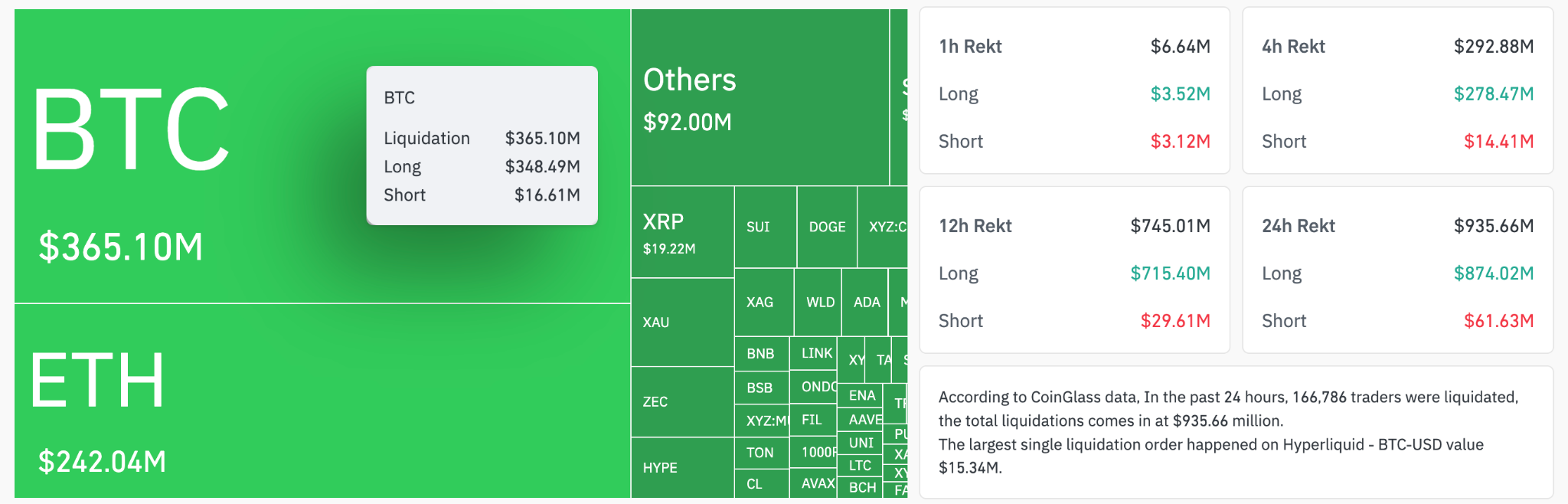
Overleveraged crypto traders were liquidated out of nearly $935 billion in the past 24 hours.
Traders say Bitcoin needs to hold above $70,000 to avoid a deeper correction toward $65,000 or lower.
Bitcoin price hits a 6-week lows below $73,000
The BTC/USD pair fell as low as $72,620 on Thursday, reversing all gains made since April 13 after the US reportedly carried out a new wave of military strikes on Iran.
This was accompanied by significant drops in other top-cap cryptocurrencies, wiping out more than $80 billion from the crypto market over the last 24 hours.
Related: Bitcoin falls further as BTC miners pivot to AI, pro-crypto legislation stalls
The derivatives market suffered a similar fate. More than $874 million in long positions were liquidated, with Bitcoin accounting for $348.5 million of that total. Ether (ETH) followed with $228.5 million in long liquidations.
Across the board, a total of $935.6 million was wiped out of the market in short and long positions, as shown in the figure below.
The single biggest liquidation occurred on Hyperliquid, where a $15.34 million BTC-USD long position was closed.
Additional data from CoinGlass showed a slight drop in Bitcoin’s futures open interest (OI) over the last 24 hours across all exchanges. The decline was more pronounced on the Chicago Mercantile Exchange and BingX, whose Bitcoin OI has fallen by 9.8% and 9% over the last 24 hours, respectively.
Even though futures longs (buyers) and shorts (sellers) are always matched, declining OI suggests reduced leverage and market participation, often signaling bearish sentiment. For example, a 30% decrease in OI between Jan. 14 and Feb. 6 was accompanied by a 38% drop in BTC price.
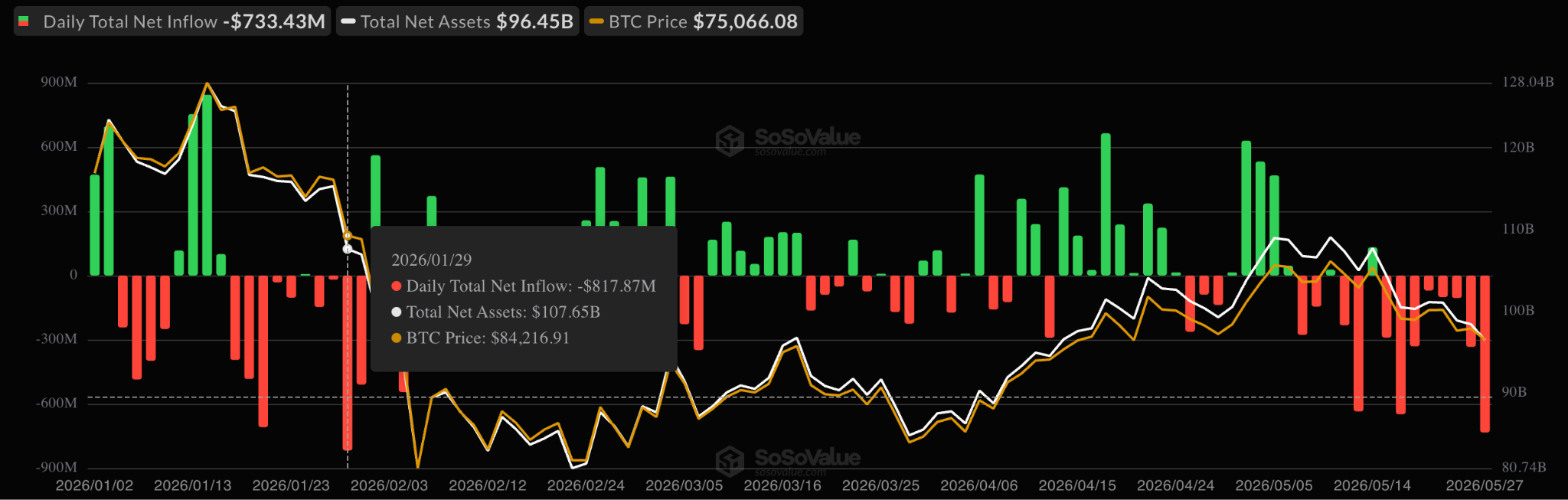
Meanwhile, US-based spot exchange-traded funds (ETFs) continue to post heavy outflows, indicating waning institutional interest. These ETFs have recorded outflows for eight consecutive days, totaling $2.6 billion. The $733 million in net outflows recorded on Wednesday marked the largest withdrawal since Jan. 29.
Spot Bitcoin ETF flows chart. Source: SoSoValue
As Cointelegraph reported, global Bitcoin investment products also posted outflows totaling $1.3 billion last week, adding to BTC’s headwinds.
$70,000 is now Bitcoin’s last line of defence
Bitcoin’s 4% drop over the last 24 hours has seen it lose the crucial $75,000 support, as the bears gained momentum.
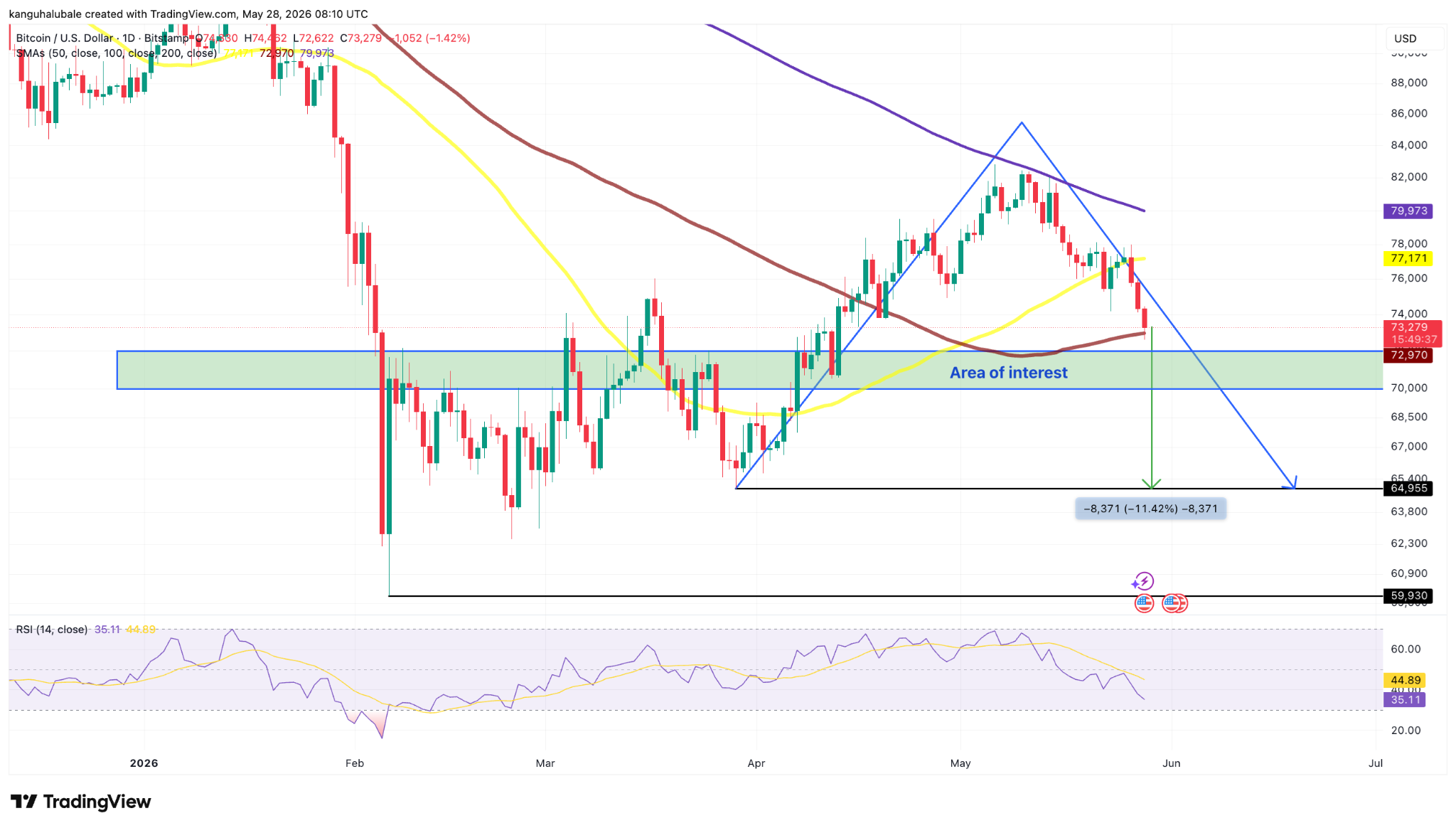
Traders are now watching key support areas on the downside, including the 100-day simple moving average (SMA) at $73,000 and the demand zone above $70,000.
“Renewed US-Iran fighting overnight sent us lower with mass liquidations,” analyst Nicrypto said in a Thursday X post, adding:
“We have fallen well below the previous $75K support zone & are now at the critical $73K support.”
MN Capital founder Michael van de Poppe referred to Bitcoin’s latest sell-off as a “standard approach” typical of the final days of the month, “where markets correct as rebalancing takes place among asset managers.”
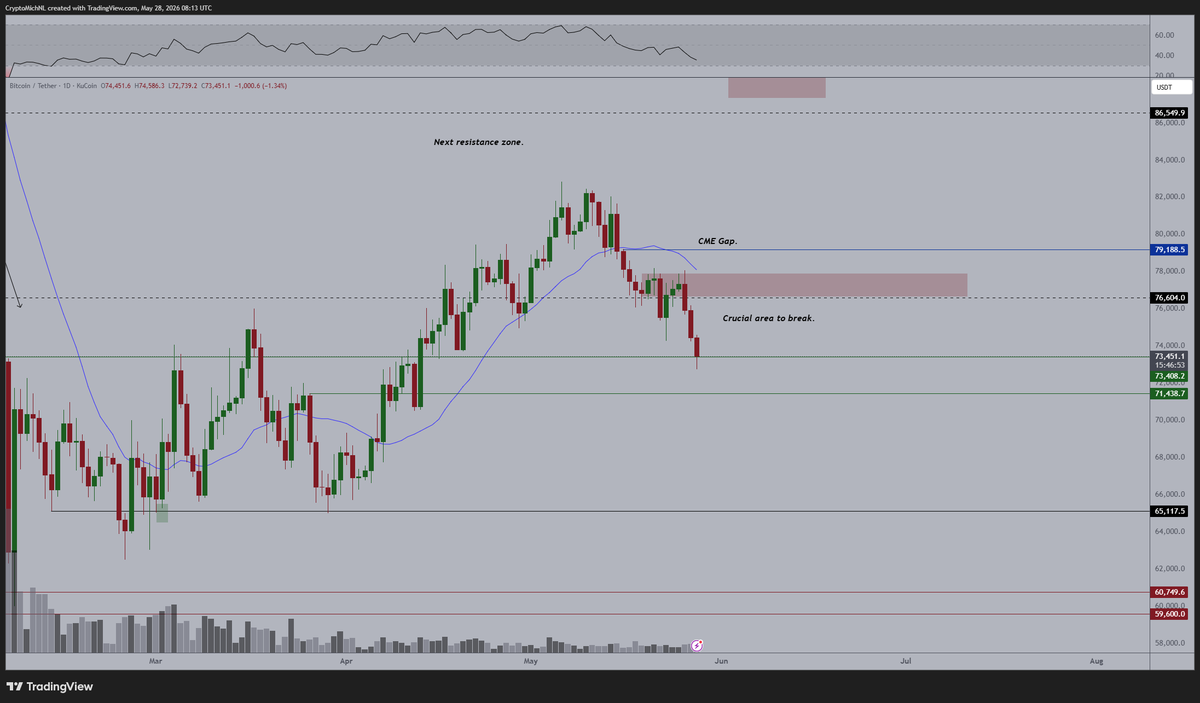
The analyst said, “Bitcoin showing weakness isn’t a recipe for a new low,” unless it drops under the $71,400-$73,400 support area as shown in the chart below.
“This is my last stance of an important support zone; otherwise, I’d expect lower $60Ks to be tested for support.”
BTC/USD daily chart. Source: Michael van de Poppe
A daily candlestick drop below $70,000 could trigger another sell-off episode toward the target of an inverted V-shaped pattern at $65,000, as shown on the daily chart below. This would represent an 11.4% drop from the current price.
As Cointelegraph reported, after losing support at $74,000-$76,000, BTC may then descend to the support line near $70,500, which is likely to attract buyers.