Home Blog Page 246

Crypto and stocks go their separate ways as bitcoin’s failed breakout continues to weigh

0

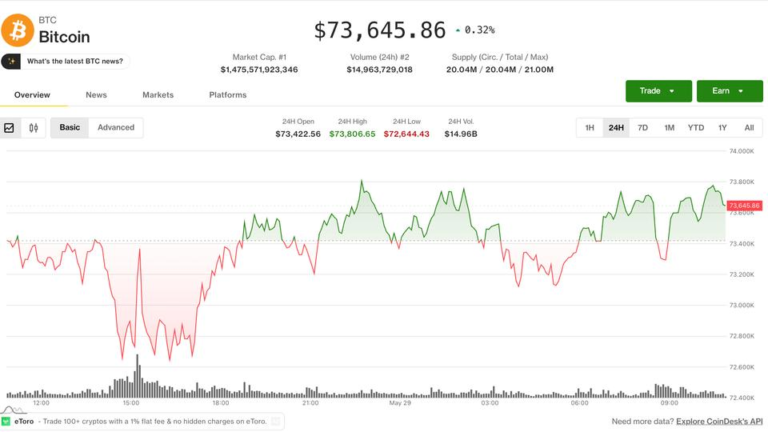
Bitcoin added as much as 0.4% since midnight UTC on Friday and was recently just 0.07% higher after slumping to its lowest level since early April the day before.

Thursday’s drop extended a decline that has emerged over the past three weeks after a failed attempt to climb above $83,000. There is now a chance that the rejection will have contributed to a series of lower highs dating back to October — a key characteristic of a bear market.

Ether (ETH) tracked bitcoin. It fell to $1,965 on Thursday before staging a recovery back above $2,000.

U.S stocks continued to outperform the crypto market on Friday, with S&P 500 and Nasdaq 100 index futures both posting 0.15% gains as the equity gauges approached fresh record highs.

There is no clear explanation why the crypto market is struggling against sectors it has historically been correlated with. The divergence since early October, however, aligns with a leverage wipeout that the market has failed to fully recover from.

Derivatives positioning

  • BTC open interest sits at $20.05 billion, up from $19.7 billion a week ago, with speculative positioning showing slight growth.
  • Funding rates remain positive across multiple venues at under 10% annualized. The exception is Deribit, where they spiked to 44%.
  • The three-month annualized basis pushed closer to 3%, led by Deribit, rising from 2.2% last week, pointing to a mild improvement in institutional risk appetite.
  • Options positioning shows mixed signals: one-week 25-delta skew ticked up to 12.85% from 12.4%, suggesting slightly higher demand for downside protection.
  • Front-end implied vol (DVOL) compressed to about 36 – the lowest since September — while the 1 month–6 month term structure slope sits at -6%, keeping the curve in contango. Markets are pricing near-term calm alongside longer-dated uncertainty.
  • Coinglass data shows $224 million in 24-hour liquidations, with a 54-46 split between longs and shorts. BTC ($46 million) and ETH ($43 million) were the leaders in terms of notional liquidations. The Binance liquidation heatmap indicates $72,280 as a core liquidation level to monitor, in case of a price drop.

Token talk

  • Stellar (XLM) was the top-performing altcoin on Friday, rising by 25% in the past 24 hours and 4.5% since midnight UTC after it was announced that The Depository Trust & Clearing Corporation (DTCC) is planning to connect its tokenized securities platform to the network.
  • There were also double-digit gains for ALGO, INJ, HBAR and HYPE over the past 24 hours as the altcoin market showed strength while the major cryptocurrencies showed weakness.
  • One asset that continued its woeful performance of late was . The token that spawned out of a Bitcoin fork in late 2017 lost 7.2% of its value in the past 24 hours and has now shed 20% in the past week alone.
  • DeFi tokens are also losing their luster, with ENA, JUP and UNI dropping as much as 18% over the past week.
  • CoinMarketCap’s “Altcoin Season” indicator reflected the weakness on Friday, falling to 34/100 from 37/100.

Early Bitcoin Dip Buyers Show Up But Will They Reverse The Trend?

0

When Bitcoin (BTC) finally escaped from its channel pattern and secured a multiple-day close above the $77,000 resistance, traders rejoiced and declared the downtrend over. 

Fast-forward to the present and BTC has fallen below multiple support levels and appears at risk of retesting $70,000, a 16% decline from its range highs. 

While billion-dollar spot BTC ETF outflows, resumption of combat between the US and Iran, concerns over rising inflation and growing fear that the CLARITY Act will not pass in the Senate are all factors in Bitcoin’s crumbling strength, the real question is whether spot and futures demand will kick in and stem the price decline.

Since falling below $75,000 in February 2026, the level has served as an important support/resistance level. With $60,000 agreed upon by analysts as the cycle bottom for BTC, longer-term leverage was built around the $70,000 to $75,000 zone, and much of that is being cleared out this week. 

Liquidation heatmap data from Hyblock highlighted this dynamic, and in a post on X, the analysts said,

“On the higher lookback (1 month of liquidity), we continue stairwelling down, taking another large long liq cluster.” 

BTC/USDT one-month liquidation heatmap data. Source: Hyblock

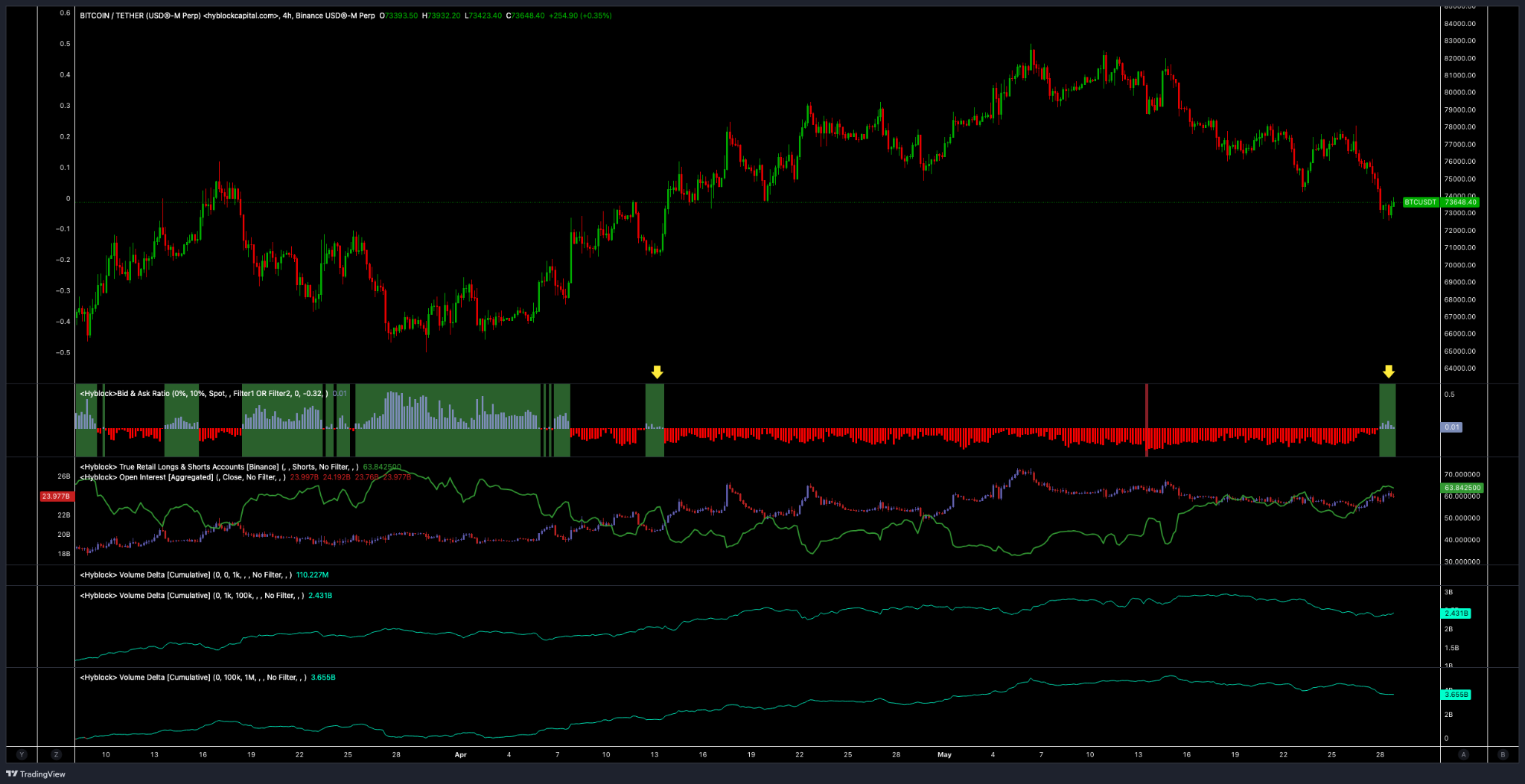
While revisiting the lower boundaries of Bitcoin’s 2026 range is far from ideal for bulls, a silver lining has emerged. As BTC fell below $73,000 on Thursday, the BTC/USDT bid-ask ratio metric at Hyblock printed candles above zero, a first since April 12. 

Set to 10% order-book depth, the bid-ask ratio at 0.03 shows bids becoming dominant in order books as BTC price dropped below $73,000, an early indication that traders are buying in spot markets. 

At the same time, the true retail longs-and-shorts accounts metric, which shows the percentage of retail futures accounts holding long positions, has risen above 64%. 

BTC one-hour chart showing bid-ask ratio and retail longs/shorts accounts. Source: Hyblock

According to Hyblock analysts, 

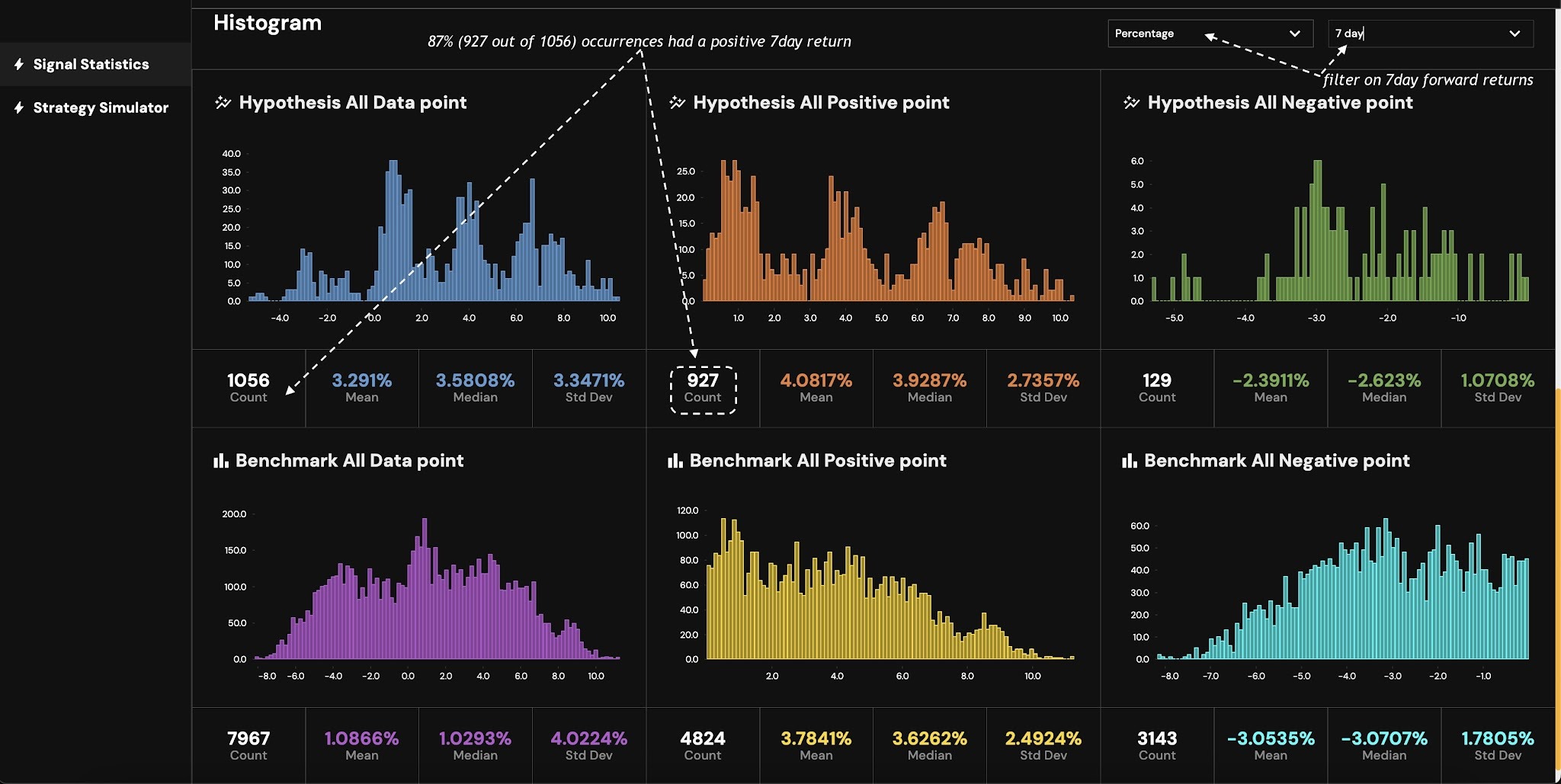
“If you long every single 15m candle that had true retail accounts long percentage above 64% (the current value), then 927 out of 1,056 (88%) of those candles results in positive 7d forward returns.” 

Bitcoin forward returns data based on true retail accounts. Source: Hyblock

The data suggest that despite the negative sentiment surrounding negative news flow, the spot ETF dynamics and fragile geopolitics, the retail investor cohorts within the spot markets view the current pricing as discounted. 

Related: Bitcoin funding spike shows longs defending $70K: Will ETF outflows reverse bulls’ efforts?

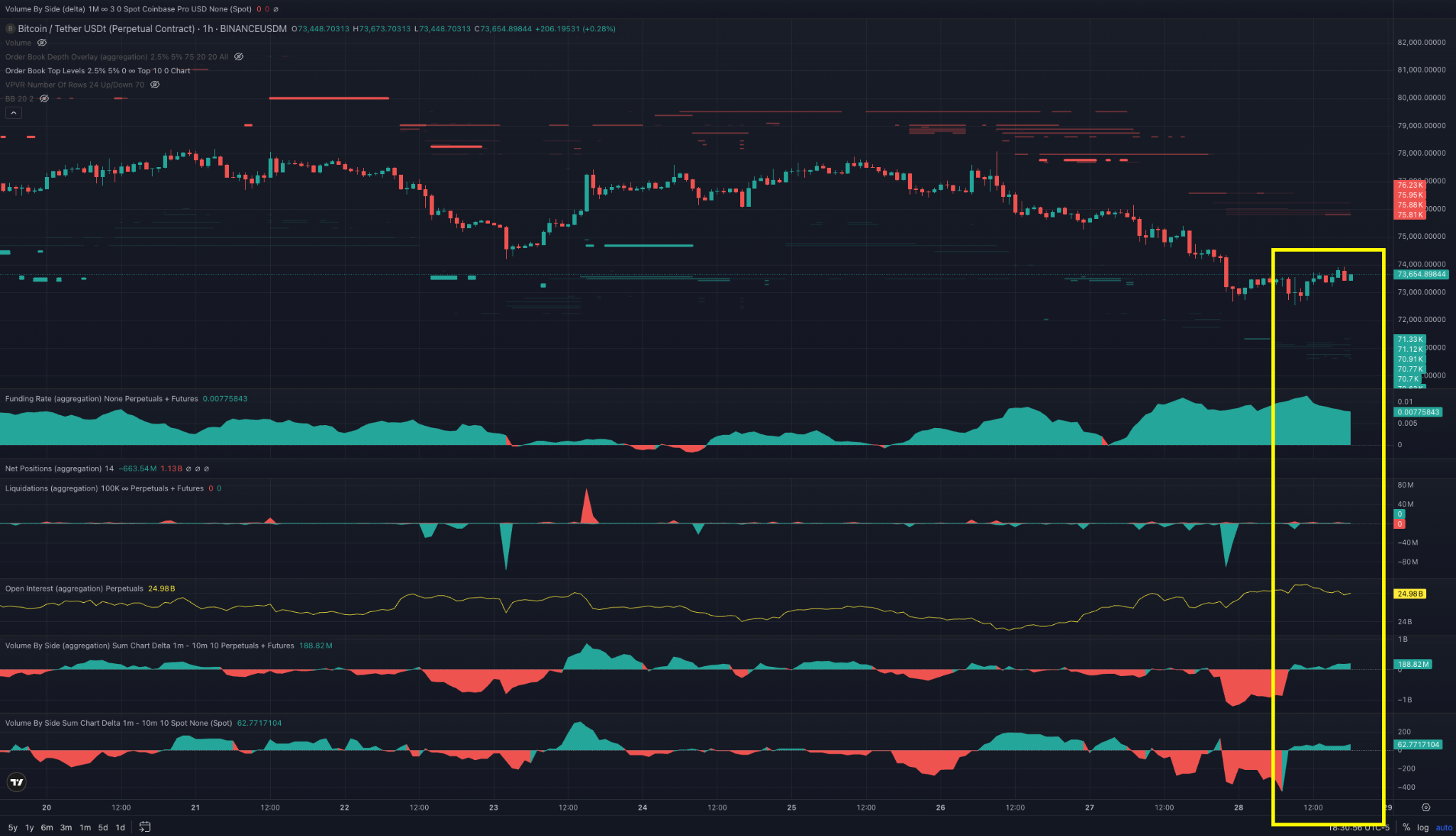
A similar view is displayed by the spot and futures aggregate cumulative volume data at Binance where “dip buyers” are seen generating $185.58 million and $62.8 million in volume over the last 10 hours. 

BTC/USDT one-hour chart spot and futures cumulative volume delta. Source: TRDR.io

Top Talent Is Leaving the EF. What Happens to ETH Now?

0

🎙️ Listen to Interview 📺 Watch Video… Read the full story at The Defiant

UTXO Enters Bitcoin Staking On Stacks, Targets BTC Yield

0

Bitcoin-native asset management company UTXO Management has become one of the first institutional participants in Bitcoin Staking on the Stacks network, marking a notable shift in how corporate Bitcoin holdings may be used.

The initiative introduces a structure that allows institutions to earn bitcoin-denominated yield without transferring custody or moving assets off the Bitcoin base layer. 

For treasury managers holding large BTC reserves, the model presents a new option that preserves core Bitcoin properties while addressing rising pressure to generate returns.

Bitcoin Staking on Stacks requires participants to lock BTC in a Bitcoin timelock alongside a smaller allocation of STX, the Stacks network’s native token, in what the protocol defines as a “protocol bond.” 

The BTC remains under the participant’s control throughout the process, while the STX component determines the scale of participation in the system. The initial bonding period is set at six months.

The yield target for the protocol is near 3% annual percentage yield, paid in bitcoin. Unlike lending-based models, the return does not rely on counterparty borrowing. Instead, it is derived from Stacks’ Proof-of-Transfer consensus mechanism. 

Under this model, miners bid BTC to secure the right to produce blocks on the Stacks network, and that BTC is distributed to eligible participants, including those engaged in Bitcoin Staking.

Proof-of-Transfer has operated for several years and has distributed more than 4,200 BTC since 2021. Bitcoin Staking builds on this framework, extending its reward structure to a broader class of participants.

The protocol is expected to reach mainnet later this summer, opening with an initial bootstrapping phase managed by the Stacks Endowment.

Staking tradeoffs as bitcoin gains traction

The model introduces trade-offs that institutions must evaluate. Participants must hold STX equal to about 5% of the BTC position, which creates exposure to a second asset. The bonded BTC remains illiquid during the lockup period, though an early exit option exists for the BTC portion. Yield levels depend on network dynamics, including miner demand and STX market conditions, which introduces variability.

Despite these factors, UTXO’s participation signals growing institutional interest in productive Bitcoin strategies that maintain self-custody. 

The structure avoids lending desks and synthetic wrappers, both of which require relinquishing some control or altering the nature of the underlying asset.

Corporate Bitcoin treasuries have expanded in recent years. The top 100 companies now hold more than 1.2 million BTC, representing about 5% of total supply. 

Executives see Bitcoin Staking as a response to that scrutiny. Tyler Evans, Chief Investment Officer of Nakamoto and UTXO, described the model as a way to generate yield while preserving Bitcoin’s settlement and custody features. 

Stacks founder Muneeb Ali framed the development as a step toward transforming idle Bitcoin into productive capital within a secure framework.

Disclaimer: Bitcoin Magazine is published by BTC Inc, a subsidiary of Nakamoto Inc. UTXO Management is also a subsidiary of Nakamoto Inc. (NASDAQ: NAKA)

Enterprise AI Agents Still Lack Independent Audit Trails. Theta and XYO Want to Change That

0

Theta Labs and XYO are developing a blockchain-based verification layer for AI agents running on Theta EdgeCloud, aiming to give enterprises an independent record of whether agent workloads were executed on reliable infrastructure.

The partnership brings together two long-running DePIN projects.

Theta operates a hybrid cloud-edge computing platform for AI, video, rendering and gaming, while XYO has built infrastructure around cryptographic proof for real-world data and recently expanded into a data-focused Layer 1 network.

The companies said XYO nodes will monitor Theta EdgeCloud workloads and record quality-of-service data, including uptime, latency, speed and throughput.

Those measurements will be written to XYO Layer One and XYO Data Lakes, creating tamper-evident attestations for AI agent activity.

The goal is to address a growing problem in enterprise AI: agents are being given more autonomy, but their execution records often remain inside systems controlled by the same provider responsible for running the infrastructure.

That creates a weak point for procurement, compliance and incident review.

“Enterprises don’t deploy infrastructure on good faith. They require auditable records, defensible performance data, and clear accountability chains,” Markus Levin, Co-founder of XYO, said in a statement shared with AlexaBlockchain.

“This collaboration gives organizations running AI agents on EdgeCloud independently verified, tamper-evident attestations settled on XYO Layer One. For compliance teams, procurement leads, and anyone responsible for infrastructure decisions, that’s non-negotiable. That’s the standard that agentic AI deployments now need to meet,” Markus added.

Why does it matter?

AI agents are moving from experimental tools to production systems.

McKinsey’s 2025 global AI survey found that 88% of organizations used AI in at least one business function, while 23% were scaling agentic AI systems somewhere in their enterprise.

That shift raises a practical question.

When an autonomous system gives a wrong answer, misses a step, overspends, or fails to respond, companies need to know whether the failure came from the model, the data source, the workflow, or the underlying compute layer.

Theta and XYO are targeting the infrastructure part of that chain.

The partnership does not verify whether an AI answer is factually correct. Instead, it focuses on whether the workload ran under measurable service conditions.

That distinction matters.

For enterprise users, verifiable uptime, latency and throughput data can support service-level agreement checks, vendor reviews, insurance claims, regulatory reporting and post-incident investigations.

Theta brings production AI agent use cases

Theta EdgeCloud is already being used in sports and entertainment.

Theta has already done AI agent deployments or planned deployments involving Olympique de Marseille, the Houston Rockets, Philadelphia Union, San Jose Earthquakes and other sports organizations.

The Houston Rockets partnered with Theta Labs on “ClutchBot,” an AI agent for the team’s official website.

The New Jersey Devils also launched an AI chatbot powered by Theta EdgeCloud, describing it as an educational and entertainment resource for fans.

“As our AI agents handle thousands of fan interactions across the NBA, NHL, MLS and beyond, independent verification of infrastructure performance is becoming a baseline expectation,” Mitch Liu, CEO of Theta Labs, said.

“XYO brings exactly that to EdgeCloud. A third-party attestation layer that gives our customers, and their fans, confidence that every interaction is backed by infrastructure performing as promised,” Mitch added.

Theta’s broader network also includes enterprise validators such as Google, Samsung and Sony.

The compliance angle

The timing is relevant because AI governance rules are becoming more demanding.

The EU AI Act requires high-risk AI systems to support automatic event logging over their lifetime. Article 26 also requires deployers of high-risk AI systems to keep logs for at least six months where those logs are under their control.

That does not mean every AI chatbot will fall under high-risk rules.

But it does show where enterprise AI governance is heading: more traceability, clearer responsibility and better records of system behavior.

For DePIN networks, this creates a possible opening.

Decentralized compute projects have often competed on cost, GPU access and availability. Theta and XYO are trying to add another layer: independent proof that the infrastructure performed as claimed.

The idea is part of a broader move toward verifiable compute and tamper-evident records

Space and Time, a Microsoft-backed verifiable data warehouse, uses Proof of SQL to let users prove that database queries were executed correctly without tampering. Google Cloud has also described Space and Time’s work as verifiable compute for Web3 developers.

Chainlink’s Proof of Reserve takes a related approach in digital assets, using oracle infrastructure to provide automated verification of reserves backing tokenized or wrapped assets.

In AI governance, open-source tools are also appearing.

Asqav, for example, signs AI agent actions and chains them into a tamper-evident audit trail.

Theta and XYO’s effort differs by focusing on infrastructure performance for agent workloads, rather than database queries, asset reserves, or internal action logs.

The larger test

The partnership gives Theta a way to differentiate EdgeCloud beyond cheaper or decentralized compute.

It gives XYO a new enterprise use case for its proof infrastructure.

But adoption will depend on whether enterprises treat third-party blockchain attestations as useful evidence in real procurement and compliance workflows.

However, the move reflects a larger shift in AI infrastructure.

As AI agents get more autonomy, companies are no longer asking only whether the model can perform a task. They are also asking whether every part of the system can be independently verified when something goes wrong.

The above article “Enterprise AI Agents Still Lack Independent Audit Trails. Theta and XYO Want to Change That” was first published on AlexaBlockchain. Read the complete article here: https://alexablockchain.com/theta-xyo-build-blockchain-audit-trail-for-enterprise-ai-agents/

Read Also: Is India Moving From Crypto Uncertainty Toward a Clearer Policy Framework?

Disclaimer: The information provided on AlexaBlockchain is for informational purposes only and does not constitute financial advice. Read complete disclaimer here.

Image Credits: Shutterstock, Canva, Wiki Commons

OKX Ventures buys $53 million stake in Korea’s Coinone exchange

0

OKX Ventures, the investment arm of crypto exchange OKX, will invest 80 billion won ($53 million) for a 19.6% stake in South Korean cryptocurrency exchange Coinone, the companies announced Friday, marking one of the largest recent investments by a global crypto firm into Korea’s digital asset sector.

Korea Investment & Securities (KIS), one of South Korea’s largest brokerages, will make an identical investment and also hold a 19.6% stake upon completion of the transaction, which remains subject to regulatory approval.

The combined 160 billion-won deal will be structured through a mix of secondary share purchases from existing shareholders and subscriptions for newly issued shares, according to a company statement.

Following the investment, Coinone CEO Cha Myunghun is expected to remain the exchange’s largest shareholder with a 27.8% stake and retain management control. Com2uS Holdings and its affiliates will hold 25%, while OKX Ventures and KIS will become joint third-largest shareholders.

The deal formalizes discussions first reported by Yonhap earlier this month, which said OKX and KIS were considering acquiring roughly 20% stakes in Coinone.

Bitcoin Price Falls 5.5% In 5 Days To Below 73,000

0

Bitcoin price has fallen more than 5.5% over the past week, sliding from above $77,000 to around $72,600 on Thursday as risk sentiment weakened. The move extends a broader pullback from early May’s highs above $82,000, leaving bitcoin price trading near 6–7% lower week-on-week as surging spot ETF outflows and US‑Iran tensions pressure prices.

BlackRock’s iShares Bitcoin Trust recorded $527.84 million in net outflows on Wednesday, its second-largest single-day withdrawal since the fund launched in January 2024 — falling short of the all-time record by roughly $500,000. The figure lands within a broader retreat across the U.S. spot bitcoin ETF complex, which together shed $733.43 million that day, the largest combined daily outflow since late January.

Despite the headline numbers, context matters. IBIT remains up more than $2 billion in year-to-date flows and has accumulated $64 billion in lifetime net inflows since launch, placing it in the top 2% of all ETFs by cumulative flows. Wednesday’s $528 million draw represents less than 1% of that total.

The outflow did not occur in isolation. Bitcoin price fell through the $73,000 level during Asian trading hours Thursday, declining 3.4% over 24 hours to $72,978. The immediate catalyst was a fresh round of U.S. airstrikes on an Iranian military site near the Strait of Hormuz, reigniting geopolitical risk that markets had begun to discount.

As investors redeemed ETF shares, BlackRock and other issuers were forced to sell underlying bitcoin to settle those exits, feeding the price decline and the outflow data in a loop.

Alongside IBIT, Grayscale’s GBTC shed $104.76 million and Fidelity’s FBTC lost $60.30 million on the same day. Morgan Stanley’s MSBT was the only spot bitcoin ETF to post positive flows, drawing in $4.3 million, according to Bitcoin Magazine Pro data.

The massive Bitcoin block trade

One factor feeding Wednesday’s outflow number was a transaction that took place Tuesday. A single investor sold $1.29 billion of IBIT shares in a dark-pool block trade — a privately negotiated transaction designed to let large players move substantial size without tipping off the broader market. Bitcoin price was around $78,000 at the time.

Bloomberg Senior ETF Analyst Eric Balchunas flagged the trade, noting it involved 29.2 million IBIT shares and helped push total bitcoin ETF volume on Tuesday to $4.4 billion, the highest since April 17.

A dark-pool sale is not the same as a net outflow. Buyers absorb the other side of the transaction, so the fund itself does not necessarily see redemptions. IBIT’s actual net outflow on Tuesday came to $192.44 million — large, but separate from the block trade headline. The two events together point to institutional players reducing bitcoin exposure, whether through direct redemptions or secondary market exits.

Lacie Zhang, Research Analyst at Bitget Wallet, told Bitcoin Magazine that the reported $1.3 billion IBIT block sale showed “the market absorbed it without disorder,” highlighting how ETF infrastructure has “changed Bitcoin’s liquidity profile” by routing large trades through institutional channels rather than triggering a visible crash.

She added that continued outflows signal “a period of institutional cooling,” with Bitcoin consolidating in the $74K–$79K range as “Wall Street’s market plumbing acted as a shock absorber,” while a move above $80K is needed to restore upside momentum.

The outflow data reflects a trend that has been building through May. Net ETF accumulation across the year had thinned to approximately 4,500 BTC, and May flipped from the steady buying seen in March and April into net distribution. 

Bitcoin price has fallen from above $82,000 on May 6 to under $73,000, and the ETF channel that drove much of the 2025 bull run has spent the past several weeks pulling capital in the opposite direction.

Bitcoin price debasement 

JPMorgan added another layer to the picture Wednesday, noting that the pandemic-era “debasement trade” — the thesis that bitcoin and gold serve as hedges against currency erosion — appears to be cooling. 

The bank suggested that institutional futures positions and ETF outflows in both assets reflect investors pricing in a potential U.S.-Iran resolution before one materializes.

IBIT has weathered extended outflow streaks before during this cycle without a permanent reversal, with capital returning each time the macro backdrop cleared. Whether this episode follows that pattern depends on the trajectory of Middle East tensions and whether the rotation out of crypto into equities proves short-lived or structural.

At the time of writing, the bitcoin price is near $72,800.

French Regulator Gives Crypto Firms June 30 Deadline for MiCA Licensing

The French Financial Markets Authority (AMF) warned that crypto companies operating in the country without a license have until June 30 to acquire the permits or exit the country.

AMF President Marie-Anne Barbat-Layani told a press event on Thursday that crypto companies that fail to obtain a license by the deadline must have “orderly wind-down ⁠plans” to offload customers and end their operations, according to Reuters.

Under the European Union’s Markets in Crypto Assets (MiCA) regulatory framework, crypto service providers are required to have licenses to operate, but can acquire a license in any of the 27 EU member states and “passport” the license to any of the other member nations.

Cointelegraph contacted AMF about the looming deadline, but did not receive an immediate response. 

With the MiCA deadlines looming, tensions are mounting between EU member states about licensing requirements and whether control over Europe’s crypto regulations should be centralized by the European Securities and Markets Authority (ESMA).

Related: EU opens consultation on MiCA stablecoin rules and DeFi gaps

Disagreements over MiCA control could disrupt current passport model

ESMA is a Paris-based organization that can potentially create a conflict of interest over crypto regulations in the EU, critics of the move say.

That’s because centralizing control with the agency takes regulatory control away from nation-states, potentially threatening the passporting of licenses across the EU region.

A spokesperson for Malta’s Financial Services Authority (MFSA) told Cointelegraph that changing the MiCA regulatory structure is “premature,” adding that regulators need time to assess the impacts of MiCA, which became legally applicable in 2024.

In April 2026, Peter Kerstens, an adviser on technological innovation, digital transformation and cybersecurity at the European Commission’s financial services department, said that MiCA may be overhauled to regulate a more mature crypto industry.

Kerstens said that EU regulators would seek consultation from the public about any potential overhaul to MiCA that would alter existing provisions or add new requirements for crypto service providers operating in the region.

Magazine: Guide to the top and emerging global crypto hubs: Mid-2026

Cointelegraph is committed to independent, transparent journalism. This news article is produced in accordance with Cointelegraph’s Editorial Policy and aims to provide accurate and timely information. Readers are encouraged to verify information independently.

Kraken Launches Bitcoin Vault Earning Product Offering up to 2.5% BTC Rewards

0

Kraken has announced Bitcoin Vault, a new product within Kraken Earn that allows customers to earn up to 2.5% in BTC-denominated rewards on their Bitcoin holdings.

Kraken has launched Bitcoin Vault, a new earning product designed for long-term Bitcoin holders to generate yield on their BTC holdings.

The product offers customers up to 2.5% in BTC-denominated rewards while maintaining custody of their Bitcoin. Bitcoin Vault is powered by Veda, with strategy design and risk curation handled by Sentora.

Bitcoin Vault is integrated into Kraken Earn, the exchange’s suite of yield-generating products for cryptocurrency holders. The product is designed to allocate customer Bitcoin to established onchain protocols while managing associated risks. Veda and Sentora provide the underlying infrastructure and risk management framework for the vault strategy.

This launch expands Kraken’s earning offerings beyond its existing USDC auto-earn product. The Bitcoin Vault product addresses demand from long-term Bitcoin holders seeking passive income on their holdings without requiring active trading or complex DeFi interactions. The product is available through Kraken’s platform.

Sources: Kraken Blog | Kraken Bitcoin Vault Product Page

Ethereum Retail is in Mood to ‘Buy the Dip’ as ETH Price Slips Under $2K

0

Ethereum’s native token, Ether (ETH), slipped below $2,000 for the first time since March, but retail traders have not reacted with panic yet.

Key takeaways:

  • Ethereum retail data shows rising “buy the dip” sentiment, which may lead to more downside ahead.
  • Macro data, such as ETF net flows and whale behavior, show institutions are selling ETH.

Retail FOMO warns of further ETH price dips

As of Thursday, “buy the dip” calls on social media were surging after ETH lost the key psychological support level, according to data resource Santiment.

That suggests retail traders are treating the decline as a discount opportunity rather than a warning sign.

Historically, excessive crowd optimism after a sharp drop can signal more downside ahead, as retail sentiment often peaks before prices stabilize. A stronger contrarian buy signal may emerge only when FOMO fades and panic takes over.

“There will be an opportunity to buy Ethereum, but ideally you will want to wait for the majority to cool down their FOMO and begin to show panic,” Santiment said in a Thursday post, adding:

“This way, you will be buying while there is true blood in the streets.”

Institutional selling is overpowering bullish retail

Larger Ethereum investors appear to be moving against retail dip buyers.

Harvard University’s endowment fund recently liquidated its entire $87 million ETH position, while Bankless co-founder David Hoffman, one of Ethereum’s advocates, also disclosed that he had sold his ETH holdings.

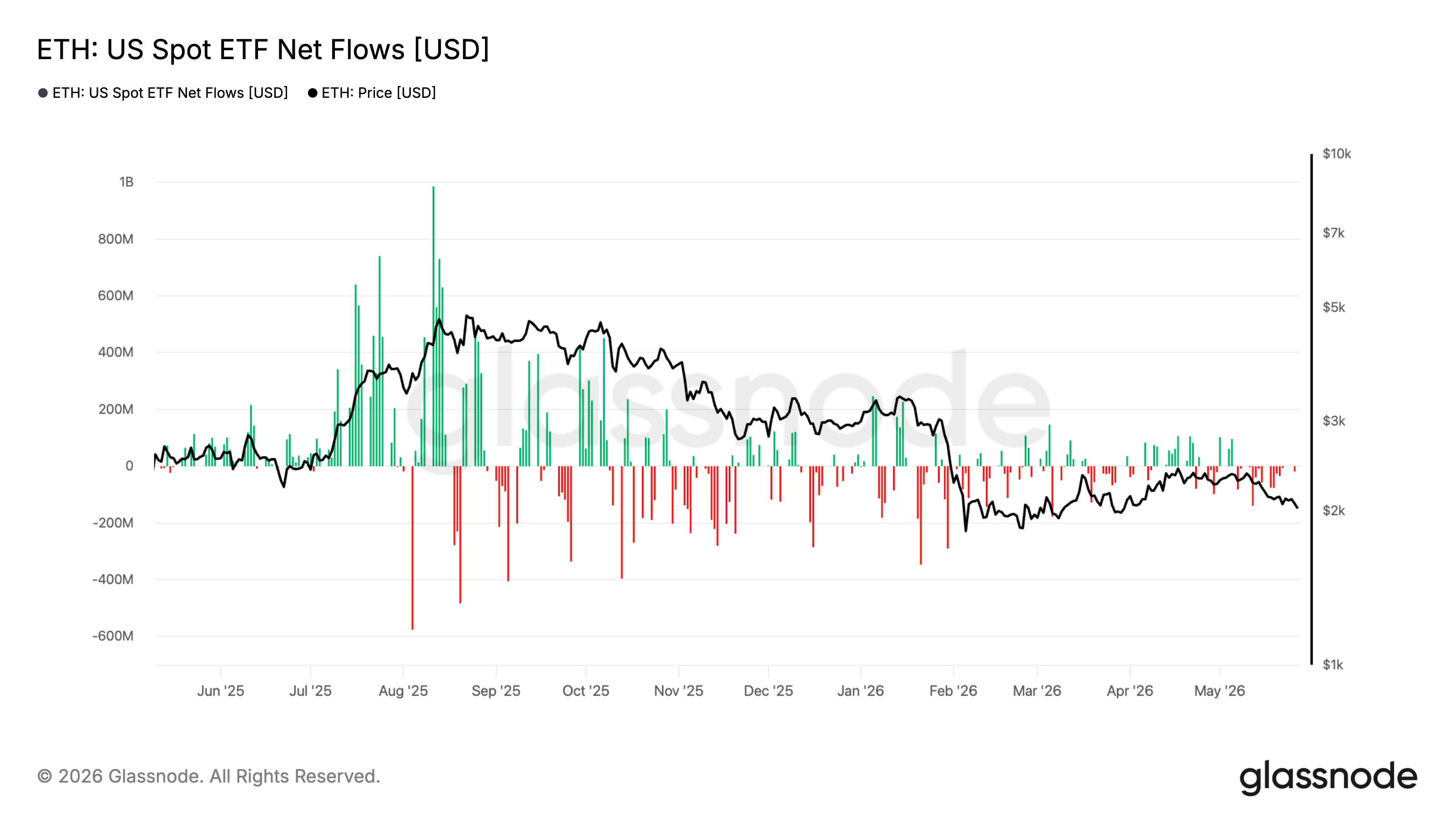
US spot Ether ETFs have witnessed consistent outflows since May 7, recording more than $470 million in withdrawals in the past two weeks.

US Spot ETH ETF daily net flows. Source: Glassnode

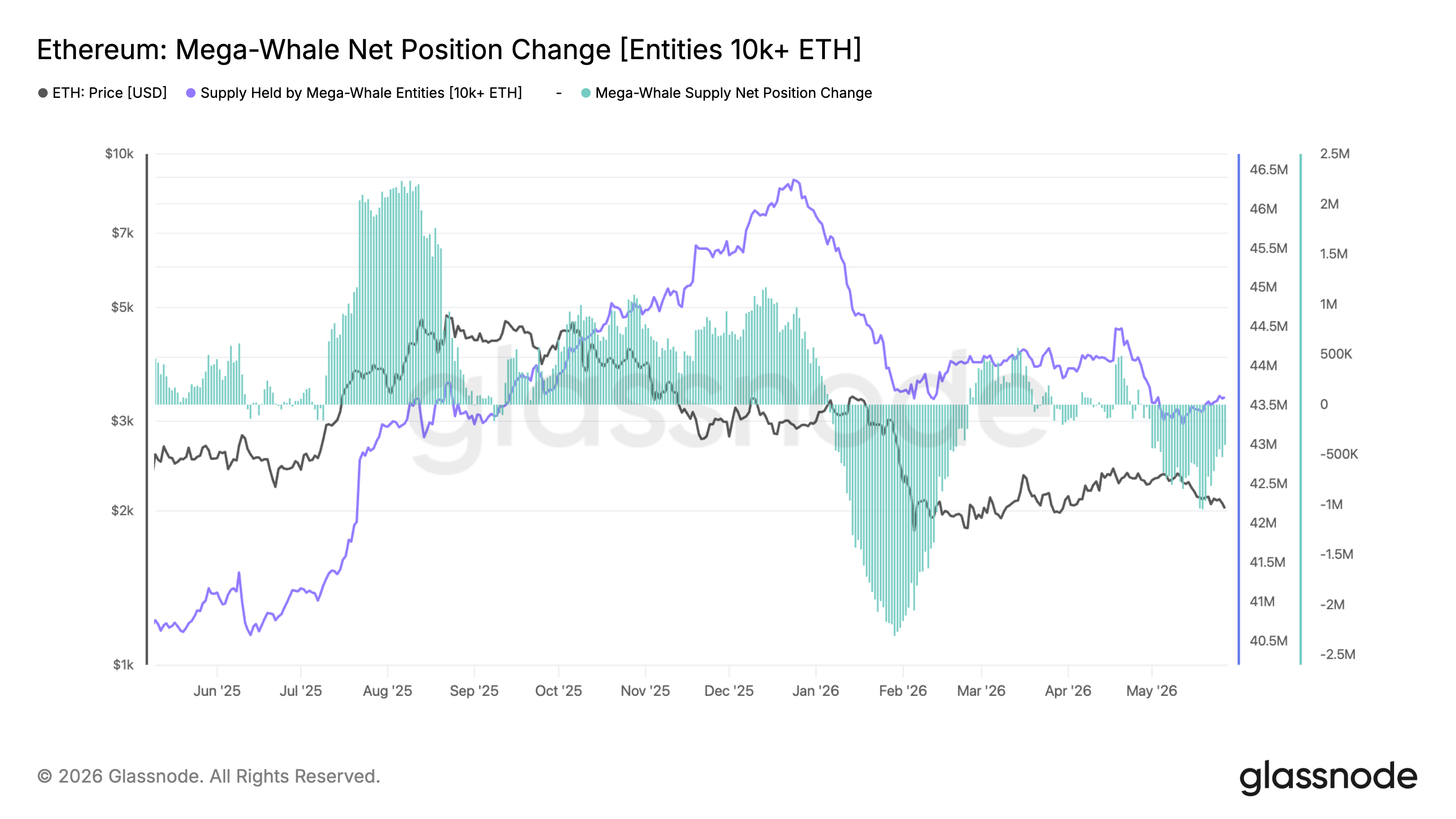
Ethereum’s mega-whales, wallets that hold over 10,000 ETH, are also reducing exposure. So far in 2026, they have cut their balances by more than 5%, according to Glassnode data.

Ethereum mega-whale net position change and balance vs. ETH price. Source: Glassnode

Tom Lee’s BitMine remains the key counterweight, holding about 5.21 million ETH, or roughly 4.31% of supply, as part of its push to own 5% of the network.

Related: Bitmine slows Ethereum buys, targets December to own 5% of supply

Lee has argued that Ethereum is entering a long-term “supercycle” driven by Wall Street tokenization and AI agents using neutral public blockchains.

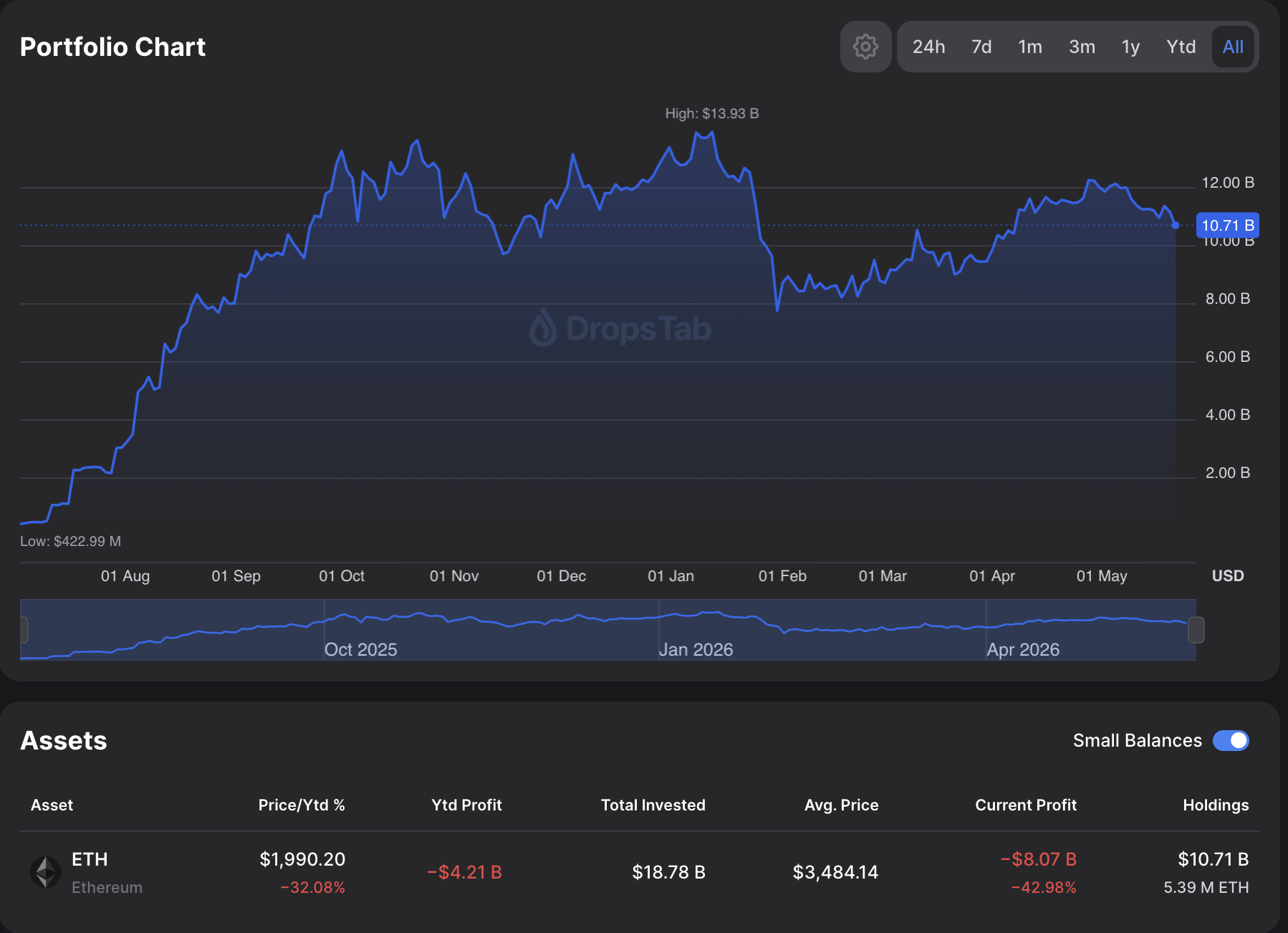
But that bet is now deeply underwater. BitMine’s average ETH purchase price sits near $3,484, while ETH trades around $1,990, leaving the firm with an estimated $8.07 billion unrealized loss, according to DropStab.COM.

Bitmine’s Ethereum portfolio performance chart. Source: DropStab.COM

ETH price may retest the $1,750 macro low

As of Thursday, ETH had fallen as much as 3% intraday to around $1,965. The move also left Ethereum down more than 40% from its 2026 high near $3,400.

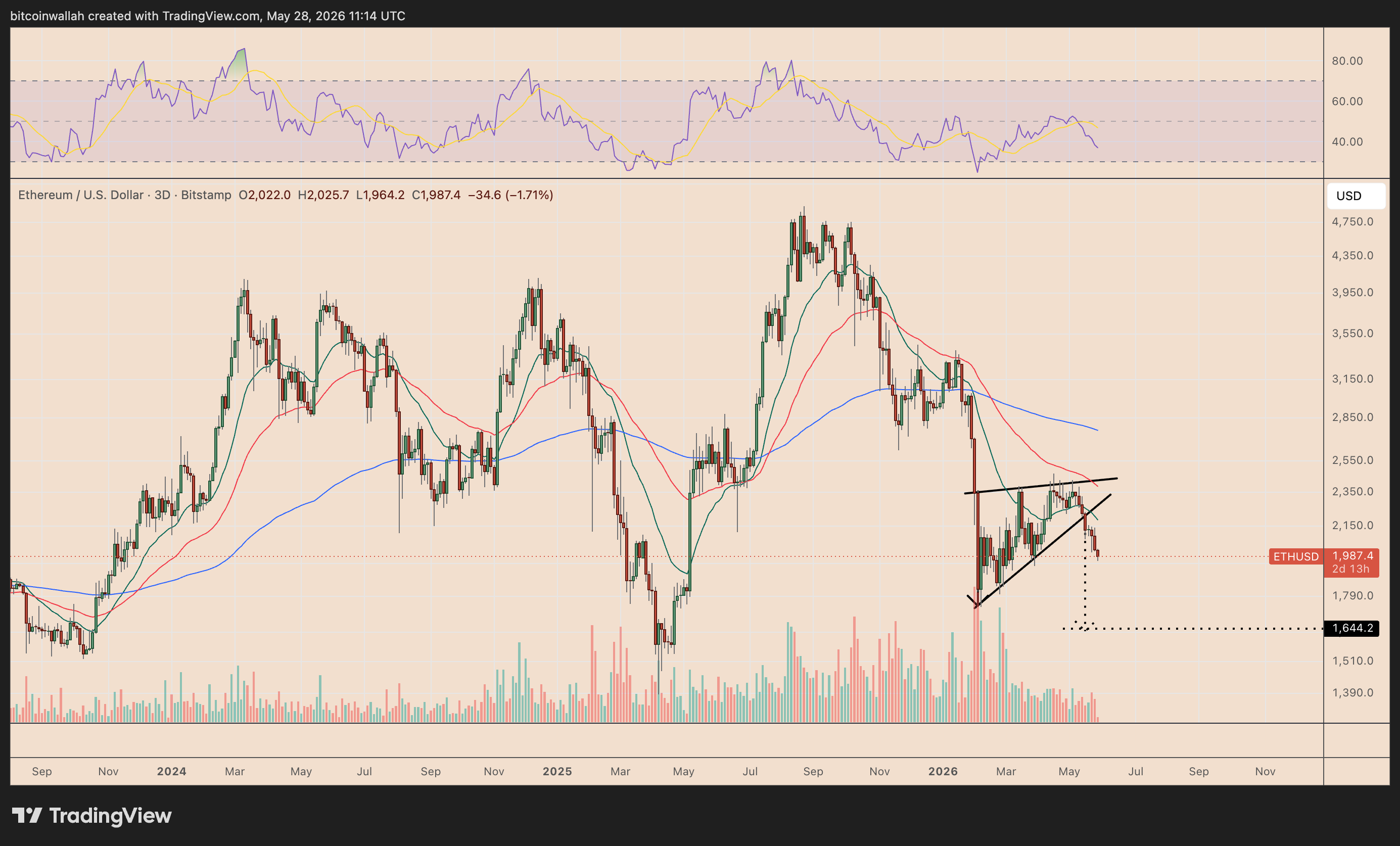
The latest decline followed a breakdown from what appeared to be a rising wedge, a bearish reversal pattern formed by two ascending, converging trend lines.

ETH/USD three-day price chart. Source: TradingView

Such setups typically resolve when price breaks below the lower trend line, with the downside target measured by subtracting the wedge’s maximum height from the breakdown point.

ETH entered the breakdown phase on Saturday and has since extended its losses, putting the measured downside target near $1,750 back in focus, down about 18.5% from the current levels.

In his Thursday post, analyst Ardi also projected $1,750 as the next ETH downside target.