

Shinhan Financial Group will use Visa’s platform to test stablecoin issuance, remittance, and redemption while building new AI-powered payment models.
Euro stablecoins get a mainstream push as Revolut begins rolling out EURR in Europe

Revolut said the stablecoin’s rollout will start with a select group of customers within Denmark, Poland, and Portugal.
Japan targets early 2030s launch for blockchain-based stock and bond settlement system

Japan’s regulators are racing to modernize national settlement systems to prevent institutional investors and foreign capital from fleeing to overseas markets.
A massive $6.4 billion bitcoin options expiry on Friday could amplify volatility
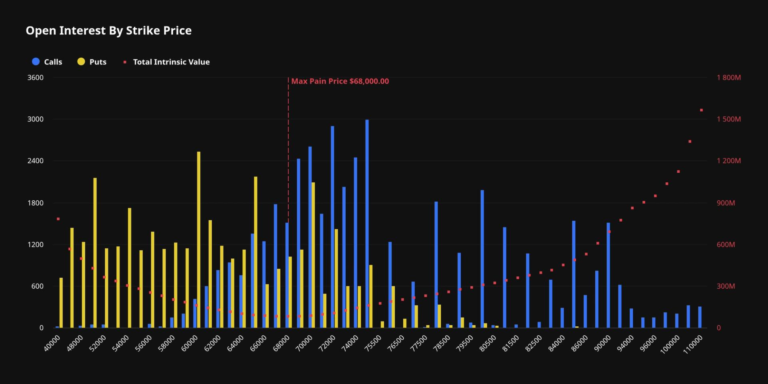
Friday’s expiry follows bitcoin’s surge from $62,000 to $80,000, leaving market makers with increased exposure to manage around several key strike prices.
XRP’s 44% rally brings leverage back, raising risk of sharper pullback
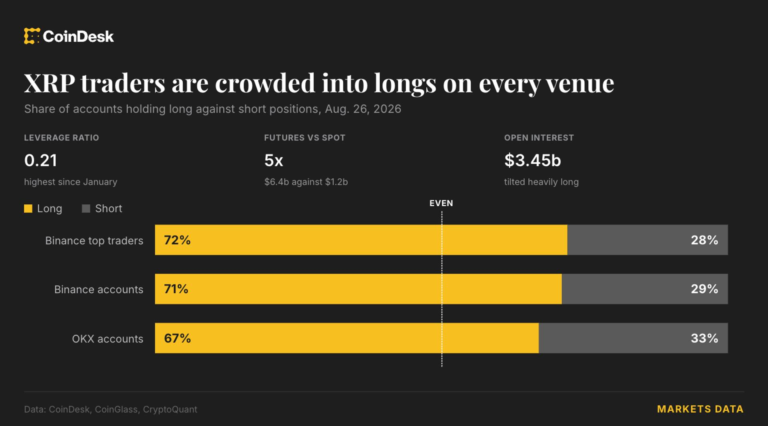
CryptoQuant data show XRP’s estimated leverage ratio on Binance at its highest since January, with long accounts outnumbering shorts as futures volume runs more than five times spot trading.
BlackRock cuts bitcoin ETF swap minimum to $1 million: Report

ETF issuers are lowering the barrier for bitcoin whales to trade self-custody for ETF shares.
Zerohash back for second effort at OCC trust bank charter

The crypto infrastructure firm failed to get approval when it first sought a U.S. charter, and the company is quickly back with what it said would be a narrower effort.
U.S. state banking associations plan to launch their own nationwide blockchain network
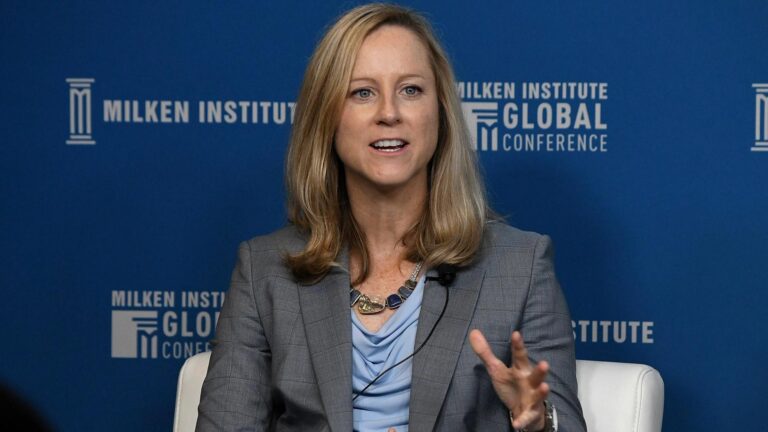
The “BankChain Alliance” is aiming for a 2027 launch, and would foster stablecoins, payments and tokenized deposits inside the banking system’s regulatory sphere.
South Korea trade giant POSCO brings trade receivables to Avalanche in latest tokenization move
The $22 billion trading company worked with Olea and Intain on the transaction, following an Injective pilot with LG CNS last month.
Rayls Launches Open-Source Private Blockchain Infrastructure for Banks
- Rayls launched Rayls Sovereign, an open-source, EVM-compatible blockchain platform for banks, financial market infrastructures and regulated institutions.
- Institutions get their own private blockchain environment, retaining control over sensitive data, security and governance.
Rayls has launched an open-source blockchain platform aimed at solving a persistent problem for banks moving assets onchain: how to keep sensitive financial activity private without becoming isolated from public blockchain markets.
The platform, called Rayls Sovereign, gives banks, financial market infrastructures and other regulated institutions their own EVM-compatible blockchain environment. Institutions retain control over infrastructure, data and governance while maintaining connections to permissioned networks and public chains.
Rayls unveiled the system at FEBRABAN TECH 2026 in São Paulo on Aug. 25.
The launch expands technology that Rayls says is already deployed across more than 30 financial institutions, moving the company from institution-specific blockchain deployments toward infrastructure that banks can install and operate themselves.
Banks Get Their Own Blockchain
Rayls Sovereign runs within a financial institution’s existing technology environment rather than requiring it to conduct all activity on a shared public ledger.
That allows a bank to keep confidential information — including client data, balances and trading activity — inside its own infrastructure. Only information or cryptographic proofs required to complete an external transaction need to be shared.
At the same time, the institution can connect its private environment to other networks and wider onchain markets.
That architecture targets a long-standing trade-off in institutional blockchain adoption. Private networks give banks greater confidentiality and control, but can fragment assets and liquidity, while public blockchains offer wider connectivity but create challenges around privacy and governance.
Rayls’ existing architecture has been built around connecting institution-controlled private environments with broader blockchain networks, allowing assets to move between regulated systems and public infrastructure. Rayls has also said institutions including XP, Núclea, AmFi and Nimofast are expected to bring assets from private networks onto its public chain as its mainnet develops.
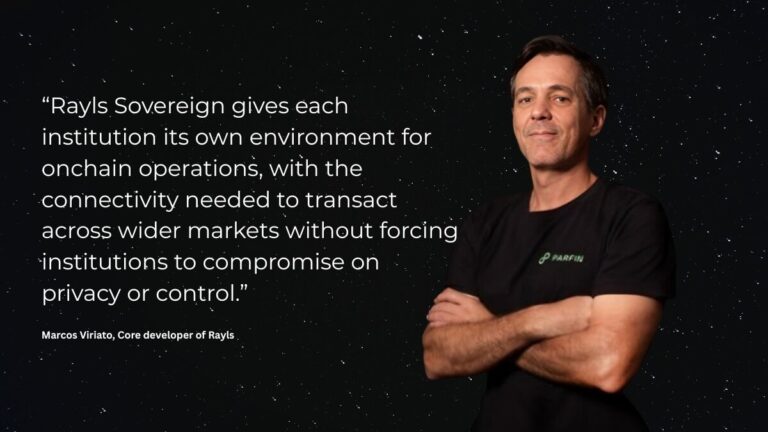
“Financial institutions need a secure and practical way to bring assets and financial processes onchain while maintaining control over their data, systems and governance,” Marcos Viriato, CEO of Parfin and core developer of Rayls, said in a statement shared with AlexaBlockchain.
“Rayls Sovereign gives each institution its own environment for onchain operations, with the connectivity needed to transact across wider markets without forcing institutions to compromise on privacy or control,” Marcos added.
Rayls Points to Production Use, Not Just Pilots
The more significant part of the launch is that Rayls is building Sovereign on technology that is already being used for financial products.
XP Inc. launched its USDXP stablecoin on Rayls infrastructure in March 2026 through its Clear Corretora subsidiary. Rayls described USDXP as a fully backed U.S. dollar stablecoin running as a production deployment rather than a proof of concept.
Rayls subsequently said about $300 million of USDXP was issued during its first week. The stablecoin initially operates within an XP-controlled private environment, with Rayls planning connectivity to its public chain and other stablecoins.
“USDXP proved that institutional-grade digital assets can run in production without compromising control or compliance,” Marcos Horie, head of digital assets at XP Inc., said in the announcement.
“Rayls Sovereign extends that same principle further, giving highly regulated institutions like ours a dedicated environment to continue building.”
Núclea, a major Brazilian financial-market infrastructure provider, is another important reference point.
Rayls says Núclea is using its infrastructure to tokenize roughly 40,000 assets a month. Rayls has also identified Núclea as one of the institutional asset providers expected to begin bringing assets from private networks to its public blockchain during 2026.
Nimofast Global, meanwhile, is targeting as much as $100 billion in tokenized receivables and other real-world assets on Rayls, according to Rayls. The figure represents a target rather than assets already tokenized.
More From AlexaBlockchain
Why Does The Launch Of Rayls Sovereign Matter?
The bigger contest in institutional blockchain is increasingly about architecture rather than whether banks will experiment with tokenization.
Banks want programmable assets, faster settlement and access to blockchain-based liquidity. They also require confidentiality, permissioning, audit controls and the ability to determine where sensitive financial information is stored.
Rayls is effectively arguing that institutions should not have to choose between those two models.
A bank could, for example, issue a tokenized deposit or stablecoin inside its private environment, apply its own compliance and governance rules, and later connect that asset with external counterparties or public markets without putting its full internal ledger on a public blockchain.
That could become more important as banks move beyond tokenization pilots toward products that need distribution and secondary-market liquidity.
The U.S. regulatory environment is also becoming clearer for some digital-asset activities.
President Donald Trump signed the GENIUS Act into law on July 18, 2025, establishing a federal regulatory framework for payment stablecoins, including reserve, disclosure and compliance requirements.
The broader CLARITY Act remains unresolved. The U.S. Senate advanced procedural work around the legislation in August, but a key vote was pushed into September and the bill continues to face disagreements over issues including stablecoin rewards, anti-money-laundering safeguards and restrictions involving government officials.
President Trump again urged Congress to pass the legislation at a White House event on Aug. 19. The bill seeks to provide broader rules for digital assets and clarify regulatory responsibilities, but it remained stalled in the Senate.
The combination of clearer stablecoin rules and continued debate over market structure increases the incentive for banks to build blockchain systems that can operate within conventional regulatory controls.
Wall Street Is Moving Toward Similar Hybrid Models
Rayls is not alone in trying to combine institutional privacy with blockchain interoperability.
Canton Network has pursued a similar problem from a capital-markets perspective, building infrastructure in which separate financial applications can interact while information remains visible only to parties entitled to see it.
A six-week Canton pilot involving 45 financial institutions and market participants tested how permissioned blockchain applications could transact with each other while maintaining privacy and regulatory controls. Participants included BNY Mellon, Goldman Sachs, BNP Paribas, Cboe Global Markets, DTCC, State Street, Standard Chartered and Visa.
The Canton ecosystem has since moved beyond pilots in some areas.
Broadridge’s Distributed Ledger Repo platform, which operates within the Canton ecosystem, has handled about $1.5 trillion in monthly repo volumes, according to a Canton report. That provides one example of distributed-ledger infrastructure reaching material scale in an institutional market rather than remaining confined to experimental tokenization projects.
Those efforts point toward a similar conclusion: regulated institutions increasingly want interoperable blockchain infrastructure without making all financial data public.
The key difference is how individual platforms implement that model. Rayls is emphasizing institution-controlled private chains that can connect outward, while Canton has focused on interoperable applications operating with need-to-know privacy across a shared institutional network.
Rayls Sovereign Can Process 15,000+ Transactions Per Second
Rayls says Sovereign can process over 15,000 transactions per second with settlement finality in under one second.
The company is positioning that capacity for workloads including high-volume payments, atomic delivery-versus-payment transactions and post-trade processing.
Blockchain throughput figures, however, are difficult to compare directly. Results can vary substantially depending on transaction complexity, hardware, validator configuration and whether tests reflect a live distributed environment.
The core Rayls Sovereign platform is being released as open-source software, giving institutions the ability to inspect, test and deploy the infrastructure rather than relying entirely on proprietary technology.
Rayls will also offer additional commercial components.
Those include Axyl, its performance infrastructure, and Enygma, a privacy layer designed to use technologies including zero-knowledge proofs to protect sensitive information while allowing transactions to be verified.
The above article “Rayls Launches Open-Source Private Blockchain Infrastructure for Banks” was first published on AlexaBlockchain. Read the complete article here: https://alexablockchain.com/rayls-launches-open-source-private-blockchain-infrastructure-for-banks/
Read Also: This is the First U.S.-Chartered Depository Bank to Offer Stablecoin Invoicing
Disclaimer: The information provided on AlexaBlockchain is for informational purposes only and does not constitute financial advice. Read complete disclaimer here.