Home Blog Page 218

Bitcoin Accumulation Weakens as BTC Realized Losses Hit $600M

0

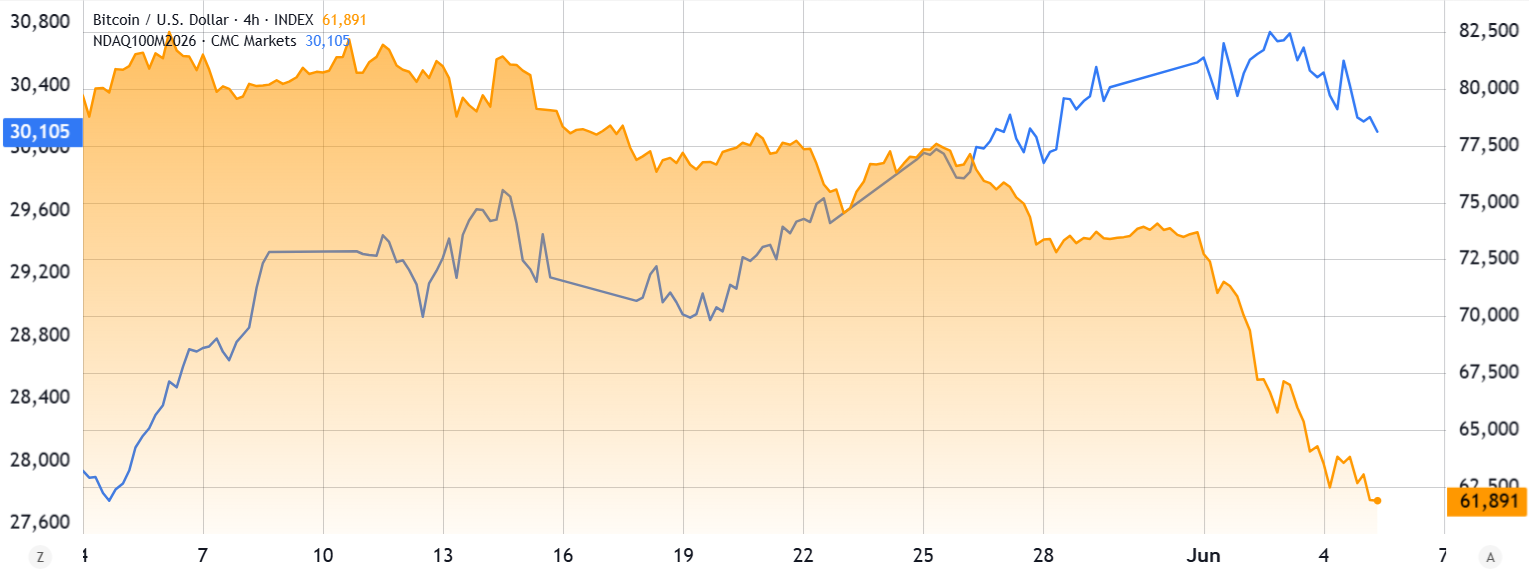
Bitcoin (BTC) has dropped nearly 7% from its local peak of $82,800, as several groups of wallet holders switched from accumulation to distribution. Data suggests that this distribution, combined with increasing realized losses, points to a potential shift in momentum.

Key takeaways:

  • Whale absorption of newly mined BTC supply drops to all-time lows below -150%.
  • Bitcoin holders shift from accumulation to distribution after BTC price drop
  • Bitcoin realized losses surged above $600 million in a single day as BTC price fell to $76,000.

Bitcoin whales absorbing at all-time lows

The yearly absorption rate measures the amount of new BTC issued that has been absorbed by the market over the past year. Currently, the absorption rate by exchanges is improving while whales are losing coins at a historic pace.

Notably, Bitcoin’s yearly absorption rate by exchanges has improved to -75 % from below -100% in April as inflows continue.

Bitcoin yearly absorption rates. Source: Glassnode

The chart above shows that a similar jump in the exchange absorption rate in January preceded a 38% BTC price decline to $60,000 from $98,000. 

While large holders (100–1,000+ BTC) are scooping up more than 150% the new issuance, the rate has dropped sharply since mid-April and is significantly below the record levels seen in November 2025.

Meanwhile, the rate of accumulation among whales (entities holding more than 1,000 BTC) has dropped to -151%, its lowest in Bitcoin’s history.

Bitcoin yearly absorption rates by whales and sharks. Source: Glassnode

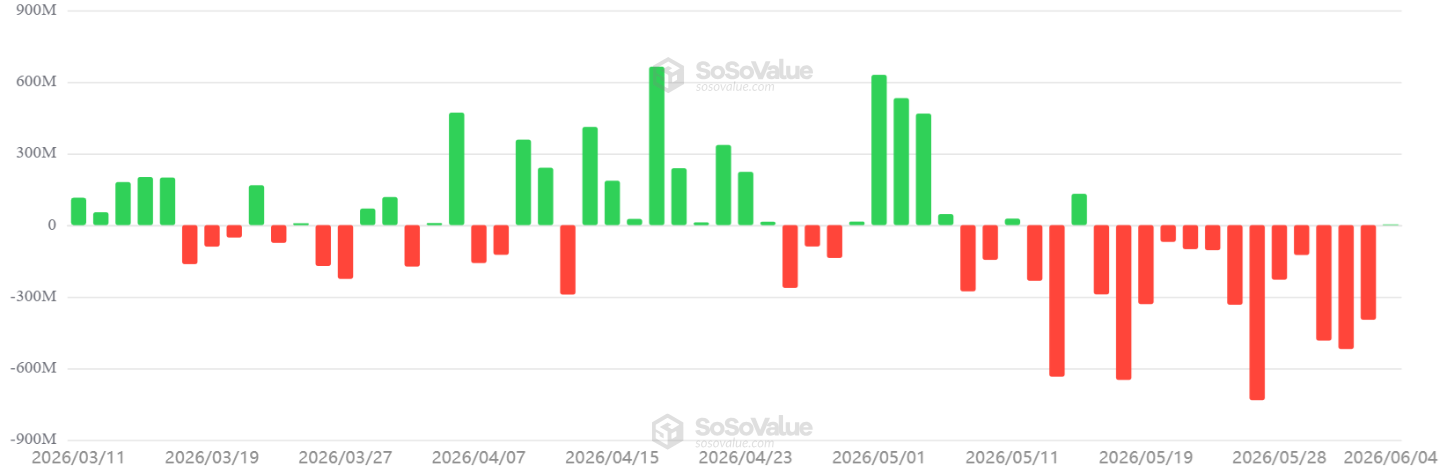
This marks a shift in institutional sentiment, particularly with heavy outflows from spot Bitcoin’s exchange-traded funds, reflecting a reduction in long-term conviction among large holders.

All Bitcoin holder cohorts are “taking profits”

Bitcoin investors went risk-off, distributing their BTC as the price dropped to $76,000.

Glassnode’s Accumulation Trend Score (ATS) is near zero (light yellow), indicating that whales are selling BTC or not accumulating. 

Related: Bitcoin retakes $71K as US sends Iran 15-point ceasefire plan

The drop in the trend score indicates a transition from accumulation to distribution across almost all cohorts. This shift mirrors a similar pattern observed in mid-January 2025, which aligned with Bitcoin’s drop to $60,000 in February. 

Bitcoin accumulation trend score. Source: Glassnode

Additional data from Glassnode reveals a shift toward distribution or inactivity across all investor cohorts, as seen in the chart below.

Bitcoin accumulation trend score by cohort. Source: X/Glassnode

This is in contrast to Q4 2024, where broad cohort accumulation preceded a sustained rally that saw BTC/USD trade above $100,000 for the first time in history, fueled by the 2024 US Presidential elections.

CryptoQuant analyst Woominkyu highlighted “continued selling pressure” from whales who sent more than 8,000 BTC to exchanges on Monday. 

“As Bitcoin rallied to a peak of $82,196, whales began sending coins back to exchanges,” the analyst said in a QuickTake note on Thursday, adding:

“This is a classic sign of smart money selling into strength — taking profits while retail FOMO was building.”

Bitcoin whale activity. Source: CryptoQuant

Bitcoin’s realized losses jump to $600 million

Bitcoin’s latest correction triggered a sharp spike in realized losses. The losses by long-term holders (LTHs) reached $513.6 million on Tuesday, while losses by short-term holders (STHs) reached $101.8 million.

The aggregate realized losses across all holders reached $616 million after Bitcoin dropped to $76,000 on Monday. 

This marked the highest single-day loss realization since March and an over 1,500% jump in less than two days, compared with $41.5 million on Sunday.

Bitcoin realized losses by LTHs and STHs. Source: Glassnode

LTHs account for the bulk of the losses, while STH losses stay comparatively contained, indicating that the stress is largely on older buyers.

As Cointelegraph reported, Bitcoin investors who have held their coins for over six months could sell near their entry price after extended drawdowns, creating strong overhead pressure that may stall Bitcoin’s recovery.

Bitcoin Opens New Opportunities As The MVRV Ratio Falls Below A Key Threshold

0

Trusted Editorial content, reviewed by leading industry experts and seasoned editors. Ad Disclosure

Bitcoin’s near-term outlook is looking quite bearish, with its price trending well below the $80,000 level as volatility mounts. Along with downside performance, several key metrics are starting to exhibit negative activity, strengthening the bearish state. However, some analysts believe that this period could offer an ideal entry point for investors and traders.

New Bitcoin Buying Opportunities Emerge After MVRV Shift

Given the bearish market environment, the Bitcoin price has failed to recover from its recent pullback. However, this weakening moment has been highlighted by some crypto analysts as a bullish angle for investors to step into the market again.

Ali Charts, a market expert and investor, in a recent analysis, shared that fresh opportunities may be emerging in the BTC market again. This is due to the Bitcoin Market Value to Realized Value (MVRV) Ratio dropping below a key historical level closely watched by traders.

It is worth noting that the MVRV metric is frequently used to determine whether BTC is overpriced or undervalued in relation to investor cost basis. It does this by comparing the asset’s market value to its realized value. The expert’s perspective is quite valid since declines into lower MVRV zones have historically been associated with times when possibilities for long-term accumulation start to emerge.

Bitcoin
Source: Chart from Ali Charts on X

Currently, the MVRV ratio has fallen below the 180-day Moving Average (MA), which implies that the market is effectively flushing out premium and pricing in a deep discount. Historically, these specific periods mark the exact foundation on which smart money tends to build its positions.

According to Ali Charts, the short-term trend will remain compressed as long as the ratio consolidates under the 180-day MA line. Such a scenario is likely to offer a highly strategic accumulation window as the asset prepares to enter another attractive positioning phase for investors.

How The $77,800 Level Plays A Key Role In Upcoming Price Action

While Bitcoin may look primed for a leg up, its next price trajectory hinges heavily on the $77,800 price level, which Ali Charts has specially called out. Currently, BTC is trading around this pivotal level, making the upcoming sessions crucial to monitor.

After persistent sideways price action, a well-defined channel has been formed on the 15-minute time frame chart. With its brief bounce on Wednesday, BTC has surged to the upper boundary of the key channel located around the $77,800 level.

Ali Charts argues that a clean breakout above the $77,800 ceiling will be significant because it will pave the way for the asset to accelerate toward $79,000. However, if the resistance holds, the analyst expects a healthy retracement back into the channel, with the purpose of grabbing liquidity. 

In the event of a rebound after the pullback, the key internal floors to watch are the mid-range at $76,900 and the bottom of the channel at $76,000. As a result, Ali Charts remains waiting for the market to prove its strength by making a definitive candle close above the $77,800 before positioning for the next leg up.

Bitcoin
BTC trading at $77,773 on the 1D chart | Source: BTCUSDT on Tradingview.com

Featured image from Getty Images, chart from Tradingview.com

Editorial Process for bitcoinist is centered on delivering thoroughly researched, accurate, and unbiased content. We uphold strict sourcing standards, and each page undergoes diligent review by our team of top technology experts and seasoned editors. This process ensures the integrity, relevance, and value of our content for our readers.

Assessing Crypto ETPs in an Evolving Market

0

In today’s newsletter, Sarah Cummings from Morgan Stanley Investment Management provides insights and considerations when assessing crypto exchange-traded funds.

Then, in “Ask an Expert,” Ryan Tannahill from iA Private Wealth USA, answers questions about borrowing against bitcoin assets.


Assessing Crypto ETPs in an Evolving Market

When evaluating exchange‑traded funds (ETFs), investors typically focus on factors such as fees, liquidity and tracking. Spot bitcoin exchange‑traded products (ETPs) introduce additional dimensions of due diligence that investors may be less accustomed to assessing. First launched in January 2024, these vehicles — structured as grantor trusts under the 1933 Act — seek to track bitcoin performance using a designated pricing benchmark. Understanding how their structure, custody arrangements and benchmarks operate is central to evaluating these products.

Core ETF considerations

As with any ETF, headline costs and trading characteristics matter.

Fees and waivers. While fee compression has occurred since the first spot bitcoin ETPs entered the market, expense ratios still vary meaningfully across products. Investors may wish to distinguish between gross and net expense ratios, particularly where fee waivers are in place. Such waivers may be subject to asset thresholds or expiration dates that could affect costs over time.

Liquidity and execution. Trading volume, bid/ask spreads, and overall fund liquidity remain important inputs when assessing the total cost of ownership. However, because bitcoin itself is a highly liquid underlying asset, onscreen fund liquidity may not fully reflect execution quality. In practice, similarly priced execution may be achievable across products despite differences in visible trading activity. Engaging with a trust sponsor or liquidity provider ahead of a trade may help manage execution costs.

Tracking and fund design. Given their single‑asset, passive structure, spot bitcoin ETPs tend to exhibit limited sources of tracking error. Expense ratios are typically the primary driver, with lower‑fee products generally expected to track more closely over time. In‑kind creation and redemption mechanisms may also support tighter tracking by reducing frictional costs.

Considerations specific to crypto ETPs

Beyond traditional ETF metrics, several factors are more specific to crypto‑based products.

Digital asset custody. Holding bitcoin requires specialized custody arrangements, a relatively new function within asset servicing. While early infrastructure was largely developed by crypto‑native firms, traditional custodians have increasingly entered the space. Custody practices, regulatory status and bankruptcy protections can differ across providers, making it prudent to understand how and where digital assets are held.

Sponsor profile. The issuer’s background may also warrant consideration. Crypto‑native sponsors and traditional financial institutions may operate under different regulatory frameworks and governance standards, which can influence risk management, operations and investor protections.

Benchmark methodology. The growth of digital asset products has led to the emergence of new benchmark providers. Evaluating a benchmark’s construction—such as exchange inclusion criteria, pricing methodologies and review processes—can be important. A poorly designed benchmark may diverge from broader bitcoin pricing, potentially affecting tracking outcomes.

Bringing it together

In a developing asset class, the structure and design of an ETP can be as consequential as the exposure it seeks to provide. Beyond headline fees, evaluating custody frameworks, sponsor profiles, benchmark methodologies and execution characteristics may help investors better understand potential costs and risks. As the market for crypto ETPs continues to evolve, a disciplined and holistic due diligence process remains essential.

– Sarah Cummings, executive director, ETF Strategist, Morgan Stanley Investment Management

Important risks and disclosures.


Ask an Expert

Q: Do I need to move my bitcoin to get a loan against it?

In many cases, yes — centralized lenders typically require custody of your bitcoin for the loan’s duration. However, structures vary across platforms, so it’s worth understanding who holds your assets and how they’re protected before committing.

Q: What’s the main risk advisors should flag?

Margin calls. If bitcoin drops sharply, clients may be forced to post additional collateral or face liquidation — often at the worst time. That forced sale can also trigger a taxable event, compounding the loss.

Q: Should I do this instead of selling some of my position?

It depends on conviction. If you believe bitcoin appreciates, borrowing preserves that upside while meeting liquidity needs. But if you’re uncertain about the position, adding leverage isn’t the answer — sometimes a clean sale is the simpler move.

– Ryan Tannahill, Investment Advisor Representative, iA Privabecoming


Keep Reading

  • The U.S. Senate Banking Committee advanced its crypto market structure bill, the Clarity Act, to the Senate floor on Thursday, bringing it a step closer to passing it into law.
  • Japan’s Financial Services Agency recognizes foreign-issued stablecoins as electronic p.yment methods under domestic law, effective June 1.
  • Bank of England Deputy Governor Sarah Breeden says the BoE will publish draft stablecoin rules next month and finalize them by year-end.

U.S. CFTC secures deal with National Hockey League on prediction market safeguards

0

In the midst of its playoffs surge, the top professional hockey league has agreed to coordinate oversight of betting on popular prediction markets with the U.S. Commodity Futures Trading Commission, securing a new memorandum of understanding similar to the one recently struck with Major League Baseball.

The National Hockey League, which had officially linked itself last year with both Kalshi and Polymarket as the league’s official prediction market partners, has agreed to share information with the regulator on event contracts tied to its games, according to a Thursday statement from the agency. The CFTC has been pursuing similar arrangements with all of the professional sports leagues, Chairman Mike Selig said at an event last week.

“This agreement is another step toward safeguarding the integrity of sports and protecting market participants in prediction markets from insider trading, fraud, and other abuses,” he said of the NHL arrangement in a statement.

Selig has made it a point to foster the industry and to defend his agency’s role as its sole regulator.

Prediction market betting has seen explosive growth in recent years, and along with its popularity has come concerns that the wagering is being abused and is encouraging cheating. In a Senate Commerce Committee hearing this week, lawmakers criticized the dark side of the industry. Bad actors — including among the athletes themselves — threaten to “sow doubt in the minds of fans,” said committee Chairman Ted Cruz.

“Integrity has always been and remains paramount to the NHL and fundamental to the trust our fans and partners place in our game,” said NHL Commissioner Gary Bettman, in a statement released by the CFTC. “Our agreement with the CFTC enhances the comprehensive integrity monitoring systems already in place and strengthens our ability to identify, deter, and address potential risks.”

According to the new MOU, the league and regulator will “endeavor to share information, upon request, regarding the integrity of professional hockey and the event contract markets related thereto or other matters deemed appropriate.”

Read More: Prediction markets firms take heat in Senate Commerce hearing scrutinizing surge

A crypto betting platform may have leaked U.S. military secrets before a surprise attack on Iran, experts warn

0

An in-depth investigation into insider trading by Bubblemaps analysts reveal how accurate bets on U.S. attacks on Iran were, exposing a trend that experts fear poses immense risks to the United States’ national security.

In an interview with CoinDesk, Nicolas Vaiman, Bubblemaps co-founder and CEO, expressed deep concern over the national security implications of this new alleged wave of insider trading. He warned that if those observing the predictions markets can spot irregular trades, so can enemies of the United States.

“The issue here is they can make war plans accordingly,” Vaiman said. “Just to put it bluntly, this could potentially expose the lives of many people.”

Vaiman said U.S. adversaries could easily spot the insider trading patterns and use that information to plan their own military strategies.

Luck alone cannot explain the accuracy

The warnings come as he and his team uncovered 80 bets on Polymarket that were so accurate that “luck alone cannot explain” the numbers.

Driven by geopolitical tensions, bets on military plans and outcomes have skyrocketed, with more than $1 billion alone this year. The ability to wager on global conflict creates an entirely new category of insider trading.

Onchain data showed that several major, high-conviction bets were placed days before the Feb. 28 surprise attacks on Iran, the removal of its supreme leader and the announcement of a ceasefire.

According to Bubblemaps, nine accounts connected to Polymarket made more $2.4 million betting almost exclusively on U.S. military operations.

“They just didn’t bet on U.S. strikes days before they took place, but across multiplate later dates to maximize profit,” Vaiman said. They also placed smaller losing bets on Feb. 20, likely attempting to avoid attention.

A 98% win-rate is hard to miss

However, executing dozens of bets with a 98% win rate is hard to miss. “During the Iran strikes, civilians were reportedly checking Polymarket to decide whether they should sleep in bunkers or not,” Vaiman added. “So yes, governments and potential enemies are probably watching that closely.”

When asked if he had any indication those insider traders were connected to the U.S. government, Vaiman responded “we have no proof these are military insiders or even Americans.” He said, “the data is suspicious and may indicate someone with an unfair informational advantage.”

Rep. Mike Levin recently said on X that the “insider trading problem with prediction markets is bigger than any of us could have known,” which is why he and Senator Adam Schiff introduced the DEATH BETS act to ban contracts on war.

One insider trading arrest has been made. A U.S. army green beret, Master Sergeant Gannon Ken Van Dyke, made $400,000 on Polymarket bets he placed on the Venezuela raid to extract President Nicolas Maduro in which he participated. Later that month, a study found that only 3% of “informed” traders drove accuracy, while 97% did not.

Bubblemaps first made their investigation public on May 18 via a series of X posts, in which they share graphics and images as evidence that confirms the statistically impossible accuracy of the timing on each of the bets.

Two weeks prior to its findings, Polymarket announced a partnership with Chainalysis to bring Wall Street-grade supervision to its platform, in a clear signal by the prediction markets provider that it is serious about clamping down on insider trading and market manipulation.

Win percentage on Polymarket (Bubblemaps Data)

Potential for manipulation

According to Vaiman, all this brings up other questions and concerns, such as the potential for prediction markets to be manipulated.

“A government could intentionally place bets to create a false signal and mislead adversaries into thinking something is about to happen,” he said. “Prediction markets are intelligence and information warfare tools.”

He also noted prediction markets do not just predict the future, “they can change it.” He mentioned cases where journalists faced extortion threats from bettors trying to protect their financial positions.

On the other hand, Vaiman defended Polymarket’s structural design and the transparency it provides, while refusing to blame the platform for the compliance failures.

“I don’t want to dunk on Polymarket,” Vaiman stated. “Realistically, anybody can use a cheap VPN or buy a KYC’d account. That is not just a Polymarket problem. It is an internet-wide problem.”

Polymarket did not immediately respond to CoinDesk’s request to comment. However, has hit back at insider trading claims in the past, saying that it has strict insider trading rules, AI-powered surveillance and blockchain forensics to identify suspicious activity and report it to relevant authorities. ”Insider trading is not welcome on Polymarket, and those who attempt it will be identified,” the platform has said.

Bitget and UNICEF Partner to Boost AI and Financial Literacy Among Youth in 8 Countries

0

Bitget, the world’s largest Universal Exchange (UEX), announced today the start of its second-year partnership in support of the UNICEF Game Changers Coalition (GCC). The coalition, which has reached over 642,000 young people, parents, and teachers across eight countries since launch, is entering a new phase of growth introducing financial literacy and AI modules into its curriculum, with blockchain content planned for 2026.

GCC is a global initiative led by UNICEF’s Office of Innovation, bringing together public and private sector partners to broaden access to technology education for young people in emerging economies, with a particular focus on girls, who make up 52% of participants to date. Operating across Armenia, Brazil, Cambodia, India, Kazakhstan, Malaysia, Morocco, and South Africa, the coalition supports young people to build practical digital skills through an innovative curriculum, community-based learning programmes, and in-person and online game hackathons.

Bitget joined the coalition in June 2025 through its partnership with UNICEF Luxembourg, contributing to the coalition’s broader mission of improving digital literacy and technology access for underserved communities. In its second year, Bitget will contribute to GCC’s curriculum growth and geographic expansion.

In the first year of the partnership, Bitget supported UNICEF through several activations aimed at expanding awareness and participation in technology education. One of the key milestones included a visit to Cambodia, where Bitget CMO, Ignacio Aguirre, met students, educators, and local partners involved in digital skills training programs. The visit highlighted how access to foundational digital education can create new pathways for employment, entrepreneurship, and participation in the digital economy, particularly for young women and students in underserved regions.

The partnership also supported broader youth engagement initiatives through events and interactive learning experiences. In late 2025, Bitget CEO Gracy Chen supported GCC’s inaugural global UNICEF Game Jam, a 40-day initiative through which young creators in emerging economies built original video games with mentorship sessions and a self-paced online course.

“Technology is becoming part of everyday life faster than education systems can adapt,” said Gracy Chen, CEO at Bitget. “What stood out during our work with UNICEF this year was how quickly young people engage once they are given access and opportunity. Our eventual goal is not only to introduce blockchain or digital tools, but to help build confidence and long-term digital and financial literacy that can create opportunities far beyond crypto.”

The update comes as demand for digital skills continues to rise globally, particularly in markets where younger populations are increasingly mobile-first but remain underserved by traditional technology education pathways. Bitget has continued to expand its education-focused initiatives alongside institutional and ecosystem growth, positioning digital literacy as a key pillar of long-term industry development.

“Too many young people are still locked out from the skills driving the digital transformation shaping today’s economy,” said Thomas Davin, Global Director at UNICEF Office of Innovation. “GCC is a clear response to this need. The initiative brings industry, governments, and communities together so the next generation has the skills, confidence, and opportunity to lead in a technology-driven economy. Alongside Bitget we expand to reach even more young people with the skills they need.”

In its second year, the partnership will support GCC’s expansion into three additional countries and the rollout of new financial literacy and AI modules within the coalition’s curriculum. Bitget will continue to engage through field visits, executive participation, and support for coalition-led learning experiences. 

About Bitget

Founded in 2018, Bitget is the world’s largest Universal Exchange (UEX), serving over 120 million users with access to crypto, tokenized assets, and AI-powered trading tools across major blockchains. Its ecosystem includes Bitget Wallet, an everyday finance app used by over 80 million people. Bitget advances global crypto adoption through partnerships with LALIGA, MotoGP™, and UNICEF.

About UNICEF

UNICEF works in over 190 countries and territories to reach the most disadvantaged children and build a better world for every child.

UNICEF Luxembourg supports this global mission by mobilizing private sector partnerships and voluntary contributions. It also advocates nationally to uphold children’s rights—focusing on reducing inequalities, promoting gender equality, tackling child poverty, supporting mental well-being, and improving access to justice for every child. For more information, visit https://www.unicef.org/

Source: Bitget

The above article “Bitget and UNICEF Partner to Boost AI and Financial Literacy Among Youth in 8 Countries” was first published on AlexaBlockchain. Read the complete article here: https://alexablockchain.com/bitget-and-unicef-partner-to-boost-ai-and-financial-literacy-among-youth-in-8-countries/

Submit Your Blockchain and Crypto Press Release here.

Disclaimer: This is a press releaseprovided by the company/ company representative. AlexaBlockchain does not endorse, guarantee, or accept responsibility for the content, accuracy, quality, advertising, products, or other materials presented in this publication. Readers are advised to conduct their own due diligence before taking any actions related to the company mentioned herein. AlexaBlockchain expressly disclaims any liability for damages or losses, whether direct or indirect, arising from or related to the use of or reliance on any content, goods, or services referenced in this press release.

Image Credits: Bitget, Shutterstock, Canva, Wiki Commons

Bitcoin Demand Weakens as BTC Price Risks Prolonged Consolidation

0

Demand for Bitcoin (BTC) has decreased sharply over the last few days as the price ran into overhead resistance above $80,000. Analysts say BTC’s inability to hold key support levels may be paving the way for a prolonged consolidation.

Key takeaways:

  • Bitcoin’s apparent demand fell to -3,138 BTC, its lowest level in four months.
  • Weak spot activity and negative ETF flows pressure the BTC price below $80,000.
  • Analysts warn that Bitcoin risks prolonged consolidation or a deeper correction if $78,000 is not broken.

Bitcoin’s apparent demand has dropped to its lowest level since mid-January, as traders and investors adopted a risk-off approach due to geopolitical and macroeconomic uncertainties.

Related: Bitcoin rallies through $77K despite spot BTC ETF outflows topping $2B

Capriole Investment’s Bitcoin Apparent Demand metric shows that demand for Bitcoin has been negative since Dec. 22, 2025 and improved slightly in late February, before reversing sharply to -3,138 BTC on Thursday. 

Bitcoin’s apparent demand. Source: Capriole Investments

“Bitcoin’s overall demand has flipped into net contraction,” CryptoQuant said in its latest Weekly Crypto report, adding:

“Spot apparent demand is contracting at a slightly faster pace than in prior weeks.”

Spot market activity has weakened in recent weeks, with the aggregate spot cumulative volume delta (CVD) across all exchanges “remaining negative into the recent pullback toward the high-$70K range,” Glassnode said in its latest Week On-chain newsletter, adding:

“Despite Bitcoin remaining relatively resilient structurally, the latest spot positioning data suggests broad-based spot accumulation has yet to re-emerge.”

Bitcoin spot CVD. Source: Glassnode

Meanwhile, US-based spot exchange-traded funds (ETFs) also turned net sellers, with the 30-day change in ETF holdings falling to its lowest level in nearly three months. 

This suggests that “outright spot demand is becoming less aggressive near the current range highs,” Glassnode added.

US ETF AUM position change. Source: Glassnode

The simultaneous deterioration across spot demand and ETF flows has “historically been more consistent with renewed price weakness than with stable consolidation,” CryptoQuant concluded.

Bitcoin’s price is at an inflection point

Bitcoin’s 38% rally to $82,800 from its $60,000 macro low marked a notable recovery above the true market mean, now sitting at $78,300.

The true market mean is a price model that tracks the average acquisition cost of actively transacted Bitcoin supply and “historically serves as the dividing line between bear and bull market regimes, according to Glassnode.

The onchain data provider said that reclaiming this level is a “necessary but not sufficient condition for a structural transition,” adding:

“Conventionally, pre-bull market phases require weeks to months of sustained consolidation around this model before a credible regime shift can be confirmed.”

Note that the price consolidated around the true market mean for over six months, between March and October 2021, before breaking into a 174% rally to its previous all-time high of $74,00 reached in March 2024.

Bitcoin risk indicator. Source: Glassnode

Glassnode added: 

“Any deeper correction from current levels would therefore reframe the recent rally as a local top within the ongoing bear market, a structure that has recurred multiple times in prior cycles and remains the higher probability outcome until price demonstrates sustained follow-through.”

Other analysts have highlighted weaknesses in Bitcoin’s market, including fading momentum, declining retail investor activity, aggressive selling in the futures markets and a weakening technical structure, putting BTC at risk of dropping to as low as $65,000 over the next few weeks.

Variational predicts RWA perpetuals will soon be the biggest contract class in DeFi

0

Variational, a peer-to-peer onchain derivatives trading protocol, said it raised $50 million in a round led by global investment fund Dragonfy with participation from companies including Bain Capital Crypto and Coinbase Ventures.

The money will be used to expand the Cayman Islands-based company’s derivatives trading services, it said in a statement released Thursday. The raise comes just as Variational introduces perpetual futures tied to real-world assets (RWAs) such as gold, silver, copper and West Texas Intermediate (WTI) crude oil.

“We believe RWA perpetuals will soon be the biggest contract class in decentralized finance (DeFi), bigger than bitcoin and ether combined,” Lucas V. Schuermann, CEO and co-founder at Variational, told CoinDesk.

Bitcoin , the largest cryptocurrency, has a market capitalization of $1.6 trillion. Ether (ETH), the second-biggest, has $256 billion. Combined, they account for almost 68% of the total cryptocurrency market cap.

Variational said it has carried more than $200 billion in trading volume since its inception in 2025, and the new funds will enable it to build the infrastructure needed to route liquidity directly from traditional markets within the coming months. Its model is uniquely designed to aggregate and route liquidity from traditional and onchain markets, avoiding the need to build it from scratch on isolated marginal order books, the company said.

“Our Series A secures the capital and partners we need to bring [traditional finance] TradFi-grade depth to 100 plus onchain perps by aggregating liquidity from the source, rather than rebuilding thin order books for each new listing,” Schuermann said.

Dragonfly’s investment comes two months after it announced a $650 million raise, at the time was one of the largest in the sector, when many blockchain-focused VCs were struggling, Managing Partner Haseeb Qureshi said. The firm did not immediately respond to a request for comment on this new investment.

MoonPay expands into tokenized assets and DeFi markets with new platform for banks

0

MoonPay is betting institutions want broader access to onchain financial products beyond simple crypto purchases.

The crypto payments firm said Thursday it started MoonPay Trade, a platform designed to connect banks, fintechs and enterprises to tokenized assets, decentralized finance (DeFi) protocols and stablecoin liquidity across more than 200 blockchains through a single integration.

The service is underpinned by Decent.xyz, the cross-chain routing startup MoonPay has acquired for a “high eight-figure” sum, a spokesperson said.

The expansion comes as tokenization is gaining momentum across finance, attracting global banks and asset managers. Tokenized real-world assets — blockchain-based versions of stocks, bonds and funds — now exceed $33 billion in market value, tripling in a year, RWA.xyz data shows. Boston Consulting Group projected the market could grow to $18.9 trillion by 2033.

Large asset managers including BlackRock, Franklin Templeton and JPMorgan have already introduced tokenized funds on public blockchains, while stablecoins increasingly serve as settlement rails for payments and trading activity.

MoonPay Trade will serve as the execution arm for MoonPay Institutional, the company’s business focused on regulated financial firms and led by former acting CFTC Chair Caroline Pham.

“Every major financial institution is building a tokenized asset strategy,” Pham said in a statement, adding that the platform gives institutions access to onchain markets “with full compliance.”

MoonPay Trade supports tokenized fund subscriptions, collateral transfers and integrations with DeFi lending protocols such as Morpho, Aave and Maple Finance. Those protocols allow users to earn yield or borrow against digital assets directly on blockchain rails.

The firm has been on an acquisition spree as it expands from crypto payments into broader financial infrastructure.

Earlier this month, the company acquired Solana trading infrastructure provider DFlow, which processed more than $12 billion in trading volume in the first quarter. This year, it also bought security startup Sodot, following last year’s acquisitions of payments processors Meso and Helio.

Kraken to Expand in Dubai After VARA Approval

Cryptocurrency exchange Kraken moved closer to a launch in the United Arab Emirates after its operator, Payward, received preliminary approval from Dubai’s Virtual Assets Regulatory Authority (VARA), according to the company.

Payward on Thursday announced its UAE expansion alongside receiving preliminary approval for a broker-dealer, investment and management licence from VARA.

A spokesperson for Kraken told Cointelegraph the preliminary approval was granted on Thursday, with a full launch date to be confirmed.

At launch, Kraken plans to offer UAE dirham (AED) funding, along with a full suite of services including margin and over-the-counter trading, as well as access to Kraken Prime for institutional clients, the representative added.

The move builds on Kraken’s earlier regulatory footprint in the region, including its 2022 approval to operate in the UAE under Abu Dhabi’s financial free zone framework.

Dubai’s VARA register now includes 49 active crypto firms

Dubai’s public VARA register currently includes 49 active companies spanning exchange, broker-dealer, custody and lending businesses.

The list includes major global crypto players such as Binance, Crypto.com, OKX, Deribit and HashKey, reflecting Dubai’s push to position itself as a regional hub for companies in the digital asset industry.

Source: Kraken 

Kraken and parent company Payward do not yet appear on the regulator’s public register. The latest company recorded on the list was centralized crypto exchange CoinCorner, which received approval to operate virtual asset broker-dealer services on May 5.

Related: Crypto.com receives UAE license for Dubai government crypto payments

Dubai remains a major crypto hub despite recent Iran-linked tensions

Kraken’s expansion in Dubai adds to signs that the UAE continues to emerge as a major global crypto hub, even as recent Iran-linked regional tensions have unsettled some investors and disrupted major events across the Gulf.

Industry executives have increasingly pointed to regulatory clarity as a key reason crypto firms are choosing the UAE over jurisdictions with more fragmented or uncertain rules.

“Dubai wrote a rulebook for crypto before most jurisdictions even acknowledged the asset class,” Payward and Kraken co-CEO Arjun Sethi said in the announcement. “That clarity is why real liquidity and institutional capital now sit in the UAE,” he added.

Magazine: Crypto scammers face death, Aussie CGT makes Asian hubs attractive: Asia Express