The Ethereum Foundation is cutting roughly 20% of its workforce, eliminating 54 positions as part of a broad restructuring that comes amid sustained senior leadership turnover and growing fragmentation across the wider Ethereum ecosystem.
The layoffs, announced Tuesday in a blog post, conclude a months-long internal reorganization tied to the implementation of the Foundation’s updated mandate and treasury policy. The EF said the reduction leaves it “leaner and more focused,” with a structure aligned around what it described as the “critical tasks” needed to support Ethereum’s long-term development.
The reduction follows a period of significant upheaval at the organization’s leadership level. Co-executive director Hsiao-Wei Wang stepped down earlier this month, following the prior departure of co-executive director Tomasz Stańczak. Board member Bastian Aue has since assumed expanded responsibilities overseeing the transition and day-to-day operations.
In total, roughly nine senior figures have left or transitioned out of the Ethereum Foundation over the past six months, fueling scrutiny of the organization’s governance model and performance as Ethereum faces intensifying competition from rival blockchain ecosystems.
While the EF shrinks, a separate ecosystem effort backed by some of Ethereum’s largest corporate holders is expanding.
Bitcoin’s BTC$62,537.93 fall below $60,000 on June 5, its lowest level since late 2024, reflects a convergence of macroeconomic and structural pressures, according to Deutsche Bank (DB), which said BTC is increasingly trading like an institutional risk asset rather than a retail-driven speculative bet.
The investment bank said bitcoin’s renewed sell-off was driven by a hawkish shift in Federal Reserve expectations, sustained outflows from U.S. spot bitcoin exchange-traded funds (ETFs), a confidence shock following Strategy’s (MSTR) first BTC sale since 2022, and a broader rotation of investor capital into artificial intelligence.
“Bitcoin is not disappearing; it is maturing into an institutional asset whose price is set by fund flows, Fed expectations, competing risk themes, and legislative outcomes,” analyst Marion Laboure said in the Tuesday report.
BTC has struggled in recent weeks, briefly falling below $60,000 on June 5 before rebounding to around $62,000-$63,000. Bitcoin remains more than 50% below its October 2025 record high, pressured by a hawkish shift in Federal Reserve expectations, persistent outflows from spot bitcoin exchange-traded funds and a broader pullback in risk appetite.
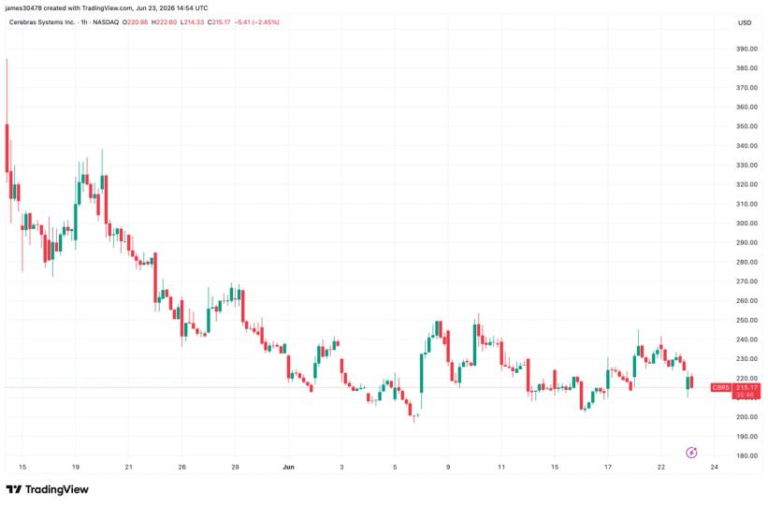
In its first earnings report since its May IPO, Cerebras Systems (CBRS) is lower by 11% in after-hours trading after guiding to lower profit margins next quarter.
First-quarter revenue nearly doubled from the year-ago level to $193.4 million, and the company’s adjusted net loss of $2.5 million beat analyst forecasts of $36.75 million.
For the second quarter, the company guided to revenue of $194 million, but investors, for now, appear focused on core gross margin — the company expects 36%-38% in the second quarter versus 46.5% in the first.
Cerebras raised $6 billion in a May IPO priced at $185 per share. The stock soared as high as $385 shortly after going public, but has since retreated. It’s down another 11% in after-hours trading at $201.55.
The House Financial Services Committee has scheduled a hearing on the Digital Asset Market Clarity Act (H.R. 3633) for July 17 in New York.
First introduced and House Financial Services Chairman French Hill on May 29, 2025, the CLARITY Act is the most significant attempt yet to build a durable regulatory framework for digital assets in the United States.
Its central mechanism is a jurisdictional division: the Commodity Futures Trading Commission (CFTC) would receive exclusive authority over spot markets for “digital commodities” — most notably Bitcoin — while the Securities and Exchange Commission (SEC) retains jurisdiction over digital assets that qualify as investment contracts.
That split has been the source of years of industry frustration. Without clear lines, firms have faced overlapping enforcement from both agencies, chilling innovation and pushing development offshore. SEC and Treasury officials have urged Congress to resolve the standoff, and the CLARITY Act represents the most concrete vehicle to do so.
The bill has been building momentum through the 119th Congress. The Senate Banking Committee advanced the CLARITY Act 15-9 on May 14, with all 13 Republicans joined by two Democrats — though several committee members noted their votes did not guarantee floor support without further work on an ethics provision addressing government officials’ financial ties to crypto assets.
By June 1, the bill landed on the Senate Legislative Calendar under General Orders (Calendar No. 423), making it formally eligible for full Senate floor consideration.
The path forward isn’t without friction. The bill still needs to clear a 60-vote Senate threshold, be reconciled with the Senate Agriculture Committee’s version, and then be harmonized with the House-passed text before heading to the president’s desk.
The House previously passed a motion to advance the CLARITY Act alongside the GENIUS Act and Anti-CBDC provisions, signaling broad legislative appetite for a package approach.
More than 100 crypto firms have urged the Senate to advance the bill, and despite some early friction over developer liability language — Coinbase briefly threatened to withdraw support — the industry coalition has largely held together.
Galaxy Research currently estimates a 60–75% chance the bill becomes law in 2026, projecting a possible presidential signature during the week of August 3. The July 17 hearing is expected to be a critical signal of whether that timeline holds.
Senate passes Housing Act and pushes through CLARITY Act
In a somewhat significant parallel development, the Senate passed the 21st Century ROAD to Housing Act in an 85-5 vote on June 22 — and tucked inside the housing supply legislation is a provision that bans the Federal Reserve from issuing a central bank digital currency (CBDC) through the end of 2030.
The bill’s language is direct: the Fed “may not issue or create a central bank digital currency or any digital asset that is substantially similar to a central bank digital currency directly or indirectly through a financial institution or other intermediary” — through December 31, 2030.
The House had already passed an Anti-CBDC measure alongside its GENIUS Act vote, and an earlier version of the housing legislation cleared the House 390-9 in February.
House GOP leaders signaled plans for an expedited vote on the Senate-amended bill upon the chamber’s return from recess on June 23.
With White House backing and near-unanimous Senate support, the CBDC ban now looks likely to reach the president’s desk attached to must-pass housing reform.
The cross-chain DEX restored signing, churning, swaps, and LP actions Tuesday morning, six weeks after an Asgard vault breach drained funds across four chains.
THORChain restored full operations Tuesday morning, bringing signing, churning, swaps, and liquidity-provider actions back online after a halt tied to a $10.7 million exploit in May.
The protocol’s official account announced the restart just before 3 a.m. ET Tuesday, confirming that signing, churning, secured and trade assets, LP actions, and swaps are all running.
RUNE was trading around $0.42 at the time of the announcement, and its up 3.7% in the past 24 hours, per CoinGecko.
The May Exploit
The halt began May 15, when one of six Asgard vaults was compromised, sending approximately $7.4 million in unauthorized transactions before the network stopped signing. Total losses reached $10.7 million as funds were drained across Bitcoin, Ethereum, BNB Chain, and Base vaults.
A second layer of scrutiny arrived June 1, when security startup V12 disclosed that it had reported a near-identical vulnerability to THORChain developers weeks before the May breach. V12 alleged the protocol silently applied a patch without paying the bounty, then later told researchers the bounty program was permanently retired. The firm said it planned to release exploit code for additional unpatched bugs.
Recovery Steps
The restart statement credited the six-week timeline to systematic verification rather than speed. Developers confirmed every vault and keyshare before reopening functions, according to the announcement. Node operators, the dev team, and the Maya Protocol team, the connected chain that kept liquidity available during the downtime, were cited as contributors to the recovery.
THORChain routes cross-chain swaps through liquidity pools without wrapped tokens or bridges. The protocol describes itself as the leading Bitcoin DEX.
What Comes Next
The restart post lists native Monero swaps as the next feature, with end-to-end testing complete and a live launch described as on the horizon. Zcash support follows close behind. Dynamic fees and deeper liquidity are also in progress, per the announcement.
The Ethereum Foundation (EF) will slash its budget by roughly 40% this year as part of a shift toward a leaner, endowment-style operating model, Ethereum co-founder Vitalik Buterin said in a blog post published Tuesday.
The reduction comes on the same day the EF confirmed a 20% reduction in headcount and follows the resignation of co-Executive Director Hsiao-Wei Wang. Her departure brings the total number of senior Ethereum Foundation figures to leave since January to nine, underscoring the scale of the organization’s ongoing turmoil.
Buterin said the spending cuts are aimed at transitioning the foundation from spending around 15% of its remaining treasury annually before 2026 to a long-term target of roughly 5% per year after 2030.
“I respect my EF colleagues far too much to pretend that there was not much that is lost,” Buterin wrote, acknowledging that the cuts involve “difficult decisions” and the departure of experienced engineers who have worked on Ethereum for years.
The launch is the latest example of tokenization, a fast-growing sector that puts traditional assets such as funds, bonds and stocks on blockchain networks. Supporters argue the technology can make assets easier to transfer and settle, reach a wider set of investors globally while enabling around-the-clock trading.
Major firms including BlackRock, Franklin Templeton and Apollo have launched tokenized investment products, helping drive the market for tokenized assets above $30 billion excluding stablecoins, according to rwa.xyz data.
From crypto critic to tokenization backer
Atlas’ move is notable because Roubini spent years criticizing cryptocurrencies as speculative assets with little intrinsic value. However, the distinction appears to be the underlying assets.
The fund behind the USAfi token seeks stable returns across different economic environments while preserving capital through exposure to U.S. Treasuries, real estate, gold and agricultural commodities.
“We are living through the most dangerous period for savers in a generation,” Roubini said, citing inflation, trade wars and geopolitical stress eroding the purchasing power of investors. “For years I argued that most digital assets offered no protection from this, because they had no real assets behind them,” he said.
Atlas is pitching the USAFi token as a “Technodollar” product. CEO Reza Bundy argued that while stablecoins are designed to move dollars across blockchain rails, tokenized investment vehicles like USAFi can serve as digital reserve assets by giving investors exposure to a diversified portfolio of productive assets.
Cody Carbone, CEO of the cryptocurrency advocacy group The Digital Chamber, received a largely muted response to his testimony at a Senate Banking Committee hearing on affordability.
In a Tuesday hearing titled The Affordability Agenda, Carbone said that the digital asset industry could help solve affordability problems in the United States, including through faster and cheaper transactions, putting “competitive pressure” on existing payment systems, and reducing barriers to “owning and transferring assets.”
However, the majority of lawmakers present did not question Carbone directly or inquire about digital assets, with the exception of Indiana Senator Jim Banks and Louisiana Senator John Kennedy. Banks asked the Digital Chamber CEO about the costs related to foreign remittances compared to US dollar-pegged stablecoins, while Kennedy largely dismissed Carbone’s testimony.
“Mr. Carbone, you seem to be here to promote cryptocurrency,” said Kennedy. “I love cryptocurrency, but I don’t think that’s the problem with our economy.”
The Digital Chamber CEO Cody Carbone speaking on Tuesday. Source: Senate Banking Committee
Carbone’s remarks centered around the US Senate moving forward on the Digital Asset Market Clarity (CLARITY) Act, which the banking committee advanced in May. The full chamber is expected to vote on the legislation in a matter of weeks, but many lawmakers are calling for additional ethics provisions, potentially complicating passage in the Senate.
Related: Crypto lobby urges Congress to pass staking and mining tax bill as is
CLARITY Act still in limbo amid pushback from interest groups
In addition to lawmakers’ concerns about ethics in the crypto market structure bill, last week gambling industry groups called for the Senate to clarify that the legislation would not allow the US Commodity Futures Trading Commission (CFTC) to oversee sports betting in prediction markets. The financial regulator, under Chair Michael Selig, has claimed “exclusive jurisdiction” over platforms such as Kalshi and Polymarket.
Some lawmakers expect that the CLARITY Act will pass through the Senate before the chamber breaks for an August recess. As of Tuesday, no floor vote was scheduled in the Senate.
Magazine: Japanese pension fund tips 1% in crypto, G7 urges action on NK hackers: Asia Express
Cointelegraph is committed to independent, transparent journalism. This news article is produced in accordance with Cointelegraph’s Editorial Policy and aims to provide accurate and timely information. Readers are encouraged to verify information independently.
“This is not just a POC,” Ariyasinghe said. “Everyone’s coming in with their eyes wide open. Appetite is very much about building real infrastructure … The target is live transactions within a legal, regulatory compliance framework within the next 12 months.”
A $150 billion trade corridor
The initiative is focusing on the trade corridor between Europe and South Korea, an economic artery that processes over $150 billion in goods and services annually, making it one of the world’s 15 largest trade routes. It also taps into regional trends: Industry data shows that 60% of all global stablecoin payments are happening in Asia.
“I completely agree with that stat,” Ariyasinghe said. “It gives people a good indication of where real demand is. In less developed financial ecosystems, demand is growing, but the infrastructure isn’t necessarily in place. These forms of tokenized cash are fulfilling a real need.”
Rather than forcing legacy financial institutions to overhaul their computer systems or buy cryptocurrency, Project Pangea intends to act as a middleware translator. Banks will trigger transactions using Swift—the global messaging network they have used since the 1970s—and Chainlink’s infrastructure will translate those commands into instant “atomic swaps” on a neutral, independent ledger called the Pangea L1 Network.
Project Pangea is designed to work with existing Swift and ISO 20022 banking standards, allowing traditional financial institutions to connect to blockchain-based settlement rails without replacing their payment infrastructure.
Bitcoin (BTC) holders who acquired their coins more than five years ago have cut spending to a 90-day average of 962 BTC, the lowest level since November 2024, according to CryptoQuant data. The slowdown follows three major spending peaks over the past two years, including a high of 3,860 BTC in May 2024.
At the same time, BTC analysts said that market and profitability indicators are converging in the second half of 2026, putting a new timeline of a potential Bitcoin bottom.
Bitcoin “OG” holders step back
Crypto analyst Darkfost said the current cycle has produced the highest level of spending by long-term Bitcoin holders on record. The cohort tracked in the dataset consists of investors who acquired Bitcoin more than five years ago.
Using spent transaction outputs (STXO), which track Bitcoin that has moved across the network, the analyst identified three major spending waves following strong rallies.
OG Bitcoin Holders selling pressure. Source: CryptoQuant
The 90-day moving average peaked at 3,860 BTC in May 2024, 3,200 BTC in February 2025 and 2,360 BTC in September 2025. Individual sessions were far larger, with some days recording output exceeding 10,000, 30,000 and even 142,000 BTC.
That selling pressure has eased sharply. The 90-day average has dropped to 962 BTC, the lowest reading in 19 months. Darkfost said the most expensive coins held by this group were acquired for about $63,200, which is close to current prices. This indicates that many of these holders are choosing not to sell, even though their holdings are trading near their highest cost basis.
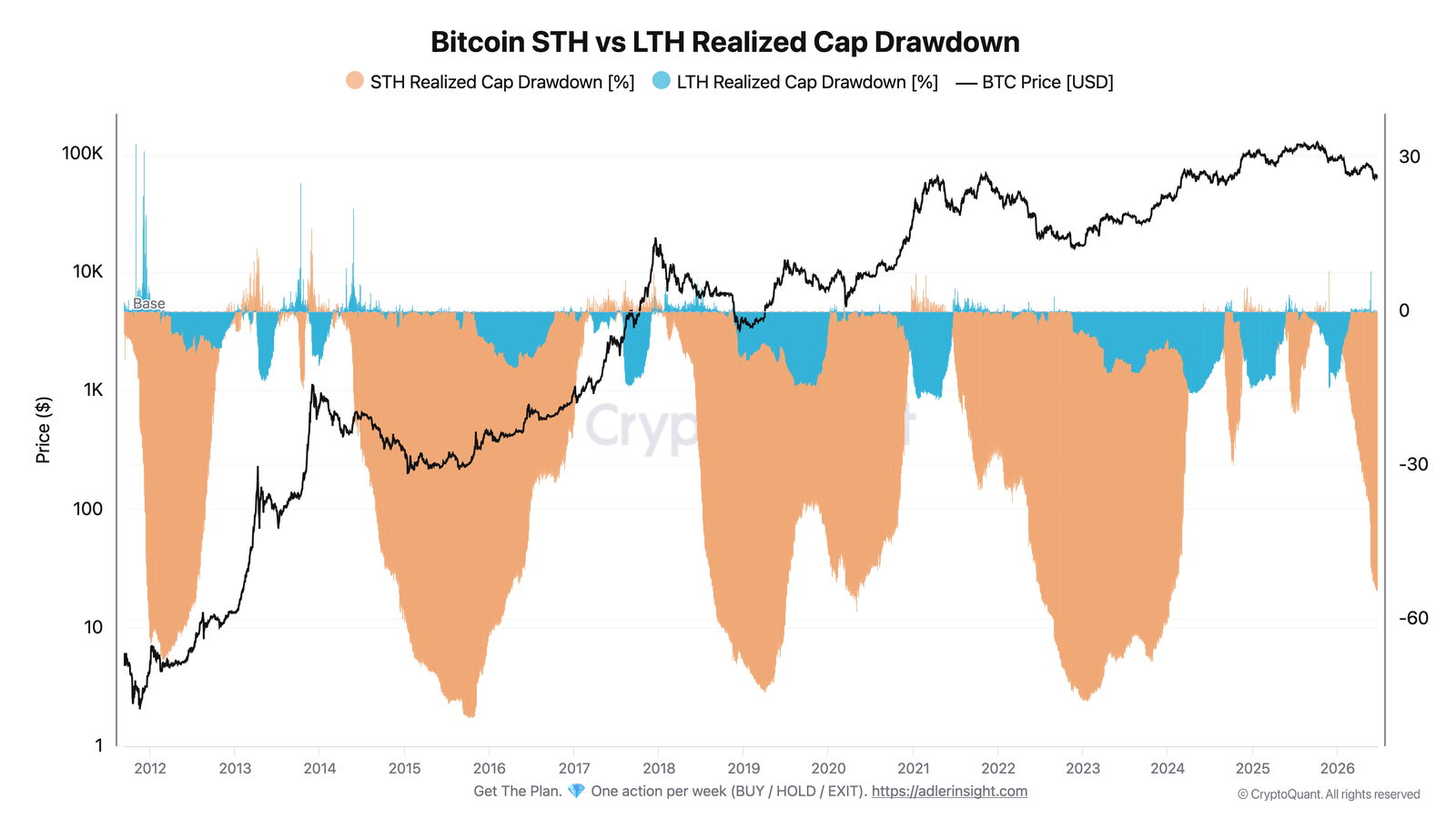
Bitcoin Researcher Axel Adler Jr. further noted a split between newer and older BTC investors. The analyst said that Bitcoin’s adjusted net unrealized profit/loss (aNUPL) has fallen to -0.14 from near zero a month ago, showing that the average holder has moved back into unrealized losses as BTC traded near $62,500. However, Adler Jr argued,
“STH capital has shrunk by -56%, while LTH capital has barely drawn down. Weak hands are capitulating. Strong hands have not even flinched.”
Adler Jr. added that the key metric has spent nearly half of the past three months below zero, indicating sustained pressure on newer BTC market participants rather than a broad capitulation across long-term holders.
STH vs LTH realized cap analysis. Source: Axel Adler Jr.
Related: Bitcoin slump worsens amid SpaceX rout: Can BTC price hold $60K any longer?
BTC halving cycle points to September bottom, says analyst
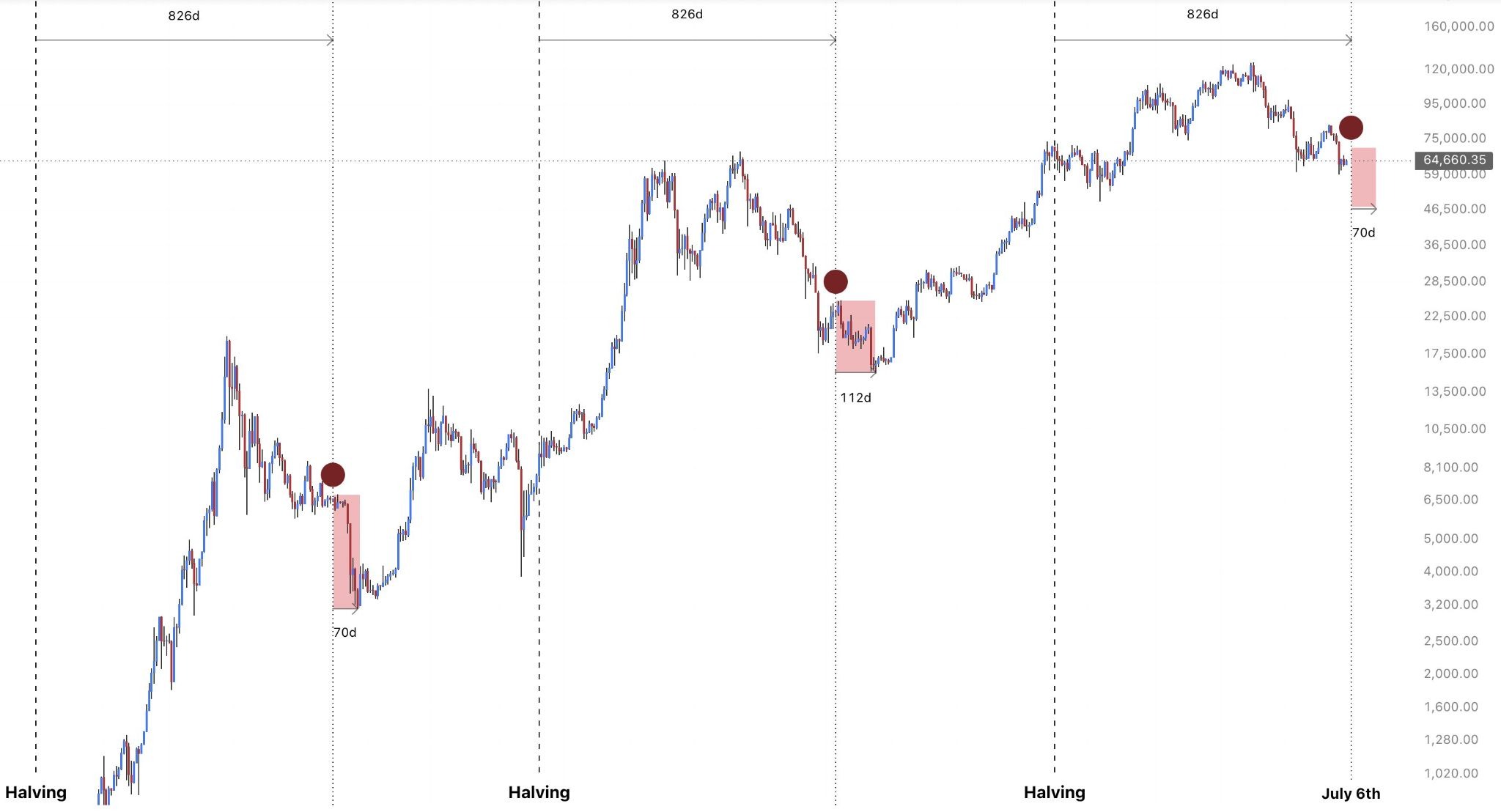
Crypto analyst LP highlighted a recurring pattern tied to Bitcoin’s halving cycles. The previous bear market entered a final capitulation phase 826 days after the halving event, followed by a major low and sideways consolidation for 70 to 110 days.
For the current cycle, the 826-day marker falls on July 6. Applying the same timing range places a potential bottoming window in early September.
BTC bottom analysis by LP. Source: X
The trader noted that the scenario becomes more relevant if Bitcoin continues to trade higher into early July.
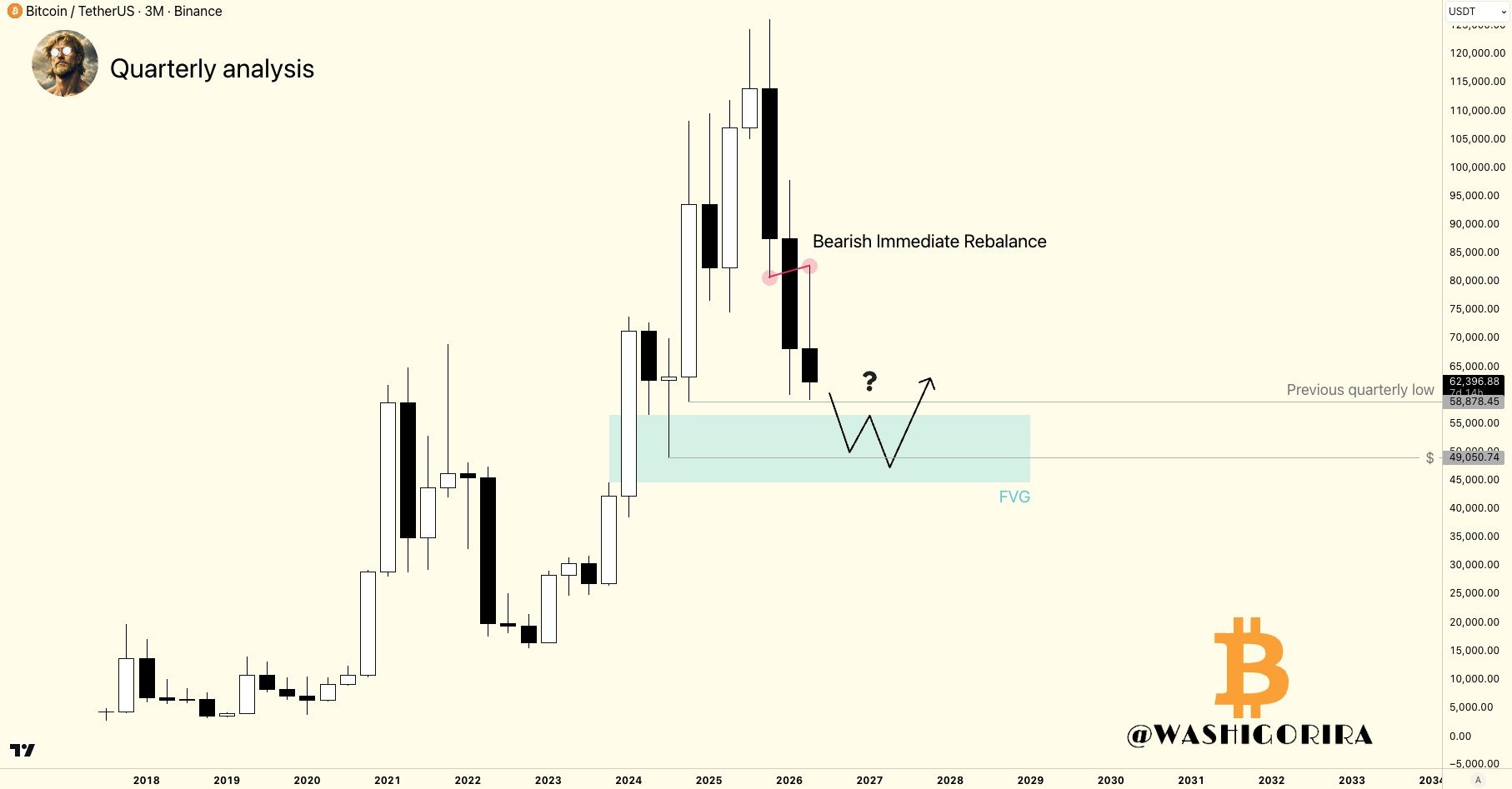
Likewise, BTC trader Titan also identified downside liquidity below the current levels. On the quarterly chart, Bitcoin has an untapped low near $58,900 and an open fair value gap between roughly $49,000 and $58,900.
The trader explained that leaving the quarterly low untouched throughout September may draw more attention to that liquidity zone, eventually leading to a market bottom between Q3 and Q4.
BTC quarterly analysis. Source: X
Related: Bitcoin gets new $54K warning as BTC price hits 11-day low on Asia tech sell-off