“Strengthening the resilience of payments in Europe has become a geopolitical necessity,” Markus Ferber, a leading member of the ECON committee said on Tuesday.
“In a world marked by geopolitical tensions, we can no longer accept that digital payments are largely dependent on the goodwill of a few foreign providers,” he added, echoing concerns expressed across the EU.
The new rules voted by the ECON Committee cleared the way for the ECB to introduce both online and offline versions of the currency by 2029. Crucially, the offline version will allow users to swap digital euros directly from phone to phone without an internet connection, guaranteeing cash-like privacy that prevents the ECB from seeing what citizens are buying.
The EU’s central bank digital euro approval comes just hours after U.S. Senate voted to place a four-year ban on a CBDC. The bill now heads to the House of Representatives. If they follow suit it then goes to President Donald Trump for his signature.
Commercial banks successfully lobbied for strict holding limits on how much a citizen can keep in a digital wallet to avoid a mass exodus of cash from traditional accounts during a crisis.
The ECB will now undertake a 12-month pilot phase using a beta version to test the infrastructure in real-world scenarios with select merchants and payment service providers.
In the same state, Fairshake backed incumbent Representative April McClain Delaney for $516,000, while also contributing ad spending in other states’ Tuesday primaries to Republican incumbent Representative Blake Moore in Utah and $1.3 million for one of the industry’s most reliable allies in the House, Representative Ritchie Torres, a New York Democrat. All of them also won their races or were winning, with McClain Delaney in an early lead with votes still being counted.
The most recent Federal Election Commission filings showed Fairshake with about $126 million still on-hand at the end of last month. But it’s spending heavily on the way to the November general elections in which the two-year destiny of the U.S. Congress will be decided.
If Boafo contributes to the rise of a new Democratic majority in the House, the crypto industry will have a campaign-finance bond with him and other Democrats the PAC has supported. A Democratic majority is set at 79% odds in betting on prediction market platform Kalshi, and if the party earns that status, it’ll have chairmanships of all the committees, complete with control of the chamber’s agenda and subpoena power.
Fairshake’s approach is to flood pro-crypto candidates from both parties with large-scale independent advertising that can’t legally be coordinated with the campaigns. The ads don’t typically mention crypto as a political issues but are instead just calculated to use whatever political message would be most helpful for the candidates.
Amid waning poll numbers and pressure from inside the Labour Party, Prime Minister Keir Starmer has stepped down.
During Starmer’s tenure, the government introduced a moratorium on cryptocurrency donations to political campaigns, citing concerns that crypto could become a vector for foreign influence in UK elections. Beyond the ban, the UK has charted a cautious path on crypto regulation under the Labour government.
Starmer’s departure from Number 10 has started discussions about his successor. A frontrunner has emerged in Andy Burnham, a member of parliament for Makerfield and former Mayor of Greater Manchester.
Burnham has expressed optimism about the blockchain industry’s ability to support economic development. But it remains to be seen whether that enthusiasm can translate into real policy moves.
Burnham wanted Manchester to be a “Web 3 powerhouse”
A graduate of Cambridge, Burnham served as a Cabinet minister under both Tony Blair and Gordon Brown, both as Health Secretary and Culture Secretary. From 2010 to 2015, he served as Shadow Education Secretary and Shadow Health Secretary under Ed Miliband before unsuccessfully contesting the Labor leadership bid in 2015.
From 2015-2016, he was Shadow Home Secretary under Jeremy Corbyn before leaving Westminster to become Mayor of Manchester in 2017.
As mayor, Burnham has consistently framed digital technology as an economic development tool and a way of driving growth and jobs in the city. This framing was evident at a Stand With Crypto and Manchester Blockchain Alliance event, where he said, “I’m bought in.”
He further noted his commitment to “make [Manchester] the Web3 powerhouse that we want it to be.”
Whether this will translate into a coherent national policy is another matter. As mayor, Burnham championed a model dubbed “Manchesterism,” which prioritized devolution, regional economic control and public-private partnerships.
It’s a bottom-up approach that, some observers in the crypto industry say, needs to be amplified if it’s to bring national-level change to the industry.
Nick Jones, founder and CEO of UK digital assets services platform Zumo, told Cointelegraph, “Burnham’s rhetoric on crypto has to date been heavily influenced by his role as Mayor of Greater Manchester. For example, he has previously drawn parallels between digital innovation and historical developments, pointing out that Manchester was the home of the Industrial Revolution and has the potential to become the home of the Web3 revolution.”
“But such soundbites were to be expected in the context of his role. If he becomes Prime Minister, he will be well aware of the need to amplify that ambition and ensure the UK as a whole sits at the heart of the world’s future financial system,” he said.
Related: UK central bank is warming up to stablecoins, but says industry input is lacking
Benoit Marzouk, the CEO of GBP stablecoin tGBP, told Cointelegraph that Burnham’s Manchester experience “is not a handicap.” Rather, his experience outside Westminster, “could help implement and accelerate the right policies for the digital asset industry across the UK.”
Burnham has not yet published a detailed digital assets policy. His public comments about crypto reflect broader enthusiasm rather than specific regulatory commitments. He has not yet addressed the Financial Conduct Authority’s crypto framework, stablecoin law, or the crypto political donation ban on public record.
The donation ban, politics, and what Burnham could actually do
In March, Stamer’s government banned crypto donations to political campaigns over concerns of foreign influence in British elections.
The ban followed an independent review by Philip Rycroft, a former civil servant turned consultant, who found that the pseudonymous nature of crypto assets created unacceptable risks to political financing transparency.
Reversing a policy introduced on the recommendation of an independent review carries political risk. Labor’s left could scrutinize any move that appears to open the party to crypto money, which Reform UK has used to fund its leading performance in recent local elections.
According to Reuters, crypto donations from billionaires based overseas put Reform well ahead of Labour in the fundraising race. Reform’s leader Nigel Farage is under investigation for an undisclosed 5 million pound ($6.6 million) gift from British Thai-based businessman Christopher Harborne.
Despite obvious ethics concerns, Farage said he should be able to spend the gift however he wishes, be it for campaigning, or on Ferraris and betting on horses.
Amid political concerns over the temporary moratorium, a 180-degree ban reversal from Burnham seems unlikely.
Marzouk expects Burnham to exhibit “pragmatism rather than political announcements.” For tGBP, success in the first year of a Burnham premiership would include a finalized stablecoin framework, pilot programs involving government and GBP stablecoins and continuing work on tokenization.
Tom Rhodes, chief legal officer for UK stablecoin issuer Agant, told Cointelegraph, “We don’t expect the next PM to interfere with any specific policies. The regulators remain independent and cryptoasset regulation is nearly settled.”
Jones said that Burnham is “on record strongly backing the underlying economic potential of our nascent sector.”
“If he does become the next Prime Minister, it’s unlikely his position will change. I believe he would continue to pursue the current growth-focused policy approach.”
The transition period could be bumpy, stalling momentum, according to Jones. “Any potential cabinet reshuffle could displace ministers who are familiar with the evolving regulatory regime at the critical inflection point when regulators and industry alike are preparing for authorization, and that would be a problem.”
Labour is yet to announce an official timetable for replacing Starmer, although the former PM has said that he’d like to see nominations open on July 9, after a NATO summit. According to Sky News, it could be a week later, on July 16, when parliament goes on summer recess.
The winner must receive more than half the votes cast. If no one receives the necessary votes, then ballots are recast based on preference.
ETH price hangs in the balance as a fresh wave of liquidations pressure the altcoin and spillover from Bitcoin’s struggles to hold $62,000 impact investor sentiment.
Bull Bitcoin has obtained a MiCA license in France, ensuring users in European Union member states can continue accessing its Bitcoin exchange and payment services without interruption or any reduction in functionality. Founder Francis Pouliot announced the development on June 23, 2026, via X, marking the end of a nearly three-year, self-financed effort to enter the European market.
“We are particularly excited to have obtained our MICA license without needing to compromise on our cypherpunk approach to self-custody and privacy,” Pouliot stated. “All features of our website and wallet will remain exactly the same as they have been for the first half of 2026, with no additional burden or restrictions imposed on our users. We have proven that it is possible to meet the highest requirements of regulatory compliance without becoming overzealous.”
The company also reported passing the required PASSI and DORA cybersecurity audits without outsourcing its core Bitcoin infrastructure to third-party hosted providers. “That was a huge win,” Pouliot wrote, noting that relying on external services would have been easier and cheaper but would have compromised sovereignty. The entire process was funded internally, with no external investors or lenders solicited.
Bull Bitcoin, founded in 2013 in Montreal by Pouliot, operates as a Bitcoin-only, non-custodial exchange. Users supply their own wallet address before any purchase, with Bitcoin sent directly to the customer’s control rather than held by the company. This model has defined the firm’s cypherpunk orientation since inception, alongside services such as Bitcoin bill payments for rent, utilities, and real estate, plus support for Lightning Network, Liquid, and Payjoin privacy tools.
The license provides a long-term regulatory foothold in Europe following the company’s expansion of its France-based team and eurozone services. Pouliot previously noted the firm’s experience navigating Canadian oversight and its willingness to meet obligations while pushing back against overreach. The new authorization aligns with that stance: core operations and user experience stay intact.
In October 2025, Bull Bitcoin launched its BULL Wallet, a global, open-source, privacy-first mobile app for iOS and Android with deep opt-in integration to the exchange. Features include Payjoin support, Lightning and Liquid compatibility, and no data collection or push notifications. The wallet and exchange integration remain unchanged under the new license.
Pouliot expressed pride in the team’s execution and outlined next steps: “Having secured a long-term foothold in Europe, our ambition is global domination and setting a new standard on how to build the infrastructure Bitcoin deserves.”
The development comes amid tightening EU crypto rules under MiCA, where many providers have faced pressure to exit or alter operations. Bull Bitcoin’s outcome suggests that rigorous compliance is achievable while maintaining direct user custody, in-house infrastructure control, and privacy tooling, though how exactly they resolved the tension between user privacy expectations and MiCA compliance was not explained in the announcement.
Ethereum is running out of money, according to former insiders.
The warning has sparked one of the fiercest Ethereum governance debates in months: should the network fund developers by taxing staking rewards, or just rely on wealthy Ether holders to bankroll its ecosystem?
At the center of the debate is a controversial proposal from Kleros co-founder Clément Lesaege. He suggested redirecting up to 10% of validator rewards to ecosystem funding through a protocol-level mechanism called Validator Redirected Revenue.
Lesaege argued that this may be necessary to solve Ethereum’s “coordination failure” and reduce the underfunding of shared ecosystem work.
The idea was met with a wave of backlash, with critics warning of cartel-like incentives and a dangerous precedent for validator-led redistribution.
Validator Redirected Revenue proposal. Source: Eth Research
But just as the Ethereum community was sharpening its knives, a “credibly neutral” solution was forming: Ethlabs.
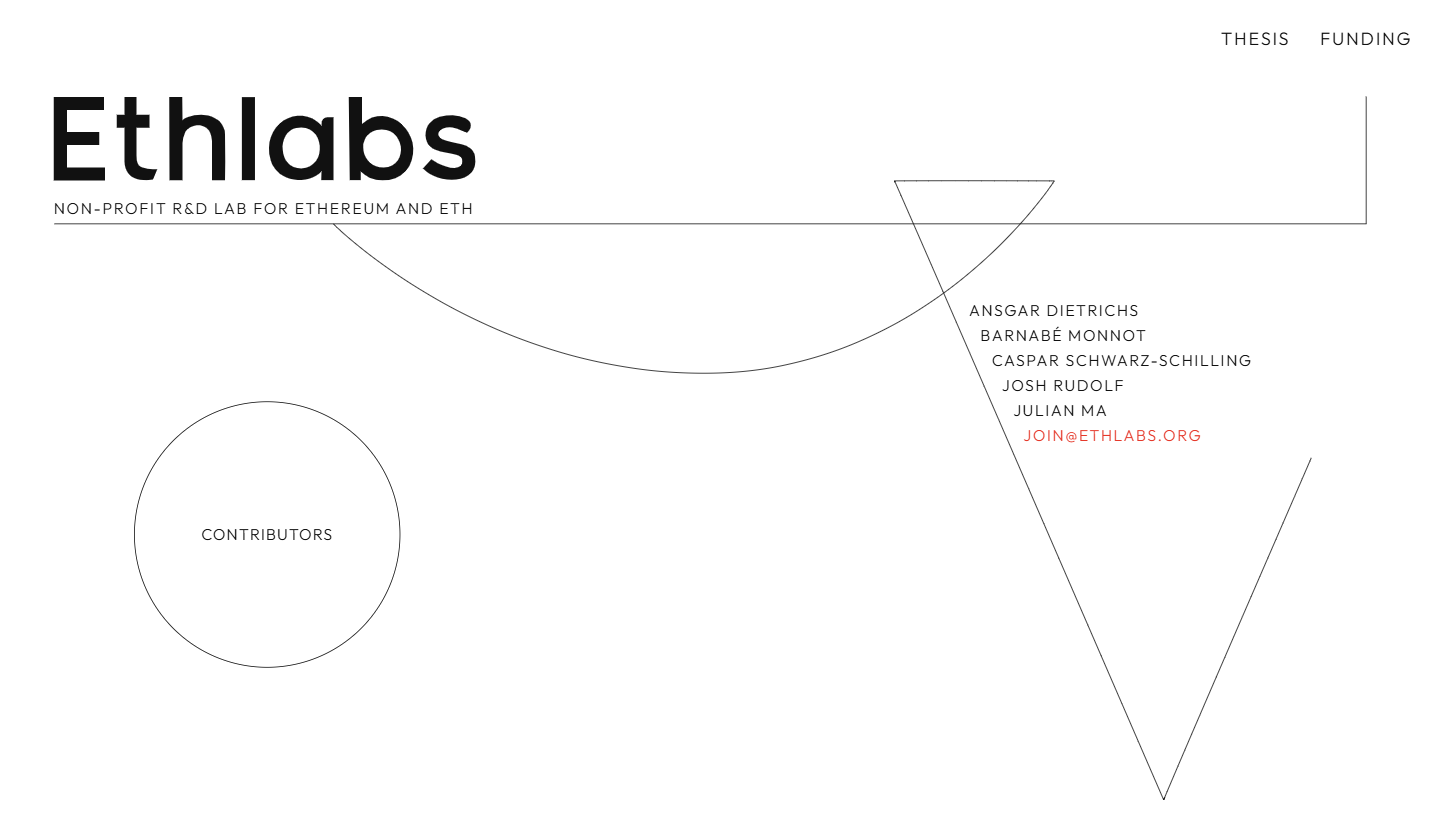
Unveiled Monday by five former Ethereum Foundation researchers, the shiny nonprofit Ethereum research and development lab is backed by the ecosystem’s biggest supporters, including BitMine, Sharplink and ConsenSys founder Joseph Lubin.
Related: Ethereum Foundation sacks 20% of workforce amid strategic restructuring
With large investors ready to dig into their pockets, the real question becomes less about whether Ethereum can fund itself and more about how it wants to be funded.
Ethereum’s ‘slow-burning funding crisis’
The latest ETH drama began on Friday when former Ethereum Foundation contributor Trenton Van Epps warned that Ethereum’s core development ecosystem could face a “slow-burning funding crisis” within three to nine months as older support programs dry up and Foundation spending falls.
He estimated that maintaining more than 10 client, research and coordination teams costs roughly $30 million a year, and that the Client Incentive Program and other support mechanisms were no longer enough to cover that bill.
Van Epps argued that Ethereum is entering an institutional “inheritance” phase in which the Foundation will move away from being the primary steward of protocol funding, and that new arrangements must replace the expiring programs he helped coordinate.
Having spent much of the year dealing with leadership turnover, public criticism over priorities, and a growing debate over core protocol funding, Van Epps’ warning touched a raw nerve.
But some Ethereum voices pushed back, arguing that the EF has “enough funds to run for at least 30 years, so there is zero funding crisis.” Bitmine’s Tom Lee also rejected the warning, saying there was “zero chance” of Ethereum running out of funds for protocol development.
Ethereum Foundation Treasury Policy. Source: Ethereum Foundation
The Ethereum Foundation’s own treasury policy already points to a multi-year operating buffer and a planned reduction in annual spending.
In June 2025, the EF said it would maintain a 2.5-year operating expense buffer in cash and stablecoins, pledged to cap annual spending at 15% of total treasury assets and gradually reduce that spending rate toward a 5% baseline over five years.
Related: Ethereum can quantum-proof accounts for just 7 cents, says Ethereum’s Kohaku lead
On Tuesday, Ethereum founder Vitalik Buterin said the Foundation is decreasing its budget by roughly 40%, in line with that policy, as it transitions from spending around 15% of its funds annually before 2026 toward a long-term target of about 5% per year after 2030. It laid off 54 staff members.
The proposal everyone hates
So the Foundation may not run out of money, but it is tightening its belt and has a lot less cash to spend on research and development than in its glory days. Lesaege argued that Ethereum suffers from a coordination failure in which everyone benefits from shared infrastructure — but no one wants to foot the bill.
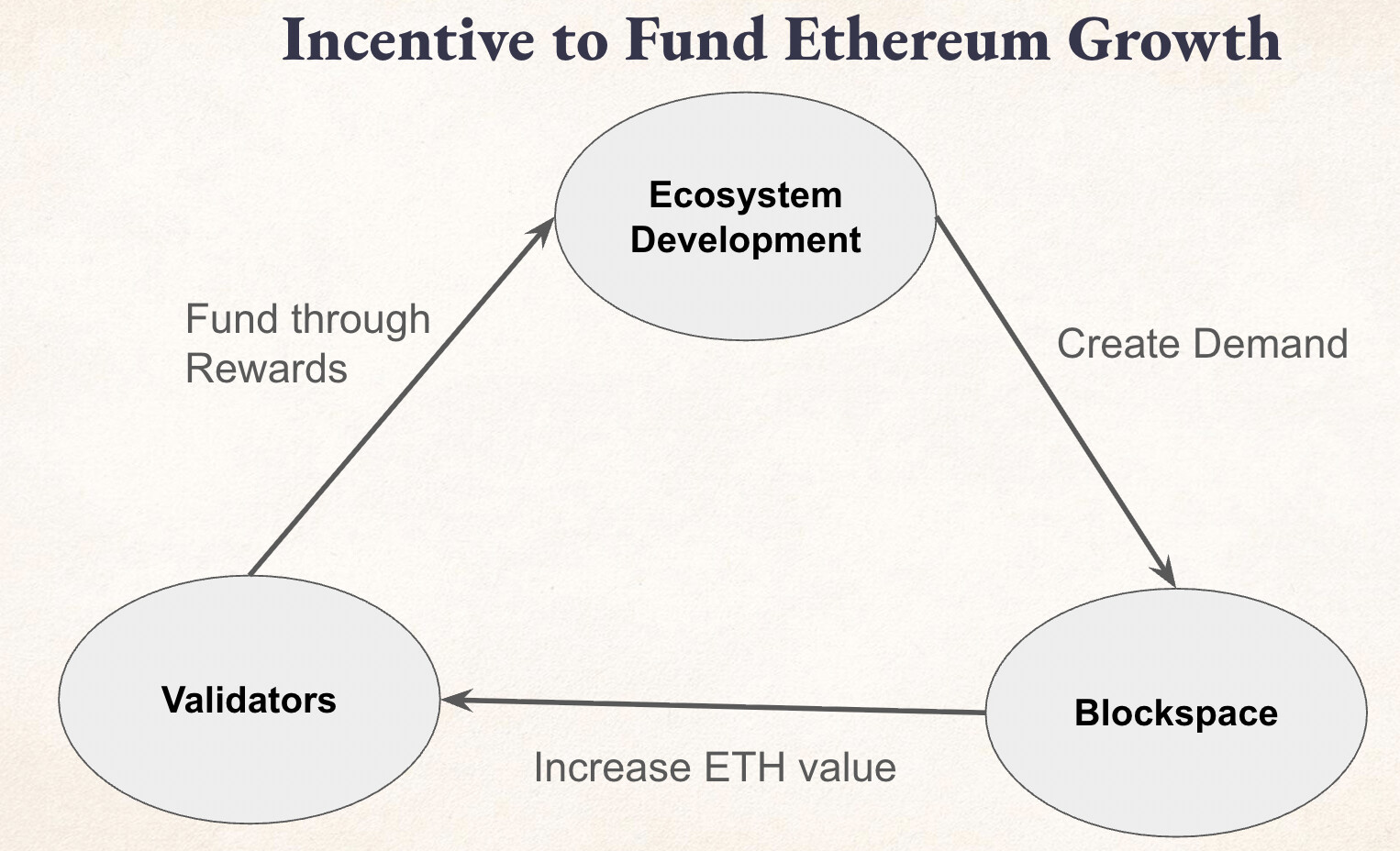
His proposal would require validators to signal how much of their staking rewards they are willing to redirect, a figure between 0% and 10%. If a majority of validators supported a non-zero rate, that redirect would become mandatory for all.
At current staking levels, he estimated that even a 5%-10% redirect could generate roughly 50,000 to 70,000 ETH per year for ecosystem work, or roughly $82.5 million to $115.5 million at current ETH prices today.
Incentive to fund Ethereum growth. Source: Eth Research
Critics quickly zeroed in on the mechanism’s power dynamics, warning that it could entrench large validators, blur the line between operators and governance actors, and give a stake-weighted majority new leverage over ecosystem funding decisions.
What staking providers say
A spokesperson for Figment told Cointelegraph the proposal would compress margins, which “tends to consolidate the validator set toward larger, more integrated operators” serving institutional clients, like Figment.
This would come at the “cost of some operator diversity and potentially fewer net new ETH stakers,” the spokesperson said.
Andrew Gibb, chief executive and co-founder of Twinstake institutional staking, told Cointelegraph that various investor segments would respond differently.
While long-term ETH holders may value the prospect of a better-funded ecosystem, shorter-term capital, such as retail participants, liquid multi-asset funds and reward-focused allocators may be less receptive.
He said the proposal would “narrow the addressable staking market at the margin,” with the most price-sensitive cohorts likely to “reduce or exit positions,” adding that he would expect some clients to reassess their staking allocations.
Related: Buterin fires back at Ethereum Foundation critics, recommits to neutrality
Senior research associate at Bitwise, Max Shannon, told Cointelegraph that Ethereum staking participation has so far shown limited sensitivity to lower rewards.
He said that the staking annual percentage rate (APR) has fallen from about 4.6% in June 2023 to around 2.7% now, while staked supply and the staking ratio roughly doubled. However, additional reward compression would make “slashing risk and exit-queue liquidity risk more material relative to the return.”
He added that a lower net consensus-layer yield could push validators to rely more heavily on maximal extractable value (MEV) to make up lost APR, which could potentially weigh on censorship resistance.
How large is the problem, really?
On paper the funding gap is not that large. Shannon noted that if the annual shortfall is around $30 million and annual staking rewards are about $1.9 billion, so the gap could be filled with just 1.6% of staking rewards.
That makes Lesaege’s proposal look modest, even though it remains politically radioactive. In economic terms, a single-digit haircut on staking rewards is manageable. In governance terms, many Ethereum participants see it as a line-crossing move that turns validators into a tax authority.
Shannon also argued that networks with hard-coded development funding are not necessarily better off just because they earmark rewards. In his view, protocol success is driven far more by token performance and contributor incentives than by any one developer funding mechanism.
A new funding model emerges
Tom Lee’s comment there was “zero chance” of an Ethereum funding crisis and that funds were “secured” foreshadowed the unveiling of the new non-profit EthLabs a few days later.
Rather than taxing rewards at the protocol level, Ethlabs enables large ETH-aligned institutions such as BitMine and Sharplink to fund development directly.
Ethlabs nonprofit R&D for Ethereum. Source: Ethlabs
It does not replace the Ethereum Foundation, but complements it. EthLabs signals that the smart contract platform’s next phase may involve a more distributed funding model, where the EF remains central to the protocol’s core, while other labs and treasury-heavy institutions fund adjacent work.
In an X post on Monday, Ethereum co-founder Joe Lubin said there is still “an enormous amount of top tier talent” at the Ethereum Foundation that remain focused on “the cypherpunk core components” of the protocol. But he added that many other Ethereum R&D teams will now explore other dimensions.
Gibb said that the responsibility for funding ecosystem development sits with foundations and protocol treasuries. There are alternate mechanisms to explore, such as staking yield or priority fees, he added, “before making changes to validator economics at the protocol level.”
Whether Ethlabs proves sufficient remains to be seen. But its emergence has already shifted the debate from how Ethereum should tax itself to whether it needs to at all.
Market Moves: Why is Ethereum Foundation selling? BTC futures warning signs
Tanya Denisova, the former chief operating officer of Robinhood Crypto, has joined stablecoin issuer Agora as head of operations, according to a Tuesday blog post by Agora’s CEO and co-founder Nick van Eck.
She will also serve as COO of Agora’s proposed National Trust Bank, subject to approval of the company’s national trust charter application with the Office of the Comptroller of the Currency (OCC), the firm said.
Denisova spent the last six years at Robinhood, where she served as COO of Robinhood Crypto. CoinDesk first reported her departure from the brokerage’s cryptocurrency unit in May.
She led Robinhood Crypto’s day-to-day operations across its regulated U.S. and European entities, overseeing settlement, liquidity, trading, execution quality, custody and wallet operations.
Agora is a stablecoin infrastructure company that issues AUSD, a dollar-pegged stablecoin backed by reserves managed by institutional asset managers. The company aims to provide businesses with a way to move dollars globally, earn yield on idle balances and access programmable payments infrastructure through blockchain networks.
Founded by Nick van Eck and Drake Evans, the firm is focused on building regulated stablecoin products for fintechs, exchanges and other financial institutions.
Craig Raw is a solo developer based in South Africa. In 2020, he built Sparrow Wallet — a free, open-source Bitcoin desktop wallet — because he thought the existing options weren’t good enough.
He has no company behind him, charges nothing for the software, and has kept building it for six years on the belief that it has value for people who want real control of their money.
Sparrow is a tool for people who take Bitcoin self-custody seriously — the kind of users who want to see every detail of what their wallet is doing, manage their own transaction privacy, and hold their own keys rather than trust a third party.
Raw designed it to educate as much as to function, building in tool tips, UTXO visibility, and transaction detail that most wallets hide from users. It runs on macOS, Windows, and Linux. There is no mobile version, and Raw has been clear about that for years.
That last point is now at the center of a fight with Apple that could end his ability to ship software on Mac entirely.
Since 2023, fraudsters have published more than a dozen fake “Sparrow Wallet” apps on the App Store, according to Raw.
These apps impersonate Raw’s software. When a user enters their seed phrase — the master key to a Bitcoin wallet — the app sends it to the attacker and the funds disappear. Raw holds registered US trademarks for the Sparrow name and logo.
He has reported the fakes to Apple and warned the community since early 2024. Users have contacted him after losing their savings, in some cases their life savings. Apple has removed some fakes. More keep appearing.
Raw’s test for Apple
Raw tried something different. He submitted a placeholder app to the App Store — never published, no functionality — whose only purpose was to display a message: Sparrow is desktop-only, any mobile app claiming to be Sparrow is not his, do not trust it.
Apple rejected the app for being placeholder content. Then it escalated. Raw’s entire Apple Developer account is now flagged for termination, with a deadline of June 30. The stated reason: “dishonest activity.”
In other words, the man trying to warn users about fraudulent apps has been charged with dishonesty by the platform those apps live on.
What makes this more than a bureaucratic frustration is what an Apple Developer account actually does. Sparrow is not sold through the Mac App Store — Raw distributes it from his own website.
But macOS requires all apps to be signed with a valid Apple Developer certificate, or the system blocks them. If Apple kills his account, the certificate dies with it. New installs of Sparrow on Mac fail. Existing users stop receiving updates.
Raw posted about the situation on X on Monday, writing that he is “confident this is an automated misclassification that Apple would reverse on review,” but that he may be terminated before a human ever looks at his appeal. The June 30 deadline is one week away.
If Apple follows through, users lose access to updates, new installs fail, and the door opens wider for the fakes Raw has spent two years trying to stop. Raw is asking people to repost his thread.
UPDATE: On June 23, Craig Raw tweeted that Apple had reversed its decision to terminate his developer account following a successful appeal, though he said fake Sparrow Wallet apps remain on the App Store and continue to put users’ funds at risk.
Cody Carbone of The Digital Chamber testified Tuesday before the Senate Banking Committee that passing the CLARITY Act is a prerequisite for reducing financial friction costs that fall hardest on lower-income households, as no Senate floor vote has yet been scheduled.
Cody Carbone, chief executive of The Digital Chamber, testified before the Senate Banking Committee on Tuesday pressing for passage of the CLARITY Act, arguing the crypto market-structure bill is a prerequisite for reducing financial costs that fall hardest on lower-income households.
In written testimony submitted to the committee, Carbone argued that blockchain-based rails can lower costs across three areas: cross-border remittances, everyday merchant payments, and asset ownership and transfer. The hearing, titled “The Affordability Agenda,” came weeks after the Senate Banking Committee advanced the CLARITY Act on a 15-9 bipartisan vote on May 14, and with no Senate floor vote yet scheduled.
Carbone’s Affordability Case
The testimony grounded the CLARITY Act argument in federal data. Carbone cited a May 2026 Federal Reserve report showing only 63 percent of adults could cover a hypothetical $400 emergency expense from cash or savings. He also cited FDIC data that 4.2 percent of U.S. households were unbanked in 2023 and another 14.2 percent underbanked, pointing to those groups as the ones most exposed to high-cost financial services.
On remittances, Carbone referenced World Bank data showing the global average cost of sending money abroad was 6.36 percent, more than double the 3 percent international target.
Carbone also cited Citi Institute projections from June 2026 that the global tokenized asset market could grow from approximately $17 billion today to $5.5 trillion by 2030.
Senate Floor Gap
The Senate’s CLARITY Act problem is arithmetic. Republicans hold roughly 53 seats; the bill requires 60 votes to clear cloture. The Defiant reported last week that seven Democratic votes are the operative gate before the August recess. The two Democrats who backed the bill in committee, Ruben Gallego and Angela Alsobrooks, both attached caveats that their committee votes do not commit them to support final passage.
Carbone addressed the political argument directly in his testimony, arguing that regulatory uncertainty has a measurable cost: companies divert resources from product development to legal compliance, and banks hesitate to engage with digital-asset products where statutory authority is unclear. A Senate floor vote has not been scheduled. Senator Cynthia Lummis, the bill’s lead Republican shepherd, has said an August-recess vote is more realistic than a pre-July-4 one.
New opposition emerged Tuesday alongside the legislative stall. Nearly 100 Catholic leaders have also urged the Senate to oppose the bill over the same provisions, per prior Defiant reporting. The Alliance to End Human Trafficking sent a letter to Senate Majority Leader John Thune and Minority Leader Chuck Schumer urging review of Section 604, which incorporates the Blockchain Regulatory Certainty Act, arguing the provision could weaken anti-money-laundering tools used to track trafficking-related financial activity, as crypto.news reported. Gambling industry organizations have separately pressed the Senate to clarify that the CLARITY Act would not expand Commodity Futures Trading Commission authority over sports betting on prediction-market platforms, per prior Defiant reporting on the gaming industry’s push.
House July Calendar
The House Financial Services Committee has scheduled a July 17 field hearing dedicated to the CLARITY Act, titled “Building the Future of Finance: How the CLARITY Act Unlocks Innovation,” to be held in New York. The hearing narrows the legislative window: Senate action before August, followed by a House floor vote rather than a conference committee, is the fastest available path to enactment.
The 1,200-company Consumer Technology Association coalition urged a Senate vote Monday, as did a coalition of more than 200 crypto firms on June 8. The bill’s fate still turns on ethics and stablecoin-yield amendments that would bring the seven Democratic votes the calendar requires.
“We keep hearing that there are other competing priorities in the Senate, and while that may be true, everyone is still prioritizing this, and that’s why you see readouts daily of different Senate groups meeting together, Republicans and Democrats sitting over lunch talking about passing clarity,” Carbone said.
Lame duck?
The period of the congressional session after the November elections, a handful of weeks known as the lame-duck session, has been held out by some lawmakers and crypto leaders as a backup option to get Clarity passed this year. However, that period can be highly unpredictable and crowded with congressional action, depending on what’s left on the agenda.
Despite its remaining hurdles, some are still expressing strong assurances that 2026 is the year for the crypto market structure law.
“Clarity is no longer a question of if, but when Congress gets it across the finish line,” said Summer Mersinger, the CEO of the Blockchain Association, in a statement to CoinDesk. “Lawmakers are tackling the outstanding issues with real bipartisan resolve, and they are ready to turn years of debate into durable law that protects consumers, gives builders certainty and keeps American leading.”
But analysts are more reserved in their expectations.
“We believe that at least the Senate needs to pass the bill before its August recess for it to become law this year,” Beacon Policy Advisors, a policy research group in Washington, said in a Monday note. “While hypothetically negotiations could continue into the fall, incentives change around the midterms, and the odds that the bill will become law at all, not just this year, will diminish significantly if the Senate misses its August deadline.”