Home Blog Page 158

Foundation cuts and departures aren’t a crisis, Joe Lubin says

0

Ethereum Foundation budget cuts, staff departures and leadership changes have fueled weeks of criticism from parts of the blockchain’s community, but Joe Lubin, who was involved in its creation and is now CEO of software developer Consensys, said the moves are a necessary evolution, not a crisis.

Lubin, who has no role at the foundation, told CoinDesk that the organization’s role should be narrower, more focused on stewarding the network’s core technology and values, while other organizations take responsibility for adoption, institutional engagement and ecosystem growth.

“It is important that the Ethereum Foundation be credibly neutral above reproach,” Lubin said in an interview. “The opportunity for conflicts of interest between the business side and the builders is just not a credibly neutral way to run your decentralized protocol ecosystem.”

The comments come after weeks of debate over the foundation’s direction. Critics have questioned whether the organization, often known by its initials, has moved quickly enough to address competitive threats and improve Ethereum’s market position, while others have raised concerns about staff departures and restructuring.

Lubin said many of those concerns stem from a misunderstanding of what the foundation is supposed to do for the blockchain, which handles about 2 million transactions a day, according to Etherscan data.

“What’s happening at the EF is cleaning that up,” he said, referring to efforts to separate protocol stewardship from commercialization and business development.

According to Lubin, Ethereum’s future will be shaped by multiple organizations rather than a single dominant institution.

“I think it’ll be clear that there’ll be a handful of major nodes that are stewards of the Ethereum ecosystem and leading in different niches or different specialties in the Ethereum ecosystem,” he said.

That model differs from other blockchains, where protocol development and commercial strategy are often housed under the same umbrella. Lubin said Ethereum’s decentralized nature requires a more distributed institutional structure.

The Ethereum co-founder also pushed back on a broader narrative that Ethereum itself has entered a period of decline. “Ethereum is not on the decline, not at all,” he said.

Still, Ethereum and the rest of the crypto industry are facing a new rival competing for funding and investment. Artificial intelligence has displaced crypto as the dominant technology narrative in recent years, said.

“We were the cool kids, the edgy bringers of the new excitement in the economy and society. We are not front and center right now in terms of capital inflows, investments,” he said.

But he argued that Ethereum’s years-long focus on scaling infrastructure is beginning to position the network for a new wave of adoption.

Among the trends he highlighted were autonomous AI agents conducting transactions onchain and growing institutional use of Ethereum-based infrastructure.

“A next major wave is agentic commerce, where the hybrid human-machine economy starts to make use of our rails,” Lubin said.

For Lubin, those emerging use cases are precisely why the Ethereum Foundation is narrowing its focus. As new organizations take responsibility for adoption and commercialization, he argued, the foundation’s job is to remain focused on the protocol itself, and ensure it can support the next generation of activity built on top

Read more: Why the Ethereum Foundation is suddenly again at the center of crypto’s culture war

Bitcoin Must Hold $60,000 Next After $2 Trillion Crypto Market Wipeout

0

Bitcoin (BTC) returned below $64,000 after Thursday’s Wall Street open as bulls nursed 13.5% weekly losses.

Key points:

  • Bitcoin struggles to stabilize amid its worst week of losses in 2026 so far.
  • $60,000 is the line in the sand for bulls to defend, analysis says.
  • BTC price action with a key trend line closely mimics the 2022 bear market.

Bitcoin “sellers remain in control” as $60,000 nears

Data from TradingView showed BTC price strength barely recovering after a slide to its lowest levels since early February.

BTC/USD one-hour chart. Source: Cointelegraph/TradingView

BTC/USD revisited its 200-week simple moving average (SMA) trend line at the lows, continuing to copy “classic” bear-market behavior from 2022.

“Continuation down after that bearish retest in the low $80Ks region,” trader Daan Crypto Trades wrote in a summary of the status quo on X. 

“Clearly still a bigger down trend this has been in since October last year.”

Daan Crypto Trades said that the focus was now on $60,000 and its ability to sustain as support.

“Key area here in the low $60Ks least with the Weekly 200MA too,” he added.

BTC/USDT perpetual contract one-day chart. Source: Daan Crypto Trades/X

Trading resource The Kobeissi Letter noted that since October 2025, crypto markets had shed more than $2 trillion in market up.

Total crypto market cap one-week chart. Source: Cointelegraph/TradingView

On short time frames, commentator Exitpump said that sellers still had the upper hand. 

“Every bounce gets met with a wall of chasing asks on Binance perps orderbook. The moment buyers start pushing, more supply shows up overhead and keeps price pinned,” they told X followers. 

“Sellers remain in control for now.”

BTC/USDT perpetual contract (Binance) chart with order-book liquidity. Source: Exitpump/X

Analysis notes “incredible” 2022 BTC price replay

At more than 13%, BTC/USD thus faced its worst week of 2026 so far, per data from CoinGlass.

Related: Trump says Iran will ‘work out well’: Five things to know in Bitcoin this week

BTC/USD weekly performance (screenshot). Source: CoinGlass

Continuing on the 200-week trend line, meanwhile, currently at $61,626, trader and analyst Rekt Capital made the case for ongoing four-year BTC price cycles.

“On the 13th of June 2022, Bitcoin reached the 200-week SMA during its Bear Market correction,” he noted on the day. 

“Now in the 2026 Bear Market, Bitcoin has reached the 200-week SMA almost exactly to the date 4 years later. Bitcoin Cycles are incredible.”

BTC/USD one-week chart with 200SMA. Source: Rekt Capital/X

How low Will Bitcoin Price go if $60K Support Fails?

0

Bitcoin (BTC) is heading for its worst weekly performance since November 2022, down around 15% week-to-date as of Friday.

BTC/USD weekly chart Source: TradingView

BTC was trading near $62,500 after briefly dropping toward $61,000 earlier in the session. The roughly $1,500 rebound showed bulls are still trying to defend the psychologically important $60,000 support level.

How low can Bitcoin go if it breaks below $60,000?

Key takeaways:

  • Bitcoin is testing its 200-week SMA near $61,800, a level that has historically acted as major cycle support.
  • Analyst says $55,000 may be Bitcoin’s worst-case downside if the 200-week SMA continues to hold.

Bitcoin to $55,000 is the worst-case scenario: Analyst

Bitcoin may print a brief wick below $60,000 before finding stronger demand, according to analyst Radz.

In a Friday post, he said $55,000 could mark the “worst” downside scenario for Bitcoin, citing the 200-week simple moving average (200-day SMA, pink) as the core reason behind his bullish outlook.

BTC/USD weekly chart. Source: BarChart/TradingView

That level has historically acted as one of Bitcoin’s strongest long-term support zones. Previous retests of the 200-week moving average in 2019, 2020, 2022 and 2023 either marked major cycle lows that preceded strong recovery phases.

In February 2026, Bitcoin rose by over 37% after testing the 200-week SMA as support too. This week is BTC’s second attempt this year to hold above the pink line, as it treads around $62,000.

Bitcoin bear flag warns of deeper correction toward $50,000

A maturing bear flag on Bitcoin’s chart suggests the correction may extend well below the $55,000 area.

As of Friday, BTC had broken below the flag’s lower trend line, with rising trading volume showing stronger conviction behind the move. In technical analysis, a bear flag forms when the price consolidates higher inside a narrow channel after a sharp decline, before resuming the prior downtrend.

The measured target is calculated by subtracting the height of the preceding decline from the breakdown point. In Bitcoin’s case, that projects a downside target near the $50,000–$51,000 support zone.

That area also aligns with previous horizontal support, making it the next major level to watch if BTC fails to reclaim the flag’s lower trend line over the next few days.

Bitcoin onchain data points to $50,000–$54,000 target

Bitcoin’s onchain data points to a similar target as the bear flag setup.

Glassnode’s MVRV pricing bands show BTC’s realized price (purple) near $53,740. In simple terms, realized price is the average price at which the Bitcoin supply last moved onchain. In the past, this level acted like a major support level during correction cycles.

BTC MVRV extreme deviation pricing bands. Source: Glassnode

The same chart also shows another key support level (blue) near $50,560, where Bitcoin would look much cheaper based on onchain valuation.

Related: Bitcoin fell 21% after Strategy’s debt buyback news: Is Terra Luna-style doom loop next?

Together, these levels create a support zone between roughly $50,000 and $54,000. That lines up closely with the bear flag target near $50,000 to $51,000.

Bitcoin cup-and-handle breakdown risks drop toward $33,000

Bitcoin’s weekly chart is showing another bearish setup: a possible cup-and-handle breakdown.

The pattern shows BTC forming a rounded top, followed by a smaller rebound attempt inside the handle. Bitcoin price is now weakening near the lower end of that handle, close to the 200-week SMA and the $60,000 support level.

BTC/USD weekly chart. Source: TradingView

If Bitcoin breaks below this area decisively, the downside target from the pattern sits near $33,000.

Bitcoin (BTC), Ether (ETH) suffer worst weekly drop since FTX crash

0

Crypto investors endured one of their toughest week in years as a wave of selling wiped out hundreds of billions of dollars from digital asset markets.

Bitcoin fell 17.3% this week while ether (ETH) dropped 22%, putting both assets on track for their largest weekly declines since November 2022, when the collapse of Sam Bankman-Fried’s FTX exchange triggered a market-wide panic.

Despite a modest stabilization on Saturday, both assets remained near their lows, with BTC trading just above $60,000 and ETH changing hands around $1,550.

The damage extended far beyond the two largest cryptocurrencies. The digital asset market shed roughly $390 billion in value during the week, leaving total market capitalization hovering just above $2 trillion, according to TradingView data. That’s less than half of the nearly $4.2 trillion peak reached in October.

It wasn’t just prices that got hit. Crypto derivatives traders suffered one of the largest wipeouts of this year.

Roughly $7 billion in leveraged positions were liquidated across digital assets during the week, according to CoinGlass data, with Monday and Friday delivering the most severe flushes.

About $5.7 billion of those were long positions, or bullish bets on higher prices.

Why crypto crashed this week

The selloff came as several bearish forces converged at once.

Starting the week, Strategy (MSTR), the largest corporate holder of bitcoin, disclosed it sold BTC for the first time in nearly four years. The transaction was negligible — just 32 BTC worth roughly $2.5 million — but the sale rattled investors who had long viewed Michael Saylor’s company as a perpetual source of demand.

Investors also began questioning whether Strategy may need to sell additional bitcoin to help cover obligations tied to its growing stack of preferred equities.

At the same time, bitcoin ETFs continued to bleed assets. K33 Research head Vetle Lunde argued earlier this week that some of those outflows reflected a broader rotation of capital away from crypto and into artificial intelligence (AI) investments.

With AI-related stocks pushing to record highs and investors anticipating potential IPOs from companies such as OpenAI, Anthropic and SpaceX, “the opportunity cost of holding BTC” has become increasingly difficult for some investors to ignore, Lunde said.

Concerns about AI’s ability to expose flaws in crypto protocols also added to the pressure. Zcash (ZEC), one of the best-performing cryptos earlier this year, tumbled more than 40% after researchers used Anthropic’s latest AI model to uncover a critical vulnerability in the network’s privacy system.

The final blow came with Friday’s stronger-than-expected U.S. jobs report, forcing investors to rethink the Federal Reserve’s next move. Markets that earlier this year anticipated rate cuts are now increasingly expect that the central bank could hike if inflation remains stubbornly high.

U.S. Treasury bond yields surged, while the Nasdaq 100 suffered its worst day since the tariff-driven selloff in April 2025, snapping a record-setting rally that had fueled much of Wall Street’s enthusiasm this year.

For now, the selling appeared to have paused with traditional markets closed for the weekend and crypto prices stabilizing on Saturday.

Whether this week’s rout marked the capitulation that often comes at market bottoms or was merely the latest episode in the downtrend may come down to the broader macro picture. Higher bond yields, rate-hike fears and continued competition from AI investments and IPOs remain key hurdles for the recovery.

Bitcoin Trader Sees Coinbase, Kimchi Premium Sparking New BTC Price Uptrend

0

Bitcoin (BTC) has fulfilled two of three key conditions to spark the next BTC price “rally,” new analysis says.

Key points:

  • Bitcoin whales on Hyperliquid and Bitfinex are already pointing to the beginning of a BTC price uptrend, according to the latest findings.
  • Bitcoin markets now need demand to return in the form of the Coinbase and Kimchi Premium.
  • Other preconditions for a bear market bottom are also in the process of forming.

Bitcoin price comeback hinges on US, Korea demand

Bitcoin whale traders are laying the foundations for BTC price relief, even as BTC/USD plumbs four-month lows.

In an X post on Friday, trader CW confirmed that Bitcoin whales on both Hyperliquid and Bitfinex are signaling a market rebound.

BTC/USD long positions on Bitfinex. Source: CW/X

CW notes that Hyperliquid whales have adopted a “bullish stance” on the market, while on Bitfinex, long positions have tailed off. The latter is a classic sign that an uptrend is due next.

“What remains is for the Kimchi Premium and Coinbase Premium to turn positive,” he commented.

The Coinbase Premium is the difference in price between Coinbase’s and Binance’s BTC/USDT pairs and has been mostly negative in 2026.

Bitcoin Coinbase Premium Index. Source: CryptoQuant

A negative premium reflects weak US demand, while the Kimchi Premium monitors the South Korean exchange sector.

Once demand returns across the board, Bitcoin has a better chance of reentering a sustainable uptrend.

CW acknowledged that the Kimchi Premium has already “decreased significantly” versus earlier in the week.

Bitcoin starts its latest “bottoming out” phase

As Cointelegraph reported, consensus overall favors a macro bottoming phase playing out for BTC/USD next.

Related: Trump says Iran will ‘work out well’: Five things to know in Bitcoin this week

The week has seen the pair touch a key bear-market trend line in the form of its 200-week simple moving average (SMA) — another essential ingredient in a bottom formation.

“Bitcoin has only just started deviating below the 200-week SMA,”  trader and analyst Rekt Capital emphasized to X followers on Friday.

“The significance of this is that historical Bear Market Bottoming out formations have started to develop via such deviations.”

BTC/USD one-week chart with 200SMA. Source: Rekt Capital/X

Earlier, trader Leviathan described BTC price action as copying the 2022 bear market “almost perfectly.”

BTC sentiment hit peak bearishness at recent price lows, peak bullishness near tops: Crypto Daily

0

In recent weeks, bitcoin sentiment has been most bullish when the price was highest and most bearish exactly when it was most stressed, according to Santiment data covering May 21 through June 4.

Peak bullishness hit on May 22, with bitcoin near its high of $78,000 for the period. The most bearish came June 3, with bitcoin near the low. While sentiment is not a timing tool, peak conviction at the highs and peak fear at the lows is the inverse of where the trade usually pays.

Bitcoin was recently trading near $62,400, down about 20% from the late-May peak. The risk picture has cracked alongside it.

The investments into artificial intelligence (AI) companies that pulled global equities to record highs this year has stalled after Broadcom’s chip forecast fell short of expectations. South Korea’s KOSPI index fell 4.7%, and the won and Indonesia’s rupiah are at multiyear lows as capital flees emerging Asia.

U.S. spot bitcoin ETFs ended a 13-day, $4.4 billion outflow streak on Thursday with a tiny $3.05 million inflow. Spot ether ETFs ended their parallel 17-session streak with $19.30 million on the same day. Both numbers are too small relative to the streaks they ended to call it a regime change.

Friday’s U.S. nonfarm payrolls report at 8:30 a.m. ET is the binary catalyst. A soft print revives Federal Reserve interest-rate cut expectations under new Chair Kevin Warsh and likely takes risk assets back up, while a hot print may extend the unwind.

And keep an eye on how bitcoin behaves at the $60,000 round number if it gets tested before the data lands. Stay alert!

Read more: For analysis of today’s activity in altcoins and derivatives, see Crypto Markets Today . For a comprehensive list of events this week, see CoinDesk’s “Crypto Week Ahead.”

What’s trending

Today’s signal

Chart of total market cap (excluding 10 largest cryptocurrencies) to bitcoin's market cap.

The chart shows weekly changes in bitcoin’s market capitalization relative to an index of altcoins that excludes the 10 largest tokens.

Bitcoin has underperformed for several weeks as the altcoin measure became stronger, and the ratio recently tested a resistance level that has persisted for over a year.

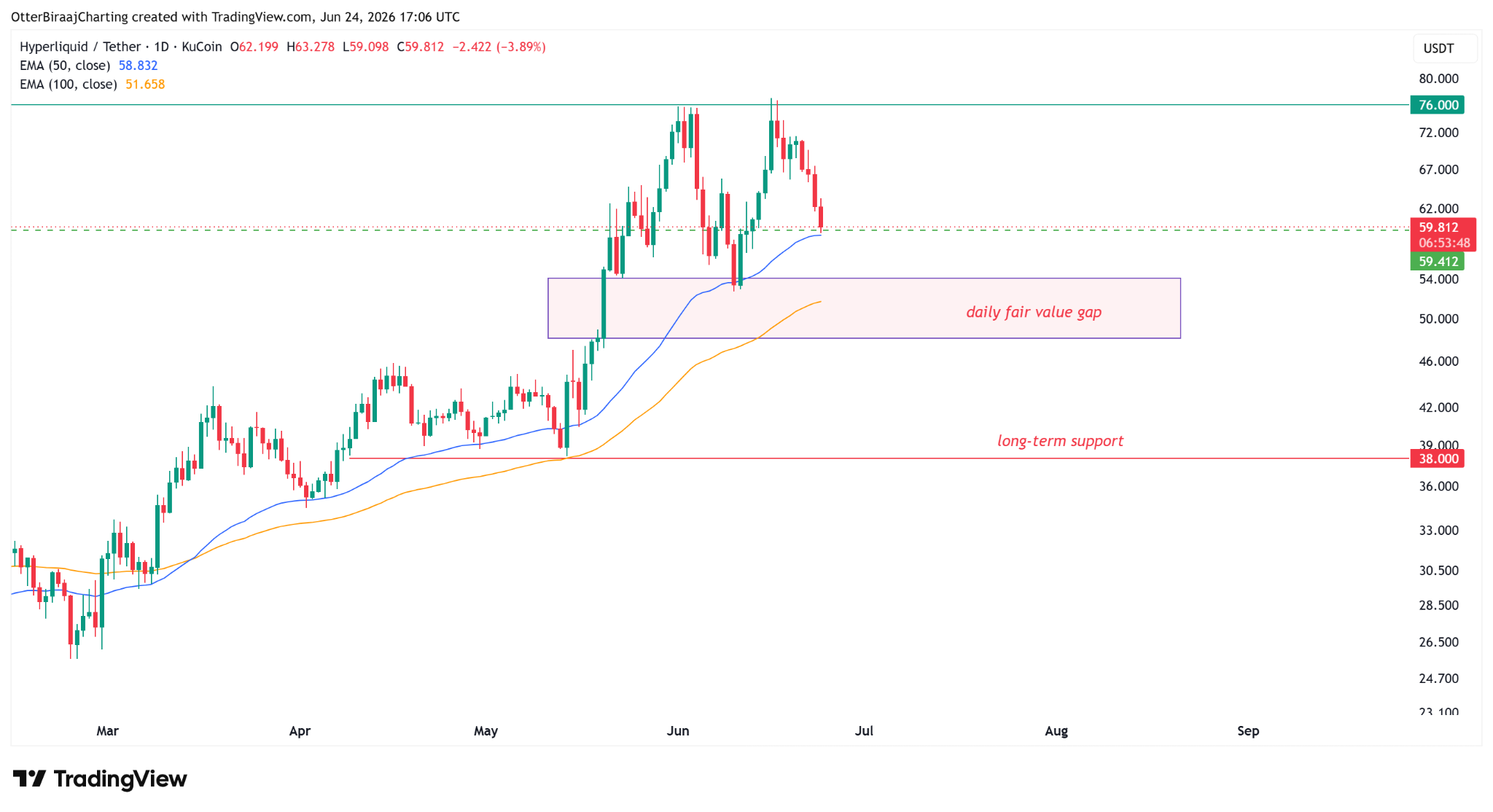
If declines in zcash, hyperliquid and near continue, the chances are that it will drop further back.

Bearish zcash (ZEC) bets hit record highs as price crashes

0

Bearish bets on privacy-focused zcash (ZEC) climbed to a record as the token slumped as much as 50% in 24 hours after a now-plugged vulnerability in its Orchard pool was disclosed.

ZEC recorded roughly $118 million in forced liquidations over the period, CoinGlass data shows.

That is remarkably small for a token whose price halved, suggesting the selling came mostly from spot held tokens rather than a futures-driven move. Only about 14% of zcash’s leveraged positions got wiped out; the number would have been far larger if a leverage cascade had driven the slide.

In comparison, about $335 million in bitcoin -tracked futures were liquidated over the same window even though the largest cryptocurrency fell only a few percent. Ether slipped a similar amount and liquidated $278 million.

Open interest — the total value of unsettled futures bets — rose to a record high in ZEC terms, suggesting traders opened new positions rather than closing them.

The long/short ratio, the number of traders betting on an increase versus a decline, shows those positions skewed bearish. On Binance, the ratio sat below 1 across retail investors at 0.77, whale accounts at 0.80 and whale positions at 0.85. Traders on OKX were more bearish, with retail at 0.67 and whale accounts at 0.72. Only Bybit’s retail traders leaned long, at 1.49.

Short investors sell securities they don’t actually own, betting the price will drop before they need to close out their positions and they’ll profit from the difference. Long investors own the securities to benefit from any increase.

The ratio indicates zcash is heavily shorted after a spot-led drop. If the selling slows and the price steadies, those shorts could be forced to buy to cover their positions, fueling a sharp bounce.

It’s worth remembering that ZEC, even after losing more than half its value in two weeks, is still up roughly 490% over the past year.

No way of knowing

The catalyst for the price drop was the disclosure by nonprofit Zcash developer Shielded Labs of a vulnerability in Zcash’s Orchard privacy pool that, if exploited, could have let an attacker create counterfeit ZEC that no one could detect.

The Orchard flaw had been live since the pool debuted in May 2022, going unnoticed for four years. It was found only last week by security engineer Taylor Hornby using Anthropic’s Opus 4.8 model and patched in an emergency fix by June 1.

The damage is less about the bug itself, which is now closed, than what Shielded Labs admitted alongside it. Because of the way Orchard’s privacy works, there is no cryptographic way to prove whether anyone exploited the flaw before it was fixed.

The firm said it probably was not, but it cannot be sure, and that uncertainty hangs over the token’s entire supply.

Arthur Hayes, the chief investment officer of Maelstrom, said he sold his entire zcash position as a result.

Meta is paying creators in Stablecoins. Spending them is someone else’s problem

0

In March, when Meta announced plans to begin paying creators in USDC across Colombia and the Philippines, with expansion to more than 160 countries expected by the end of the year, the move was widely interpreted as another milestone for stablecoins entering the financial mainstream. A company responsible for nearly $3 billion in annual creator payouts choosing onchain settlement over traditional banking rails is unquestionably significant. What Meta introduced, however, was not a complete payments experience. It was a faster way to move money between accounts.

For many users, particularly in emerging markets, the difficult part begins only after the payment arrives. Stablecoins have largely solved cross-border digital settlement, but integration into local consumer financial systems remains uneven. That is precisely where the next phase of payments competition will be decided.

The real friction starts after settlement

Creators receiving USDC payouts from Meta must connect external wallets, choose a supported network such as Solana or Polygon and manage their own custody. Meta warns that funds sent to the wrong address or an unsupported chain cannot be recovered. From that point onward, the platform steps out of the transaction entirely.

The transfer itself is efficient. Settlement is near-instant, costs are negligible and cross-border movement is effectively frictionless compared to traditional banking rails. But a creator in Manila or Bogotá will often still need to convert USDC into local currency to participate fully in the local consumer economy. That means sending funds to an exchange or liquidity provider, passing compliance checks, selling into fiat and withdrawing through domestic banking infrastructure. Each step introduces fees, delays and operational friction that sit entirely outside Meta’s ecosystem. For a creator whose expertise is content, not crypto, that is a significant amount of complexity to navigate just to access their own earnings.

And this is where stablecoin payments reveal their structural limitations. The infrastructure optimizes settlement, while usability still varies significantly by market.

The choice of the Philippines and Colombia as pilot markets makes this tension even more apparent. Both countries combine strong creator economies with costly cross-border payment systems, where conversion and transfer fees can consume a meaningful share of smaller payouts. In the Philippines in particular, mobile wallet adoption is already deeply embedded in everyday commerce, supported by platforms such as GCash and Maya and reinforced by the arrival of tokenized payment services from global technology companies. These are precisely the kinds of markets where stablecoin payouts should have a compelling advantage. Yet the off-ramp infrastructure remains fragmented, with uneven liquidity, compliance requirements, fees and user experience across providers and jurisdictions.

Card rails are starting from the other end

Card networks have taken a different approach. Instead of starting with blockchain settlement and leaving conversion to the user, they have focused on embedding stablecoins into existing financial infrastructure.

Mastercard’s $1.8 billion acquisition of BVNK expands its stablecoin settlement capabilities across more than 130 jurisdictions, integrated into established reporting and compliance systems. Visa’s partnership with Bridge enables stablecoin-linked cards that allow users to spend digital dollar balances at any merchant that accepts Visa, with conversion handled in the background.

The distinction reflects a deeper architectural choice about where complexity should sit. In Meta’s model, a payout requires a multi-step journey through wallets, exchanges and withdrawal queues before it becomes spendable. While this lighter-touch approach may also reflect the regulatory and operational burden of directly offering fiat conversion and custody services across dozens of jurisdictions, the user is ultimately responsible for navigating the crypto layer. In the card network model, stablecoins exist entirely behind the scenes. Users never see USDC balances or manage blockchain networks. Fiat enters and exits the system as normal, while stablecoins handle settlement invisibly.

Both models use stablecoins in the settlement layer, but they differ significantly in how user-facing complexity is handled.

Where stablecoin adoption actually scales

Stablecoin transaction volumes reached $33 trillion in 2025, up 72 percent on the previous year, with institutional adoption continuing to accelerate. At this point, the question for the payments industry is no longer whether stablecoins will become part of global financial infrastructure – that shift is effectively underway – but whether the off-ramp layer can scale at the same pace as onchain settlement.

The systems that will ultimately scale are those that make blockchain infrastructure invisible to the end user. Stablecoins may sit in the middle of the stack, but the user experience will be defined entirely in fiat terms: pesos in a wallet, a card balance, or a payment accepted at checkout, with no awareness of the underlying rails.

This is where current implementations, including Meta’s, expose the industry’s remaining friction. By surfacing wallets, networks, and conversion steps directly to creators, they reveal the operational complexity that still sits beneath what is marketed as instant global payments. The infrastructure is efficient at settlement but fragmented at integration, reflecting an industry that has progressed faster in building onchain systems than at embedding them cleanly into existing financial workflows.

Meta has helped push the conversation forward, but the next phase of adoption will be defined less by transaction speed or blockchain throughput and more by seamless integration into the financial stack: card networks, banking apps and merchant terminals. In that end state, stablecoins will be present in the system but largely invisible to users. That work is already underway across the card networks; the platforms handling payouts will need to keep pace.

Bitcoin most oversold since 2020 crash: Can BTC rebound to $70K next?

0

Bitcoin’s latest oversold RSI mirrors 2020 and February 2026 setups that preceded 50% and 30% rebounds, putting $70K back in focus.

Visa and Brale Test Privacy-Enabled SBC Stablecoin Settlement on Canton Network

0

Visa and stablecoin issuer Brale are piloting settlement using SBC, a U.S. dollar-backed stablecoin, on Canton Network, the privacy-preserving institutional DLT, testing whether blockchain settlement can meet bank-grade compliance requirements.

Visa and stablecoin infrastructure company Brale are piloting settlement using SBC, a U.S. dollar-backed stablecoin issued by Brale, on the Canton Network — the permissioned-but-privacy-preserving blockchain built by Digital Asset for regulated financial institutions. The two companies announced the collaboration on Wednesday, framing it as a test of whether blockchain-based settlement can satisfy the privacy and compliance standards that banks require.

SBC is fully backed by cash, cash equivalents, and short-term U.S. government bonds, with monthly reserve attestations from a third-party accounting firm. Its circulating supply stands at $8.99 million across 11 chains, per DefiLlama — reflecting a pilot-stage instrument, not a scaled issuance.

The proof of concept sits inside a larger stablecoin push at Visa. The company’s stablecoin settlement pilot now spans nine blockchains and has reached a $7 billion annualized run rate, up 50% quarter over quarter, Visa said in April. Canton was among the five blockchains Visa added at that point.

The Privacy Architecture Argument

The Canton Network, launched by Digital Asset in 2023 and now backed by more than 30 financial institutions, is designed to let participants transact on shared infrastructure without exposing sensitive transaction data to other network members. That configurability, rather than raw throughput or cost, is Canton’s institutional sales pitch.

“Stablecoin settlement has shown how blockchain infrastructure can improve the speed and efficiency of money movement,” said Cuy Sheffield, Visa’s head of crypto, in the company’s press release. “Through our work with Brale, we’re exploring how SBC on the Canton Network can support institutional settlement use cases that require both programmability and privacy controls.”

Ben Milne, founder and CEO of Brale, said financial institutions are “increasingly looking for stablecoin infrastructure that meets their operational, regulatory, and privacy requirements.”

SBC is natively issued on Canton, which avoids the bridging mechanics that introduce settlement risk on networks where the stablecoin wasn’t designed to originate.

Canton’s Institutional Rail Thesis

Canton’s TVL stands at roughly $961,000 as of June 4, per DefiLlama, a nascent onchain footprint that understates its institutional deployment, since much of the activity on permissioned settlement networks does not register in standard TVL calculations. The chain’s measured TVL has risen 207% since mid-May, an early signal of growing operational usage.

The network has been accumulating institutional participants. JPMorgan’s Kinexys unit announced in January that it plans to issue JPM Coin (JPMD), its USD deposit token, natively on Canton across a phased rollout. DTCC and Digital Asset are separately working to make U.S. Treasuries available on Canton. HSBC completed a tokenized deposit pilot on the network in April. And Digital Asset itself is reportedly targeting a $2 billion valuation in a $300 million raise led by a16z crypto.

Institutional Permissioned Settlement

The Canton model competes and sometimes overlaps with other institutional blockchain settlement efforts. JPMorgan’s Kinexys (formerly Onyx) has processed billions in interbank settlement through its permissioned ledger since 2020. Fnality, a consortium-owned utility backed by a group of global banks including Santander and Goldman Sachs, is working toward wholesale payment settlement using tokenized central bank money.

The Visa-Brale pairing differs in one respect: Brale is a third-party stablecoin issuer, not a bank, and Visa is a card network running settlement obligations through the instrument, not a direct bank-to-bank transfer. That positions the collaboration closer to a payment-network layer than to a wholesale interbank settlement system.

Pilot Scope and Open Questions

The announcement does not disclose settlement volumes, currencies other than USD, or named counterparties beyond Visa and Brale. No timeline for moving from proof of concept to production is given. Visa described the exercise as evaluating “what it takes to bring these capabilities into production environments.”

SBC can be minted and redeemed 1:1 with USDC, USDP, and PYUSD on 10-plus blockchains, and via wire and ACH, according to Brale’s documentation. That interoperability means any settlement balances built up on Canton could theoretically flow back to the broader stablecoin ecosystem, a design consideration for institutions that don’t want liquidity trapped on a single network.