Bitcoin BTC$59,793.52 could be approaching a major turning point after a rare combination of onchain indicators flashed signals that have historically coincided with market bottoms, according to Chris Sullivan, co-founder and portfolio manager at digital asset hedge fund Hyperion Decimus.
In a recent report, the hedge fund explained that four proprietary onchain signals have aligned only five times during bitcoin’s 15-year history. Each previous occurrence marked a cycle bottom, although Sullivan cautioned that this time still lacks final technical confirmation.
“We have literally like every box checked, except for a final pattern,” Sullivan said in an interview with CoinDesk. “Either we have to break above the $82,000 pivot to confirm, or we have one final low, call it between $54,000 and $57,000. Perhaps a wick to $48,000 to capitulate. One of those two conditions we expect to happen in the next 90 days.”
If either scenario unfolds, Sullivan believes bitcoin could quickly diverge from broader financial markets. The crypto asset is trading at $59,386 after losing 23% over the past month, extending its divergence from U.S. equities, which had climbed to record highs before also coming under pressure this month.
STRC trading well below its $100 target level simply makes Strategy’s bitcoin acquisition and funding engine less efficient, because the company can no longer issue the preferred shares on attractive terms, as Benchmark analyst Mark Palmer previously noted. That is very different from suggesting the model is failing.
The bigger issue is one of confidence rather than solvency. STRC was marketed as a low volatility income product designed to trade near $100, and its sharp decline has undermined investor trust.
The real damage is to credibility, Two Prime CEO Alexander Blume argues, not the company’s ability to keep paying dividends. And therefore it may be trust that keeps STRC from returning to its $100 par value.
Michael Saylor’s repeated pivots and deviations from his stated plans have shattered investor trust, leading to a dramatic collapse in Strategy’s (MSTR) ecosystem, Blume told CoinDesk on Thursday.
“Beyond any spreadsheet or logic, markets are about trust, especially when your investor base is retail-centric,” Blume, who heads the bitcoin-focused investment SEC-registered investment adviser, said in a Telegram message.
“Saylor’s repeated pivots and deviations from his stated plans, alongside poor performance of STRC and MSTR, have broken that trust.”
Blume has been sounding the alarm for months. In March, as Strategy’s perpetual preferred stock was still riding early momentum, Blume warned:”There’s no free lunch, a product that pays more than 6% over Treasuries must come with additional risk.”
XRP is trading just above $1, leaving the token at its weakest price level of the year, but onchain data paints a different picture.
The exchange-held XRP supply continues to fall, Binance withdrawals have exceeded deposits for seven straight days, whale flows are holding positive and spot XRP exchange-traded funds (ETFs) have attracted $243 million in inflows since April.
The improving onchain data points to healthy network positioning, even as XRP continues to search for a price bottom.
XRP supply on exchanges continues to shrink
Crypto analyst Amr Taha noted that Binance’s XRP reserve has fallen to its lowest level since March after roughly 100 million XRP left the exchange over the past month. Binance’s balance stood at about 2.68 billion XRP on June 25, down from 2.78 billion XRP on May 12, accounting for the largest outflow among major trading platforms.
Other exchanges also posted smaller declines. Upbit’s reserve fell to 2.48 billion XRP on June 25 from 2.51 billion XRP on May 31, while Bybit’s holdings declined to 82 million XRP from 92 million XRP on June 2. Binance led in absolute outflows, while Bybit recorded the steepest percentage decline.
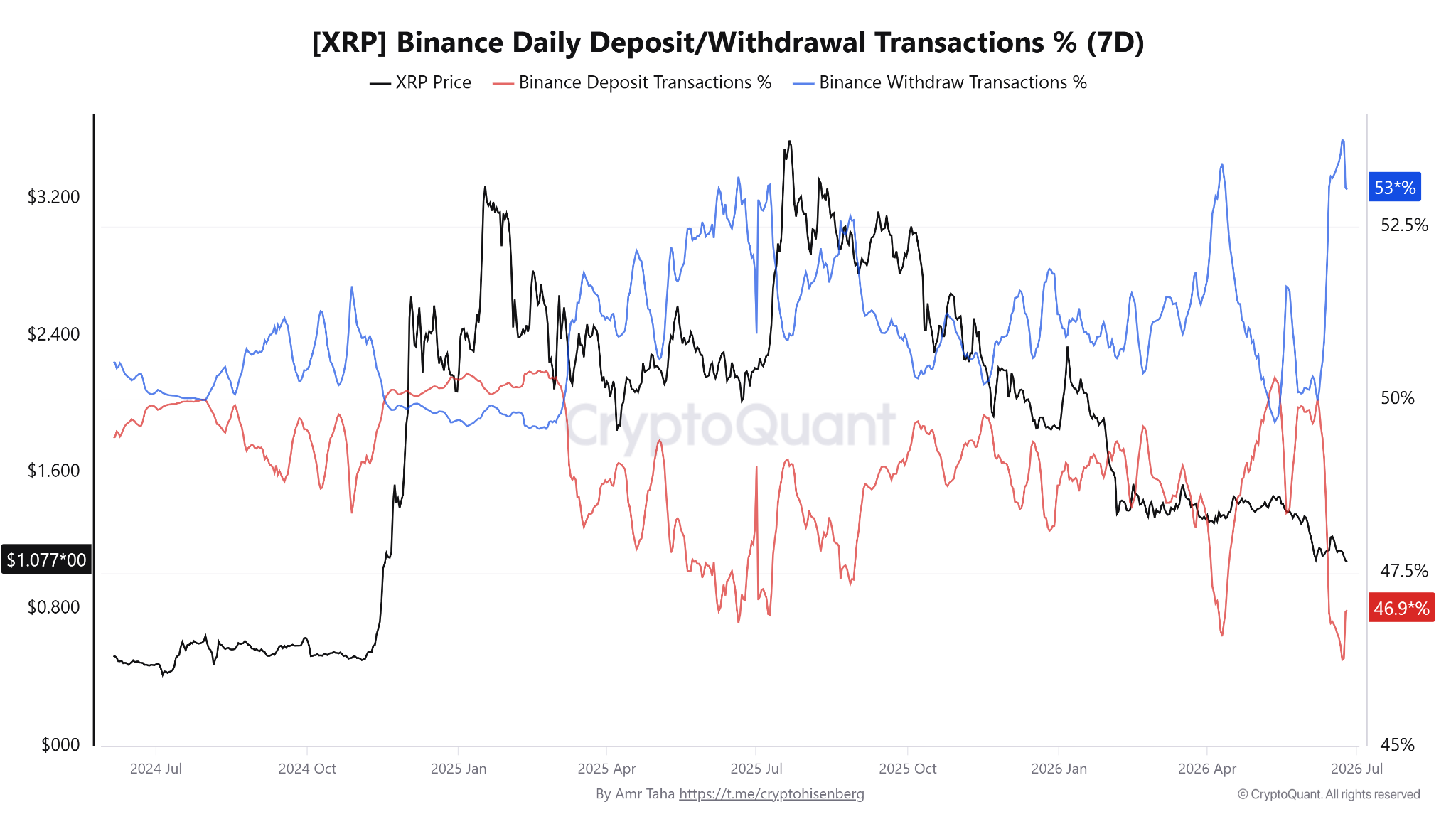
Taha also highlighted a significant shift in Binance transaction activity. XRP withdrawal transactions have exceeded deposits for seven consecutive days since June 17. The seven-day withdrawal share climbed to 53.8% on June 23, its highest reading since June 2024, while deposits fell to 46.1%, the weakest level since 2024.
XRP daily deposit/withdrawal transactions (%) on Binance. Source: CryptoQuant
The metric tracks transaction count rather than XRP volume. This indicates users are moving coins off Binance more frequently than sending them to the exchange, marking the longest withdrawal-led stretch in roughly a year.
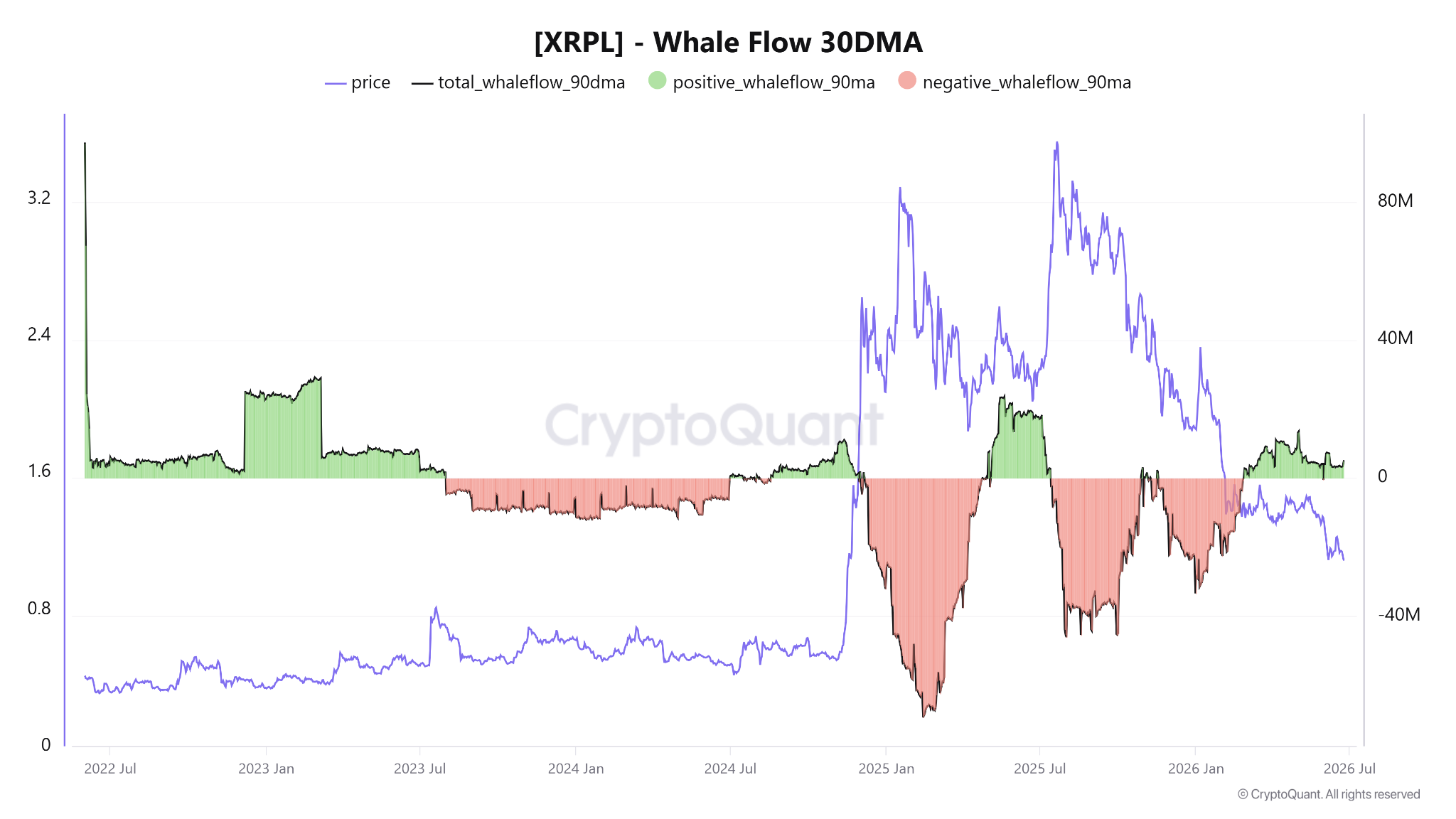
Large XRP holders supported the trend. XRP whale flow on the 90-day moving average has stayed positive throughout the quarter at 5.143 million XRP per day, showing consistent net accumulation by large wallets instead of distribution.
XRP whale flows. Source: CryptoQuant
Institutional demand has also added support. Spot XRP ETFs recorded $2 million in net inflows on June 24, lifting June’s total netflows to $31 million. Since April, the total cumulative inflows have reached $243 million.
Related: SBI to acquire Bitbank in $289M deal creating Japan’s biggest crypto exchange
XRP price approaches a major demand zone
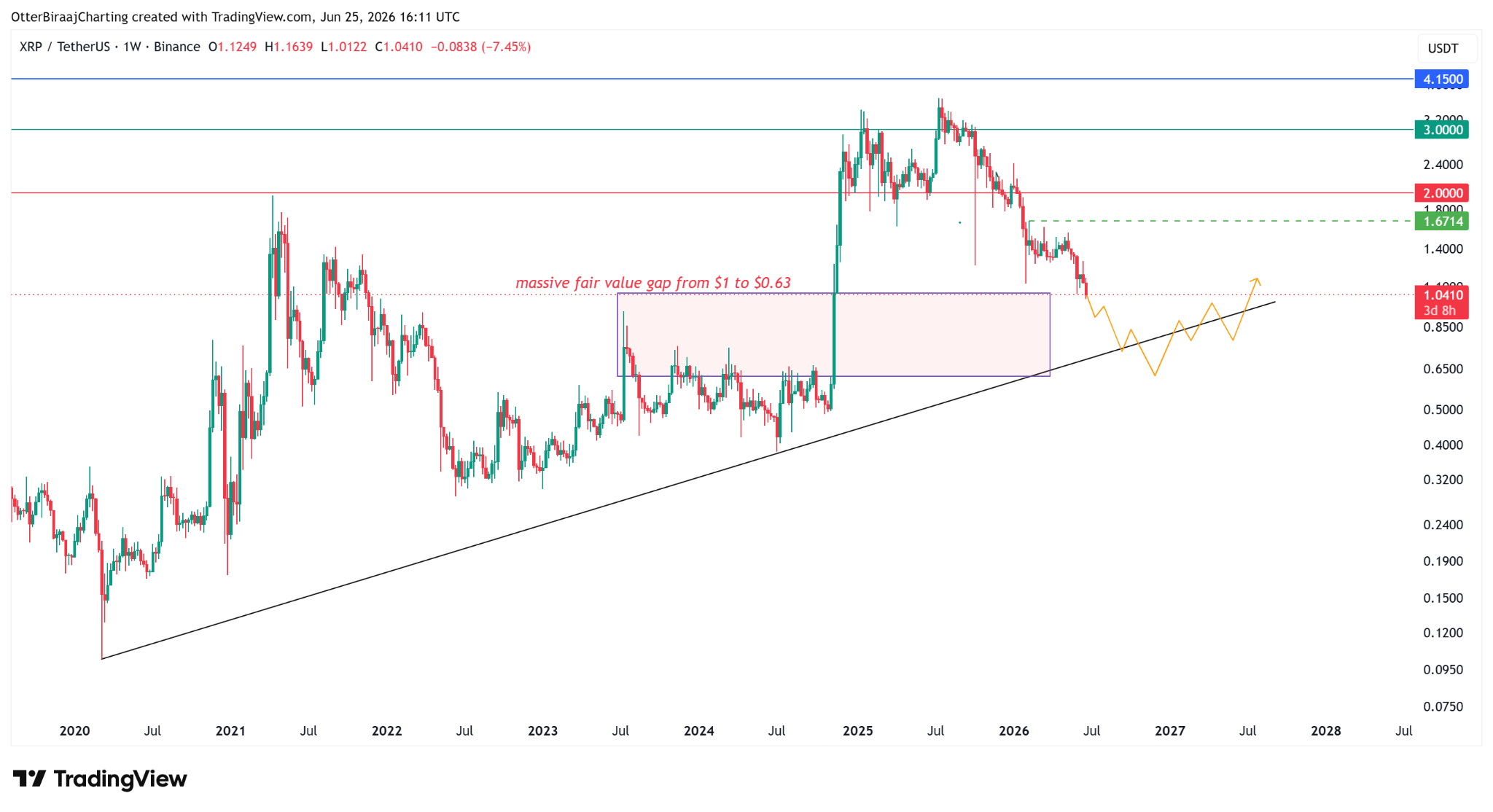
From a technical standpoint, the higher-time-frame market structure remains bearish for the altcoin. XRP touched $1.01 on Thursday, its lowest price of 2026, leaving the token close to its first move below $1 since November 2024. The decline has pushed XRP down 43% year-to-date.
The next key area for XRP sits within the fair value gap between $1 and $0.63, an unfilled price gap created during the sharp rally in late 2024 that could attract buying interest if the decline extends in the coming weeks.
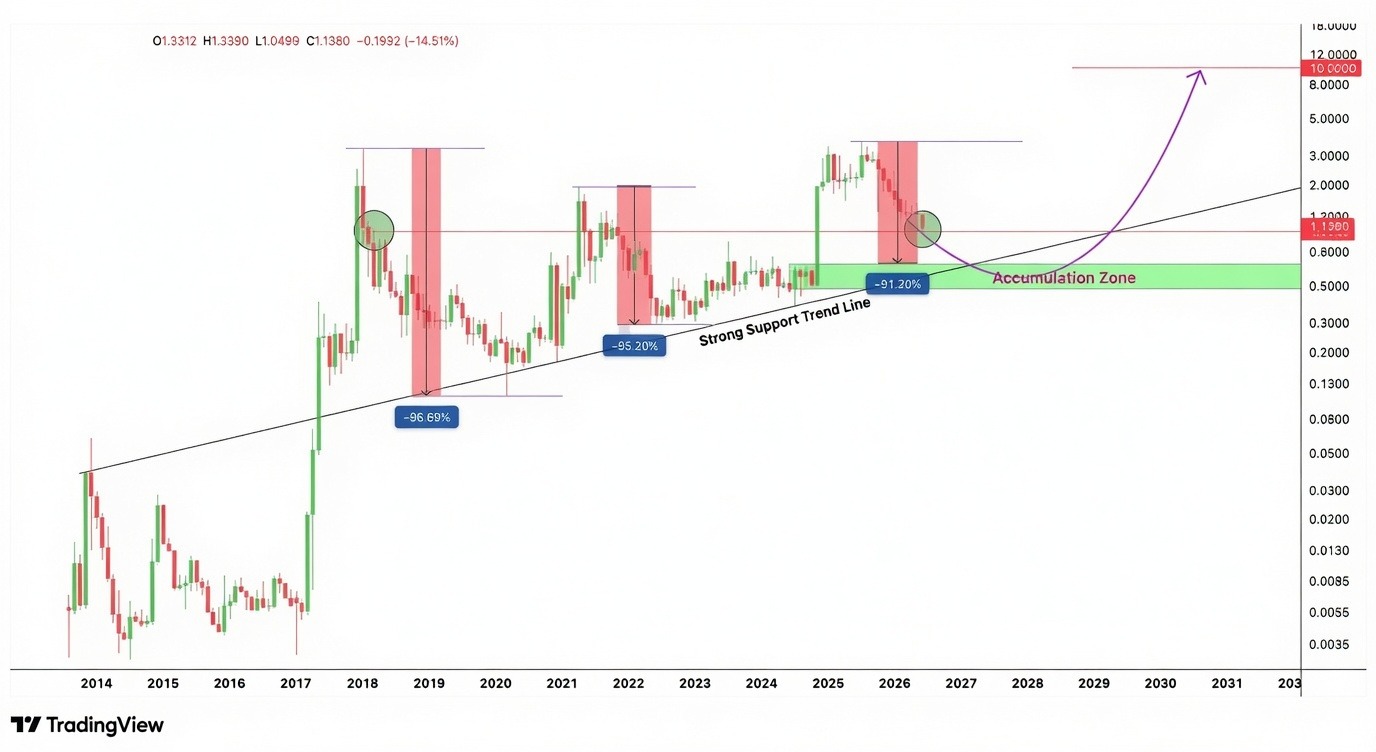
Black Swan Capitalist founder Versan Aljarrah continues to focus on the longer-term chart. The analyst said XRP has spent years building a large accumulation range with higher lows on both weekly and monthly timeframes.
XRP/USD, one-month chart analysis by Versan Aljarrah. Source: X
Aljarrah argued that extended consolidations often produce stronger breakout moves once the price eventually breaks out of the range, with the analyst targeting $10, i.e., a 900% increase from the current price.
Related: HYPE down 22% from record highs: Will spot demand revive the uptrend?
A group of Democratic US House lawmakers is questioning the US securities regulator over how it is overseeing investment advice and trading powered by artificial intelligence.
In a letter to SEC Chair Paul Atkins dated Tuesday, the lawmakers said that platforms offering AI trading agents to retail traders “raises serious questions for investor protection, broker-dealer responsibilities, market integrity, and the accountability of AI developers.”
“While such trading may initially be limited in scope, there are indications that agentic trading could expand to a broad range of additional products, including options, cryptocurrency, event contracts, and futures,” the lawmakers wrote.
AI agents have grown in popularity among crypto users as traders look to gain an edge in the always-on market, an idea that has spread to retail traders of traditional equities as they seek help with strategies.
Crypto exchange Coinbase is one of the latest major platforms to introduce such a tool, releasing an AI agent earlier this month integrated into its app, which it said is a Securities and Exchange Commission- and Commodity Futures Trading Commission-registered financial adviser that can give guidance on trades.
The letter, led by Bill Foster, the top Democrat on the House Financial Services Financial Institutions Subcommittee, and Brad Sherman, the top Democrat on the Capital Markets Subcommittee, said the agents have “operated largely outside the securities regulatory framework,” even as they are making “consequential investment decisions on behalf of retail investors.”
Representative Bill Foster speaking at a hearing in early June. Source: YouTube
The lawmakers said the disclosures accompanying AI agents say that brokerage platforms can’t guarantee the accuracy or suitability of any AI output or control, monitor or audit the agents.
Related: Bitcoin’s deeply discounted versus AI-stocks, but hawkish Fed risk lingers: Bitwise
Such disclaimers “raise urgent questions about the regulatory treatment of agentic trading tools and create uncertainty regarding legal responsibility among brokers, AI developers and retail investors.”
The letter asked the SEC to provide written responses to a list of questions by July 31, including what guardrails or analysis the agency has on agents, when an AI agent would need to register and the extent of its consultations with platforms over AI.
It also asked if the SEC has the authority it needs to address the risks of AI agents, or if it needs congressional action to address them.
Representatives Stephen Lynch, Jim Himes, Sean Casten, Rashida Tlaib, Brittany Pettersen and Sylvia Garcia also signed the letter.
Magazine: The end of anonymity? AI could unmask crypto’s hidden identities
US asset manager files for a GENIUS Act reserve money market fund whose shares are recorded directly on public blockchains, with Superstate as sub-transfer agent
Invesco, the asset manager with $2.45 trillion under management, filed with the U.S. Securities and Exchange Commission to launch a money market fund whose shares are recorded as tokens on public blockchains and that is designed to hold the reserves to back stablecoins.
The filing for the Invesco Stablecoin Reserves Onchain Fund was submitted Wednesday under the Short-Term Investments Trust and proposes the fund become effective 60 days after filing.
Superstate Services LLC, the digital transfer agent founded by Compound creator Robert Leshner, will act as sub-transfer agent, maintaining the official record of share ownership through what the filing calls a “blockchain-integrated recordkeeping system.” The specific blockchain is listed as undetermined in the filing, though the document repeatedly references Ethereum in its risk disclosures.
The fund is a Rule 2a-7 government money market fund seeking a stable $1.00 share price. It does not invest in crypto. Per the filing, it holds cash, U.S. Treasury bills, notes and bonds with a remaining maturity of 93 days or less, and overnight repurchase agreements collateralized by Treasuries — the narrow set of eligible reserve assets that payment stablecoin issuers are permitted to hold under the GENIUS Act, the federal stablecoin law signed in July 2025.
The fund states explicitly that it does not invest in stablecoins or in stablecoin issuers. Its 93-day maturity ceiling is tighter than the standard 397-day limit Rule 2a-7 otherwise allows, matching the GENIUS Act’s reserve-asset rules.
Blockchain-based Shares
Under the filing, ownership and transfer of shares are “authenticated and recorded as a token on a permissionless, public blockchain,” with the public ledger and an off-chain register together forming the official shareholder register.
The filing adds Invesco to a fast-growing 2026 race among asset managers building money market funds to hold stablecoin reserves under the GENIUS Act and, increasingly, putting them on public blockchains.
JPMorgan launched a tokenized reserve fund on Ethereum in May, and BlackRock has filed similar vehicles. What sets Invesco’s apart is its reliance on Superstate’s third-party tokenization and transfer-agent infrastructure rather than a proprietary, in-house platform, extending a partnership the two firms struck earlier this year.
A Crowded Field
The fund enters a crowded race. At least eight other major asset managers have launched or filed GENIUS Act reserve funds in 2026, and under the hood they look nearly identical: each is a Rule 2a-7 government money market fund targeting a stable $1.00 share price, and each holds the same narrow set of GENIUS-permitted assets — cash, U.S. Treasuries maturing in 93 days or less, and overnight repurchase agreements backed by Treasuries. None invests in crypto. What separates them is how they issue shares.
Most record shares conventionally, off-chain. Those include Morgan Stanley’s Stablecoin Reserves Portfolio (MSNXX), launched in April; State Street’s Stablecoin Reserves Money Market Fund (SSCXX), launched June 8; Fidelity’s Reserves Digital Fund (FYMXX), launched in mid-June; BNY’s Dreyfus Stablecoin Reserves Fund; Goldman Sachs Asset Management’s Stablecoin Reserves Fund; and BlackRock’s Circle Reserve Fund, which manages reserves backing Circle’s USDC. Federated Hermes’ Digital Treasury Fund (OFFXX) carries a crypto-oriented name but does not use blockchain technology, the firm has said.
A smaller group issues fund shares directly as tokens on a public blockchain — the structure Invesco is pursuing, and the feature that makes its filing notable rather than novel. JPMorgan moved first, launching its OnChain Liquidity-Token Money Market Fund (JLTXX) on public Ethereum in May, and BlackRock has filed for additional tokenized money market funds. Like Invesco’s proposed fund, JLTXX records share balances at investors’ blockchain addresses, though JPMorgan keeps the official ownership ledger off-chain through a traditional transfer agent and runs the fund on its own in-house Kinexys platform rather than a third-party crypto firm’s rails.
The contest is over scale. Stablecoin issuance stands at roughly $315 billion today, according to DefiLlama, and State Street cites estimates that it could grow to between $1.9 trillion and $4 trillion by 2030 — the pool of reserves all these funds are built to manage.
Superstate’s Infrastructure at the Center
Superstate runs what the filing describes as a permissioned system operating on top of public, permissionless blockchains. The firm registers each wallet against off-chain identity records and grants transaction permission only to approved wallets on an “Allowlist.” Smart contracts enforce transfer restrictions, can freeze shares, and can burn and re-mint tokens if a holder loses control of a wallet, per the filing.
The arrangement extends a relationship that began earlier this year. In March, Invesco took over management of Superstate’s flagship tokenized Treasury fund USTB, becoming the first independent asset manager to use Superstate’s digital transfer agent rails — a deal Leshner called “the blueprint for how funds and ETFs will come onchain.”
Superstate has since handed its USCC crypto carry fund to Bitwise and powered the launch of Coinbase Asset Management’s tokenized credit fund through its FundOS platform, as it pivots from running funds toward operating tokenization infrastructure for other managers. Superstate’s onchain assets currently total roughly $769 million, the majority on Ethereum, according to DefiLlama.
Tokenized U.S. Treasuries and money market funds have grown into the largest real-world-asset category onchain, surpassing $15 billion, per RWAxyz figures. Tokenized RWAs overall have grown past $30 billion.
Not Live Yet
This is a registration statement, not a live fund. The filing is marked “subject to completion,” the fund’s ticker and the designated blockchain are left blank, and Invesco may amend or withdraw it before it takes effect. Several GENIUS Act implementing rules from the OCC, FDIC, and Treasury remain unfinalized, and the filing warns that changes to those rules could force the fund to adjust holdings or operations.
The fund could become effective as soon as 60 days after the Tuesday filing if the SEC does not intervene. Invesco and Superstate have not announced a launch date, a supported blockchain, or a management fee for the new fund.
Perception, a real-time narrative intelligence platform for digital asset firms, has exited beta and announced integrations with BitGo (NYSE: BTGO), Swan, Relai, and Bitcoin Well (TSX.V: BTCW).
The four companies embedded Perception’s data layer into their internal AI workflows during the beta period, ahead of today’s public launch.
The platform targets a structural problem in how digital asset teams gather market intelligence. High-value industry discourse has scattered across a fragmented web of specialized media, conference transcripts, social platforms, and regulatory filings — channels that standard monitoring tools and general-purpose AI models do not reach.
The company argued in a note to Bitcoin Magazine that legacy tools compound the problem rather than solve it: as AI-generated content floods public channels, noise-to-signal ratios worsen, and tools that simply scrape the open web transfer that degradation to their users.
General-purpose large language models face a related limitation.
Their outputs reflect what search engines surface and what was indexed during training — not what is happening before market consensus forms. For firms making positioning decisions in real time, that lag carries real cost.
Perception as a reasoning layer
Perception’s approach is to serve as a context layer between reasoning models and live industry data, aggregating signal from more than 1,000 curated sources. The company describes the product not as a research tool but as infrastructure — a feed that AI agents can query to stay current on narrative shifts, competitor coverage, and share of voice before those signals reach mainstream channels.
The launch comes against a backdrop of headcount reductions at major digital asset firms. Coinbase, Dune, and Block have each cut teams by significant margins over the past year, pushing remaining staff toward higher-leverage workflows.
Perception’s pitch is that firms can maintain analytical depth without proportional team growth by routing live, curated industry context into automated pipelines.
The product suite spans three categories: Narrative Systems (Pulse and Voices), Workflow Engines (Work and Brains), and Integration Models (Stream and MCP). REST APIs and a Model Context Protocol gateway allow firms to pipe structured narrative data into their own models or dashboards.
Fernando Nikolic, Perception’s founder and former Vice President of Marketing at Blockstream, put the distinction plainly: “General AI does not summarize the market; it homogenizes it on stale averages. The pioneers in our space are combining AI’s reasoning capabilities with a live, specialized context feed to engineer their own narratives, map competitor share of voice, and secure their market positioning.”
Whether the model scales beyond established players remains the central question. The four launch partners signal demand from firms with resources to build custom AI workflows. Perception’s durability will depend on how accessible that infrastructure becomes for teams operating with leaner budgets.
New subscribers who sign up before July 15, 2026, can lock in a rate of $499 per month using the code BETA499, ahead of standard pricing of $799 per month.
Binance has notified European Union users that access to key services will be restricted after the exchange failed to secure Markets in Crypto-Assets (MiCA) authorization from a member state before a July 1 deadline.
Those restrictions include halting the onboarding of new EU users and limiting certain services for EU-based accounts effective July 1, according to exchange notices shared by users on social media.
The notices said users will still be able to withdraw their assets after that date, stating that “all digital assets are still available for withdrawal,” in line with applicable regulatory requirements.
The move marks one of the first major transitions under the EU’s MiCA framework after Binance announced it withdrew its MiCA license application in Greece on Wednesday.
Cointelegraph approached Binance for comment on its plans but did not receive a response prior to the time of publication.
Binance advises moving funds to self-custodial wallets or other exchanges
In circulating notices, Binance told users they may move assets to self-custody wallets or transfer funds to other crypto asset service providers (CASPs).
The exchange operator said the transition is intended to be an “orderly process” aimed at minimizing disruption to users, with services reduced to position management and withdrawals after the deadline.
Source: IT_Tech_PL
Multiple MiCA-licensed CASPs including Revolut and OKX have been actively recruiting new users in EU member states ahead of next week’s deadline.
Users seek clarity on staking and trading
Some Binance users have raised concerns over how specific services will be handled once EU service restrictions take effect after the MiCA transition ends.
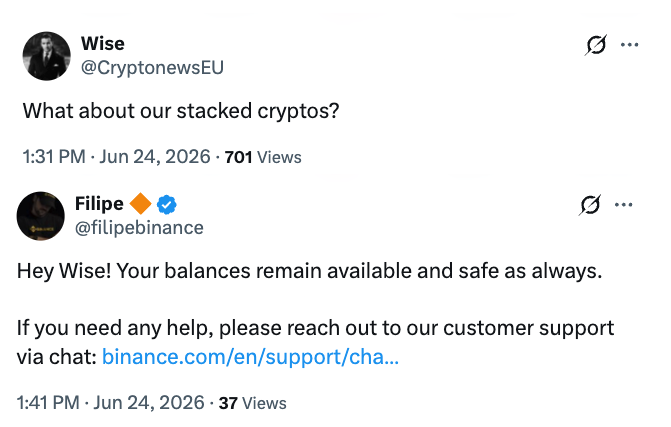
In public replies on social media, users asked what will happen to staked crypto assets on Binance after the deadline, reflecting uncertainty around whether yield-generating positions will be affected by the upcoming service changes.
Source: Filipebinance
In response, a Binance representative said user balances “remain available and safe as always,” but did not provide specific details on how staking rewards or active positions will be treated under the restricted-services phase.
Community divides over Binance user impact
Views across the crypto industry differ on how significant the upcoming MiCA transition will be for existing Binance users in the European Union.
Dominik Tomczyk, CEO of SIA AlphaRoute, operating as Kanga Exchange EU, told Cointelegraph that non-licensed platforms may still continue serving existing users under the legal concept of “reverse solicitation.” He said that, from a user perspective, “nothing will change,” apart from restrictions on marketing and user acquisition within the EU.
Sławomir Zawadzki, co-CEO of Kanga Exchange, said existing users are unlikely to see major disruptions. He also suggested that much of the concern around MiCA-related changes is being overstated, adding that competitive positioning may be shaping parts of the public narrative.
Mixed response from users
One Binance EU user told Cointelegraph they were not overly concerned about the MiCA deadline, pointing to Binance’s liquidity and proof-of-reserves reporting. “I’ll honestly continue using Binance until I see evidence of a potential enforcement action,” the person said.
Another user said the impact on Binance EU users would depend on how heavily they rely on the platform. They noted that their primary use of the platform is as a trading gateway and would switch to another exchange if needed, while suggesting the biggest disruption would likely affect active traders and users with large balances on the platform.
Related: EUR trading accounts for 1% of Binance spot volume, CryptoQuant says
According to media reports, Binance’s global client base counts at least 300 million customers, while the app was downloaded more than 4 million times in the EU last year.
Magazine: How crypto laws changed in 2025 — and how they’ll change in 2026
For the past two cycles, Bitcoin DeFi has lived more as a promise than a category.
Programmable Bitcoin has remained a vision held by a certain breed of Bitcoin maxi who believes that the world’s largest cryptocurrency can become productive without losing its security or sound money qualities.
Yet the closure of Bitcoin scaling platform Botanix earlier this month has called that vision into question.
If a well-funded, technically ambitious Bitcoin layer-2 with live apps, integrations and competitive yields can’t attract enough usage to survive, does that mean Bitcoiners simply don’t care about decentralized finance?
Bitcoin DeFi remains a niche proposition in 2026, despite years of being touted as the next big thing.
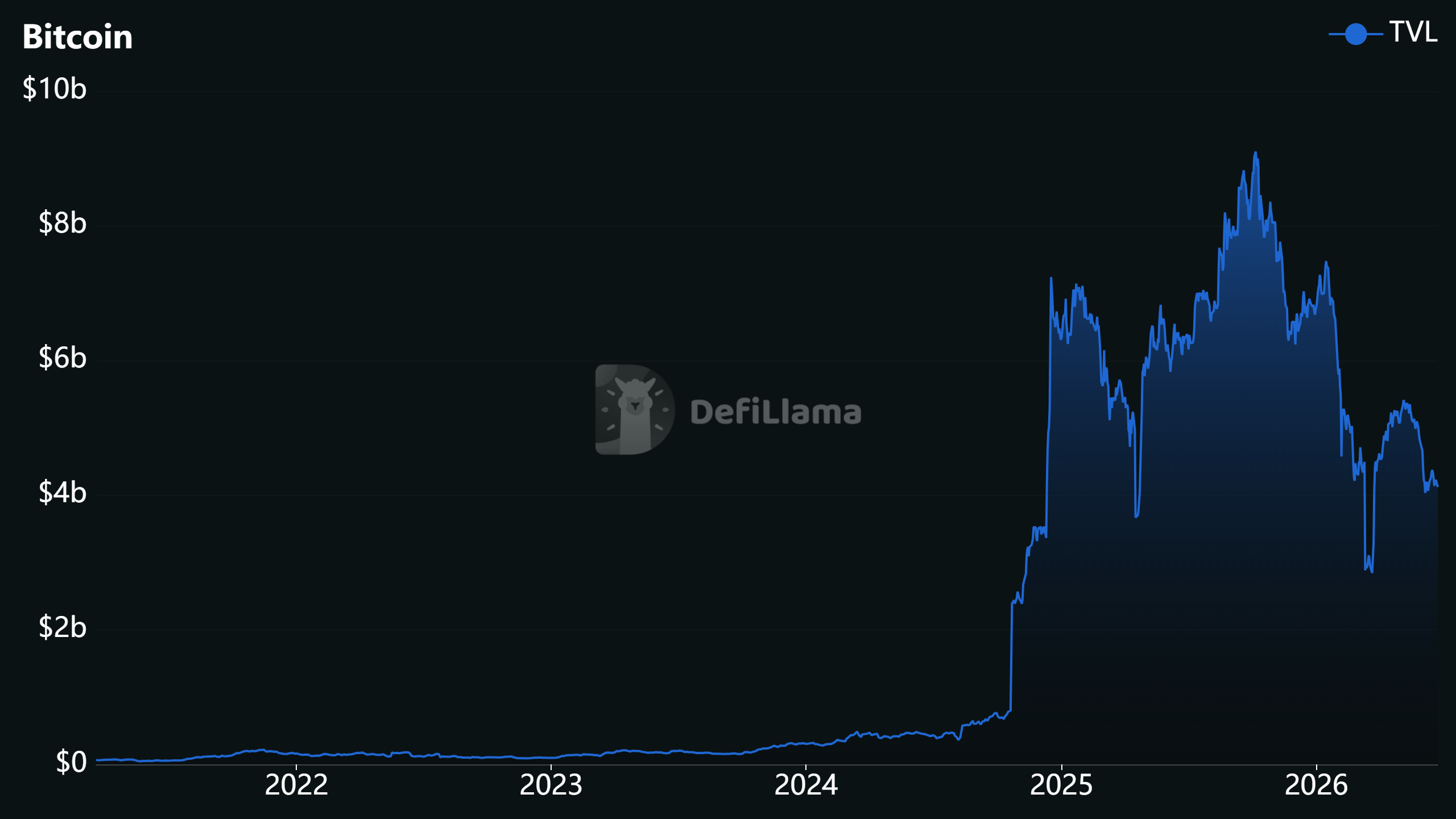
DefiLlama’s dashboard shows just $4.12 billion of total value locked (TVL) across all of the Bitcoin DeFi protocols. That’s a rounding error next to Bitcoin’s $1.2 trillion market cap, and the hundreds of billions held via spot exchange-traded funds, corporate treasuries and custodial accounts.
Andre Dragosch, head of research Europe at Bitwise, told Cointelegraph, “Bitcoin is winning decisively as a monetary asset and as pristine collateral, but the case for Bitcoin as a standalone DeFi execution layer was always structurally weaker than the narrative suggested.”
Botanix closes after four years
When Botanix announced it was winding down after nearly four years of work and a year of mainnet uptime, the team didn’t blame a hack or a regulatory shock; they blamed demand.
Botanix described a chain that “worked” in every technical sense: 25 million transactions, 200,000 wallets, and tens of millions of dollars in bridged funds, yet it never generated the fee volume needed to cover its infrastructure costs.
Users came for the yield, treated BTC as store-of-value collateral, and then largely stuck to passive, buy-and-hold strategies, rather than actively borrowing, trading, or moving funds often enough to generate meaningful fee volume.
Related: Fireblocks to integrate Stacks for institutional-grade Bitcoin DeFi
Like most BTCFi stacks today, Botanix still requires users to bridge their Bitcoin into a tokenized version on a separate Ethereum Virtual Machine (EVM)-based chain before they can access DeFi. That introduces additional bridge and smart contract assumptions that worry many Bitcoiners.
Botanix’s shutdown notice. Source: Botanix
Even so, Botanix co-founder Willem Schroé told Cointelegraph that he wouldn’t have changed the core design. Despite Botanix offering what he described as “the best rates in the industry” and a more Bitcoin-aligned security model than typical wrapped BTC bridges, wrapped BTC on Ethereum still out-competed Botanix.
He attributed that to Ethereum’s “huge infrastructure network and Lindy effect,” as well as a mix of liquidity depth, user experience and regulatory comfort.
What Botanix learned about Bitcoin DeFi
The team concluded that Bitcoin is still viewed as a reserve asset rather than something that has programmable utility.
For most existing use cases like lending, leveraged exposure, or yield, a wrapped BTC position on a large, mature EVM ecosystem such as Ethereum is “genuinely sufficient” for most users. Rather than bridge into a Bitcoin-aligned EVM chain like Botanix, users preferred to stick with wBTC on venues where the liquidity, apps and integrations already exist.
Related:Mercado Bitcoin expands LatAm RWA push with $20M in Rootstock private credit
Botanix also pointed to onchain activity consolidating around venues like Hyperliquid, and major centralized exchanges and retail-facing fintechs that “own the user relationship,” leaving independent infrastructure “rowing upstream” against convenience and branding.
Wilhelm said he hopes Botanix’s wind-down “will definitely be looked at by others,” and framed the process as a professionally managed experiment whose lessons other BTCFi builders should take seriously.
Bitcoiners, DeFi and wrapped BTC
While estimates vary, only a small fraction of Bitcoin’s supply is currently productive in DeFi, and most of that sits in wrapped BTC products on Ethereum and its L2s like Base and Arbitrum, as well as Polygon, Solana and BNB Smart Chain. A smaller percentage is on “Bitcoin L2” chains, with Bitcoin-aligned L2s and sidechains accounting for a modest share of that activity by value.
Tokenized BTC products themselves represent just a sliver of the asset: A May 2026 analysis estimated that roughly $20 billion worth of BTC — less than 2% of the total Bitcoin supply — is circulating on EVM chains in wrapped form.
Total Value Locked (TVL) in Bitcoin DeFi. Source: DeFiLlama
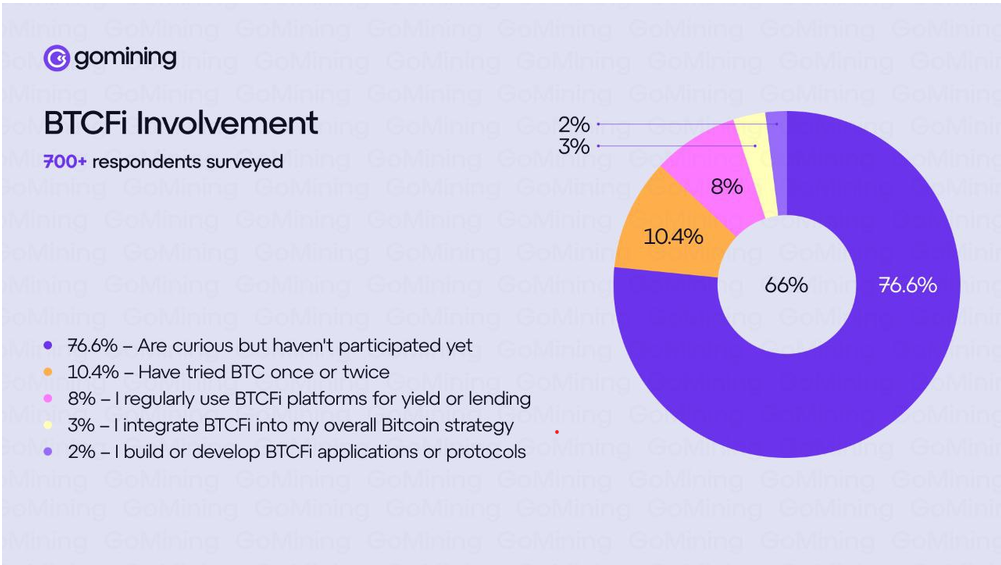
An October 2025 GoMining survey of 730 Bitcoin holders found that 77% of respondents had never used a BTCFi platform, and only 3% integrated BTCFi into their overall Bitcoin strategy.
Even allowing for sample bias (these respondents were plugged-in, survey-answering BTC holders), the numbers show that BTCFi platforms that keep users in Bitcoin-aligned stacks remain a niche activity rather than a mass behavior.
Justin d’Anethan, head of research at crypto private markets advisory firm Arctic Digital, told Cointelegraph, “There is more liquidity and better yields on EVM or SVM [Solana Virtual Machine] native solutions than on BTC solutions, period.”
When clients ask about “putting their Bitcoin to work,” the practical routes, he said, are still centralized desks, exchanges lending out BTC at 2% to 4%, basis trade structures “à la Ethena,” or institutional credit pools like Maple.
He said the big obstacle for most Bitcoiners was the risk of bridging to a less secure Bitcoin L2. For “hardcore BTC maxis,” the default remains cold storage, HODLing and riding price appreciation, rather than trying to “eke out 2-3% with counterparty risk.”
Native BTCFi as a structural mismatch
Dragosch said Botanix’s failure suggested that demand for standalone Bitcoin DeFi execution layers was much weaker than their backers expected.
He argued that capital that “genuinely wants yield has migrated to wrapped BTC on mature, liquid venues rather than bridging into bespoke federations.”
In this view, the problem isn’t just that Bitcoiners haven’t “discovered” native DeFi yet; it’s that the architecture and user base are misaligned. Bitcoin’s base layer is slow, conservative and firmly anchored in the store-of-value narrative.
“Bitcoin as reserve collateral is the durable trade,” Dr. Dragosch said, “the next leg of adoption runs through institutions and balance sheets, not necessarily through onchain execution layers.”
77% of respondents have never used a BTCFi platform. Source: GoMining
Who is still building BTCFi, and for whom?
Diego Gutierrez Zaldivar, chief executive of RootstockLabs, a Bitcoin-secured, EVM-compatible sidechain, doesn’t buy the idea that there’s “no demand” for Bitcoin-backed lending, yield products or broader BTCFi services.
He said the main constraint is trust: putting in place the operational, legal and risk management frameworks that institutions need.
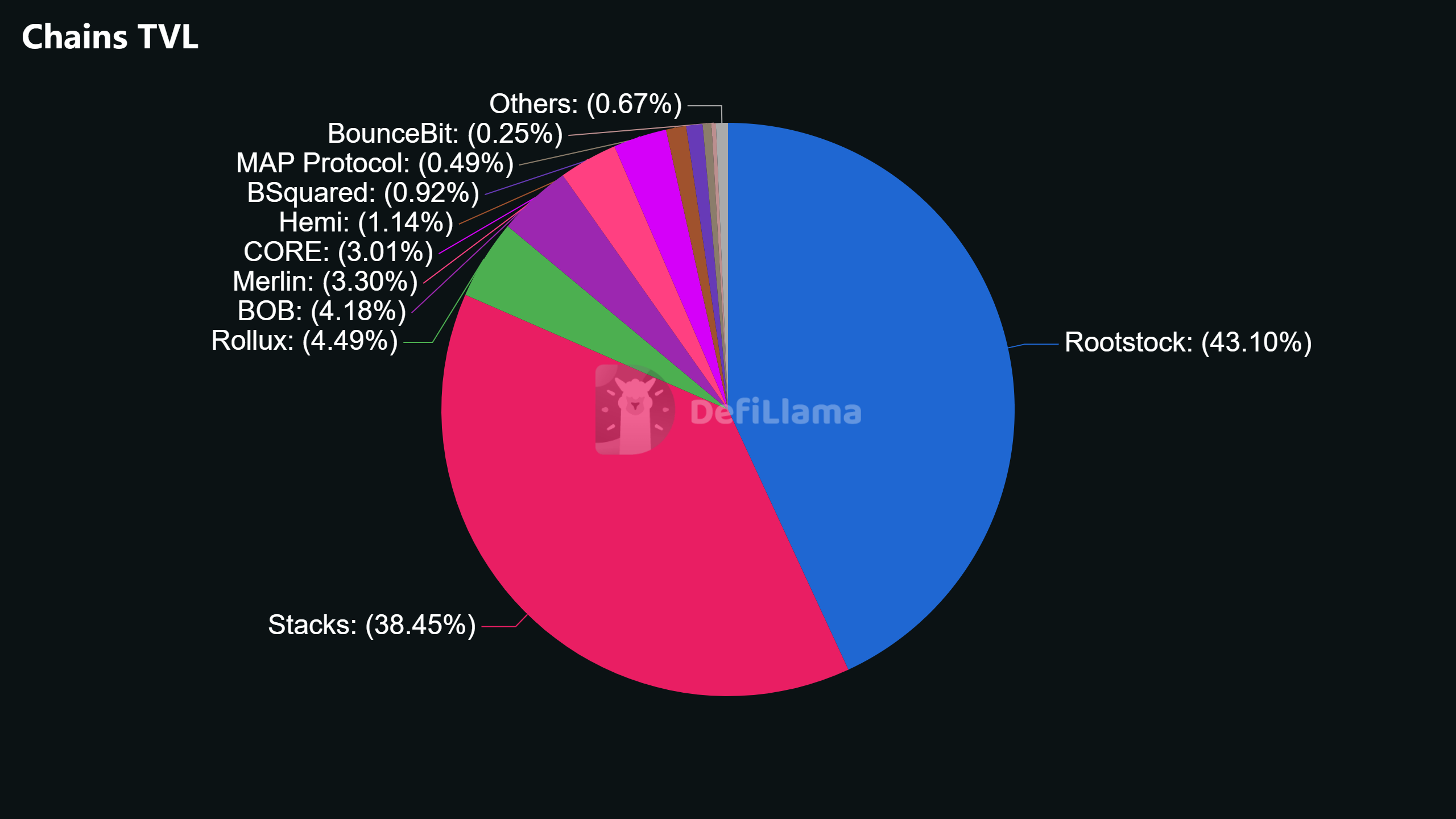
More than 40% of all Bitcoin DeFi activity now runs through Rootstock, he said, including real-world asset settlements and institutional vaults. Over the past year, he said, funds have started asking to deposit hundreds or even thousands of BTC at a time into Rootstock-based products; flows that were almost unheard of two or three years ago.
Chains TVL. Source: DeFiLlama
Orkun Mahir Kılıç, co-founder of Chainway Labs, which is behind Citrea, a Bitcoin-anchored rollup combining the Bitcoin Virtual Machine (BVM) and zero-knowledge proofs, argued that cloning EVM DeFi primitives onto Bitcoin is a dead end, and said that Botanix’s experience is a verdict on that model, rather than BTCFi itself.
Orkun Mahir Kılıç is co-founder of Chainway Labs, behind Citrea, a Bitcoin-anchored rollup that keeps user assets inside Bitcoin’s security perimeter and proves its state with zero-knowledge proofs. He argued that cloning EVM DeFi primitives onto Bitcoin is a dead end, and said that Botanix’s experience is a verdict on that model, rather than BTCFi itself.
He told Cointelegraph that “more secure” doesn’t change most people’s behavior.
“People don’t price counterparty risk until something breaks,” he said. ”Where it matters” is for institutions and large holders that need trust-minimized transactions with no custodian to fail.
“For everyone else, the reason to be here isn’t the security guarantee in the abstract; it’s the applications that don’t exist elsewhere.”
Magazine: Bitcoin will not hit $1M by 2030, says veteran trader Peter Brandt
Bitcoin’s (BTC) drop to $58,000 has pushed the price into a zone that long-term power-law models have historically associated with cycle bottoms. The data does not confirm a bottom range, though it shows BTC trading in a price range that has repeatedly marked major lows since 2014.
Derivatives data and liquidation levels highlight $55,000 as the next key support level and the $65,000-$68,000 range as the next major upside area of interest.
Bitcoin power-law puts $58,000 in historical range
Giovanni’s Bitcoin power-law model places the network’s long-term trend price near $135,000, making the recent drop to $58,000 roughly 54% below the all-time high and 1.22 standard deviations beneath that trend.
According to the analyst, the key takeaway is straightforward: the previous cycle lows in 2012, 2015, 2019, 2020, and 2022 all fell within a similar statistical range. By that measure, the latest decline falls within a territory that has historically marked the deep bear-market lows rather than a break in Bitcoin’s long-term growth path.
Bitcoin price deviation based on the power-law trend. Source: X
The model estimates the commonly referenced “-1σ” support near $68,000, while the stronger historical floor sits closer to $55,000. Giovanni also noted that Bitcoin would need to trade below roughly $17,000 for more than a year before the power-law itself could be considered invalid.
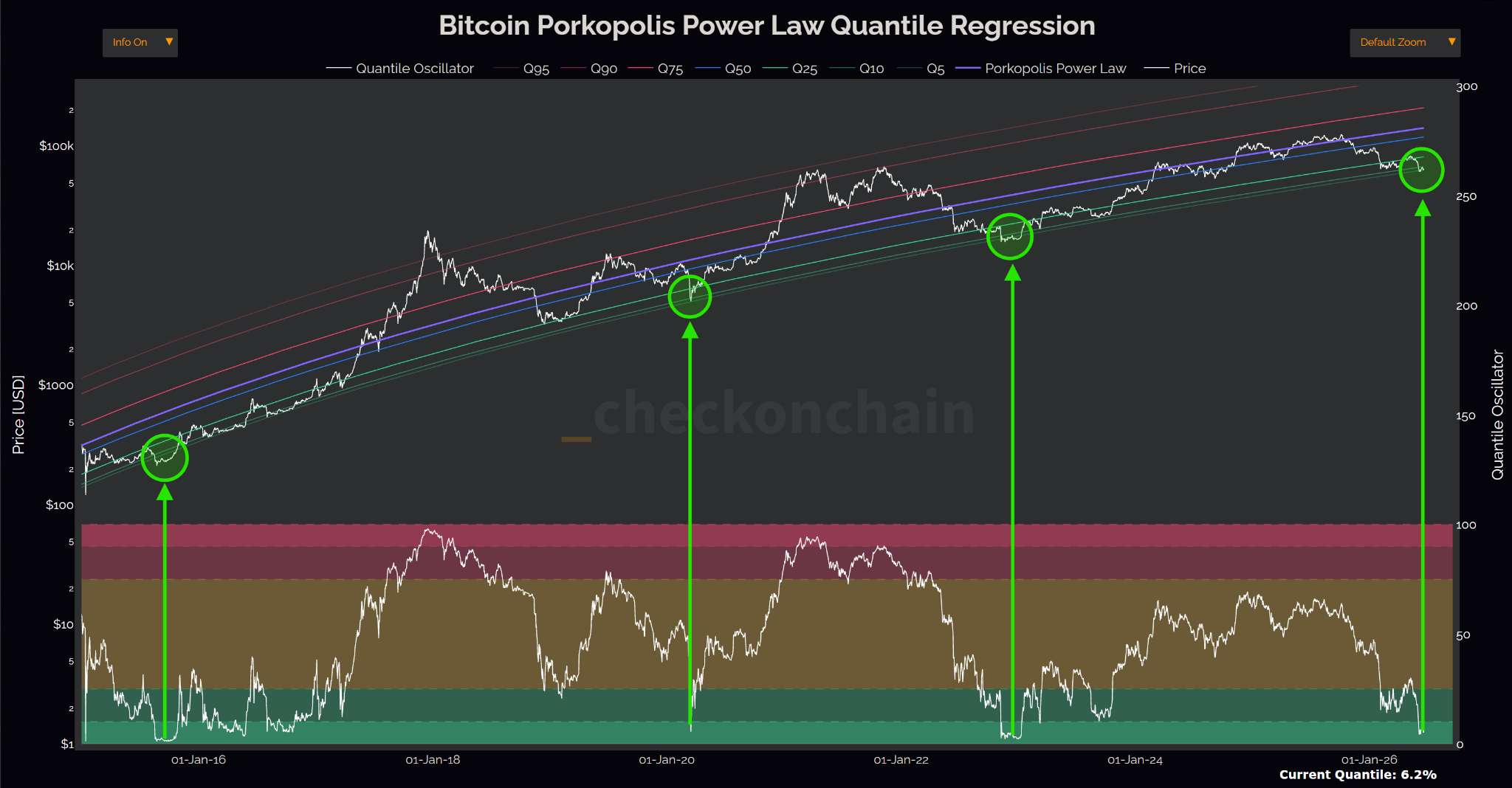
A second metric points in the same direction. Bitcoin’s power-law quantile has fallen to 6.2%, indicating the asset is cheaper than roughly 94% of its historical observations when measured against the power-law model. The chart highlights similar readings during the 2015, 2020, and 2023 cycle lows, with the current market now revisiting that historically rare valuation zone.
Related: Bitcoin drops to $58K on high US PCE inflation as trader sees ‘manipulation’
Key BTC price levels to watch
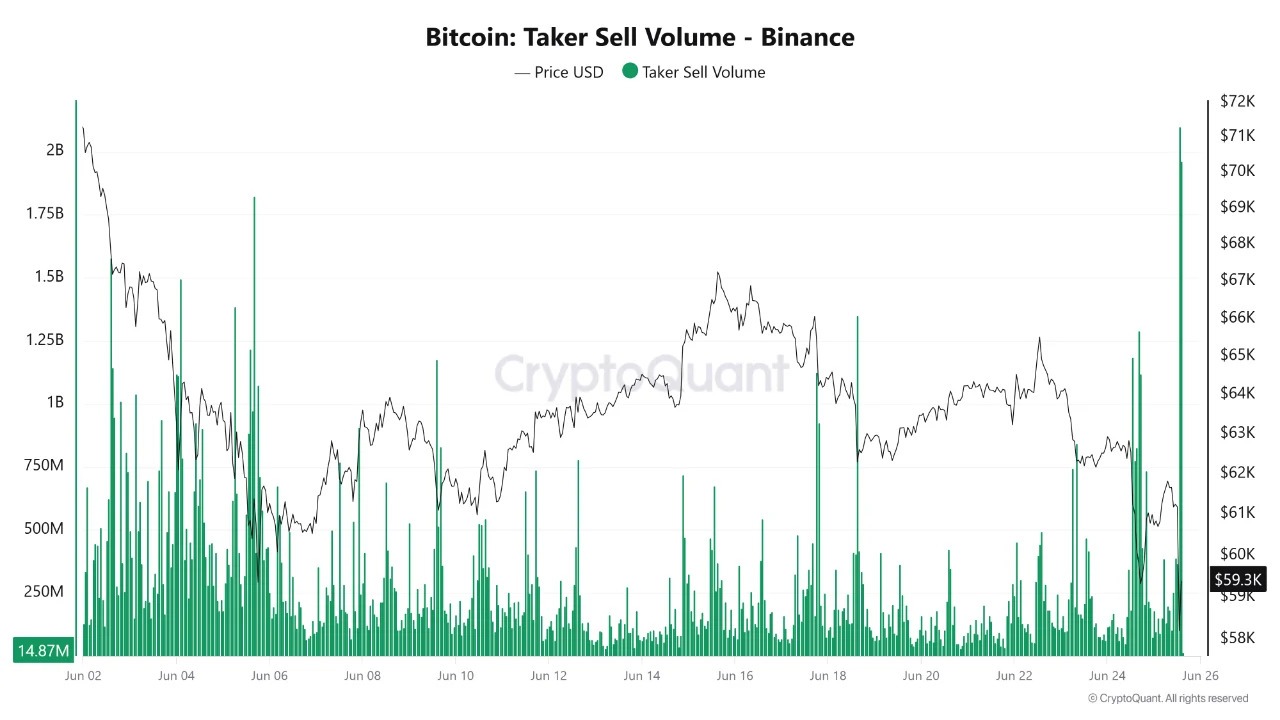
Bitcoin fell to a new yearly low of $58,000 after aggressive selling swept through Binance. The hourly taker sell volume reached $2.1 billion, followed by another $1.9 billion in the next hour after the New York market open, marking the exchange’s largest hourly sell pressure since May 4.
Bitcoin taker sell volume on Binance. Source: CryptoQuant
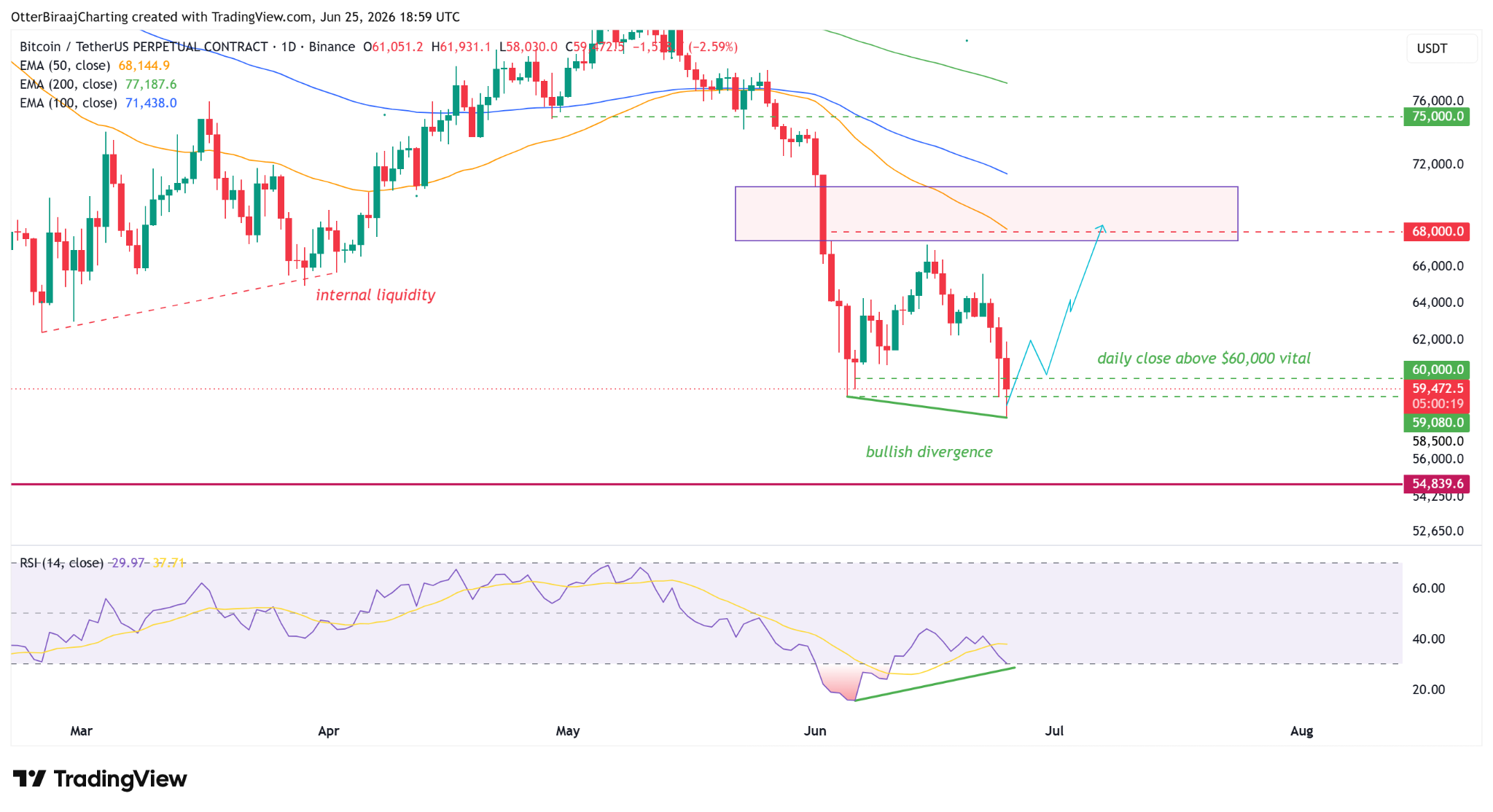
The flush liquidated more than $300 million in long BTC positions before the price rebounded toward $60,000. That level now carries added significance. A daily close back above $60,000 preserves the developing relative-strength index (RSI) bullish divergence across the one-hour, four-hour, and daily time frames which signals that selling momentum is fading even as the price prints lower lows.
Futures trader Byzantine General shared a similar outlook, saying the move to $58,000 cleared out leveraged longs while drawing in fresh short sellers. In his view, a daily close above $60,000 would strengthen the case that Bitcoin has printed a local bottom for now.
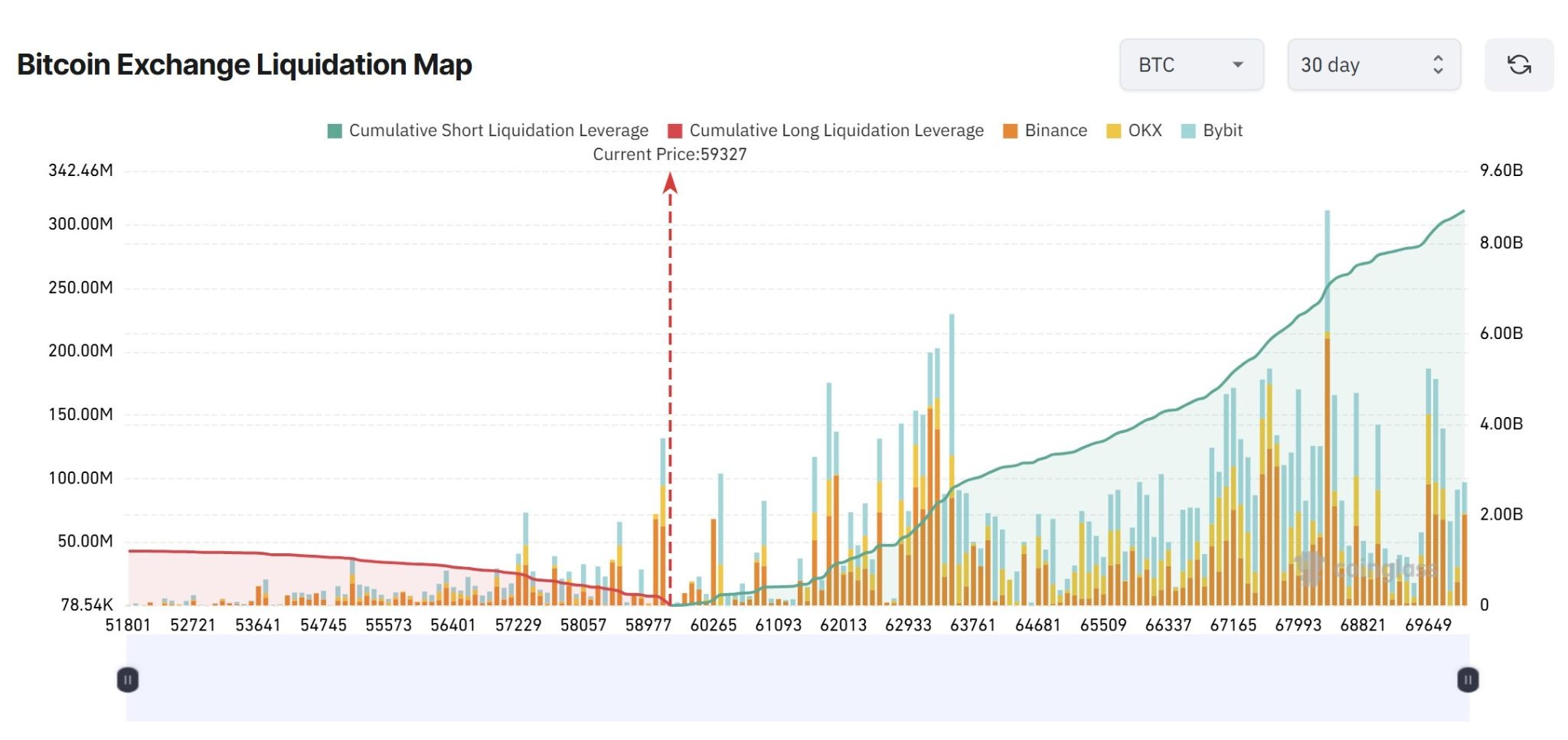
That would also shift attention toward a large pocket of upside liquidity. More than $4 billion in short liquidations cluster near $65,000, compared with about $1 billion below $55,000, creating a four-to-one imbalance. A relief rally could then target internal liquidity near $68,000, where a daily fair-value gap adds another area of interest for traders.
BTC liquidation map. Source: CoinGlass
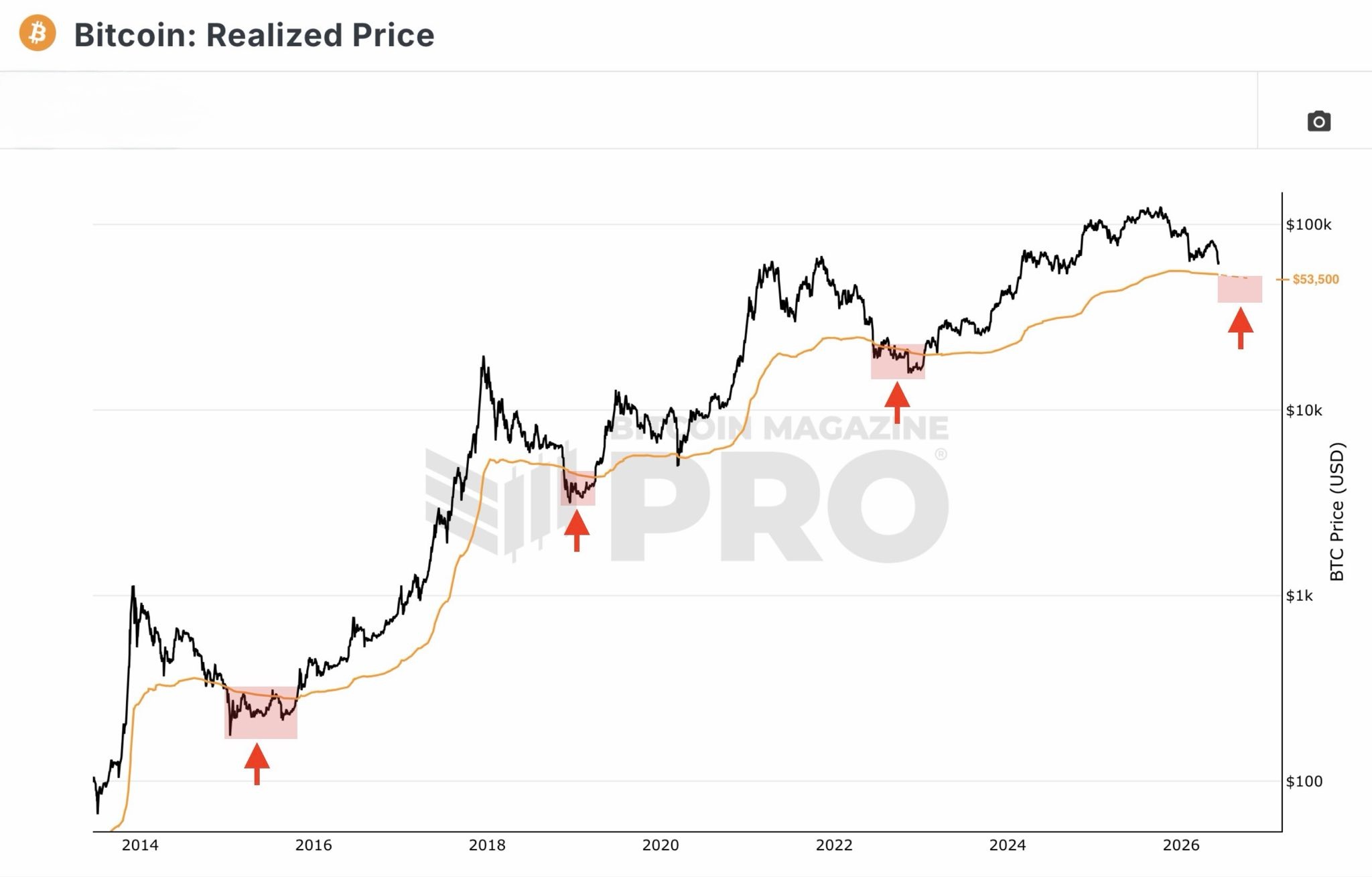
Meanwhile, a daily close below $60,000 reinforces the bearish bias on both the short-term and long-term charts. The next area of interest then shifts to $55,000, where Bitcoin’s September 2024 weekly range low converges with its realized price near $54,000.
The realized price, which tracks the average cost basis of all onchain coins, has historically provided support at every major Bitcoin bear-market bottom since 2014. That trend makes the $54,000-$55,000 region a key level for traders to watch if selling pressure continues.
Bitcoin’s realized price. Source: X
Related: Bitcoin drop to $58K brings out bears: Is BTC’s next stop below $50K?
South Korean cryptocurrency exchange Bithumb was order to pay a $136,000 fine after it was found to have breached personal information protections rules when it sent user data overseas.
In a Thursday notice, the country’s Personal Information Protection Commission (PIPC) said that its investigation into Bithumb found that the exchange had “transferred personal information overseas without the separate consent of the data subjects during the process of order book sharing and virtual asset transfer with overseas virtual asset exchanges.”
The incident was connected to Bithumb sharing its Tether (USDT) order books between September and November 2025 with BingX, despite obtaining consent to share the data with Stellar, as well as sharing user information with 13 overseas exchanges.
“The Personal Information Protection Commission determined that there is a necessity to provide personal information for anti-money laundering purposes when transferring virtual assets to other exchanges, but regarding the overseas transfer of personal information and the data subject’s right to self-determination, it was determined that, as this is a closely related matter, it is necessary to strictly comply with the requirements and procedures stipulated in the Protection Act,” the notice said, in translation.
Source: PIPC
One of the largest crypto exchanges in South Korea, Bithumb has been subject to intense scrutiny from authorities.
The country’s financial watchdog imposed a six-month suspension of the exchange’s activities in March over alleged violations of South Korea’s Financial Information Act, but a court reversed the decision in April. Earlier this month, police reportedly raided Bithumb’s offices as part of an investigation into alleged nepotism involving South Korean lawmaker Kim Byung-gi.
Related: SBI to acquire Bitbank in $289M deal creating Japan’s biggest crypto exchange
South Korean crypto tax set to take effect in 2027
South Korea’s Finance Ministry confirmed in May that a 22% tax on cryptocurrency gains would be imposed beginning in January 2027. The tax has faced several delays in implementation after initially expected to go into effect in 2025, but will likely affect many South Koreans who hold crypto.
According to the Yonhap news agency, about 16 million South Koreans were invested in digital assets as of March 2025.
Earlier this month, Chainalysis said that it signed a memorandum of understanding with the Korean National Police Agency (KNPA), aimed at building investigative capability within South Korea’s law enforcement.
One of the driving factors behind the pact is to better combat North Korea-linked crypto attacks, with South Korea’s police “at the forefront” of tackling these threats.
Magazine: Japanese pension fund tips 1% in crypto, G7 urges action on NK hackers: Asia Express