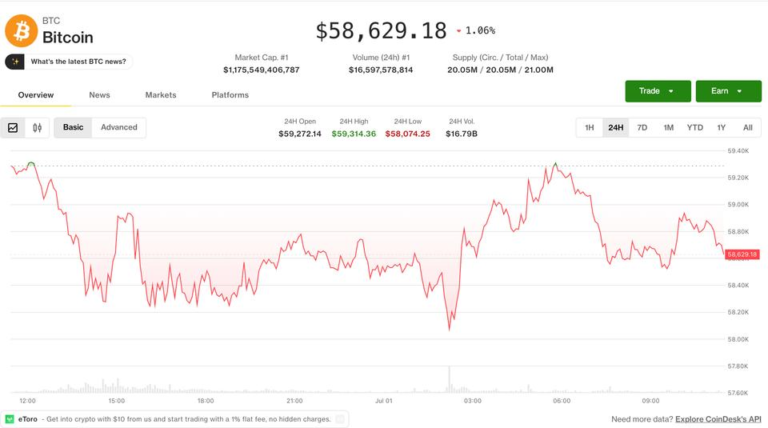
The comparison may indicate how much the U.S. crypto derivatives market could change over the next several years. While spot bitcoin ETFs opened the door for traditional investors to gain exposure to bitcoin through brokerage accounts, regulated perpetual futures could give both retail and institutional traders access to one of crypto’s most popular trading instruments without needing to use offshore venues.
Prediction market platform Kalshi, which launched U.S. perpetual futures last week, said on Wednesday that it already crossed $1 billion in trading volume.
Palmer argued that one reason perpetual futures became so successful outside the U.S. is their simplicity. Unlike dated futures, which require traders to manage expirations and contract rolls, perps allow positions to remain open indefinitely.
“I think it’s a simple derivative structure compared to some of the nuances of dealing with dated futures,” he said. “If I buy a June [future], then it expires, and if I want to keep my position on, I have to roll it.”
Kraken believes removing those complexities — and eventually allowing crypto assets to be used as collateral — could help bring U.S. traders closer to the experience available in international markets, he said.
For now, the company sees the launch of regulated perps as just the beginning. Despite crypto derivatives generating trillions of dollars in annual volume globally, Palmer said the U.S. market remains in its early stages.
Three major crypto exchanges canceled their tokenized SpaceX IPO allocation campaigns Friday after xStocks could not source underlying shares, while rival onchain protocols from Ondo, xStocks’ DeFi arm and Backpack launched successfully on the same morning.
Binance, Bybit and Bitget canceled their tokenized SpaceX IPO allocation campaigns Friday and refunded subscribers in full after xStocks, the tokenized-equity provider routing the deals, could not source the underlying shares — even as xStocks’ own onchain token and competing protocols brought SpaceX exposure live the same morning.
Bybit moved first. In a Friday notice, the exchange told subscribers that “due to xStocks’ inability to deliver the underlying assets, no SpaceX allocations were received,” and that it would return all subscription funds automatically. Binance followed with its own cancellation notice, citing “circumstances outside of our control” for the collapse of its Binance Wallet SPCXX campaign. Bitget also canceled and refunded.
Binance, the largest crypto exchange by trading volume, had drawn $557 million in onchain subscriptions for its SPCXX campaign ahead of the IPO. The exchange unwound the campaign with no allocations distributed.
Changpeng Zhao, Binance’s co-founder, posted Friday linking to the cancellation notice with a brief note: “Protect users when things don’t go as planned.” He offered no further detail on how the sourcing breakdown occurred.
xStocks Role
xStocks is a tokenized-equity provider that issues onchain tokens tracking the price of real shares; its assets had crossed $100 million on Ethereum and $30 million on BNB Chain in the weeks before the IPO.
xSrocks has its own DeFi token, SPCXx, is an onchain instrument that traded on decentralized exchanges from IPO morning. Separately, xStocks agreed to procure physical SpaceX shares and hand them to Binance, Bybit and Bitget, which packaged that supply into centralized IPO-allocation campaigns for their users.
The DeFi token launched as planned. The share-sourcing handoff to the three exchanges did not.
Kraken Rollout
Kraken, the US-based crypto exchange, split its launch across two products, and neither depended on the route that failed. Its US listing, SPCX, sources shares through Payward Securities, Kraken’s affiliated broker-dealer, and never touched xStocks. Its non-US offering, SPCXx, is the same xStocks DeFi token that traded everywhere else. Kraken posted Friday that “SpaceX has officially landed on Kraken,” with SPCX tradable in the U.S. and SPCXx available outside it.
The Onchain Launches Held
Three onchain protocols brought tokenized SpaceX exposure live on IPO morning. Ondo Finance, a tokenization protocol, posted that SPCXon went live on Ondo Global Markets across Solana, Ethereum and BNB Chain simultaneously, with the token swappable through 1inch, which announced the integration Friday. 1inch separately noted that xStocks’ SPCXx was live and swappable on its decentralized exchange.
On Solana, the Solana account posted that SPCX was live via Sunrise, issued by Backpack Securities, redeemable for an underlying SpaceX share and tradable around the clock. Pyth Network announced a live SPCX price feed for Pyth Pro users Friday morning.
Where the Delivery Broke Down
Ondo’s SPCXon, xStocks’ SPCXx and Backpack’s SPCX are onchain instruments linked directly to underlying shares or price feeds. Kraken’s US SPCX routes share procurement through its own broker-dealer.
The Binance, Bybit and Bitget campaigns were the only products that relied on xStocks to source physical shares from the IPO pipeline and deliver them to a centralized exchange. That handoff is where the failure sat.
The onchain tokens went live, the broker-dealer path went live, and only the share-sourcing route into the three exchanges broke down.
By the exchanges’ own accounts, the breakdown originated with xStocks. xStocks has made no public statement explaining why it could not deliver the shares.
To Be Sure
The cancellations do not point to a broad failure of tokenized equities. xStocks’ own token, Ondo’s and Backpack’s tokens, and Kraken’s broker-dealer listing all delivered SpaceX exposure on schedule.
The failure was confined to the centralized allocation model, which depends on an intermediary procuring real shares from the IPO and delivering them to an exchange, a step the purely onchain and broker-dealer paths skip.
The Defiant previewed the tokenized-equity stack on the eve of the IPO, and Bybit and Kraken had listed xStocks SpaceX derivatives in the pre-IPO run-up.
SpaceX began trading on the Nasdaq on Friday at a valuation of roughly $1.75 trillion. xStocks has not said whether it will attempt to source the shares again, and none of the three exchanges has indicated plans to relaunch its campaign.
Metaplanet Inc., Japan’s largest corporate Bitcoin holder, has entered into an agreement to acquire 100% of Siiibo Securities Co., Ltd. in a deal valued at approximately 2.1 billion yen, or roughly $13.1 million, the Tokyo-listed company announced on Friday, June 12.
The acquisition, expected to close on July 13, 2026, marks the first major transaction under “Project Nova” — Metaplanet’s medium- to long-term strategy to build a Bitcoin-centric financial platform in Japan. Following the close, Siiibo Securities will be renamed Metaplanet Securities Inc.
The deal gives Metaplanet something it has not held before: a Type I Financial Instruments Business Operator registration, the license required under Japanese law to structure and distribute financial products to retail investors.
That regulatory standing, combined with Siiibo’s existing customer base and online platform, positions the group to begin offering Bitcoin-linked investment products to individual Japanese investors.
Siiibo Securities was founded in January 2019 and operates an online platform for private placement corporate bonds — a market segment once reserved for institutional investors and high-net-worth individuals.
The company has backed more than 40 issuers and facilitated over 100 bond offerings, building one of the largest track records in Japan’s retail corporate bond space.
The strategic rationale for Metaplanet
Metaplanet held 40,177 BTC as of May 31, 2026, with a net asset value of 457.6 billion yen, making it the third-largest corporate Bitcoin holder in the world and the largest in Asia.
The company has spent the past two years accumulating Bitcoin as a treasury reserve asset, a strategy that has drawn comparisons to Strategy in the United States. Project Nova represents the next phase: converting that treasury into the backbone of a financial services business.
Simon Gerovich, Metaplanet’s President and CEO, framed the acquisition as a structural shift.
“We view Bitcoin not as a treasury reserve asset, but as the foundation of the next generation of financial ecosystems,” Gerovich said in the press release. “Siiibo Securities’ Type I Financial Instruments Business registration, corporate bond platform, and established customer base give us the tools to make that vision real.”
Metaplanet outlined four core synergies it expects from the deal. The company plans to distribute Siiibo’s existing bond products to its shareholder base of approximately 250,000 investors. It also intends to develop BTC-linked financial products — including BTC-linked bonds — for distribution through the Siiibo platform.
Joint underwriting of bond and digital securities issuances is planned in collaboration with Metaplanet Ventures Inc., with a focus on venture companies in cryptocurrency and decentralized finance.
A pilot program for security tokens and other digitized financial instruments is on the roadmap as well.
Kazuki Komura, CEO of Siiibo Securities, said the combination would enable capital formation structures not possible before.
“By combining the strengths of both companies in finance, technology, and community building, we believe we can create new forms of capital formation and investment experiences,” Komura said.
Metaplanet said it will fund the acquisition from cash on hand and borrowings, with the option to draw on Bitcoin-backed credit facilities that carry an aggregate borrowing capacity of up to $500 million.
I’ve been vocal about accumulating Bitcoin aggressively at current levels. Now I’m starting to look seriously at Strategy too. The same kind of confluence that flagged Bitcoin as a sizeable accumulation opportunity is appearing on MSTR, and in some cases, the readings are even more extreme.
This week at a glance:
The RSI has only been lower on a handful of occasions since Strategy adopted a Bitcoin standard.
The Mayer Multiple for MSTR has just reached the lower percentiles.
The BTC vs MSTR ratio is close to entering a zone that has historically preceded sustained MSTR outperformance.
At the previous Bitcoin all-time high with a 1x net asset value premium, the fair value of MSTR shares would be over $300.
Discount
Strategy currently holds approximately 845,000 BTC with an Average Cost Basis in the mid-$70,000s. That means, at current Bitcoin prices, they’re sitting at a pretty massive loss on their holdings.
Figure 1: Strategy’s Average BTC Cost Basis and other key metrics.
View Live Charts
This has coincided with the NAV dropping even deeper beneath 1.00x; with MSTR’s market cap currently sitting approximately 18% below the USD value of its Bitcoin holdings. In other words, buying MSTR at current prices is the equivalent of buying $1 of Bitcoin for $0.82.
Support
The 200-week moving average is usually pretty notable support for assets, especially those that typically trend to the upside. Strategy’s share price is currently sitting right on this level, the same level that has previously marked significant accumulation zones.
Figure 2: Strategy’s share price tests the 200-week moving average.
A sustained hold and reclaim of this level, combined with Bitcoin showing any upward momentum, historically sets up the conditions for meaningful MSTR recovery. The level is being tested. Whether it holds will be one of the key signals to watch over the coming weeks.
RSI
Since Strategy adopted a Bitcoin standard, the RSI for MSTR has only been lower on a handful of prior occasions, both during previous Bitcoin bear market cycle lows, when the share price was in the low teens. The current reading isn’t quite at those depths, but it’s approaching them, and the direction of travel is continuing downward.
Figure 3: MSTR’s RSI drops beneath 25. Historically, such levels have preceded price appreciation.
The Mayer Multiple, simply the ratio between MSTR’s closing price and its 200-day moving average, recently registered a reading where 99.2% of all prior data points were higher. That’s a historically extreme level of underperformance relative to its own moving average, and it’s occurred at broadly the same time as the RSI signal. Giving two independent momentum indicators, both flashing readings only seen at the most significant cycle lows in MSTR’s history.
MSTR Or BTC?
The ratio between Bitcoin’s price and MSTR’s share price is one of the cleaner ways to gauge whether exposure should be in Bitcoin directly or rotated toward the higher-beta proxy. When the ratio is in the green upper zone, MSTR has historically been positioned to outperform. When it’s in the red lower zone, Bitcoin tends to lead.
Figure 4: The BTCUSD/MSTR ratio is close to the green zone, a level that has previously preceded sustained MSTR outperformance.
The ratio is currently close to entering that green zone again. Previous instances of this were followed by extended periods of significant MSTR outperformance relative to Bitcoin. The ratio is also making lower highs on the long-term trend, indicating the general trajectory is shifting toward MSTR becoming increasingly favorable relative to direct Bitcoin exposure.
Fair Value
At the previous all-time high of around $126,000 and with no additional accumulation priced in, a 1x net asset value premium on MSTR would imply a share price of over $300. That’s roughly a 2.5x from current levels just to reach fair value at Bitcoin’s last peak.
Figure 5: MSTR price targets modeled across varying BTC holdings and NAV premium scenarios.
If MSTR continues accumulating toward the 900,000 BTC range and the NAV premium moves modestly higher toward 1.25x or 1.5x, well below the 3x+ levels seen in the previous cycle, the numbers become pretty enticing! Crucially, the MSTR dilution that drove bitcoin accumulation is increasingly being funded through STRC rather than common share issuance, reducing that particular headwind.
Where Are We?
I’ve been accumulating bitcoin aggressively. I’m now also looking to add more MSTR. The combination of extreme momentum readings, the 200-week moving average support, an implied discount to the underlying Bitcoin holdings, and the BTC vs MSTR ratio close to entering historically favorable territory makes this feel like a no-brainer for a short-term play to increase my own BTC stack.
That said, MSTR is a high-beta Bitcoin play. If Bitcoin continues to struggle, MSTR will struggle more. I’m not treating this as a replacement for Bitcoin exposure, but as an additional asymmetric position at a point where the data suggests the risk-reward is historically favorable.
For more data, charts, and insights into bitcoin price trends, visit BitcoinMagazinePro.com.
Subscribe to Bitcoin Magazine Pro on YouTube for more expert insights!
Disclaimer: This article is for informational purposes only and should not be considered financial advice. Always do your own research before making any investment decisions.
Ripple is trying to put XRP and RLUSD into the market for AI-agent payments in an environment that is still mostly paying in the dollar-pegged USDC stablecoin.
The company introduced the XRPL AI Starter Kit earlier this week, a set of developer tools for building AI agents that can send payments on the XRP Ledger, per a release shared with CoinDesk.
This kit includes XRPL documentation access through an MCP server (which connects a service’s AI tools to external data sources), Claude skills for wallet creation, balance checks and payments, and support for x402 payments using XRP and Ripple USD, Ripple’s dollar-backed stablecoin.
The pitch is that if AI agents are going to buy API access, pay for model inference, settle invoices or move value between services, they need payment rails that are cheap, fast and easy to trigger without a human clicking approve each time.
Ripple says XRPL can do that with three-to-five-second settlement, predictable fees, native payments, escrow, multisig and a built-in decentralized exchange.
But turning that into actual usage is where challenges lie, with the novel x402 system in focus.
Strategy also sold about 800,000 shares for $128 million through its at-the-market program in the same week. If the bitcoin sale did not matter, traders were left asking why it needed to happen at all.
One possible answer is the S&P 500.
Strategy met the technical requirements for index inclusion in September 2025 but was passed over. Some market commentators have argued that the company’s refusal to sell bitcoin could make it look more like an investment vehicle than a treasury company, which would hurt its chances. Selling a small amount of bitcoin may help Strategy show it can use BTC as a corporate treasury asset, not just hold it forever.
The market reaction was real, however, as bitcoin was already trading into weak risk appetite. Iran tensions had pushed oil higher and revived higher-for-longer rate worries. Tech stocks were under pressure. Bitcoin traded more like a high-beta Nasdaq proxy than an independent store-of-value trade.
But the rebound came from the same macro channel.
President Donald Trump said the U.S. had effectively ended the war with Iran, while officials pointed to progress toward a signed accord. Brent crude fell toward $85. Stocks rallied. SpaceX listed on Nasdaq on Friday and closed at $161, up 19% from its $135 offer price, giving risk traders another reason to step back in.
The government told Anthropic it had become aware of a method to bypass, or jailbreak, Fable 5. Anthropic reviewed the technique and said what it saw was narrow, not a universal jailbreak, and involved identifying a small number of previously known, minor vulnerabilities. It said other publicly available models, including OpenAI’s GPT-5.5, can find the same vulnerabilities without any bypass at all.
The company said the government has so far provided only verbal evidence of a potential narrow jailbreak, which it described as essentially asking the model to read a codebase and fix software flaws, a task defenders use every day.
It said applying this standard across the industry “would essentially halt all new model deployments for all frontier model providers.”
Anthropic built its entire brand around safety-first AI development, and it is now publicly disputing a national security directive on the grounds that the government’s evidence does not clear its own stated bar.
The company will share more details about the specific jailbreak within 24 hours.
The crypto market is now pricing the shutdown as a negative for the IPO case, and the Anthropic perp’s drop from its post-launch highs reflects that. The first question for the company’s public listing ambitions is whether the government’s order gets reversed, narrowed, or extended to other model classes once Anthropic publishes its technical rebuttal.
Coinbase Derivatives is moving its CFTC-registered gold and silver futures to around-the-clock trading effective Friday evening, the first time these US-regulated contracts will not close for weekends, with oil futures to follow.
Coinbase Derivatives is moving its US-regulated gold and silver futures to around-the-clock trading effective Friday evening, the first time these CFTC-registered contracts will not close for weekends.
Coinbase Institutional said Friday afternoon the US commodities futures market “just changed forever.” The main Coinbase account added that oil and more commodities will follow. Coinbase Derivatives, a CFTC-registered Designated Contract Market, lists gold futures at one troy ounce and silver futures at 50 troy ounces, accessible via a network of futures commission merchants and broker platforms including Interactive Brokers, Webull, and Wedbush.
The Market-Structure Shift
US commodity futures have long followed set trading-session windows that closed on weekends. Under the new schedule, traders will be able to respond to geopolitical developments, central bank announcements, and macro data releases that drop outside regular hours without waiting for Monday’s open.
The change arrives as a competing market operator moves in the same direction. CME Group announced Thursday that its 1-ounce gold futures on COMEX will move to 24/7 trading on July 26, and a new 10-barrel WTI crude oil contract will debut August 30 on a 24/7 schedule, pending regulatory approval. Both exchanges had already converted their crypto futures to round-the-clock trading; CME’s crypto switch drew 7,200 contracts in its first weekend.
Coinbase’s Broader Derivatives Push
Coinbase Derivatives processed more than $52 billion in notional volume across its traditional commodity futures in the first quarter of 2026, representing 7.6% of all contracts traded on the exchange that quarter. The platform launched oil and gold futures in June 2024 and later added silver. Earlier this month, Coinbase launched perpetual-style equity index futures in the US, continuing its push to list traditional assets alongside crypto under the “Everything Exchange” strategy it has flagged to investors.
The Crypto Connection
The US-listed gold and silver contracts on Coinbase Derivatives are dollar-settled traditional futures. The crypto tie-in runs through two parallel channels. First, Coinbase Derivatives and Nodal Clear are partnering to integrate USDC as collateral for US futures trading, pending CFTC approval, which would allow traders to post the dollar-pegged stablecoin as margin. Second, Coinbase’s International Exchange already offers GOLD-PERP and SILVER-PERP perpetual futures for eligible non-US traders, with both contracts settled in USDC. Coinbase and Circle co-founded USDC; USDC market cap stands near $75 billion, making it the second-largest stablecoin by supply.
One of Sam Bankman-Fried’s last credible paths to freedom closed Friday as a federal appeals court upheld his fraud conviction and 25-year prison sentence, ruling that the case against him was, in the court’s own words, “conservatively stated, robust.”
A three-judge panel of the Manhattan-based 2nd U.S. Circuit Court of Appeals handed down the 42-page opinion on June 12, rejecting every argument Sam Bankman-Fried’s legal team advanced to undo the November 2023 conviction that cemented one of the largest financial collapses in crypto history, according to Reuters.
At the heart of the appeal was a claim that the U.S. District Judge Lewis Kaplan had stripped Sam Bankman-Fried of a fair defense by barring evidence that FTX held enough assets to cover customer withdrawals.
Defense attorney Alexandra Shapiro told the appellate panel in November 2025 that “Mr. Bankman-Fried’s trial was fundamentally unfair because the jury only got to hear one side of the story.”
Prosecutors countered that Kaplan’s ruling was correct: fraud charges hinge on misappropriation, not on the possibility that assets could have covered liabilities under different circumstances. The appellate panel agreed, finding the trial court’s evidence rulings sound and the government’s case against Sam Bankman-Fried overwhelming.
How FTX Fell
The exchange, once valued at $32 billion, collapsed in November 2022 once it was exposed that the balance sheet of Alameda Research — Bankman-Fried’s affiliated hedge fund — was built on FTX’s own exchange token rather than independent assets. The disclosure triggered a customer run that ripped open an $8 billion hole in FTX’s accounts.
Three of Bankman-Fried’s former deputies — Alameda CEO Caroline Ellison, FTX co-founder Gary Wang, and engineering head Nishad Singh — each pleaded guilty and testified against him. Ellison, the trial’s star witness, told jurors Bankman-Fried gave her the instruction to divert customer deposits to Alameda to repay loans from crypto lenders. “Sam directed me to commit these crimes,” she said from the stand.
The court ordered an $11 billion forfeiture and three years of supervised release following Bankman-Fried’s March 2024 sentencing. Ellison received two years and was released in January 2026 after serving 14 months.
The appeals court ruling lands just weeks after Bankman-Fried also filed a formal clemency petition with the DOJ’s Office of the Pardon Attorney, requesting a presidential pardon from Donald Trump. The application is listed as a “pardon after completion of sentence” — not a commutation — and Trump has said publicly he will not grant it.
Judge Kaplan denied a separate Rule 33 new trial motion in April 2026, calling Bankman-Fried’s claim that witnesses had been threatened by the government “wildly conspiratorial and entirely contradicted by the record.” Bankman-Fried withdrew an earlier version of that motion on April 22 without prejudice.
With the 2nd Circuit now closed, his legal options narrow to a habeas petition — a route with a lower success rate than direct appeals — or a Supreme Court petition.
What’s next for Sam Bankman-Fried
Sam Bankman-Fried remains at a low-security federal prison near Santa Barbara, California, and is not eligible for release until 2044.
In a prison interview with Fox Business this month, he maintained his position: “I didn’t steal user funds.” He pointed to the FTX bankruptcy estate’s recovery of crypto assets, which have allowed the estate to pay creditors more than 100 cents on the dollar — a figure he frames as proof of FTX’s underlying solvency, though courts at every level have rejected that framing.
The Friday ruling closes the chapter on what federal prosecutors called a “fraud of epic proportions” — a case that shook institutional confidence in crypto markets, triggered congressional hearings, and forced exchanges across the industry to overhaul proof-of-reserves practices.
Back in January, President Donald Trump said he would not pardon former FTX CEO Sam Bankman-Fried, rejecting clemency for the convicted crypto executive.
Bitcoin does not have native yield. But that has not stopped institutions, treasury companies, miners, whales, ETFs, and crypto-native desks from looking for ways to generate returns on top of BTC.
In this episode of Converge by The Defiant, David Lawant, Head of Research at Anchorage Digital, joins the show to unpack the rise of Bitcoin options, synthetic yield, covered call strategies, and the growing intersection between TradFi and crypto-native market structure.
Podcast
🎧 Listen to Interview
💻 Watch Video
Subscribe now to level up on the convergence of DeFi / TradFi
A weekly news briefing and in-depth analysis on the highest-signal RWA, tokenization and stablecoin news.
Join 20k+ tokenization leaders and decision makers