Manny Rutinel, a Democratic candidate running to represent Colorado’s 8th congressional district, has won his party’s primary and will head to the November election after being supported by a crypto-aligned political action committee (PAC).
Early on Wednesday, Rutinel reported that he would be the Democratic nominee for Colorado’s 8th district, having won with 61.7% of the vote against Shannon Bird’s 33.6%. Before the primary, the You Can Push Back Super PAC, backed by $3.5 million from Ripple Labs co-founder Chris Larsen, reportedly spent $1 million on media to support Rutinel’s run.
The Colorado Democrat has a “strongly supports crypto” rating from the Coinbase-affiliated Stand With Crypto organization, based on his answers to questions about stablecoins, market structure and regulatory clarity. Coinbase is also a major contributor to the Fairshake PAC, which supports what it considers “pro-crypto” Democratic and Republican candidates for Congress.
Source: Stand With Crypto
On Tuesday, the consumer advocacy group Public Citizen reported that the cryptocurrency industry had spent about $189 million so far on contributions to influence the 2026 US elections, largely through PACs. In what some experts say is the industry repeating its 2024 strategy, crypto-aligned groups are expected to continue spending to elect what they consider “pro-crypto” politicians.
Related: Senate leaders push for July passage of CLARITY Act
Cointelegraph reached out to a spokesperson for You Can Push Back but did not receive an immediate response.
Poll shows Americans think crypto has too much influence in Washington, DC
A new poll commissioned by Americans for Financial Reform released on Wednesday showed that a majority of Americans are concerned about the influence the crypto industry has on US lawmakers. The results followed financial disclosures showing that US President Donald Trump profited by more than $1.4 billion from his crypto investments.
“Voters have seen serious crypto corruption and high ranking government officials raking in profits while everyday people experience crypto-fueled losses and scams,” said Mark Hays, the associate director of crypto and fintech at Americans for Financial Reform. “Voters want crypto to have to play by the same kinds of rules as other financial companies, not dictate special privileges for itself.”
White House Deputy Press Secretary Anna Kelly said on Tuesday that neither Trump nor his family “has ever engaged — or will ever engage — in conflicts of interest.”
Among the poll’s results included a majority of Democrats, Republicans and Independents being concerned about crypto-related laws being influenced by donations from those in the industry. Americans for Financial Reform concluded that voters were likely to agree that the crypto industry needs sensible regulation.
Magazine: The end of anonymity? AI could unmask crypto’s hidden identities
Erik Voorhees’ privacy-first AI platform Venice landed a $65 million Series A at a $1 billion equity valuation, its first outside capital, after hitting profitability in Q1.
Venice, a privacy-first AI platform founded by Erik Voorhees, raised a $65 million Series A at a $1 billion equity valuation in a round led by Dragonfly. It is the company’s first outside capital since launching.
Voorhees announced the round Wednesday morning, saying Venice hit profitability in the first quarter and has become, by revenue, the largest company at the intersection of AI and cryptoeconomics. TechCrunch reported the raise makes Venice a unicorn. Coinbase CEO Brian Armstrong called Venice “important infrastructure for freedom.”
Equity Over Token
Venice chose to sell equity rather than tap its treasury of VVV, the platform’s native token, which is up 11.6% over the past 24 hours to $13.80, according to CoinGecko. Voorhees said the company holds more than 30 million of the roughly 80 million VVV in circulation and has not sold any tokens to date.
Series A investors received 8.98% of the company, a vesting grant of 1.5 million VVV, and an option to buy another 5 million VVV over the next eight years. Exercising that option would require investors to pay Venice an additional $66.5 million, bringing total potential proceeds to $131.5 million.
Funding the Buildout
Venice plans to use the capital to build out its own datacenters, the first time the company will own compute infrastructure rather than renting it. Voorhees said the move ensures capacity in a coming resource squeeze and increases gross margins, making room for larger revenue-funded token burns.
The rest will go toward customer growth, new markets, acquisitions and hiring as Venice pushes to become, in Voorhees’ words, “the port city for agentic civilization.”
Any VVV granted or optioned to investors is locked for a year and unlocks linearly over three additional years, meaning tokens would not reach the market until roughly two years after Venice’s token launch. Voorhees said the resulting supply release, if the full warrant is exercised, would run just under 6,000 VVV per day, about 0.2% of current daily trading volume.
The deal caps an 18-month run in which VVV traded openly before Venice brought in outside capital, a sequencing Voorhees framed as the reverse of the typical pre-sale model used by most crypto projects.
To support its case, the report highlighted Ethereum’s technical track record, noting that the network has maintained uninterrupted uptime since launching in 2015. Citing a recent OpenZeppelin report, the foundation said Ethereum was secured by roughly $76 billion worth of staked ETH as of March 2026, while emphasizing its geographically distributed validator network, multiple independent client implementations and large developer ecosystem.
Beyond technical metrics, the report framed Ethereum as digital public infrastructure rather than simply a financial network. It pointed to existing deployments, including decentralized identity initiatives in Bhutan and Buenos Aires and Ethereum-based land registry projects in India, as examples of governments already experimenting with the technology.
The publication comes as governments around the world increasingly explore blockchain-based infrastructure for identity, asset tokenization and public records. The Ethereum Foundation said policymakers should distinguish between decentralized public blockchains and networks that remain controlled by corporations or foundations, arguing that governance structures will play a critical role in determining which platforms are suitable for long-term public sector use.
Read more: Ethereum gets a new nonprofit focused on institutional adoption
Its launch comes as Ethereum’s support ecosystem undergoes a broader evolution, following the debut of EthLabs and amid ongoing efforts by the Ethereum Foundation to respond to community criticism over transparency, communication and its role within the ecosystem by encouraging more independent organizations to take the lead on adoption and ecosystem growth.
Vivek Raman, CEO of Etherealize, said on X that Ethereum Institutional is another example of Ethereum’s decentralized model in action.
“Ethereum is not built by or run by a single organization,” Raman wrote. “Ethereum is a network of independent nodes that collectively make the infrastructure inevitable. Ethereum Institutional will play a key role in amplifying and growing Ethereum. Could not be more excited for this launch.”
Joe Andrews, CEO of privacy developer firm Aztec Labs, told CoinDesk that the launch reflects the continued decentralization of Ethereum’s support ecosystem rather than the emergence of a single voice.
“Over the last two weeks, the Ethereum community has further added to the decentralisation of the network,” he said. “There are now three non-profits all advocating for adoption of Ethereum. It is natural that one of these entities is focusing on institutions, as the world needs a global settlement layer and Ethereum is the only credible option.”
Solana Foundation says onchain governance is now live, letting validators with at least 100,000 SOL delegated open proposals that go to a stake-weighted vote once they clear 15% cluster support.
Solana Foundation announced Wednesday that onchain governance is live on the network, letting validators propose and vote on protocol-level decisions through a system called Solana Governance Proposals, or SGPs.
The mechanism is fully onchain, stake-weighted and verified by Merkle proof, according to the Foundation’s announcement thread. Any validator with at least 100,000 SOL delegated can open a proposal, and a proposal only opens for a vote once it clears 15% of cluster stake support. Delegators who disagree with how their validator voted, or whose validator did not vote at all, can override that vote using their own stake weight.
Merkle-Verified Votes
The system runs on two onchain programs described in the project’s technical documentation: an NCN, or Node Consensus Network, snapshot program that establishes verifiable stake weights, and a voting program called svmgov. Whitelisted operators independently build Merkle trees of validator stake from the Solana ledger and vote on a canonical snapshot. Once they agree, a consensus result publishes onchain, and validators prove their stake weight against it with a Merkle proof when they vote.
The two onchain programs are deployed as `ncn-snapshot` and `svmgov`, according to the governance documentation, with the snapshot program building the canonical stake tree that the voting program checks against for every ballot cast.
SGPs Versus SIMDs
SGPs sit apart from Solana Improvement Documents, or SIMDs, the process core developers already use for technical protocol changes. Per the solana-governance-proposals repository, a SIMD answers “how exactly do we do this,” decided by technical review from core developers, while an SGP answers “should we do this,” decided by a stake-weighted onchain vote. By default, decision-making stays with core developers and the SIMD process; an SGP interrupts that path only when the 15% stake-support threshold is met, and does not block a SIMD from moving forward on its own.
The Foundation pointed validators and delegators to the governance dashboard, documentation and the svmgov codebase to start participating.
The launch follows a run of Solana Foundation initiatives aimed at institutional and validator participation, including a native payments rail for subscriptions and allowances and MoneyGram joining the network as a validator.
SPOILER ALERT: Jeff Booth does not know what the world will look like in 2036.
I know, I know… You probably wanted to hear from Jeff — author of The Price of Tomorrow and someone with incredible foresight and vision — that all eight billion of us would be living in the type of abundance he often talks about on podcasts.
You likely wanted to read that Jeff foresees Bitcoin replacing fiat by 2036 and that we’ll all be able to just kick back and relax as we enjoy living in a deflationary system by then.
I, too, was slightly disappointed when he didn’t paint a picture of a Bitcoin-fueled utopia that will exist a decade from now.
That said, in true Jeff Booth fashion, he offered some perspective that was perhaps even more profound than expected:
“It can exist for them right this second,” said Jeff in regard to when people can begin to reap the benefits of existing in a Bitcoin-buoyed system. “The question is ‘Do people move their time and energy to this new system?’”
Leave it to Jeff, someone who I often refer to as the Eckhart Tolle (author of The Power of Now) of Bitcoin to remind us that we don’t have wait for a day in the far off future when Bitcoin has transformed the world, we can begin to use right now it to transform our own personal world and the worlds of those with whom we engage.
“We are the change,” said Jeff. “We always have been.”
There’s just one caveat to Jeff’s message, though…
To fully experience the benefits that Bitcoin offers, we cannot simply view it as another asset within a broken system, we have to see it for what it actually is: a protocol.
Bitcoin As A Protocol
According to Jeff, seeing Bitcoin as anything but a protocol will not only result in our not fully benefitting from it, but ultimately in the failure of the protocol itself.
That’s a lot, I know.
Let’s unpack it.
When Jeff looks out at the world, he sees a spectrum of Bitcoin enthusiasts — and, of course, those who will continue to simply dismiss Bitcoin.
The latter will resume focusing their efforts on trying to reform the broken and insolvent system that continues to steal their time and wealth while consistently blaming the powers that be for their lot in life, further handing over their power to those actors in the process.
If you’re reading this article, you’re likely not one of those types. You, instead, exist somewhere on a spectrum of Bitcoin understanding that Jeff has conceptualized.
On one side of that spectrum are those who take risky bets with bitcoin or even with other crypto assets in efforts to get rich quickly. This type lends much of their energy to searching for the next scheme to trade. Very few in this world win big and almost all lose over a longer time horizon.
One level up from that are those who see bitcoin as a store of value. The problem with this perspective is that the asset is trapped within the broken monetary and financial systems instead of replacing them. If bitcoin only remains a store of value, its ownership will continue to centralize over time, leading to a Bitcoin elite, a new breed of kings, as opposed to a world in which all human beings benefit from bitcoin. This scenario will also lead to continued issues with Bitcoin custodians.
“If we continue to have a debt-based system on top of bitcoin, bitcoin will continue to be held by custodians who will get liquidated time and time again as they take risks with their customers’ bitcoin,” said Jeff. “It’ll look like Celsius and BlockFi over and over and over again.”
Finally, there are those who see Bitcoin as a protocol.
They understand that Bitcoin emerges in layers, each of them enabling it to be used more easily and privately as money. It’s those for whom Bitcoin will serve as a true catalyst.
“It’s only if you view Bitcoin through the protocol lens that the world will change for you,” said Jeff.
“Every single other one of those perspectives relies on ‘It’s somebody else, not me.’ But the last one says ‘I create the future from my intention,’” he added.
“So, when we think about 2036, the real question is ‘How many people realize that they have the agency to change the world?’”
While this may seem like a relatively easy question to answer for oneself, it becomes more challenging when considering that we exist in a world that is constantly trying to distract us from what Bitcoin truly is.
Don’t Get Caught
From flavor of the month FUD to hero worship, it’s easy to give up your power.
“People often give their agency away to the likes of those who spread fear around quantum computing breaking Bitcoin or to those talking about how Jeffrey Epstein tried to infiltrate Bitcoin Core,” said Jeff.
Much of the Core vs. Knots debate was also driven by fear, which also siphoned people’s power, according to Jeff. With regard to this particular issue, Jeff noticed the name calling and ad hominem attacks, but opted not to contribute to the drama. Instead, he simply saw it as a signal that the issue was worth investigating. He believes that the debate offered people an important opportunity to fight for what they want Bitcoin to be.
“We’re used to seeing only a small part of consensus and not seeing views that are outside of it,” said Jeff. “The consensus mechanism and the agency of all participants fighting for what they see bitcoin as allows each person to see the entire debate and make their choice of what bitcoin is to them.”
Jeff went on to say that instead of being driven by fear and blindly digging in with one side or the other in such debates, it’s important to look inward at these times. Both doing so and advocating for what you want Bitcoin to be is ultimately how the protocol stays safe in his eyes.
“If there are enough hypervigilant people focused on the issues, Bitcoin stays secure,” said Jeff. “If there are enough people building on this and they are all hypervigilant as they build, it stays decentralized.”
Bitcoin enthusiasts also give away their agency to figures in the Bitcoin space who convince them that bitcoin is nothing more than a store of value — digital capital, if you will — according to Jeff.
“If you talk about digital capital and digital assets or building a debt-based system on top of Bitcoin, you aren’t viewing Bitcoin as a protocol,” explained Jeff. “Building a debt-based system on top of Bitcoin is centralizing, which isn’t good for Bitcoin. If you’re trying to concentrate bitcoin and become a new king, then both Bitcoin and the game you’re playing will ultimately fail.”
Jeff attributes the fact that some aren’t able to see how building a system that resembles the system Bitcoin was designed to replace is ultimately doomed to the notion that many are trapped in old mental models. In other words, we often bring our baggage from the old system into this new one. Those who see Bitcoin as a protocol, those using it as money in Bitcoin circular economies on a day-to-day basis, fundamentally understand Bitcoin through a different lens. They intuitively know that every choice, want, and need is a choice to distribute value or give value. And as bitcoin becomes more ubiquitous as money, then those playing financial games with bitcoin will ultimately be forced to give up their coins.
“You can try to create debt on top of bitcoin, but, eventually, as Bitcoin adoption increases, prices will begin falling so fast that those trying to centralize Bitcoin will have to figure out a way to deliver value to society in excess of what they’re spending to pay back and service their debt, which they won’t be able to do, forcing them to distribute their bitcoin,” said Jeff.
In short, Bitcoin inevitably liquidates those playing a zero-sum game; therefore, according to Jeff, it’s best to focus on what you’re doing to provide value to the world rather than focusing on how prominent figures in the Bitcoin space are rebuilding the same type of debt-based system that we’re trying to escape on top of bitcoin.
Why Bitcoin Remains Decentralized and Secure
For this issue, the editorial staff and writers involved have presupposed that Bitcoin is still sufficiently decentralized and secure come 2036. The truth is, though, as Jeff points out, if we all don’t claim our own power and embrace Bitcoin as a protocol, then it centralizes and fails.
Put another way, Bitcoin is not inevitable.
Yet, at the same time, Jeff is all but 100% convinced that Bitcoin does, in fact, succeed.
Why is that? you might ask.
Well, to use Jeff’s own words, he believes that Bitcoin will win because he “believes in us.”
Now, I know what you might be thinking: How could Jeff believe in us?… I mean, has he seen all the pleb slop out there? Has he seen how quickly many have been to abandon their Bitcoin vision and morals in pursuit of fiat gains? And does he think we’re all as good at thinking for ourselves as he is?
While I didn’t ask Jeff those questions, I’d imagine his answers to the second and third ones are “yes” and that he’s too humble to even respond to the final one. And as for the first question, he answered it without my posing it to him directly.
“As time goes on, more and more people discover what Bitcoin truly is, and each of them begins to move their agency into this space,” he explained. “In the process, people discover that their agency matters and that they can bend reality to their will. And when we share different thoughts about Bitcoin with others, it opens people’s minds, further causing them to shift their time and energy. I’m so positive that Bitcoin succeeds because I believe in the best in us, and I’ve already seen so many people move their time into this space and how that has had such a positive impact on them.”
Still, Jeff, c’mon! Most of us are still simply trying to convince our friends and family members that Bitcoin isn’t a scam, much less something that they should be moving their time and energy into. Even the idea of moving one’s time and energy into Bitcoin seems like an abstract and foreign concept to most people today.
Jeff gets that, too. And so he offered a caveat:
“Not everybody has to move their time — only a small fraction do.”
Now, given that my intention in writing this piece isn’t simply to help share Jeff’s perspective but to encourage you to embrace your own agency and power, I’m not going to share how much that small fraction is composed of in Jeff’s mind. Doing so might put you back into the mindset you may have had before you started reading this piece, the “Bitcoin is inevitable, and my efforts mean nothing in regard to its success or failure” mindset. Since that’s neither productive nor empowering, let’s not go there. The point is that Jeff believes that there are enough of us out there who will “hold the line and fight for freedom” as we work to maintain what he terms “the honest chain.”
“__% of people will cheat and go back to the dishonest chain,” said Jeff. “They’ll tell themselves ‘I needed to do it for my family.’ Deep down, they won’t have wanted to move to the dishonest chain, but they will feel that the consequences of not doing so were just too great. So, they’ll take the bribe. They’ll tell themselves ‘If not me, somebody else will do it, and I have to do it, too.”
Though that remaining percentage of people who support the honest chain may be small, it will be more than enough to have the balance of most people eventually move with them, according to Jeff.
“That small group forces a foundation from which others can benefit,” said Jeff.
A beautiful dimension of Bitcoin is that it’s a group, as opposed to a single figure, that keeps the network safe. And what shields this group is that Bitcoin enables them to remain anonymous. This can be contrasted with public leaders or religious figures who’ve challenged power and been martyred for it.
“Those leaders and religious figures had to be killed because they were open and very dangerous to the system of power,” said Jeff. “Now, those who want to stand up for what’s right no matter what to keep Bitcoin protected can do so because privacy is built into its layers. If this fight were occurring in the open, the intransigent minority, those who want to stand up for what is right, would be knocked off in time; it would be too dangerous for them to stand up.”
In this light, Bitcoin could be viewed as the greatest tool for human liberation we’ve ever seen. And the most exciting part is, we may have all of the components we need to scale it securely and in a manner that offers people transactional privacy.
Scaling Bitcoin: We May Already Have All We Need
Given how often Jeff refers to scaling Bitcoin in layers, I asked him how many layers he envisions Bitcoin having by 2036, anticipating that he had some ideas for layers that few of us could have yet conceptualized.
To my surprise, his answer to my question was direct: “I think we have almost everything already.”
(LFG.)
“We have Bitcoin, composed of energy, mining, and the consensus rules,” began Jeff. “Next, we have Lightning, Liquid, Ark, etc. This is the transport layer where you can now transport value instantly at very fast speeds. On top of or integrated with that, you have fedimints for ecash, the privacy layer. We also have Nostr, the identity layer, web of trust, and privacy layer. And that might be all we require. Everything there is enough to enable all applications to take part in the first global free market that’s ever existed.”
But what about a capital markets layer? Will we see tokenized assets on a Bitcoin layer by 2036, or at any point in the future for that matter?
According to Jeff, that’s a hard “no.”
“Tokenization is part of the fiat scam,” said Jeff. “The idea with tokenization is that people are going to take more assets and drive more money into those assets. In the world I’m talking about, you don’t need tokenization because the protocol preserves value for you — everything is priced in prices that are falling.”
According to Jeff, tokenized assets, whether on traditional ledgers (e.g., brokerage accounts) and on blockchains, are part of the current system, which is extractive. In a world underpinned by bitcoin, people won’t need to rely on tokenized assets to preserve their wealth.
“In this new world, capital markets get way smaller,” said Jeff. “In 1900, capital markets only made up about 1% of the economy, and now it’s closer to 40%. Tokenization helps the extractive economy carry on; it becomes unnecessary in a world in which Bitcoin succeeds as a protocol.”
Jeff contextualized his point by describing how he and the team at ego death capital, the Bitcoin venture capital firm that he co-founded, think about making investments in a world where bitcoin continues to appreciate in value.
“At ego death, we deploy risk capital where we think we can exceed a 45% IRR (internal rate of return),” Jeff explained. (Bitcoin’s IRR over the past 15 years is approximately 45%.) “Most startups don’t get funded with debt. Family and friends typically fund startups and what they’re doing is saying ‘I believe you can do this,’ while not necessarily considering the fact that most startups fail because it’s so hard to create value in the free market. Investors only come in when they see a startup starting to win and when they think a business will provide tons of value moving forward.”
And most investors in public markets today are only investing because fiat currencies are losing value at such an alarming rate. In a world that’s on a bitcoin standard, speculating in markets as a means to preserve value is no longer necessary.
Start Today
Each of our actions in this Bitcoin space have power.
They are helping to chart a course in which, by 2036, there will be exponentially more of us reaping the benefits of living on a bitcoin standard.
While that future surely isn’t promised, Jeff feels confident that we’re on the right path.
“Our future is created by these collisions of us talking to each other, learning from one another, and expanding our knowledge to other people,” he explained.
Plus, the longer Jeff works with and invests in high-integrity builders in the Bitcoin space, the more confident he feels that Bitcoin remains decentralized and secure, as it must for it to succeed.
With that said, Jeff understands that many will sell out as the fight continues to be brought to Bitcoin’s doorstep, which is why he says that we should feel free to “slay our heroes.” Instead, he believes, we should look within ourselves for answers.
The Bitcoin story isn’t one of looking out to or up to; it’s one of looking inward and embracing responsibility and critical thinking, both of which are necessary in pursuit of increased personal power and agency.
If we want a world transformed by Bitcoin in 2036, we have to start by making the essential personal transformations and moving more of our time and energy into Bitcoin today.
Don’t miss your chance to own The 2036 Issue — featuring articles written by many influential figures in the space pondering the challenges of the next decade!
This piece is featured in the latest Print edition of Bitcoin Magazine, The 2036 Issue. We’re sharing it here as an early look at the ideas explored throughout the full issue.
Current global shifts clearly signal a critical need for shared, neutral digital public infrastructure outside the control of any single centralized actor. As a public, programmable network designed to operate without reliance on any single party, Ethereum was built to address precisely these needs.
Today, the Ethereum Foundation Global Policy Strategy (GPS) team is publishing “Ethereum for Governments and Institutions”, a guide for public sector and institutional leaders facing policy and deployment decisions. The report is a non-technical primer covering how Ethereum works, how it is governed, how it compares with perceived alternatives, and where it is already being deployed. This post introduces the report and answers the core questions that motivated its development: why digital infrastructure needs to be neutral and why Ethereum is suited for the role.
Why we need neutral digital infrastructure
The digital systems that underpin modern economies, including payments, identity, registries, and institutional record-keeping are fragmented, proprietary, and in the hands of a small number of intermediaries.
Using these systems creates single points of failure, concentrating operational risk. A cyberattack, regional outage, or natural disaster affecting the centralized operator can take down the entire system at once.
Using these systems also requires trusting these intermediaries and accepting their rules. Whether by choice or under external pressure, these intermediaries retain the power to unilaterally remove participants and alter previously agreed rules. What happens when an operator can no longer be trusted? When counterparties clash over whose rules apply?
These risks multiply as more value gets put online, and as such, cracks in our digital foundation are widening. In recent years, we have experienced increasing instances of cloud outages taking down government services, financial systems weaponized across borders, and major identity providers breached resulting in invasions of personal privacy, and major losses in business confidence. This is not a series of isolated anomalies; it is the baseline reality for infrastructure tied to centralized control.
Patching the existing fragile foundation with better rules will not correct the issues. The only real answer is credibly neutral infrastructure where the protocol itself enforces the rules, free from human discretion or external pressure, this is what Ethereum was built for.
This report serves as a comprehensive primer on Ethereum and the broader blockchain landscape. Crafted for governments and institutions evaluating digital infrastructure, it provides the objective and rigorous analysis that high-stakes decisions demand.
Evaluating blockchains by objective metrics
Blockchains exist on a wide spectrum, varying fundamentally in their technical architecture and governance structures. At one end of the spectrum sit truly decentralized protocols. These are open, ownerless, and operate like other public infrastructure that everyone uses, but no one controls, like the internet. At the other end, sit blockchains that are effectively corporate products, controlled by a company or small group of insiders who set the rules. These products can fail the way companies fail and the insiders should bear responsibility if things go wrong. This distinction carries profound implications for policymakers and regulators. A blockchain’s structure will determine whether it can serve as credibly neutral public infrastructure for decades to come, or whether it must be treated like a corporate product with inherent accountability and systemic risks.
One of the key objectives of this report is to educate governments and institutions about factors that are critical to consider before making policy decisions or deploying products on blockchains. Some key differences between layer one blockchains were identified in a recently published OpenZeppelin Report, here are a few points noted about Ethereum (all data is as of March 2026, except where otherwise stated):
Uptime and resilience: Ethereum has maintained uninterrupted uptime since its launch in 2015 and has been extensively battle-tested. All other blockchains in the report have had between one and seven outages, including a 19-hour halt on one major blockchain in 2023. Outages have also continuously occurred across centralized internet services, Ethereum is unique in that it has never gone down.
Economic security: At the time of the OpenZeppelin Report, Ethereum was secured by around 76 billion USD in staked ETH, and the cost to finalize a fraudulent transaction was approximately 50.7 billion USD, in addition to penalties in the form of automatic on-chain slashing. The equivalent cost on other blockchains was substantially lower, with many of them further lacking automatic on-chain slashing as a deterrent.
Decentralization of validators by design. Ethereum validators are distributed across continents and legal jurisdictions, with no single country hosting a dominant share. This breadth is partly a function of how accessible participation is. Anyone with a consumer-grade computer and 32 ETH can become a validator, which is substantially less onerous than all other blockchains reviewed in the report. Many of the other layer 1s, by contrast, require enterprise-grade infrastructure, deep Linux administration expertise, and near-perfect uptime, concentrating validation among well-capitalised operators. The result is a validator set on Ethereum that is more diverse, more decentralized, and harder to capture than any other blockchain included in the report.
Software and infrastructure diversity. Ethereum’s nodes and validators run across multiple cloud providers and physical servers, with no provider commanding a dominant share. The community maintains more than five independent software client implementations, developed by separate teams in different programming languages, materially reducing the risk of a one bug or failure taking down the network. No other layer 1 blockchain included in the report has a comparable degree of diversity. Most of them operate on a single client software, creating a major risk of network failure.
Counterparty risk. Because Ethereum has no operator, building on it does not introduce a new counterparty. No party can change the rules, restrict access, reprioritise the network for commercial advantage, or turn it off. The integrity of the system does not rest on the continued solvency, goodwill, or strategic interests of any single entity. Most other layer 1 blockchains do not meet this test. For instance, the foundation behind a blockchain identified in the OpenZeppelin Report shapes its validator ecosystem directly. Other blockchains have corporations exercising material influence over the chains. The OpenZeppelin Report identified that in one case, the corporation behind a major blockchain controls approximately 42% of the token supply, and extends that control to validator selection and node lists. These are the kinds of counterparty exposures that institutions are normally required to disclose, justify, and manage.
Ecosystem maturity, developer base, and forward roadmap. The standards established by Ethereum have become the technical foundation the rest of the blockchain ecosystem builds on. For governments and institutions, this means building on common standards, with unparalleled interoperability and greater flexibility to move between networks if needed. It also means access to a mature ecosystem of tools, libraries, audit firms, and compliance providers. The Ethereum Virtual Machine (EVM) stack has over 11,000 total developers, substantially more than the other chains included in the report. This depth shows up in the Ethereum community’s forward work which includes a post-quantum security roadmap built into the core protocol rather than offered as a bolt-on, supported by a dedicated research team and a public cryptographic prize fund.
What this means for governments and institutions
Public discourse often reduces Ethereum to a financial tool. That framing fails to account for Ethereum’s capacity as an open, neutral, programmable infrastructure for any system where multiple parties need to coordinate without a trusted intermediary. That includes trade settlement, asset issuance, identity, registries, attestations, public records, supply chain provenance, and tokenized markets.
Many of these use cases are already visible in practice. For instance, Bhutan and Buenos Aires anchored their decentralized digital identity system on Ethereum, enabling users to own their identity and choose the data they want to share. Ethereum-based rails have also been leveraged for managing land records, combating fraud and ensuring the immutability of public records in India.
For many other governments and institutional stakeholders, there are currently two pressing priorities (1) choosing the neutral infrastructure on which to coordinate with other parties while preserving their own sovereignty; and (2) working out how to govern this category of infrastructure that does not fit cleanly into existing regulatory models. These decisions inform each other. A network that is genuinely neutral, with no controlling party to capture or coerce, supports a unique class of public-sector deployment and calls for a different regulatory approach than one that carries such risks.
Ethereum Basics for Governments and Institutions is our effort to inform these decisions by helping stakeholders understand the Ethereum blockchain and how it differs from other infrastructures, including existing intermediated systems and other blockchains.
At a London keynote, the trading platform opened its Arbitrum-based Layer 2 to the public, rolled out new stock tokens and a Morpho-powered lending product, and confirmed launches in Canada and Singapore alongside plans for crypto trading in the UK.
Robinhood put its blockchain ambitions into production on July 1, launching the public mainnet of Robinhood Chain and pairing it with a wave of trading and lending products built to run on top of it.
The announcements came during a keynote called “Robinhood Presents: The World is Flat,” streamed live from the Old Royal Naval College in London and hosted by CEO Vlad Tenev and Johann Kerbrat, SVP and General Manager of Crypto and International.
“Decentralized finance unlocks possibilities beyond what traditional finance can offer, but historically, it has required technical expertise to navigate,” Kerbrat said in the announcement. “We’re bringing the best of traditional finance and DeFi together, and in doing so, expanding financial ownership to every corner of the globe.”
Robinhood Chain Moves From Testnet to Mainnet
Robinhood Chain first went live as a public testnet in February, when the company launched the Arbitrum-based Layer 2 at Consensus Hong Kong. The network is now live in production, with Robinhood describing it as an institutional-grade, permissionless chain built for tokenized real-world assets and DeFi primitives like onchain lending and borrowing.
Uniswap is deploying a dedicated automated market maker on the chain to act as a public liquidity venue, and a firm called Pleiades is deploying its own AMM as a proprietary trading venue, according to Robinhood. The company also named Alchemy, BitGo, and Chainlink as infrastructure partners providing custody, oracle, and data services.
Stock Tokens Go Live in the Robinhood Wallet
Robinhood is rolling out a new version of its tokenized-equity product, called Stock Tokens, inside the Robinhood Wallet in more than 120 countries, though availability depends on jurisdiction. Under the new structure, eligible users can trade around the clock on Robinhood Chain and use the tokens as collateral or deposit them into lending pools across DeFi. Trading will route through decentralized exchanges including Uniswap, Rialto, Lighter, Arcus, and 1inch.
Per Robinhood’s disclosures, Stock Tokens are tokenized debt securities issued by Robinhood Assets (Jersey) Limited that track the price of the underlying stock but do not confer any legal or beneficial ownership in the security itself — a distinction that drew scrutiny when Robinhood first launched tokenized shares of OpenAI and SpaceX in the EU last year and OpenAI publicly said it had not endorsed or partnered on the product. The original version of the product, now called Classic Stock Tokens, remains available as a derivative contract through the Robinhood Europe app.
Stock Tokens are not available to US persons and are restricted in a number of other jurisdictions, including Canada, the UK, Switzerland, and the UAE, according to Robinhood.
Onchain Lending
Robinhood is also rolling out Robinhood Earn to eligible US users, a self-custody lending product that lets people lend USDG for an estimated 7% APY. Robinhood said the lending runs on Morpho, the lending protocol that currently holds roughly $6.6 billion in total value locked across chains, according to DefiLlama.
Robinhood named Steakhouse, Ethena, Spark, and Maple as partners on the product and said losses from cyber or smart-contract exploits are covered by insurance procured through Lloyd’s of London and RELM.
Perpetuals Expand in the Wallet and in Europe
Robinhood updated its self-custody Wallet app to integrate more directly with Robinhood Chain, and eligible users in select jurisdictions can now trade perpetual futures on Lighter, a decentralized derivatives exchange, from within the Wallet.
Lighter said it has committed $11 million worth of its LIT token to Robinhood users, who can earn points toward that allocation at a 2x rate when trading through the Wallet versus 1x on Lighter’s own app. LIT was trading around $1.65 on CoinGecko at time of publication, with the token’s most recent moves tied to momentum around the CLARITY Act, US market-structure legislation, rather than the Robinhood integration.
Separately, Robinhood is expanding perpetual futures in Europe beyond crypto for the first time. Eligible EU users can now trade perpetuals on commodities, ETFs, and FX pairs — including gold, silver, QQQ, EUR/USD, WTI and Brent crude, and EWY — with up to 10x leverage, rolling out in waves. Crypto perpetuals became one of Robinhood’s fastest-growing products in Europe after the company expanded its regulated platform to 30 EU and EEA countries last year.
In the US, Robinhood is introducing maker order types for crypto traders, with fees as low as 0% based on volume for professional and advanced traders providing liquidity.
Global Footprint
Robinhood said it now serves nearly 28 million customers across 38 countries on three continents, and it paired the keynote with several regional updates.
Robinhood said it plans to launch crypto trading in the UK “soon,” a step that would add crypto to the equities, options, and futures products already offered through Robinhood UK Ltd, which is regulated by the Financial Conduct Authority.
In Canada, Robinhood said its app is now officially available to Canadian residents, following the close of its acquisition of WonderFi, the parent company of crypto platforms Bitbuy and Coinsquare. Crypto services in Canada are offered through Coinsquare Capital Markets Ltd., and Robinhood said Canadian customers will pay zero trading commissions through September 30.
Robinhood Singapore said it has received a capital markets services licence from the Monetary Authority of Singapore, which the company described as a significant step toward offering brokerage services in the country. MAS had granted Robinhood in-principle approval for the licence in April, according to earlier reporting, meaning Wednesday’s announcement marks the conversion of that preliminary approval into a full licence.
Agentic Trading Extends to Crypto
Robinhood is preparing to expand Agentic Trading to crypto for eligible US users. The company introduced Agentic Trading and the Agentic Credit Card in late May, letting customers connect third-party AI agents to a dedicated account through Robinhood’s Trading MCP server; that initial beta supported equities, with options and other asset classes described as coming later.
Robinhood said the crypto version will let eligible traders connect an AI model of choice to Robinhood’s data and execute strategies automatically, while giving users control over capital allocation and safety guardrails. The company said Agentic Trading for crypto will roll out at no additional cost.
Robinhood’s own disclosures caution that agentic trading carries the risk that AI agents can misinterpret instructions, act on outdated information, or behave unexpectedly, and that the company does not guarantee the accuracy of any agent-generated trade.
Robinhood shares (NASDAQ: HOOD) were trading around $108, up more than 7% on the day, according to StockAnalysis.com — a move that predates the keynote and tracks with strong preliminary June trading volumes and a string of Wall Street price-target increases in the days before the event, rather than a reaction to Wednesday’s announcements.
Beyond the Robinhood Chain ecosystem, the company announced several additional product launches and international expansion efforts. Robinhood said it is expanding perpetual futures trading in Europe to include commodities, ETFs and foreign exchange markets alongside crypto. It also plans to launch crypto trading in the U.K. and said its services are now available in Canada following its acquisition of WonderFi.
The company also unveiled Agentic Accounts for crypto, an AI-powered trading tool that will allow eligible U.S. users to connect AI models to Robinhood’s trading infrastructure while retaining control over capital allocation and trading parameters.
“Decentralized finance unlocks possibilities beyond what traditional finance can offer, but historically, it has required technical expertise to navigate,” Johann Kerbrat, Robinhood’s senior vice president of crypto.
Robinhood’s product push shows how the lines between crypto and traditional finance are continuing to blur. The brokerage has steadily expanded beyond stocks and spot crypto trading into tokenized equities, derivatives and event contracts, better known as prediction markets. That strategy fits into the race for the “everything exchange” to host all kinds of trading and financial activity under one roof, increasingly on top of blockchain rails.
At the same time, the company also said last month it would lay off 10% of its workforce, some 290 employees, to streamline its organization and management structure.
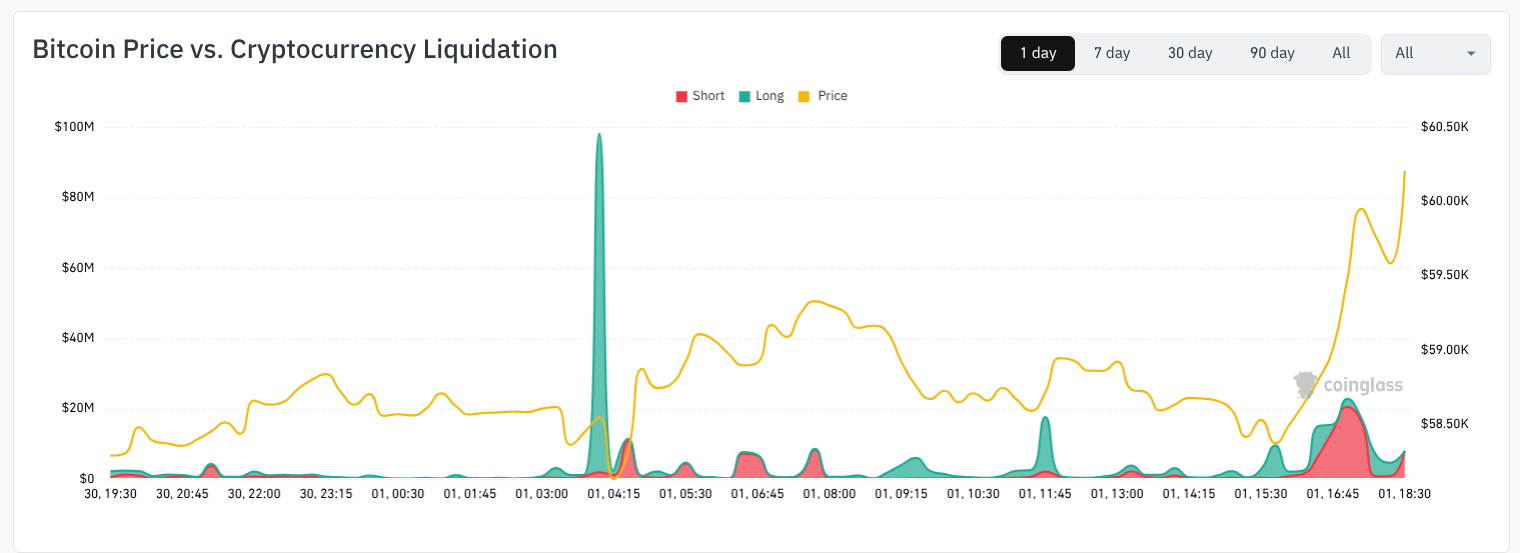
The new monthly candle had started with a bump and a trip to new multiyear lows for the pair, and 24-hour crypto long liquidations totaled more than $200 million at the time of writing, per data from CoinGlass.
BTC/USD vs. cryptocurrency liquidations (screenshot). Source: CoinGlass
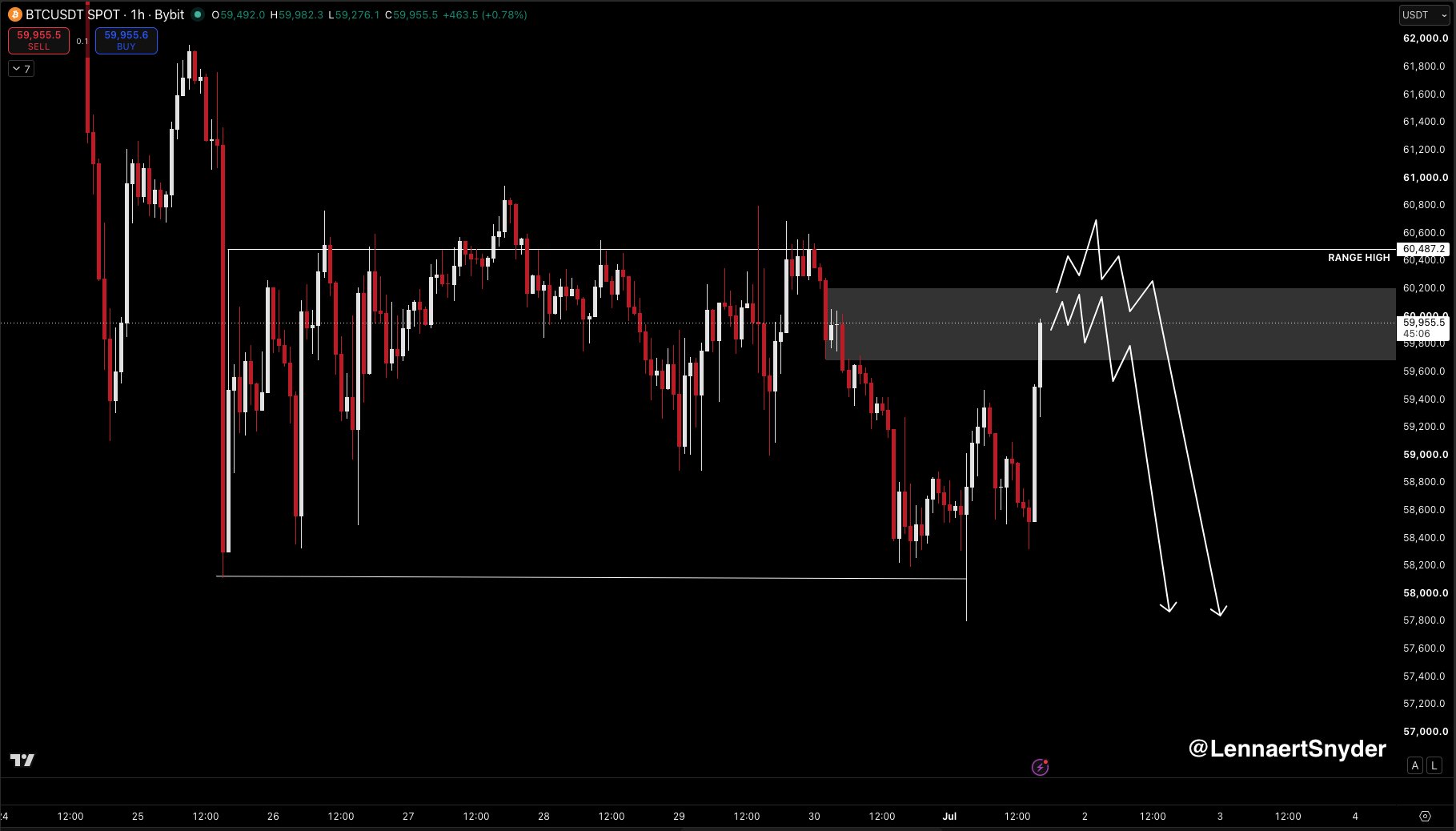
“$BTC showing a lovely pump this NY session,” trader Lennaert Snyder wrote in a response on X.
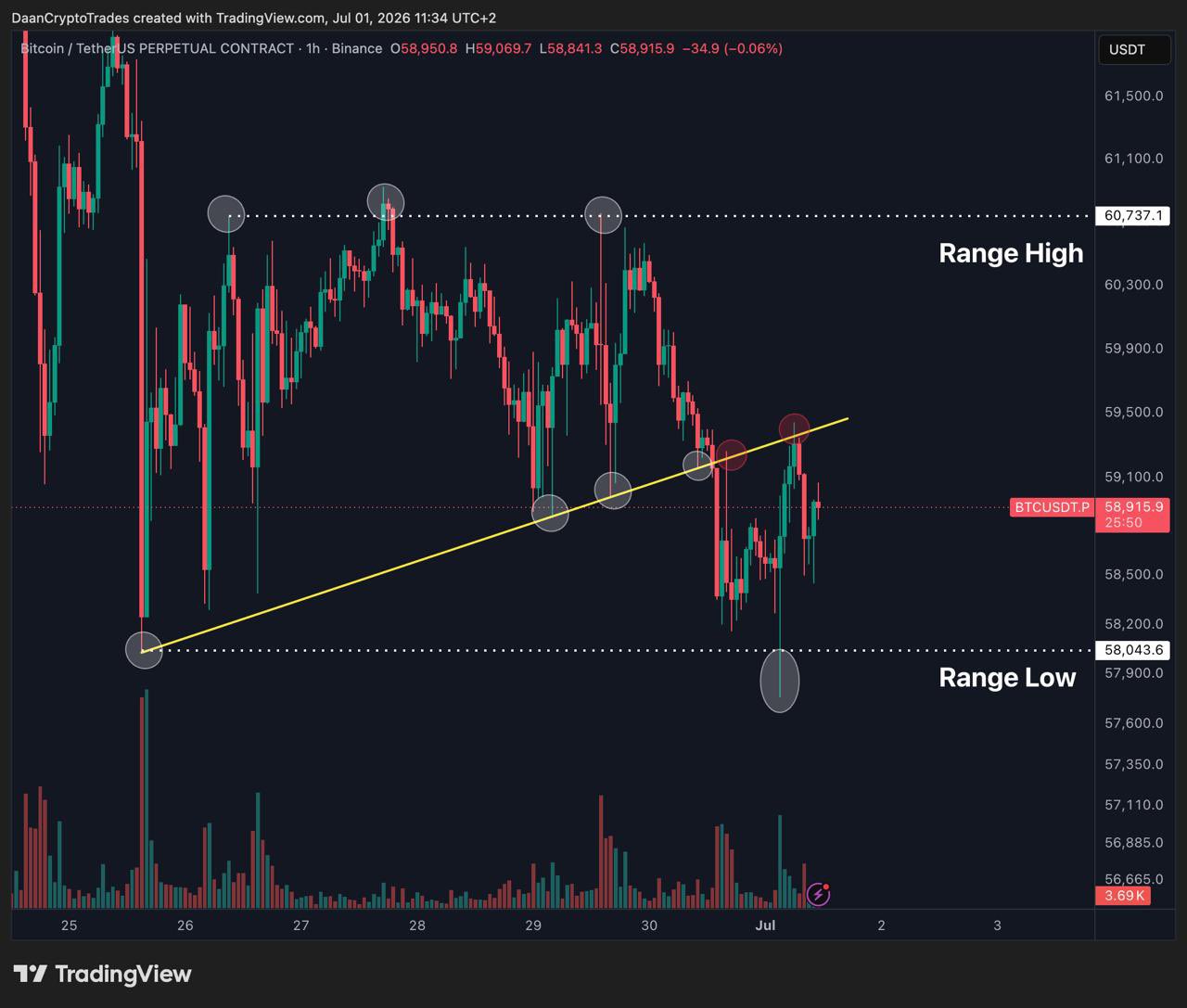
Snyder expected a low-time frame reversal to kick in, with an accompanying chart showing “exhaustion” to hit before price reached $60,700.
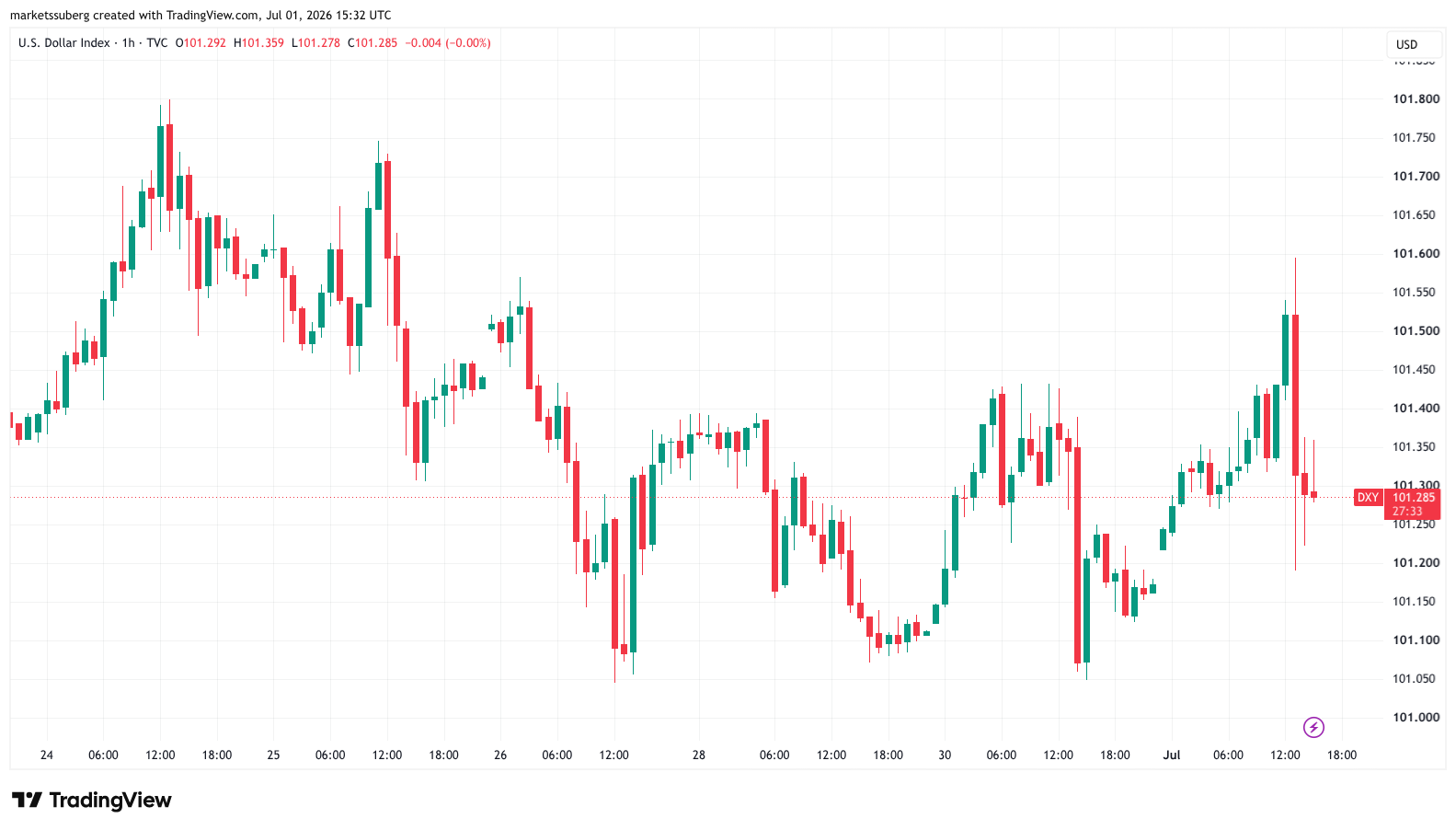
Bitcoin appeared to benefit from a drop in US dollar strength, with the US dollar index (DXY) reversing from local highs of 101.6 at the open.
US dollar index (DXY) one-week chart. Source: Cointelegraph/TradingView
Stock markets trended higher after some initial volatility, in part fueled by Meta stock, which added over 11% in the first hour.
Commenting on DXY, trading resource The Kobeissi Letter warned that a broader dollar trend change could come “soon.”
“The long US Dollar trade is crowded: Speculative long positioning in the US Dollar surged to +$34.3 billion as of June 23rd, the highest in 18 months,” it reported on X.
US dollar long position data. Source: The Kobeissi Letter/X
Bitcoin July relief rally becomes “base case”
Other market participants continued to call for a BTC price relief rally through July.
Related: Bitcoin just $5K away from ‘best investment opportunity’ of bear market
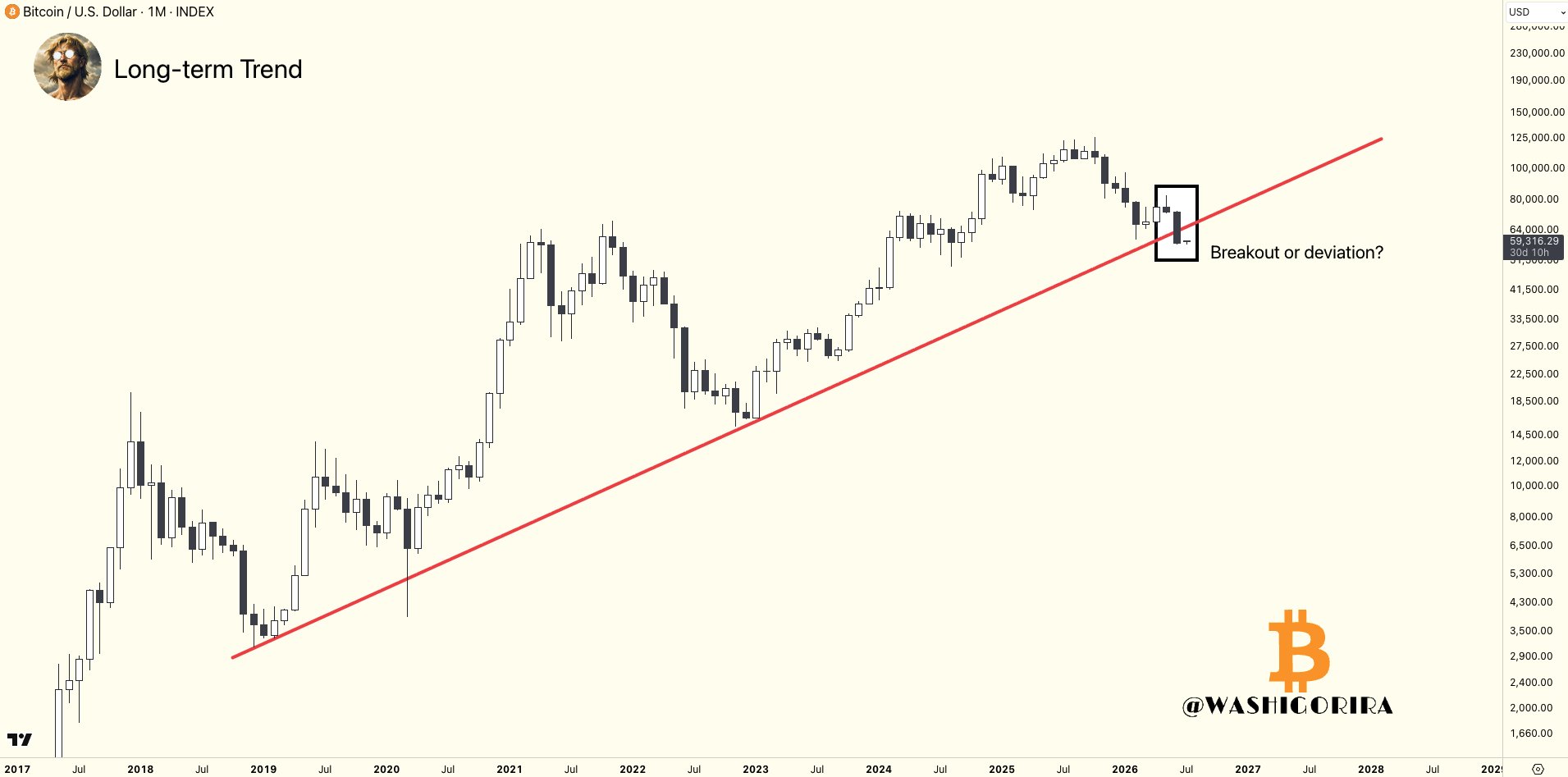
“Bitcoin Monthly close below its long-term trendline,” trader Titan noted alongside the one-month BTC/USD chart.
“My base case: a relief rally in July before the downtrend resumes.”
BTC/USD one-month chart. Source: Titan/X
Trader and analyst Rekt Capital reiterated his belief that July would offer the opposite of June’s downside before a return to bearish moves in August.
“Red June. Green July. Red August. This is what Bitcoin price history suggests,” he summarized on the day.
“Bitcoin could possibly see some downside wicking below the new Monthly Open in early July. But history suggests price should be able expand to the upside as the month progresses.”