
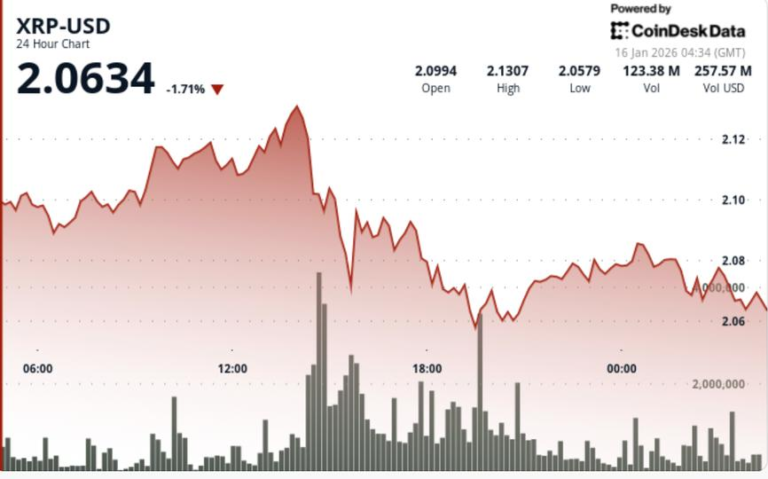
Short-term price action is driven by technical positioning, with $2.13 acting as a key resistance level.
Google Play Policy Shift Threatens Crypto Exchange Access in South Korea

Google is rolling out updated crypto app requirements in South Korea, a move that may significantly restrict access to offshore crypto exchanges by tying app availability to local regulatory clearance.
According to South Korean media outlet News1, starting Jan. 28, crypto exchange and wallet apps listed on Google Play in South Korea must upload documentation proving that their Virtual Asset Service Provider (VASP) registration with the country’s Financial Intelligence Unit (FIU) has been accepted.
Google reportedly clarified that developers listing crypto exchange and custodial wallet apps must upload proof of completed FIU registration acceptance through its developer console.
Apps that fail to meet the requirement may be blocked in South Korea, preventing new downloads and potentially disrupting access over time.
Binance, OKX face potential Google Play app lockout
According to the News1 report, Google’s updated policy is expected to have a significant impact on major overseas crypto exchanges. The media outlet specifically cited crypto exchanges Binance and OKX as platforms that may be affected by the rollout.
While South Korea requires crypto exchanges servicing domestic users to register with the FIU, obtaining formal registration can be challenging for offshore companies.
The process typically involves establishing a local legal entity, implementing anti-money laundering (AML) systems, undergoing on-site inspections and obtaining Information Security Management System (ISMS) certification.
While Binance has a 10% stake in the local crypto exchange Gopax, it doesn’t have an official local entity in South Korea. OKX previously faced allegations of operating as an unregistered crypto exchange in the country.
A Binance spokesperson told Cointelegraph that they are aware of the new policy but highlighted that this was “not unique to Binance and impacts other crypto apps as well.”
The spokesperson said that users who change devices, perform a factory reset, uninstall the app or complete a major OS update that requires re-installation “may temporarily be unable to re-download” their application from Google Play once the changes are rolled out.
“We are actively engaging with Google to seek a constructive resolution,” Binance told Cointelegraph. “We remain fully committed to providing our users with secure, reliable, and compliant services worldwide.”
OKX declined to comment.
A broader Google Play crypto policy shift
The requirement reflects Google’s enforcement of its global cryptocurrency app policy, rather than a new directive from South Korean regulators.
The rollout in South Korea is part of a wider Google Play effort to align crypto apps with local financial regulations across multiple jurisdictions.
On Aug. 14, 2025, Google Play updated its Cryptocurrency Exchanges and Software Wallets policy to require exchanges and custodial wallet providers to meet licensing and regulatory standards in specific countries.
Under the framework, developers operating in the United States must register with regulators such as the Financial Crimes Enforcement Network (FinCEN). Meanwhile, those in the European Union must qualify as licensed crypto-asset service providers.
Related: South Korea considers pre-emptive crypto account freezes, report says
Tighter app access contrasts with the tokenization framework approval
Google Play’s enforcement arrives as South Korea advances a separate regulatory track focused on integrating blockchain technology into its capital markets.
On Thursday, the National Assembly passed amendments to the Electronic Securities Act and the Capital Markets Act, formally introducing tokenized securities and allowing the regulated distribution of investment contract securities.
The framework aims to support blockchain-based issuance and settlement within the existing securities regime.
Under the revised laws, securities issued using distributed ledger technology are treated as traditional financial instruments and remain subject to disclosure, licensing and investor-protection mandates.
Magazine: OKX user’s desperate plea, Hong Kong talks gold stablecoins: Asia Express
Cointelegraph is committed to independent, transparent journalism. This news article is produced in accordance with Cointelegraph’s Editorial Policy and aims to provide accurate and timely information. Readers are encouraged to verify information independently. Read our Editorial Policy https://cointelegraph.com/editorial-policy
Bitcoin Recoils to $95K, But Classic Chart Pattern Projects 18% Gains

Bitcoin’s (BTC) price traded 9.5% above its Jan. 1 open of $87,500, and traders were confident that BTC’s short-term “trend is up” as the price approached a key level of interest.
Key takeaways:
-
Bitcoin price consolidates around $95,000 as bulls face a major barrier ahead.
-
Technical analysis shows an ascending triangle targeting $113,200 BTC price.
Bitcoin price is at an “inflection point”
As Cointelegraph reported, Bitcoin’s ability to return to a six-figure price hinges on overcoming the resistance at $98,000 — the short-term holder (STH) cost basis.
This is the critical point on traders’ radar and one that has not received a convincing retest recently.
Related: Bitcoin rally collapses at $97K as funding rate stalls, retail traders sit out
“$BTC is approaching a key inflexion point,” said Glassnode analyst Chris Beamish in a Friday post on X, adding:
“Reclaiming the STH cost basis would signal that recent buyers are back in profit, typically a prerequisite for momentum to re-accelerate. ”
MN Capital Founder Michael van de Poppe said as long as the BTC/USD pair holds above the 21-day moving average at $91,200, “the trend is up,” and it will just be a matter of time until it breaks $100,000.
Analyst Mags spotted Bitcoin bouncing from a multi-year trendline in the weekly timeframe.
“Bitcoin is bouncing from the long-term trendline support it has been holding since March 2023,” Mags said in their latest analysis on X, adding:
“Each time the price has bounced from this support, we have witnessed a strong run-up.”

Note that the last time Bitcoin bounced off this trendline in October 2023, it rallied 172% to its previous all-time high of $73,800, reached on March 14, 2024.
Other analysts expect the BTC/USD pair to push higher into the six-figures, citing several factors, including whale accumulation, strong institutional demand, and positive onchain metrics.
Bitcoin’s ascending triangle targets $113,000
The BTC/USD pair is currently retesting the horizontal trendline of an ascending triangle, as shown on the daily chart below.
A major resistance zone sits between $96,000 (100-day EMA) and $99,500 (200-day EMA), which bulls must overcome to open the way for a run-up toward the measured target of the triangle at $113,200.

Bitcoin is consolidating in an “ascending triangle along with confirmed weekly hidden bullish divergence,” said analyst Matthew Hyland in a recent post on X, adding:
“Price goes up.”
The relative strength index has increased to 64 on Friday, from oversold conditions in mid-November.
This suggests Bitcoin is “trading strong but is pretty far from being overbought in the short term,” Daan Crypto Trades said, adding:
“There’s definitely a good amount of room to move higher for now. Just need the bulls to hold the lower timeframe bullish market structures.”
As Cointelegraph reported, a bullish divergence from the RSI and a MACD cross provided classic reversal signals as bulls eye $101,000 as the next major level to reclaim for a trend confirmation.
This article does not contain investment advice or recommendations. Every investment and trading move involves risk, and readers should conduct their own research when making a decision. While we strive to provide accurate and timely information, Cointelegraph does not guarantee the accuracy, completeness, or reliability of any information in this article. This article may contain forward-looking statements that are subject to risks and uncertainties. Cointelegraph will not be liable for any loss or damage arising from your reliance on this information.
Best Crypto Exchanges of 2026 So Far – Mid-January Market Leaders

Disclosure: This article contains affiliate links. If you click a link and make a purchase or sign up for a service, Bitcoin.com may receive a commission. Our editorial content is independent and based on objective analysis. As 2026 begins, the top crypto exchanges are setting a strong tone for the year ahead, continuing to raise […]
Ondo Finance TVL Doubles to Over $2B in Less Than a Year

Ondo’s TVL surge is driven by its tokenized U.S. Treasuries fund.
Tokenization platform and DeFi protocol Ondo Finance’s total value locked (TVL) broke over the $2 billion mark this week, marking a record high, according to DefiLlama data. The figure is more than double its TVL from early March of last year.
The move highlights the rapid growth of real-world assets (RWAs) on-chain, particularly tokenized securities and U.S. Treasuries. As The Defiant reported previously, 2025 was a breakout year for the tokenized RWA sector, and analysts estimate that the total value of RWAs on blockchains could reach about $2 trillion by 2030 under base-case scenarios.
Ethereum remains the dominant network for Ondo’s tokenized assets, with roughly $1.5 billion in value on the chain as of press time. Solana follows with about $248 million, while BNB Smart Chain accounts for around $123 million.

As TVL has expanded, Ondo Finance’s flagship OUSG product — a fund holding tokenized short-term U.S. Treasury bills — has also grown, now holding more than $820 million in T-bills, according to data from RWAxyz.

Ondo’s Big Year
Ondo’s rapid rise builds on momentum from early 2025, when its TVL first crossed $1 billion following the launch of Ondo Nexus, a product that was designed to improve liquidity for tokenized assets by allowing third-party issuers to connect their assets directly to Ondo.
Ondo Finance also gained an additional reputational win in December, when the U.S. Securities and Exchange Commission (SEC) closed a multi-year investigation into the platform without bringing any charges.
Just today, Ondo announced a partnership with Hyperliquid-based DeFi protocol Felix to offer on-chain trading of tokenized spot U.S. equities.
Southern Utah man sentenced to 3 years in prison for crypto-linked wire fraud scheme

Federal prosecutors said Brian Garry Sewell defrauded investors of nearly $3 million and ran an unlicensed cash-to-crypto business that moved more than $5 million.
Engineering AI into Enterprise Operations in 2026

2025 was the year of AI acceptance and experimentation led by hype cycles and increased expectations. In 2026, we will see the AI landscape settle into a new phase of transformation as business leaders consider tougher questions around ROI delivery, ecosystem control, and autonomy. Leaders will no longer simply deploy AI, they will design for it. And we’ll see some recurring themes related to that deep integration of AI across enterprises and industries in the new year – from commoditization, to ROI, to agentic AI, to autonomous intelligence.
The Foundation Model Market Will See Commoditization
In 2026, foundation models will continue their march toward commoditization as the market matures. There will be a focus shift from the release of the latest generative model to who is using these models most effectively. The gap between the top players will shrink, and differentiation will increasingly come from application, integration, and infrastructure.
There will also be greater emphasis on scaling infrastructure and building distribution channels. OpenAI, as an independent, will continue to diversify, turning assets into hard tangibles such as data center bricks and chips. Open-source players like DeepSeek and Qwen will gain further momentum, offering credible alternatives in global markets, particularly in regions seeking technological independence from U.S.-based providers.
Tech giants like Google, on the other hand, will use their advantage across their vertical stacks, using everything from bare metal to massive interaction channels to outmaneuver competitors, and aim to counter commoditization by moving into the application layers. Already in the first weeks of January, Google announced deep AI integration into Gmail, partnered with retailers such as Walmart, Shopify and Etsy to change the way we shop within Gemini, and announced a partnership with Apple for Gemini to power Apple Intelligence.
AI ROI Will Be Under the Microscope
2026 will be the year enterprises get serious about value. The backlash that began in late 2025, centered on a perceived lack of ROI from GenAI pilots, will intensify before it stabilizes. Many organizations will come to terms with the hard truth: value from AI isn’t instant. It comes from long, methodical transformation.
The most successful AI programs in 2026 will be the ones delivering transformative results where technology is woven into processes to improve service outcomes and operational efficiency. This does not involve just piloting lab projects, but rather 12–18-month programs for full-scale rollout and adoption.
While quick wins will still exist, executives will demand clearer paths to scale, sustainability, and accountability. Vendors will be forced to connect their tech to measurable business outcomes or otherwise find themselves falling by the wayside.
Agentic AI Will Begin to Prove Its Worth, Carefully
The money and action in 2026 will appear in the application layer, where AI is applied and value is either created or lost. This is where AI gets embedded into the often-unglamorous reality of business strategy, enterprise architecture, and workflows. Enter: the ‘advent’ of agentic AI. These are systems designed to take action, complete tasks, and operate semi-independently. But after early overpromises, 2026 will be the year of controlled ambition in agent design.
Despite rapid development, in state-of-the-art agentic benchmarks, most agent systems still fail at least half their tasks. This won’t change overnight. Instead, it becomes crucial to focus on the right half of the tasks: some are simply too hard, and others are better solved by non-agentic AI or business processes.
The most successful agent deployments in 2026 will need to be robust, predictable, and reliable. They will operate within clearly scoped workflows, using defined data, and collaborating with humans. Transparency and explainability will become critical, as AI moves from labs into regulated industries and sensitive systems. Companies will invest in automated evaluation benchmarks to add more science into agent development.
Also, as AI assisted coding has grown substantially in 2025, such design time use of agentic AI will also make its way into low code, freeing up budget and resource for innovation by transforming legacy into modern AI-driven apps.
The Push Toward Autonomous Intelligence Will Begin Cautiously
Agentic systems are just the beginning. In 2026, we will see the first serious efforts to move from reactive AI to systems with true autonomy where AI can learn continuously, act with purpose, and respond to dynamic environments.
Agentic systems must actively acquire the right data, perform goal and intrinsic motivation-based reasoning, form long-term memories, and continuously learn from feedback to adapt to dynamic conditions. These systems will interact with humans and other agents, coordinate tasks, negotiate conflicts, and adapt in real-time.
But do not expect “artificial general intelligence” in 2026, nor is it required to make good and responsible use of AI. Instead, expect to see controlled experiments in narrow domains like supply chain, operations, and customer service, where autonomy can be governed, controlled, and monitored.
Bottom Line: 2026 Will Be the Year AI Grows Up
AI in 2026 will move beyond shiny demos to make meaningful progress. The market will mature, and the hype will settle as serious players focus on infrastructure, value delivery, and responsible autonomy. Commoditization will reshape the model landscape, and the pressure to see true ROI will clarify what matters. And agentic systems will begin their long evolution toward something smarter, more useful and more autonomous than what came before.
Two Prime selected to manage $250 million in bitcoin for Digital Wealth Partners

The institutional bitcoin manager expands its mandate as demand for professional risk-managed digital asset strategies grows.
KBC Bank To Launch MiCA-Regulated Crypto Trading in Belgium

KBC, one of Belgium’s largest banks, is set to roll out Bitcoin and Ether trading to retail investors next month via its own custodial solution and investment platform.
From Feb. 16, KBC customers will be able to buy and sell crypto assets through the online investment platform Bolero, the bank announced Thursday.
“This will enable self-directed investors in Belgium to invest in cryptocurrencies within a secure and fully regulated environment, a first in Belgium,” KBC said.
Launched in compliance with the European Union’s Markets in Crypto-Assets Regulation (MiCA), KBC’s crypto trading will operate on the bank’s proprietary custodial architecture, the announcement said.
KBC claims MiCA compliance, but Belgium has issued no licenses yet
KBC said it would be the first Belgian bank to meet MiCA requirements, and has submitted a full crypto asset service provider (CASP) notification to the competent authority to offer crypto trading services.
“By offering the opportunity to purchase and sell crypto within a regulated framework, we are making innovation concrete and accessible,” KBC Group’s chief innovation officer Erik Luts said.
KBC initially announced plans to offer Bitcoin (BTC) and Ether (ETH) trading via Bolero in July 2025, pending regulatory approval that was expected by the end of the year.
Related: France flags 90 unlicensed crypto companies ahead of MiCA cutoff: Report
The bank did not specify which authority it had coordinated with, but Belgian authorities have not issued any MiCA licenses yet, according to the public register maintained by the European Securities and Markets Authority (ESMA).
Belgium’s MiCA framework has just come into effect
While the MiCA framework entered into full force in late 2025, Belgium had not adopted national laws implementing MiCA until recently. The member state published its implementing law in December 2025, with MiCA becoming legally effective in Belgium on Jan. 3, 2026, according to the Belgian Official Gazette.
The law officially designated two Belgian authorities for crypto asset market oversight, the Financial Services and Markets Authority (FSMA) and the National Bank of Belgium (NBB).

Belgium’s delayed MiCA implementation comes amid ongoing debate over whether the EU should grant centralized supervisory authority to ESMA as well as allow MiCA licenses issued in one member state to be passported across the bloc.
Some EU member states, such as France, have backed proposals to give ESMA direct oversight of major crypto firms, arguing that fragmented oversight could threaten the bloc’s financial sovereignty.
Related: Germany’s DZ Bank secures MiCA license for ‘meinKrypto’ platform
As a critic of passporting, France has even raised the possibility of blocking MiCA licenses issued by other member states, warning some companies may seek approvals in jurisdictions with more lenient standards.
Others, particularly Malta, have opposed such centralization, warning it could potentially hinder competitiveness and innovation.
Cointelegraph reached out to KBC for comment but had not received a response at the time of publication.
Magazine: How crypto laws changed in 2025 — and how they’ll change in 2026
Cointelegraph is committed to independent, transparent journalism. This news article is produced in accordance with Cointelegraph’s Editorial Policy and aims to provide accurate and timely information. Readers are encouraged to verify information independently. Read our Editorial Policy https://cointelegraph.com/editorial-policy
Citrea Launches USD Stablecoin for Bitcoin Liquidity Issued by Moonpay, Powered by M0

Citrea introduces Citrea USD (ctUSD), a 1:1 USD stablecoin issued by Moonpay and powered by M0 for bitcoin liquidity. Citrea announced the launch of Citrea USD (ctUSD), a U.S. dollar–denominated stablecoin backed 1:1 by short‑term U.S. Treasury bills and cash, issued by Moonpay and built on M0’s universal stablecoin platform to serve as native liquidity […]