

In 2025, Web3 fraud surged to $15.87 billion, far surpassing the $2.5 billion plus lost to traditional hacks. Unlike isolated breaches, losses were spread across millions of transactions, reflecting the rise of “industrialized” crime networks that use address clusters and cross‑platform flows. Sophisticated Networks and ‘Authorized’ Fraud In 2025, the Web3 security landscape shifted dramatically. […]
From Capability to Consequence: Why India Is Redefining AI’s Measure of Success: By Dr Ritesh Jain

For much of the last decade, the global conversation on artificial intelligence has been dominated by a single question:
Who has the most advanced models? The race for larger datasets, faster compute, and more powerful algorithms has shaped investment priorities, policy choices, and public imagination alike. Intelligence itself became the benchmark.
That benchmark is now proving insufficient.
As AI systems move from laboratories into markets, institutions, and public life, a harder and more consequential question is emerging:
What does AI actually change? Not in prototypes or pilot programs, but in outcomes that affect citizens, customers, and the stability of systems at scale. The measure of success is shifting—from capability to consequence.
India, by necessity rather than choice, sits at the centre of this transition.
Why Capability Alone Is Not Enough
The limits of a capability-first approach are becoming visible across sectors. Organisations deploy dozens, sometimes hundreds, of AI use cases, yet struggle to demonstrate durable value. Productivity gains are episodic, governance
remains fragmented, and risk accumulates quietly in the background. The result is an uncomfortable paradox: more AI activity, but less clarity on impact.
In India, this tension is amplified by scale. Systems here do not serve millions; they serve hundreds of millions, often across linguistic, economic, and digital divides. An AI model that performs well in controlled environments
but fails in real-world diversity is not merely ineffective—it is exclusionary.
This is why the Indian context forces a different framing. At population scale, intelligence without accountability is not innovation; it is liability.
Learning from Digital Public Infrastructure
India’s most successful digital transformations offer an instructive blueprint. Platforms such as Aadhaar, UPI, and the broader India Stack did not succeed because they were technologically novel. They succeeded because they were
designed as infrastructure—governed, interoperable, and embedded into everyday economic and civic life.
UPI, for instance, is not impressive because it processes billions of transactions. It is transformative because it converted digital payments into a public utility—reliable, low-cost, and inclusive. Its success was measured not
by technical sophistication, but by adoption, resilience, and trust.
AI, increasingly, must follow the same path.
AI in Banking: A Case Study in Constraint-Driven Design
Nowhere is this clearer than in Indian banking. Many institutions are experimenting with generative AI for customer service, fraud detection, credit underwriting, and operations. Yet legacy core systems, built for batch processing
and transactional integrity, were never designed for real-time intelligence.
The challenge is not model accuracy. It is architecture.
Banks that treat AI as an overlay—a set of tools bolted onto existing systems—quickly encounter limits: opaque decisions, delayed interventions, and heightened regulatory risk. By contrast, banks investing in private or hybrid
LLMs, retrieval-augmented generation, curated datasets, and explicit prompt and output controls are beginning to see a different kind of progress. Not faster demos, but safer deployment.
Here, impact is defined by questions boards can answer with confidence: Can we explain every AI-driven decision? Can we override it instantly? Do we know what data the model must never see? Who owns model risk when something goes
wrong?
These are not technical questions. They are governance questions. And governance, increasingly, is where competitive advantage lies.
AI for Public Good: Beyond the Pilot Trap
India’s public sector faces an even higher bar. AI in healthcare, education, agriculture, and welfare delivery must operate in environments marked by uneven data quality, constrained infrastructure, and frontline human dependency.
A system that works only in ideal conditions is functionally irrelevant.
Encouragingly, some of the most promising efforts focus not on automation, but on augmentation—using AI to support frontline workers rather than replace them. Decision-support tools in healthcare, grievance redressal systems in
public administration, and language-inclusive interfaces for citizen services reflect a quieter, more durable form of innovation.
The lesson is consistent: AI creates value when it is operationalised into systems, not showcased as isolated success stories.
Trust as a Strategic Asset
As AI systems increasingly influence financial outcomes, eligibility decisions, and access to services, trust becomes the defining currency. Trust cannot be asserted; it must be engineered. This means transparency by design, clear
accountability, and regulatory readiness that goes beyond audit compliance.
India’s evolving data protection and digital governance frameworks signal an important recognition: AI legitimacy depends not on speed of deployment, but on clarity of responsibility. Systems that cannot be explained, challenged,
or corrected will not scale—regardless of their technical sophistication.
Redefining Leadership in the AI Era
The future of AI will not belong exclusively to those who build the largest models or command the greatest compute. It will belong to those who can translate intelligence into outcomes that are measurable, defensible, and inclusive.
India’s experience with population-scale digital systems offers a critical insight for the world:
AI leadership is not about building the biggest systems; it is about building the right ones. Systems that work under constraint. Systems that respect context. Systems that earn trust through impact.
The benchmark has shifted. Intelligence is assumed. Impact must now be proven.
And in that transition—from capability to consequence—India is not merely participating. It is quietly shaping the terms of the next AI era.
US Lawmakers Demand Action from SEC on Justin Sun Enforcement Case

Update (Jan. 16 at 7:35 pm UTC): This article has been updated to include a response from Justin Sun.
Three Democrats in the House of Representatives are asking US Securities and Exchange Commission (SEC) Chair Paul Atkins to provide information related to the agency closing investigations, dismissing enforcement actions, or pausing cases through extended stays in “at least one dozen crypto-related cases,” including Tron founder Justin Sun.
In a Thursday letter to Atkins, Representatives Maxine Waters, Brad Sherman and Sean Casten questioned the SEC’s “priorities and effectiveness” given its dismissals of the crypto-related cases. The lawmakers wrote that the agency had “openly and boldly dismissed the majority of its crypto enforcement cases,” including cases involving crypto exchange Binance, Coinbase and Kraken.
The bulk of the letter, however, urged the SEC to consider reopening its case against Sun. In February, the agency’s lawyers asked a federal court to stay its enforcement action against the Tron founder to explore a potential resolution.
Waters, Sherman and Casten raised questions about Sun’s connections to China and said that the case being dropped “may be part of a pay-to-play scheme,” given the Tron founder’s purchasing of millions of dollars worth of tokens from World Liberty Financial, the crypto company backed by US President Donald Trump and his sons. There is no public evidence that the token purchases influenced the SEC’s decision, and the agency has not commented on the allegation.
“The SEC’s decision to seek a stay of its strong case against Sun […] threatens to undermine investors’ confidence in the SEC,” said the letter, adding:
“Without a strong, independent SEC, capital formation will undoubtedly suffer, as would our real economy. The SEC’s request to stay the Sun case, which has now been in place for 11 months, signals to the market that securities laws are enforced selectively, and that those with sufficient political influence can evade accountability.”
Related: Crypto industry split over CLARITY Act after Coinbase breaks ranks
The three lawmakers asked the SEC to preserve and produce all documents and communications regarding its decision in the Sun case. Cointelegraph reached out to the SEC for comment, but had not received a response at the time of publication.
A spokesperson for Sun told Cointelegraph that the letter contained “numerous misstatements of the record and of fact,” and personally attacked him ”based on unproven allegations and mere innuendo.”
“The SEC matter remains pending, and Justin Sun has not sought to influence its outcome,” said the spokesperson for the Tron founder, adding that:
“He [Sun] respects the independence of the SEC and is engaging through appropriate legal channels. He has not requested special treatment, nor conditioned any commercial activity on regulatory decisions.”
In December, Waters called on Representative French Hill, who chairs the House Financial Services Committee, to hold a hearing to explore what she called the SEC’s “rapid, significant, and questionable policy shifts during the Trump Administration.” She cited the agency terminating and staying enforcement actions against crypto companies.
Casten also joined with Senator Jeff Merkley to question the SEC’s dropping of the Sun case in a September letter to Atkins.
SEC left without Democratic commissioners after Crenshaw’s departure
Caroline Crenshaw left the SEC earlier this month as the last remaining Democratic commissioner. Her departure left the agency with three Republican commissioners, Mark Uyeda, Hester Pierce and Atkins.
As of Thursday, Trump had not announced any potential replacements for the two empty commissioner seats, nor any plans to maintain the bipartisan balance by nominating Democrats.
The Commodity Futures Trading Commission (CFTC) is in a similar situation, where the only sitting commissioner, Michael Selig, is a Trump-picked Republican. The CFTC’s leadership normally consists of five Senate-confirmed commissioners.
Magazine: How crypto laws changed in 2025 — and how they’ll change in 2026
Cointelegraph is committed to independent, transparent journalism. This news article is produced in accordance with Cointelegraph’s Editorial Policy and aims to provide accurate and timely information. Readers are encouraged to verify information independently. Read our Editorial Policy https://cointelegraph.com/editorial-policy
Robinhood Offers Prediction Market ‘Custom Combos’—But Don’t Call Them Parlays

In brief
Daily Debrief Newsletter
Start every day with the top news stories right now, plus original features, a podcast, videos and more.
BofA CEO Warns Interest-Bearing Stablecoins Could Pull $6T from Banks

Bank of America CEO Brian Moynihan warned that interest-bearing stablecoins could pull as much as $6 trillion out of the US banking system, arguing that large-scale deposit migration would reduce lending capacity and push borrowing costs higher.
The comments surfaced after a crypto investor shared a screenshot from Bank of America’s earnings call transcript on X.
During the call, Moynihan pointed to Treasury-cited studies showing that a significant share of bank deposits could shift into stablecoins if issuers are allowed to pay interest. He said such products would function more like “a money market mutual fund concept,” with funds held in cash, central bank reserves or short-term Treasurys rather than deployed for lending.
Moynihan said such a shift would move deposits off bank balance sheets, shrinking credit availability, particularly for small and mid-sized businesses that rely more heavily on bank loans than capital markets.
The comments come amid stalled progress in crypto legislations in the United States. On Wednesday, the US Senate Banking Committee postponed a markup of the crypto market structure bill that had been scheduled for Thursday, with committee Chair Tim Scott saying the delay was needed to allow for further bipartisan negotiations. Scott did not provide a new date for the markup.
The postponement followed a similar move by the Senate Agriculture Committee, which earlier this week pushed its own markup of the crypto bill to Jan. 27.
Related: Coinbase could pull CLARITY Act support over stablecoin rewards ban
The debate over stablecoin yield
Whether stablecoin issuers or the exchanges and third parties that distribute their tokens should be allowed to offer yield has emerged as a key point of contention in negotiations across Congress.
Banking groups have said yield-bearing stablecoin products function similarly to unregulated investment products and have been vocal about closing any loopholes that allows yield to be passed to tokenholders.
On Jan. 7, the Community Bankers Council wrote a letter to lawmakers that echoed concerns raised by Moynihan, warning that as much as $6.6 trillion in bank deposits could be at risk if restrictions are not enforced. They wrote:
If billions are displaced from community bank lending, small businesses, farmers, students, and home buyers in towns like ours will suffer. Crypto exchanges and the constellation of stablecoin-affiliated companies are not designed to fill the lending gap, nor will they be able to offer FDIC-insured products.
Crypto industry leaders are divided on the current state of the CLARITY Act, a bill aimed at clarifying the regulatory framework for digital assets that has passed in the House of Representatives and is awaiting Senate consideration.
On Wednesday, Coinbase CEO Brian Armstrong said the company could not support the Senate Banking Committee’s draft of the bill because, among other things, it would “draft amendments that would kill rewards on stablecoins, allowing banks to ban their competition.”
He added that Coinbase would “rather have no bill than a bad bill” if the legislation advances in its current form.

Other industry leaders have taken a more optimistic view. On Thursday, a16z Crypto managing partner Chris Dixon said that while the bill is “not perfect” and still requires changes, advancing the CLARITY Act is necessary if the US wants to remain a leading hub for crypto innovation.
Magazine: ‘China’s Ethereum’ in civil war, Japan to embrace Bitcoin ETFs: Asia Express
Cointelegraph is committed to independent, transparent journalism. This news article is produced in accordance with Cointelegraph’s Editorial Policy and aims to provide accurate and timely information. Readers are encouraged to verify information independently. Read our Editorial Policy https://cointelegraph.com/editorial-policy
Korea Deepens Crypto Push With Tokenized Securities Rules

Trusted Editorial content, reviewed by leading industry experts and seasoned editors. Ad Disclosure
As South Korea intensifies its push for crypto regulation, lawmakers have advanced a bill to establish a legal framework for issuing and trading security token offerings (STOs) using distributed ledger technology (DLT).
Lawmakers Amend Framework For Tokenized Securities
On Thursday, South Korea’s National Assembly passed key amendments to the Capital Markets Act and the Electronic Securities Act, creating a legal framework for the issuance and distribution of tokenized securities.
According to an official government release, the revised rules define tokenized securities as a broad category that extends to both debt and equity products, and recognize them as legitimate financial instruments.
The amendments to the Electronic Securities Act will allow qualified issuers to launch tokenized securities using distributed ledger technology. Meanwhile, the Capital Markets Act changes will enable the products to be traded as investment contract securities on brokerages and other licensed intermediaries.
Notably, the existing Capital Markets Act prohibited the distribution through securities firms, deeming investment contract securities “unsuitable for distribution due to their non-standard characteristics.”
The changes are “expected to enhance accessibility to investments and improve the provision of investment information for these securities,” the official government release stated.
After legislative approval, the bill will be submitted to the State Council, followed by official presidential promulgation. Therefore, the legislation is expected to be enacted one year after being signed into law, tentatively in January 2027.
Moreover, the Financial Services Commission (FSC) is set to lead the implementation, forming a joint “Token Securities Council” with relevant agencies to ensure seamless preparatory work, including the development of supporting infrastructure and enhanced safeguards.
The consultation body will comprise the FSC, the Financial Supervisory Service, the Korea Securities Depository, the Financial Investment Association, industry participants, and experts.
South Korea’s Crypto Regulatory Push Continues
This major step follows South Korea’s efforts to develop and establish clear, comprehensive rules to regulate the local crypto industry. Last week, the government shared its 2026 Economic Growth Strategy, which included a plan to open its market to Bitcoin (BTC) Exchange-Traded Funds (ETFs) this year.
Crypto-based ETFs have been banned in South Korea since 2017. In 2024, the country’s regulator reaffirmed its stance after the US Securities and Exchange Commission (SEC) approved the investment products. However, it has now cited the success of the US and Hong Kong’s crypto funds as a key factor for their shift.
The FSC will also accelerate the next phase of its digital asset legislation this quarter to establish a clear regulatory framework for stablecoins. As reported by Bitcoinist, South Korea’s Second Phase of the Virtual Asset User Protection Act was delayed until the start of 2026 due to an ongoing disagreement between the FSC and the Bank of Korea (BOK).
The financial authorities have been clashing for months over rules related to the issuance and distribution of stablecoins, disagreeing on the extent of banks’ role in the issuance of won-pegged tokens.
Nonetheless, the main policies of the crypto framework have been decided, set to include investor protection measures, such as no-fault liability for crypto asset operators and isolation of bankruptcy risks for stablecoin issuers.
Moreover, the country is lifting its long-standing ban on institutional crypto trading, which is anticipated to begin later this year. According to local reports, the FSC is considering a rule to limit corporate cryptocurrency investments at 5% of a company’s equity capital.
Under the latest proposal, eligible firms would be able to allocate up to 5% of equity capital per year to digital assets, limited to the top 20 cryptocurrencies by market capitalization. The final draft version could be released as early as January or February.
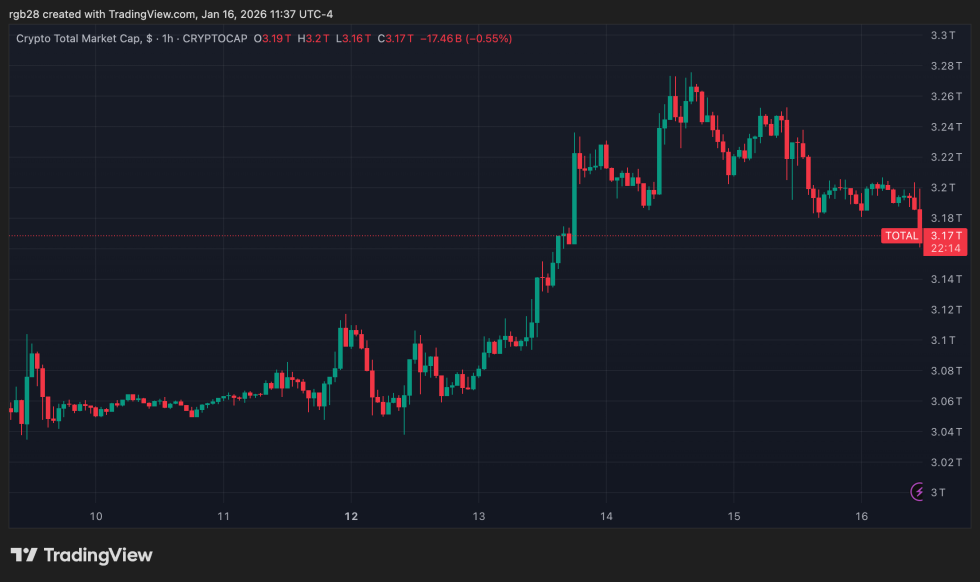
The total crypto market capitalization is at $3.17 trillion on the one-week chart. Source: TOTAL on TradingView
Featured Image from Unsplash.com, Chart from TradingView.com

Editorial Process for bitcoinist is centered on delivering thoroughly researched, accurate, and unbiased content. We uphold strict sourcing standards, and each page undergoes diligent review by our team of top technology experts and seasoned editors. This process ensures the integrity, relevance, and value of our content for our readers.
Anchorage Digital looks to raise up to $400M ahead of potential 2027 IPO

Key Takeaways
- Anchorage Digital is eyeing a $200M–$400M capital raise.
- The firm is America’s first federally chartered crypto bank.
Share this article
Anchorage Digital is looking to raise as much as $400 million as it weighs tapping into the US public market next year, Bloomberg reported Friday.
Anchorage, the first crypto firm to obtain a federal banking charter in the US, is among the crypto companies analysts view as the next candidates for listing after Circle, Gemini, and Bullish, all of which went public last year.
Talks about the expected capital raise come after BitGo, Anchorage’s main custody competitor, filed its IPO plan with the SEC earlier this week.
The rival custodian, which has been granted conditional approval to convert into a federal charter, is targeting up to $201 million at a valuation of around $1.9 billion.
Anchorage offers a full suite of services, including custody, trading, and staking, for hundreds of digital assets. It is backed by major investors like Goldman Sachs, Andreessen Horowitz (a16z), KKR, GIC, and Visa.
The firm secured $350 million in a Series D funding round in late 2021 that valued it at more than $3 billion.
Base App Pivots to ‘Trading-First’ Six Months After SocialFi Rebrand

Base lead Jesse Pollak said the web3 app will focus more on trading features, dialing back its social-heavy approach.
Jesse Pollak, Coinbase’s head of Base and Base App, announced that the Base App will shift its product focus to trading after mixed user feedback on its social-heavy features.
In an X post on Wednesday, Jan. 14, Pollak said the centralized exchange is now refocusing the Base App “to be trading-first,” signaling a shift to a finance focus for the web3 app after months of debate over its direction.
Base is the Ethereum Layer 2 developed by Coinbase, while Base App is the rebranded version of what was Coinbase Wallet, the CEX’s self-custody web3 wallet app.
After the company positioned the rebranded product as a “super app” in July of last year — combining crypto wallet, trading, social, and other functions — Pollak said “hundreds of thousands” of users indeed tried it for creating, trading, and building. But, as Pollak revealed this week, the response to the Base App’s social features was mixed.
“The app felt overly focused on social,” he wrote, adding it felt “too close to web2” and didn’t reflect the range of assets people want to trade. Pollak also wrote that users are asking for “more high quality assets” and a feed that shows not only social tokens.
Finance-First UX
“We’re going to lean into a finance-first UX. We believe it makes more sense to layer social features on top of finance, than the other way around,” Pollak wrote on X.
The shift follows a similar move by Farcaster, a prominent SocialFi protocol that recently stepped back from its original social-first model to focus more on trading.
Commenting on Base’s refocus, Dragonfly Capital partner Rob Hadick said in an X post on Jan. 15 that the move reinforces the view that blockchains work best for moving money, saying that “Base may have been the last meaningful hold out” of the social-first approach in web3.
The change also follows Coinbase CEO Brian Armstrong’s public request for feedback late last year, in which he questioned whether the Base App should prioritize trading, social features, or a mix of both.
Elon Musk once backed a $10 billion OpenAI ICO, internal notes show

Internal OpenAI call notes show Elon Musk agreed to explore an ICO with a for-profit arm in early 2018, but later dropped the idea and exited the organization.
SC Ventures and Fujitsu announce quantum innovation roadmap

Standard Chartered Ventures and Fujitsu Limited have announced the roadmap for their quantum-powered project, Qubitra Technologies.
Editorial
This content has been selected, created and edited by the Finextra editorial team based upon its relevance and interest to our community.
Originally announced as Project Quanta in 2025, the new launch has been under the title Qubitra technologies.
The initiative aims to accelerate quantum capability and foster resources and talent to drive innovation in quantum computing.
The company will operate in the UK, enabling quantum-powered applications focusing on high performance and developing a global marketplace platform.
Vivek Mahajan, corporate executive officer, corporate vice president, CTO, in charge of system platform at Fujitsu Limited, said:
“Qubitra’s applications for financial institutions, in the areas of fraud detection, derivatives pricing and in financial markets trading, will utilise novel machine learning and optimisation techniques which harness the latest quantum and quantum inspired computing devices. Qubitra is already working with financial institutions including Standard Chartered Bank, to deploy advanced solutions in these areas. These approaches are designed to deliver measurable improvements over conventional methods used today, paving the way for broader adoption of quantum technologies in financial services and beyond.”
Qubitra is developing solutions in fraud detection and financial markets trading using quantum algorithms and machine learning. Financial institutions, hedge funds, and family offices will soon be able to use the technology, expected to go live early this year.
The objective of the marketplace platform is to connect quantum hardware and software providers, and users across the quantum communities to deploy and test solutions, forming an open-source collaboration.
Fujitsu will supply quantum hardware and proprietary quantum applications.
The founding leadership team of Qubitra has been announced as:
- Vishal Shete as CEO, a former managing director at Terra Quantum
- Daniel Wynne as COO, an ex-founding COO at Carbonplace
- Kugendran Naidoo as CSO, who has extensive experience working with frontier technologies at JP Morgan and IBM
Alex Manson, CEO of SC Ventures, commented: “We use modern and at times frontier technologies to re-invent financial services: Qubitra, with access to Fujitsu’s quantum software and hardware, will leverage quantum technology across a number of use cases to rewire the DNA in banking and beyond.”