

Japan’s bond market convulsions are rattling global debt assumptions, with Bitwise warning the sell-off exposes structural cracks that could foreshadow mounting U.S. fiscal strain as borrowing costs climb worldwide. Bond Market Turmoil in Japan Sparks New Warnings on US Fiscal Stability, Bitwise Says Japanese government bond markets plunged into rare disorder as long-term yields spiked […]
Traders Are Finally Choosing a Better Way to Get Funded With Forex Funds Flow

For a long time, traders believed that strict rules were the price of opportunity.
However, that belief is changing.
In today’s market, traders are more informed. They ask better questions. And most importantly, they no longer accept systems that work against them.
Instead, they look for freedom.
They look for fairness.
And above all, they look for firms that trust skill.
That is why the idea of the Best Instant Funding firm is no longer a marketing phrase. It is now a real demand from serious traders.
The Old Prop Firm Model Is Losing Trust
Traditionally, prop firms followed the same pattern.
Long challenges.
Daily drawdown pressure.
Strict consistency rules.
At first glance, it looked professional. However, once traders stepped inside, reality felt different.
Normal drawdowns became punishments.
Strong trading days raised red flags.
And profitable traders were often restricted instead of rewarded.
As a result, many traders burned out. Not because they lacked discipline, but because the environment was unrealistic.
Consequently, traders began searching for something new. Something that felt closer to real trading.
Why Instant Funding Changed Everything
Markets do not wait.
Opportunities come & go quickly. Therefore, waiting weeks or months just to access capital makes little sense in modern trading.
This is where instant funding changed the game.
An Instant funded account with static drawdowns allows traders to focus on execution instead of survival. Instead of worrying about daily limits, traders can manage risk over time, just like professionals do.
Because of this, confidence improves. Decisions become cleaner. And trading becomes more sustainable.
That shift alone explains why instant funding models are now dominating conversations across the industry.
A Prop Firm Without Rules That Hurt Performance
Let’s be honest.
Rules are not the problem.
Bad rules are.
A true prop firm without rules does not mean chaos. It means removing restrictions that do not reflect real market behavior.
For example:
No daily drawdown traps
No forced trading frequency
No artificial performance caps
Instead, traders operate with logic and accountability. They are trusted to manage risk rather than being micromanaged.
As a result, traders behave more professionally. They plan better. And they trade less emotionally.
Ironically, fewer rules often lead to better discipline.
Funded Accounts With No Daily Drawdown Pressure
Daily drawdown limits are one of the most stressful elements in prop trading.
They force early exits.
They punish volatility.
And they create unnecessary fear.
A funded account with no daily drawdown removes this pressure completely.
Instead of judging performance day by day, traders are evaluated based on their overall risk management and consistency over time.
Because of this, traders can:
Hold positions longer
Avoid panic decisions
Recover naturally from losing days
This environment mirrors real professional trading desks, not retail traps.
Instant Funding With No Consistency Rules
Consistency is important.
However, forced consistency often does more harm than good.
Many firms demand fixed daily profits or strict percentage distributions. Unfortunately, markets do not behave that way.
With instant funding and no consistency rules, traders are free to trade when conditions are favorable and stay patient when they are not.
This flexibility leads to:
Better trade selection
Fewer impulsive entries
More realistic performance curves
As a result, traders develop genuine consistency, not artificial compliance.
Fast Payouts Build Real Trust
Trust is not built by promises.
It is built by actions.
One of the clearest signals of a healthy prop firm is payout speed. When traders receive prompt and consistent payouts, their confidence increases.
That is why a prop firm with rapid payouts every three days stands out immediately.
Fast payouts:
Reduce uncertainty
Improve trader motivation
Reinforce long-term commitment
Moreover, frequent payouts allow traders to manage their finances properly. They can reinvest, scale responsibly, and stay focused on performance.
In short, fast payouts respect traders’ time & effort.
What Makes the Best Instant Funding Firm Different
Not every instant funding firm is equal.
The best instant funding firm is not defined by hype or flashy marketing. Instead, it is defined by structure, fairness, and alignment with traders.
It provides:
Instant funded accounts with static drawdowns
No daily drawdown pressure
No forced consistency rules
Clear and transparent conditions
Reliable, fast payouts
Most importantly, it treats traders as partners, not customers.
This mindset changes everything.
Why Traders Are Making the Switch
More traders are leaving traditional prop firms every year.
They are tired of:
Passing challenges but failing payouts
Trading well but breaking technical rules
Being profitable yet restricted
Instead, they choose environments that reward skill.
As a result, instant funding models with realistic rules are becoming the new standard, not the exception.
The Bigger Picture
Trading is already difficult.
Therefore, the funding environment should support traders, not fight them.
Fair rules, realistic drawdowns, and timely payouts improve the performance of traders. They last longer. And they grow sustainably.
This approach is not just better for traders. It is better for the industry.
Final Thoughts
The future of prop trading is becoming clearer every year.
Traders want freedom, but they also want responsibility.
They want structure, but without constant pressure.
And most importantly, they want firms that reward performance instead of profiting from failure.
This is exactly where Forex Funds Flow fits in.
By offering instant funded accounts with static drawdowns, removing daily drawdown pressure, and eliminating forced consistency rules, Forex Funds Flow creates a trading environment that feels professional and fair. At the same time, fast payouts ensure traders are rewarded without unnecessary delays.
In the end, Forex Funds Flow is not about shortcuts or unrealistic promises.
It is about building a prop trading experience the right way, with trust, transparency, and real opportunity at the core.
Bitcoin Price Slumps 6% In Two Days, Falls Below $90,000

Bitcoin price fell sharply over the past 36 hours, sliding more than 5% over that time and briefly dipping below $90,000 early Tuesday as macroeconomic uncertainty and renewed scrutiny of corporate bitcoin treasuries weighed on the market.
The world’s largest cryptocurrency was trading near $95,500 on Sunday night but fell to around $89,800 by Tuesday morning, extending losses that began with a violent sell-off late Saturday and into Sunday evening and Monday morning.
The move erased nearly $5,700 from bitcoin’s price in less than two days, according to Bitcoin Magazine Pro data.
The initial leg lower came Sunday night, when the bitcoin price plunged nearly $4,000 in a two-hour window amid heavy selling across crypto markets.
Around 6 p.m. EST, a wave of liquidation-driven selling hit derivatives markets, wiping out more than $500 million in leveraged long positions in roughly an hour, with total crypto long liquidations topping $525 million during the period.
Tariff drama
The sell-off coincided with heightened macro uncertainty after U.S. President Donald Trump announced plans to impose sweeping new tariffs on European nations beginning February 1.
Under the proposal, a 10% tariff would apply to goods from eight countries — Denmark, Norway, Sweden, France, Germany, the United Kingdom, the Netherlands and Finland — rising to 25% by June 1 if no agreement is reached.
Trump tied the measures to U.S. efforts to secure Greenland, further escalating transatlantic tensions.
European leaders pushed back strongly, warning the tariff threats could trigger a “dangerous downward spiral.”
All this is happening as gold surges to a new all-time high near $4,750, underscoring a flight toward traditional safe-haven assets as risk markets sold off. This flight hasn’t been reflected in the bitcoin price.
Adding to uncertainty, the U.S. Supreme Court is expected to rule on whether Trump had the authority to impose broad tariffs under emergency powers.
The case centers on the use of the International Emergency Economic Powers Act (IEEPA) to declare trade deficits a national emergency.
A ruling against the administration could force the government to refund more than $100 billion in tariffs already collected, potentially disrupting budget and defense funding assumptions.
Corporations affecting the bitcoin price
On-chain data shows GameStop allegedly transferring a total of 2,396 BTC to Coinbase Prime in January, including 100 BTC on Jan. 17 and 2,296 BTC on Jan. 20.
The transfers represent roughly 51% of the company’s original 4,710 BTC holdings, sparking speculation that the meme-stock retailer may be preparing to sell part of its bitcoin position.
GameStop added bitcoin to its corporate treasury in mid-2025, purchasing 4,710 BTC during a brief window in May at an average price near $106,000 per coin.
While transfers to brokerage wallets are often interpreted as potential selling signals, the company has made no official announcement confirming a sale.
In contrast, Strategy (MSTR), the world’s largest publicly traded corporate bitcoin holder, continued to buy aggressively last week.
The company disclosed the purchase of 22,305 BTC for approximately $2.13 billion at an average price of $95,284 per bitcoin. As of Jan. 19, Strategy holds 709,715 BTC acquired at an average price of $75,979, representing more than 3% of bitcoin’s circulating supply.
Despite the accumulation, Strategy shares fell about 7% in early trading as the bitcoin price slid below $90,000, highlighting the growing sensitivity of bitcoin-exposed equities to short-term price moves.
The bitcoin price is trading at $90,252, down 3% over the past 24 hours on $45 billion in volume, leaving it about 3% below its seven-day high of $93,302.
The network’s market capitalization stands at roughly $1.8 trillion, with 19.98 million BTC in circulation out of a capped supply of 21 million.
US Lenders Dip Their Toes in Crypto Mortgages

On Jan. 16, Pennsylvania-based lender Newrez announced plans to accept certain cryptocurrency holdings when considering mortgage applications. The change, which the company said will take effect in February, will apply to loans for homes, refinancing and other investment properties.
For Newrez, the plan comes on the tailwinds of directions from the US Federal Housing Finance Agency (FHFA) last year. In June 2025, the FHFA ordered Fannie Mae (Federal National Mortgage Association) and Freddie Mac (Federal Home Loan Mortgage Corporation) to develop plans for recognizing crypto in loan applications.
In doing so, crypto gained at least partial recognition from two major government enterprises that provide liquidity and stability to mortgage markets. At the time, Michael Saylor, chair of Bitcoin (BTC) treasury company Strategy, said, “Future generations will remember this as the moment Bitcoin entered the American dream.”
But despite guidance from housing authorities and growing acceptance, issuers are still risk-averse, and regulatory clarity is far from solid.
Crypto mortgages give young Americans a fighting chance
Expanding the “American dream” — i.e., homeownership — was at least one prominent motivator for the FHFA to make its decision. In his official directive to Fannie Mae and Freddie Mac, the agency’s director, Bill Pulte, wrote that crypto was to be considered as part of those companies’ goal to “help ensure sustainable, long-term home ownership.”
Homeownership rates in the US have remained relatively stable for the last 60 years. Peaks and valleys have occurred during recessions and other volatile economic events, yet the rate has stayed somewhere between 60% and 70%.
But in recent years, the average age of homeowners has spiked. It was around 39 years old in 2010. Just 15 years later, the average age nearly doubled to 59. This shows that there are few young entrants from the Millennial and Gen Z generations into the real estate market.

The concentration of single-family homes into fewer hands is exacerbated by the presence of major institutional investors in the housing market. A 2023 report from the Hamilton Project found that so-called mega-investors owned as much as 27% of single-family home rental stock in Atlanta. They owned 45% in Memphis and 37% in Birmingham.
The vast majority of crypto owners are under 44. Allowing them to use their holdings to count toward a mortgage could, at least in some small way, make it easier for younger investors to own homes.
Related: US regulator orders Fannie Mae, Freddie Mac to consider crypto for mortgages
Pulte recently said in an interview with CNBC, “We are doing everything we can to increase affordability. One of the reasons that we are doing this with regard to crypto is because crypto has an enormous opportunity to help with [affordability.]”
In 2022, well before the guidance from the FHFA, Miami-based fintech company Milo announced that borrowers would be able to use their crypto in securing 30-year mortgages while retaining ownership of their assets. At the time, Milo CEO and founder Josip Rupena said, “The existing ways for crypto consumers to access home credit has left them with unintended tax liabilities of selling for a down payment.”
But if crypto mortgages do have the ability to affect positive change in homeownership, they still have challenges to contend with.
Investors should expect to “take a haircut” on crypto valuations
The FHFA may have opened the door a crack for crypto — but caveats apply. The asset in question must be held on US-regulated exchanges. Fannie Mae and Freddie Mac must also consider risk mitigation.
While it is able to direct Fannie Mae and Freddie Mac to make recommendations and assessments, the FHFA can’t force individual lenders to accept crypto.
And even if lenders accept crypto, they may not accept every altcoin out there. Charles Whalen, chairman of Whalen Global Advisors, told CNBC, “There are some lenders right now that are willing to do business based on Bitcoin.”
“Not so much the other tokens, but I think Bitcoin is way in the lead in terms of getting this kind of recognition.”
He said that these types of loans are possible but are confined mostly to what the industry calls “private label” or “jumbo markets.”
“These are not mortgages that are going to be sold to Fannie Mae or Freddie Mac,” Whalen said.
Crypto investors may be further dismayed by having to “take a haircut” on their crypto valuations. In order to manage crypto’s notorious volatility, lenders may assume that the crypto price will fall, decreasing its power as collateral.
Future of US crypto mortgages partially driven by politics
There may also be a political component to crypto mortgages. Pulte said that his June order was partly “in keeping with President Trump’s vision to make the United States the crypto capital of the world.”
Daryl Fairweather, chief economist at Redfin, said that the order “helps normalize crypto, helps to legitimize cryptocurrency, which I think helps the president’s agenda.” Whalen said that the move should be seen as more political than substantive.
Top Democrats were notably opposed to the move. Five senators, including crypto critic Elizabeth Warren and former presidential candidate Bernie Sanders, signed a letter in which they claimed Pulte was prioritizing politics over risks to the financial system.
“Your order states that ‘each Enterprise must submit and receive approval from its Board of Directors.’ However, you are the current Chair of each Board, and you have stacked the Boards with members who represent FHFA personnel and your industry allies,” they wrote.
“There also appears to be a serious conflict between your ability to order and approve the Enterprises’ proposals as FHFA Director and to ultimately influence the development of such proposals as Chair of the Enterprises’ boards,” they continued.
Republican lawmakers have attempted to codify the order into law. Wyoming Senator Cynthia Lummis introduced a bill, the 21st Century Mortgage Act, to do just this in July 2025. The bill hasn’t gone anywhere; it’s still sitting in the Committee on Banking, Housing, and Urban Affairs.
The political momentum behind crypto loans may have its limits. Whalen said that major lenders could have a hard time getting behind the bill due to the market risk between when the crypto is considered for a loan and when it gets turned into dollars.
“The mortgage market ultimately is about a lender helping you buy your house, and then they sell that loan into the bond market. That bond transaction is in dollars.”
While lenders consider the order and its implications for their business models, the Trump administration is making strides elsewhere to try to lower housing costs. This month, the administration floated different ideas for expanding homeownership. National Economic Council Director Kevin Hassett hinted at a plan to let Americans use their retirement savings, like 410(k) plans, to make down payments.
Trump has also suggested banning large institutional investors from buying single-family homes. He wrote on Truth Social on Jan. 7:
“For a very long time, buying and owning a home was considered the pinnacle of the American Dream […] It is for that reason, and much more, that I am immediately taking steps to ban large institutional investors from buying more single-family homes, and I will be calling on Congress to codify it.”
There is currently strong political momentum behind cryptocurrencies in Washington, from stablecoins to crypto mortgages. But much of this momentum, and any potential effect it could have on housing affordability, is ultimately dependent on whether lenders think it makes sound business sense.
Magazine: Here’s why crypto is moving to Dubai and Abu Dhabi
Cointelegraph Features and Cointelegraph Magazine publish long-form journalism, analysis and narrative reporting produced by Cointelegraph’s in-house editorial team and selected external contributors with subject-matter expertise. All articles are edited and reviewed by Cointelegraph editors in line with our editorial standards. Contributions from external writers are commissioned for their experience, research or perspective and do not reflect the views of Cointelegraph as a company unless explicitly stated. Content published in Features and Magazine does not constitute financial, legal or investment advice. Readers should conduct their own research and consult qualified professionals where appropriate. Cointelegraph maintains full editorial independence. The selection, commissioning and publication of Features and Magazine content are not influenced by advertisers, partners or commercial relationships.
Bitcoin Sellers Drive BTC Below $90,000 in Tariff Aftermath

Bitcoin sellers entered at the Wall Street open to drive BTC price action below $90,000, but a six-figure price target stayed in play.
Bitcoin (BTC) narrowly avoided major losses at Tuesday’s Wall Street open as US markets reacted to EU trade-war fears.
Key points:
-
US markets offer their first reactions to the EU trade war over Greenland with $90,000 BTC price support on the line.
-
Gold and silver continue to top all-time highs while stocks panic.
-
Bitcoin can still hit $100,000 again if support here holds, a popular trader says.
Bitcoin struggles with stocks on Greenland nerves
Data from TradingView showed a battle unfolding for $90,000 as BTC price support.
US stocks opened with predictable losses, with the S&P 500 and Nasdaq Composite Index both down around 1.5% at the time of writing.
Precious metals, meanwhile, continued their record bull run — gold hit $4,750 per ounce for the first time, while silver coiled beneath $96.

Both sides’ rhetoric ramped up before the open, with US President Donald Trump sharing images of both Greenland and Venezuela forming part of US territory. This followed posts showing text communications between Trump and European state leaders.

“I had a very good telephone call with Mark Rutte, the Secretary General of NATO, concerning Greenland,” Trump wrote in one of several posts on Truth Social.
“I agreed to a meeting of the various parties in Davos, Switzerland.”
Trader: $100,000 BTC price target still in play
With the focus thus switching to the World Economic Forum taking place through Jan. 23, crypto market participants were in “wait and see” mode.
Related: BTC vs. new $80K ‘liquidity grab’: Five things to know in Bitcoin this week
“$BTC got rejected from its weekly bull market support band,” trader BitBull summarized in his latest X analysis, pointing to two overhead moving averages.
“This happened twice in Q1 2025, before BTC finally reclaimed it and hit a new ATH. As long as BTC holds above the $88,500 level, the uptrend is still intact.”

Earlier, Cointelegraph reported on the various key BTC price levels now in play as support retest zones.
Among them was a warning from veteran trader Peter Brandt that $60,000 or lower could result from the latest rejection at $98,000. Brandt subsequently said that BTC/USD was in a diagonal structure unsuitable for trading.
Bitcoin has now become a diagonal pattern. I do NOT trade diagonal patterns. I leave these for the Elliott Wave guys who without fail after the next big move will tell us how they had it all figured out $BTC pic.twitter.com/hj04jJHdod
— Peter Brandt (@PeterLBrandt) January 20, 2026
Swapping his characteristic bearishness for cautious optimism, meanwhile, trader Il Capo of Crypto saw the potential for a reclaim of $100,000 on two-day timeframes.
“Support zone here. Hold this and $100k levels should be next,” he told X followers.
“This could be an important higher low for the entire crypto market, before strong bullish continuation.”

This article does not contain investment advice or recommendations. Every investment and trading move involves risk, and readers should conduct their own research when making a decision. While we strive to provide accurate and timely information, Cointelegraph does not guarantee the accuracy, completeness, or reliability of any information in this article. This article may contain forward-looking statements that are subject to risks and uncertainties. Cointelegraph will not be liable for any loss or damage arising from your reliance on this information.
Bitmine Adds 35,000 ETH in a Week, Cementing Lead as Top Ethereum Treasury Firm

On the very same day Strategy revealed locking in its $2 billion bitcoin buy, Bitmine Immersion Technologies quietly bulked up its ethereum stack to 4.203 million ETH, snapping up 35,268 tokens over the past week and further cementing its title as the world’s largest ethereum treasury holder. Bitmine’s Ether Treasury Swells The update came in […]
Fluid Quip Technologies Expands Deployment of Low Energy Distillation™ Technology at United Ethanol

CEDAR RAPIDS, Iowa–(BUSINESS WIRE)–Fluid Quip Technologies (FQT) continues to advance the biofuels industry’s transition toward higher efficiency and lower carbon intensity with another commercial deployment of the patented Low Energy Distillation™ (LED™) system at United Ethanol in Milton, Wisconsin.
The LED™ system, is a next-generation distillation platform designed to reduce steam usage, eliminate unnecessary phase changes, lower water consumption, and support continuous, reliable operation. By removing direct-inject steam from the distillation process and incorporating advanced heat integration, LED™ can significantly reduce energy usage, helping producers lower operating costs and improve carbon intensity (CI) scores.
The LED™ platform integrates technology developed over a multi-year collaboration between Fluid Quip Technologies and RCM Thermal Kinetics, combining FQT’s system integration expertise with RCM’s advanced Distillation, Dehydration and Evaporation (DDE) process design and intellectual property. The underlying architecture rethinks conventional ethanol distillation by tightly integrating heat recovery, allowing plants to achieve significant energy reductions.
“With every LED installation, we’re demonstrating that ethanol production can be more efficient, profitable, and sustainable,” said Neal Jakel, President of Fluid Quip Technologies. “Producers are achieving meaningful energy savings, increased uptime, and measurable carbon reductions without compromising throughput or reliability.”
“We are excited to move forward with the LED system,” said Dan Wych, Vice President of Wisconsin Ethanol Operations at United Cooperative. “Reducing our energy demand is a strategic priority, and FQT’s LED technology aligns with our goals for efficiency, reliability, and CI reduction.”
This installation further reinforces FQT’s position as a leading provider of energy-reduction technologies for the ethanol industry. It marks the fourth commercial deployment of the LED™ system demonstrating the technology’s success and seamless integration into existing plant infrastructure.
About Fluid Quip Technologies
Fluid Quip Technologies® (FQT) is a premier technology and process engineering firm based in Cedar Rapids, Iowa. FQT’s skilled engineering and technical teams have been developing new technologies and providing unique process engineering solutions to the beverage, biofuels and bio-chemical markets for more than 30 years. For more information, visit www.fluidquiptechnologies.com.
Strategy ($MSTR) Spends $2.13 Billion To Buy 22,305 Bitcoin

Strategy (MSTR), the world’s largest publicly traded corporate holder of bitcoin, has added another major tranche of BTC to its balance sheet, purchasing 22,305 bitcoin for approximately $2.13 billion over the past week.
The acquisition, disclosed today, was made at an average price of roughly $95,284 per bitcoin, roughly 4% more than current prices. As of Jan. 19, 2026, Strategy now holds a total of 709,715 BTC, acquired for approximately $53.92 billion at an average price of $75,979 per coin.
The latest purchase marks Strategy’s largest weekly bitcoin acquisition since November 2024 and its fifth-largest bitcoin purchase announcement to date.
Led by executive chairman Michael Saylor, the company has continued its aggressive, near-weekly accumulation strategy, using capital markets activity to convert traditional financial assets into bitcoin exposure.
The latest purchase was funded through a combination of common stock issuance and sales of the company’s perpetual preferred equity, Stretch (STRC).
Strategy’s aggressive bitcoin purchasing strategy
According to regulatory filings, the company raised about $2.125 billion in net proceeds between Jan. 12 and Jan. 19 through its at-the-market (ATM) programs. The bulk of the funds came from the sale of 10.4 million shares of MSTR Class A common stock, generating approximately $1.83 billion.
An additional $294.3 million was raised through the issuance of roughly 2.95 million STRC preferred shares. Smaller amounts were generated via STRK preferred stock, while no shares were issued under the STRF or STRD programs during the period.
Despite the continued accumulation, Strategy shares were under pressure in early trading, falling about 5% as bitcoin prices slid below $91,000. The pullback follows a broader crypto market sell-off after BTC traded above $94,000 late last week.
With more than 709,000 bitcoin now held, Strategy controls over 3% of bitcoin’s total circulating supply.
Several weeks ago, the company also announced they are increasing their U.S. dollar reserve to $2.25 billion, up from $1.44 billion in December, intended to support dividend payments on preferred shares and interest obligations on outstanding debt.
Strategy and MSCI
Earlier this month, the company was relieved of some selling pressure when MSCI concluded its review of digital asset treasury companies and decided not to exclude them from its major global equity indexes.
The index provider said bitcoin-heavy firms will remain eligible under existing rules while it conducts further research on how to distinguish operating companies from investment-like entities.
The decision eased months of market anxiety after MSCI had proposed reclassifying companies with more than 50% of assets in digital assets as fund-like and therefore ineligible for inclusion.
Companies like Strategy, along with industry groups, pushed back strongly, warning that exclusions could trigger billions of dollars in forced passive selling.
Toku Brings Instant USDC Payroll to Polygon, Targeting 100+ Countries

Toku said it will let employers pay workers in stablecoins on Polygon, aiming to turn payroll—one of the world’s most routine and regulated money flows—into a blockchain-native transaction with real-time settlement and low fees.
The company, which markets itself as a compliance-focused platform for stablecoin and token compensation, said the Polygon integration is designed to work alongside existing HR and payroll software such as ADP and Workday, with Toku handling employment contracts, tax withholding, benefits administration and regulatory filings across more than 100 jurisdictions.
The pitch taps into a growing push by crypto infrastructure firms to move beyond trading and speculation and into operational finance—payments, payroll and invoicing—where volumes are recurring and sticky, but compliance requirements are unforgiving. Stablecoins, which are typically pegged to the US dollar, have been gaining traction as a settlement rail for cross-border transfers because they can move 24/7 and clear without correspondent banks.
From “crypto comp” to corporate plumbing
Toku’s announcement leans on a recent Pantera Capital compensation survey, which found that stablecoins dominate crypto-denominated compensation, with USDC and USDT together accounting for more than 90% of reported crypto salary payments. A Thomson Reuters analysis of the same survey flagged that while interest is rising, payroll in stablecoins still runs into hard edges—tax reporting, withholding, worker classification and jurisdiction-by-jurisdiction rules that don’t map neatly onto crypto rails.
Toku has been building around those constraints rather than around a consumer wallet experience. Last year, it partnered with stablecoin payments firm Rain to offer stablecoin payroll in more than 100 countries, framing the product as “instant” payouts that plug into employers’ existing workflows. More recently, Toku has also highlighted integrations aimed at making stablecoin payroll work inside systems used by finance teams, including ADP and Workday.
Toku and partners have separately pointed to scale: a Crossmint case study described Toku as administering more than $1 billion of global payroll using stablecoins.
Why Polygon wants payroll traffic
For Polygon, the tie-up fits a broader strategy to position its network as a payments settlement layer rather than just a venue for decentralized finance. Polygon has been emphasizing retail-sized stablecoin transfers and local-currency stablecoin volume as a wedge into payments adoption.
Polygon handles a large share of USDC transfers in the $100 to $1,000 range in the US—an activity band that proponents argue looks more like everyday commerce than institutional treasury movement.
The payroll use case also arrives as Polygon accelerates dealmaking around stablecoin payments. Polygon Labs said this week it agreed to acquire crypto payments firm Coinme and wallet infrastructure provider Sequence for more than $250 million, as it works toward becoming a regulated US payments player and targets business-to-business payments first.
The practical hurdle: compliance, not throughput
Stablecoin payroll has long been a niche product, partly because employers can’t treat payroll like a casual transfer. Payments must be timed to local pay cycles, backed by documentation, and paired with statutory deductions and filings. A “send” button is the easy part; the hard part is making the payment legally equivalent to payroll across countries that have different labor codes, reporting standards and enforcement norms.
That’s where Toku says it competes: the company positions itself as an intermediary layer that can keep employers on familiar HR systems while moving value over blockchain rails. Toku also promotes employer-of-record style services for hiring across jurisdictions without opening local entities—an approach that could be attractive to globally distributed teams, though it also pulls stablecoin payroll deeper into local employment law.
The Thomson Reuters analysis noted that tax and reporting requirements remain a central friction point—especially in the US, where wage reporting, withholding and documentation standards are tightly enforced even when the “money” arrives as a digital token.
Why does stablecoin payroll matter?
If stablecoin payroll becomes mainstream for certain categories of employers—remote-first companies, global contractor-heavy businesses, or firms paying workers in high-inflation markets—the implications would go beyond crypto HR perks. Payroll is a repeated, predictable flow; it can anchor other services such as earned-wage access, benefits, contractor management, and even small-business treasury operations.
It could also deepen the competition among blockchains to host “boring” payments traffic. Networks that win payroll and invoicing flows may benefit from consistent transaction volume and a pathway to partnerships with traditional fintech providers—even if margins are thin.
The market is still too early. Pantera’s survey suggested crypto compensation is growing but still far from universal, even inside the blockchain industry. Still, the direction of travel is clear: as stablecoins become less of a trading instrument and more of a settlement format, vendors like Toku are trying to package them into something corporate finance teams can use without rewriting how payroll works.
Disclaimer: The information provided on AlexaBlockchain is for informational purposes only and does not constitute financial advice. Read complete disclaimer here.
Image Credits: Toku
Ripple Exec Pushes Central Banks To Back Regulated Stablecoins

Trusted Editorial content, reviewed by leading industry experts and seasoned editors. Ad Disclosure
Ripple’s UK & Europe policy director Matthew Osborne is urging central banks to stop treating stablecoins as an external threat and instead fold well-regulated issuers into core safeguards, arguing that oversight plus access to official infrastructure can make stablecoins a net stabiliser for payments and settlement.
Writing for the Official Monetary and Financial Institutions Forum on 19 January 2026, Osborne said stablecoins have moved well beyond a niche experiment, citing a market value “in excess of $300bn” and annual transaction volumes that he wrote now surpass Visa and Mastercard combined. He argued momentum could accelerate in the US after the Genius Act, which he said would introduce federal rules and allow banks to issue stablecoins.
The Ripple exec framed the shift as already visible among central banks themselves. He pointed to the European Central Bank’s recent recognition of stablecoins’ benefits for cross-border payments and its view that tomorrow’s financial system will host multiple forms of money. He also cited the Bank of England’s stance that stablecoins could support “faster, cheaper retail and wholesale payments” as part of a “multi-money” system underpinned by central bank money.
Ripple Exec: Bring Stablecoins Into The Safety Net
At the centre of his case is the claim that stablecoins should be treated as an incremental evolution rather than an adversarial replacement. “Regulated stablecoins could play a key role in financial markets alongside other forms of money,” Osborne wrote. “First, stablecoins are more likely to complement the existing financial system than replace it. This is evolution, not revolution.” He then added: “The solution lies in central banks channelling stablecoin momentum, not fighting it.”
Osborne argues central bank money will remain essential as a risk-free settlement asset and safe store of value, but its relative role could shift in digital markets. He pointed to atomic settlement, where legs of a transaction settle simultaneously and conditionally, as reducing the traditional need to use central bank money purely to mitigate settlement risk.
Where stablecoins could be structurally preferred, he wrote, is in cross-border flows and multi-chain markets. “Cross-border payments are one example, given that stablecoins can move value anywhere in the world in seconds,” the Ripple exec said.
“In contrast, central bank money is likely to be less suitable for cross-border payments given access may be geographically limited and adoption of on-chain central bank money is far from universal around the world.” He also argued stablecoins are likely to exist across more blockchain networks than central bank money, making same-chain settlement between tokenized assets and cash more achievable while interoperability remains uneven.
Central banks have repeatedly warned that stablecoins could pull funds from bank deposits, weakening bank credit creation and potentially amplifying stress events. Osborne pushed back, arguing the risk is overstated because markets already accommodate instruments backed by highly liquid assets, money market funds, e-money, and “narrow banks”, without causing sustained deposit runs.
His bigger point is that regulation, while necessary, is insufficient without a backstop. “But regulation alone is not enough,” Osborne wrote. “Stablecoin issuers lack access to the safety net that gives bank deposits their resilience. Without it, even well-managed stablecoins are more vulnerable to shocks – as seen when USDC temporarily lost its peg following exposure to Silicon Valley Bank in 2023.”
He argued central banks should consider extending elements of that safety net, including allowing well-regulated stablecoin issuers to hold part of their backing assets in central bank accounts, offering liquidity insurance against market-wide shocks, and granting more direct payment-system access to reduce tiering risk.
The Ripple exec closed by positioning the choice for central banks as strategic: resist stablecoins and risk the market scaling beyond official influence, or “bring them inside the tent,” shaping development through prudential oversight and infrastructure access as tokenized settlement rails mature.
At press time, XRP traded at $1.9216.
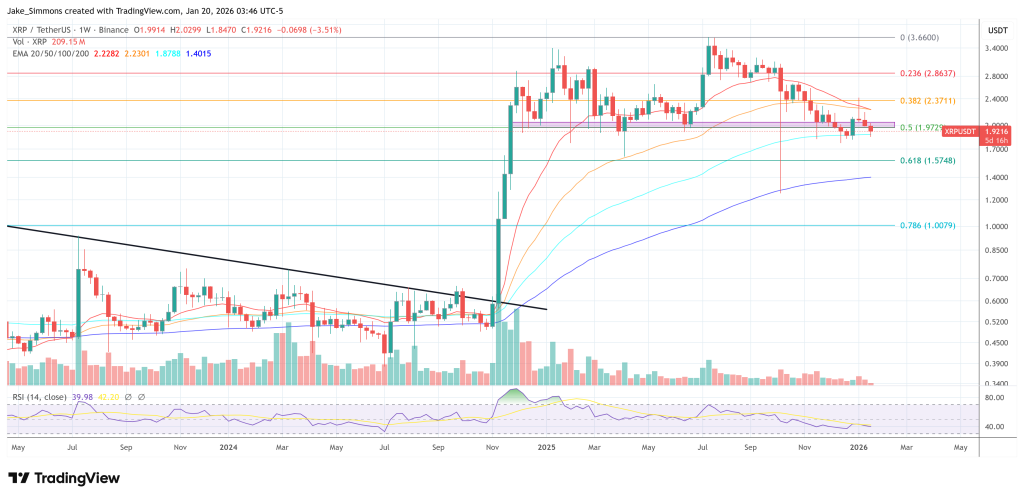
Featured image created with DALL.E, chart from TradingView.com

Editorial Process for bitcoinist is centered on delivering thoroughly researched, accurate, and unbiased content. We uphold strict sourcing standards, and each page undergoes diligent review by our team of top technology experts and seasoned editors. This process ensures the integrity, relevance, and value of our content for our readers.