

In this episode of The Defiant Podcast, Chris Storaker sits down with Alex Garn, Chief Product Officer at Borderless, to unpack how stablecoins are quietly transforming cross-border payments — and what it actually takes to move money at scale across jurisdictions.
Toncoin drops, falls through key support levels in technical breakdown
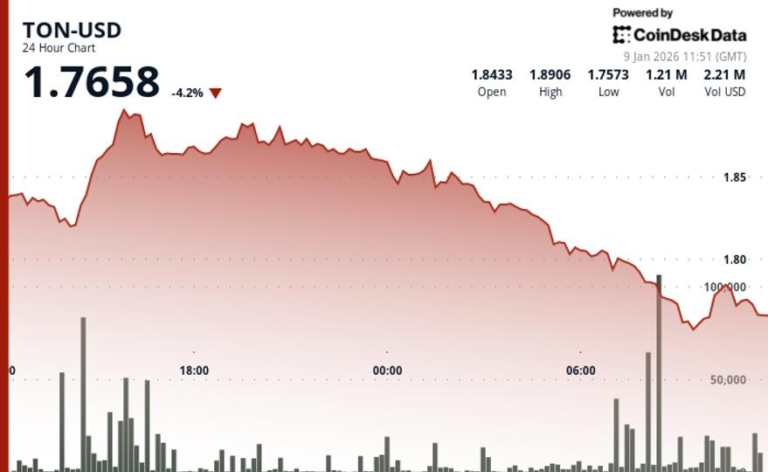
The decline was accompanied by a spike in volume, suggesting large-holder or institutional activity, and analysts see a risk of continued pressure.
UK car insurance premiums continue to slide with 13% annual fall

The cost of car insurance has fallen by £111 over the past year, with motorists now on average paying £726.
Comprehensive car insurance premiums have fallen by 13% (£111) during the last 12 months with UK motorists now paying £726 on average, according to the latest Confused.com Car Insurance Price Index in association with WTW (NASDAQ: WTW), a leading global advisory, broking and solutions company.
Car insurance premiums for younger drivers have seen the greatest changes to their average premiums, with premiums for under 25s dropping by 16% on average year-on-year.Drivers aged 17 experienced the greatest price fall compared to other age groups, benefiting from a significant 25% annual price decrease, reducing their average premiums by £636 from £2,568 to £1,932. Drivers aged 18 saw the next biggest reduction in annual prices of 18%, taking their average premiums to £2,262.
While all age groups saw double digit falls, drivers aged 48 saw the most marginal decrease to their car insurance prices with a fall of 10% (£73) and an average annual premium of £653.
Average car insurance premiums have fallen by £269 (27%) since prices peaked at £995 in December 2023, with prices having decreased for eight consecutive quarters, according to the longest established and most comprehensive car insurance price index in the UK. However, the latest price fall of 1% (£9) during September to November 2025 was the smallest quarterly drop since the current downward trend began in early 2024, indicating a continued deceleration in the pace of price reductions.
| Comprehensive Car Insurance – Annual Price Trends | ||
| 2024 – November | 2025 – November | |
| Average Premium* | £837 | £726 |
| % Change Annually* | -15% | -15% |
| £ Change Annually* | -£146 | -£111 |
Source: WTW / Confused.com Car Insurance Price Index. *Average values rounded to the nearest whole number.
Tim Rourke, UK Head of P&C Pricing, Product, Claims and Underwriting at WTW, said: “Motorists have benefitted from lower insurance premiums driven by a continued decline in personal injury claims through 2025. Most likely due to the whiplash reforms, bodily injury claims have now fallen from 16% of insurers’ spend in 2021 to 9% in 2025.
“While UK motor insurers can expect to break even in 2025, rising claims inflation and higher repair costs linked to increasingly complex vehicle technology may lead to losses in 2026, putting pressure on insurers to reverse the recent downward trend in prices.”
Northern Ireland was the only region to experience an annual rise in prices, where premiums increased by 1% from £894 to £907. This reflects a significant increase in its ranking compared to previous years, largely due to smaller price drops compared to other regions. Northern Ireland is now listed as the third most expensive region in the UK for car insurance, only narrowly behind Outer London in second place.
Drivers in Manchester / Merseyside saw the largest percentage decrease in the cost of comprehensive car insurance, with an annual dip of 18% (£178), reducing their premiums from £1,014 to £836. Drivers in the North West benefited from the next biggest percentage drop at just under 16% (£123), with their premiums decreasing from £790 to £667 during the same period.
Of the regions to experience a reduction, the smallest was seen in the Scottish Highlands and Islands, where drivers saw a more modest annual fall of 8% (£51), with average premiums now at £574 compared to £625 in November 2024. South West England remains the cheapest region for car insurance, where average premiums now cost £500, with Central and North Wales following close behind at £509.
| Most Expensive Regions in the UK | ||
| 2024 – November | 2025 – November | |
| Inner London | £1,305 | £1,119 |
| Outer London | £1,081 | £917 |
| Northern Ireland | £894 | £907 |
| West Midlands | £1,015 | £875 |
| Manchester / Merseyside | £1,014 | £836 |
Source: WTW / Confused.com Car Insurance Price Index. *Average values rounded to nearest whole number.
More locally focused data shows motorists in the Manchester / Merseyside postcode areas of Liverpool and Bolton benefited from the biggest annual falls in car insurance premiums, where prices dropped by 20% and 18% respectively. Drivers in Liverpool saw premiums decrease from £998 to £799, while average prices in Bolton fell from £1,049 to £858. West Central London, still the most expensive postcode in the country, saw an annual fall of 12% (£193), with average premiums now at £1,444 compared to £1,637 in November 2024.
Llandrindod Wells in Wales continues to be the cheapest town in the UK with prices on average now costing £476, where prices fell by 7% compared to 12 months ago. Drivers in the South West towns of Torquay (£482), Truro (£484), Exeter (£486) and Dorchester (£487) also continue to enjoy average premiums less than £500.
Steve Dukes, CEO at Confused.com, comments: “This recent drop in car insurance prices signals more than 12 months of decreases. While this creates opportunities for customers to save, motorists can see cost increases on the way in the form of vehicle excise duty, fuel prices and more. Customers continue to wrestle with broader financial pressures and so continue to look for ways to refresh their financial commitments, review the cover they have and save where they can.”
Tennessee Orders Kalshi, Polymarket, Crypto.com to Halt Sports Betting

Tennessee’s sports betting regulator has ordered prediction market platforms Kalshi, Polymarket and Crypto.com to halt the offering of sports event contracts to residents of the state.
In cease-and-desist letters dated Friday, the Tennessee Sports Wagering Council (SWC) accused all three platforms of illegally offering sports wagering products without holding a license issued under the Tennessee Sports Gaming Act, according to copies of the letters published on X by sports betting attorney Daniel Wallach.
The SWC said the sports event contracts listed on Kalshi, Polymarket and Crypto.com’s North American Derivatives Exchange allow users to wager money on the outcome of sporting events, a practice Tennessee law reserves exclusively for licensed sportsbooks. The regulator argued that packaging the products as “event contracts” does not exempt them from state gambling statutes.
The regulator also pointed to consumer protection requirements imposed on licensed operators, including age restrictions, responsible gaming tools and anti-money laundering controls, which it says are absent from the platforms’ offerings.
Related: How prediction markets raise insider trading and credit risks
Tennessee orders prediction markets to issue refunds
The SWC ordered the companies to immediately stop offering sports-related contracts to Tennessee residents, void all existing contracts entered into by users in the state and refund all funds on deposit by Jan. 31, 2026.
Failure to comply could result in fines of up to $25,000 per offense, according to the letters. The regulator also warned that continued noncompliance could lead to injunctive relief and referrals to law enforcement for further investigation into illegal gambling operations.
While Kalshi and Polymarket are registered with the US Commodity Futures Trading Commission (CFTC), the SWC maintained that federal registration does not override Tennessee’s authority to regulate sports wagering within its borders.
Cointelegraph reached out to Kalshi, Polymarket and Crypto.com for comment but had not received a response by publication.
Related: CFTC issues no-action letter to Bitnomial, clearing way for event contracts
Judge temporarily blocks Connecticut from enforcing order against Kalshi
Last month, a US federal judge temporarily barred Connecticut regulators from enforcing a cease-and-desist order against Kalshi, granting the company a short-term reprieve as the legal dispute moves forward. The order follows action by the Connecticut Department of Consumer Protection, which accused Kalshi, Robinhood and Crypto.com of offering unlicensed sports wagering through online event contracts.
Kalshi challenged the state’s move in court, arguing that its event contracts fall under federal commodities law and are regulated exclusively by the CFTC. Judge Vernon Oliver ruled that Connecticut must pause enforcement while the court considers Kalshi’s request for a preliminary injunction, setting deadlines for filings in January and scheduling oral arguments for mid-February.
The case adds to a growing legal fight between Kalshi and state regulators nationwide, as several states have questioned whether prediction market contracts tied to sports constitute illegal gambling. Kalshi has launched lawsuits against regulators in New York, Massachusetts, New Jersey, Nevada, Maryland and Ohio.
Magazine: How crypto laws changed in 2025 — and how they’ll change in 2026
Cointelegraph is committed to independent, transparent journalism. This news article is produced in accordance with Cointelegraph’s Editorial Policy and aims to provide accurate and timely information. Readers are encouraged to verify information independently. Read our Editorial Policy https://cointelegraph.com/editorial-policy
Onchain Analyst Willy Woo Defends Bitcoin’s Four-Year Cycle, Dismissing ‘Death of the Pattern’ Narratives

Willy Woo rejects claims that Bitcoin’s four‑year cycle has ended, arguing that price data still supports the traditional rhythm until at least 2026. He likens social media misinterpretations to assuming a heartbeat no longer exists when its pace varies. The ‘Heartbeat’ Analogy Onchain analyst Willy Woo is pushing back against a growing wave of skepticism […]
Bitcoin may be gearing up for a rally that sent price to $126,000 last year
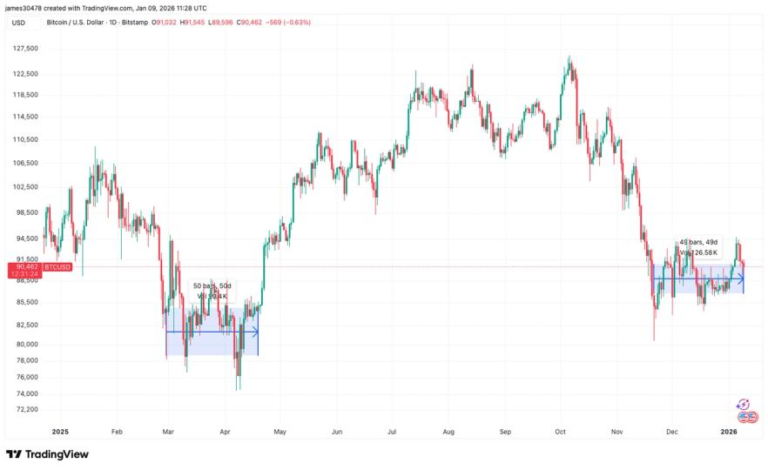
The current tight consolidation closely mirrors the April 2025 range that set the stage for the record run above $126,000.
U.S. added 50,000 jobs in December as unemployment rate fell to 4.4%

Bitcoin continued to hold just above $90,000 in the minutes following the report.
The Crypto payment gateways market: Global strategic business report 2025-2030 | Adoption of NFTs and digital goods payments strengthens gateway use in Metaverse and Gaming

The “Crypto Payment Gateways – Global Strategic Business Report” has been added to ResearchAndMarkets.com’s offering.
The global market for Crypto Payment Gateways was valued at US$1.5 Billion in 2024 and is projected to reach US$3.5 Billion by 2030, growing at a CAGR of 15.6% from 2024 to 2030. This comprehensive report provides an in-depth analysis of market trends, drivers, and forecasts, helping you make informed business decisions.
The growth in the crypto payment gateways market is driven by several factors, including increasing adoption of digital assets, advancements in blockchain technology, and rising demand for borderless and low-cost payment solutions. The surge in online commerce, particularly within the metaverse and NFT marketplaces, has created a strong need for seamless crypto payment integrations.
Additionally, the growing acceptance of cryptocurrencies by large corporations, including Tesla, Microsoft, and PayPal, is normalizing digital asset transactions, encouraging more businesses to integrate crypto payment solutions. The expansion of decentralized applications (DApps) and DeFi ecosystems is further fueling the demand for crypto-friendly financial infrastructures, making crypto payment gateways an essential component of the digital economy.
Furthermore, improvements in user-friendly interfaces, security enhancements, and regulatory compliance tools are increasing trust and adoption among both businesses and consumers. As blockchain technology continues to evolve and more industries recognize the potential of decentralized payments, the crypto payment gateway market is expected to witness sustained growth, positioning itself as a fundamental pillar of the future financial ecosystem.
Report Scope
The report analyzes the Crypto Payment Gateways market, presented in terms of market value. The analysis covers the key segments and geographic regions outlined below.
- Segments: Payment Gateways (Web-based Payment Gateways, Mobile-based Payment Gateways); Cryptocurrency (Bitcoin, Ethereum, Litecoin, Ripple (XRP), Bitcoin Cash, Dash, Other Cryptocurrencies).
- Geographic Regions/Countries: World; United States; Canada; Japan; China; Europe (France; Germany; Italy; United Kingdom; and Rest of Europe); Asia-Pacific; Rest of World.
Key Insights:
- Market Growth: Understand the significant growth trajectory of the Web-based Payment Gateways segment, which is expected to reach US$2.3 Billion by 2030 with a CAGR of a 18.2%. The Mobile-based Payment Gateways segment is also set to grow at 11.8% CAGR over the analysis period.
- Regional Analysis: Gain insights into the U.S. market, valued at $389.3 Million in 2024, and China, forecasted to grow at an impressive 14.6% CAGR to reach $542.6 Million by 2030. Discover growth trends in other key regions, including Japan, Canada, Germany, and the Asia-Pacific.
Some of the 39 companies featured in this Crypto Payment Gateways market report include:
- AlfaCoins
- BitPay
- Block (formerly Square)
- BVNK
- Coinbase Commerce
- CoinGate
- CoinPayments
- Coinremitter
- CoinsBank
- CoinsPaid
- CryptoPay
- CryptoProcessing.com
- GoCoin
- MoonPay
- NOWPayments
- PayPal
- SpectroCoin
- SpicePay
- Stripe
- Transak
Key Attributes
| Report Attribute | Details |
| No. of Pages | 139 |
| Forecast Period | 2024-2030 |
| Estimated Market Value (USD) in 2024 | $1.5 Billion |
| Forecasted Market Value (USD) by 2030 | $3.5 Billion |
| Compound Annual Growth Rate | 15.6% |
| Regions Covered | Global |
MARKET OVERVIEW
- Trade Shocks, Uncertainty, and the Structural Rewiring of the Global Economy
- How Trump’s Tariffs Impact the Market? The Big Question on Everyone’s Mind
- Crypto Payment Gateways – Global Key Competitors Percentage Market Share in 2025 (E)
- Competitive Market Presence – Strong/Active/Niche/Trivial for Players Worldwide in 2025 (E)
MARKET TRENDS & DRIVERS
- – Global Surge in Cryptocurrency Ownership Propels Demand for Crypto Payment Acceptance Infrastructure
- – Rising Merchant Demand for Borderless Transactions Strengthens the Business Case for Crypto Gateways
- – Decentralized Finance (DeFi) and Web3 Trends Fuel Integration of Wallets With On-Chain Payment Systems
- – OEM Focus on Multi-Coin Acceptance and Conversion Features Expands Merchant Adoption
- – Growing Demand for Lower Transaction Fees and Instant Settlements Supports Crypto Over Traditional Rails
- – Integration With E-Commerce Platforms Enhances Market Penetration
- – Increased Acceptance Among Freelancers, Creators, and Global Gig Economy Workers Expands B2C Adoption
- – Volatility Risk Management Features Like Auto-Conversion to Fiat Drive Adoption Among Risk-Averse Merchants
- – Regulatory Clarification and Tax Guidance in Key Markets Strengthens Merchant Confidence
- – Expansion of Stablecoin Payment Options Supports Use in Inflation-Prone and Developing Economies
- – OEMs Offering Custodial and Non-Custodial Gateway Models Cater to Varied Risk Profiles
- – Rising Consumer Expectations for Privacy and Anonymity Encourage Crypto Use Over Traditional Payment Apps
- – Use of Layer 2 Scaling Solutions and Lightning Networks Reduces Gas Fees and Enhances Transaction Speed
- – Adoption of NFTs and Digital Goods Payments Strengthens Gateway Use in Metaverse and Gaming
Bitcoin’s Next Parabolic Rally Hinges On A Key Data Point

Bitcoin’s long-term holders (LTHs) went through one of the most aggressive distribution phases on record in 2025. While the scale of selling rattled the market, onchain data analysis suggests that this pressure may be fading, possibly outlining the next bullish period for BTC price.
Key takeaways:
-
Long-term holders distributed about $300 billion in BTC in 2025, marking a historic supply reset.
-
Heavy LTH selling has occurred near cycle peaks or during structural transitions, not at the start of new downtrends.
-
With selling pressure stalling, the next phase may hinge on how early the long-term holder supply stabilizes.
A historic unwind backed Bitcoin’s 2025 volatility
The amount of Bitcoin (BTC) that had remained unmoved for at least two years moved onchain sharply in 2025. Nearly $300 billion worth of Bitcoin that had been dormant for over a year re-entered circulation. The 30 days from Nov. 15 to Dec. 14, 2025, marked one of the heaviest long-term holder (LTH) distribution periods in more than five years.
Since 2019, sharp declines in long-term holder (LTH) supply have rarely appeared in isolation. They have surfaced during phases when Bitcoin’s trend was already under strain, either approaching exhaustion or undergoing a structural shift.
In 2018, the LTH supply fell to 12 million BTC from 13 million, with selling intensity peaking when the 30-day distribution reached 1.08 million BTC in December. At that point, Bitcoin had already spent months declining. Price bottomed near $3,500 in February 2019, before stabilizing and rallying to $11,000 by mid-year, illustrating how heavy LTH selling could precede recovery rather than mark its end.
The 2020–2021 cycle unfolded differently. LTH supply dropped to 11.65 million BTC from 13.7 million BTC, while Bitcoin price rose to $61,000 from $14,000. The 30-day distribution peak of 891,000 BTC did not immediately halt the rally.
Instead, selling persisted as prices rose, gradually eroding upside momentum before the cycle ultimately rolled over, a reminder that LTH distribution can accompany expansion before defining its limits.

During the 2024–2025 bull run, supply declined to 14.5 million BTC from 15.8 million BTC, with the 30-day distribution peaking at 758,000 BTC. Price topped slightly earlier in March, and both metrics then moved sideways through Q2–Q3, reinforcing a familiar pattern: Price strength tends to fade as long-term holders step up distribution.
The final phase in mid-to-late 2025 proved more abrupt. LTH supply briefly recovered to 15.4 million BTC in June, before collapsing to 13.5 million BTC by December, the sharpest decline on record.
Price weakness appeared in October, but the most selling followed later, with the largest-ever 30-day distribution peak of 1.14 million BTC in November. That sequence suggests capitulation rather than orderly profit-taking, marking a reset rather than a continuation of the prior trend.
Related: Bitcoin RSI hints at $105K BTC price rebound as bull signals multiply
What the pause in selling may be signaling
Since December, the LTH supply has stopped falling, currently around $13.6 million, while Bitcoin has entered a sideways range. Additional confirmation comes from the long-term/short-term holder supply ratio.
Every time this ratio has fallen to –0.5 or below, Bitcoin has either entered a base-building phase or rallied to new highs within weeks. In December, the ratio dropped to about -0.53, after which price volatility compressed and momentum stalled, consistent with a reset rather than trend continuation.

Thus this combination, aggressive distribution followed by supply stabilization, has historically marked transition phases rather than trend continuation. If the trend repeats, the consolidation through Q1to Q2 could act as a base-building period, with any sustained rally more likely to emerge later, potentially into Q3.
Related: BlackRock adds $900M BTC as Bitcoin long-term selling falls to 2017 lows
This article does not contain investment advice or recommendations. Every investment and trading move involves risk, and readers should conduct their own research when making a decision. While we strive to provide accurate and timely information, Cointelegraph does not guarantee the accuracy, completeness, or reliability of any information in this article. This article may contain forward-looking statements that are subject to risks and uncertainties. Cointelegraph will not be liable for any loss or damage arising from your reliance on this information.
CoinDesk 20 Performance Update: Index Trades Flat as Polygon Gains 11.2%
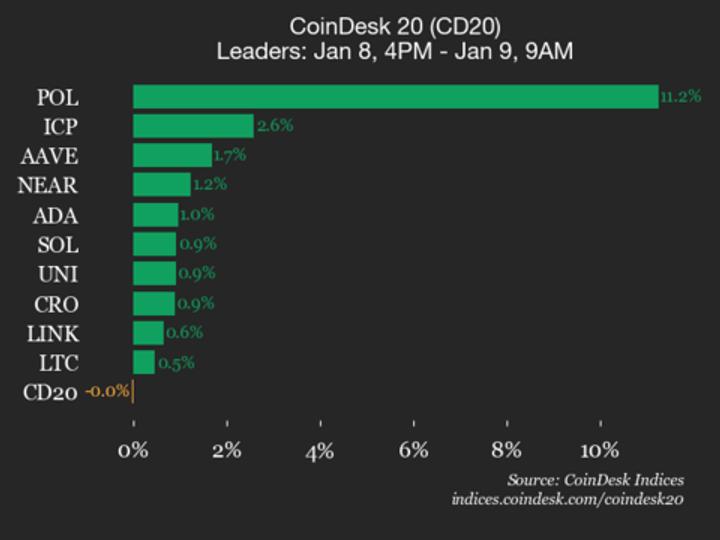
Polkadot (DOT) dropped 1.4% and Ripple (XRP) fell 0.9% from Thursday.