Home Blog Page 1223

Finextra’s US Regulation Pulse Check 2026

0


  • Which 2026 regulatory deadlines pose the greatest operational challenge for organisations?

  • How confident are companies in their ability to meet the new AML/CFT program requirements proposed by FinCEN?

  • Will the GENIUS Act drive the uptake of digital assets?

  • How have organisations adjusted capital planning or liquidity frameworks in response to anticipated Basel III recalibrations?

  • What partnerships or external support are banks leveraging to navigate the evolving US regulatory landscape?


Building on Finextra’s US Regulation 2025 Survey, our 2026 version captures and explores ongoing priorities within US regulation. It’s been a year since President Trump returned to office, giving way to a clearer deregulatory agenda, with many firms now facing new questions around risk, resourcing, and long-term planning. 

At the same time, multiple regulatory deadlines are converging for the US in 2026, including Treasury Central Clearing mandates, ACH fraud monitoring rules, the GENIUS Act, and AML/CFT programme redesigns, financial institutions are under pressure to prioritise and sequence their compliance efforts. 

As a result, the financial services industry must evaluate in advance which deadlines are causing the greatest concern and how firms are balancing urgency with strategic planning. Alongside this, while regulators revisit capital and liquidity frameworks, firms are recalibrating their financial strategies. 

Our 2026 US Regulation Pulse Check survey deep dives into this, providing insights into how ahead of 2026, institutions are leveraging AI and automation to meet compliance deadlines, adjusting their capital planning, stress testing, and liquidity buffers in anticipation of rule changes, and figuring out what this means for long-term financial stability and competitiveness. In a landscape marked by complexity and fragmentation, partnerships are becoming essential. 

Register for this PREDICT 2026 Finextra Research webinar to join our panel of industry experts who will discuss the 2026 US regulatory deadlines that pose the greatest operational challenge for organisations.
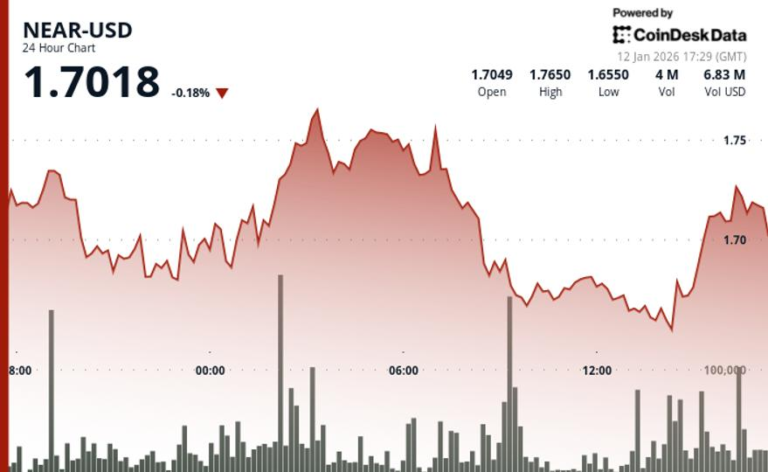

NEAR rises 5.7% to $1.73 before giving back gains

0

The layer 1 blockchain token advanced on moderately elevated volume but underperformed key benchmarks, raising sustainability questions.

Pundit Says Current Altcoin Trend “Feels” Like January 2019, Here’s What Happened Back Then

0

Trusted Editorial content, reviewed by leading industry experts and seasoned editors. Ad Disclosure

Talks of an impending altcoin season are once again gaining traction in the market as major cryptocurrencies saw a fresh rebound at the start of this year. A crypto analyst has likened the current altcoin market trend to that seen in January 2019—a period that marked the early stages of a major market turn. The comparison now has many traders watching closely to see whether the market could be setting up for a similar move. 

Current Altcoin Market Echoes Trend From January 2019

Crypto pundit Chad Steingraber said in a recent X post that today’s market feels a lot like January 2019, when investor sentiment was extremely negative. At the time, Bitcoin was trading near $3,000, and Ethereum’s price was around $100, when most believed the market was over. Yet despite the downtrend, the analyst revealed that he had invested heavily in both cryptocurrencies. 

Although the market was recovering from a bear market, Steingraber revealed that things began to turn around in April of that year, leading to the strong long-term results that are now widely known. Notably, during that time, the crypto market saw a strong breakout that changed sentiment across the space. 

According to CoinGecko’s yearly report for 2019, Bitcoin’s price surged over $13,000 in June and ended the year 95% higher than where it started. This price jump helped drive a broader market rally and marked a key transition from bear market lows earlier in the year. Altcoins also reacted to this surge in market momentum, as traders and investors sought growth beyond Bitcoin and diversified into lower-cap cryptocurrencies. 

While some altcoins, including Ethereum, Litecoin, and Bitcoin Cash, climbed by more than 40% in 2019, other large-cap tokens, such as XRP, performed poorly, finishing the year significantly weaker despite earlier strength in 2018. Excluding individual altcoin gains, the total cryptocurrency market capitalization grew by more than 44% in 2019, peaking at $350 billion in late June. The market also experienced a surge in trading volume of over 600%, along with renewed enthusiasm among investors who had stayed on the sidelines during the prior downturn. 

Altcoin Market Eyes Breakout As Analyst Flags 221B Level

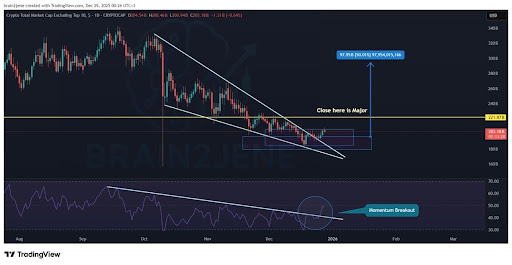
In a separate post, crypto analyst @brain2jene shared a chart tracking the total altcoin market capitalization, excluding the top 10 coins. He explained that a Falling Wedge breakout has already set the stage for the market’s next move. The analyst noted that the wedge pattern has been forming for weeks and emphasized that altcoins typically begin to move once the price breaks above the wedge lines shown on the chart. 

Altcoin
Source: Chart from @brain2jene on X

The chart also shows a clear pullback after the price hit the 221.87B resistance, which @brain2jene identified as the key level to watch. He explained that a clean break above 221.87B is critical and could add another $50-$60 billion to the market, with the target zone near the upper trend line.

Related Reading: Altcoin Season Index Crashes To Low 17 As Bitcoin Price Struggles, What This Means

Supporting this outlook, momentum appears strong, as the RSI on the chart has broken out of a downtrend. The analyst noted that this could signal the start of a broader altcoin rally, potentially boosting the price of coins like VeChain (VET), SUI, Internet Computer (ICP), and IMO.

Altcoin
Overall market cap excluding BTC at $1.25 trillion on the 1D chart | Source: TOTAL2 on Tradingview.com

Featured image from Adobe Stock, chart from Tradingview.com

Editorial Process for bitcoinist is centered on delivering thoroughly researched, accurate, and unbiased content. We uphold strict sourcing standards, and each page undergoes diligent review by our team of top technology experts and seasoned editors. This process ensures the integrity, relevance, and value of our content for our readers.

Russian boomers want their pensions paid in crypto, government body reveals – DL News

0

  • Russian pensioners ask pension fund for crypto pensions.
  • Older Russians also mining crypto, fund reveals.
  • Crypto adoption rates in older age groups growing fast all over the world.

Scores of Russian pensioners want their pensions paid in crypto and spend their free time mining Bitcoin.

The issue of cryptocurrency pensions was one of the Pension and Social Insurance Fund of Russia’s most popular requests last year, the Russian publication RG reported.

The fund said its agents fielded 37 million calls from pensioners in 2025.

“Current trends are being reflected in citizens’ questions,” the fund wrote on its Telegram channel.

“Many people inquired about whether it was possible to receive their pensions in cryptocurrency. Others asked whether their crypto mining income would be taken into account when we calculated their social benefit payments.”

More older people are turning to Bitcoin, as preconceptions about crypto being a young-person’s game begin to fade.

An analyst compared the baby boom generation to the Rock of Gibraltar in 2024, praising older investors’ resilience in hanging onto Bitcoin exchange-traded fund holdings.

Boomers eye Bitcoin

Despite a recent uptick in crypto adoption, Russian law still outlaws the use of crypto as a payment tool for private citizens, government entities, and corporations.

Crypto mining is also gaining momentum in Russia. Most private citizens can mine crypto at home without declaring their activities to the government.

But a November 2024 law stipulates that anyone using more than 6,000 kilowatt-hours of electricity per month must register with a Federal Tax Service-run registry and pay taxes on their earnings.

“Our experts politely explained to callers that all pension payments made from the fund are made exclusively in rubles,” the fund said. “They told callers that taxation of digital assets falls under the jurisdiction of the Federal Tax Service.”

Elsewhere, crypto adoption is also on the rise in older communities.

Prior to his election in May, South Korean President Lee Jae-myung promised to allow the National Pension Fund to invest in crypto. US pension providers have also discussed buying crypto in the future.

In the US, 12% of men aged 50 or older and 9% of women aged 50 or older say they own crypto, a Gallup poll revealed last year.

And in the UK, the pensions provider Cartwright Pension Trusts has backed an unnamed pension scheme to invest directly in Bitcoin.

The programme has since recorded a 56% gain over 12 months, with Bitcoin accounting for 3% of its holdings.

Tim Alper is a News Correspondent at DL News. Got a tip? Email at tdalper@dlnews.com.

Buterin Calls for Ethereum Updates to Ensure Blockchain Outlasts Its Developers

0

Ethereum’s co-founder said the network should remain usable and secure even if core developers step back from active updates.

Ethereum co-founder Vitalik Buterin says the network should eventually become more independent, arguing that the blockchain should remain usable and resilient even without constant updates.

In an extended X post today, Buterin framed this as a long-term test of Ethereum’s durability, calling it the “walkaway test,” and noting that Ethereum is “meant to be a home for trustless and trust-minimized applications, whether in finance, governance or elsewhere.”

As Buterin explained, Ethereum should host applications that work more like tools, “the hammer that once you buy it’s yours,” rather than like services that stop functioning if the vendor abandons them. He added that the network should reach a point where it can “ossify if we want to,” meaning the network’s core rules could remain stable for years without requiring constant upgrades.

“We do not have to stop making changes to the protocol, but we must get to a place where Ethereum’s value proposition does not strictly depend on any features that are not in the protocol already,” Ethereum’s co-founder wrote.

All Innovation Through Client Optimization

To reach that milestone, Buterin outlined several technical priorities, including quantum-resistant cryptography, a scalable architecture using zero-knowledge proofs, and a proof-of-stake model that “can last and remain decentralized for decades.” He added:

“Ideally, we do the hard work over the next few years, to get to a point where in the future almost all future innovation can happen through client optimization, and get reflected in the protocol through parameter changes.”

Buterin’s suggestion comes just a week after Zcash faced a governance shakeup, when the entire team at the Electric Coin Company (ECC), the for-profit company that oversaw Zcash development, announced they were leaving, following a dispute tied to the nonprofit, Bootstrap, that supports the project.

Josh Swihart, the now-former CEO of ECC, said in an X post that the team was “constructively discharged” after a majority of the Bootstrap board changed employment terms. He added that the changes made it impossible for the team to carry out its work “effectively and with integrity.” Despite the fact that the entire team announced it would continue to work on Zcash, just as part of a new company, the price of ZEC dropped by 20% in a day.

Practical AI for smarter payment exception handling

0


  • Design-time intelligence vs. runtime automation: How can financial institutions leverage upfront tooling to reduce exceptions before they happen or are noticed, especially as payments grow in volume and become more real-time? 
  • Balancing innovation with regulation: Banks can’t afford risky processes in exception handling, reconciliation, and triage. What are financial institutions proven strategies for deploying AI without adding risk to their clients’ working capital? 
  • Learning from the pioneers: Discover real-world lessons from teams already seeing impact by embedding AI into their design and decision-making processes. 
  • Knowing where each AI solution fits: Traditional deterministic processes excel at structured payment and exception handling. Where can generative and agentic AI supercharge human interventions and human reviews without overstepping their limitations? 


Payments keep the business world running. JP Morgan finds that global payment flows reached $195 trillion in 2024 and are expected to reach $320 trillion by 2032, with most value coming from demanding B2B clients. These corporations drove the shift to faster payments, and now they’re quick to switch banks in search of superior client servicing if even 1% of transactions hit snags that take weeks to resolve while the other 99% complete in moments. 

As organisations progress their ISO 20022 transitions and payment volumes continue to surge, investigation and exception handling becomes imperative to improve. But here’s the challenge: How can financial institutions effectively increase automation and apply AI to a process as sensitive as exception handling, where their clients’ working capital is already at risk and they face such robust regulatory scrutiny? 

Leading institutions are demonstrating that design-time intelligence can resolve up to 90% of exceptions through predictable, deterministic, workflow-based strategies, while strategically applying AI to influence the remaining 10%. These same institutions have discovered both the limitations and the secure applications of generative and agentic AI to supercharge their teams. 

With ISO 20022, CBDCs, digital currencies, and blockchain looming on the horizon, finetuning your payment exception handling, investigation, reconciliation, and triage isn’t optional — it’s essential for 2026 and beyond. 

Register for this Finextra webinar, hosted in association with Pega, to join our panel of industry experts who will discuss the impact of design-time tooling on exception handling and explore practical lessons for embedding AI into design and decision-making processes. 

BitMine adds 24,000 ether, but warns accumulation may slow without shareholder approval

0

The largest Ethereum-focused crypto treasury firm lifted holdings to 4.17 million ETH but signaled limits ahead without authorization to issue fresh equity.

Political Tensions Lift Gold as Bitcoin’s Rally Fades

0

Bitcoin briefly joined a rally in gold and silver sparked by U.S. political tensions, but failed to hold its gains. Options activity and persistent selling pressure suggest traders are pushing bullish expectations further out. Political Tensions Spark Safe-Haven Bid as Bitcoin Lags Bitcoin, gold, and silver moved higher during early Asian trading as the U.S. […]

Wall Street broker Benchmark says this could be a pivotal week for digital assets

0

Senate action on market structure legislation could end years of regulatory uncertainty, unlock institutional liquidity and re-rate crypto-linked stocks.

Trump Presses US Oil Expansion Into Venezuela, Signals Exxon Exclusion

0

President Donald Trump is pressing major U.S. oil companies to invest billions in Venezuela’s battered energy sector, but his enthusiasm cooled quickly after Exxon Mobil’s CEO dismissed the country as “uninvestable.” Trump Pitches Venezuela Oil Revival Venezuela reportedly holds the world’s largest officially recognized oil reserves, yet its production capacity has withered after years of […]