Home Blog Page 120

Crypto industry aghast at Illinois’ new tax on holding or transferring digital assets in state budget

0

The crypto industry is pushing back against a new tax law in the state of Illinois that enacts a 0.2% tax on businesses transacting or storing crypto for customers in the state, but it may be too late to change it in the short-term.

The law enacts a 0.2% tax on “receiving any digital asset business activity,” according to the text of the bill, which defined digital asset business activity as “any single occurrence of exchanging, transferring or storing a digital asset as part of a business or on behalf of a customer.”

The tax applies to firms that are based in Illinois or provide services to residents of the state with total gross receipts of at least $100,000. The tax is expected to raise around $60 million, said a person following the process.

The provision was added last-minute to Illinois’ broader budget bill, according to two people following the matter, and was approved by Governor J.B. Pritzker on June 16, according to the bill’s status page. The legislation creates a roughly $56 billion budget for the 2027 fiscal year and also includes new taxes on fantasy sports, social media and other areas, ABC 7 reported.

Mexican Billionaire Ricardo Salinas Bets 70% Of His Portfolio On Bitcoin, Eyes $1 Million Price

0

Long before bitcoin existed, Ricardo Salinas Pliego was learning about hard money at the family dinner table.

Born in Mexico City in 1955, Salinas is the founder and chairman of Grupo Salinas, a corporate conglomerate with interests in telecommunications, media, financial services, and retail. In 1987, he took over from his father as CEO of Grupo Elektra — originally a family-owned furniture manufacturing company founded in 1906 by his great-grandfather — and refocused it on appliances, electronics, and consumer credit for Mexico’s emerging middle class. 

Today, his empire includes Banco Azteca, TV Azteca, and dozens of other enterprises spanning the country.

But Salinas’ financial philosophy was shaped well before any of that. He traces his deep belief in fiat devaluation to the era when President Richard Nixon severed the U.S. dollar’s direct convertibility into gold, ending the gold standard. 

“The conversation at the family table, way back then, with my grandfather and my father was always about gold,” he told CoinDesk in a recent interview, adding that “the famous fiat fraud committed by Richard Nixon” was a constant topic of discussion at home. The Salinas family, long involved in gold and silver mining, had direct skin in the game.

Salinas: Bitcoin is unseizable 

Those early lessons hardened into conviction. Salinas has argued for years that bitcoin is unseizable and can be transferred instantly worldwide — advantages he sees as superior to both fiat money and the gold standard, which he says “has always been subject to governmental intervention.”

Salinas didn’t arrive at bitcoin all at once. His bitcoin allocation has grown dramatically — from just 10% of his investment portfolio in 2020 to 70% today, a trajectory that mirrors his deepening conviction in the asset over half a decade.

In June 2021, Salinas publicly announced he was working with his bank, Banco Azteca, to make it the first in Mexico to accept bitcoin — a bold move that drew both applause from the crypto community and swift pushback from Mexican financial regulators, who issued warnings about virtual assets. The banking ambitions stalled, but his personal conviction only grew.

That same year, his hunger for bitcoin exposure led him into one of the stranger episodes of his financial career. Salinas wanted to put $400 million into bitcoin in 2021 but didn’t have the liquid cash readily available, so he borrowed against his shares in Grupo Elektra — pledging $416 million as collateral for a $150 million loan. 

His instincts about bitcoin were correct. The only problem was the lender turned out to be a fraud: a firm calling itself Astor Capital Fund, whose CEO “Thomas Astor-Mellon” introduced himself on a video call from what appeared to be a yacht, but was actually a man with prior convictions for forging prescriptions and stealing jewelry.

Even that painful episode didn’t shake him loose. At Bitcoin 2022, Salinas gave a keynote address discussing what he calls the “fiat fraud” — his term for centralized institutions that assure users of generational wealth while quietly destroying their currency’s purchasing power. He told the crowd his conviction was personal, not theoretical: “It’s one thing to understand a theoretical problem, and another to have lived it in your skin.”

The 70% bet — and why you should mortgage your house to buy Bitcoin

As of today, Salinas has placed approximately 70% of his investment portfolio into BTC — a figure he discussed in the interview with CoinDesk. 

The allocation dwarfs what most wealth advisers would sanction. But Salinas has never been one for conventional wisdom. He is so convinced of BTC’s long-term superiority that he persuaded his own wife to act. 

“I know this is a controversial topic, but I convinced my wife to mortgage the house that she has and take a loan to buy bitcoin,” he said. And she did.

He wants ordinary investors to think similarly. “For most people, the biggest investment, their nest egg, is their home equity,” he said. “Find a way to transform that into some kind of bitcoin exposure to a larger or to a smaller degree.”

His argument is grounded in a straightforward historical comparison. In January 2016, bitcoin hovered near $400 and the average Central London home cost roughly $1.6 million — about 4,000 bitcoin. With London property prices little changed a decade on, that same home would now cost fewer than 30 bitcoin. For Salinas, that comparison is all the proof anyone needs.

“It’s an asymmetrical bet to the upside,” he told CoinDesk. “The more people find out about bitcoin, the more demand there will be.”

When asked on the price predictions of fellow BTC bulls like Cathie Wood and Michael Saylor — who have suggested bitcoin could eventually reach seven figures — Salinas was uncharacteristically brief.

“So it will be a million dollars,” he said. “I just don’t know when.”

Bybit added to Singapore MAS Investor Alert List

0

Crypto exchange Bybit has been added to the Monetary Authority of Singapore’s (MAS) Investor Alert List, a registry designed to warn consumers about entities that may be wrongly perceived as licensed or regulated by the financial watchdog. 

Bybit Fintech Limited and Bybit appeared on the MAS alert list on Wednesday, although the regulator did not provide a specific reason for their inclusion.

Bybit Fintech Limited, the corporate entity behind the exchange, appears on the MAS Investor Alert List website. Source: MAS

According to MAS, the Investor Alert List identifies entities and investment offers that may create the false impression of being licensed, authorized, regulated or registered by the authority, or whose investment offerings may be mistakenly viewed as having received MAS approval.

Based on publicly available information, Bybit is not licensed or regulated by MAS. Cointelegraph reached out to a Bybit spokesperson for comment but did not receive a response by the time of publication.

Although Bybit was founded by Singaporean entrepreneur Ben Zhou, the exchange does not operate in the city-state. Singapore is listed among the company’s “Service Restricted Countries” on its website, meaning users in the jurisdiction are not permitted to access its services.

Related: SBI Holdings targets majority stake in Singapore crypto exchange Coinhako

Singapore maintains strict oversight of crypto sector

Singapore has cemented its position as a leading crypto hub, ranking among the world’s top jurisdictions for decentralized finance and institutional digital asset services in Chainalysis’ 2025 Global Crypto Adoption Index. Retail crypto adoption, however, ranked significantly lower.

The MAS has continued to take an assertive approach to industry oversight. In May, the regulator revoked the Major Payment Institution license of crypto liquidity provider Bsquared Technology after uncovering what it described as serious regulatory breaches, including weaknesses in risk management and conflict-of-interest policies. 

MAS also said the company had provided false or misleading information on multiple occasions, from its initial license application through a subsequent inspection.

Separately, Singapore police charged former Hodlnaut CEO Zhu Juntao in May with six counts of fraud for allegedly misleading customers about the crypto lender’s exposure to the 2022 Terra ecosystem collapse.

Hodlnaut, a Singapore-based crypto lending platform that once served tens of thousands of users, suspended withdrawals in August 2022 following the Terra implosion and was later ordered to liquidate.

The regulator placed Binance.com on its Investor Alert List in 2021, The Straits Times reported at the time. However, a search on Wednesday of the list did not show any mention of Binance among 910 records in the query.

Related: Singapore Gulf Bank adds stablecoin mint and redeem for 24/7 settlement

Coinbase Stakes Out Brokerage Territory With SEC-Registered AI Advisor and Stock Options Push

0

Coinbase used its latest “System Update” Tuesday to push deep into territory long held by retail brokerages, rolling out an SEC-registered AI investment advisor, stock and ETF trading on its professional platform, and options markets for both equities and crypto. The bundle moves the exchange’s competitive frame from Binance and Kraken toward Robinhood, Schwab, and Interactive Brokers.

Coinbase used its latest “System Update” on Tuesday to push deep into territory long held by retail brokerages, rolling out an SEC-registered AI investment advisor, stock and ETF trading on its professional platform, and options markets for both equities and crypto. The bundle moves the exchange’s competitive frame from Binance and Kraken toward Robinhood, Schwab, and Interactive Brokers.

The package, outlined Tuesday in a blog post from the company, frames the strategy as building “the Everything Exchange.” CEO Brian Armstrong’s team itemized a wave of new and forthcoming features that include Coinbase Advisor, an AI-powered tool registered with the SEC, CFTC and NFA; pre-IPO perpetual futures via Coinbase Bermuda; real-world-asset perps tied to thematic equity baskets; and a planned unified global liquidity pool merging the company’s US spot exchange, international derivatives venues, and Deribit.

Available Now

Several pieces are available now. Coinbase Advisor, the AI investing tool, is rolling out first to Coinbase One subscribers in the United States. Existing stock portfolios can be transferred in from outside brokerages, and equities trading is now exposed inside Coinbase Advanced with zero commissions, fractional shares, TradingView charting, and rewards of up to 3.5% on idle USDC balances.

Borrowing against staked Solana also went live this week through an integration with Jito and Morpho on Base, with JitoSOL loans capped at $100,000. The Coinbase One Card travel portal, paying 5% Bitcoin back on bookings, and a USDC-collateralized version of the card aimed at applicants without traditional credit histories also launched.

Pre-IPO perps debuted earlier in June. SpaceX was the launch listing, and Coinbase said contracts referencing Anthropic and OpenAI, which are anticipated to go public later this year, will follow. The product is offered by Coinbase Bermuda under a BMA license, and excludes US customers.

Not Yet Live

The headline products in the bundle still carry forward dates. Tokenized stocks backed 1:1 by underlying US shares, with on-chain dividend payouts and shareholder rights, arrive next month for non-US customers, the company said.

Options trading for crypto and stocks is “in the coming months,” with no specific date attached. The unified global liquidity pool combining Coinbase’s US spot venue, international derivatives platforms, and Deribit is similarly slotted for “the next few months.”

Regulatory frame

Coinbase Advisor is the most novel piece. The company describes it as one of the world’s first AI-powered, SEC-registered in-app investment advisors. Per Coinbase’s disclosures, the product is offered by Coinbase Advisors, LLC, a Commodity Trading Advisor registered with the NFA and a Registered Investment Advisor registered with the SEC.

The advisor pulls from a user’s portfolio and account history and surfaces tax-loss harvesting strategies, news-driven multi-asset trade ideas, and portfolio recommendations through a natural-language interface.

Coinbase notes in fine print that outputs may be inaccurate or incomplete and that CFTC, NFA, or SEC registration does not imply endorsement of the product.

The advisor sits alongside Coinbase for Agents, launched June 11, which lets third-party AI systems like ChatGPT or Claude execute trades within user-defined guardrails on a separate sub-account.

The derivatives stack

Beyond options, Coinbase is layering several derivatives expansions. RWA perpetual futures will offer thematic exposure to AI, Chinese equity, Defense, and Tech 100 baskets, complementing the perpetual-style equity index futures the firm rolled out on its CFTC-regulated US venue earlier in June. Crypto binaries, time-boxed up-or-down contracts on assets including BTC, ETH, and SOL across 15-minute to annual windows, and “combos” that bundle multiple predictions into a single trade, expand the prediction-markets footprint Coinbase has been building since acquiring The Clearing Company late last year.

The unified liquidity pool will matter most for sophisticated traders. Coinbase said it is the first venue approved by the CFTC to offer global regulated crypto derivatives, including options, to Americans. Routing US spot, international perps, and Deribit options inventory through one book would put the firm closer to the depth profile of Binance’s combined spot and perp markets.

Diversified Revenue

Coinbase generated $1 trillion in annual stablecoin payment volume on its rails, according to disclosures Armstrong made the previous week, but the firm reported a Q1 quarterly loss of $394 million and has been working to diversify away from transaction-based revenue.

The System Update’s recurring-revenue components, the credit card travel portal, USDC-secured loans, and subscription-tier access to Coinbase Advisor, are the financial reframing.

Competitive pressure has tightened as well. Kraken launched perpetual futures in the US via Bitnomial earlier in June, and brokerages such as Robinhood have steadily layered crypto onto their own equities apps. Coinbase’s response is to push the convergence in the opposite direction, putting stocks, options, prediction contracts, and an AI advisor inside what was an exchange app.

Moody’s rolls out credit ratings onchain in tokenized asset push

0

Moody’s Ratings is rolling out its credit ratings to Solana (SOL), allowing issuers of tokenized bonds and other fixed-income securities to embed the firm’s assessments directly into blockchain-based assets.

The move, announced Wednesday in partnership with Solana-focused tokenization specialist Alphaledger, expands Moody’s Token Integration Engine (TIE) to a major public blockchain after its first deployment earlier this year on the institutional-focused Canton Network (CC).

The move builds on a pilot project completed last year, when they demonstrated how municipal bond ratings could be attached directly to tokenized securities on Solana.

Tokenization — the process of creating blockchain-based versions of traditional assets — has become one of the fastest-growing areas of finance. Asset managers including BlackRock, Franklin Templeton and Apollo have launched tokenized funds and credit products, while Boston Consulting Group and Ripple estimate the market could reach $18.9 trillion by 2033.

As tokenization gains traction, financial firms are increasingly focused on bringing the infrastructure surrounding traditional assets onto blockchain rails. That includes ownership records, pricing data, compliance information and credit ratings.

Bitcoin Markets Still Spooked by Possible Strategy BTC Sales: Analysis

0

Bitcoin (BTC) bounced off week-to-date lows into Wednesday’s Wall Street open as corporate sell pressure returned to the radar.

Key points:

  • Bitcoin sees a new low for the current weekly candle with the Fed FOMC meeting due in hours.
  • Analysis warns that markets remain concerned over Strategy potentially selling more BTC.
  • Fed chair Kevin Warsh faces a tough balancing act at his first interest-rate decision.

Strategy selling still impacting Bitcoin price strength

Data from TradingView showed BTC/USD heading higher after dropping to $64,500 on Bitstamp.

BTC/USD one-hour chart. Source: Cointelegraph/TradingView

The pair saw ongoing weakness ahead of the US Federal Reserve’s interest-rate meeting, scheduled for 2pm Eastern time. As Cointelegraph reported, such events tend to trigger BTC price downside.

In its latest Market Color analysis, trading company QCP Capital said that the BTC price outlook was clouded by more than just the Fed.

“While broader markets continue to trade higher on optimism across multiple fronts, BTC remains stuck below the 66k level,” it wrote. 

“The underperformance has been driven in part by concerns that Strategy may need to sell more Bitcoin to fund dividend payments, especially after buying back $1.5 billion of its 2029 Convertible Senior Notes.”

Source: Cointelegraph

QCP explained that contingency measures by technology company Strategy had “extended its runway” in terms of liquidity after selling 32 BTC in May, but markets remained wary of potential problems further down the line.

“In the short term, we think this overhang may continue to prevent Bitcoin from fully participating in the broader macro optimism. However, as Strategy continues to issue shares and lengthen its runway, that optimism may eventually catch up to BTC,” it continued.

“For now, the macro tide has turned more supportive, but Bitcoin still has one very specific overhang to work through.”

Fed’s Warsh faces “difficult opening act”

On the Fed, meanwhile, QCP joined those putting the focus on new Fed chair, Kevin Warsh.

Related: Can BTC rebound to $69K as oil price plunges? Five things to know in Bitcoin this week

“Warsh takes the stage at his first Fed meeting as Chair today,” it stressed.

“Previous expectations had positioned him as dovish and more inclined toward rate cuts, but the economic backdrop has shifted materially.”

QCP described a “difficult opening act” for Warsh, who should balance inflationary trends with pressure to cut rates from president Donald Trump.

“Today’s meeting will therefore be about more than the rate decision,” it continued, referring to outgoing chair, Jerome Powell. 

“It will be Warsh’s first opportunity to secure buy-in from Powell and the rest of the Board, while establishing himself as a credible and independent Fed Chair.”

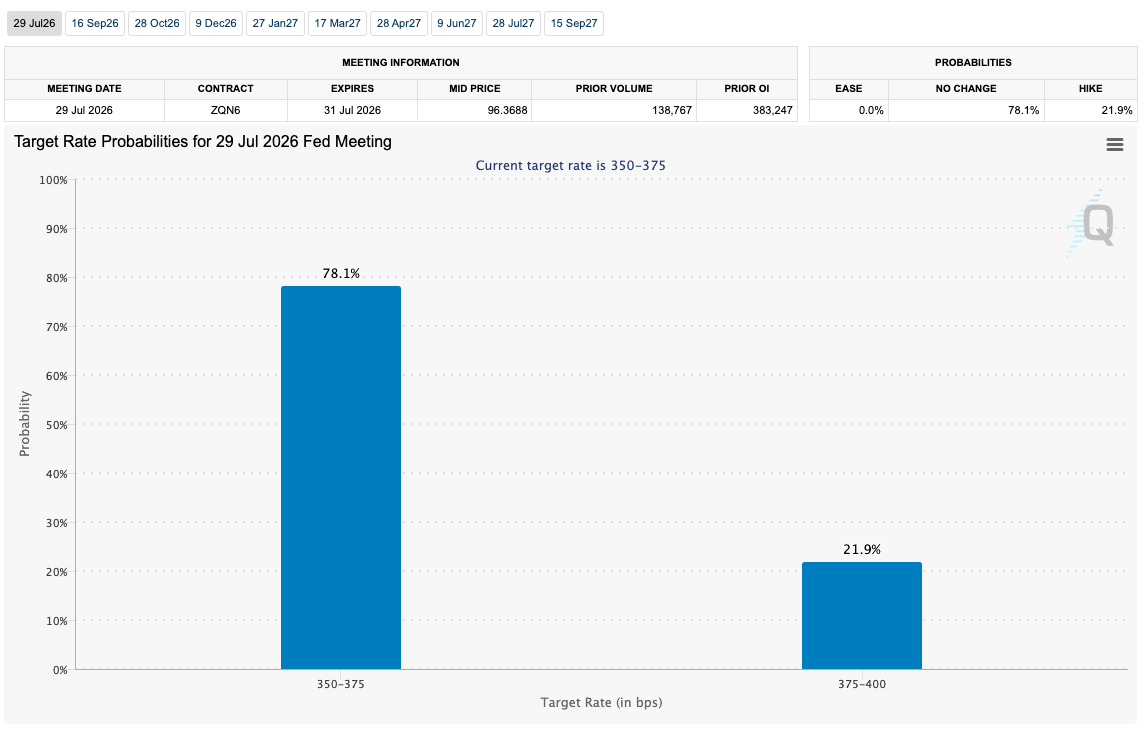
Fed target rate probabilities for Wednesday FOMC meeting (screenshot). Source: CME Group

Data from CME Group’s FedWatch Tool showed no odds of the Federal Open Market Committee (FOMC) cutting rates.

Andre Dragosch, European head of research at crypto asset manager Bitwise, noted that markets increasingly expected a rate hike by the end of the year — a clear would-be headwind for crypto and risk assets.

“IMO still a lot of monetary policy uncertainty around the question whether Warsh is rather hawkish or dovish amid the rise in inflation,” he wrote in a post on X.

Fed target rate probabilities (screenshot). Source: CME Group

BitGo’s $50 million buyback sparks rally after shares lost 65% since IPO

0

The decline is a reflection of a broader slump in investor sentiment toward digital asset-linked stocks. After a wave of crypto IPO enthusiasm last year, bitcoin and cryptocurrency prices have tumbled, and attention has increasingly turned toward artificial intelligence (AI) companies and a pipeline of highly anticipated tech listings like SpaceX (SPCX).

Several crypto companies, including Kraken and Consensys, have halted their efforts amid turbulent crypto markets.

BitGo provides custody, trading, staking and settlement services for digital assets. It also issues USD1, the U.S. dollar stablecoin tied to the Trump family-backed World Liberty Financial project.

The firm has also been promoting its Germany’s BaFin-regulated infrastructure platform as an option for companies adapting to the European Union’s digital asset regime, MiCA, ahead of a licensing deadline at the end of the month.

Crypto’s security nightmare won’t be solved by ordinary audits

0

Audits are accomplishing exactly what they are designed to do — discovering errors in the code. And they’re working. Fewer attacks than before take advantage of faulty code to steal platform funds.

The problem, however, is that we’re seeing a growing disconnect between what audits examine and what attackers actually exploit. Today, the industry’s largest losses don’t actually originate from traditional smart contract vulnerabilities. Rather, they come from compromised private keys, governance manipulation, insider compromise, malicious dependency updates and operational failures.

As brilliant as they are at identifying code vulnerabilities, traditional audits cannot prevent a developer from falling victim to a phishing campaign. The best code in the world can still sit atop vulnerable operational infrastructure.

In fact, our research shows that, when measured by financial damage, these operational exploits are often far more devastating than code vulnerabilities themselves. The industry has invested enormous resources into reducing smart contract risk, but the costliest attack vectors remain comparatively under-defended. It’s like the industry is still focused on defending against the last generation of attacks, whereas malicious actors have moved on to different strategies.

Audits alone create a dangerous illusion of safety

Platforms frequently advertise the number of audits they have completed, the reputation of the firms they hired, or the volume of findings identified during review. These have become shorthand indicators for whether a project is safe.

DeFi Lending and DEX Fees Slump as Leverage Drains Out After June Selloff

0

Fees fell as much as 65% week over week across the largest lending protocols and decentralized exchanges.

Fees across DeFi’s largest lending protocols and decentralized exchanges fell by as much as much as 65%, a broad contraction that lending and credit-market operators attribute to leverage unwinding after early June’s selloff rather than a structural break in onchain credit.

Rolling seven-day fees of Aave V3, the largest decentralized lending protocol by TVL, dropped by 60% versus the previous perid, to $6.72 million, per DefiLlama. Morpho Blue’s fees fell by 60% to $3.27 million and Maple Finance’s dropped 59% to $1.25 million. The pullback was just as steep on exchanges: Uniswap V3 fees fell 57% to $3.74 million and Curve DEX dropped 65% to $891,000.

The weekly numbers look like a rout. The 30-day numbers do not. Over the trailing month, Morpho Blue’s fees are up 23%, Maple’s up 49%, Uniswap V3’s up 27% and Curve’s up 71%, DefiLlama data show. The gap between a steep weekly drop and a higher monthly signal a deleveraging reset.

DeFI Lenders 7-day Fees. Source: DeFiLlama

Fees on variable-rate onchain credit and trading venues move with the amount of leverage and risk appetite in the system.

The week the contraction is measured against included early June’s selloff and one of the heaviest liquidation days of the year, when unwinding positions and spiking borrow rates generate outsized fees, said Himanshu Sahay, co-founder of Arch Network, a fixed-rate onchain lending platform, rejects the framing outright.

“Crash weeks generate outsized fees as leverage unwinds and borrow rates spike. The past week was the calmer, deleveraged aftermath, so the comparison reads as a collapse when it is closer to mean reversion,” Sahay said.

The mechanism is structural to the product, he added: “Fees on these protocols track how much leverage is in the system, so when utilization falls, rates and fees fall with it. That sensitivity is a natural tradeoff of variable-rate, onchain credit.”

the-defiant
DeFi DEXs 7-day Fees. Source: DeFiLlama

The Carry-Trade Compression

The reason the contraction hit every cohort at once is a familiar one to anyone who watches traditional credit. Yields are a function of what borrowers can profitably do with capital, not just how much is available to lend, said Misha Putiatin, co-founder of Symbiotic, a collateral markets platform.

“Borrowers pay interest because they expect to deploy that capital into strategies that generate a higher return, it’s called a carry trade. Right now, there is still a large amount of capital available to lend, but fewer attractive, scalable opportunities to deploy borrowed funds, especially since liquidity providers are broadly risk averse after KelpDAO hack and STRC depeg,” said Putiatin.

When the supply of lendable capital outruns productive demand, Putiatin said, borrowing costs fall and lending yields compress. The pattern explains why protocols with distinct architectures and borrower bases moved together: when carry opportunities dry up across the asset class, every venue absorbs the same compression at roughly the same rate.

A Leverage Cycle, Not a Structural Break

Jacopo Buriollo, founder and CEO of Megawatt Finance, which finances energy infrastructure onchain, reads the move the same way.

“The recent collapse in DeFi lending fees looks less like structural weakness and more like leverage premium unwinding,” he said. “After the post-exploit liquidity squeeze, stablecoin borrow rates normalized as capital returned and risk appetite cooled. The bigger lesson is that DeFi credit is still too dependent on reflexive leverage cycles.”

The contraction was not uniform, which further undercuts the collapse reading. SparkLend, the MakerDAO-affiliated lender, fell 20.7% to $989,000 in seven-day fees. Euler V2 edged down just 2.8% to $477,000. Compound V3 was the lone protocol with positive momentum, rising 3.8% to $368,000. Compound’s resilience suggests its borrower base, which skews toward USDC working-capital positions, sat out the week’s deleveraging, while SparkLend’s milder decline may reflect its integration with DAI liquidity reserves.

The market is not pricing structural distress. The AAVE token is up roughly 23% over the past seven days, per CoinGecko, while UNI is up 31%.

All three operators pointed past the leverage cycle to real-world assets as the next source of onchain yield.

“The next phase of sustainable onchain yield will come from financing productive, cash-flowing real-world assets, including energy infrastructure, where returns are driven by economic activity, not just speculative borrowing demand,” Buriollo said. Putiatin made the same case, arguing the industry is “much better positioned to find our footing, with new sources of yield coming onboard from RWAs and other sustainable sources.”

Bitcoin Cash (BCH) drops 3.1%, leading index lower

0

CoinDesk Indices presents its daily market update, highlighting the performance of leaders and laggards in the CoinDesk 20 Index.

The CoinDesk 20 is currently trading at 1774.43, down 1.5% (-26.19) since 4 p.m. ET on Tuesday.

Four of 20 assets are trading higher.

Leaders: UNI (+2.5%) and XLM (+2.3%).

Laggards: BCH (-3.1%) and ADA (-2.8%).

The CoinDesk 20 is a broad-based index traded on multiple platforms in several regions globally.