Home Blog Page 1197

Ethereum Foundation Forms Post-Quantum Team as Security Concerns Mount

0

In brief

  • The Ethereum Foundation has created a new Post Quantum team, according to a post from researcher Justin Drake.
  • The effort centers on LeanVM, new developer calls, live post-quantum devnets, and $2 million in prizes.
  • Drake said a full post-quantum roadmap is coming, with the goal of zero fund loss or network downtime.

The Ethereum Foundation has officially elevated post-quantum security to a top-tier strategic priority, establishing a dedicated internal team as industry experts warn of accelerating threats from quantum computing.

In an announcement posted on X on Friday, Ethereum Foundation researcher Justin Drake unveiled the formation of the Post-Quantum (PQ) team, labeling the initiative a decisive “inflection point” for the network’s long-term strategy.

“After years of quiet R&D, EF management has officially declared PQ security a top strategic priority,” Drake wrote, saying that Ethereum’s journey to post-quantum began in 2019. “It’s now 2026, timelines are accelerating. Time to go full PQ.”

The effort, Drake said, will be led by Thomas Coratger and the contributing team behind LeanVM, which he called a “cryptographic cornerstone of our entire post-quantum strategy.”

The announcement follows growing pressure across the crypto industry to prepare for a future in which quantum computers could undermine today’s blockchain cryptography. Ethereum, like Bitcoin, relies on elliptic-curve cryptography, which researchers say could eventually be broken by sufficiently powerful quantum machines.

Earlier this month, Ethereum co-founder Vitalik Buterin warned developers not to delay preparing for the day a practical quantum computer comes online, arguing that the network should be able to function for decades without relying on constant upgrades.

“Being able to say ‘Ethereum’s protocol, as it stands today, is cryptographically safe for a hundred years’ is something we should strive to get to as soon as possible, and insist on as a point of pride,” he said.

Beginning in February, Drake continued, Ethereum Foundation researcher Antonio Sanso will lead a biweekly All Core Developers breakout call on post-quantum transactions, focused on user-facing security issues like account abstraction, and longer-term transaction signature aggregation.

Drake also announced a $1 million Poseidon Prize, a contest to harden the Poseidon hash function used in Ethereum applications. “We are betting big on hash-based cryptography to enjoy the strongest and leanest cryptographic foundations,” he wrote.

Drake’s work on Ethereum’s post-quantum strategy overlaps with broader industry efforts. He is also a member of a recently formed quantum advisory board at crypto exchange Coinbase, which is focused on assessing how future quantum advances could affect blockchain security and how long-term cryptographic transitions might be managed.

“Believe in something,” he wrote. “Believe in [post-quantum] security.”

Daily Debrief Newsletter

Start every day with the top news stories right now, plus original features, a podcast, videos and more.

Bitcoin Pattern From 2022 That Led To Crash To $20,000 Has Reappeared Again

0

Trusted Editorial content, reviewed by leading industry experts and seasoned editors. Ad Disclosure

Bitcoin (BTC) is mirroring the same setup from its 2022 bull cycle, which led to a massive price crash to $20,000. According to market expert Crypto Bullet, this recurring structure could signal another major correction for BTC ahead. However, this time the leading cryptocurrency could give up almost a quarter of its current value. 

2022 Bitcoin Chart Pattern Signals Over 20% Crash

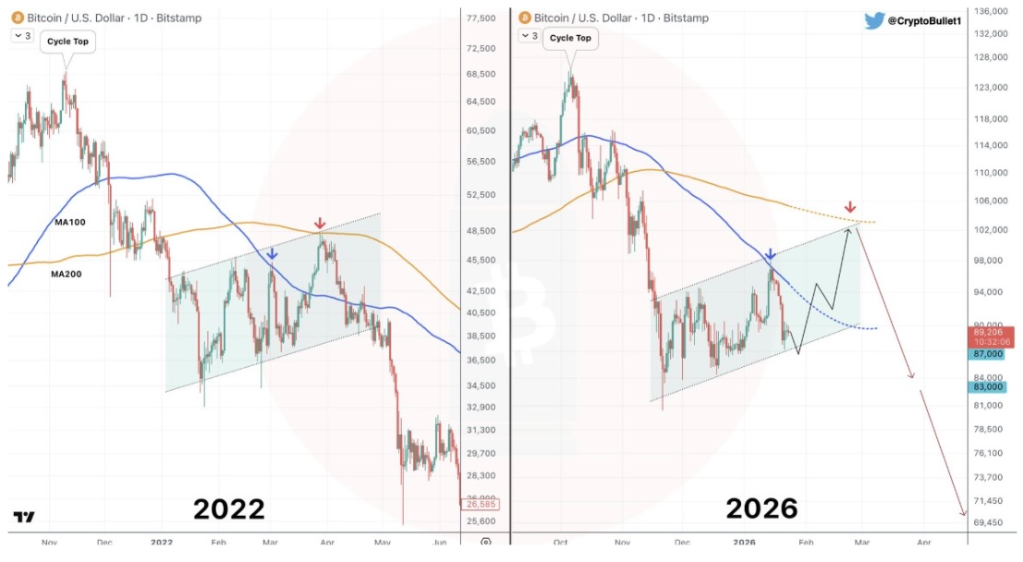
In his technical analysis released on X, Crypto Bullet revealed that Bitcoin is currently repeating a 2022 structure that could lead to a more than 20% decline in its value. To support his bearish outlook, the analyst presented a parallel chart comparing Bitcoin’s price action from 2023-2022 and 2025-2026, highlighting similar technical patterns, price behavior, and Moving Averages (MA). 

During the 2022 cycle, Bitcoin experienced a similar pattern, beginning with a test of the 100-day Moving Average (MA100), highlighted as the blue trendline on the chart. After facing rejection at that level, the price pulled back to a nearby support zone inside a rising channel. From there, BTC staged a sharp rally, surging to fresh highs around $48,500, where it aligned with the 200-day Moving Average (MA200), marked in orange. 

However, the recovery proved short-lived. Bitcoin soon reversed course and failed to reclaim the MA200 as support. Once the cryptocurrency’s price structure was lost, downside momentum accelerated, pushing the price into a much deeper correction toward the $20,000 level. 

According to Crypto Bullet, Bitcoin is repeating this exact pattern in 2026. It has already retested the MA100, gotten rejected, and moved lower into a support zone within a similar ascending channel. The chart also showed that in both cycles, BTC reached a “market cycle top,” first around December 2023 and then again in November 2025, before breaking down and entering a consolidation phase. 

BTCUSD currently trading at $89,361. Chart: TradingView

Given how closely Bitcoin is mirroring its 2022 setup, Crypto Bullet has forecast another dramatic price crash, predicting a more than 23.5% drop from its current price near $89,500 to $68,450. Before this decline happens, the analyst expects BTC to experience a short-term recovery, potentially climbing back above the $100,000 psychological level to reach $102,000. 

Bitcoin Could Still Rally To $92,000

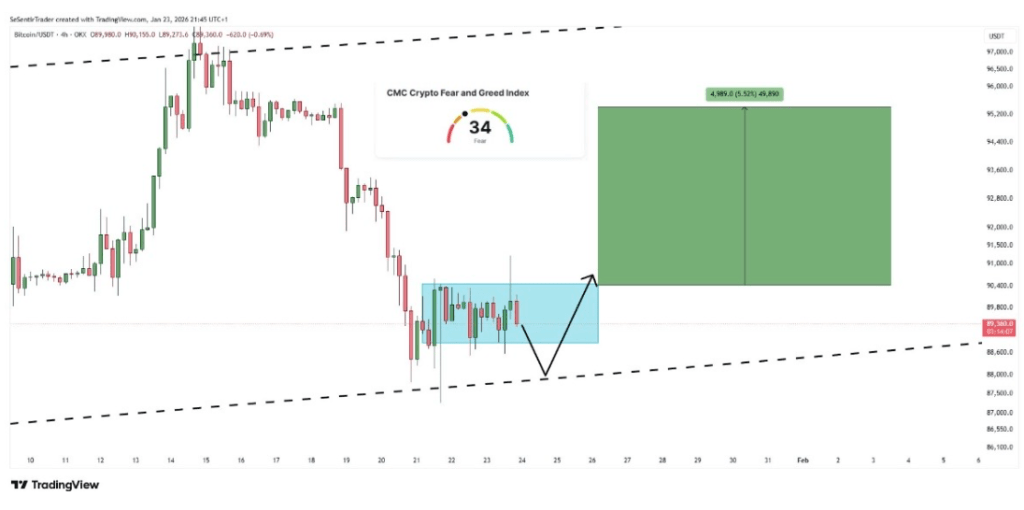
Crypto analyst Tyrex has stated that Bitcoin has been consolidating for the past 48 hours, with price holding above $89,000 for most of that period. Despite the muted price action, he believes that BTC could soon rally to $92,000. The analyst also noted that the broader market is in a state of fear, with many traders anticipating further declines in Bitcoin.

However, the analyst cautions that this expected drop may be a trap. He points out that an ascending channel is forming on Bitcoin’s chart, prompting him to adopt a more bullish outlook despite the prevailing bearish sentiment and sideways price movement.  

Featured image from Unsplash, chart from TradingView

Editorial Process for bitcoinist is centered on delivering thoroughly researched, accurate, and unbiased content. We uphold strict sourcing standards, and each page undergoes diligent review by our team of top technology experts and seasoned editors. This process ensures the integrity, relevance, and value of our content for our readers.

Bitcoin price slumps after investors fast cash out of ETFs to avoid risk – DL News

0

  • Bitcoin is down significantly over the past week.
  • Investors cashed out of US exchange-traded funds, pushing the asset’s price down.
  • Geopolitical headwinds have rocked all markets in January.

Bitcoin’s price is down nearly 7% over the past week after US investors cashed more than $1.3 billion out of exchange-traded funds giving exposure to the leading digital coin.

The price of Bitcoin recently stood at $89,225, according to CoinGecko, a drop of 1% over a 24-hour period. Investors cashed out every single day this week from US funds, according to Farside Investors data.

Bitcoin traded higher last weekend — briefly touching $95,419 — before dropping hard on US President Donald Trump’s renewed tariff threats.

The US leader reiterated the US’ claim on Greenland Wednesday and said he’d hit European allies with trade tariffs, spooking markets and spurring an immediate sell-off across major assets, including bonds, stocks and crypto.

Bitcoin is down from this time last year. Source: CoinGecko.

“ETFs continues to see outflows and on the desk we’ve noticed a pickup in off-ramping activity from stables to fiat, which indicates some reversal in mainly institutional participation which was picking up at the start of the year,” Jasper De Maere, desk strategist at market maker Wintermute, said in a Friday note shared with DL News, “noting geopolitical jitters” as a main catalyst.

Though the stock market rebounded Friday after Trump on Thursday reversed course on Europe tariff threats. Bitcoin and other digital coins and tokens are still down.

Experts earlier in the week told DL News that Bitcoin could drop as low as $75,000 due to increased volatility.

Should investors be worried?

Bitcoin is down 29% from the record of $126,080 it touched in October, and has largely struggled to recover from a sell-off that month when over $19 billion in leveraged positions were liquidated — the largest such event in the history of digital assets.

Things were looking up for crypto markets at the start of the year when US investors pumped over $1.5 billion in fresh cash at Bitcoin and Ethereum ETFs over the space of two days.

But geopolitical headwinds haven’t helped the digital coin — which has typically traded in line with other “risk-on” assets — either.

Still, investors are reminded to zoom out, according to experts, bearing in mind that long-term gains are what one should pay attention to with digital assets.

“Sometimes with Bitcoin, you have to really focus on the annualized return,” Bloomberg’s senior ETF analyst told DL News, adding that all things are in place — such as government debt and increased liquidity — for the asset to have a good 2026.

Following the COVID-19 pandemic, Bitcoin largely traded in correlation with tech stocks. But its returns are becoming more de-coupled from other assets.

Last year, Bitcoin finished in the red while stocks finished on a high. But while some investors bemoaned this, it’s actually what they should look for, added Balchunas.

“If you want Bitcoin to be seen as an alternative, you want it to act in a way that isn’t expected,” he said, adding that investors should pay less attention to short-term news that causes Bitcoin’s price dips and use the asset as something over the long-term that can give returns when other assets don’t.

Mathew Di Salvo is a news correspondent with DL News. Got a tip? Email at mdisalvo@dlnews.com.

Robert Kiyosaki Predicts Silver to Hit $200 as He Buys More Bitcoin

0

Silver is positioned for a dramatic surge as mounting U.S. debt and eroding dollar purchasing power push investors toward hard assets, with Robert Kiyosaki spotlighting precious metals and crypto as long-term winners amid deepening distrust in monetary leadership. Robert Kiyosaki Keeps Buying More Bitcoin and Silver as the Dollar Nears a Breaking Point Rich Dad […]

Vibe With Mommy OnlyFans: Building Community, Connection, and Creativity

0

In the evolving world of digital content creation, platforms like OnlyFans have opened the door for creators to connect directly with their audiences in authentic, engaging, and subscriber-focused ways. One standout presence in this landscape is vibe with mommy Onlyfans— a creator who has cultivated a dedicated following by combining personality, connection, and a unique brand identity.

This article explores how Vibe With Mommy has shaped her online presence, the value of her content, and how creators like her are redefining what it means to build a digital community in today’s creator economy.

What Is OnlyFans and Why It Matters

OnlyFans is a subscription-based platform that enables creators to share content directly with fans who choose to subscribe. While the platform is often associated with adult content, it is also widely used by fitness coaches, chefs, artists, musicians, and lifestyle influencers for sharing exclusive content. The appeal is simple: creators own their content, set their pricing, and have direct control over who sees it and how it’s distributed.

For many creators, including Vibe With Mommy, OnlyFans represents independence, creativity, and the chance to build personal brands on their own terms — without traditional gatekeepers.

The Brand Behind Vibe With Mommy

At first glance, Vibe With Mommy offers more than just content — she offers an experience. Her brand is built on connection, personality, and community. Far from a generic handle, Vibe With Mommy communicates warmth, familiarity, and a space where subscribers feel welcomed and engaged.

This tone is important; it signals that her content isn’t just transactional, but relational. Fans don’t just subscribe to see content — they subscribe because they feel like they’re part of something bigger, something positive, and something uniquely expressed by the creator herself.

Content Style and Audience Engagement

One of the reasons Vibe With Mommy has resonated with her audience is her approach to content and engagement:

  1. Authentic Interaction

She treats her subscribers like a community rather than a marketplace. Personal messages, responses to fan comments, and interactive posts create a two-way relationship that many followers find rare on larger, less personal platforms.

  1. Consistent Updates

A successful subscription page thrives on consistency. Rather than sporadic posts, Vibe With Mommy maintains a schedule that keeps fans engaged and eager for the next update. Predictability builds trust and encourages long-term subscriptions.

  1. Versatile Content

While remaining within her chosen niche and audience expectations, her content reflects variety. This can include behind-the-scenes glimpses of her daily life, lifestyle insights, creative photo and video content, and personalized messages that make subscribers feel seen and appreciated.

Community and Culture

The community built around Vibe With Mommy extends beyond a simple content viewership. Followers often engage not just with the creator but with one another, building a culture of shared interest and connection.

OnlyFans enables creators to foster this kind of engagement through features such as:

  • Direct messaging and replies
  • Polls and interactive stories
  • Custom content options
  • Live sessions and exclusive broadcasts

For Vibe With Mommy, these tools help create a dynamic environment where fans feel part of an intimate circle rather than passive observers.

Empowerment and Creator Independence

Platforms like OnlyFans have empowered creators to take ownership of their work, set their own boundaries, and define their own success. For many, financial independence is a major draw. Instead of relying on ad revenue or sponsorships, creators earn direct support from their audience.

This model has several benefits:

  • Control over pricing and content
  • Creative freedom
  • Direct fan relationships
  • Repeat monthly income
  • Flexibility in work and schedule

For Vibe With Mommy, this means bringing her vision to life without compromise.

Balancing Privacy and Personal Branding

A challenge for any creator on a subscription platform is balancing personal privacy with audience engagement — especially when content is based on personal connection. Vibe With Mommy manages this balance by curating her content and interactions in ways that feel genuine without oversharing or compromising personal boundaries.

This is an important lesson for other creators:

  • Establish clear personal boundaries
  • Communicate expectations with followers
  • Separate personal life from creator identity
  • Protect privacy while building openness where appropriate

Striking this balance is key to long-term sustainability and well-being.

Monetization Beyond Subscriptions

While subscription revenue is the backbone of many creators’ income on OnlyFans, Vibe With Mommy and others increasingly leverage additional monetization strategies:

  • Tips and paid messages
  • Exclusive custom content
  • Collaborations or shout-outs
  • Merchandise or branded products
  • Partnerships off-platform (e.g., Patreon, merchandise stores)

Diversifying income streams helps creators maintain a steady financial foundation and grow beyond the platform itself.

The Future of Creator Platforms

The success of Vibe With Mommy reflects broader trends in digital media:

  • Fans are willing to pay for authentic, direct access
  • Personalized content is more valued than mass communication
  • Creators seek independence and ownership
  • Platforms are shifting toward subscription and community models

These trends show a shift away from traditional advertising models and toward meaningful engagement between creators and fans.

Positive Takeaways for Aspiring Creators

For anyone considering building a presence on OnlyFans or a similar platform, Vibe With Mommy offers a few insightful lessons:

  1. Define Your Brand

Know what makes you unique, and lean into it. Authenticity attracts audiences.

  1. Build Relationships First

People subscribe for connection as much as for content. Engage with sincerity.

  1. Stay Consistent

Regular updates keep subscribers happy and loyal.

  1. Protect Your Boundaries

Clear guidelines help maintain comfort and sustainability.

  1. Diversify Revenue Streams

Options beyond subscriptions can strengthen long-term success.

Conclusion

The digital creator economy continues to grow, and platforms like OnlyFans provide tools for individuals like Vibe With Mommy to turn creativity into community and connection. While every creator’s journey is unique, the core elements of meaningful engagement, consistent content, and personal branding remain central to success.

Whether you are a fan curious about the experience, a creator looking for inspiration, or someone interested in the evolving landscape of online content, exploring what makes creators like Vibe With Mommy successful offers valuable insights into how digital communities continue to transform the way we connect, create, and support one another.





$7 Trillion Player Is Moving Into Bitcoin, Can This Trigger A Surge To $200,000?

0

Trusted Editorial content, reviewed by leading industry experts and seasoned editors. Ad Disclosure

Swiss banking giant UBS, with assets under management (AuM) of up to $7 trillion, is set to launch Bitcoin trading for some of its clients. This comes amid predictions that regulatory clarity and broader adoption could send the BTC price to as high as $200,000. 

UBS To Offer Bitcoin Trading To Some Wealth Clients

Bloomberg reported that UBS is planning to launch crypto trading for some of its wealth clients, starting with its private bank clients in Switzerland. The bank will reportedly begin by offering these clients the opportunity to invest in Bitcoin and Ethereum. At the same time, the crypto offering could further expand to clients in the Pacific-Asia region and the U.S.

The banking giant is currently in discussions with potential partners, and there is no clear timeline for when it could launch Bitcoin and Ethereum trading for clients. This move is said to be partly due to increased demand from wealth clients for crypto exposure. UBS also faces increased competition as other Wall Street giants are working to offer crypto trading. 

Morgan Stanley, in partnership with Zerohash, announced plans to launch crypto trading in the first half of this year, starting with Bitcoin, Ethereum, and Solana. The banking giant may soon also be able to offer its crypto products, as it has filed with the SEC to launch spot BTC, ETH, and SOL ETFs. 

Furthermore, JPMorgan, another of UBS’ competitors, is considering offering crypto trading to institutional clients, although this plan is still in the early stages. The bank already accepts Bitcoin and Ethereum as collateral from its clients. Last year, it also filed to offer BTC structured notes that will track the performance of the BlackRock Bitcoin ETF.

Can Bank’s Entry Trigger A BTC Rally To $200,000  

Kevin O’Leary predicted that Bitcoin could rally to between $150,000 and $200,000 this year, driven by the passage of the CLARITY Act. His prediction came just as White House Crypto Czar David Sacks said banks would fully enter crypto once the bill passes. As such, there is a possibility that BTC could reach this $200,000 psychological level in anticipation of the amount of new capital that could flow into BTC from these banks once the bill passes. 

BitMine’s Chairman, Tom Lee, also predicted during a CNBC interview that Bitcoin could reach between $200,000 and $250,000 this year, partly due to growing institutional adoption by Wall Street giants. Meanwhile, Binance founder Changpeng “CZ” Zhao said that a BTC rally to $200,000 is the “most obvious thing in the world” to him.

At the time of writing, the Bitcoin price is trading at around $89,600, up in the last 24 hours, according to data from CoinMarketCap.

Bitcoin
BTC trading at $89,661 on the 1D chart | Source: BTCUSDT on Tradingview.com

Featured image from Pixabay, chart from Tradingview.com

Editorial Process for bitcoinist is centered on delivering thoroughly researched, accurate, and unbiased content. We uphold strict sourcing standards, and each page undergoes diligent review by our team of top technology experts and seasoned editors. This process ensures the integrity, relevance, and value of our content for our readers.

Bitcoin holders slip into losses for first time in years as market signals bull-to-bear transition: report – DL News

0

  • Bitcoin holders are in the red for the first time since October 2023, new data shows.
  • A new report says the market is mirroring the previous bull-to-bear transition.
  • Market observers are torn on where the leading cryptocurrency will go in 2026.

Could we be heading into a Bitcoin bear market? A new report says the signs are there.

Data released Friday from blockchain research firm CryptoQuant shows that holders of the largest cryptocurrency by market cap are now in the red for the first time since October 2023, with losses now at 69,000 Bitcoins — today worth $6.1 billion — since December.

“The current pattern closely mirrors the 2021–2022 bull-to-bear transition, when realized profits peaked in January 2021, formed lower highs through 2021, and then flipped into net losses ahead of the 2022 bear market,” CryptoQuant researchers wrote.

Bitcoin was recently priced at $89,195 per coin, according to CoinGecko data, down nearly 30% from its October record of $126,080. Over the past year, the coin has slumped by 16%.

Experts are currently torn on what happens with Bitcoin next, with some market observers this month telling DL News that Bitcoin’s four-year cycle is broken and signs are in place for a rally.

What the data shows

CryptoQuant said in its report that things have changed over the past 30 days, with profit taking moving to loss realization.

Investors now are firmly in the red, with annual net realized profits having dropped from 4.4 million Bitcoins in October to 2.5 million Bitcoins now.

Bitcoin is down from this time last year. Source: CoinGecko.

The worry, CryptoQuant said, is that this is a drop comparable to March 2022 — when crypto markets entered a brutal bear market.

CryptoQuant first pointed to bear market conditions in December, noting buyer exhaustion for the coin’s listless price action. Bitcoin finished 2025 in the red — the fourth time in its 17-year history it has done so.

What others are saying

Not everyone agrees with CryptoQuant, though.

Experts over the past month told DL News that lower interest rates, expected with a new Federal Reserve chairman, nation state adoption, increased involvement from institutions could all help propel the coin’s price upwards.

Heavy selling from whales — entities holding 1,000 Bitcoins or more — also put downward pressure on the asset’s price last year.

Huge holders of the cryptocurrency have since slowed down their selling, according to on-chain analysts.

Mathew Di Salvo is a news correspondent with DL News. Got a tip? Email at mdisalvo@dlnews.com.

Finextra & ACI Worldwide release new survey report on the global state of fraud and financial crime

0

Our latest Finextra global survey report ‘AI in Action: Global Survey on fraud and financial crime’, produced in association with ACI Worldwide, is now available to download.

Editorial

This content has been selected, created and edited by the Finextra editorial team based upon its relevance and interest to our community.

The research, based on a survey of 154 global industry leaders, revealed real-world insights on how AI is transforming fraud strategies worldwide, and how your organisation can lead the way:

Over half (51%) of organisations are already live with AI, and a near equal half (47%) have go-live capabilities planned within the next 24 months.  

Despite fraud accelerating at unprecedented levels, the majority rely on human oversight for AI-powered decision making, increasing costs and limiting full operational resilience.

Only one in five firms report sufficient in-house data science expertise, driving reliance on outsourcing and cloud platforms.

As institutions upscale their AI capabilities for fraud prevention, compliance remains the top internal challenge. Despite this, or perhaps because of it, 90% feel prepared for emerging AI legislation.  

Data privacy risks in AI training emerges as the top global AI-driven threat, overtaking fraud itself, with 85% valuing data or intelligence exchange — reinforcing its central role in modern fraud prevention strategies. 

Securing payment environments (42%) remains the primary focus for the next 12 months, while customer experience objectives score far lower. Organisations must balance long-term strategic growth with short-term operational resilience. 

Gary Wright, managing director, Finextra Research commented: “Our survey results highlight how AI is no longer a future ambition — it’s a business imperative for fraud and financial crime prevention. Success will depend on strategic investments in infrastructure, trusted partnerships, and robust data governance, not just technology alone. Organisations that get this balance right will not only mitigate risk but gain a competitive edge. We are delighted to share these insights alongside our sponsor, ACI Worldwide, to help our global members navigate this increasingly complex landscape.”

Adriana Iordan, head of merchant and payments intelligence product management, ACI Worldwide said: “This report marks a pivotal moment for the payments industry: AI is no longer optional — it’s essential to combat increasingly sophisticated fraud. With 98% of organisations pursuing advanced AI initiatives, the urgency to balance innovation with trust and compliance has never been greater. 

“At ACI Worldwide, we see this as an opportunity to lead with purpose — combining real-time AI decisioning, ethical data practices, and secure intelligence sharing to build resilience at scale. The future of payments belongs to those who harness AI not just to fight fraud, but to deliver frictionless, trusted customer experiences. These findings aren’t just about protecting transactions — they’re about safeguarding growth and trust in a rapidly evolving digital economy.” 

Don’t miss the insights that global financial leaders are already using to shape their fraud prevention frameworks.

The full report, including region specific takeaways and actionable recommendations, is available to download here. 

Stablecoins Gain Ground In Africa As Remittances Outpace Aid, Ex-UN Official Says

0

Trusted Editorial content, reviewed by leading industry experts and seasoned editors. Ad Disclosure

Africa is seeing a quiet shift in how people send and hold value. Mobile phones are central. According to Vera Songwe, a former UN under-secretary-general, millions who lack bank accounts can use stablecoins to protect savings and move money faster. That access matters in places where inflation has been high and bank fees are steep.

Use By Businesses And Everyday People

Reports have disclosed that stablecoins now make up around 43% of all crypto transaction volume in sub-Saharan Africa. Nigeria alone processed nearly $22 billion in dollar-linked stablecoin activity over a recent 12-month span.

That money is used for remittances, payroll and business settlements. Firms and market traders are among the biggest users, but many everyday people are joining in too.

In countries such as Egypt, Nigeria, Ethiopia and South Africa, demand is driven by volatile local currencies and rules that limit access to dollars. Mobile money networks help push adoption along.

Stablecoins Speed Up Cross-Border Payments

Traditional remittances can be costly. At a World Economic Forum panel in Davos, Switzerland on Thursday, Songwe noted that sending $100 through traditional money transfer services in Africa often costs around $6, making cross-border payments both slow and costly.

Stablecoins cut those costs and shorten wait times from days to minutes for many transfers. Small payments and wages can be settled quickly, and that speed changes how businesses plan cash flow.

Local Rules Are Changing Fast

Governments are reacting in different ways. Ghana passed a Virtual Asset Service Providers law to bring trading into a formal framework. On January 13, Nigeria required crypto platforms to link transactions to tax ID numbers, a move meant to bring activity into official records.

Total crypto market cap currently at $2.99 trillion. Chart: TradingView

South Africa’s central bank has warned that stablecoins and other tokens could pose risks to financial stability as use grows. Policy is being written while users and tech firms keep pushing ahead.

Risks And The Road Ahead

High inflation remains a core reason people are turning to stablecoins. Reports say inflation has exceeded 20% in 12 to 15 countries since the pandemic, and that reality pushes people to look for alternatives to local notes.

Everyday Use, Measured Change

What started as a tech niche has grown into a practical tool for many across the continent. For small and medium businesses, the benefit is clear: faster settlements and lower costs.

For people without bank accounts, a smartphone can now open a route to store value in currencies less tied to local inflation. Adoption will likely keep rising, but how quickly it becomes part of mainstream finance will depend on stronger rules, better safeguards, and the continued spread of simple mobile services that people trust.

Featured image from Unsplash, chart from TradingView

Editorial Process for bitcoinist is centered on delivering thoroughly researched, accurate, and unbiased content. We uphold strict sourcing standards, and each page undergoes diligent review by our team of top technology experts and seasoned editors. This process ensures the integrity, relevance, and value of our content for our readers.

CertiK plans IPO push to become first publicly traded Web3 security firm

0

CertiK, a New York based Web3 security firm, is preparing a roadmap toward a public listing. Founder Gu Ronghui said in an interview with CBS that the company is actively pursuing plans to go public and aims to become the leading Web3 infrastructure stock.

The move follows a strategic investment from Binance, which has become CertiK’s largest investor to date.

The firm is accelerating development of Skynet Enterprise, an institutional-grade security platform designed to meet transparency and risk monitoring requirements for regulators and large financial institutions.

CertiK is also expanding its core auditing business through formal verification technology powered by its proprietary Spoq engine. The framework integrates artificial intelligence to improve verification efficiency and scalability.

CertiK joins a growing list of crypto firms exploring public listings as institutional investor interest in the sector accelerates. Last year, USDC issuer Circle raised $1 billion in its IPO, while companies including Bullish, Gemini, Galaxy Digital, Figure, and Exodus also tapped public markets.

The trend is expected to continue in 2026, with BitGo debuting yesterday on the New York Stock Exchange after raising $213 million in its IPO, and firms such as Kraken, Ledger, Consensys, and Animoca Brands preparing their own offerings. With investor appetite rising, CertiK’s most recent private funding rounds value the company at over $2 billion.