Home Blog Page 1186

Starknet Partners with NEAR to Bring STRK to Solana

0

Ethereum L2 Starknet’s native token is now available across the Solana ecosystem, a day after Solana’s official X account mocked the L2 for low usage.

Ethereum Layer 2 Starknet’s token STRK is now natively accessible on Solana, with cross-chain interoperability provided by NEAR Intents, according to an announcement on Jan. 15.

The integration allows users to receive STRK directly in a Solana wallet from “a wide range of supported tokens and chains.”

The move brings STRK into Solana’s ecosystem — which has a TVL of nearly $11 billion — without requiring users to go through a standard bridging process. Instead, NEAR Intents uses a “solver-based execution model” where users specify an outcome and execution is handled behind the scenes, according to a press release viewed by The Defiant. The release emphasized the integration is meant to make the token easily accessible in Solana DeFi.

“The result is a practical cross-ecosystem workflow that prioritizes speed, usability, and real DeFi participation over novelty,” the release reads.

STRK will be available for spot trading on Solana-based decentralized exchange Jupiter, while fellow Solana DEX Meteora will act as the primary liquidity venue for STRK on the chain.

The launch comes a day after Solana’s official X account posted a jab at Starknet, criticizing the network’s reported daily activity and valuation. The post claimed Starknet had “8 daily active users” and “10 daily transactions,” while referencing its market cap and fully diluted valuation (FDV) and concluding, “Send it straight to 0.”

It also comes as Starknet has added more than $100 million in TVL since December, reaching over $313 million by press time, though it is still slightly below its March 2024 peak of nearly $331 million.

Starknet TVL 2023-present. Source: DefiLlama

STRK is currently trading at $0.086 at press time, down about 6% over the past 24 hours, according to CoinGecko. The token has a market cap of roughly $435 million. Solana’s native token, SOL, is currently changing hands at $143, down 3% on the day.

PlusAI Launches Southern Europe’s First Autonomous Trucking Program with IVECO

0

SANTA CLARA, Calif. & TURIN, Italy–(BUSINESS WIRE)–PlusAI, a leader in AI software for autonomous trucks, announced an expansion of its long-standing partnership with IVECO, the commercial vehicle brand of Iveco Group N.V. (EXM: IVG). Together, the companies will launch the first deployment of heavy-duty trucks equipped with Level 4 Autonomous Driving Systems (ADS) in Southern Europe, in collaboration with Spanish logistics operator Sesé and the Government of Aragon. This announcement comes on the heels of PlusAI’s planned public listing via a business combination with Churchill Capital Corp IX (Nasdaq: CCIX).

PlusAI and IVECO will launch the first deployment of heavy-duty trucks equipped with Level 4 Autonomous Driving Systems (ADS) in Southern Europe, in collaboration with Spanish logistics operator Sesé and the Government of Aragon.Share

Under this program, PlusAI and IVECO will develop two IVECO S-Way heavy-duty trucks integrated with PlusAI’s SuperDrive™ virtual driver, enabling Level 4 autonomous capabilities. The autonomous trucks will undergo multi-year testing starting in 2026. For the entire trial period, these trucks will operate with a safety operator on board on freight routes between Madrid and Zaragoza, a corridor spanning approximately 300 km (184 miles).

“Autonomous trucks are a transformative technology that could dramatically improve road safety and reshape commercial freight transportation worldwide,” said Shawn Kerrigan, COO and Co-Founder of PlusAI. “We are proud to deepen our partnership with IVECO and demonstrate how autonomous driving technology can enhance safety, efficiency, and sustainability while strengthening Europe’s supply chains.”

Marco Liccardo, Chief Technology & Digital Officer at Iveco Group, added: “Vehicle automation is a key pillar of Iveco Group’s technology strategy. We are thrilled to reinforce our strong partnership with PlusAI to further innovate our ADAS and ADS technologies on board IVECO trucks. This project will take us forward on our journey to offer customers the highest quality technology for increasingly sustainable transport.”

This initiative builds on years of joint research and testing between PlusAI and Iveco Group, including advanced Level 2+ and Level 4 programs. It also marks a significant milestone as PlusAI moves into its next phase of growth as a publicly traded company through its previously announced business combination with Churchill Capital Corp IX (Nasdaq: CCIX).

Upon closing, the combined company will operate as “PlusAI” and is expected to be listed on Nasdaq under the ticker symbol “PLS.” The business combination remains subject to approval by Churchill IX shareholders, the Registration Statement being declared effective by the SEC, and other customary closing conditions. The business combination is expected to close in Q1 of 2026.

About PlusAI

PlusAI is an artificial intelligence company pioneering AI-based virtual driver software for factory-built autonomous trucks. Headquartered in Silicon Valley with operations in the United States and Europe, PlusAI was named by Fast Company as one of the World’s Most Innovative Companies. Partners including TRATON GROUP’s Scania, MAN, and International brands, Hyundai Motor Company, Iveco Group, Bosch, and DSV are working with PlusAI to accelerate the deployment of next-generation autonomous trucks. PlusAI announced in June 2025 that it plans to go public via a merger with Churchill Capital Corp IX (Nasdaq: CCIX). For more information, visit www.plus.ai or follow PlusAI on LinkedIn and YouTube.

About Churchill Capital Corp IX

Churchill IX is a blank check company formed for the purpose of effecting a merger, amalgamation, share exchange, asset acquisition, share purchase, reorganization or similar business combination with one or more businesses. It may pursue an initial business combination target in any business or industry.

Additional Information About the Proposed Transaction and Where to Find It

The proposed transaction will be submitted to shareholders of Churchill IX for their consideration. Churchill IX has filed a registration statement on Form S-4 with the SEC, which includes and will include a preliminary proxy statement/prospectus and definitive proxy statement/prospectus, respectively, to be distributed to Churchill IX’s shareholders in connection with Churchill IX’s solicitation of proxies for the vote by Churchill IX’s shareholders in connection with the proposed transaction and other matters described in the Registration Statement, as well as the prospectus relating to the offer of the securities to be issued to PlusAI stockholders in connection with the completion of the proposed transaction. After the Registration Statement has been filed and declared effective, a definitive proxy statement/prospectus and other relevant documents will be mailed to PlusAI stockholders and Churchill IX shareholders as of the record date established for voting on the proposed transaction. Before making any voting or investment decision, Churchill IX shareholders, PlusAI stockholders and other interested persons are advised to read the preliminary proxy statement/prospectus and any amendments thereto and, once available, the definitive proxy statement/prospectus, as well as other documents filed with the SEC by Churchill IX in connection with the proposed transaction, as these documents will contain important information about Churchill IX, PlusAI and the proposed transaction. Shareholders may obtain a copy of the preliminary proxy statement/prospectus, and the definitive proxy statement statement/prospectus once available, as well as other documents filed by Churchill IX with the SEC, without charge, at the SEC’s website located at www.sec.gov or by directing a written request to Churchill Capital Corp IX, 640 Fifth Avenue, 12th Floor, New York, NY 10019.

Forward-Looking Statements

This press release includes “forward-looking statements” within the meaning of the federal securities laws. Forward-looking statements may be identified by the use of words such as “plan,” “project,” “will,” “estimate,” “intend,” “expect,” “believe,” “target,” “continue,” “could,” “may,” “might,” “possible,” “potential,” “predict” or similar expressions that predict or indicate future events or trends or that are not statements of historical matters. We have based these forward-looking statements on current expectations and projections about future events. These statements include: expectations regarding the completion of the business combination between PlusAI and Churchill IX; estimates of customer adoption rates and usage patterns; projections regarding the value and capabilities of autonomous driving solutions; projections of development and commercialization timelines; expectations regarding PlusAI’s ability to execute its business model; expectations regarding safety and system maturity of SuperDrive; PlusAI’s deployment of virtual driver software; PlusAI’s expectations concerning relationships with strategic partners, suppliers, governments, regulatory bodies and other third parties; future ventures or investments in companies, products, services, or technologies; the potential benefits of the proposed transaction and expectations related to its terms and timing; and the potential for PlusAI to increase in value.

These forward-looking statements are provided for illustrative purposes only and are not intended to serve as, and must not be relied on as, a guarantee, an assurance, a prediction or a definitive statement of fact or probability. Actual events and circumstances are difficult or impossible to predict and will differ from assumptions, many of which are beyond the control of PlusAI and Churchill IX.

These forward-looking statements are subject to known and unknown risks, uncertainties and assumptions that may cause our actual results, levels of activity, performance or achievements to be materially different from any future results, levels of activity, performance or achievements expressed or implied by such statements. Such risks and uncertainties include: that PlusAI is pursuing an emerging technology, faces significant technical challenges and may not achieve commercialization or market acceptance; PlusAI’s historical net losses and limited operating history; PlusAI’s expectations regarding future financial performance, capital requirements and unit economics; PlusAI’s use and reporting of business and operational metrics; PlusAI’s competitive landscape; PlusAI’s dependence on members of its senior management and its ability to attract and retain qualified personnel; the capital requirements of PlusAI’s business plans and the potential need for additional future financing; PlusAI’s ability to manage growth and expand its operations; potential future acquisitions or investments in companies, products, services or technologies; PlusAI’s reliance on strategic partners and other third parties; PlusAI’s ability to maintain, protect and defend its intellectual property rights; risks associated with privacy, data protection or cybersecurity incidents and related regulations; the use and regulation of artificial intelligence and machine learning; uncertainty or changes with respect to laws and regulations; uncertainty or changes with respect to taxes, trade conditions and the macroeconomic environment; the combined company’s ability to maintain internal control over financial reporting and operate a public company; the possibility that required regulatory approvals for the proposed transaction are delayed or are not obtained, which could adversely affect the combined company or the expected benefits of the proposed transaction; the risk that shareholders of Churchill IX could elect to have their shares redeemed, leaving the combined company with insufficient cash to execute its business plans; the occurrence of any event, change, or other circumstance that could give rise to the termination of the business combination agreement; the outcome of any legal proceedings or government investigations that may be commenced against PlusAI or Churchill IX; failure to realize the anticipated benefits of the proposed transaction; the ability of Churchill IX or the combined company to issue equity or equity-linked securities in connection with the proposed transaction or in the future; and other factors described in Churchill IX’s filings with the SEC. Additional information concerning these and other factors that may impact such forward-looking statements can be found in filings and potential filings by PlusAI, Churchill IX or the combined company resulting from the proposed transaction with the SEC, including under the heading “Risk Factors.” If any of these risks materialize or assumptions prove incorrect, actual results could differ materially from the results implied by these forward-looking statements. In addition, these statements reflect the expectations, plans and forecasts of PlusAI’s and Churchill IX’s management as of the date of this communication; subsequent events and developments may cause their assessments to change. While PlusAI and Churchill IX may elect to update these forward-looking statements at some point in the future, they specifically disclaim any obligation to do so. Accordingly, undue reliance should not be placed upon these statements.

In addition, statements that “we believe” and similar statements reflect our beliefs and opinions on the relevant subject. These statements are based upon information available to us as of the date of this communication, and while we believe such information forms a reasonable basis for such statements, such information may be limited or incomplete, and our statements should not be read to indicate that we have conducted an exhaustive inquiry into, or review of, all potentially available relevant information. These statements are inherently uncertain and investors are cautioned not to unduly rely upon these statements.

An investment in Churchill IX is not an investment in any of our founders’ or sponsors’ past investments, companies or affiliated funds. The historical results of those investments are not indicative of future performance of Churchill IX, which may differ materially from the performance of our founders’ or sponsors’ past investments.

Participants in the Solicitation

Churchill IX, PlusAI and certain of their respective directors, executive officers and other members of management and employees may, under SEC rules, be deemed to be participants in the solicitation of proxies from Churchill IX’s shareholders in connection with the proposed transaction. Information regarding the persons who may, under SEC rules, be deemed participants in the solicitation of Churchill IX’s shareholders in connection with the proposed transaction will be set forth in proxy statement/prospectus/consent solicitation statement when it is filed by Churchill IX with the SEC. You can find more information about Churchill IX’s directors and executive officers in Churchill IX’s final prospectus related to its initial public offering filed with the SEC on May 1, 2024 and in the Annual Reports on Form 10-K filed by Churchill IX with the SEC. Additional information regarding the participants in the proxy solicitation and a description of their direct and indirect interests will be included in the proxy statement/prospectus/consent solicitation statement when it becomes available. Shareholders, potential investors and other interested persons should read the proxy statement/prospectus/consent solicitation statement carefully when it becomes available before making any voting or investment decisions. You may obtain free copies of these documents from the sources described above.

No Offer or Solicitation

This communication does not constitute an offer to sell or the solicitation of an offer to buy any securities, or a solicitation of any vote or approval, nor shall there be any sale of securities in any jurisdiction in which such offer, solicitation or sale would be unlawful prior to registration or qualification under the securities laws of any such jurisdiction. This communication is not, and under no circumstances is to be construed as, a prospectus, an advertisement or a public offering of the securities described herein in the United States or any other jurisdiction. No offer of securities shall be made except by means of a prospectus meeting the requirements of Section 10 of the Securities Act of 1933, as amended, or exemptions therefrom. INVESTMENT IN ANY SECURITIES DESCRIBED HEREIN HAS NOT BEEN APPROVED BY THE SEC OR ANY OTHER REGULATORY AUTHORITY NOR HAS ANY AUTHORITY PASSED UPON OR ENDORSED THE MERITS OF THE OFFERING OR THE ACCURACY OR ADEQUACY OF THE INFORMATION CONTAINED HEREIN. ANY REPRESENTATION TO THE CONTRARY IS A CRIMINAL OFFENSE.


Mass Protests Fuel Iran’s Crypto Boom, Shattering $7.8B Mark

0

Trusted Editorial content, reviewed by leading industry experts and seasoned editors. Ad Disclosure

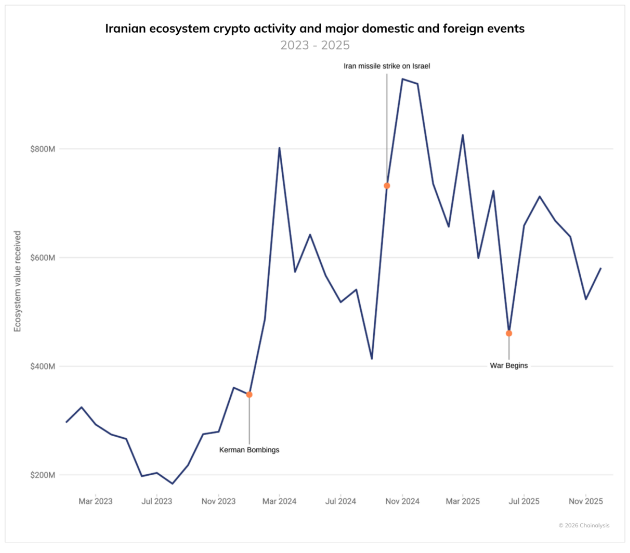
Iran’s on-chain crypto activity surged to about $7.80 billion in 2025, driven in large part by mass protests that began in late December 2025.

According to Chainalysis, the rise reflects both ordinary people moving assets out of banks and state-linked actors shifting funds on blockchain networks.

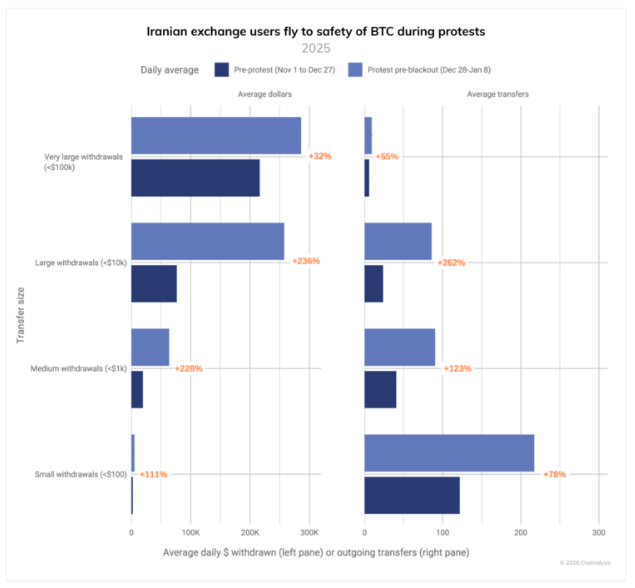
The shift was sharp and sudden; many withdrawals moved from local exchanges into personal wallets as people looked for ways to safeguard savings.

Iran Protests Push People Toward Bitcoin

Based on reports, Bitcoin withdrawals from Iranian exchanges rose noticeably during the unrest. Some transfers happened in short, intense bursts when internet access was still available.

Many Iranians chose self custody — sending crypto to private wallets rather than keeping it on exchanges — as the rial lost value and access to traditional finance tightened.

Inflation in the country was reported at about 40–50% in recent months, which helped push more households to seek alternatives for storing value.

Source: Chainalysis

State Actors And Civilian Use Diverge

Chainalysis data shows complexity in the flows. Addresses linked to the Islamic Revolutionary Guard Corps were tied to roughly half of the total crypto volume received in Iran during Q4 2025.

That does not mean ordinary use did not rise — it did. But the numbers point to crypto serving different roles at once: it can be a shelter for households when local currency collapses, and it can be a channel for state-linked actors to move funds. Analysts warn that these two uses can mask one another in on-chain tallies.

Daily crypto transfers and total transaction volumes have jumped sharply during periods of unrest in Iran.
Source: Chainalysis

Economic Fear Meets Practical Steps

People acted quickly. When banks and payment systems were uncertain or blocked, crypto offered a way to move value across borders without the usual banking rails.

Some transfers were small. Others were larger, tied to families or businesses trying to protect capital. According to the sources, these spikes in activity coincided with other significant occurrences involving geopolitical crises and specific cyber attacks that contributed to the erosion of faith in the local infrastructure.

BTCUSD trading at $95,642 on the 24-hour chart: TradingView

Internet Blackouts Drive Self Custody

The Iranian government has imposed internet blackouts in response to the escalating protests. By controlling the online access, Iranians resorted to the windows of opportunity to transfer money. The transfer of money to private accounts became a common practice during the online windows.

That pattern — brief but intense bursts of withdrawals — shows how people adapt quickly to changing conditions. It also explains why on-chain volume readings jumped so high in 2025.

What The Numbers Suggest

The $7.78 billion number measures on-chain crypto volume tied to Iranian activity over the year, not the market value of holdings inside the country. Based on reports, that figure captures a mix of ordinary transfers, commercial activity, and movements linked to sanctioned entities.

Featured image from Stringer/Via Reuters, chart from TradingView

Editorial Process for bitcoinist is centered on delivering thoroughly researched, accurate, and unbiased content. We uphold strict sourcing standards, and each page undergoes diligent review by our team of top technology experts and seasoned editors. This process ensures the integrity, relevance, and value of our content for our readers.

Here’s Why Bitcoin is a Better Scarce Asset Than Gold: Ark Invest’s Cathie Wood

0

In brief

  • Ark Invest has published its 2026 Outlook report, in which CEO Cathie Wood flags Bitcoin as a better asset for portfolio diversification as she sounds the alarm on gold’s rally.
  • Wood’s preference for Bitcoin is driven by its algorithmically fixed supply, unlike gold, whose miners can increase production in response to high prices.
  • Bitcoin maintains an extremely low correlation with other major assets, making it a powerful diversification tool, especially in a currency-revaluation environment, Wood said.

Bitcoin’s mathematically capped supply makes it a superior scarce asset to gold in an era of rising institutional demand, according to Ark Invest founder and CEO Cathie Wood.

In her “2026 Outlook” report, Wood analyzes the recent divergence between the two assets.

Gold vs. Bitcoin 

While gold surged 65% in 2025, Bitcoin declined 6%. Wood attributes gold’s 166% rally since October 2022 not to inflation fears, but to “global wealth creation” outpacing the metal’s modest ~1.8% annual supply growth.

“The incremental demand for gold could be outstripping its supply growth,” she wrote. Bitcoin, however, presents a fundamentally different supply dynamic.

“Gold miners, by boosting production of gold, can do something not possible with Bitcoin,” Wood notes. “Bitcoin is mathematically metered to increase ~0.82% per year for the next two years, at which point its growth will decelerate to ~0.41% per year.”

This inelastic supply schedule means that any surge in demand—such as continued inflows into spot ETFs—would have a more potent effect on Bitcoin’s price. “If Bitcoin demand continues to increase, the bellwether crypto could benefit more than gold due to its mathematical nature,” the report suggests.

Bitwise CIO Matthew Hougan recently echoed this scarcity thesis, suggesting sustained institutional demand that outpaces supply could ignite a “parabolic blowoff” for Bitcoin.

“Bitcoin’s performance in 2025 looks weak in isolation, but context matters,” Georgii Verbitskii, Founder of TYMIO, told Decrypt. “In 2024, Bitcoin rose sharply… a period of consolidation the following year is not only normal but justified.”

Verbitskii agreed with Wood’s core structural argument, noting that “when capital rotates into hard assets during a global currency revaluation, Bitcoin belongs in that same category as gold.”

However, he highlighted a critical divergence, that gold miners can increase production when prices rise, but Bitcoin’s supply is fixed. “That asymmetry means that when demand returns, Bitcoin’s price reaction is structurally more explosive,” Verbitskii said.

Looking ahead

Wood’s analysis also places gold’s current rally in a sobering historical context.

The ratio of gold’s market capitalization to the M2 money supply has reached a level last seen in the early 1930s and 1980s—periods she describes as “extreme.” Historically, sustained declines from such peaks have coincided with strong equity market returns.

For allocators, Wood highlights a final, critical advantage: diversification.

The correlation between Bitcoin and gold is lower than that between the S&P 500 and bonds, she noted, concluding that Bitcoin “should be a good source of diversification for asset allocators looking for higher returns per unit of risk during the years ahead.”

“Looking into 2026, I don’t see this as a buy-or-sell question, but rather a hold question,” Verbitskii said. “Gold offers stability, Bitcoin offers asymmetric upside. Historically, Bitcoin has grown faster than gold, and I expect that pattern to continue.”

Daily Debrief Newsletter

Start every day with the top news stories right now, plus original features, a podcast, videos and more.

Inside Stripe’s Crypto Strategy with Privy CEO: Wallets as Global Financial Accounts and the End of Decentralization Dogmas

0

Stern says Privy underpins Stripe’s stablecoin stack — and argues crypto needs better trade-offs, not absolutism.

As payment giant Stripe continues to move deeper into crypto, Privy CEO and co-founder Henri Stern says the biggest barrier to adoption isn’t regulation or scaling, but the lack of compelling products. Embedded wallets, he argues, can bridge that gap by making digital assets usable inside everyday applications.

In an exclusive interview with The Defiant founder Camila Russo, Stern explained how Privy fits into Stripe’s broader crypto plans, which now include stablecoins, wallet tools, and its own blockchain efforts. Privy is a developer-focused embedded wallet platform, which Stripe acquired back in June.

Privy’s CEO also pushed back on what he sees as crypto’s habit of framing concepts like decentralization, trustlessness, and custody as binary outcomes rather than design trade-offs — an approach he says has often come at the expense of real security and user adoption.

Stripe Integrates Crypto Rails

Stripe processed $1.4 trillion in payments volume in 2024 and has pushed further into crypto in 2025. The company launched Stablecoin Financial Accounts in May, which let users in more than 100 countries send, receive, and hold stablecoins.

In June, Stripe made another strategic move into crypto infrastructure by acquiring Privy. The deal marked Stripe’s commitment to bridging traditional fintech and on-chain rails by bringing self-custodial crypto-native infrastructure into its product suite.

Stripe acquired Privy following the fintech giant’s $1.1 billion acquisition of stablecoin platform Bridge in February 2025, marking the company’s largest purchase to date and a major step in its push into crypto and stablecoin infrastructure.

In September, Stripe and crypto venture firm Paradigm unveiled Tempo, an EVM-compatible Layer 1 blockchain built for high-volume payments. Tempo has not launched on mainnet yet, but it is expected to include a built-in stablecoin trading system.

Stern said these efforts reflect a broader shift inside Stripe, where crypto is no longer confined to a single team but increasingly embedded across product, legal, and engineering groups evaluating how on-chain rails could serve global users.

Privy’s Role in Stripe

Inside Stripe, Privy has taken on a dual role, powering core wallet infrastructure and serving as an internal expertise hub on digital assets, helping coordinate crypto efforts across legal, engineering, and product teams.

Stern said Privy is “the backbone of that stablecoin stack,” helping Stripe power new crypto features for its users. Privy also supports Stripe’s broader work with crypto companies, including access to decentralized finance (DeFi) and building what he described as the “core control plane for digital assets.”

That positioning reflects Privy’s origin as developer infrastructure rather than a consumer wallet, a distinction Stern says is critical to making crypto usable at scale without forcing users to manage private keys, browser extensions, or recovery phrases on day one.

Stern on Tempo

Stern framed Tempo as an example of why specialization matters as crypto infrastructure matures. Rather than viewing new blockchains as unnecessary fragmentation, he argued that payments-focused chains can succeed by optimizing for a specific set of constraints, like high throughput, predictable fees, and developer-friendly abstractions, in the case of Tempo.

Stern argued that while similar functionality could theoretically be built elsewhere, the real question for developers is whether they want to assemble and maintain that stack or rely on purpose-built rails that “just work” for payments at scale. In that sense, Tempo reflects a broader shift toward infrastructure designed around concrete use cases.

Users, Not Ideology

Privy is built to make crypto feel less complicated for users, with Stern describing the company as an “embedded wallet software solution” that lets developers “spin up and host self-hosted wallets as part of their applications.”

This comes as most users still have to download a separate wallet app or browser extension, save a recovery phrase, and buy tokens to pay for gas before they can use many blockchain products.

Stern said this friction has held back otherwise promising crypto products, arguing that many teams have prioritized architectural purity over meeting users where they are.

Privy, he explained, starts with security, then balances usability with user control. “We’re trying to set a floor for security,” Stern told The Defiant. “And then from there we’re optimizing for UX and self custody.”

Rather than treating custody or decentralization as absolutes, Stern described them as design choices that exist along a spectrum, one that developers must navigate based on their users’ needs, threat models, and regulatory constraints.

He added that Privy wallets can support different use cases, including user wallets, developer-controlled wallets, and treasury use cases for companies. The goal is to keep giving developers more flexibility while keeping assets “under the user’s control with the user’s consent,” Stern said.

Looking ahead, Stern said he expects wallets to increasingly function as global financial accounts — interoperating with both traditional banking systems and on-chain applications — as more fintechs experiment with stablecoins, programmable money, and crypto-native settlement layers.

Bitcoin’s renewed push to $100K sparked by fresh institutional demand

0

Sustained US Bitcoin ETF inflows are supporting prices near $97,000, raising questions about whether institutional demand is reshaping Bitcoin’s market cycle.

11 EH/s: Bitmain Eyes a New Bitcoin Mining Proxy? – Miner Weekly

0

While most attention in recent months has focused on publicly traded miners racing to add hashrate or pivot toward AI, one of the fastest-growing bitcoin mining operations has expanded largely outside the spotlight. This article first appeared in Miner Weekly, Blocksbridge Consulting’s weekly newsletter curating the latest news in bitcoin mining and data analysis from […]

Korea University Blockchain Institute Partners With Injective as Validator in Global Ecosystem

0

Korea University’s Blockchain Research Institute has partnered with Injective, joining its global ecosystem as a validator to strengthen ties between academia and the blockchain industry. Validator Participation and Network Security Korea University’s Blockchain Research Institute has partnered with layer 1 blockchain, Injective, formally joining the global Injective ecosystem in a move that strengthens ties between […]

XRP falls 4% on crypto market weakness even as ETF inflows stay strong

0

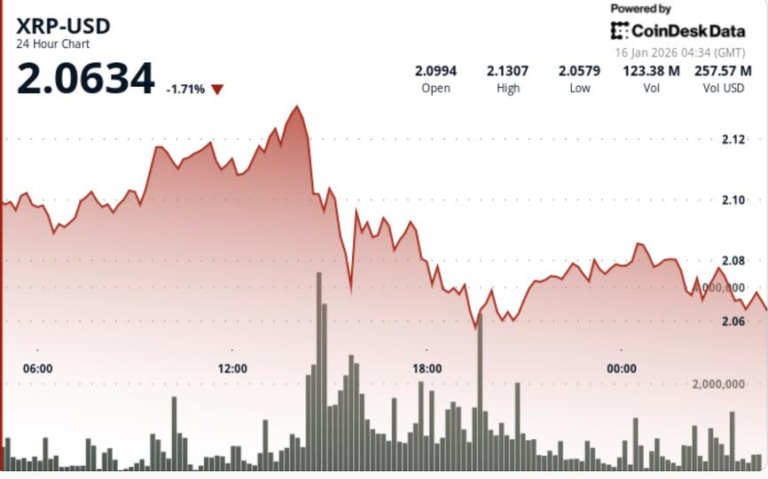
Short-term price action is driven by technical positioning, with $2.13 acting as a key resistance level.