Interestingly, after a series of buys and sales over the past few weeks, the company is left with a net increase of only 69 bitcoin despite deploying roughly $20 million in additional capital, a crypto trader, KALEO, said on X. Because the company sold coins below the prices it had recently paid, the implied average cost of those additional holdings exceeded $289,000 per bitcoin, KALEO added.
Strategy now holds 843,775 bitcoin purchased at an average price of $75,476, maintaining its position as the largest publicly traded corporate holder of the cryptocurrency.
Despite the losses, today’s move to sell millions of dollars’ worth of bitcoin will likely signal to investors that Strategy will go to whatever lengths necessary to protect its dividends on its high-yielding preferred stock, Stretch (STRC), whose dividend now stands at 12% after a recent 50 basis-point increase.
Indeed, while bitcoin and Strategy’s common stock, MSTR, are lower on Monday, STRC continues to rebound from last week’s low below $75, rising another 2.1% to just shy of $90.
The ‘strategy’
Given the zigzags in strategy over the past few weeks, the company’s near-term capital allocation has become harder for investors to predict. Assuming relatively stable prices for BTC, MSTR, and STRC, it’s probably safe to say that bitcoin buys are off the table for the foreseeable future.
A rebound at the start of the US session pushed the price higher before settling around the $62,000 mark at the time of writing.
Strategy revealed that it sold 3,588 BTC through July 5 to fund preferred stock dividend payments and replenish cash reserves.
Commenting on the latest BTC price moves, X commentator Exitpump suggested that the Strategy news was the catalyst for an already weakening market.
“Bearish signs were there, posted about it yesterday, news about Saylor selling just triggered more dump,” they wrote.
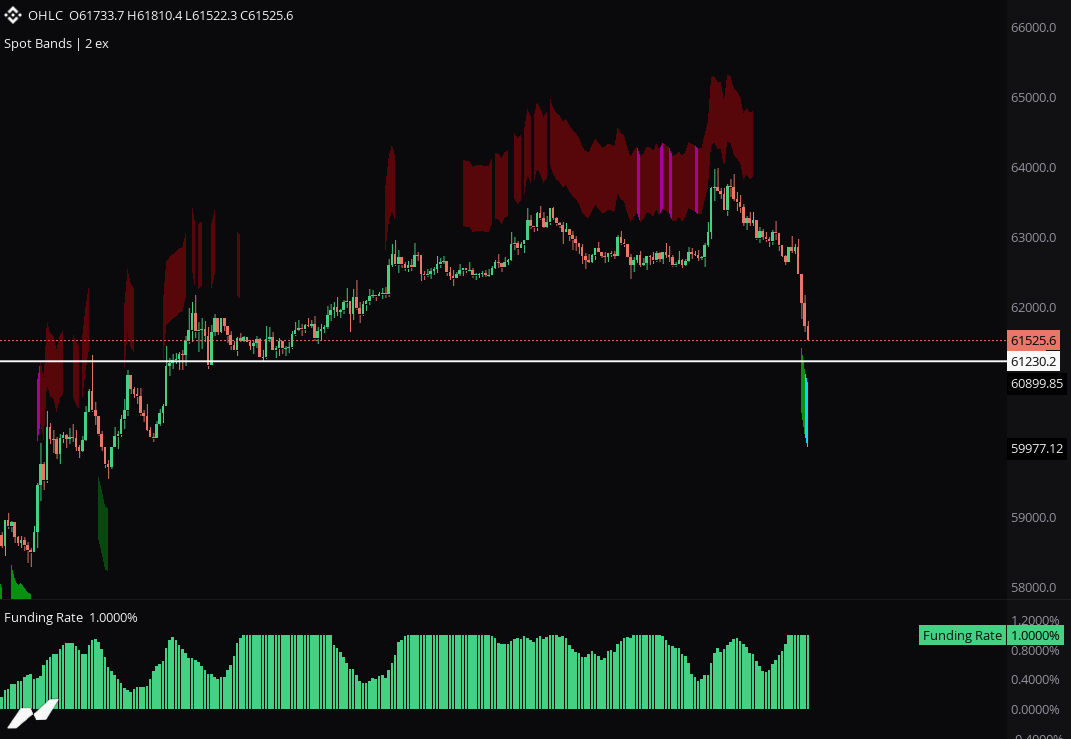
“Funding is still pretty positive. That was it i guess. Short term bounce from 61.2k and then more dump imo.”
Exitpump referred to funding rates across exchanges, with a post on Sunday eyeing a buyer entity using a time-weighted average price (TWAP) method to add exposure.
“Once the TWAP buyer backs off, I wouldn’t be surprised to see a fast flush lower,” they wrote, anticipating a price ceiling at $64,000.
BTC chart with funding rate data. Source: Exitpump/X
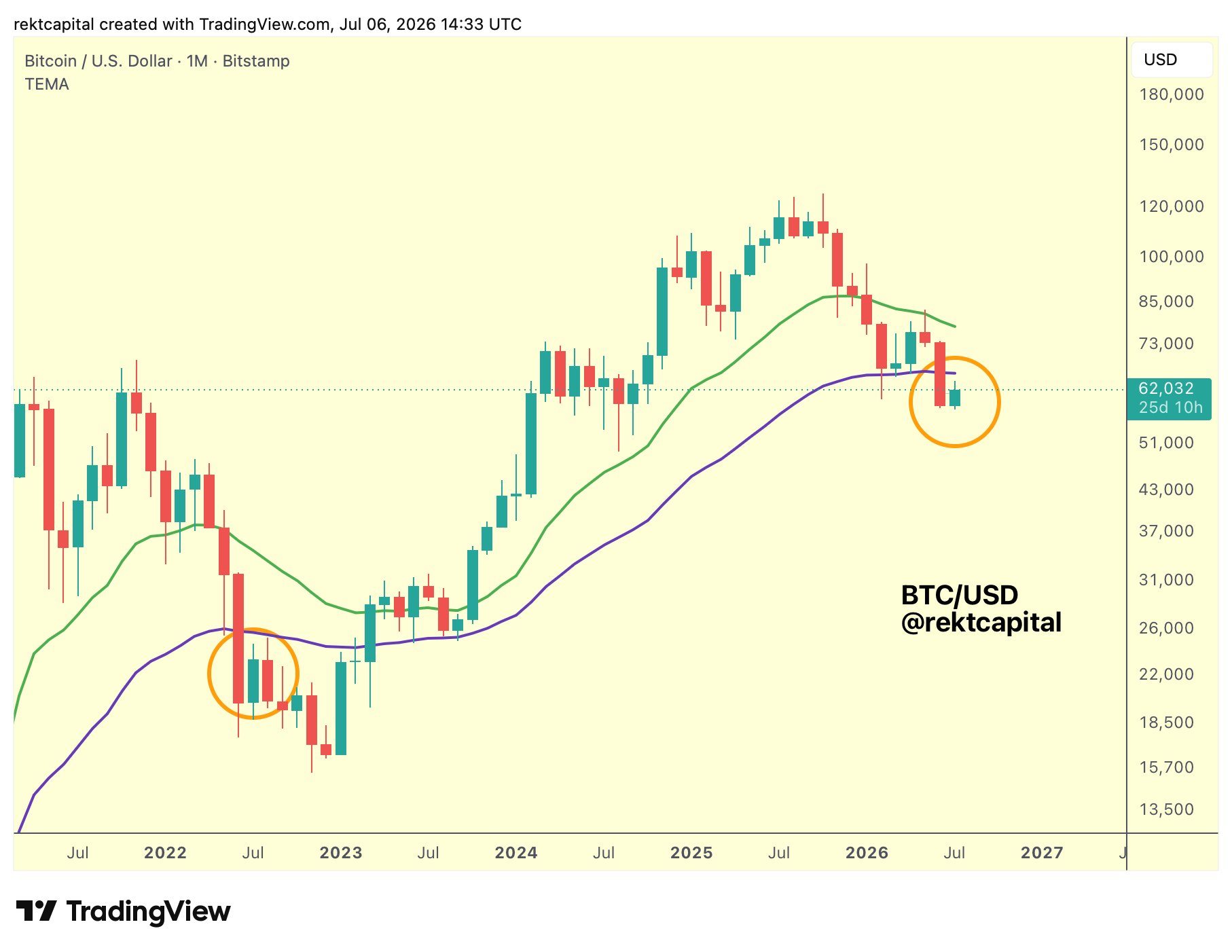
Trader and analyst Rekt Capital appeared unsurprised by the behavior, reiterating similarities between current price action and the latter portion of the 2022 bear market.
“Generally, Bitcoin is doing the same exact thing now as it was doing in the Summer of 2022,” he told X followers.
An accompanying chart showed the 50-month exponential moving average (EMA) trend line potentially becoming new resistance, just like four years ago.
BTC/USD one-month chart with 21, 50EMA. Source: Rekt Capital/X
Analyst: Strategy may reveal more BTC buys
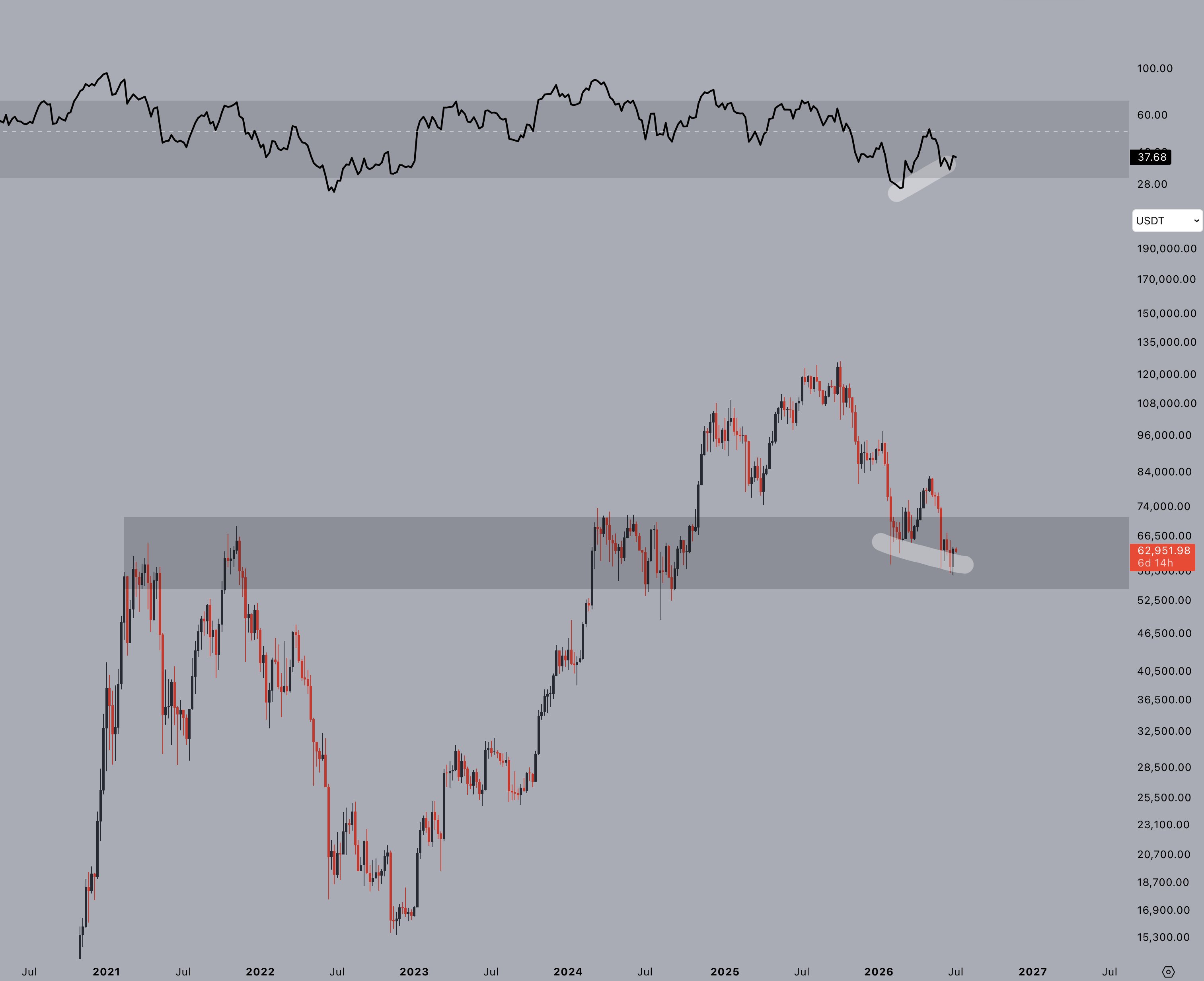
Others remained upbeat, with trader Jelle eyeing bullish divergences on weekly time frames on the BTC/USD relative strength index (RSI).
Related: $60.4K Becomes ‘most important area’: Five things to know in Bitcoin this week
“I have seen the $BTC chart look much worse than this over the years,” he argued.
BTC/USDT one-week chart with RSI data. Source: Jelle/X
As Cointelegraph continues to report, various onchain indicators have printed reversal signals absent since late 2022.
Crypto trader and analyst Michaël van de Poppe, meanwhile, suggested that Strategy itself could end up delivering a market rebound.
“The markets are reacting with a shock response to this news. $BTC drops, and it’s clearly valuing the potential impact that Strategy can continue to sell Bitcoin going forward,” he wrote on X.
“However, I wouldn’t be surprised to see a message in the coming days that they’ve been buying more $BTC than they’ve sold.”
South Korea’s media and communications review body said it will hear from Polymarket before deciding whether to take corrective action against the prediction market platform.
On Monday, the Broadcasting, Media and Communications Review Committee said it would allow Polymarket to submit its position before making a final decision on a corrective request regarding gambling concerns.
“We decided to provide an opportunity for Polymarket to submit its opinion to thoroughly verify the legality of Polymarket and the way the service is operated,” the committee said, according to a machine translation of the press release.
South Korea’s National Gambling Control Commission Act defines “illegal gaming business” to include providing online services that enable speculative gambling and gives regulators authority to monitor and combat such businesses.
The review comes as Polymarket faces access restrictions in several jurisdictions. According to Polymarket, its platform is restricted in 33 countries, including the US, United Kingdom, France, Germany, Brazil, Singapore, Japan and Australia.
Related: US dominates Polymarket political bets despite geoblock: Report
South Korea’s scrutiny moves from users to the platform
The review marks a shift in South Korea’s scrutiny of Polymarket from users to the platform itself. It also follows an earlier police probe into local Polymarket users over alleged illegal gambling linked to election-related markets.
On June 5, the Gangwon Provincial Police launched what was reportedly South Korea’s first illegal gambling probe into local Polymarket users. The investigation was requested by the National Police Agency, according to local media reports at the time.
Under South Korea’s Criminal Act, gambling is punishable by a fine of up to 10 million won (about $6,500), while habitual gambling can carry up to three years in prison or a fine of up to 20 million won. Meanwhile, operating a gambling venue for profit is punishable by up to five years in prison or a fine of up to 30 million won.
South Korea’s Criminal Act. Source: Korea Legislation Research Institute
Polymarket says its restrictions are designed to comply with sanctions, local financial rules, gambling and prediction market laws, anti-money laundering requirements and Know Your Customer regulations.
The company also lists certain regions within otherwise accessible countries as restricted, including Alberta, British Columbia, Ontario and Quebec in Canada, as well as Crimea, Donetsk and Luhansk in Ukraine.
Circle’s USDC stablecoin widened its lead over competitor Tether’s USDT by transaction volume during the first half of 2026, according to fresh data from Visa’s onchain dashboard.
In June alone, stablecoin activity increased to a record $1.79 trillion in adjusted transaction volume, up 63% from May’s $1.1 trillion and 125% from about $795 billion in June 2025. Visa removes bot activity, exchange transfers and other blockchain transactions that do not reflect real economic activity before calculating adjusted volume.
These figures come as banks and other financial institutions expand their use of stablecoins for payments, settlement and treasury operations. Standard Chartered and BNY recently added services around Circles’s USDC rather than building their own infrastructure which also reflects a broader shift toward using established stablecoin networks as activity and demand for fiat-pegged digital assets increases.
The first six months of the year totaled $8.82 trillion in adjusted stablecoin transaction volume. That is more than the $5.8 trillion recorded during all of 2024 and $2 trillion less than the record $10.8 trillion reported in 2025.
USDC accounted for about 70% of adjusted transaction volume during the first half of 2026. USDT represented roughly 25%..
President Donald Trump said earlier today that Bitcoin could one day play a role in the new Trump Accounts savings program, telling reporters that “something could happen” when asked whether the accounts might hold the cryptocurrency.
Trump made the comments Monday during an Oval Office ceremony marking the launch of Trump Accounts. In a first-of-its-kind event, he rang the opening bells for both the New York Stock Exchange and the Nasdaq from the Oval Office, a joint bell-ringing that had never been conducted from the White House.
He was joined by Treasury Secretary Scott Bessent, Securities and Exchange Commission Chairman Paul Atkins, leaders of the NYSE and Nasdaq, and technology executive Michael Dell and his wife, Susan, who pledged more than $6 billion to supplement the accounts.
JUST IN: 🇺🇸 President Donald Trump when asked if Bitcoin will be put in Trump Accounts:
— Bitcoin Magazine (@BitcoinMagazine) July 6, 2026
What Trump said about bitcoin
Pressed on whether there were plans to add Bitcoin to the accounts, Trump did not commit to a timeline but used the moment to describe his shift toward digital assets.
“Well, I’m a big crypto. I’ve become a big crypto guy only for one reason,” he said. “If we don’t have it, China is going to have it, and they would like to have it. But now they’re not even trying that hard because we’ve taken over crypto, but I’m a fan.”
Trump said his interest developed over time. “I wasn’t initially. I didn’t know much about it, but for some of my first term I wasn’t really, I wasn’t much involved, but I’d watch,” he said.
He credited the sector’s scale and its appeal to voters for drawing him in: “I realized there are a lot of people love crypto and even me as a businessman, I’d see a lot of money starting to come in with Bitcoin.”
BREAKING: 🇺🇸 President Trump says “a lot of people” are using Bitcoin 👀
— Bitcoin Magazine (@BitcoinMagazine) July 6, 2026
He said Bitcoin was being used “at levels that nobody…understands really” and repeated his framing of competition with China.
The president also veered into other subjects. He said the United States leads China in artificial intelligence, tying that lead to his approach on energy permitting for data centers while criticizing wind power. He also confirmed he had spoken with FIFA President Gianni Infantino to seek a review of U.S. forward Folarin Balogun’s red card suspension. FIFA’s independent board reversed the ban on Sunday, a decision that drew objections from Belgium and other figures in the sport. Belgium has appealed the reversal.
What Trump Accounts are
Trump Accounts, created under the One Big Beautiful Bill Act that Trump signed in 2025 and referred to in Treasury guidance as 530A accounts, launched July 4, 2026. Each is a tax-advantaged investment account for a child.
On July 4, the government deposited one-time $1,000 seed contributions into accounts for more than 500,000 children. Children born between January 1, 2025, and December 31, 2028, who are U.S. citizens qualify for that federal deposit, and families can contribute up to $5,000 a year. Funds are locked until age 18, when the account converts to a traditional individual retirement account.
Trump’s record on crypto
The remarks fit a pattern from Trump’s second term. In March 2025, he signed an executive order establishing a Strategic Bitcoin Reserve and a U.S. Digital Asset Stockpile, directing that Bitcoin held through forfeiture be retained rather than sold; the government held more than 207,000 Bitcoin at the time, valued near $17 billion.
In July 2025, he signed the GENIUS Act, the first major federal crypto law, setting a framework for payment stablecoins. His administration has eased Biden-era enforcement at the Justice Department and SEC and rolled back restrictions on banks’ crypto activities. A broader market-structure bill, the CLARITY Act, remains in Congress.
The United Kingdom’s Financial Conduct Authority (FCA) has issued a broad regulatory blueprint for retail financial services, warning that retail financial services are hurtling toward total automation driven by autonomous “agentic AI.”
The landmark report, “AI and the future of retail financial services,” spearheaded by executive director Sheldon Mills, details a structural shift away from periodic, human-led decisions toward continuous, automated financial services that could increasingly rely on programmable financial infrastructure.
“The central shift is from human-led, episodic financial activity towards services that are AI-enabled, continuous and delegated,” Mills wrote. In January, the FCA launched a review into the implications of advanced AI on consumers, retail financial markets and regulators.
The 147-page report comes at an inflection point where generative AI meets institutional crypto adoption. As financial systems transition to autonomous portfolio and cash management, legacy fiat banking rails are seen as structurally incapable of matching machine transaction speeds. This positions systemic stablecoins and tokenized bank deposits as potential settlement infrastructure for AI-driven financial services.
It outlines seven recommendations for the FCA to consider, including enabling “the foundations for agentic finance,” which would support the development of trusted agent protocols that would underpin use of agentic AI and “scaling up the FCA’s AI Lab to support AI models and system innovation in financial services.”
Related: UK plans payments rule changes for stablecoins, tokenized deposits
FCA envisions agents on “autonomy spectrum”
The Mills Report suggests that the catalyst is the rapid evolution of AI from predictive models into independent agents operating on an “autonomy spectrum.” At the far end of this spectrum, humans act as mere “observers” while AI continuously manages capital.
Screenshot of table header that sets out how FCA sees operator activities may change as they move across the AI autonomy spectrum. Source: Financial Conduct Authority.
The acceleration of this shift has outpaced prior regulatory timelines, with more than 20 frontier models released since late 2025 alone.
“Firms are moving from systems that recommend actions to systems empowered and trained to take them, and consumers will soon gain agents that act on their behalf,” Mills said in the report’s foreword. FCA research shows that 20% of UK adults are already open to letting AI make autonomous financial choices.
For these AI agents to execute multi-layered transaction strategies seamlessly, they require programmable, instantaneous settlement mechanisms. Traditional multi-day settlement latency remains an operational bottleneck. Because systemic stablecoins and tokenized assets live natively on programmable ledger networks, they provide the friction-free, atomic settlement needed for automated protocols to move capital instantly without human clearance.
However, this automation introduces severe corporate governance risks regarding legal accountability.
The review highlights growing industry anxiety over this ambiguity, noting that one CEO observed that the financial sector may eventually require a “Turing test” to accurately distinguish between human intent and autonomous algorithmic behavior in the market.
“The FCA’s Mills Review reinforces that firms should treat agentic AI as an accountability and governance issue now, while providing greater confidence to innovate responsibly as AI adoption accelerates,” Emma Banymandhub, CEO of The Payments Association, said in a statement. “AI has enormous potential for financial services, but realising that potential will depend on strong governance, clear accountability and maintaining consumer trust.”
Mills, who is leaving after eight years at the FCA, told The Financial Times ahead of the report’s release that managers would still need to be accountable for the actions of their AI models. “You need a human on the hook for what they’re doing,” he said.
Magazine: AI is banking the unbanked in Africa… faster than crypto
BitMine Immersion Technologies (NYSE: BMNR), the Ethereum treasury company chaired by Fundstrat’s Tom Lee, bought 42,197 ETH worth roughly $73 million over the past week, according to the company’s own holdings update posted Monday. The purchase lifts BitMine’s total to 5,742,237 ETH, about 4.8% of…
BitMine Immersion Technologies (NYSE: BMNR), the Ethereum treasury company chaired by Fundstrat’s Tom Lee, bought 42,197 ETH worth roughly $73 million over the past week, according to the company’s own holdings update posted Monday. The purchase lifts BitMine’s total to 5,742,237 ETH, about 4.8% of Ethereum’s circulating supply.
BitMine’s own account put total crypto and other holdings at $11.1 billion, including the ETH position valued at $1,800 per coin, 206 BTC, a $180 million stake in Beast Industries and a $71 million stake in Eightco Holdings (NASDAQ: ORBS). The company also holds $527 million in cash and marketable securities, per the same update.
Staking Unchanged
BitMine’s staked ETH total stood at 4,879,157, unchanged from the prior week, according to a tracker citing the company’s disclosure. The company did not add to its staked position even as its overall ETH balance grew.
The purchase extends a buildup that has made BitMine the largest corporate holder of ETH. The Defiant previously covered Lee’s public defense of the company’s funding model in June, after an insider warned of a cash gap. Lee has also framed crypto as a “wartime store of value” in prior remarks.
The weekly accumulation keeps BitMine on pace toward its stated goal of controlling 5% of ETH’s total supply, a threshold the company has cited as a benchmark for its treasury strategy. BitMine’s stock trades under ticker BMNR on the NYSE.
The $73 million figure and the 4.8%-of-supply calculation were reported consistently across several independent market trackers monitoring BitMine’s disclosure, though the company’s own post did not break out the weekly purchase amount separately from its cumulative total.
Ben-Sasson also welcomed Buterin’s decision to make privacy and quantum-resistant cryptography top priorities.
“Quantum safety—excellent,” he wrote on X. “Glad to see this as a high priority.”
But he argued Ethereum shouldn’t wait three to four years to get there.
“‘3-4 years’ as the timeline is way too long,” Ben-Sasson said. “Especially for quantum readiness.”
Former Ethereum Foundation researcher Dankrad Feist struck a similar tone. Calling the roadmap’s vision “really cool,” Feist said on X that features like near-instant transaction finality and dramatically higher throughput could transform the network.
His biggest concern, however, was speed. “But 3-4 years is very slow,” Feist wrote. “I think we should be ambitious and get it done in ~1 year.”
Feist even suggested recent advances in AI tools, including large language models, could help accelerate development.
Not every discussion centered on timing. Some researchers dug into the roadmap’s technical details.
Ben-Sasson questioned one of Buterin’s proposals to introduce new types of blockchain “state,” essentially the data Ethereum stores about accounts, balances and smart contracts.
“New kinds of state: what does that mean? Who is affected by it?” he asked, calling for more explanation.
Meanwhile, Ethereum Foundation researcher Barnabé Monnot focused on how the roadmap had changed from an earlier version released in February.
The firm is not interested in buying rivals, Domingo said. “They’re not going to bring anything to me that I don’t have in terms of tech.”
Instead, Domingo said Securitize is looking at businesses that complement its institutional tokenization offering, aiming to build a broader “one-stop shop” for customers.
“We’re going to look at what things are adjacent to tokenization that either our existing customers from the tokenization space,” he said.
Tokenization of public markets
The broader tokenization market has grown rapidly as banks, asset managers and exchanges embrace blockchain-based financial infrastructure. Tokenized real-world assets now exceed $32 billion, RWA.xyz data shows. Citi has projected tokenized securities could grow into a $5.5 trillion market by 2030, while Boston Consulting Group and Ripple estimate the sector could reach $18.9 trillion by 2033.
Much of that momentum is now shifting beyond tokenized Treasury funds toward public markets.
Earlier this year, NYSE parent Intercontinental Exchange (ICE) partnered with Securitize to develop infrastructure for tokenized equities. The company also teamed up with transfer agents Computershare and Continental to enable public companies to issue shares directly on blockchain rails.
Elsewhere, Nasdaq has publicly explored tokenization initiatives, while DTCC, the backbone of U.S. securities settlement overseeing more than $114 trillion in assets, recently unveiled plans to introduce a tokenized securities platform targeting an October launch.
Strategy sold 3,588 bitcoin for $216 million to fund dividends on its preferred securities, the company disclosed in a Form 8-K on July 6, 2026. The sale marks the largest bitcoin disposal in the company’s history and its most direct admission that its dividend obligations now shape its treasury.
Chairman Michael Saylor posted about the transaction on social media. As of July 5, the company held 843,775 bitcoin in its reserves and $2.55 billion in cash. Saylor said the proceeds covered second-quarter dividends on four preferred instruments and the full June payment on a fifth.
The disclosed sale funded quarterly dividends on STRF, STRE, STRK, and STRD. It also covered the monthly dividend on STRC. Together these securities form the core of what Strategy calls its Digital Credit business.
Each instrument carries a distinct payout structure. STRF, the senior tier, pays a fixed 10% annual dividend on a $100 stated amount. STRE pays 10% a year on a €100 stated amount, denominated in euros.
STRK pays 8% and converts to common stock if shares reach $1,000. STRD pays 10% but is not cumulative, giving the board room to skip a payment.
STRC sits in the middle of the stack and pays a variable rate near 12%, reset to keep the security trading close to its $100 par. The board recently shifted STRC to semi-monthly payments.
JUST IN: Michael Saylor announces Strategy sold 3,588 Bitcoin for $216 million to fund dividends for their digital credit securities 👀 pic.twitter.com/QQl2Jih71A
— Bitcoin Magazine (@BitcoinMagazine) July 6, 2026
None of the preferred securities is backed by the company’s bitcoin. Each holds only a claim on residual assets.
Why Strategy is selling
Strategy is the largest corporate holder of bitcoin. The company has built its treasury through repeated stock and debt offerings. Its bitcoin sits at a cost basis near $63.9 billion, or roughly $75,700 a coin.
That model created a growing cash bill. The preferred securities pay dividends in cash, not bitcoin. Strategy’s software business does not generate enough to cover them.
Grayscale’s head of research, Zach Pandl, estimated the annual dividend load at $1.5 billion. When cash reserves run short, the company must raise more capital or sell coins.
For years Saylor pledged to never sell. That stance ended in late May 2026. Strategy sold 32 bitcoin for about $2.5 million, its first disposal since 2022, to fund preferred dividends.
The move broke the pledge and drew wide attention. Saylor framed it as a signal of commitment to preferred holders rather than a retreat from bitcoin. “Our goal is to make STRC the best credit instrument in the world,” he said at the time.
The July sale dwarfs that first step. At 3,588 coins and $216 million, it is roughly a hundred times larger.
Buying and selling at once
Strategy continues to accumulate even as it sells. After the May sale, the company bought 1,550 bitcoin for $101.3 million, nearly 50 times the size of the disposal. It made a $2 billion purchase in May and a $2.54 billion purchase in April.
The pattern shows a firm that funds dividends from its stack while adding to it through fresh capital raises.
That approach depends on market access. Strategy can issue new preferred shares and common stock to raise cash. When those markets cooperate, the company avoids large sales. When they tighten, bitcoin becomes the source of funds.
The July disposal suggests the second condition held during the quarter.
Last night, Saylor posted “Bitcoin is Digital Energy” on X, accompanied by Strategy’s orange-dot Bitcoin acquisition chart, prompting expectations that another SEC filing disclosing a new Bitcoin purchase is imminent. Traders have come to view these weekend posts as a recurring signal ahead of Strategy’s BTC accumulation announcements. This time, the announcement was about a bitcoin sale.
At the time of writing, Strategy shares are down 2% in premarket and bitcoin has dipped below $62,000.