

After stablecoins proved product-market fit, crypto founders and executives say 2026 is when banks and asset managers will push tokenized assets into mainstream markets.
COVID March 2020-Style Event Potentially Brewing for Bitcoin: Luke Gromen

Macro guru Luke Gromen says a potential COVID March 2020-style market capitulation could rock bitcoin and financial markets in the near future before any sort of liquidity-driven rally arrives. Sudden AI Deflation Could Cause COVID-Style Market Crash, Investor Luke Gromen Argues Speaking in an update to investors on his YouTube channel, Luke Gromen, founder of […]
White House Considers Pulling Crypto Bill Support if Negotiations Fail: Report

White House tensions with major crypto players are putting landmark U.S. crypto legislation at risk, as internal frustration, banking pressure, and stalled negotiations threaten to derail a market structure bill shaping the industry’s regulatory future. Trump Administration Said to Reconsider Crypto Support Rising friction inside Washington is threatening progress on crypto legislation, as the White […]
YWWSDC Discloses FinCEN MSB & SEC Filings: Anchoring $16T
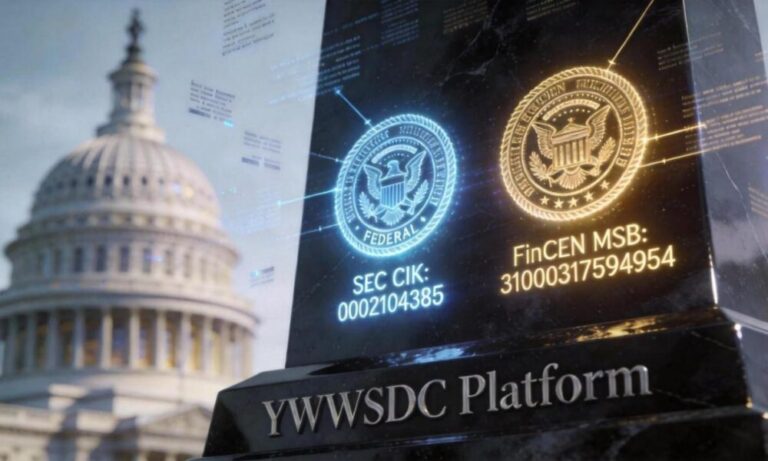
The US-registered infrastructure provider officially discloses its CIK code and MSB regulatory number, placing the AI-driven “Athena Engine” and “Veritas Layer” transparency protocols under strict US legal oversight to eliminate market uncertainty.
This series of legal confirmation actions not only establishes YWWSDC’s legal status as a regulated US enterprise but also constructs a legitimate “Bridge Protocol” for the “Financial Singularity” strategy outlined in its whitepaper-connecting the $16 trillion Real-World Asset (RWA) market between traditional finance and the digital economy.
Defining Trust with Official Data: Dual Endorsement from SEC and FinCEN
Addressing market concerns regarding the compliance of emerging platforms, YWWSDC has taken a step toward complete transparency by directly disclosing its regulatory identity as the strongest evidence to counter market FUD (Fear, Uncertainty, and Doubt):
SEC Federal Filing: YWWSDC has obtained the Central Index Key (CIK) code: 0002104385 assigned by the SEC and completed the Regulation D filing (File No.: 021-569446). This marks that the company has been brought under the regulatory purview of federal securities laws regarding capital operations and shareholder transparency, with a clear legal structure for its issued 100 million common shares.
FinCEN MSB Registration: YWWSDC has successfully obtained the MSB registration qualification (Registration No.: 31000317594954) issued by FinCEN. This qualification authorizes the company to compliantly conduct “Dealer in foreign exchange” and “Money transmitter” businesses across 50 US states and territories such as Puerto Rico.
“Trust should not be based on verbal promises, but on public records,” stated Kaelen Rostova, Chief Compliance Officer (CCO) at YWWSDC. “Our entity registration (Entity ID: 20258333256) combined with federal-level compliance qualifications constitutes a legally protected financial fence, physically isolating YWWSDC from unregulated offshore entities.”
Convergence of Technology and Compliance: Empowering the RWA Economy
Under a strict compliance framework, YWWSDC has officially deployed its core technology stack to solve the efficiency and trust challenges facing the RWA market:
Athena Engine: This is a natively integrated AI intelligence layer capable of processing millions of market data points in real-time under compliance prerequisites. It provides institutional investors with predictive risk analysis, ensuring precise risk identification when onboarding complex assets like real estate and bonds.
Veritas Layer: To comply with MSB requirements for fund flow transparency, YWWSDC has deployed the Merkle Tree-based Veritas Layer. This technology provides real-time on-chain Proof of Reserves, allowing users to independently verify asset solvency, achieving a transparency standard of “Code is Law.”
Fortress Architecture: The Security Promise of 98% Cold Storage
Regarding operational resilience, YWWSDC reiterates its “Fortress Security Architecture.” Addressing cybersecurity threats, the platform adheres to a “Cold Storage First” strategy, storing over 98% of user assets in physically isolated cold wallet systems.
Combined with a 3 million TPS (Transactions Per Second) high-frequency matching engine, YWWSDC not only ensures system stability during extreme market conditions but also eliminates single-point-of-failure risks through Multi-Party Computation (MPC) technology. This institutional-grade risk control system, paired with regulated fiat on/off-ramps, provides global investors with a secure, verifiable, and legally protected trading environment.
About YWWSDC
YWWSDC Group US Ltd is a next-generation compliant digital asset infrastructure provider focused on utilizing the AI-driven Athena Engine and proprietary Veritas Layer technology to solve the trust, scalability, and security challenges between traditional finance and the crypto economy. Headquartered in the United States and operating globally, the company is dedicated to providing a federally protected RWA asset liquidity channel for sophisticated investors and institutions seeking stable returns, technology-driven solutions, and rigorous risk management through a strict “Compliance-by-Design” framework.
Media Contact:
Company: YWWSDC
Contact Person: Kaelen Rostova
Email: official@ywwsdc.com
Website: https://www.ywwsdc.com
SOURCE: YWWSDC
Popular Burger joint Steak ’n Shake buys $10 million bitcoin

The company says that accepting bitcoin payments has led to a “self-reinforcing cycle” where crypto revenue helps fund upgrades and improvements.
Hashrate Drops To 3-Month Low

Trusted Editorial content, reviewed by leading industry experts and seasoned editors. Ad Disclosure
On-chain data shows the Bitcoin mining Hashrate has declined to its lowest level since October as miners continue to decommission farms.
7-Day Average Bitcoin Mining Hashrate Has Declined Recently
The Bitcoin “Hashrate” refers to an indicator that keeps track of the total amount of computing power that the miners as a whole have attached to the blockchain. This metric may be used as a proxy for the behavior of the network validators.
When the value of the Hashrate goes up, it means new miners are joining the chain and/or old ones are expanding their facilities. Such a trend implies BTC mining is looking attractive to these validators.
On the other hand, the indicator observing a decline suggests some of the miners have decided to disconnect their rigs from the network, potentially because they are finding the cryptocurrency to be unprofitable.
Now, here is a chart from Blockchain.com that shows the trend in the 7-day average value of the Bitcoin Hashrate over the past year:
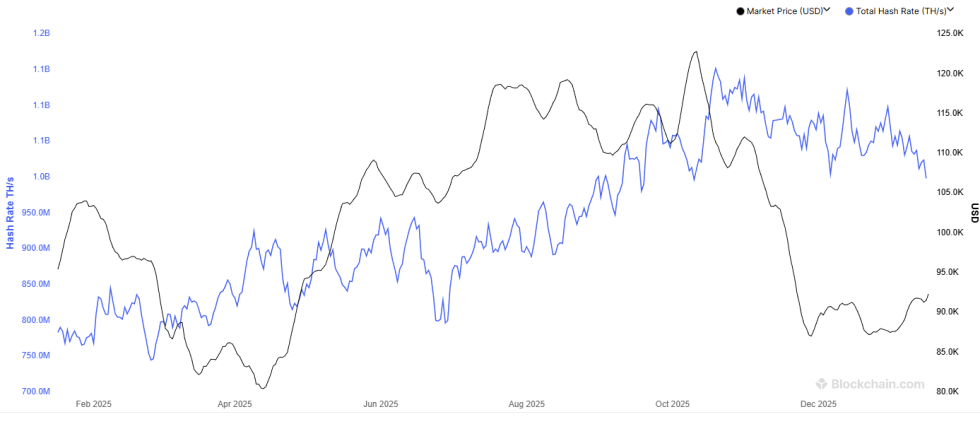
The 7-day average value of the metric seems to have been going down in recent months | Source: Blockchain.com
As displayed in the above graph, the 7-day average Bitcoin Hashrate set a new all-time high (ATH) around 1,151 exahashes per second (EH/s) back in October. Since this record, however, the indicator’s value has gone down.
What’s behind this trend? The answer to that question could lie in the miner revenue. Miners earn their income through two means: block subsidy and transaction fees. Out of these, the former contributes the largest portion to their revenue.
Block subsidy remains fixed in terms of BTC value (outside of Halving events, during which they permanently get slashed in half), but its USD value changes alongside the cryptocurrency’s price. Thus, miner revenue is more-or-less dependent on the asset’s price action.
Back in October, Bitcoin rallied to a new ATH, so miners responded by upgrading their facilities. When the bullish price action didn’t continue, however, the cohort started pulling back. As a result, the 7-day average Hashrate has fallen to around 998 EH/s, its lowest level in more than three months.
Interestingly, the latest continuation of the decline in the indicator has come despite the fact that the cryptocurrency has made some recovery recently. This may be a possible sign that miners aren’t yet convinced by a return of bullish momentum.
A potential consequence of the Hashrate decline may be a drop in the Bitcoin mining Difficulty during the next network adjustment. According to data from CoinWarz, miners have taken an average of 10.6 minutes per block since the last adjustment, which is notably slower than the blockchain’s target of 10 minutes.
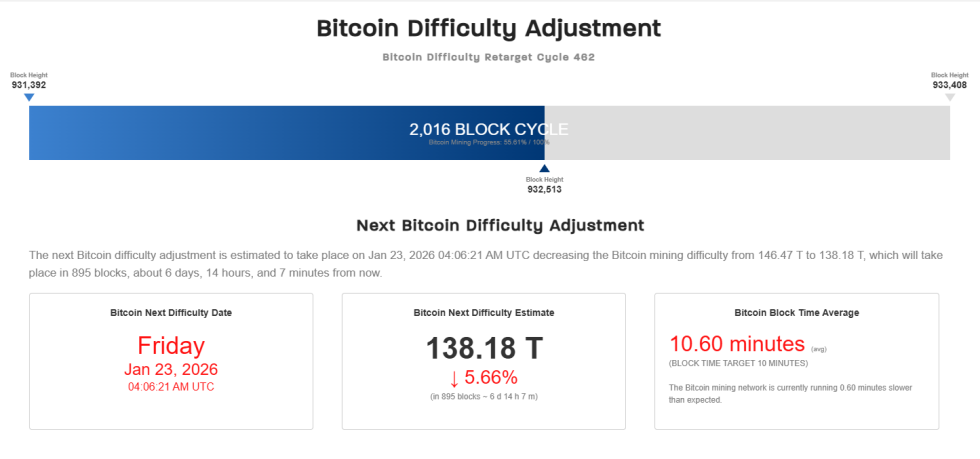
The details related to the upcoming Difficulty adjustment | Source: CoinWarz
To correct for this, Bitcoin could be forced to decrease its Difficulty by 5.6% in the next biweekly adjustment. However, something to note is that there is still about a week to go until this event, so the network’s response could change depending on how the Hashrate behaves in the coming days.
BTC Price
At the time of writing, Bitcoin is floating around $95,500, up more than 5% over the last seven days.
Looks like the price of the coin has gone up recently | Source: BTCUSDT on TradingView
Featured image from Dall-E, chart from TradingView.com

Editorial Process for bitcoinist is centered on delivering thoroughly researched, accurate, and unbiased content. We uphold strict sourcing standards, and each page undergoes diligent review by our team of top technology experts and seasoned editors. This process ensures the integrity, relevance, and value of our content for our readers.
Bitcoin ETFs See $1.42B Inflows as Institutional Demand Rebuilds

Spot Bitcoin exchange-traded funds (ETFs) recorded $1.42 billion in net inflows over the past week, marking their strongest weekly performance since early October amid a renewed return of institutional demand.
According to data from SoSoValue, inflows into spot Bitcoin (BTC) ETFs peaked midweek, with Wednesday recording the largest single-day net inflow of roughly $844 million, followed by $754 million on Tuesday.
Despite late-week pullbacks, including a $395 million outflow on Friday, the sequence of large midweek inflows pushed the weekly total to $1.42 billion, the strongest since early October when the funds attracted $2.7 billion.
Inflows into Ether (ETH) ETFs were also front-loaded earlier in the week, with the largest single-day net inflow of roughly $290 million recorded on Tuesday, followed by about $215 million on Wednesday. The weakest session came later in the week, with net outflows of roughly $180 million on Friday, trimming weekly gains to approximately $479 million.
Related: Bitcoin ETF inflows cross $1.8B: Will BTC respond with a rally to $100K?
Investors return as Bitcoin supply tightens
Vincent Liu, chief investment officer at Kronos Research, said the pattern suggests long-only allocators are re-entering after a period of caution.
“ETF inflows point to long-only allocators re-entering via regulated channels,” Liu told Cointelegraph. “ETF absorption alongside whale stabilization implies tightening effective supply and a more risk-on market environment.”
Liu said onchain indicators show that large holders, often referred to as whales, have reduced net selling compared with late December, easing a key source of distribution pressure. When combined with steady ETF buying, the result is a market where available supply appears to be tightening, even as price volatility persists.
However, he cautioned that the shift remains early-stage rather than conclusive. “This is an early phase of the shift, rather than full confirmation,” he said, adding that renewed inflows, reduced whale selling and improving market structure point to a more durable institutional bid forming beneath the market.
“Odds point to more green days, though not in a straight line,” Liu said. “ETF inflows are providing a structural bid while easing whale selling suggests dips are more likely to be absorbed,” he concluded.
Related: Different types of ETFs, explained – Cointelegraph
Short ETF inflows aren’t enough to sustain Bitcoin rallies
According to the Bitcoin macro intelligence newsletter Ecoinometrics, recent spikes in spot Bitcoin ETF inflows have tended to trigger short-lived price rebounds rather than sustained upside, with gains often fading once inflows slow.
The newsletter argues that Bitcoin needs several consecutive weeks of strong ETF demand to shift the broader trend, noting that cumulative ETF flows remain deeply negative. Isolated positive days may help stabilize prices, but without sustained inflows, they are unlikely to support a lasting uptrend.
Magazine: How crypto laws changed in 2025 — and how they’ll change in 2026
Cointelegraph is committed to independent, transparent journalism. This news article is produced in accordance with Cointelegraph’s Editorial Policy and aims to provide accurate and timely information. Readers are encouraged to verify information independently. Read our Editorial Policy https://cointelegraph.com/editorial-policy
Investment Manager Predicts XRP Will Dominate This Trillion-Dollar Sector

Trusted Editorial content, reviewed by leading industry experts and seasoned editors. Ad Disclosure
Canary Capital’s CEO, Steven McClurg, has predicted that XRP will be the leading token in real-world assets (RWAs), which is projected to be a trillion-dollar sector. This came as he highlighted recent developments that put the altcoin on course to dominate the industry.
Canary Capital CEO Predicts XRP Will Dominate RWAs
During an interview, the investment manager opined that XRP will be the leading token for real-world assets, based on Ripple’s moves over the last two years. He noted that the crypto firm has done a great job of integrating the XRP Ledger (XRPL) into many transactions and into Wall Street, which has led to institutional adoption.
The Canary Capital CEO further noted that the XRP Ledger is moving assets such as stablecoins, including Ripple’s RLUSD stablecoin, and other tokenized real-world assets. Notably, Ondo Finance has also tokenized its U.S. treasury fund (OUSG) on the XRPL, while Ripple has partnered with Securitize to add RLUSD access for BlackRock’s BUIDL fund.
Furthermore, Ripple partnered with Archax and UK-based asset manager abrdn to introduce the first tokenized money market fund on the XRP Ledger. There are also plans for the network to get a tokenized gold upgrade, even as demand for precious metals rises. It is also worth noting that Ripple has previously predicted that the XRP Ledger could dominate the real-world assets industry, putting XRP at the heart of the industry, as McClurg has also predicted.
Interestingly, McClurg’s prediction comes as the XRP ETFs draw institutional investors into the altcoin’s ecosystem. These ETFs have been a success since their launch, recording only one net outflow since November. Coincidentally, McClurg’s Canary Capital is currently the largest XRP ETF issuer, with $374 million in total net assets, according to SoSoValue data.
New Features To Onboard TradFi Onto The XRPL
Ripple and XRP Ledger developers continue to work on introducing new features on the network to attract traditional finance (TradFi) institutions. XRPL validator Vet recently revealed that compliance features for TradFi are coming to the network. This includes on-chain compliance tools such as KYC, AML, and other credentials, which will be used by lending protocols, as well as the XRPL DEX and the Permissioned DEX.
Meanwhile, Ripple developers also described Permissioned Domains, which are part of the amendments, as a game-changer for the XRP Ledger because they will bring institutional-grade controls to a public network, without sacrificing the trade-offs of a private chain. The developers further noted that this will set the stage for financial institutions to engage in permissioned flows on a fast, scalable, and resilient blockchain network such as the XRPL.
At the time of writing, the XRP price is trading at around $2.06, down in the last 24 hours, according to data from CoinMarketCap.
Featured image from Freepik, chart from Tradingview.com
Editorial Process for bitcoinist is centered on delivering thoroughly researched, accurate, and unbiased content. We uphold strict sourcing standards, and each page undergoes diligent review by our team of top technology experts and seasoned editors. This process ensures the integrity, relevance, and value of our content for our readers.
Traders Eye $98K as Bitcoin Coils for a High-Stakes Move

If bitcoin had a theme song today, it’d be “Can’t Stop, Won’t Stop”—except, maybe it might stop to catch its breath. Trading in a narrow intraday range, the asset has taken a breather above the $95K threshold, forming what might be a bullish flag waving at momentum. The market’s pulse? Steady with a chance of […]
Three Reasons Why Bitcoin’s ‘Real Breakout’ Toward $107K Has Begun

Bitcoin (BTC) could reclaim $100,000 as support and rally toward $107,000 in the coming days, driven by a combination of supportive technical and fundamental metrics.
Key takeaways:
-
Bitcoin’s breakout is gaining traction, backed by bullish technicals and fading selling pressure.
-
Macro signals lean bullish, with liquidity expansion and divergence between BTC and gold.
Ascending triangle, bull cross raise BTC rally odds
Bitcoin confirmed its breakout from a multi-week ascending triangle earlier this week and shifted into a textbook post-breakout retest phase.
After pushing above the pattern’s upper boundary near $95,000, BTC pulled back to retest the former resistance as support before bouncing higher, a move typically associated with valid breakouts rather than false moves.
Holding this reclaimed level keeps the “real breakout” structure intact and preserves the pattern’s measured upside objective near $107,000, derived by adding the triangle’s maximum height to the breakout point, by February.
At the same time, Bitcoin’s daily chart approached a potential bullish crossover between the 20-day (green) and 50-day (red) exponential moving averages (EMAs).
The last time BTC printed a similar bull cross, the BTC price advanced by roughly 17% over the following month, strengthening the case for trend continuation if the signal is confirmed.
Bitcoin long-term holders reduce selling
Bitcoin’s breakout gained credibility as selling pressure from long-term holders continued to fade.
Data tracking UTXOs spent by OG Bitcoin holders, coins dormant for more than five years, showed that distribution into recent local tops had slowed materially.
As of January, the 90-day average of spent outputs peaked near 2,300 BTC earlier in the cycle but later declined toward the 1,000 BTC level, suggesting fewer coins hitting the market.

Earlier in the rally, OG selling had surged to levels well above the previous bull market, reflecting an unusually attractive exit window created by spot ETF demand, deeper liquidity, and institutional participation.
“This suggests that OGs have also slowed down their selling,” said analyst DarkFrost, adding:
“Their selling pressure, which can sometimes be massive, has clearly decreased, and the prevailing trend now seems to lean more toward holding rather than distribution.”
The slowdown in OG selling also aligned with the largest net Bitcoin outflows from exchanges since December 2024.

Negative Bitcoin-gold correlation: Bullish for BTC?
Another macro signal aligned with the breakout thesis came from Bitcoin’s historical relationship with gold.
In past instances where BTC’s correlation with gold turned negative, Bitcoin rallied by an average of 56% within roughly two months. The lone exception in May 2021 was driven by exogenous shocks, including China’s mining crackdown and forced deleveraging.

As of 2026, the setup appeared more favorable, supported by rising global liquidity and the end of the Federal Reserve’s quantitative tightening.
Related: Bitcoin ‘groove’ to return despite gold, Nasdaq spotlight: Arthur Hayes
This article does not contain investment advice or recommendations. Every investment and trading move involves risk, and readers should conduct their own research when making a decision. While we strive to provide accurate and timely information, Cointelegraph does not guarantee the accuracy, completeness, or reliability of any information in this article. This article may contain forward-looking statements that are subject to risks and uncertainties. Cointelegraph will not be liable for any loss or damage arising from your reliance on this information.