Home Blog Page 1172

USDT on Tron central to $1 billion money laundering scheme, feds say – DL News

0

  • A Venezuelan national allegedly laundered around $1 billion for crooks, feds say.
  • He used a number of crypto wallets to do so.
  • The alleged criminal transactions were made using Tether’s USDT on Tron.

The US Department of Justice has charged a man for allegedly laundering $1 billion in criminal funds, using USDT on the Tron blockchain to help him do so.

Feds said in a statement that Venezuelan national Jorge Figueira, 59, allegedly made the transactions in “a scale of criminal conduct that poses a profound threat to financial systems and public safety.”

Court documents unsealed this month allege that Figueira’s cryptocurrency of choice was Tether’s USDT stablecoin, which he used to receive huge payments in digital tokens before converting them via liquidity providers into US dollars.

“Let me be clear with you, [USDT] is used a lot for laundering money,” Feds quoted Figueira saying in a phone call.

“It is used for what we are doing,” he continued. “It is used to transfer money in a quick way, even to make it get to jurisdictions that have some type of issues, etcetera,” he added, using China as an example.

Tron’s blockchain

Feds allege in court documents that blockchain analysts found the illicit money movements were made using the Tron blockchain — the crypto network founded by entrepreneur Justin Sun.

USDT, the most-traded digital asset, runs on a number of blockchains but transactions on Tron are faster and cheaper than other networks.

Figueira allegedly made many transactions to a number of crypto wallets before using liquidity providers to then convert the crypto to cash for American bank accounts.

But using USDT or other cryptocurrencies to launder money is nothing new, FBI Special Agent Stephen A. Walker said in the affidavit.

“The cryptocurrency ecosystem is often used by money launderers to receive money, and to launder it quickly, anonymously, and at scale,” Walker testified.

Walker added that “a series of convoluted transactions and quick swaps between financial accounts, whether traditional bank accounts or cryptocurrency wallets” often shows that money movements are being obfuscated.

Big transfers

Figueira allegedly received huge transfers for crooks, with feds quoting him boasting that he and his associates would manage sometimes up to $700 million per month, sending funds all over the world — from Colombia to China.

Court documents added Figueira allegedly said he could receive $100 million in a single transaction with his digital wallet.

The Justice Department said it had identified approximately $1 billion that moved through digital wallets used by Figueira and his operation to individuals and businesses throughout the world.

Figueira now faces up to 20 years in prison if convicted of conspiracy to launder money, the Justice Department said.

The Justice Department did not immediately respond to further questions from DL News.

DL News reached out to Tron’s press department for comment.

Mathew Di Salvo is a news correspondent with DL News. Got a tip? Email at mdisalvo@dlnews.com.
Galaxy CEO predicts imminent crypto bill passage with compromise on stablecoins

0

Key Takeaways

  • Galaxy CEO Mike Novogratz predicts a crypto bill will pass in weeks, thanks to bipartisan interest despite disagreements over stablecoin provisions.
  • A compromise on stablecoins is expected, which may not fully satisfy the crypto industry but would enable the sector’s growth.

Share this article

Galaxy CEO Mike Novogratz expects the crypto market structure bill to pass within weeks, with a compromise on stablecoins that may not fully satisfy the crypto industry but would allow the sector to progress and grow under regulatory clarity.

Speaking on CNBC’s ‘Squawk Box‘ this morning, Novogratz said that despite ongoing disagreements over stablecoin provisions, there is genuine bipartisan interest in reaching a deal from both Democratic and Republican senators.

“I fundamentally think a bill is going to get done in the next few weeks,” Novogratz said during the interview. “The Democratic senators in earnest want to get something done. The Republican senators in earnest want to get something done.”

The Galaxy founder identified stablecoin interest payments as a central sticking point, with banks lobbying against provisions that could trigger deposit flight.

“If you go to J.P. Morgan right now or Bank of America or any of the big banks, you put money in a savings account, you get about 11 basis points or one basis point,” Novogratz said. “They worry that stablecoins could have deposit flight.”

He argued banks are using community banks as a shield to protect their margins, noting consumers could already move to neobanks offering better rates if deposit flight were a genuine concern.

Novogratz noted that overly restrictive rules could entrench existing monopolies, making it difficult for new, compliant stablecoins to compete, and emphasized that some incentives or yields would be necessary to foster innovation and global adoption.

“If you don’t allow some interest or some mechanism to generate interest on stablecoins, you’re going to continue with this monopoly where Tether has the majority of overseas stablecoins,” Novogratz noted.

“I do think that there will be a compromise on this. I don’t think it will be great for crypto, but I think it’ll be fine,” he said. “We’ve got to get this bill passed so we can move on, and the industry can start growing.”

Banks and crypto firms clash over stablecoin rewards as Senate crypto bill hits obstacles

The bill, intended to set rules for the crypto industry and provide clarity on market structure, was scheduled for a Senate Banking Committee markup this week. However, the hearing was canceled at the last minute after some lawmakers opposed key provisions, and Coinbase withdrew its support.

Coinbase CEO Brian Armstrong cited concerns with the latest draft, including a reduced role for the CFTC and limitations on crypto companies offering interest-like rewards on stablecoins.

Following the cancellation of the markup, Senate Democrats are set to resume talks with the crypto industry on Friday to address unresolved issues.

Banks are worried that allowing stablecoin rewards could divert hundreds of billions from deposits.

Bank of America CEO Brian Moynihan warned on this week’s earnings call that up to $6 trillion could leave the US banking system if stablecoin issuers pay interest.

SIMIT vs RUNT by License Plate in Colombia: Complete Guide [2026]

0

In Colombia, vehicle owners, buyers, and drivers must ensure their vehicles are legally compliant. Two official systems—SIMIT and RUNT—provide important information about vehicles, but they serve different purposes. Understanding the difference is crucial to avoid fines, prevent fraud, and verify vehicle legality. This guide explains both systems, how to use them, and their benefits.

1.What is SIMIT?

SIMIT (Sistema Integrado de Información sobre Multas y Sanciones por Infracciones de Tránsito) is the national registry of traffic fines and penalties in Colombia. Managed by the Federation of Municipalities of Colombia, it collects data on traffic violations, unpaid fines, and related penalties for all registered vehicles.

Key Features of SIMIT:

  • Provides current fines and penaltiesby vehicle license plate.
  • Tracks payment statusof fines (paid or pending).
  • Helps drivers avoid legal complicationsand late fees.

SIMIT is primarily a driver-focused tool, designed to keep individuals informed about their traffic obligations.

2.What is RUNT?

RUNT (Registro Único Nacional de Tránsito) is the national vehicle registry in Colombia. Managed by the government, it provides a full legal and administrative record for vehicles. Unlike SIMIT, RUNT is not focused on fines; instead, it gives detailed vehicle and ownership data.

Key Features of RUNT:

  • Records vehicle registration details.
  • Tracks current and previous owners.
  • Shows SOAT insurance
  • Displays Tecnomecánica inspection
  • Provides VIN and technical specifications.

RUNT is particularly important for buyers, sellers, and authorities, as it ensures that a vehicle’s legal and administrative records are accurate.

3.Information Provided: SIMIT vs RUNT

Feature SIMIT RUNT
Traffic fines ✅ Yes ❌ No
Vehicle registration ❌ No ✅ Yes
Owner details ❌ No ✅ Yes
SOAT insurance ❌ No ✅ Yes
Tecnomecánica inspection ❌ No ✅ Yes
Legal history for sales ❌ No ✅ Yes

Summary:

  • Use SIMITif your main concern is traffic fines.
  • Use RUNTfor legal verification, buying/selling vehicles, or checking compliance with insurance and inspections.

4.How to Check SIMIT by License Plate

Checking SIMIT by plate is fast and free. Follow these steps:

  1. Visit SIMIT official site.
  2. Click “Consulta por Placa”(Check by Plate).
  3. Enter your vehicle’s license plate.
  4. Complete security verification (captcha).
  5. Click “Consultar”(Check).

The portal displays:

  • Pending fines.
  • Fine amounts and dates.
  • Payment status.

Tips:

  • Double-check the plate number to avoid errors.
  • If fines do not appear, contact your local traffic authority.

5.How to Check RUNT by License Plate

RUNT provides a complete legal overview. Here’s how:

  1. Go to RUNT official portal.
  2. Select “Consulta por Placa”.
  3. Enter the vehicle’s license plate number.
  4. Complete the captcha or security check.
  5. Submit the query.

You will see:

  • Vehicle registration details.
  • Owner history.
  • SOAT insurance and Tecnomecánica inspection status.
  • VIN and technical specifications.

Tips:

  • Basic reports are free, but detailed reports may require a fee.
  • Always use the official RUNT website to avoid scams.

Benefits of Using SIMIT

  • Avoid fines:Keep track of unpaid traffic tickets.
  • Prevent extra charges:Pay fines before late fees increase.
  • Legal compliance:Ensure you are up to date with traffic obligations.
  • Peace of mind:Check fines before purchasing a used vehicle.

SIMIT is primarily driver-focused, helping individuals manage their traffic responsibilities.

  1. Benefits of Using RUNT
  • Vehicle verification:Ensure the vehicle is legally registered.
  • Fraud prevention:Avoid buying stolen or illegally registered vehicles.
  • Insurance compliance:Verify SOAT insurance is valid.
  • Inspection compliance:Check Tecnomecánica inspection status.
  • Ownership history:Know previous owners before buying a used vehicle.

RUNT is buyer and seller-focused, providing a complete vehicle legal overview.

  1. Common Use Cases: SIMIT vs RUNT
Scenario SIMIT RUNT
Paying traffic fines
Checking ownership history
Buying a used car ⚠️ (partial) ✅ (full legal record)
Verifying insurance
Avoiding legal complications ✅ (administrative compliance)

Example:
Before purchasing a second-hand car, a buyer should check RUNT to verify registration, owner history, and insurance. They should check SIMIT separately to see if there are unpaid fines that could affect ownership transfer.

  1. Frequently Asked Questions

Q1: Are SIMIT and RUNT free?

  • SIMIT is completely free for all users.
  • RUNT offers free basic checks; detailed reports may require payment.

Q2: Can SIMIT replace RUNT?

  • SIMIT only tracks fines; RUNT provides a full legal record.

Q3: Can RUNT show traffic fines?

  • For fines, always check SIMIT.

Q4: How often is the data updated?

  • Both systems update regularly, but some fines or registrations may take a few days to appear.

Q5: Are these official sources?

  • Yes, both SIMIT and RUNT are government-managedand reliable.
  1. Conclusion: Which One to Use?

Both SIMIT and RUNT are essential for vehicle owners in Colombia, but their purposes differ:

For full compliance, many vehicle owners check both systems before buying, selling, or managing their vehicles. Using the official portals ensures accuracy, security, and peace of mind.


Industry Expert Predicts Complete Bitcoin Collapse, Here’s The Timeframe

0

Trusted Editorial content, reviewed by leading industry experts and seasoned editors. Ad Disclosure

Justin Bons, the founder and CIO of CyberCapital, has laid out a blunt and unsettling view of where Bitcoin could be headed over the next decade. In a detailed note shared on X, Bons noted that Bitcoin is moving toward total collapse within the next seven to 11 years, which is going to be caused by the way the network pays for its security and the continued fall of block rewards.

Reduced Miner Payouts To Cause Complete Bitcoin Collapse?

Bitcoin is known for its halving cycle, which reduces the block rewards given to miners by about 50% every 210,000 blocks, which comes up to about roughly four years. Bons’ critique focuses on this event as the reason why Bitcoin’s network security will finally fail and cause a complete collapse of the leading cryptocurrency.

As each halving cuts the block rewards further, Bons believes Bitcoin is drifting toward a point where it can no longer reliably fund the miners who protect the network, setting off a chain of risks that become harder to ignore with every cycle. 

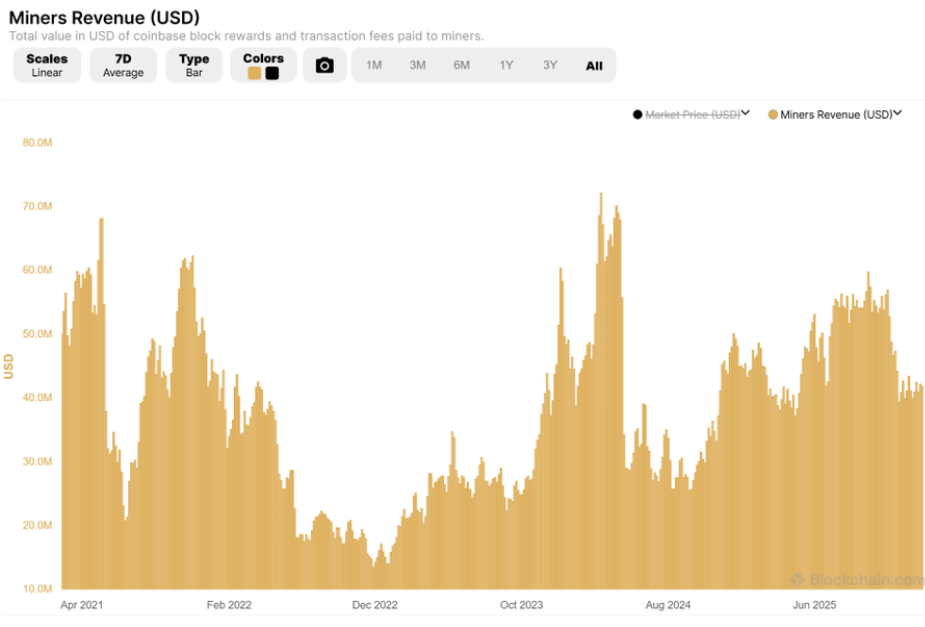
Many Bitcoin proponents will argue that the Bitcoin network is still highly secure due to the rising hashrate. However, according to Justin Bons, hashrate can rise even while real security is weakening because advances in mining hardware reduce the cost of producing hashes. The most important thing is how much money is actually being made by miners, since that figure represents the profitability and the cost an attacker would have to match or exceed.

Charts tracking block rewards and miner revenue show that, in economic terms, Bitcoin’s security is already lower than it was several years ago. Keeping security at current levels, he says, would require either transaction fees so high that users would simply stop using the network or the price of Bitcoin to double every four years at a pace that would quickly outpace the size of the global economy.

Bitcoin Miner Revenue. Source: @Justin_Bons on X

Prediction: Bitcoin To Plunge In Two To Three Halvings

The seven to 11-year timeframe Bons outlined for Bitcoin’s collapse is tied directly to its halving schedule. According to the industry expert, the cost of attacking the Bitcoin network for a sustained period could fall into territory that makes such attacks financially attractive within two to three more halvings.

If miner payouts are low enough, Bons believes the potential rewards from hitting multiple exchanges or protocols could outweigh the cost of carrying out the attack. The most realistic scenario for this to happen is through double-spend attacks against exchanges. 

Bitcoin is now trading at $95,270. Chart: TradingView

An attacker controlling 51% of the entire mining power could deposit Bitcoin, trade it for another asset, withdraw those funds, and then roll back the blockchain to reclaim the original coins.

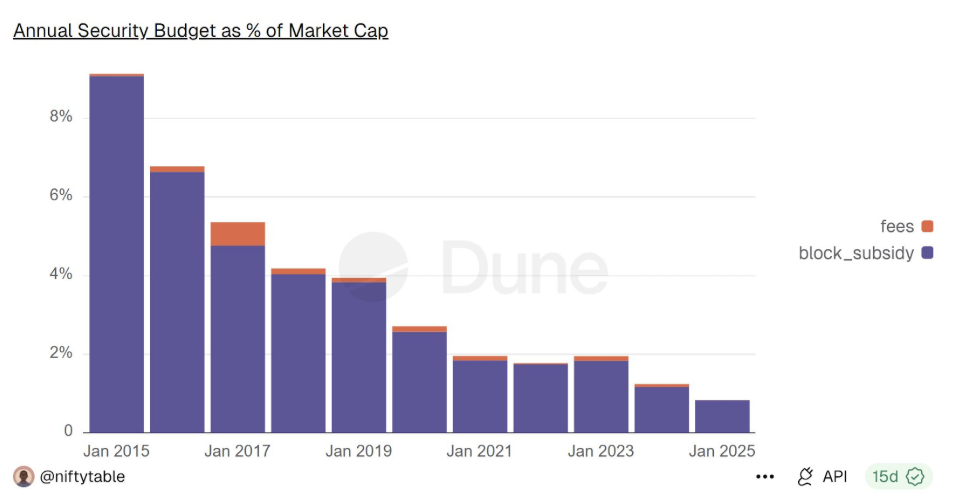
He also highlights data showing that Bitcoin’s security budget relative to its total market value has been trending downward for years. This means Bitcoin does not automatically become safer as it grows larger.

Bitcoin Security Budget as % of Market Cap. Source: @Justin_Bons

This leaves Bitcoin facing an eventual breaking point. From here, it is either the network increases its fixed 21 million supply cap to restore miner incentives, a move that would likely split the chain, or the entire Bitcoin ecosystem accepts the risk of double-spend attacks.

Featured image from Unsplash, chart from TradingView

Editorial Process for bitcoinist is centered on delivering thoroughly researched, accurate, and unbiased content. We uphold strict sourcing standards, and each page undergoes diligent review by our team of top technology experts and seasoned editors. This process ensures the integrity, relevance, and value of our content for our readers.

Bitcoin-loving burger joint Steak ‘n Shake adds $10m to crypto treasury – DL News

0

  • Burger chain Steak ‘n Shake has added $10 million in Bitcoin to its strategic reserve.
  • The restaurant franchise last year started accepting Bitcoin payments.
  • Steak ‘n Shake claims sales have increased since it started accepting crypto.

Another day, another crypto treasury buy.

Popular US burger restaurant franchise Steak ‘n Shake said on Friday that it had added $10 million in Bitcoin to its strategic reserve.

“We have created a self-sustaining system — growing same-store sales that grow the [strategic Bitcoin reserve],” the Indianapolis, Indiana-based company wrote on X.

“Improving food quality expands Steak n Shake’s reach and leverages Bitcoin into a new and delicious dimension.”

The move comes after the firm last year started accepting Bitcoin payments, claiming that any crypto it received for payments would be added to its balance sheet.

Friday’s statement is the first time the company has announced a Bitcoin buy following its 2025 crypto pivot.

Lightning fast

Steak ‘n Shake first started accepting Bitcoin payments in May 2025. The chain said it was using the Lightning Network — a second network built on top of Bitcoin designed to speed up transactions and cut costs — to receive digital payments.

“Eight months ago today, Steak ‘n Shake launched its burger-to-Bitcoin transformation when we started accepting Bitcoin payments,” the company said, adding that its same-store sales have “risen dramatically ever since.”

Steak ‘n Shake did not say how much Bitcoin it had received since 2025 in Bitcoin from customers and did not immediately respond to DL News’ questions.

DAT boom

2025 was the year digital asset treasuries — or DATs — became mainstream. There are currently 263 companies, public and private, holding Bitcoin, according to data from BitcoinTreasuries.net.

Bitcoin is down from this time last year. Source: CoinGecko.

The model is the brainchild of Strategy (formerly MicroStrategy) co-founder Michael Saylor, who transformed his sleepy Nasdaq-listed software company into a Bitcoin juggernaut in 2020.

The idea is that companies buy Bitcoin — or other cryptocurrencies — to get shareholders better value for money as cash depreciates but digital assets go up in value.

Private companies like Steak ‘n Shake hold the cryptocurrency in the hope it’ll appreciate over cash.

But the idea has been criticised by those who claim the model is unsustainable if Bitcoin’s price falls.

Bitcoin as everyday money?

Bitcoin was created to cut middlemen like banks out of Internet payments. But since the crypto network went live in 2009, it’s still difficult to actually find retailers that accept the digital coin.

Companies like Steak ‘n Shake — as rare as they are — are pushing Bitcoin to be used for transactions rather than just as a store-of-value investment.

Twitter co-founder and Block CEO Jack Dorsey, whose payment products Square and Cash App are Bitcoin-friendly, has repeatedly said that in order for the leading cryptocurrency to succeed, it must be used like cash.

Robert Kiyosaki Predicts $107 Silver on Monday as Market Faces Sudden Supply Shock

0

Silver markets face a potential shock as Rich Dad Poor Dad author Robert Kiyosaki predicts a rapid surge toward $107, arguing that tightening physical supply and industrial demand leave prices dangerously misaligned. Robert Kiyosaki Predicts $107 Silver on Monday, Warns the Market Is Underpricing Scarcity Robert Kiyosaki, author of Rich Dad Poor Dad, shared a […]

Nigerian SEC Partners With Police To Tackle Crypto Ponzi Schemes – Details

0

Trusted Editorial content, reviewed by leading industry experts and seasoned editors. Ad Disclosure

The Nigerian Securities and Exchange Commission (SEC) is maintaining an intense focus on the local cryptocurrency industry, as indicated by recent developments. While introducing minimum capital requirements for previously unregulated virtual asset service providers (VASPs), the securities regulator has also formed an alliance with the Nigeria Police Force (NPF) against cryptocurrency fraud, among other illegal operations.

Nigerian SEC Looks To Improve Crypto Investors’ Protection

According to local media Voice of Nigeria, the SEC is ramping up efforts aimed at investor protection and transparent market operations in the crypto ecosystem. In a recent meeting with the NPF, the Commission’s Director-General (DG), Dr. Emomotimi Agama, communicated to the Inspector General of Police (IGP), Kayode Egbetokun, concerns over malicious actors in the financial markets who exploit investors’ trust for personal gains. 

Dr. Agama said:

They cloak their deceit in the glamorous but misunderstood language of cryptocurrency and forex trading. They target the vulnerable, the optimistic, and the simply unsuspecting, leaving behind a trail of shattered lives, depleted pensions, and broken trust. This is not just a financial crime; it is a social menace that erodes public confidence in our entire financial system.

Currently, there is a gap, a seam between identification and enforcement that these scammers exploit. Today, we aim to close that gap permanently.

In particular, the SEC DG is proposing the formation of a specialized SEC-NPF team with members who bring understanding of the financial principles and operations and the tactical intelligence to curb these investment frauds and protect the Nigerian cyberspace. The IGP approved the collaboration request while also stating a strong commitment to help the SEC achieve its aims.

Crypto Fraud In Nigeria

Notably, Nigerians have been victims of several cryptocurrency investment scams in the past few years. The most prominent of these is the Crypto Bridge Exchange (CBEX) platform, which crashed in April 2025, losing over N1.3 trillion ($916 million) in user funds. 

The Nigerian SEC is strongly committed to reducing such menace as shown by the recent collaboration with the NPF alongside other measures such as a revised minimum capital requirements for VASPs and a published list of all identified fraudulent crypto and financial investment businesses. 

Notably, Nigeria remains one of the fastest-growing crypto hubs globally. According to data from TripleA, approximately 10.34% of Nigeria’s population, i.e., 22 million people, hold one digital asset or the other, therefore indicating the need for an effective regulatory oversight and protection system. 

Nigeria
Total crypto market cap valued at $3.18 trillion on the daily chart | Source: TOTAL chart on Tradingview.com

Featured image from Oriental News Nigeria, chart from Tradingview

Editorial Process for bitcoinist is centered on delivering thoroughly researched, accurate, and unbiased content. We uphold strict sourcing standards, and each page undergoes diligent review by our team of top technology experts and seasoned editors. This process ensures the integrity, relevance, and value of our content for our readers.

DOJ confirms seized Bitcoin from Samourai Wallet case has not been sold

0

Key Takeaways

  • The US Department of Justice has confirmed that seized Bitcoin from the Samourai Wallet case will not be liquidated but will remain as part of the Strategic Bitcoin Reserve.
  • US government holds roughly 328,000 Bitcoin in seized assets, according to onchain data.

Share this article

Department of Justice has confirmed that Bitcoin forfeited in the Samourai Wallet case has not been liquidated and will remain part of the US government’s Strategic Bitcoin Reserve.

The confirmation was shared by Patrick Witt, executive director of the White House President’s Council of Advisors for Digital Assets, who said the assets will not be sold and will remain on the US government balance sheet under Executive Order 14233.

Concerns had emerged earlier this month after onchain analysts observed roughly $6.3 million in Bitcoin moved from a Samourai Wallet linked address to Coinbase Prime, prompting speculation that the US Marshals Service or DOJ may have sold the assets. Witt said the transfers did not represent a liquidation and were permitted under the executive order.

Executive Order 14233 was signed by Donald Trump in March 2025 and explicitly bars US agencies from selling seized Bitcoin. The order established the Strategic Bitcoin Reserve, marking a shift away from prior practices where forfeited crypto was routinely auctioned.

The forfeited assets stem from the prosecution of Samourai Wallet founders Keonne Rodriguez and William Lonergan Hill, who faced charges in 2024 and 2025 tied to operating a privacy focused Bitcoin mixing service. About 57 Bitcoin was forfeited as part of their plea agreement.

Onchain data from Arkham Intelligence indicates that the US government currently holds roughly 328,000 Bitcoin in seized and controlled assets as part of the Strategic Bitcoin Reserve, valued at about $31.2 billion at current prices near $95,000. The Samourai-related Bitcoin forms part of this broader pool of government-held BTC.

The Strategic Bitcoin Reserve is managed by the US Treasury and is intended to hold seized Bitcoin as a long-term national asset rather than liquidating it into the market.

Editor’s note: Updated to include details on US government Bitcoin reserves.

Daily Crypto Banking Is Coming: Old Glory Targets Full Integration Inside a Chartered US Bank

0

A pro-America digital bank is racing toward Nasdaq with an ambitious plan to fuse traditional banking and crypto, promising faster blockchain access, new lending options, and a stablecoin-powered payments future through a high-profile SPAC merger. The Banking Disruption Wall Street Feared: Old Glory Targets Daily Crypto Use, Challenging Legacy Giants A new banking and crypto-focused […]

Despite the Dip, Bitcoin Just Flashed Its Most Reliable Bullish Signal: Analysis

0

The price of Bitcoin is down today, but BTC also just flashed its most-watched bullish signal. Is a recovery rally on the way?