

In an exclusive interview with CoinDesk, Immunefi’s CEO, Mitchell Amador, said onchain security is improving despite losses continuing to rise.
Bitcoin, ether, solana and XRP extend ETF inflow streak before reversal
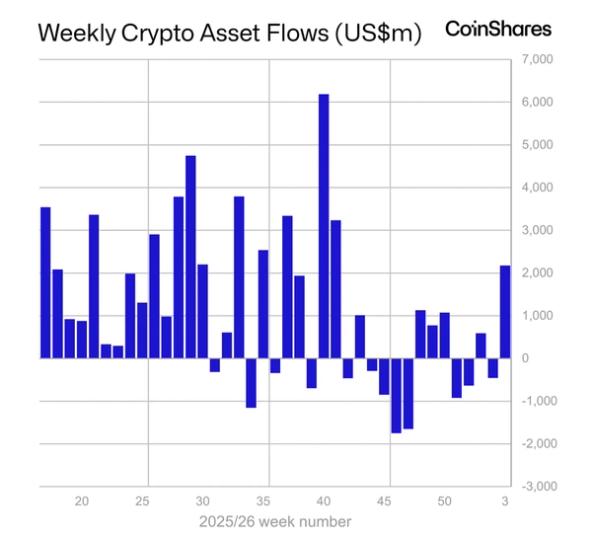
Bitcoin funds took in $1.55 billion while ethereum and solana added $496 million and $45.5 million, respectively.
Ethereum posts record onchain activity as research points to possible spam-driven growth: Asia Morning Briefing

Data suggests much of the recent spike in Ethereum transactions is tied to address poisoning, a scam that relies on cheap “dust” transfers to contaminate transaction histories rather than organic user demand.
Bitcoin $92K Drop Resets Leverage, Clears Unhealthy Investor Optimism

Bitcoin (BTC) saw a sharp pullback during the Asian market open, shaking out leveraged positions without breaking its market structure. While sentiment cooled rapidly, onchain and derivatives data suggest that the move resembles a structural reset rather than a deeper trend reversal.
Key takeaways:
-
$233 million in Bitcoin long liquidations flushed leverage while spot selling stayed muted, pointing to a reset, not panic distribution.
-
Sentiment collapsed to 45% from 80% as open interest fell to $28 billion, confirming a mild risk-off unwinding.
Bitcoin dip flushes leverage as sentiment cools
Bitcoin slid to $91,800 from $95,300, a 3.7% drop, during the Asian market open on Monday, triggering about $233 million in long liquidations over the past 24 hours. The move followed a period of elevated bullish positioning, leaving the market open for a downside sweep.
Bitcoin researcher Axel Adler Jr. noted that Bitcoin’s Advanced Sentiment Index fell sharply to 44.9% from 80%. The index, which integrates volume-weighted average price (VWAP), net taker volume, open interest and volume delta, had reached extreme bullish levels Tuesday-Thursday, aligning with a local high near $97,000.
The drop below the neutral 50% threshold signals a shift toward weaker risk conditions. According to Adler, price stabilization would require a sustained recovery above 50%, while a further slide toward the 20% zone could increase the odds of a deeper correction.
BTC open interest also declined back to its yearly opening levels near $28 billion. This suggests that leveraged positions were unwound rather than new shorts aggressively entering the market. Aggregated futures cumulative volume delta (CVD) remained slightly elevated relative to open interest, while spot CVD stayed flat, indicating limited spot-driven selling pressure.

Related: Bitcoin futures OI rebounds 13% as analysts see cautious return of risk appetite
Will traders cut and run, or buy the dip?
From a technical standpoint, Bitcoin continues to print higher highs and higher lows on the daily chart. The $92,000 to $93,000 region aligns with a daily order block demand zone and a retest of the rolling monthly VWAP support, making it a plausible higher-low area before another upside attempt toward $100,000.

Hyblock Capital data also shows that about $250 million in net long positions were filled near $92,000 over the past day, suggesting dip demand rather than capitulation.
In the near term, price action may round out within this order block range, provided Bitcoin holds above $90,000. With US equity markets closed on Monday, clearer directional pressure may emerge on Tuesday, potentially allowing bulls to reassert control.

Related: BTC vs. new $80K ‘liquidity grab’: 5 things to know in Bitcoin this week
This article does not contain investment advice or recommendations. Every investment and trading move involves risk, and readers should conduct their own research when making a decision. While we strive to provide accurate and timely information, Cointelegraph does not guarantee the accuracy, completeness, or reliability of any information in this article. This article may contain forward-looking statements that are subject to risks and uncertainties. Cointelegraph will not be liable for any loss or damage arising from your reliance on this information.
ChatGPT Is Getting Ads—Here’s What to Expect

In brief
In the coming weeks, we plan to start testing ads in ChatGPT free and Go tiers.
We’re sharing our principles early on how we’ll approach ads–guided by putting user trust and transparency first as we work to make AI accessible to everyone.
What matters most:
– Responses in… pic.twitter.com/3UQJsdriYR— OpenAI (@OpenAI) January 16, 2026
What to expect
Daily Debrief Newsletter
Start every day with the top news stories right now, plus original features, a podcast, videos and more.
$10K Bitcoin Path: Strategist Warns Failure to Hold $100K Signals End-Game Risk

Bitcoin could face a deep, prolonged slide toward $10,000 if it fails to hold above $100,000, signaling a potential late-cycle peak and broader risk-asset reversal, according to Bloomberg Intelligence strategist Mike McGlone. $10K No Longer Unthinkable if $100K Fails, Strategist Warns Bloomberg Intelligence senior macro strategist Mike McGlone shared on social media platform X on […]
ETH Searches for Direction & LTC Builds Pressure While ZKP Draws Investor Attention With a $5,000,000 Giveaway

Crypto markets are moving through a period of hesitation, but not every project is waiting for direction. Zero Knowledge Proof (ZKP) is already active, drawing investor attention through participation-driven mechanics rather than price momentum. While much of the market remains focused on recovery, Zero Knowledge Proof (ZKP) continues to operate through live auctions, infrastructure deployment, and incentive-led engagement.
That contrast stands out against established assets. Ethereum has stabilized after a sharp selloff but remains unable to confirm a new trend, while Litecoin is seeing increased on-chain and derivatives activity without a decisive price response. These mixed signals are shaping how traders approach the Ethereum price prediction and Litecoin price prediction. As volatility compresses, the discussion around the best crypto to buy right now is shifting toward systems that keep moving even when price action elsewhere slows.
Ethereum’s Recovery Remains a Work in Progress
Ethereum is consolidating near $3,315 following a relief rally, but the broader setup remains restrained. Price continues to trade below the declining 100-day and 200-day EMAs clustered around the $3,280–$3,340 region, an area that has consistently capped upside since late 2025. As a result, the current Ethereum price prediction points to stabilization rather than a confirmed trend shift. On the downside, the 50-day EMA near $3,145 has emerged as first support, while $3,000 remains the next key reference if weakness returns.
Structurally, ETH has broken its pattern of lower lows but has yet to form higher highs, leaving the market in transition. Momentum has improved, with RSI rising into the low-60s, though past rebounds stalled at similar levels. Flow data remains cautious, with negative spot netflows and falling open interest indicating de-risking rather than accumulation. Until ETH secures a daily close above $3,350–$3,400, the Ethereum price prediction favors range-bound trade, keeping traders selective as they reassess the best crypto to buy right now.
Litecoin Builds Pressure Beneath the Surface
Litecoin is showing a growing disconnect between price action and underlying activity. While spot performance remains weak, whale transactions above $100,000 have climbed to a five-week high, and exchanges have recorded more than $45 million in net outflows. Together, these signals point toward accumulation rather than distribution, adding depth to the current Litecoin price prediction beyond what charts alone suggest.
Derivative data reinforces that view. Open interest has jumped more than 54% to roughly 8.25 million LTC, its highest level since the October leverage flush, when prices traded above $100. Despite this buildup, price continues to face rejection at the 20-day and 50-day EMAs after holding support near $75, and momentum indicators remain below neutral. For now, the Litecoin price prediction depends on whether buyers can reclaim short-term averages and challenge the descending trendline from November. Until that happens, Litecoin remains a pressure-building setup rather than a confirmed breakout, keeping it in play, but not leading the debate around the best crypto to buy right now.
Zero Knowledge Proof Advances Through Participation, Not Price
As broader crypto markets remain anchored to recovery narratives, Zero Knowledge Proof is attracting attention through activity and execution. Rather than relying on momentum or headline-driven rallies, the project centers engagement around a $5,000,000 giveaway tied directly to participation in its live on-chain auction and broader ecosystem. The auction releases a fixed amount of tokens each day, creating continuous price discovery and removing the dependency on a single launch moment to define value.
That structure reshapes how participants interact with the network. Instead of timing entries around listings or short-lived incentives, users engage with a system that resets daily. Each auction forces the market to reprice based on current demand, keeping participation active even when broader sentiment turns cautious. The giveaway functions less as a marketing push and more as a mechanism to widen engagement within this ongoing process.

Infrastructure underpins the model. Proof Pods, $249 plug-and-play hardware devices, perform verifiable compute and zero-knowledge proof generation for the network. Rewards are earned through measurable contribution such as uptime and task execution, not passive holding. A level-based system allows contributors to scale involvement over time, directly linking rewards to real usage. This anchors value creation to participation rather than speculation.
The broader technology stack reinforces that focus. Zero Knowledge Proof is built around privacy-first, verifiable computation with full EVM compatibility, allowing integration with existing tools and workflows. With roughly $100 million already committed to development, the project is positioned as infrastructure rather than an experiment.
Closing Note!
The current market perspective highlights a clear divide. Ethereum is stabilizing but lacks confirmation, Litecoin is building pressure without price follow-through, and Zero Knowledge Proof (ZKP) is advancing through deployment and participation. Each reflects a different response to uncertainty.
For investors, this divergence matters. Assets tied to recovery narratives depend on sentiment shifting, while infrastructure-led systems depend on engagement and execution. As discussions around the best crypto to buy right now evolve, the focus is broadening beyond charts alone. Whether tracking an Ethereum price prediction, reassessing a Litecoin price prediction, or evaluating emerging infrastructure plays, investor attention is increasingly drawn to projects that continue moving even when the broader market pauses.
Website: https://zkp.com/
Auction: https://auction.zkp.com/
X: https://x.com/ZKPofficial
Telegram: https://t.me/ZKPofficial

NYSE targets weekend investors with new blockchain platform for 24/7 stock trading

The Intercontinental Exchange-owned operator is seeking SEC approval for a new venue that promises instant settlement and stablecoin funding to meet the growing global demand for “around-the-clock” markets.
Ripple Advances Zero-Knowledge Proofs For The XRP Ledger

Trusted Editorial content, reviewed by leading industry experts and seasoned editors. Ad Disclosure
RippleX, the developer arm of Ripple, is prototyping zero-knowledge proof (ZKP) capabilities for the XRP Ledger (XRPL), positioning the technology as a route to “programmable privacy,” trust-minimized interoperability, and a scaling model that pushes heavy computation to layer-2 systems while keeping XRPL as the settlement layer.
In Episode 9 of Ripple’s “Onchain Economy” video series, Aanchal Malhotra, Ph.D., Head of Research at RippleX, framed ZK enablement as a near-term research priority and a long-horizon bet on XRPL’s competitiveness. “I would really like to see an XRP ledger with zero knowledge proof technology enabled. There are so many use cases. There are so many innovative applications that we can build using this technology. So my number one priority right now is to work on enabling zero knowledge proofs on XRP ledger,” Malhotra said.
What Ripple Is Planning With ZK-Proofs
Malhotra also stressed that integrating modern ZK systems into XRPL is not a simple plug-in exercise. “We are getting past the exploration phase of zero knowledge technologies. When the XRP ledger was built, these technologies were not even around. So it takes a while. We cannot just use any off-the-shelf solution. It takes a while for us to figure out the specifics of ZK technology to integrate with XRP ledger,” she said, describing the work as moving from exploratory research into prototyping.
That prototyping effort, according to RippleX’s Head of Research, is taking a hybrid form. Some components of ZK proofs would be implemented “natively for better performance,” while another portion would sit in a “programmability layer” to let developers choose proving systems and build applications tuned to their requirements.
The goal, she indicated, is a design that balances throughput and developer flexibility rather than forcing a single ZK stack across all use cases. “We are at the stage of prototyping zero knowledge proof,” Malhotra said, adding that the approach is intended to support “different applications [and] different proving systems.”
Much of Malhotra’s framing centered on privacy, specifically, a version that can satisfy compliance and business constraints without collapsing into blanket opacity. “In my opinion, zero knowledge proofs is a very very powerful tool. When we talk about privacy, people think about 100% privacy where everything is hidden […] and those things could be used in nefarious ways,” she said.
“However, what blockchains enable is something called programmable privacy […] you can do selective disclosure meaning disclose the relevant information to third parties for example auditors for compliance purposes.” In her example, a user could prove they are above a threshold, such as being over 18, without revealing the underlying data like an exact age.
Malhotra also pointed to interoperability as a domain where ZK techniques could reduce reliance on trusted intermediaries. She characterized bridges as “fraught with technical challenges,” with trust being the biggest: today’s designs often depend on third parties, federators, or other centralized structures. “What zero knowledge proofs provide is trustlessness. It provides verifiability. So you do not have to trust a third party. Instead what you trust in is cryptography,” she said.
Zero-knowledge proofs will drive breakthroughs in privacy and compute scalability.
Watch Episode 9 of the Onchain Economy: https://t.co/joOV5Uj7uU@aanchalmalhotre, Head of Research at RippleX, explains how zero-knowledge proofs enable programmable privacy on XRP, supporting… pic.twitter.com/oCSBYAitY6
— RippleX (@RippleXDev) January 18, 2026
On scaling, Malhotra described a model where ZK proofs help compress or externalize execution: layer-2 systems perform computation, then submit succinct proofs that can be verified on XRPL. That, in her telling, lets the base layer focus on settlement and proof verification rather than running every workload directly. The practical implication is an architecture where XRPL could support more complex applications without forcing all computation onto the L1.
At press time, XRP traded at $1.976.
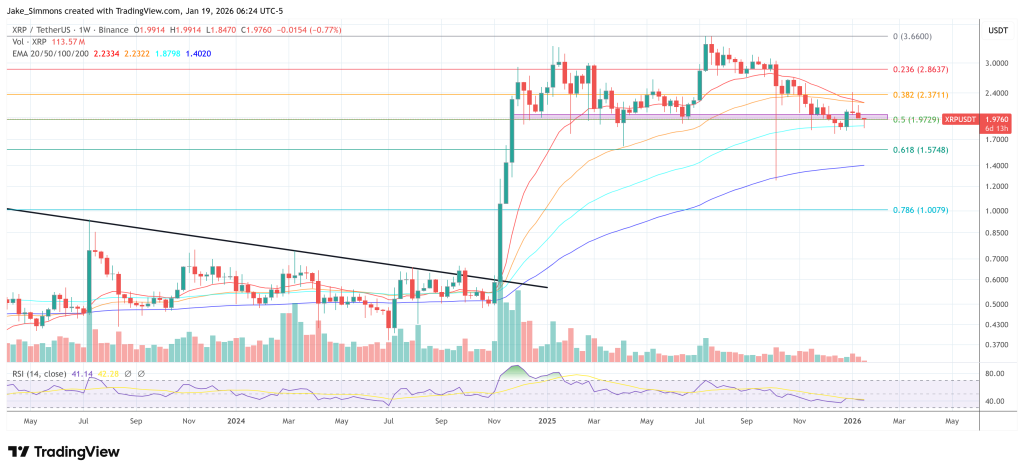
Featured image created with DALL.E, chart from TradingView.com

Editorial Process for bitcoinist is centered on delivering thoroughly researched, accurate, and unbiased content. We uphold strict sourcing standards, and each page undergoes diligent review by our team of top technology experts and seasoned editors. This process ensures the integrity, relevance, and value of our content for our readers.
Vitalik Buterin Says DAOs Need a Rethink Beyond Token-Holder Voting

Ethereum co-founder Vitalik Buterin is calling for a new generation of decentralized autonomous organizations ( DAOs) that move beyond token-holder voting, arguing that today’s dominant DAO model is inefficient, fragile, and prone to political capture. Buterin Pushes for Smarter DAOs That Move Past Simple Token Voting Buterin laid out his critique in a detailed post […]