

On the very same day Strategy revealed locking in its $2 billion bitcoin buy, Bitmine Immersion Technologies quietly bulked up its ethereum stack to 4.203 million ETH, snapping up 35,268 tokens over the past week and further cementing its title as the world’s largest ethereum treasury holder. Bitmine’s Ether Treasury Swells The update came in […]
Fluid Quip Technologies Expands Deployment of Low Energy Distillation™ Technology at United Ethanol

CEDAR RAPIDS, Iowa–(BUSINESS WIRE)–Fluid Quip Technologies (FQT) continues to advance the biofuels industry’s transition toward higher efficiency and lower carbon intensity with another commercial deployment of the patented Low Energy Distillation™ (LED™) system at United Ethanol in Milton, Wisconsin.
The LED™ system, is a next-generation distillation platform designed to reduce steam usage, eliminate unnecessary phase changes, lower water consumption, and support continuous, reliable operation. By removing direct-inject steam from the distillation process and incorporating advanced heat integration, LED™ can significantly reduce energy usage, helping producers lower operating costs and improve carbon intensity (CI) scores.
The LED™ platform integrates technology developed over a multi-year collaboration between Fluid Quip Technologies and RCM Thermal Kinetics, combining FQT’s system integration expertise with RCM’s advanced Distillation, Dehydration and Evaporation (DDE) process design and intellectual property. The underlying architecture rethinks conventional ethanol distillation by tightly integrating heat recovery, allowing plants to achieve significant energy reductions.
“With every LED installation, we’re demonstrating that ethanol production can be more efficient, profitable, and sustainable,” said Neal Jakel, President of Fluid Quip Technologies. “Producers are achieving meaningful energy savings, increased uptime, and measurable carbon reductions without compromising throughput or reliability.”
“We are excited to move forward with the LED system,” said Dan Wych, Vice President of Wisconsin Ethanol Operations at United Cooperative. “Reducing our energy demand is a strategic priority, and FQT’s LED technology aligns with our goals for efficiency, reliability, and CI reduction.”
This installation further reinforces FQT’s position as a leading provider of energy-reduction technologies for the ethanol industry. It marks the fourth commercial deployment of the LED™ system demonstrating the technology’s success and seamless integration into existing plant infrastructure.
About Fluid Quip Technologies
Fluid Quip Technologies® (FQT) is a premier technology and process engineering firm based in Cedar Rapids, Iowa. FQT’s skilled engineering and technical teams have been developing new technologies and providing unique process engineering solutions to the beverage, biofuels and bio-chemical markets for more than 30 years. For more information, visit www.fluidquiptechnologies.com.
Strategy ($MSTR) Spends $2.13 Billion To Buy 22,305 Bitcoin

Strategy (MSTR), the world’s largest publicly traded corporate holder of bitcoin, has added another major tranche of BTC to its balance sheet, purchasing 22,305 bitcoin for approximately $2.13 billion over the past week.
The acquisition, disclosed today, was made at an average price of roughly $95,284 per bitcoin, roughly 4% more than current prices. As of Jan. 19, 2026, Strategy now holds a total of 709,715 BTC, acquired for approximately $53.92 billion at an average price of $75,979 per coin.
The latest purchase marks Strategy’s largest weekly bitcoin acquisition since November 2024 and its fifth-largest bitcoin purchase announcement to date.
Led by executive chairman Michael Saylor, the company has continued its aggressive, near-weekly accumulation strategy, using capital markets activity to convert traditional financial assets into bitcoin exposure.
The latest purchase was funded through a combination of common stock issuance and sales of the company’s perpetual preferred equity, Stretch (STRC).
Strategy’s aggressive bitcoin purchasing strategy
According to regulatory filings, the company raised about $2.125 billion in net proceeds between Jan. 12 and Jan. 19 through its at-the-market (ATM) programs. The bulk of the funds came from the sale of 10.4 million shares of MSTR Class A common stock, generating approximately $1.83 billion.
An additional $294.3 million was raised through the issuance of roughly 2.95 million STRC preferred shares. Smaller amounts were generated via STRK preferred stock, while no shares were issued under the STRF or STRD programs during the period.
Despite the continued accumulation, Strategy shares were under pressure in early trading, falling about 5% as bitcoin prices slid below $91,000. The pullback follows a broader crypto market sell-off after BTC traded above $94,000 late last week.
With more than 709,000 bitcoin now held, Strategy controls over 3% of bitcoin’s total circulating supply.
Several weeks ago, the company also announced they are increasing their U.S. dollar reserve to $2.25 billion, up from $1.44 billion in December, intended to support dividend payments on preferred shares and interest obligations on outstanding debt.
Strategy and MSCI
Earlier this month, the company was relieved of some selling pressure when MSCI concluded its review of digital asset treasury companies and decided not to exclude them from its major global equity indexes.
The index provider said bitcoin-heavy firms will remain eligible under existing rules while it conducts further research on how to distinguish operating companies from investment-like entities.
The decision eased months of market anxiety after MSCI had proposed reclassifying companies with more than 50% of assets in digital assets as fund-like and therefore ineligible for inclusion.
Companies like Strategy, along with industry groups, pushed back strongly, warning that exclusions could trigger billions of dollars in forced passive selling.
Toku Brings Instant USDC Payroll to Polygon, Targeting 100+ Countries

Toku said it will let employers pay workers in stablecoins on Polygon, aiming to turn payroll—one of the world’s most routine and regulated money flows—into a blockchain-native transaction with real-time settlement and low fees.
The company, which markets itself as a compliance-focused platform for stablecoin and token compensation, said the Polygon integration is designed to work alongside existing HR and payroll software such as ADP and Workday, with Toku handling employment contracts, tax withholding, benefits administration and regulatory filings across more than 100 jurisdictions.
The pitch taps into a growing push by crypto infrastructure firms to move beyond trading and speculation and into operational finance—payments, payroll and invoicing—where volumes are recurring and sticky, but compliance requirements are unforgiving. Stablecoins, which are typically pegged to the US dollar, have been gaining traction as a settlement rail for cross-border transfers because they can move 24/7 and clear without correspondent banks.
From “crypto comp” to corporate plumbing
Toku’s announcement leans on a recent Pantera Capital compensation survey, which found that stablecoins dominate crypto-denominated compensation, with USDC and USDT together accounting for more than 90% of reported crypto salary payments. A Thomson Reuters analysis of the same survey flagged that while interest is rising, payroll in stablecoins still runs into hard edges—tax reporting, withholding, worker classification and jurisdiction-by-jurisdiction rules that don’t map neatly onto crypto rails.
Toku has been building around those constraints rather than around a consumer wallet experience. Last year, it partnered with stablecoin payments firm Rain to offer stablecoin payroll in more than 100 countries, framing the product as “instant” payouts that plug into employers’ existing workflows. More recently, Toku has also highlighted integrations aimed at making stablecoin payroll work inside systems used by finance teams, including ADP and Workday.
Toku and partners have separately pointed to scale: a Crossmint case study described Toku as administering more than $1 billion of global payroll using stablecoins.
Why Polygon wants payroll traffic
For Polygon, the tie-up fits a broader strategy to position its network as a payments settlement layer rather than just a venue for decentralized finance. Polygon has been emphasizing retail-sized stablecoin transfers and local-currency stablecoin volume as a wedge into payments adoption.
Polygon handles a large share of USDC transfers in the $100 to $1,000 range in the US—an activity band that proponents argue looks more like everyday commerce than institutional treasury movement.
The payroll use case also arrives as Polygon accelerates dealmaking around stablecoin payments. Polygon Labs said this week it agreed to acquire crypto payments firm Coinme and wallet infrastructure provider Sequence for more than $250 million, as it works toward becoming a regulated US payments player and targets business-to-business payments first.
The practical hurdle: compliance, not throughput
Stablecoin payroll has long been a niche product, partly because employers can’t treat payroll like a casual transfer. Payments must be timed to local pay cycles, backed by documentation, and paired with statutory deductions and filings. A “send” button is the easy part; the hard part is making the payment legally equivalent to payroll across countries that have different labor codes, reporting standards and enforcement norms.
That’s where Toku says it competes: the company positions itself as an intermediary layer that can keep employers on familiar HR systems while moving value over blockchain rails. Toku also promotes employer-of-record style services for hiring across jurisdictions without opening local entities—an approach that could be attractive to globally distributed teams, though it also pulls stablecoin payroll deeper into local employment law.
The Thomson Reuters analysis noted that tax and reporting requirements remain a central friction point—especially in the US, where wage reporting, withholding and documentation standards are tightly enforced even when the “money” arrives as a digital token.
Why does stablecoin payroll matter?
If stablecoin payroll becomes mainstream for certain categories of employers—remote-first companies, global contractor-heavy businesses, or firms paying workers in high-inflation markets—the implications would go beyond crypto HR perks. Payroll is a repeated, predictable flow; it can anchor other services such as earned-wage access, benefits, contractor management, and even small-business treasury operations.
It could also deepen the competition among blockchains to host “boring” payments traffic. Networks that win payroll and invoicing flows may benefit from consistent transaction volume and a pathway to partnerships with traditional fintech providers—even if margins are thin.
The market is still too early. Pantera’s survey suggested crypto compensation is growing but still far from universal, even inside the blockchain industry. Still, the direction of travel is clear: as stablecoins become less of a trading instrument and more of a settlement format, vendors like Toku are trying to package them into something corporate finance teams can use without rewriting how payroll works.
Disclaimer: The information provided on AlexaBlockchain is for informational purposes only and does not constitute financial advice. Read complete disclaimer here.
Image Credits: Toku
Ripple Exec Pushes Central Banks To Back Regulated Stablecoins

Trusted Editorial content, reviewed by leading industry experts and seasoned editors. Ad Disclosure
Ripple’s UK & Europe policy director Matthew Osborne is urging central banks to stop treating stablecoins as an external threat and instead fold well-regulated issuers into core safeguards, arguing that oversight plus access to official infrastructure can make stablecoins a net stabiliser for payments and settlement.
Writing for the Official Monetary and Financial Institutions Forum on 19 January 2026, Osborne said stablecoins have moved well beyond a niche experiment, citing a market value “in excess of $300bn” and annual transaction volumes that he wrote now surpass Visa and Mastercard combined. He argued momentum could accelerate in the US after the Genius Act, which he said would introduce federal rules and allow banks to issue stablecoins.
The Ripple exec framed the shift as already visible among central banks themselves. He pointed to the European Central Bank’s recent recognition of stablecoins’ benefits for cross-border payments and its view that tomorrow’s financial system will host multiple forms of money. He also cited the Bank of England’s stance that stablecoins could support “faster, cheaper retail and wholesale payments” as part of a “multi-money” system underpinned by central bank money.
Ripple Exec: Bring Stablecoins Into The Safety Net
At the centre of his case is the claim that stablecoins should be treated as an incremental evolution rather than an adversarial replacement. “Regulated stablecoins could play a key role in financial markets alongside other forms of money,” Osborne wrote. “First, stablecoins are more likely to complement the existing financial system than replace it. This is evolution, not revolution.” He then added: “The solution lies in central banks channelling stablecoin momentum, not fighting it.”
Osborne argues central bank money will remain essential as a risk-free settlement asset and safe store of value, but its relative role could shift in digital markets. He pointed to atomic settlement, where legs of a transaction settle simultaneously and conditionally, as reducing the traditional need to use central bank money purely to mitigate settlement risk.
Where stablecoins could be structurally preferred, he wrote, is in cross-border flows and multi-chain markets. “Cross-border payments are one example, given that stablecoins can move value anywhere in the world in seconds,” the Ripple exec said.
“In contrast, central bank money is likely to be less suitable for cross-border payments given access may be geographically limited and adoption of on-chain central bank money is far from universal around the world.” He also argued stablecoins are likely to exist across more blockchain networks than central bank money, making same-chain settlement between tokenized assets and cash more achievable while interoperability remains uneven.
Central banks have repeatedly warned that stablecoins could pull funds from bank deposits, weakening bank credit creation and potentially amplifying stress events. Osborne pushed back, arguing the risk is overstated because markets already accommodate instruments backed by highly liquid assets, money market funds, e-money, and “narrow banks”, without causing sustained deposit runs.
His bigger point is that regulation, while necessary, is insufficient without a backstop. “But regulation alone is not enough,” Osborne wrote. “Stablecoin issuers lack access to the safety net that gives bank deposits their resilience. Without it, even well-managed stablecoins are more vulnerable to shocks – as seen when USDC temporarily lost its peg following exposure to Silicon Valley Bank in 2023.”
He argued central banks should consider extending elements of that safety net, including allowing well-regulated stablecoin issuers to hold part of their backing assets in central bank accounts, offering liquidity insurance against market-wide shocks, and granting more direct payment-system access to reduce tiering risk.
The Ripple exec closed by positioning the choice for central banks as strategic: resist stablecoins and risk the market scaling beyond official influence, or “bring them inside the tent,” shaping development through prudential oversight and infrastructure access as tokenized settlement rails mature.
At press time, XRP traded at $1.9216.
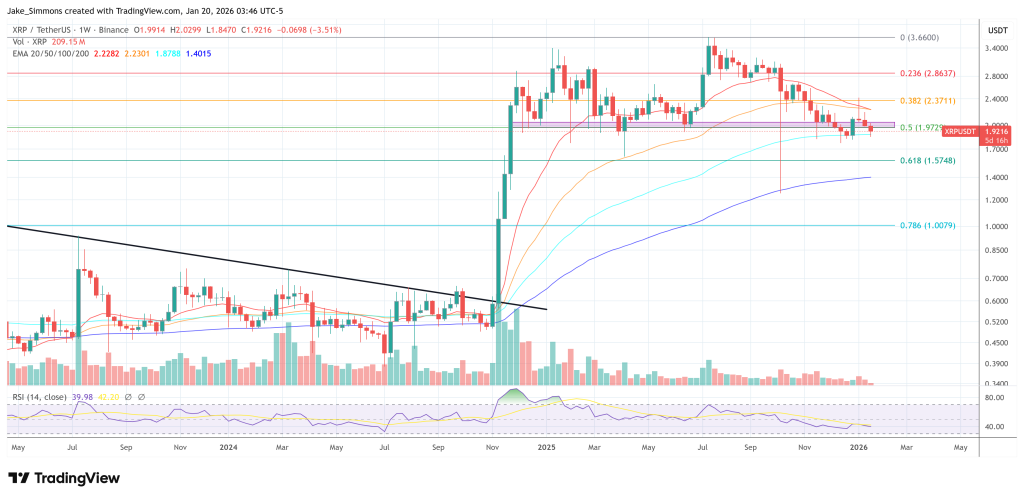
Featured image created with DALL.E, chart from TradingView.com

Editorial Process for bitcoinist is centered on delivering thoroughly researched, accurate, and unbiased content. We uphold strict sourcing standards, and each page undergoes diligent review by our team of top technology experts and seasoned editors. This process ensures the integrity, relevance, and value of our content for our readers.
Plastic surgery chief used crypto to tuck away millions from Chinese payments, say customs officials – DL News

- Suspects “used crypto to launder payments made using Alipay, WeChat Pay.”
- South Korea is home to an $11 billion plastic surgery industry.
- Three people arrested, Seoul customs chiefs say.
South Korean customs officials have vowed to crack down on plastic surgery clinics that cater to foreign tourists after unearthing a $102 million crypto-powered money laundering network.
Investigators say criminals in Seoul used unnamed cryptocurrencies to launder customer payments for cosmetic surgery procedures made using the Chinese e-pay platforms Alipay and WeChat Pay.
“We plan to carry out stricter on-site inspections at clinics,” a Korea Customs Service official told South Korean newspaper Joongang Ilbo. “We must prevent instances of illegal currency exchange in the overseas medical tourism sector.”
The South Korean plastic surgery industry is worth around $11 billion, with the so-called “medical tourism” sector set to grow to $3.1 billion by 2033. The flow of plastic surgery clients from China is rising at an average rate of 100% per year.
However, crypto-powered money laundering is rising at a similarly exponential rate in the country, with some unscrupulous operators looking to cash in on the cosmetic surgery boom.
Nip-tucking the books
Seoul Customs say the network’s mastermind was the Chinese-Korean head of consultations at a “large” plastic surgery clinic.
This individual, unnamed for legal reasons, allegedly funneled customers’ WeChat Pay and Alipay payments into dedicated bank accounts.
Then, working with a Chinese national, they withdrew these funds and used the money to buy cryptocurrencies in multiple overseas jurisdictions.
They transferred these coins to wallets on South Korean crypto exchanges, officials said. Next, they reportedly sold these coins for South Korean won, and withdrew the funds in cash at ATMs after sending them through numerous South Korean bank accounts.
In 2024, the duo allegedly decided to broaden the scope of their operation, branching out from the plastic surgery industry to other sectors popular among Chinese tourists.
They reportedly convinced the South Korean owner of a mobile phone store to help them launder payments made in small-scale export trade deals, as well as duty-free purchases and tuition fees for language courses.
Customs officials said all three individuals have been charged, with their cases handed over to prosecutors.
The connection between plastic surgery and crypto is growing. In 2024, a paper in an industry journal advised, “Plastic surgeons should consider investing in Bitcoin exchange-traded funds and accepting cryptocurrency as payment for services.”
“Plastic surgeons will likely be at the forefront of assimilating [Bitcoin] into healthcare,” the authors said.
Tim Alper is a News Correspondent at DL News. Got a tip? Email him at tdalper@dlnews.com.
Bitcoin’s “Failed” Breakout Sees $58,000 Target Return

Bitcoin (BTC) slid to eight-day lows on Tuesday as macro headwinds gave bulls new headaches.
Key points:
-
Bitcoin toyed with the 2025 and 2026 yearly opens after a “failed” breakout from its multimonth range.
-
Some analysts argue BTC’s current weakness is technically driven, despite macro headlines.
-
Targets for Bitcoin include a drop to 15-month lows.
Bitcoin “breakout failed” as $90,000 looms
Data from TradingView showed BTC price action retargeting $90,000 prior to the week’s first Wall Street trading session.
This was tipped to be volatile amid a potent combination of geopolitical and macroeconomic forces, chief among which was the reemergence of a US-EU trade war, stemming from US President Donald Trump’s renewed rhetoric around US control of Greenland.
With Trump tariffs back in the cards, risk assets suffered while precious metals hit new all-time highs as traders sought safe havens.
“Now fully back into the ~$84K-$94K range it has spend the past 2 months in already,” trader Daan Crypto Trades summarized in his latest analysis on X.
“Breakout failed and doesn’t make for a pretty look now.”

An accompanying chart showed price sliding through its 200-period simple (SMA) and exponential (EMA) moving averages on four-hour timeframes.
For Daan Crypto Trades, the 2026 yearly open near $87,000 was now of interest as a potential support level.
“Been talking about that yearly open likely being taken out at some point as it’s rare to see no wick below on the yearly candle. So better get that out of the way sooner than later if you ask me. Still just observing as I don’t see any reason to trade this chop,” he told X followers.
Trader and analyst Rekt Capital, focused on the 2025 yearly open at $93,500, a level that was of key importance for the weekly chart.
“In fact, Bitcoin has marginally Weekly Closed above $93500, therefore resembling more the April 2025 Weekly Close above $93500 than the November 2024 one (both green circles),” he wrote Monday alongside an explanatory chart.
“Bitcoin will need to find a way to reclaim $93500 throughout the week to ensure this becomes a successful retest to confirm the breakout from the Weekly Range (black-black).”

Back to $58,000 for BTC price?
Exchange order-book data showed signs of stress on the day, with liquidations hitting $360 million in the 24 hours to the time of writing, per data from CoinGlass.
Related: BTC vs. new $80K ‘liquidity grab’: Five things to know in Bitcoin this week

Overnight Sunday, liquidations spiked as US futures markets opened to news of fresh trade-war fears.
Despite the macro timing, Keith Alan, cofounder of trading resource Material Indicators, argued that the writing had been on the wall for Bitcoin bulls.
“If you were caught off guard by the Bitcoin selloff, you simply haven’t been paying attention to the right things. This move had nothing to do with narratives. We’ve seen it developing in the charts, and have been talking about it for over a month,” an X post stated after the futures open.
Alan pointed to a so-called “death cross” involving the 21-week and 50-week SMAs, something that in the past has “always led to a macro bottom.”
The signal refers to a shorter-term weekly crossover, where the 21-week moving average fell below the 50-week, rather than the classic 50-day/200-day “death cross,” and is typically viewed as a lagging indicator of momentum rather than a definitive trend reversal.

The cross occurs when the falling 21-period trend line crosses under the 50-period equivalent. Alan added that he was looking at the 100-week SMA for a bounce, which was at $86,900.
Even more downbeat was veteran trader Peter Brandt, who eyed a retreat below the $60,000 mark.
The last time that BTC/USD traded at that level was in October 2024.
58k to $62k is where I think it is going $BTC
If it does not go there I will NOT be ashamed, so I do not need to see you trolls screen shot this in the future
I am wrong 50% of the time. It does not bother me to be wrong pic.twitter.com/NDOuSrqLwa— Peter Brandt (@PeterLBrandt) January 19, 2026
This article does not contain investment advice or recommendations. Every investment and trading move involves risk, and readers should conduct their own research when making a decision. While we strive to provide accurate and timely information, Cointelegraph does not guarantee the accuracy, completeness, or reliability of any information in this article. This article may contain forward-looking statements that are subject to risks and uncertainties. Cointelegraph will not be liable for any loss or damage arising from your reliance on this information.
Coinbase Argues the Real Divide is Brokered vs. Unbrokered

A new Coinbase Institute report argues that the most important divide in global finance is no longer rich versus poor, but between those who have direct access to capital markets and those who do not, which it describes as the “brokered” versus the “unbrokered.”
The report estimates that traditional intermediated rails exclude roughly four billion unbrokered individuals from owning productive assets or raising capital at scale. Closing this gap, it argues, will require rebuilding core market infrastructure so smaller investors and issuers can participate directly rather than through layers of intermediaries.
According to the report, over the last 40 years in the United States alone, capital income grew 136% while labor income lagged at just 57%.
The paper’s central claim is that access to capital markets, not just basic banking, has become the real gatekeeper of wealth creation.
Traditional systems rely on layers of brokers, custodians and clearing houses, making it uneconomical to serve smaller investors or issuers and leaving a “capital chasm” between the brokered minority and everyone else.
Related: Bermuda partners with Coinbase and Circle for ‘fully onchain‘ economy
Meanwhile, ownership of stocks, bonds and funds clusters heavily in advanced economies, among already brokered households.

Why Coinbase wants permissionless rails
Coinbase’s argument is not just that tokenization matters, but that permissionless tokenization is essential if the unbrokered are to benefit.
The report claims that permissioned consortia and closed enterprise blockchain models tend to replicate existing power dynamics, with a few gatekeepers deciding who can issue, list or access tokenized assets.
By contrast, it likens an open, permissionless architecture to internet protocols like TCP/IP, where anyone can build on the same rails and interoperability cannot be quietly revoked later.
Related: Sygnum sees tokenization and state Bitcoin reserves taking off in 2026
Tokenization is already happening
The report arrives as tokenization is already moving from pitch decks into production across both crypto and traditional finance.
Franklin Templeton’s tokenized US money market fund shares, issued on public blockchains, for example, give investors onchain fund units that can settle faster while remaining within existing securities rules.
In banking, JPMorgan runs a live Tokenized Collateral Network on its Kinexys platform, using blockchain‑based tokens representing assets like money market fund shares to move collateral between institutional clients more efficiently while keeping the underlying assets on the bank’s balance sheet.
Meanwhile, the New York Stock Exchange unveiled a plan on Monday for a 24/7 trading venue for tokenized stocks and exchange-traded funds (ETFs) with blockchain‑based post‑trade infrastructure and stablecoin settlement.
The release of the report coincides with the annual meeting of the World Economic Forum in Davos. Coinbase CEO Brian Armstrong said in a post on X that he planned to use meetings to discuss market structure legislation, tokenization, and what he described as economic freedom through updated financial systems.
Magazine: TradFi is building Ethereum L2s to tokenize trillions in RWAs — Inside story
Cointelegraph is committed to independent, transparent journalism. This news article is produced in accordance with Cointelegraph’s Editorial Policy and aims to provide accurate and timely information. Readers are encouraged to verify information independently. Read our Editorial Policy https://cointelegraph.com/editorial-policy
Revolutionizing Digital Advertising: The Positive Impact of Prime Ad Partners – TechBullion

In the fast-paced world of digital marketing, where brands compete for every click and conversion, one agency stands out as a beacon of precision and innovation: Prime Ad Partners. Based in Alpharetta, Georgia, this premium media buying and ad management firm is dedicated to helping modern brands scale their advertising efforts without the guesswork that plagues so many campaigns. Founded on the principles of data-driven decision-making, transparency, and strategic excellence, Prime Ad Partners has carved a niche in the industry by treating clients’ ad budgets as if they were their own. This promotional exploration delves into the agency’s services, methodologies, and the profound positive impacts they’ve had on businesses, the marketing landscape, and even broader economic growth. Through their commitment to eliminating inefficiencies and maximizing ROI, Prime Ad Partners is not just an agency—it’s a true partner in success.
At its core, Prime Ad Partners operates with a philosophy that prioritizes results over rhetoric. Unlike traditional agencies that might rely on outdated tactics or vague promises, this firm leverages cutting-edge tools and expertise across multiple channels, including Programmatic, Social, and Native advertising. Their approach begins with a deep dive into each client’s unique needs, ensuring that every campaign is tailored for maximum impact. This isn’t about throwing money at ads; it’s about intelligent allocation that drives real growth. By acting as an extension of a client’s internal media team, Prime Ad Partners provides direct access to seasoned media buyers, bypassing the layers of bureaucracy that often slow down larger firms. This model fosters a sense of ownership and urgency, leading to faster iterations and better outcomes.
One of the agency’s flagship services is Paid Search management on platforms like Google and Bing Ads. In an era where high-intent traffic is gold, Prime Ad Partners excels at capturing it through sophisticated strategies such as keyword targeting, Shopping and Performance Max (PMax) campaigns, and meticulous negative keyword optimization. Imagine an e-commerce brand struggling with low visibility in search results—Prime Ad Partners steps in to refine their ad spend, ensuring that every dollar targets users who are ready to buy. The positive impact here is immediate: increased traffic, higher conversion rates, and a significant boost in revenue. For businesses, this means not just surviving in competitive markets but thriving, with ad efficiencies that can turn a modest budget into a powerhouse of sales.
Complementing their search expertise is Native Advertising, where Prime Ad Partners crafts seamless, engaging ads that blend into premium publisher networks like Taboola and Outbrain. These aren’t intrusive banners; they’re contextual discoveries that resonate with audiences, leading to higher engagement and trust. By focusing on native formats, the agency helps brands build long-term relationships with consumers, rather than one-off interactions. The ripple effect is profound—clients report improved brand perception and loyalty, which translates to sustained growth. In a digital ecosystem cluttered with noise, Prime Ad Partners’ native strategies cut through, delivering messages that feel organic and valuable, ultimately enhancing user experiences and fostering positive word-of-mouth.
Content Marketing is another pillar of their offerings, where strategy meets creativity. Prime Ad Partners doesn’t just create content; they engineer it to fuel campaigns. This includes ad copywriting, creative development, landing page optimization, and even advertorials or Video Sales Letters (VSL) scripts. For a client launching a new product, this service can be
transformative. By aligning content with audience segmentation and A/B testing roadmaps, the agency ensures that every piece of material is optimized for conversions. The positive impact extends beyond immediate sales; it builds a content ecosystem that supports ongoing marketing efforts, reducing future costs and increasing organic reach. Businesses benefit from a cohesive narrative that strengthens their market position, often leading to viral shares and community building.
Video Production rounds out their creative services, recognizing the dominance of video in today’s social media landscape. From scripting and editing to producing platform-specific formats for Reels, TikTok, and beyond, Prime Ad Partners turns ideas into captivating visuals. In a world where attention spans are shrinking, high-quality video ads can make all the difference. Clients have seen engagement skyrocket, with videos that not only sell but also entertain and educate. This service has a multiplier effect: a well-produced video can be repurposed across channels, amplifying reach and impact. For emerging brands, this means leveling the playing field against bigger competitors, democratizing access to professional-grade content that drives emotional connections and boosts brand affinity.
What truly sets Prime Ad Partners apart is their emphasis on The Strategy—a pre-launch phase that involves competitor analysis via ad libraries, precise audience segmentation, and rigorous creative testing. This foundational work eliminates risks before any budget is spent, ensuring campaigns launch with momentum. Coupled with Transparent Reporting, which includes
real-time attribution modeling, custom Looker Studio dashboards, and weekly ROI breakdowns, clients gain unprecedented visibility into their ad performance. No more black boxes; every click, impression, and conversion is tracked, allowing for data-driven pivots that scale winners and cull underperformers. This transparency builds trust, a rare commodity in marketing, and empowers clients to make informed decisions that align with their business goals.
The positive impacts of Prime Ad Partners extend far beyond individual campaigns. On a business level, their clients experience tangible growth: optimized ad spends lead to higher profits, freeing up resources for innovation and expansion. Small and medium-sized enterprises (SMEs), in particular, benefit immensely. In an economy where digital presence is crucial, Prime Ad Partners levels the playing field, enabling SMEs to compete with industry giants. For instance, a hypothetical fashion brand partnering with the agency might see their online sales double through targeted native and video ads, leading to job creation and supply chain stimulation. This isn’t just about numbers; it’s about empowering entrepreneurs to realize their visions, fostering economic vitality in communities like Alpharetta and beyond.
From an industry perspective, Prime Ad Partners is pushing boundaries toward more ethical and efficient advertising. By prioritizing data privacy and accurate attribution, they contribute to a healthier digital ecosystem, reducing waste and ad fatigue. Their model discourages the “spray and pray” approach that clutters the internet, instead promoting targeted, value-driven ads that respect user preferences. This shift has broader implications: improved ad relevance enhances user satisfaction across platforms, potentially increasing overall digital engagement. Moreover, as an independent entity, Prime Ad Partners offers unbiased advice, encouraging diversity in the agency space.
Environmentally, their precision media buying has indirect positive effects. By minimizing ineffective ad impressions, they reduce the digital carbon footprint associated with unnecessary data processing and server loads. In a time when sustainability is paramount, this efficiency
aligns with global efforts to make marketing greener. Clients adopting these strategies often report not only financial savings but also a sense of corporate responsibility, enhancing their brand image in the eyes of eco-conscious consumers.
Socially, Prime Ad Partners’ work amplifies positive messages. Whether promoting health products through educational videos or supporting non-profits with pro-bono audits, their expertise can drive societal good. Imagine a wellness brand using their services to reach underserved audiences with life-changing content—this creates ripple effects in public health and awareness. The agency’s location in Georgia, a hub for innovation, also positions them to mentor local talent, potentially through internships or workshops, contributing to skill development in the region.
Looking ahead, Prime Ad Partners is poised for even greater influence. With consultations that include free account audits and growth roadmaps delivered within 48 hours, they’re making high-level expertise accessible. Their focus on realism rather than hype builds long-term partnerships. As digital advertising evolves with AI and emerging platforms, Prime Ad Partners’ adaptable strategies ensure clients stay ahead.
In conclusion, Prime Ad Partners isn’t just managing ads; they’re transforming businesses and the marketing industry at large. Through their comprehensive services, unwavering transparency, and strategic prowess, they’ve created a model that delivers measurable positive impacts—from revenue growth and job creation to ethical advertising and environmental efficiency. For any brand ready to scale without the guesswork, partnering with Prime Ad Partners means investing in a future of sustainable success. Visit: https://primeadpartners.com/ today to unlock your potential. In a world of digital noise, Prime Ad Partners is the clear signal of progress.
Wyden, Taurus Integrate Trading and Custody

Wyden, the global leader in institutional digital asset trading technology, and Taurus, a leading provider of enterprise-grade digital asset infrastructure, announced a strategic partnership between Wyden’s institutional trading platform, Wyden Infinity, and Taurus-PROTECT. The integration allows institutions to execute digital asset trades without manual transfers or operational workarounds. This creates a smooth, fully automated workflow across connected systems.
Institutional-grade security for digital assets
Wyden manages execution, routing, and order management while Taurus-PROTECT maintains secure, regulated asset custody. This architecture removes the need to pre-fund exchanges or hold assets at trading venues, significantly reducing operational and counterparty risk.
Safe, streamlined trade execution
The connector supports near-real-time settlement workflows, including pre-trade checks, post-trade confirmations, and automated treasury movements. This improves execution speed and precision while preserving the governance controls, approval chains, and auditability required by regulated institutions.
By leveraging Wyden’s execution and automation capabilities combined with Taurus-PROTECT’s secure custody features, banks and brokers can operate digital asset businesses with enhanced reliability, transparency, and efficiency.
“Bringing together Taurus-PROTECT’s robust custody infrastructure with Wyden’s trading and lifecycle automation delivers a compelling combination for institutional clients,” said Andy Flury, founder of Wyden. “This integration simplifies complex front- and back-office processes, giving clients a single, automated pathway from custody to trading and settlement with the transparency and control required at scale.”
“By integrating Taurus-PROTECT with Wyden Infinity, we remove the gap between custody and trading for institutional clients,” said Victor Busson, Chief Marketing Officer at Taurus. “Institutions can execute and settle trades directly from custody with automated workflows and full regulatory oversight.”
The integration expands on the integration between Wyden and Taurus, which have been connected through Wyden’s liquidity network since 2023, and now extends that connectivity into a unified institutional workflow. Regulated institutional clients will now benefit from a fully connected operating model that seamlessly links custody with execution, treasury, and settlement.
The collaboration underscores both companies’ commitment to advancing institutional digital asset adoption by delivering secure, integrated infrastructure that meets the needs of highly regulated financial institutions.
Read Also:
Disclaimer: The information provided on AlexaBlockchain is for informational purposes only and does not constitute financial advice. Read complete disclaimer here.
Image Credits: Wyden, Taurus, Shutterstock, Canva, Wiki Commons