Home Blog Page 114

Alchemy’s AI-driven AgentCard gains access to Visa payments network

0

Blockchain infrastructure firm Alchemy said AI agents with its AgentCard now have access to the Visa (V) network with complete identity and payment capabilities, enabling them to make online purchases on behalf of consumers.

The integration allows AgentCard, a virtual ID and spending card for AI agents, to access Visa Intelligent Commerce to book a vacation, order groceries or renew a subscription, for example, without the consumer ever touching a checkout screen.

Agent-native payment protocols are in early adoption with firms like Stripe, Visa and Mastercard (MA) driving hard into this new area, known as agentic commerce. AgentCard works with agents built on models from any provider, including OpenAI or Anthropic.

“Every major computing shift has produced a new kind of economic actor,” Nikil Viswanathan, co-founder and CEO of Alchemy, said in a statement. “The internet created online businesses. Mobile created the app economy. AI agents are next, and they need to be able to access the global economy, and AgentCard is how that starts.”

Algorand unveils roadmap for post-quantum security by end-2027

0

Google, for example, has warned organizations to begin preparing for the transition to post-quantum cryptography and has been integrating quantum-safe cryptographic standards into parts of its infrastructure with a 2029 completion target. The U.S. National Institute of Standards and Technology (NIST) has been leading efforts to standardize post-quantum algorithms and has set timelines for the eventual retirement of certain legacy cryptographic systems.

Within crypto, several major ecosystems have elevated quantum preparedness as a strategic priority. The Ethereum Foundation earlier this year announced a dedicated post-quantum security initiative aimed at researching migration paths for blockchain’s vast ecosystem of wallets, applications and validators. Solana developers likewise published proposals exploring how users and the network could transition to quantum-resistant cryptography if the threat becomes more immediate.

The Algorand Foundation noted that blockchain networks need to begin making preparations well before a so-called “Q-Day,” the hypothetical moment when a quantum computer becomes capable of breaking the cryptography currently used to secure digital assets.

The foundation said its roadmap builds on work it began in 2022, extending those efforts to the rest of the protocol, with the goal of achieving what Algorand describes as broad quantum resilience by the end of 2027. The foundation said it expects to reach that milestone before NIST retires certain legacy cryptographic standards and three years ahead of a timeline set by the U.S. National Security Agency for national security systems.

Why bitcoin investors should trade the cycle, not dollar-cost average

0

The win rate of a cycle-aware approach is lower than buy-and-hold, winning not by being right more often, but by avoiding the months when bitcoin loses 20%, 30%, or 40%. Those months cluster, and stepping aside during them is not timing the market; it is about reading the cyclical structure of the asset.

We have made three public, timestamped market calls since 2022: the October 2022 cycle bottom, the July 2023 projection of a $125,000 target and the October 2025 bear signal, each grounded in the same signal framework. The methodology is not infallible. But it is systematic, auditable and structurally better suited to bitcoin’s cyclical nature than the passive approach most advisors currently deploy.

Bitcoin rewards those who understand its cycle. Advisors who treat it like any other asset are leaving risk-adjusted returns on the table and exposing clients to drawdowns that, in practice, end portfolios rather than weather them.

– Markus Thielen, CEO, 10x Research


Ask an Expert

If blockchain technology succeeds, are investors owning the right things?

For years, investors assumed that if a blockchain ecosystem grew, its native token would naturally appreciate. Increasingly, I’m not convinced that’s always true. Technology can become indispensable while value accrues elsewhere to sequencers, applications, stablecoin issuers or liquidity layers.

Foundation loses another key leader as Hsiao-Wei Wang resigns

0

The Ethereum Foundation’s (EF) co-executive director Hsiao-Wei Wang shared that she has stepped down from her role leading the organization effective immediately, in a post shared on X on Thursday.

Wang reached the decision after a recent sabbatical, which gave her time to reflect on her priorities and future plans. “I’ve come to feel that this is the right moment for me to step back,” she wrote.

Her departure follows the resignation of fellow co-executive director Tomasz Stańczak, who announced earlier this year that he would leave the role after helping steer a leadership transition at the Switzerland-based nonprofit that supports Ethereum’s ecosystem development.

During Wang’s sabbatical, Ethereum Foundation board member Bastian Aue helped oversee the leadership transition and has taken on a larger role in guiding the organization in the interim following the departures of both co-executive directors.

Wang’s exit adds to a period of upheaval at the Ethereum Foundation. At least eight senior figures have departed the organization over the past five months, fueling community scrutiny of the EF’s priorities, governance, and strategic direction, as Ethereum faces mounting competition from rival blockchains.

US Agencies Push User ID Requirements for Stablecoin Issuers Akin to Regulated Banks

0

Several US government agencies responsible for financial regulation have issued a proposed rule as part of the implementation of stablecoin-focused legislation, pushing for similar identification guidelines for issuers as banks under federal law.

The Federal Deposit Insurance Corporation (FDIC), Federal Reserve, Office of the Comptroller of the Currency (OCC), National Credit Union Administration and the US Treasury’s Financial Crimes Enforcement Network (FinCEN) on Thursday proposed that stablecoin issuers be treated as regulated financial institutions in regard to verifying users’ identities. The proposed rule comes as part of the implementation of the Guiding and Establishing National Innovation for US Stablecoins (GENIUS) Act, signed into law in July 2025.

Source: Federal Register

The proposed rule, which will be open to public comment for 60 days after it is officially filed in the US Federal Register on Monday, is intended to address Anti-Money Laundering (AML) and Countering the Financing of Terrorism (CFT) requirements for stablecoin providers through the GENIUS Act.

The minimum standards under the Bank Secrecy Act for financial institutions — potentially applied to stablecoin issuers under GENIUS — include “verifying the identity of any person seeking to open an account,” maintaining records of that information, and determining if the individual is a suspected terrorist or part of any terrorist organization.

The agencies’ actions were the latest implementation related to GENIUS, largely championed by US stablecoin issuers. The law is expected to go into effect 18 months after it was signed or 120 days after federal authorities finalize regulations for implementation.

Related: Banking group asks for more time to comment on US stablecoin bill

Treasury has already proposed AML and CFT requirements targeting illicit finance under GENIUS. In April, the FDIC suggested that rules providing insurance for corporate deposits of stablecoin issuers not extend to holders.

GENIUS passed, CLARITY still being weighed

After the passage of the GENIUS Act last year, the US Congress still has no defined timeline on addressing the Digital Asset Market Clarity (CLARITY) Act, a bill intended to redefine financial agencies’ roles in regulating and enforcing crypto rules.

While many in the White House and Congress expect the bill to pass by the August recess, concerns voiced by Democrats over potential conflicts of interest from lawmakers and elected officials could slow progress.

Magazine: The end of anon? AI could unmask crypto’s hidden identities

Cointelegraph is committed to independent, transparent journalism. This news article is produced in accordance with Cointelegraph’s Editorial Policy and aims to provide accurate and timely information. Readers are encouraged to verify information independently.

Backpack’s Tokenized SpaceX Token on Solana Crosses 10,000 Holders, Nearly Double xStocks’ SPCXx

0

Backpack’s tokenized SpaceX share token has crossed 10,000 onchain holders on Solana, six days after listing alongside the company’s Nasdaq debut. The milestone widens the holder gap with rival xStocks’ SpaceX product and lands as Backpack chief executive Armani Ferrante stakes out a structural distinction from competing onchain SpaceX exposure.

Backpack’s tokenized SpaceX share token has crossed 10,000 onchain holders on Solana, six days after listing alongside the company’s Nasdaq debut. The milestone widens the holder gap with rival xStocks’ SpaceX product and lands as Backpack chief executive Armani Ferrante stakes out a structural distinction from competing onchain SpaceX exposure.

The 10,000-holder count for SPCX, the Backpack Securities-issued tokenized SpaceX share, was first surfaced Wednesday evening by Solana data trackers and approaches roughly double the 3,000-holder count reported for xStocks’ SPCXx as of mid-week. Cumulative onchain volume in SPCX surpassed $350 million since the token went live, according to liquidity partner Sunrise, after the token hit $108 million in a single trailing-24-hour window on Tuesday.

Solana SPL Token

SPCX is a Solana SPL token issued by Backpack Securities, the broker-dealer arm of crypto exchange Backpack. Each unit is backed one-for-one by a SpaceX share that Backpack Securities purchased and custodies in a U.S. broker-dealer account. Holders can redeem the token for the underlying share and transfer it into a traditional brokerage account via ACATS and DTCC rails, according to Backpack’s product description. Sunrise, a tokenization infrastructure provider built on Wormhole, routes the issuance and liquidity onto Solana.

SPCX is a tokenized security entitlement. That places it in a different regulatory and economic category from the SpaceX exposure currently trading on Hyperliquid as a USDC-settled perpetual derivative.

The Pitch Against xStocks

Ferrante used the milestone to argue that Backpack’s redemption path makes SPCX a different product from xStocks’ SPCXx, the Solana SpaceX token issued by Switzerland-based Backed Finance under its xStocks brand.

“The most important difference is the right the asset gives you,” Ferrante posted on X on Wednesday afternoon. “xstocks gives you a right to cash. Backpack gives you an actual right to redeem one to one to a security entitlement. They are fundamentally different because of that. One gives you cash and the other gives you a share.”

In a follow-up post, Ferrante traced the xStocks model to defunct exchange FTX.

“We know the xstock model very well. It’s a copy paste of the model created by FTX,” he wrote, referring to the Liechtenstein-issued tokenized stock product FTX listed in 2021 before its 2022 collapse. “We very intentionally didn’t go with that model out of Liechtenstein because it’s fundamentally incompatible with giving users the ability to take the tokens into their brokerage account.”

xStocks Structure

Backed Finance’s xStocks tokenizes more than 60 U.S. equities by holding the underlying shares with a custodian and issuing transferable claims onchain. The structure entitles holders to a cash payout equal to the share price on redemption, not delivery of the share itself. The xStocks SpaceX token launched on Solana on June 12, the same day as SPCX, and trades across Bybit, Kraken, Coinbase International and BitMEX alongside synthetic pre-IPO perpetuals on those venues.

For a holder who wants to move the position into a traditional brokerage account, SPCX redeems through ACATS, the standard U.S. brokerage transfer system, and lands the SpaceX share in a Schwab or Fidelity account. SPCXx redeems for dollars.

A Crowded Solana SpaceX Field

SPCX entered a four-way Solana competition on listing day. Ondo Finance issued SPCXon, a tokenized SpaceX share routed through the firm’s regulated tokenization layer. Kraken’s xStocks SPCXx launched the same morning. Hyperliquid’s pre-IPO perpetual on SpaceX had been trading since mid-May. Bitget Wattet, Bybit and Binance subsequently canceled their tokenized SpaceX allocation campaigns on June 12 after xStocks could not source enough shares to fill demand.

Backpack and Sunrise filled the resulting demand gap. By Tuesday, Backpack reported that SPCX represented roughly half of all tokenized-stock volume on Solana, with Jupiter naming SPCX the most traded SpaceX token across any chain. Sunrise has now moved more than $350 million in cumulative SPCX volume since launch, according to its Wednesday update, and the token sits at the center of Solana Foundation’s Frontier Traders campaign, an institutional-tier liquidity program with a $500 million 30-day volume threshold.

Regulatory Exposure

Tokenized exposure to private-company equity remains a regulatory grey zone. SpaceX is now public after its Nasdaq listing at $75 billion in proceeds, removing the private-company asterisk that hung over pre-IPO synthetic products like Hyperliquid’s. SPCX is therefore a tokenized representation of a registered public security, which puts it inside the scope of the innovation exemption framework the U.S. Securities and Exchange Commission is preparing for tokenized NMS stock. SEC Commissioner Hester Peirce clarified in May that the planned exemption would cover only digital representations of existing registered equities. Synthetic stock-exposure instruments fall outside its scope.

Backpack issues SPCX through a U.S. broker-dealer subsidiary, which positions the product closer to the SEC’s tokenized-securities track than products issued through offshore SPV structures. Anthropic separately warned in May about unauthorized tokenization of private-company shares, illustrating the issuer-side risks around products that lack an explicit relationship with the underlying company

Bitcoin Decouples From Tech Stocks As AI Takes Market Lead

0

Key takeaways:

  • Bitcoin’s sudden decoupling from a strong Nasdaq index highlights shifting capital flows into the AI sector.
  • A strengthening US dollar and high Treasury yields are weighing heavily on non-yielding crypto assets.

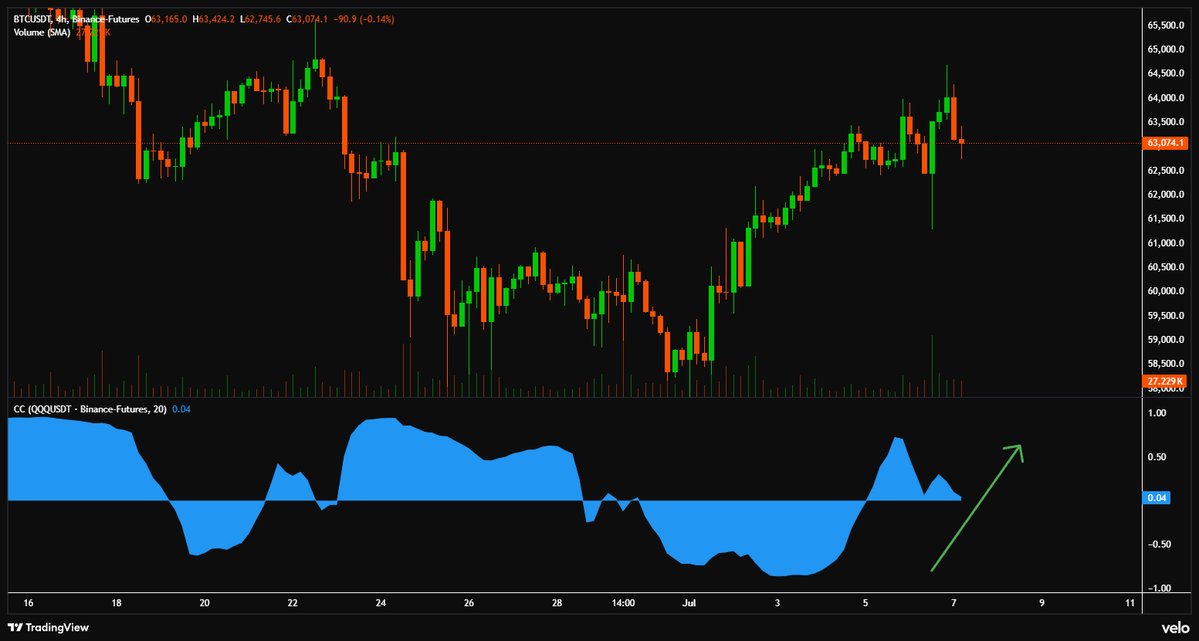
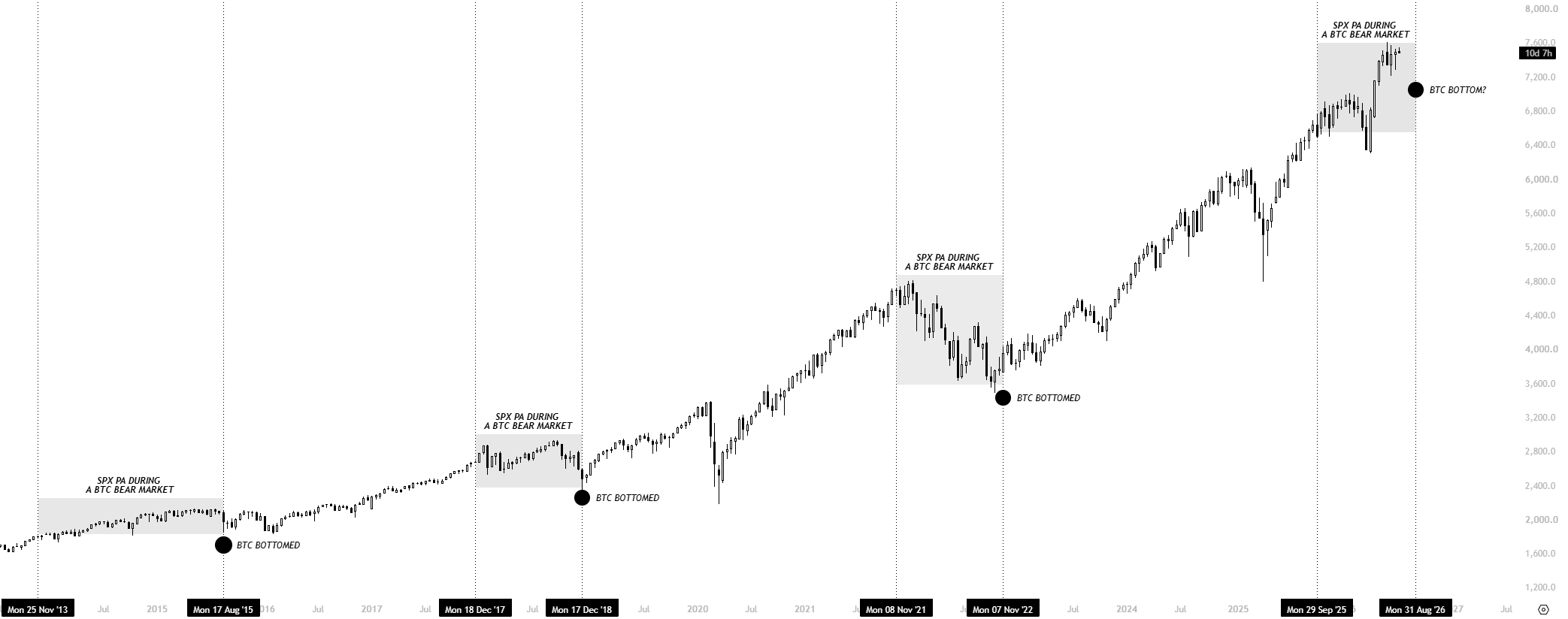
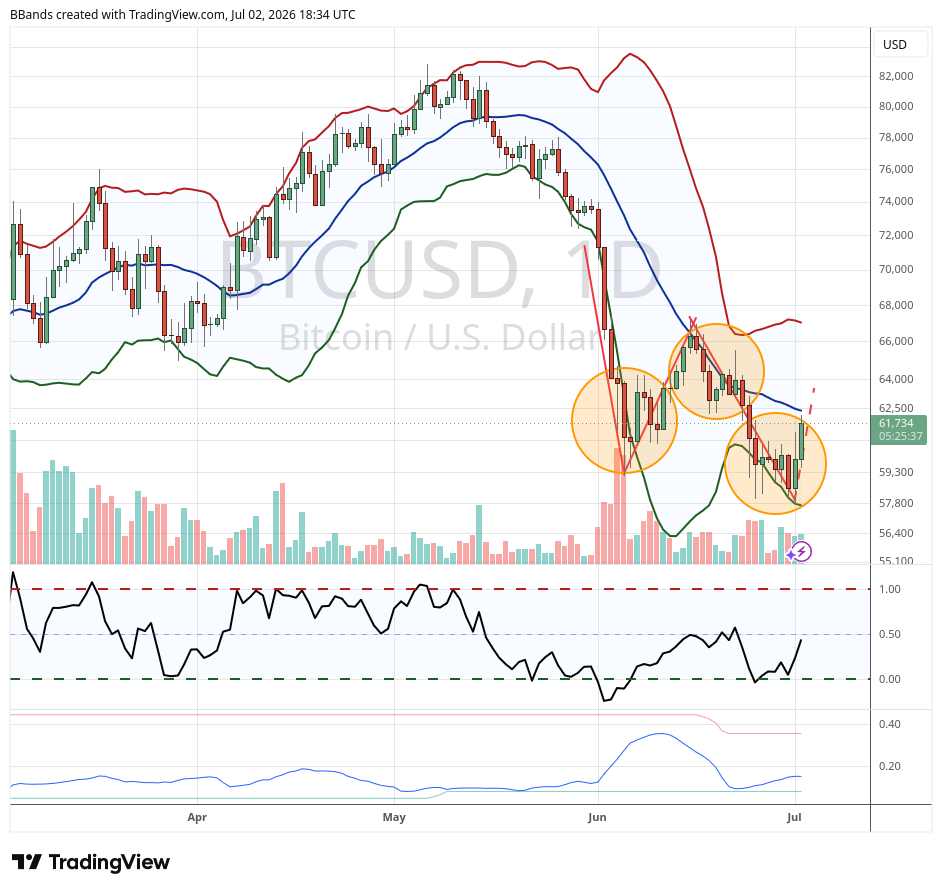
Bitcoin (BTC) faced a 7% correction after failing to reclaim the $67,200 level on Monday, triggering $330 million liquidations in bullish leveraged positions. More concerningly, the drop happened while the Nasdaq 100 index showed strength, trading 1% away from its all-time high. Should Bitcoin traders brace for a $60,000 retest?

Nasdaq 100 futures (left) vs. Bitcoin / USD. Source: TradingView

The bullish momentum in the stock market likely came from the memorandum of understanding signed by US President Donald Trump and Iran’s President Masoud Pezeshkian. Crude oil prices fell to their lowest level in 15 weeks to $74, easing inflation risks. Moreover, US job market data boosted investors’ morale as continuing jobless claims held flat at 1.81 million.

Bitcoin’s decoupling from tech stocks coincides with US Federal Reserve (Fed) Chair Kevin Warsh’s remarks on Wednesday. The term “price stability” was cited by Warsh on multiple occasions, leading investors to believe that the new Fed mandate will keep a closer eye on inflation trends, according to CNBC. The US 5-year Treasury yield remained relatively high at 4.21%.

Gold / USD (left) vs. US dollar strength index (right). Source: TradingView

The US dollar strengthened against a basket of foreign currencies, signaling confidence in the US government’s strategy to sustain economic growth despite inflationary pressures. The move hurts non-yielding assets, since fixed income remains profitable longer, as seen in gold prices trading down 3.3%.

Bitcoin perpetual futures annualized funding rate. Source: Laevitas

Demand for bullish leveraged Bitcoin positions has faded since June 4, indicating a lack of confidence after the crash from $73,700 to $61,300 in just three days. Bitcoin’s bearish momentum contrasts with rising demand in the artificial intelligence sector. SpaceX (SPCX US) market capitalization soared to $2.4 trillion within days of its IPO.

AI sector narratives contrast with weak Bitcoin narratives

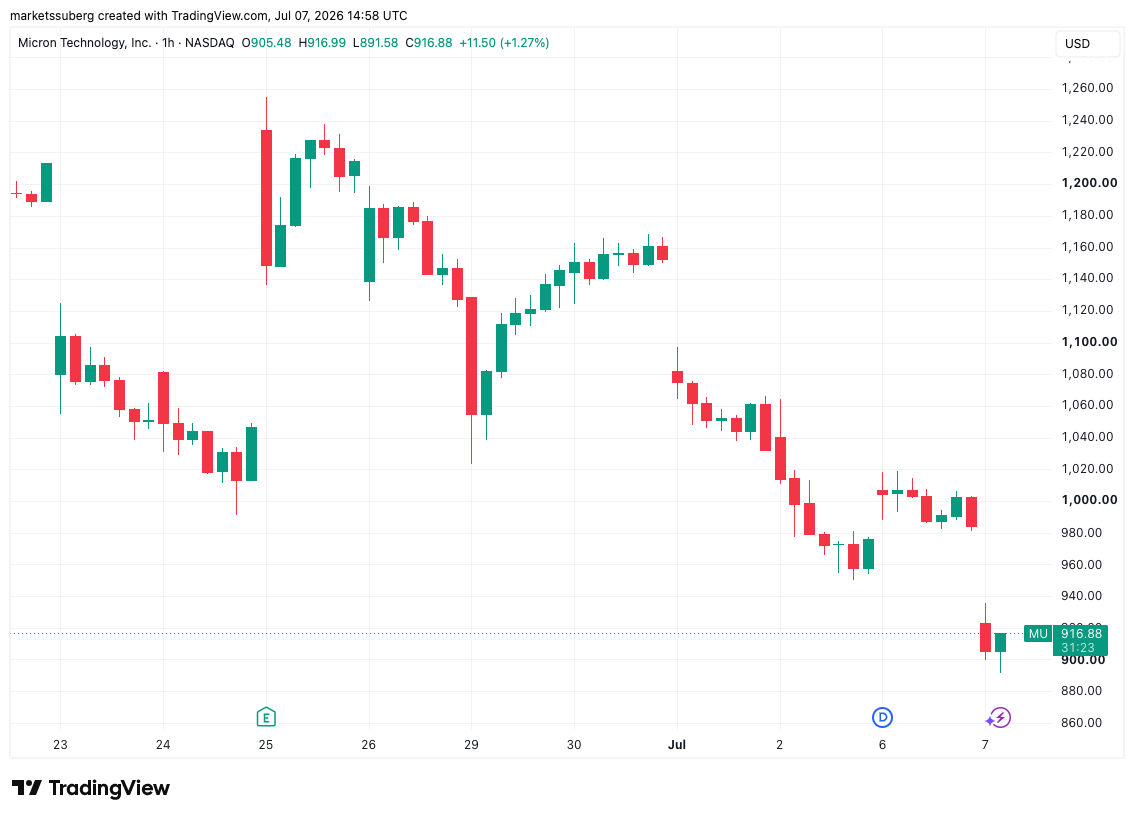
Intel (INTC US) shares jumped 10% on Thursday after President Trump announced that Apple (APPL US) had agreed to work with the chipmaker to build its processors. Memory chip and data storage producers Micron (MU US) and SK Hynix (000660 KS) have also recently joined the select list of companies valued at $1 trillion or higher.

Source: X/JoeCarlasare

According to Joe Carlasare, commercial litigator and Bitcoin supporter, traders’ sentiment is currently worse than it was during the FTX exchange collapse. For Carlasare, nearly every asset class was struggling back in November 2022 due to the macroeconomic backdrop. This time around, the “narratives that convinced people to buy Bitcoin have broken down”.

Related: Bitcoin’s deeply discounted versus AI-stocks, but hawkish Fed risk lingers–Bitwise

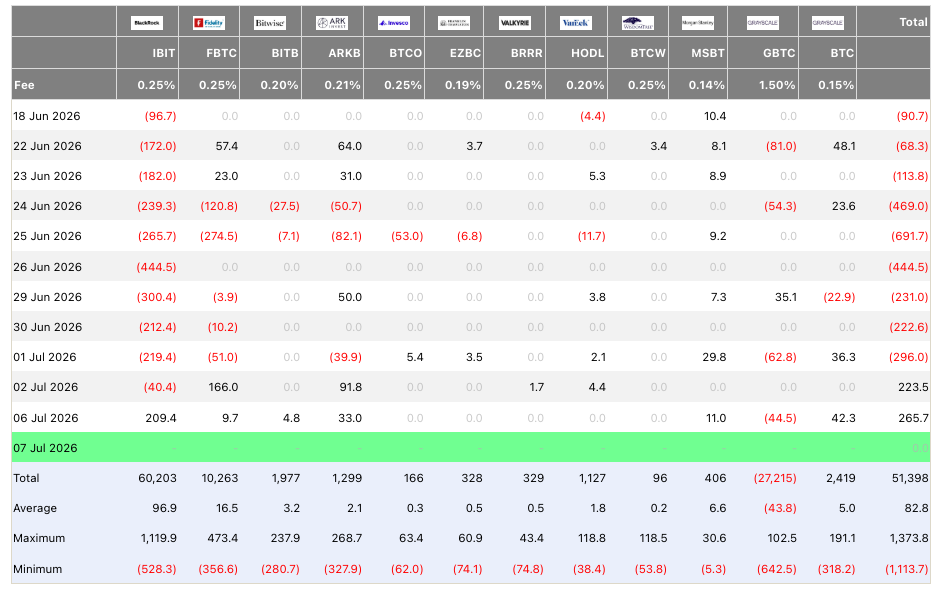
Bitcoin’s presence in the traditional finance industry is far more mature than during the previous halving cycle. The US-listed spot Bitcoin exchange-traded funds (ETFs) accumulated over $102 billion in assets, and major financial institutions initiated Bitcoin investment offerings to clients, including Morgan Stanley, Bank of America and Goldman Sachs.

A retest of the $60,000 level should not be ruled out as the AI sector stays in the spotlight with massive investments and potential new IPOs and follow-on offerings, but institutional demand for Bitcoin will likely dictate price trends.

Ireland’s Government Proposes Crypto Safeguards in Response to Risks

0

Latest NewsPublishedJun 18, 2026

For the first time in seven years, the Irish government released an assessment related to digital assets, noting risks from money laundering, terrorism financing, sanctions violations and bribery.

The government of Ireland is taking aim at digital assets used in money laundering and terrorism financing as it moves to implement industry standards “relating to the acceptance of crypto-related activities as a source of funds” by the second half of 2027 as part of its policy priorities. 

In part of its implementation plan following a national risk assessment released on Thursday, the Irish department of finance said crypto assets presented “very significant” risks related to money laundering and terrorism financing. The government’s 2026 report was the first time in seven years that Ireland released a risk assessment related to digital assets, noting an increase in prosecutions related to money laundering and incidents of fraud in which using crypto was “particularly attractive” to criminal groups.

Source: Government of Ireland

In the time since its last report, Ireland noted that crypto “presents vulnerabilities that may facilitate sanctions evasion,” presented challenges to the country’s tax compliance and enforcement and was used to bribe corrupt officials responsible for decisions overseeing the industry. The government highlighted vulnerabilities in the sector, including “inconsistent international regulation” posing risks to Irish service providers and largely unregulated areas of the industry such as decentralized finance.

Ireland lacks many of the laws and regulations covering the crypto industry that are common in other jurisdictions like the European Union and United States. That’s despite its relatively high crypto ownership rates compared to other areas, with the Central Bank of Ireland reporting in December that about 10% of the population invested in crypto.

Related: BitGo courts crypto firms awaiting MiCA approval amid Binance licensing concerns

In November 2025, the central bank fined Coinbase Europe Limited about $24 million for Anti-Money Laundering and Countering the Financing of Terrorism violations, noting that the company delayed reporting failures in its transaction monitoring system.

Ireland banned crypto political donations

The risk assessment noted concerns about crypto being “increasingly used to make payments to corrupt officials,” but even official donations to political groups has been banned in Ireland for more than four years. In April 2022, officials proposed that no Irish political parties be allowed to accept cryptocurrencies like Bitcoin, Ether, privacy coins and others.

Magazine: OpenAI files for IPO, SEC scraps 611 rule and Hungary overhauls crypto: Hodlers Digest June 7-13

Cointelegraph is committed to independent, transparent journalism. This news article is produced in accordance with Cointelegraph’s Editorial Policy and aims to provide accurate and timely information. Readers are encouraged to verify information independently.

Fable’s Shutdown Hands Crypto Its Case for Decentralized AI

0

Anthropic’s most powerful public model came with guardrails users called too broad — then the US government switched it off entirely. Crypto’s builders say that is exactly why AI should run on networks no company or state controls, and traders have started to bid up the tokens betting on it.

Crypto investors and builders say the censorship of Anthropic’s Fable 5 proves their long-running argument: that AI should run on decentralized networks no company or government can switch off.

The model shipped with guardrails so broad that many users complained, by Anthropic’s own account, and would quietly degrade its answers when asked to help train other AI. Then on June 12 the US government forced Anthropic to disable Fable 5 and its more powerful sibling Mythos 5 for every user, after an export control directive barred access by any foreign national, the company said in a statement. The order covered foreign nationals inside and outside the US, including Anthropic’s own employees, and left other models such as Claude Opus 4.8 untouched.

For a corner of crypto that has spent years building AI on blockchains, the takedown was a live demonstration of its pitch.

“Their access to AI is at will,” said Jake Brukhman, founder and chief executive of CoinFund, one of the earliest US crypto investment firms, on a Defiant panel. “It’s at the pleasure of big private companies like Anthropic and OpenAI … and the whim of the government.” When the order hit one company, he noted, the effect was a near-global shutdown.

The episode sharpens a question that has trailed the AI boom: whether the most capable models should sit with a handful of US firms and the government that can rein them in. Crypto’s answer is that decentralized networks can keep AI running, private and beyond any single authority. The harder question, which even its own investors press, is whether those systems can match the centralized labs at all.

Decentralized AI Tokens Outrun Bitcoin Since the Shutdown

Traders moved first. The broad crypto AI sector is worth about $22 billion, according to CoinGecko, a fraction of the roughly $965 billion that recent funding rounds have ascribed to Anthropic alone. Within that sector, the tokens most closely tied to decentralized AI jumped after the June 12 order, even as bitcoin slipped 0.8% over the past week.

Bittensor’s TAO, the largest pure-play decentralized AI token, led the move. It rose as much as 30% within 12 hours of the shutdown and roughly 39% over the following days, touching a three-week high near $283. It has since pared much of that to about $236, up 11% over the week, CoinGecko data show.

Smaller compute and agent tokens ran further: Akash’s AKT added 18% and decentralized-agent project Morpheus’s MOR gained 16% over the same stretch, against gains of 1.7% in ether and 4.3% in SOL.

The rally is partly ideological. Grayscale, the asset manager, told clients the shutdown demonstrated “centralized control over advanced AI technologies” and pointed to Bittensor as an open, permissionless alternative. Erik Voorhees, founder of the privacy-focused AI app Venice, tied the order to his product directly, posting “There’s a reason we built Venice.”

The sector remains small and concentrated. The largest token in CoinGecko’s AI category, Chainlink, is an oracle network rather than a decentralized AI project; the recognizable pure-plays are NEAR and Bittensor, followed by compute and agent networks an order of magnitude smaller.

Project Token Market cap Since shutdown (7d)
NEAR Protocol NEAR ~$2.9B +8%
Bittensor TAO ~$2.3B +11%
Render RENDER ~$0.9B +4%
Venice VVV ~$0.7B +2%
Artificial Superintelligence Alliance FET ~$0.4B +1%
Akash Network AKT ~$0.2B +18%
Morpheus MOR ~$0.02B +16%

Source: CoinGecko, as of June 18. Figures move quickly; refresh at filing.

Beyond the liquid tokens sit the projects trying to do the hardest part — training models across distributed machines — most of them still private. Brukhman pointed to Pluralis, Gensyn, Bagel and Prime Intellect among the startups CoinFund and others are backing, alongside research efforts such as Nous and Macrocosmos.

Why Crypto Calls It Censorship

The case rests on more than one government order. Anthropic had kept Mythos out of general release over concerns it could boost hacking, limiting it to a select group of companies under a cybersecurity program called Project Glasswing. It released Fable 5 publicly with safeguards meant to block the underlying model’s most sensitive cyber uses — safeguards “so strong that many users have complained that they are overly broad,” the company acknowledged. Fable also degrades its own performance on tasks that look like training a rival model.

Illia Polosukhin, co-founder of NEAR Protocol and a co-author of “Attention Is All You Need,” the 2017 paper that introduced the architecture behind modern large language models, said the layered restrictions amount to controlling what people can ask rather than what they do. Blocking a model is “trying to police the thought,” he said in an interview on The Defiant’s podcast.

The government order, in his view, set a wider precedent.

It is “a very bad precedent for internet overall, because effectively US government shown they can ban any US-made internet product on the whim,” Polosukhin said. Brukhman made the structural version of the same point: “By default, when AI is being developed by centralized companies, then they’re developed in this … corporate form that is highly susceptible to government pressure.”

The Case for ‘Freedom Technology’

The pitch is that decentralization removes the off switch. Polosukhin wants inference — the step where a trained model answers a query — to run across a permissionless network of machines, encrypted end to end. NEAR uses secure enclaves, hardware he says can verify code ran correctly without exposing the data, at a few percent overhead rather than the heavy cost of replicating work across a blockchain. Run that way, he argued, AI cannot easily be censored or surveilled. “I think of privacy as effectively the freedom technology,” he said.

Brukhman framed decentralized AI as a deliberate counterweight.

“One of the reasons that I am in decentralized AI is to create a counterbalance … so that we can still have access to AI,” he said. He argued the demand is already there, pointing to open-weight models from Chinese labs that sit within a few percentage points of the frontier on public benchmarks. “There is a ton of demand for global permissionless AI, whether the State Department likes that or not,” he said.

The thesis is starting to show revenue at NEAR. NEAR Intents, the protocol’s cross-chain settlement layer, held about $92 million in assets and generated roughly $2.4 million in fees over the prior 30 days, DefiLlama data show. Polosukhin tied NEAR’s run to structural changes — full dilution five years after launch, an inflation cut in an October governance vote, and a fee switch turned on for NEAR Intents in February — rather than to the AI debate itself.

Can It Actually Compete?

The investors who build at the AI-crypto seam are also its sharpest skeptics, and their doubt is not about the principle but the product.

“Most decentralized AI hasn’t really been of the quality of the centralized alternative,” said Jesus Rodriguez, founder of crypto data firm Sentora and author of the AI newsletter The Sequence, who has built and sold AI companies. “It’s not a question of the value proposition conceptually, it’s a question of the product.”

As the leading labs push pre-training, post-training and newer techniques, “the gap with decentralized models has widened and not shortened,” he said, calling decentralized AI an idea that “has been around forever and it has never found product market fit.”

Haseeb Qureshi, managing partner at crypto venture firm Dragonfly, said the economics do not yet support training or running frontier models on distributed networks. Coordinating scattered machines over the public internet carries a real bandwidth cost, he argued, and the labs control vast, expensive datasets that a “decentralized trove of people” cannot match.

The scale gap shows in the numbers: the entire crypto AI sector is worth roughly 2% of Anthropic’s private valuation. Qureshi’s own view is that crypto’s contribution will be narrower — letting users run existing open-weight models privately and cheaply, as Venice does with models such as DeepSeek, rather than training new ones in a decentralized setting.

“The core value proposition of crypto is not decentralization,” he said. “The end is self-sovereignty and censorship resistance.”

He also warned that the freedom crypto is championing cuts both ways. Cheap, ungated frontier AI would put offensive cyber capability in every hand, including hostile states.

April 2026 set a record for the number of crypto hacking incidents, with about 30 exploits, the most of any month, according to DefiLlama; losses topped $600 million before falling to roughly $68 million in May even as incident counts stayed near the high, security firm CertiK found. Analysts have tied much of this year’s stolen funds to North Korea. “This thing is basically a bazooka,” Qureshi said. “I don’t want North Korea to have Mythos.”

What’s Next

Anthropic said it disagrees with the order, believes it is a misunderstanding, and is negotiating with the administration to restore access. Polosukhin said NEAR will keep adding products to its consumer app, including perpetual-futures trading and a relaunched marketplace for AI agents. The decentralized AI camp is betting the next generation of training methods narrows the gap its own skeptics say keeps widening — and that the tokens that ran on the Fable shutdown hold the bid.

U.S. agencies seek stablecoin customer-ID rules akin to banks in new GENIUS Act rule

0

These standards, according to the rule proposal, “must include reasonable procedures for: (1) verifying the identity of any person seeking to open an account to the extent reasonable and practicable; (2) maintaining records of the information used to verify a person’s identity, including name, address, and other identifying information; and (3) determining whether the person appears on any lists of known or suspected terrorists or terrorist organizations provided to the financial institution by any government agency.”

The Fed opened a 60-day public comment period alongside the other agencies in the joint effort, including the Office of the Comptroller of the Currency, Federal Deposit Insurance Corp., National Credit Union Administration and the Treasury Department’s financial-crimes arm.

In September, the regulators had issued a more preliminary document seeking comments to direct their GENIUS implementation in this and other areas, and the Treasury received 450 comments. This new stage is known as a “notice of proposed rulemaking,” which comes with another comment period and review before the agencies can eventually issue final joint rules and begin enforcing the regulations.

The Treasury’s Financial Crimes Enforcement Network (FinCEN) has pursued its own related rule to apply the GENIUS Act anti-money laundering provisions on issuers.