
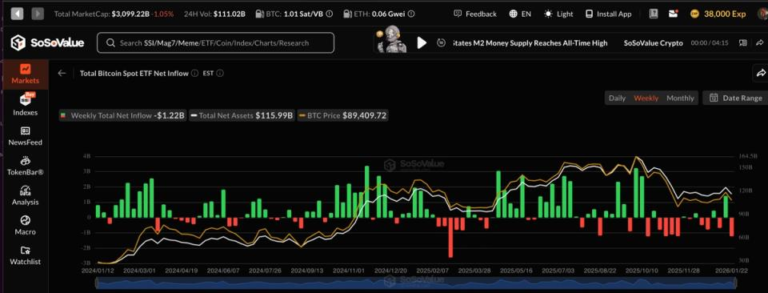
This week’s redemptions reached the highest level since November, a signal that often marks a local bottom in the price of bitcoin.
Bitcoin Struggles to Hold $90,000 Despite Stocks and Gold Rallying

Altcoins posted mild losses as total crypto market capitalization dipped 1% to $3.11 trillion.
Crypto markets dipped slightly on Thursday, with Bitcoin (BTC) struggling to find its footing despite a stock market rebound and another record high for gold and silver.
BTC is trading at $89,500, mostly unchanged over the past 24 hours, after slipping to $88,400 earlier in the day. Meanwhile, ETH dropped 2% to $2,950 even as BitMine Immersion purchased more than $100 million worth of Ether over the past 24 hours, according to Arkham. The Ethereum treasury company now holds more than 3.5% of the total ETH supply.
SOL and XRP are down less than 1%, while BNB is flat on the day.
The overall crypto market capitalization decreased by 1.1% to $3.11 trillion, according to Coingecko.
Onchain data shows that BlackRock moved more than $400 million in BTC and ETH to Coinbase Prime earlier today from wallets tied to its spot exchange-traded funds (ETFs). The transfers came after nearly $1.2 billion in outflows from U.S. Bitcoin ETFs over the past two days.
Most of the Top 100 digital assets posted losses over the last 24 hours, while a few altcoins bucked the trend. RIVER surged 35% after securing an investment from Tron founder Justin Sun.
MYX, PUMP and ARB are today’s biggest losers, down around 7%.
Around 114,000 leveraged traders were liquidated for a total of $207 million in the past 24 hours, according to CoinGlass. Bitcoin accounted for $46 million, while ETH positions made up $69 million.
Meanwhile, stocks rallied, and precious metals hit another record high. The S&P 500 and Nasdaq gained 0.5% and 0.7%, respectively, while gold is changing hands at $4,920/oz.
Crypto’s 2025 ‘whipsaw’ year drove capitulation as markets look toward a 2026 rebound, Pantera says

In its ‘Navigating Crypto in 2026’ outlook, the fund says non-bitcoin tokens have been sliding since late 2024, weighed down by weak value capture, slowing on-chain activity, and fading retail flows.
AI Startups Merge to Launch First Full-Stack AI Cloud

Two AI startups merged to establish a full-stack cloud, the first built from the outset with AI in mind.
New York-based Lightning AI, a cloud platform where developers run AI apps, is joining up with Voltage Park, a GPU provider based in San Francisco, Calif., with the pair operating under the Lightning AI name.
The merger sees the pair bring together AI software and on-demand GPU compute in a single AI cloud designed for training, deploying and running AI models and applications. While financials for the deal were not disclosed, Lightning AI’s founder and CEO William Falcon told Forbes that the combined company has more than $500 million of annual recurring revenue and is valued in excess of $2.5 billion.
Lightning’s more than 400,000 users, including individual developers, startups and large enterprises, will now gain access to more than 35,000 Nvidia H100, B200, and GB300 GPUs based in six data centers across the U.S., according to a press release.
Falcon said traditional clouds were designed for hosting and building websites and services. Generative AI, however, requires a different set of tools built for GPU-based workloads such as large-scale inference, multinode training and massive data preparation.
The gap between what’s on offer and what’s needed has meant there are too many single-use tools deployed across the AI lifecycle, driving up complexity and costs. “Imagine instead of using an iPhone, having to carry a separate calculator, flashlight, radio, and more — that’s where AI tooling is today,” Falcon said in the press release.
Now, customers of the merged company are promised “purpose-built AI software with enterprise-grade reliability at neocloud GPU prices.”
Saurabh Giri, former chief product and technology officer at Voltage Park and now CPTO at Lightning AI, spelled out the uniqueness of the proposition, saying in the release: “Most neoclouds sell raw GPU capacity without a deep software stack. Most AI platforms depend on third-party clouds underneath. We’re software-first and infrastructure-native, and designed end-to-end for AI workloads.”
Existing customers of Lightning AI will benefit from the expanded functionality at no additional cost, with no change to contracts. They will also still be able to use other cloud services if that is their preference.
Gold nears $5,000, silver closes on $100 while bitcoin remains listless

Prediction markets price further upside for bullion as volatility data shows silver absorbing momentum while gold grinds higher
Binance Pursues MiCA Approval in Greece As EU Deadlines Loom

Binance submitted an application for authorization under the European Union’s Markets in Crypto-Assets Regulation (MiCA) in Greece as regulators warn of looming compliance deadlines.
A Binance spokesperson confirmed to Cointelegraph on Friday that the exchange had filed for a MiCA license in Greece and was working with the country’s financial regulator, the Hellenic Capital Market Commission (HCMC).
“We welcome the opportunity to work closely with the HCMC as this new regulation takes shape in the EU and look forward to contributing to the long-term growth of the EU’s Europe’s digital financial ecosystem,” the exchange’s representative said.
France flagged Binance among non-MiCA-licensed exchanges last week
The news follows France’s Autorité des Marchés Financiers (AMF) warning on Jan. 13 that Binance was among 90 crypto companies it had registered, but which remain unlicensed under MiCA.
The regulator said it notified the companies in late 2025 that France’s MiCA transition period ends on June 30, forcing non-compliant firms to cease operations in July.
Related: Moldova moves to regulate crypto under EU-style MiCA rules
Founded in 2017, Binance is the world’s largest centralized exchange (CEX) by trading turnover, averaging $11.9 billion in reported daily volume, according to CoinGecko.
“We see MiCA as a positive and important milestone for the industry — one that brings greater regulatory clarity, stronger user protections, and a clear framework for responsible innovation,” Binance’s spokesperson said.
Greece is yet to issue its first MiCA license
Publicly available data from the European Securities and Markets Authority (ESMA) indicates that Greece has not issued a single MiCA license for a crypto-asset service provider (CASP) to date.
As of Jan. 15, Germany and the Netherlands lead the EU in issued CASP MiCA licenses, with 43 and 22, respectively, while France’s AMF has granted 11 authorizations.

Last Friday, KBC — one of Belgium’s largest banks — announced plans to launch Bitcoin (BTC) and Ether (ETH) trading in February.
The bank said it expected to obtain a MiCA license in Belgium, a country that has yet to issue its first authorization under the framework.
Magazine: How crypto laws changed in 2025 — and how they’ll change in 2026
Cointelegraph is committed to independent, transparent journalism. This news article is produced in accordance with Cointelegraph’s Editorial Policy and aims to provide accurate and timely information. Readers are encouraged to verify information independently. Read our Editorial Policy https://cointelegraph.com/editorial-policy
ETH, SOL and ADA slip as bitcoin fails to build momentum near $90,000

Asian equities pushed higher and the dollar stayed under pressure, giving crypto a firmer footing after a volatile week.
Gold Bugs Remain Bullish as Central Banks Hedge Against Uncertainty

Gold has become one of the hottest commodities this year, soaring in response to economic and geopolitical uncertainty. Predictions indicate its price could exceed $7,000 by the end of the year, as central banks continue to signal strong demand. Analyst: Gold to $7,150 in 2026, Central Banks Continue to Provide Strong Demand The precious metals’ […]
Enterprises Should Prioritize Governance Amid Agentic AI Boom

Businesses should treat AI agents as formal digital identities as 2026 prepares to be the year of an agentic workforce, amid concerns that most companies are underprepared for the technology’s security and governance risks.
So said Greg Callegari, managing director of identity security at Accenture, during a recent webinar discussion with Harish Peri, senior vice president and general manager of AI Security at identity management firm Okta.
Most organizations — 91% — are already using AI agents, but only 10% feel like they have an effective governance strategy for them, according to Okta.
Similarly, Accenture’s State of Cybersecurity Resilience 2025 research found 90% of organizations lack a clear strategy for managing AI-related threats despite 91% already using AI agents in some capacity.
Autonomous systems are seeing increased uptake across business workflows, from writing documents and scheduling meetings to more advanced tasks such as software development. With this rapid proliferation, sustainable and measured deployment is key. Without it, Peri warned that agentic AI deployment could create a new form of identity sprawl.
“In 2026, you’re going to have tens, if not hundreds, of AI agents that are acting on your behalf in your workforce,” he said. “The problem is actually simple: All these agents need access to your systems. Without access, they’re useless. And that’s why the question of agent identity, and what an agent can access, becomes the key to everything.”
Agentic Identity
Unlike traditional chatbots, modern agents have the power to interact with and control enterprise systems directly, performing tasks previously reserved for human workers. To bolster transparency and accountability in monitoring agent actions, Callegari argued that they should be treated as individual entities, not unlike human workers.
At its core, the challenge is familiar: Companies need to manage authentication, authorization and access control to monitor the technology as it scales.
“If you strip away all of the noise, it’s really an open authorization problem,” Callegari said. “It’s a machine talking to a resource. The question is: Should it be allowed to be there, who grants that access, for how long and who revokes it?”
The scale and speed of the technology’s development is accelerating the issue. In many cases, engineers are encouraged to prioritize speed over governance, resulting in vast numbers of unmanaged non-human identities across enterprise environments.
“Agents are acting like employees, they perform tasks humans would do,” Callegari added. “So, the way to secure them is by managing them as identities.”
In this light, Callegari posited that agents must be onboarded, governed and monitored in the same way as human employees, with defined identities and lifecycle management.
“Agents need their own identity,” he said. “Once you accept that, everything else flows — access control, governance, auditing and compliance.”
Better defined standards and governance models was also highlighted as a key consideration for companies wanting to adopt agentic AI. Having these models in place before opening the floodgates to mass deployment is, the speakers said, crucial to long term viability.
The matter is also anticipated to be considered at a regulatory level, with compliance regimes planned in the U.S. and EU which would require greater transparency and accountability for agents.
While the future of agentic AI is generally pitched as exciting and opportunity-rich, the message from security leaders such as Callegari and Peri is clear. Without adequate governance and identity structures, innovation in agentic AI could quickly sour from AI’s biggest productivity boost into its biggest risk.
Bitcoin Sharks Accumulate Despite ‘Perfect Bull Trap’ Warnings

Several chartists warn that Bitcoin could decline toward $30,000 in February as the price action mirrors previous four-year cycles.
Bitcoin’s (BTC) 30% drawdown from all-time highs did little to deter large investors, who continued to increase their holdings throughout January.
Key takeaways:
-
Large holders are buying the dip, signaling long-term confidence.
-
Chartists warn that a bull trap could still drive BTC sharply lower.
Bitcoin sharks are buying the dips
As of Wednesday, so-called “sharks,” which represent entities holding 100-1,000 BTC, were accumulating Bitcoin at their fastest pace since 2013, data from Glassnode showed.
These entities, which typically include early adopters and institutional trading desks, accumulated Bitcoin despite the latest correction to around $87,900 from almost $98,000.
As a result, the accumulation suggested that large investors view the ongoing BTC pullback as a buying opportunity, signaling confidence in its longer-term bullish outlook.
Related: Can Bitcoin regain $90K? Bulls at risk as long-term holders ramp up selling
Historically, similar spikes in shark accumulation preceded strong rallies, including a roughly 160% price gain within a year and the mid-2024 move that saw BTC climb from around $54,000 to over $116,000.
BTC will crash to $35,000 in February, analyst warns
Chartists tracking Bitcoin’s four-year cycle warned that the multi-month slump will continue in the coming weeks.
For instance, analyst Lofty said BTC price can dump to $35,000 in February, citing a “perfect bull trap” after Bitcoin failed to hold above its rising channel’s upper boundary, as shown below.

He compared the structure to Bitcoin’s 2021 double top, where successive breakout attempts trapped late buyers before a sharp, multi-month sell-off followed.
However, several top crypto companies argued against such bearish scenarios, noting that Bitcoin’s four-year cycle is dead. That included Grayscale Investments, which expected BTC’s price to reach a new record high in the first half of 2026 due to institutional adoption.
Bitwise also predicted 2026 to be an “up year” for Bitcoin.
This article does not contain investment advice or recommendations. Every investment and trading move involves risk, and readers should conduct their own research when making a decision. While we strive to provide accurate and timely information, Cointelegraph does not guarantee the accuracy, completeness, or reliability of any information in this article. This article may contain forward-looking statements that are subject to risks and uncertainties. Cointelegraph will not be liable for any loss or damage arising from your reliance on this information.