Trusted Editorial content, reviewed by leading industry experts and seasoned editors. Ad Disclosure
Based on data from the weekly price chart, Bitcoin is witnessing a significant loss of over 6% following recent widespread market liquidations. Notably, the premier cryptocurrency has taken on a consolidatory stance in the past day, as if to lend credence to growing hopes of some price recovery. However, a recent on-chain analysis points out that Bitcoin’s outward show of resilience might merely be theatrical and that the flagship cryptocurrency could be facing a dark future ahead.
Bitcoin Enters 30-Day Cumulative Realized Loss Phase Since October 2023
In a recent Quicktake post on CryptoQuant, crypto education and research group XWIN Research Japan dissects the present on-chain situation of Bitcoin, with the center of attraction being the Bitcoin Net Realized Profit/Loss metric, which shows the leading cryptocurrency has recorded a net realized loss on a 30-day basis for the first time since October 2023.
Source: CryptoQuant
However, the losses seen in 2023 were short-lived and rapidly retraced, unlike the current decline, which is broader and more persistent, suggesting a possible structural shift in market dynamics. At this moment, it appears that investors are less-interested in “buying the dip,” nor are they looking to “HODL” through the Bitcoin price action, and are more willing to accept losses.
For this reason, the market can be more plausibly described as being in a state of caution. It is, however, worth mentioning that the present phase does not necessarily precede a market crash. If anything, it reflects that Bitcoin may be entering a more volatile phase, independent of speculative frenzies.
Realized Profits Signal Late-Stage Of Bull Cycle
XWIN Research further reinforces the hypotheses by referencing the trend in realized profits. According to the market experts, Realized Profits peaked in March 2024 at approximately 1.2 million BTC, and reduced slightly to 1.1 million in December 2024.
As of July, 2025, realized profits had sharply dropped to 517,000 BTC, reflecting an increasing exit of profit-taking activity within the market. But this pales in comparison to the lower 331,000 BTC recorded in October. The analytics group explained that this contraction occurred despite a rise in prices, thus suggesting an absence of deep upside momentum.
The group further highlights that this is a telltale sign of a late-stage bull market, one which was seen in 2021-2022. In this period, realized profits slowly dropped before the Bitcoin price flipped bearish. More shockingly, the annual timeframe tells a similar story, with annual net realized profits contracting from 4.4 million BTC to 2.5 million BTC, just within October 2025 and early 2026. This is also similar to the phase that preceded the bear market of 2022.
In essence, Bitcoin is in a transitioning phase, from a mature bull phase to a volatile environment. As of this writing, the Bitcoin price stands at $89,462.
BTC trading at $89,818 on the daily chart | Source: BTCUSDT chart on Tradingview.com
Featured image from Pexels, chart from Tradingview
Editorial Process for bitcoinist is centered on delivering thoroughly researched, accurate, and unbiased content. We uphold strict sourcing standards, and each page undergoes diligent review by our team of top technology experts and seasoned editors. This process ensures the integrity, relevance, and value of our content for our readers.
Spacecoin, a decentralized physical infrastructure network (DePIN), has launched its SPACE token, marking a key step in the company’s plan to create a decentralized satellite internet network, just days after partnering with the Trump family-linked decentralized finance project World Liberty Finance.
The token is now live across centralized exchanges, including Binance, Kraken, and OKX, as well as on decentralized platforms such as PancakeSwap and Uniswap.
The token’s price is down around 12.2% since its launch, according to CoinMarketCap data, with a fully diluted value of $357 million, at the time of publication.
The move comes after Spacecoin’s recent partnership with World Liberty Financial that included a token swap and collaborative plans to connect WLFI’s $3.2 billion USD1 stablecoin with Spacecoin’s satellite infrastructure.
Together, the projects aim to offer decentralized internet access and financial services to people in regions where traditional infrastructure falls short.
The SPACE token is intended to help fund and coordinate the infrastructure powering its plans to give people with weak or no broadband coverage a way to get online without relying on telecom companies or governments.
Spacecoin’s first satellites, CTC-0 and CTC-1, have already demonstrated blockchain-based communication from space, the company said. The SPACE token adds a financial layer to that network, enabling users to trade, stake, and participate in governance.
The company said it has also started an airdrop claim for early supporters who met eligibility requirements during promotional campaigns.
The United States’ geopolitical brinkmanship over Greenland has thrown its economic ties to the EU into sharp relief. European powers are considering what instruments it has to combat US belligerence, including the “nuclear option” of offloading US debt.
The tone has shifted after a supposed “framework of a deal” at Davos, and US ambitions to take over Greenland have cooled, for now. But EU heads of state are still preparing possible responses to further escalation.
One option was cutting off access to US markets through the so-called “trade bazooka.” If triggered, it would cut off US companies from the EU market, costing them billions. Another option is offloading the trillions of dollars in US assets held in Europe.
But questions remain regarding its feasibility, as dumping could drastically change the global economic landscape. It could also have knock-on effects for the US financial system’s exposure to stablecoins.
Can the EU actually dump US debt?
Prior to Jan. 21, European leaders were considering possible responses. While Denmark deployed special forces to Greenland, other heads of state suggested the trade bazooka, which would deny the US access to EU markets.
Others, including former Dutch Defense Minister Dick Berlijn, suggested that Europe could use US debt as leverage. Berlijn said, “If Europe decides to offload those bonds, it creates a big problem in the US. [The dollar] crashes, high inflation. The US voter won’t like that.”
George Saravelos, Deutsche Bank’s chief FX strategist, wrote in a note last weekend, “For all its military and economic strength, the US has one key weakness: it relies on others to pay its bills via large external deficits.”
Source: Reddit/Bloomberg
Saravelos said that the US currently owns $8 trillion in US bonds and equities, which is “twice as much as the rest of the world combined.”
But can Europe actually offload this debt? There are both questions of how the EU could compel a sale and, in a world that is increasingly de-dollarizing, who potential buyers are.
Yesha Yadav, a professor of law and associate dean at Vanderbilt University, told Cointelegraph, “Foreign government buyers tend to be sticky, meaning that they will not easily move their holdings unless there is a serious need for them to do so.”
Furthermore, according to the Financial Times, much US debt in Europe is not held by governments themselves, but by private entities like pension funds, banks and other institutional investors. Yadav noted that hedge funds in the UK, Luxembourg and Belgium have emerged as major buyers of US Treasurys.
Therefore, even if European powers wanted to dump US debt, they’d need to compel these private buyers to sell. Yadav said that it “does not seem likely in the near term that European governments may impose restrictions on hedge funds buying US Treasurys.”
SocGen’s chief FX strategist, Kit Juckes, wrote, “The situation probably needs to escalate a fair bit further before they damage their investment performance for political purposes.”
However, “they may potentially think about opening up the kinds of government debt that are considered most secure as collateral,” said Yadav.
The main problem is that there aren’t a lot of alternatives to US debt as a risk-off investment. Treasurys still boast a “risk-free” status and generally are highly liquid.
“Even as other highly stable and safe countries, such as Germany, begin to issue debt, their debt markets remain relatively small, such that it is very difficult to envision them ever taking the place of the US Treasury market,” said Yadav.
There’s also a paucity of potential buyers. China has been scaling back the tempo of its US debt purchases, Yadav noted.
Asian buyers do not have the capacity to absorb that many US assets. The market capitalization of the MSCI All-Country Asian index, which tracks large and mid-cap stocks across developing and emerging markets in Asia, is roughly $13.5 trillion. Per the Financial Times, the FTSE World Government Bond Index is about $7.3 trillion.
Rabobank’s analysts wrote, “While the US’s large current account deficit suggests that in theory there is the potential for the USD to drop should international savers stage a mass retreat from US assets, the sheer size of US capital markets suggests that such an exit may not be feasible given the limitations of alternative markets.”
Stablecoins become major buyers of US debt
One emerging major buyer of US debt is stablecoin issuers.
According to the GENIUS Act, the US’ landmark legislation creating a framework for stablecoins, issuers of those assets operating in the country must have dollars and US Treasurys in reserve to back their coins.
“That [stablecoin issuers] are growing as fast as they are means that their need for Treasurys is correspondingly high. To the extent that this trend continues, it offers a great advantage for US policymakers, but it also deepens the link between the continuity of stablecoin issuers and that of the ability of US Treasury markets to continue remaining liquid and popular,” said Yadav.
Related: Senate passes GENIUS stablecoin bill amid concerns over systemic risk
The proliferation of stablecoin issuers as a buyer for US debt doesn’t come without its risks. This, combined with fewer buyers of US debt, particularly in the event of the EU dumping or even significantly decreasing its exposure, could spell trouble for US Treasury markets.
Yadav and Brendan Malone, who formerly worked in payments and clearing at the Federal Reserve Board, have previously noted liquidity shocks in US debt markets, both in March 2020 and April 2025.
In the event of a run on stablecoin issuers, this lack of liquidity and growing lack of counterparties to sell to could prevent the issuer from selling off its securities. It would become insolvent and also significantly impact the credibility of US Treasury markets.
Economic and military escalation in an increasingly multi-polar world has created rifts between former allies. While there is hope for a dialogue between the EU and US, Latvian President Edgars Rinkēvičs said, “We are not yet out of the woods [..] Are we in an irreversible rift? No. But there is a clear and present danger.” The danger appears not only to Europe and Greenland’s sovereignty, but to US debt markets as well.
Magazine: The critical reason you should never ask ChatGPT for legal advice
Cointelegraph Features and Cointelegraph Magazine publish long-form journalism, analysis and narrative reporting produced by Cointelegraph’s in-house editorial team and selected external contributors with subject-matter expertise. All articles are edited and reviewed by Cointelegraph editors in line with our editorial standards. Contributions from external writers are commissioned for their experience, research or perspective and do not reflect the views of Cointelegraph as a company unless explicitly stated. Content published in Features and Magazine does not constitute financial, legal or investment advice. Readers should conduct their own research and consult qualified professionals where appropriate. Cointelegraph maintains full editorial independence. The selection, commissioning and publication of Features and Magazine content are not influenced by advertisers, partners or commercial relationships.
Nifty Gateway, the non-fungible token (NFT) trading platform that was once central to the 2021 digital art boom, will shut down on Feb. 23, 2026.
Starting immediately, the platform has entered withdrawal-only mode, giving users one month to move any NFTs or funds still on the site, according to an announcement from the company. The website also shows a notice of closing on its homepage. Users can withdraw their funds from the platform through a connected Gemini Exchange account or to their bank via Stripe.
Nifty website shutdown notice (Nifty)
The Gemini-owned platform helped bring digital collectibles to a broader audience by simplifying NFT purchases. It was one of the oldest NFT trading platforms and hosted curated “drops” with artists like Beeple and Grimes, and accepted credit card payments, a rarity in a crypto-native market.
At its peak in mid-2021, Nifty Gateway had facilitated over $300 million in sales. But in April 2024, the company shifted away from marketplace operations, rebranding as Nifty Gateway Studio.
The focus moved toward building onchain creative projects in partnership with brands and artists.
“This decision will allow Gemini to sharpen its focus and execute on the vision of building a one-stop super app for customers,” the marketplace’s parent company, Gemini, wrote in a blog post. “We will continue to support NFTs via the Gemini Wallet.”
The NFT market reached a $17 billion market capitalization in early 2022 but has since been in a long, drawn-out bear market. Its current market capitalization is now at $2.8 billion.
Read more: Founders of Gemini-Owned NFT Marketplace Nifty Exchange Are Leaving the Company
Gemini is winding down its NFT marketplace Nifty Gateway as it shifts focus toward building a one-stop super app for customers.
The digital art platform has entered withdrawal-only mode and will cease operations on February 23, according to a statement issued on Friday. Customers with remaining USD, ETH, or NFT holdings will be notified by email with instructions on transferring assets off the platform.
An OG in the NFT space, Nifty Gateway is home to exclusive NFT drops from top digital artists, musicians, and brands like Beeple, CryptoKitties, and Pak.
“Nifty Gateway was launched in 2020 with the vision of revolutionizing digital art,” the team said in a statement. “We are incredibly proud of the work the Nifty team has pioneered and grateful to Nifty Gateway’s customers and artists for joining us on this journey.”
Gemini acquired Nifty Gateway in late 2019, marking the exchange’s entry into the NFT sector. In early 2023, founders Duncan and Griffin Cock Foster departed the company amid declining NFT trading volumes.
Gemini said it will continue supporting NFTs through the Gemini Wallet, which launched in August 2025.
There is no legal way for Web3 prediction markets to operate in Ukraine under current laws, according to a senior official involved in shaping the country’s digital economy policy.
In comments shared with CoinDesk days after Ukraine blocked access to Polymarket and nearly 200 gambling-related websites Dmitry Nikolaievskyi, chief legal officer at the Project Office for the Development of Ukraine’s Digital Economy at the Ministry of Digital Transformation, revealed a deadlock for Web3 prediction markets in the country.
Nikolaievskyi said that while the decision to ban Polymarket followed existing legal procedures, the underlying problem is that the country’s legal framework doesn’t recognize prediction markets at all.
“Ukrainian legislation does not contain such a concept as ‘prediction markets,’” Nikolaievskyi said. He added that a long-delayed law “On Virtual Assets” is necessary for companies, not just individuals, to operate legally using crypto.
Until that law passes, platforms that use cryptocurrency to facilitate betting on event outcomes, including Polymarket, are effectively unlicensed gambling operators in the eyes of the state.
“This really means that there is currently no legal way for Web3 prediction markets to operate in Ukraine until the legislation changes,” he said.
Polymarket, which lets users bet on the outcome of events ranging from elections to geopolitical events, is currently restricted in more than 30 countries. Portugal is the latest in a growing list of countries cracking down on it.
Earlier, Ukraine’s National Commission for State Regulation of Electronic Communications (NKEK) issued a directive requiring internet service providers to block access to the prediction market.
‘War-related’ bets
The order followed a recommendation from PlayCity, Ukraine’s state gambling regulator, which cited Polymarket’s lack of a gambling license and the nature of its markets, which include bets tied to the Russia-Ukraine war.
While Nikolaievskyi insisted that the ban was based on existing legal grounds and carried out through proper channels, he acknowledged that war-related markets may have prompted regulators to act more quickly.
“We cannot rule out the fact that the presence of “war-related” bets on the platform may have accelerated the decision to block it, drawing the regulator’s attention to it,” he said.
Local media outlet AIN previously reported that more than $270 million in war-linked bets had been placed on Polymarket, including markets predicting the capture of territories.
The situation leaves other prediction markets like Kalshi and PredictIt operating in a gray zone.
Though they were not included in the initial list of blocked sites, Nikolaievskyi noted that PlayCity allows anyone to file formal complaints about platforms suspected of violating gambling laws.
That means a single citizen report could prompt similar enforcement actions against other prediction markets, even if they’ve stayed under the radar so far.
There may still be a way
Still, the ban is seemingly aimed squarely at the platforms, not users.
According to Nikolaievskyi, there is currently no legal effort underway to pursue individuals who interact with platforms like Polymarket using virtual private networks (VPNs) or by interacting directly with smart contracts.
“I am not aware of any attempts by the state to prohibit its own citizens from interacting with decentralized protocols,” he said, nor has he seen examples of users being held responsible for bypassing the blocks.
Legal change isn’t likely to come soon. Nikolaievskyi said any revisions to Ukraine’s definition of gambling would have to be passed by Parliament and that “the likelihood of its revision is extremely low,” especially during wartime.
Société Générale announced its plan to axe 1,800 of its staff in France on Thursday amid cost-cutting efforts.
Editorial
This content has been selected, created and edited by the Finextra editorial team based upon its relevance and interest to our community.
Chief executive Slawomir Krupa is attempting to slow down spending by reducing the jobs available in France by 1,800 out of 40,000.
The bank is looking to avoid large job cut programmes that have high redundancy payouts and leave gaps in staff and instead will pursue the job cuts through voluntary leave or retirement.
The General Confederation of Labour (CGT) trade union told the FT that staff cuts were “deficient” and should include more options for staff to move or retrain internally, and voluntary redundancies.
Krupa, who has lead SocGen since 2023, has made staff cuts and sold off businesses since taking office.
Trusted Editorial content, reviewed by leading industry experts and seasoned editors. Ad Disclosure
In an interesting development, Grayscale has applied to the United States Securities and Exchange Committee to launch a spot exchange-traded fund (ETF) linked to BNB, the Binance Ecosystem’s native token. This move marks a power play by the asset management firm to further establish itself in the cryptocurrency space.
Grayscale Looks To Add To List Of Crypto-Linked ETFs
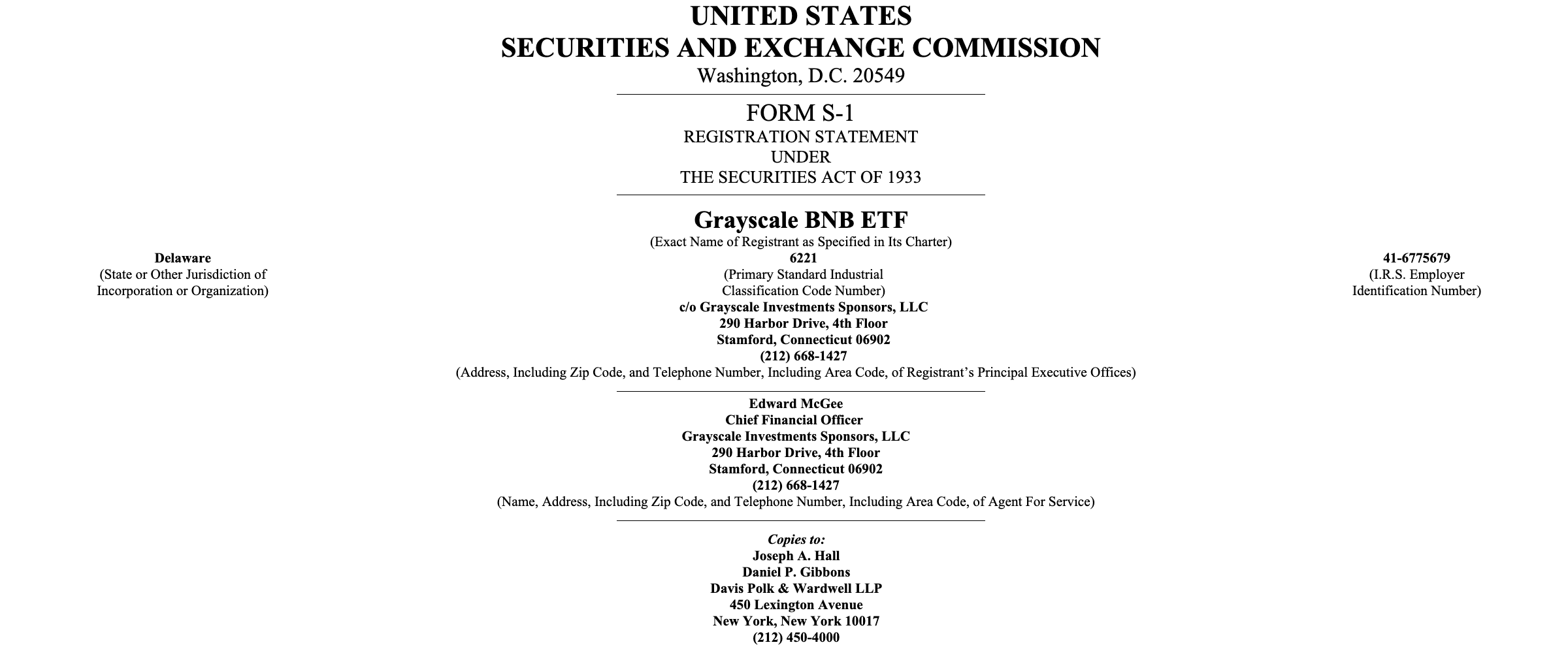
On Friday, January 23, Grayscale filed an S-1 registration statement with the SEC to launch a spot BNB exchange-traded fund in the US. According to the SEC filing, the proposed Grayscale ETF would hold the Binance ecosystem’s native token directly and issue shares designed to track the token’s market value.
This Grayscale investment product, if approved, would offer US investors exposure to the BNB token without having to own or hold the asset themselves. The asset manager’s registration statement also revealed that the exchange-traded fund would trade on the Nasdaq exchange under the ticker symbol GBNB, subject to regulatory approval.
Source: SEC
It is worth mentioning that Grayscale is not the first asset manager to file for a spot BNB ETF, as VanEck applied as far back as April 2025. However, this latest filing reflects the firm’s resolve to expand its list of crypto-linked investment products, especially after the successful launch of the Bitcoin and Ethereum ETFs.
It was always only a matter of time before BNB, the fourth-largest cryptocurrency by market capitalization, received extra attention from institutions focused on exchange-traded products. As such, this move by Grayscale has caught the attention of the cryptocurrency market, including former Binance CEO Changpeng ‘CZ’ Zhao.
In a Friday post on the social media platform X, CZ said that Grayscale’s submission of its S-1 filing to the SEC represents a small step toward making the United States the capital of crypto. “A small step in helping to make America the Capital of Crypto, by giving access to the 3rd largest crypto,” the Binance co-founder wrote on Friday.
Meanwhile, Bloomberg ETF expert James Seyffart concurred that a spot ETF approval could mean that the BNB token will be classified as a commodity rather than a security. This is because the approval of an exchange-traded fund is often an indication that the SEC views the underlying asset as a commodity rather than as a security.
BNB Price At A Glance
After making a play for $900 on Friday afternoon, the price of BNB now stands at around $890. According to data from CoinGecko, the fourth-largest cryptocurrency is down by nearly 5% in the past seven days.
The price of BNB on the daily timeframe | Source: BNBUSDT chart on TradingView
Featured image from Shutterstock, chart from TradingView
Editorial Process for bitcoinist is centered on delivering thoroughly researched, accurate, and unbiased content. We uphold strict sourcing standards, and each page undergoes diligent review by our team of top technology experts and seasoned editors. This process ensures the integrity, relevance, and value of our content for our readers.
There will come a time when this newsletter is not about crypto market structure legislation. But this is not that time.
You’re reading State of Crypto, a CoinDesk newsletter looking at the intersection of cryptocurrency and government. Click here to sign up for future editions.
The narrative
The Senate Agriculture Committee published its new draft crypto market structure bill last Wednesday.
Why it matters
This bill, like its Banking Committee counterpart, aims to reshape the federal regulatory framework to define how regulators like the Commodity Futures Trading Commission and Securities and Exchange Commission will oversee the crypto markets. And once again, the question is if it will survive the markup hearing, let alone the full Senate.
Breaking it down
The new draft, naturally, is more focused on the CFTC and how it would regulate digital commodities. The Agriculture Committee was expected to produce a more bipartisan effort that would, if not easily sail through a markup, at least prove less contentious than the Banking Committee draft.
The first sign of trouble came earlier this week, when multiple people told CoinDesk’s Jesse Hamilton that they feared the bill would be a partisan one, risking its passage through the Senate.
Those fears were seemingly confirmed when Senator John Boozman, the Republican chair of the committee, acknowledged “fundamental policy differences” in his statement thanking Senator Cory Booker, the lead Democrat negotiating the bill.
“Although it’s unfortunate that we couldn’t reach an agreement, I am grateful for the collaboration that has made this legislation better,” he said in the statement. “It’s time we move this bill, and I look forward to the markup next week.”
Late Friday, Democrats (and a few Republicans) filed a number of proposed amendments to be debated Tuesday. As a reminder, the markup is where lawmakers will debate provisions in the bill and amendments to those provisions. The Senators will then vote on the amendments before voting on the bill itself.
An initial glance at the new text suggests lawmakers were at least able to come to agreement on issues like whether the CFTC will have a bipartisan quorum of commissioners to run the agency — a section that was previously under debate under the prior discussion draft.
“It is the sense of Congress that prior to implementation of this Act the Commodity Futures Trading Commission — (1) be fully constituted … with not fewer than 2 of the Commissioners nominated, prior to such appointments, following consultation and coordination with the ranking minority member,” one section read.
Other sections may be more controversial.
Like the Banking version of the bill, this text included a provision on legal protections for developers. One of the committee members is Senator Chuck Grassley, the Iowa Republican who chairs the Senate Judiciary Panel and wrote a letter to the Banking Committee last week saying such provisions are within his committee’s jurisdiction.
Much of the bill itself seemed fine to the crypto industry at large. By press time, there were no significant concerns expressed about the text or its potential impact on crypto businesses.
All of that leaves next week’s hearing in an uncertain area.
It’s possible, one individual following the situation said, that there will be bipartisan support for amendments that will allow the bill to advance on a bipartisan basis, even if the current form does not have buy-in from both parties.
It’s also possible that the threat of primary challenges funded by crypto political action committees like Fairshake will persuade enough Dems into voting for the bill that it’ll have a comfortable margin when it goes to the Senate.
It’s also possible that this bill advances on a purely partisan basis, which will make things more difficult in the Senate.
Or it might not advance (which, as I pointed out last week, won’t be the end of the bill).
And just for good measure, the Senate Banking Committee may not get back to market structure for a few weeks, either. Multiple individuals told CoinDesk earlier this week that the White House and committee members wanted the crypto industry and the banking lobby to sort out their issues on stablecoin yield before they pick the effort back up.
It all remains to be seen.
Some other things to watch for next week:
There appears to be a massive snowstorm heading for the East Coast, and a snow/ice storm with ridiculously low temperatures aimed at the Midwest and south/southeast U.S. This storm is expected to start on Saturday night and last through Monday morning. The Senate was out of session last week, meaning many of its members are in their home states. Snowstorms can famously disrupt flights.
If Senators on the Agriculture Committee are unable to fly back in time for Tuesday’s hearing, that hearing may need to be postponed, an individual following the process told CoinDesk.
A spokesperson for the committee did not return a request for comment on what a delay may look like.
More pressingly, there is another key deadline coming up: The U.S. government runs out of funding on Friday. The House of Representatives rushed a funding package through on Thursday and sent it to the Senate, but the Senate still needs to vote on this package. That might also take up oxygen and time next week.
Tuesday
15:00 UTC (10:00 a.m. ET) The SEC and CFTC’s chairs will hold a joint discussion to talk about how great they’ll be at working together on regulation.
20:00 UTC (3:00 p.m. ET) The Senate Agriculture Committee is scheduled to hold a markup hearing on its version of the crypto market structure legislation.
If you’ve got thoughts or questions on what I should discuss next week or any other feedback you’d like to share, feel free to email me at [email protected] or find me on Bluesky @nikhileshde.bsky.social.
You can also join the group conversation on Telegram.
Bitcoin’s recent price action has all the drama of a soap opera—with a rollercoaster drop from its high-flying $97,939 cameo down to a modest flirtation with $88,665 before landing comfortably around $89,396. Despite the theatrics, it appears the market is catching its breath in a narrow trading band, preparing for its next act. Whether it’s […]