Home Blog Page 1105

Bitcoin Price Enters Next Parabolic Phase, Analysts Set New Targets

0

Trusted Editorial content, reviewed by leading industry experts and seasoned editors. Ad Disclosure

The recent market downturn has not deterred analysts from maintaining a bullish outlook on the Bitcoin price. New reports from these market watchers suggest Bitcoin may be entering a new parabolic phase, potentially signaling the end of its prolonged correction. While one analyst points to BTC’s correlation with gold as a signal of a possible ATH, another applies an Elliott Wave analysis to set a new price target for the leading cryptocurrency. 

Bitcoin Price Prepares For $245,000 Parabolic Move

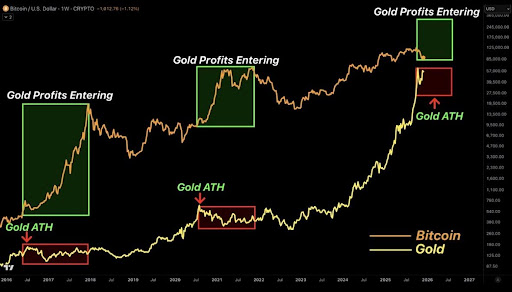
A recent technical analysis by Crypto Tice suggests that gold has taken the lead, while Bitcoin currently stands at a transition point. The analyst presented a weekly price chart tracking both assets, and showing how gold’s price movement could be used to determine Bitcoin’s next parabolic move to a $245,000 all-time high. 

The chart tracks gold and Bitcoin’s price action from 2016 through projected moves into 2026, showing a repeating pattern where uncertainty peaks in gold first. After which, capital flows into the precious metal, its price then breaks out and ranges, and then money rotates into BTC. Crypto Tice has said that this rotation phase has repeated in every market cycle.  

In the first cycle, from July 2017 to Q4 2018, gold climbed to an all-time high before trading in a narrow range, signaling broader trend exhaustion rather than a breakdown. Shortly afterward, Bitcoin launched a strong rally, reflecting a rotation of capital from the precious metal into a higher-risk asset. 
Bitcoin
Source: Chart from Crypto Tice on X

The same pattern appeared during the 2020-2021 cycle. Gold reached a new peak and stalled in a tight range, while Bitcoin followed with a powerful breakout to the upside. That surge aligned with another green profit rotation zone on the analyst’s price chart. 

On the far right side of the chart, Crypto Tice has revealed that gold has once again reached a record high in the current cycle and is consolidating inside a red range. At the same time, Bitcoin has already moved sharply higher and is now experiencing a modest pullback. The analyst calls this overlap a “transfer window” between the two assets.

Crypto Tice noted that this recent pause mirrors the same pattern seen in past cycles before Bitcoin staged a major price rally. The analyst has predicted that if BTC continues to follow this historical trend, it could soon enter a new parabolic phase, potentially triggering a price surge above $245,000.  

Elliott Wave Analyst Shares Next BTC Price Target

In a separate analysis, crypto market expert Merlijn the Trader has shared a video chart analysis showing a repeating Elliott wave structure that could indicate Bitcoin’s next potential bullish target. From late 2024 to mid 2025, BTC formed a five-wave pattern, creating higher lows and building a base that led to a significant price rally. 

According to Merlijn the Trader, Bitcoin is repeating this five-wave pattern in the current cycle. Waves 1 through 3 are already complete, showing higher lows, while Waves 4 and 5 are forming a base following a massive price crash. Once this stage completes, the analyst predicts BTC could rally strongly from its current price above $87,900 toward $124,000.

Bitcoin
BTC trading at $87,810 on the 1D chart | Source: BTCUSDT on Tradingview.com

Featured image from Pixabay, chart from Tradingview.com

Editorial Process for bitcoinist is centered on delivering thoroughly researched, accurate, and unbiased content. We uphold strict sourcing standards, and each page undergoes diligent review by our team of top technology experts and seasoned editors. This process ensures the integrity, relevance, and value of our content for our readers.


Supreme court judge to review Brazil’s ban on use of crypto in election campaigns – DL News

0

  • Court to reveal its decision in March ahead of October 3 elections.
  • Judges most recently upheld ban in February 2024.
  • Bans on crypto donations are becoming harder to sustain, says lawyer.

A Brazilian Supreme Federal Court judge reviewing a ban on the use of crypto in election campaigns signals that reforms are in the cards in Brazil and beyond, according to legal experts.

Nuno Marques, the vice president of the court-supervised electoral committee, is set to finalise a comprehensive review of election rules, including the long-standing crypto ban, ahead of the October general election, Brazilian media outlet Livecoins reported.

“What is changing now in Brazil and beyond is a growing recognition that blanket prohibitions are difficult to sustain as digital assets become more mainstream,” Jennifer Ouarrag, the head of legal at the staking provider Twinstake, told DL News.

As the popularity of crypto continues to grow in Brazil, more politicians are embracing adoption ahead of this year’s election — where digital assets are poised to become a deciding factor for some voters.

Renan Santos, a prospective presidential candidate, recently pledged to create a national Bitcoin reserve if elected. Crypto community leaders say they would back his bid if he develops crypto-friendly policies.

Last year, the volume of crypto transactions rose by 43% in Brazil, the crypto exchange Mercado Bitcoin wrote in a report last month, with the average Brazilian trader spending more than $1,000 on crypto.

Room for change

While Marques has not spoken directly about crypto funding in elections, he has suggested there may be room for reform.

As things stand, Article 62 of the Brazilian electoral code explicitly forbids the use of crypto as a donations tool.

In comments about “campaign financing,” Marques said candidates and parties were welcome to challenge the present rules if they “present justifications for the change,” Brazilian media outlet Ultimo Segundo reported.

The court says it will listen to public proposals from citizens, companies, and political parties until the end of the month. It will then follow up with public hearings in early February before finalising rules in March.

The reasons why Brazilian authorities banned crypto in 2019 are largely technical, Ouarrag said.

“In Brazil, [electoral rules] emphasise donor identification, contribution limits, source-of-funds controls, and transparent valuation at the time of donation,” she said. “Crypto challenged that framework not because it is inherently opaque, but because it did not fit neatly into reporting and oversight systems designed around bank transfers and fiat currencies.”

All this helps explain why Brazil “initially opted for an outright prohibition rather than incremental accommodation,” Ouarrag explained.

Regulations changing worldwide

Brazil could soon follow in the footsteps of the US, where crypto is beginning to play an increasingly large role in politics.

The Federal Election Commission approved Bitcoin donations in 2014. Last year, Bloomberg reported that crypto firms have raised $263 million from industry players to back pro-crypto candidates in the 2026 midterm elections.

Ouarrag said similar “reassessments” about the use of crypto donations are underway in parts of Europe and Asia, where regulators are “being forced to engage more directly with crypto’s inherent volatility, “rather than trying to fit it into frameworks designed exclusively for cash or bank transfers.”

She said electoral commissions are likely to “adapt, rather than abandon” existing safeguards to ensure electoral funds remain traceable and transparent in the digital age.

Brazil’s Supreme Court last reviewed election rules in February 2024, when it decided to uphold the ban.

At the time, it said the decision was made “to ensure transparency and the proper tracking of donations made to political campaigns.”

Tim Alper is a News Correspondent at DL News. Got a tip? Email him at tdalper@dlnews.com.

Bitmine Scoops up 40,302 Ethereum, Pushing ETH Stack to 4.243M Tokens

0

Bitmine Immersion Technologies (BMNR) has taken another oversized step into the crypto treasury race, revealing ethereum holdings that now rival sovereign-scale balance sheets. Bitmine Ramps up Ethereum Accumulation Bitmine said on Monday that its ethereum ( ETH) holdings have climbed to 4.243 million tokens, helping lift total crypto and cash assets to $12.8 billion as […]

Why Digital Identity Systems Are Moving Away from Centralized Data Storage

0

With the ever-increasing digital interactions in the various industries, the management of personal information of identity is experiencing a significant change. Identity verification has traditionally been based on traditional centralized databases, but growing security risks and privacy concerns are spurring the change. However, nowadays, the digital identity are no longer centralized in terms of data storage but rather decentralized and more secure.

The dangers of Centralized Identity Databases

In centralized identity systems, sensitive personal information is held in large quantities in central location. Although this model has been highly utilized, it has a major vulnerability. One attack has the potential to reveal millions of records resulting in identity theft, financial fraud, and permanent damage to privacy. Centralized storage has proven to be a risky form of data storage, as evidenced by high-profile data breaches that have prompted organizations to rethink their approach to the design and protection of digital identity systems.

Increasing Privacy Requirements by the users

The recent years have seen the heightened rate of public awareness on the issue of data privacy. Users have become more demanding when it comes to the way their personal information is stored and shared with them. The centralized identity systems can be characterized by the lack of visibility of data usage, and thus, it is not easy to control the digital identities of a person. The current digital identity systems are focused on returning the control to the users by minimizing the data collection and decreasing the dependency on the centralized storage.

Compliance Problems and Regulatory Pressure

The global regulations on data protection are increasingly being tough, and more responsibility is being put on the organizations holding the personal information. Storing identity centrally presents a higher risk of non-compliance: companies have to store and handle a large volume of sensitive information. Decentralized digital identity solutions allow users to minimize regulatory exposure, as they allow the data to be stored in minimum amounts and allow it to be selectively revealed. Such a strategy is more in compliance with the modern privacy regulations and the rules of compliance.

Better Decentralization of Security

Decentralized architectures are better at improving security by dispensing identity information instead of storing it at a single location. Cryptography and distributed registers are typically employed in contemporary digital identity systems to authenticate credentials without revealing raw personal data. This has a major effect of minimizing the effect of cyberattacks since hackers have no single point of failure.

User Control and Self-Sovereign Identity

One of the benefits of going beyond centralized storage is the emergence of identity models that are user-controlled. Self-sovereign identity enables people to directly possess and operate their credentials. Digital identity systems constructed on this model allow users to provide the minimum information needed to verify them, and not complete identity profiles. This is selective sharing, which enhances trust and efficiency and privacy.

Scalability and Readiness to Future Infrastructure

The centralized systems are usually unable to keep up with the growth of digital interactions. Decentralized digital identity systems are more flexible and resilient, and can be used in a global scale in various industries including finance, healthcare, and government services. The need to have a flexible identity infrastructure emerges as digital ecosystems grow to be long-term sustainable.

Conclusion

The move towards decentralized data storage is indicative of a larger change in the design of digital identity systems. Decentralized models overcome the inabilities of traditional models by emphasizing security, privacy, and user control. Also, with technology changing and policies still being adapted as it goes, decentralized digital identity systems have a role to play as the cornerstone of secure and trusted digital interactions.


U.S. marshals investigate claim of $40 million crypto theft by son of federal crypto custodian

0

The U.S. Marshals Service (USMS) is investigating allegations that the son of a Department of Defense and Department of Justice services provider, charged with managing cryptocurrency seized by law enforcement, stole more than $40 million worth of confiscated digital assets.

Blockchain investigator ZachXBT accused John “Lick” Daghita, son of Dean Daghita, president of CMDSS — a firm that says on its website it provides critical services for the Department of Justice and Department of Defense — of stealing the seized digital assets from crypto walltes managed by his father’s company.

ZachXBT, who said he reported John to authorities, stated it remains unclear how John Daghita allegedly obtained access to the wallets, including whether that access came through his father.

Brady McCarron, chief of public affairs for the USMS, told CoinDesk that the agency could not comment further on this case because investigations were underway.

“Meet the threat actor John (Lick), who was caught flexing $23M in a wallet address directly tied to $90M+ in suspected thefts from the US Government in 2024 and multiple other unidentified victims from Nov 2025 to Dec 2025,” ZachXBT posted on X last Friday.

ZachXBT identified the individual as John Daghita, claiming CMDSS currently holds an active federal IT contract. The blockchain investigator later said he reported a wallet address holding 12,540 ETH, worth roughly $36.3 million, which he said was controlled by Daghita. ZachXBT added that Daghita sent him 0.6767 ETH, which he said he would forward to a U.S. government seizure address.

“In case you are curious how John Daghita (Lick) was able to steal $40 million plus from U.S. government seizure addresses: John’s dad owns CMDSS, which currently has an active IT government contract in Virginia,” ZachXBT wrote, pointing to a CoinDesk report that CMDSS was awarded a contract to assist the U.S. Marshals Service (USMS) in managing and disposing of seized and forfeited crypto assets.

The Department of Defense, ZachXBT, and CMDSS did not immediately respond to a CoinDesk request for comment.

Caught on video

In February 2025, after the White House announced it was considering a national crypto reserve, a source familiar with the matter told CoinDesk the U.S. Marshals Service did not appear to know how much cryptocurrency it held.

The USMS is tasked with managing assets seized by law enforcement during criminal investigations, including real estate, cash, jewelry, antiques and vehicles.

John Daghita drew attention to himself after becoming embroiled in a recorded argument in a Telegram group chat with another individual. The exchange, known in cybercriminal circles as a “band for band,” involved both participants attempting to prove who controlled more cryptocurrency. ZachXBT captured the dispute on video.

“In part 1 of the (video) recording, Dritan (another threat actor) mocks John,” Zach said. “However, John screenshares [a] Exodus Wallet,” showing $2.3 million. In part 2 of the recording, Dritan continued to mock John while another $6.7 million worth of ETH is moved” into a wallet address.

ZachXBT said the full recording shows that Daghita “clearly controls both addresses.” The sleuth then explained he traced the funds to verify their origin, finding that at least $23 million was tied to roughly $90 million in crypto seized by the government in 2024 and 2025.

“Threat actors only continue to showing off stolen funds in leaked recordings rather than simply just staying quiet after an alleged theft from the U.S. government,” criticized Zach, saying they only make it easy for law enforcement to support a case against them.

Bitfinex Analysts: Bitcoin Faces Fragile Standoff as Institutional Demand Cools

0

Bitcoin’s January rally has lost traction, with the leading cryptocurrency retracing more than 10% from its mid-month peak as institutional demand softens and exchange-traded fund (ETF) flows turn decisively negative. Bitcoin Range Holds as ETF Redemptions Weigh on Market Confidence According to Bitfinex’s latest Alpha report, bitcoin failed to sustain a breakout above the $95,000–$98,000 […]

NEO PAY and Wio Bank Join Forces to Streamline SME Financing in the UAE

0

NEO PAY, a UAE-based payment solutions provider, has partnered with Wio Bank PJSC, the region’s leading digital financial platform, to launch a new Point-of-Sale (PoS) lending solution tailored for small and medium-sized enterprises (SMEs).

The collaboration aims to address a critical pain point for merchants: access to capital. By leveraging sales data directly from PoS terminals, the new facility offers swift access to funds, bypassing the lengthy approval processes and credit checks often associated with traditional banking.

Revenue-based repayments

A key feature of the solution is its repayment model, which links instalments directly to a merchant’s revenue flow. This structure ensures that repayments scale down during slower sales periods, easing financial pressure and fostering greater stability for businesses.

The facility is designed to provide working capital for essential growth activities, including inventory purchases, marketing campaigns, and business expansion.

Vibhor Mundhada, CEO of NEO PAY, commented on the launch: “We’re thrilled to collaborate with Wio Bank to launch a groundbreaking PoS lending solution, designed to empower merchants with quick and easy access to the capital they need for growth. This partnership is a step forward in making financial support more accessible and impactful for merchants and reflects NEO PAY’s commitment to merchants at every stage of their journey.”

Jayesh Patel, CEO of Wio Bank PJSC, highlighted the strategic importance of the sector: “SMEs are at the heart of the UAE’s economy, and at Wio Bank, our priority has always been to make banking work better for them. Through our partnership with NEO PAY, we’re helping merchants access timely capital and real-time insights to manage cash flow more smoothly and grow their businesses with confidence.”

Wio Bank, headquartered in Abu Dhabi and backed by investors including ADQ and First Abu Dhabi Bank (FAB), continues to expand its footprint in the embedded finance space. Meanwhile, NEO PAY, with an annual processed payment volume of over $30billion, reinforces its position as a key enabler of digital payments in the region.

Jefferies sees market structure bill as tokenization inflection point, despite rocky path ahead

0

Jefferies, a Wall Street investment bank, said maturing blockchain infrastructure and incremental regulatory progress are laying the groundwork for a new wave of tokenization by institutions in traditional finance (TradFi). Broad adoption, however, depends on having clear U.S. market structure rules, it said.

The bank pointed to the draft Digital Asset Market Clarity Act as the most detailed blueprint yet for how blockchain-based financial infrastructure could develop, even though hurdles remain in its path.

“Although passage remains uncertain, implications across FIs, blockchain-natives, and tokens may emerge sooner than anticipated,” wrote analysts led by Andrew Moss, in the Sunday report.

Tokenization is the process by which real-world assets are converted into blockchain-based tokens.

The Senate Agriculture Committee postponed its crypto market structure markup hearing from Tuesday to Thursday, citing the winter storm that hit much of the U.S. over the weekend.

The analysts noted that the Senate Banking Committee released its version of the CLARITY Act on Jan. 12, building on the House bill passed last July. Industry reaction has been largely positive, the report said, but political headwinds remain after a planned markup was postponed amid industry pushback.

A separate Senate Agriculture Committee bill must still be reconciled, and final approval requires a full Senate vote and presidential sign-off. The report highlighted that on prediction market Polymarket the odds for passage in 2026 have dropped sharply.

According to the bank’s analysts, the bill would mark a break from “regulation through enforcement,” aiming instead to harmonize agency oversight through a technology-neutral framework covering asset classification, regulatory jurisdiction, financial institution activities, decentralized finance (DeFi) oversight, tokenization and consumer protections.

Stablecoins have drawn outsized attention. The analysts said the Senate draft would close the so-called “stablecoin yield loophole” by banning rewards paid solely for holding stablecoins, while still allowing transaction-based incentives.

Jefferies argued the bigger impact of CLARITY would be unlocking broader participation by regulated financial institutions. Tokenization efforts are already accelerating, it said, citing initiatives from NYSE, Nasdaq, DTCC and Swift.

Clear market-structure rules could accelerate blockchain-based trading, lending and custody, shift capital toward TradFi-led projects, and strengthen regulatory moats for compliant crypto-native firms, it said.

Many of these initiatives will rely on specific blockchains for settlement, creating potential upside for tokens tied to revenue-generating network activity, the report added.

Benchmark, a broker, said the absence of legislation would postpone, rather than undermine, crypto’s maturation, constraining the U.S. market as capital flows toward bitcoin-linked exposure, balance-sheet strength and cash-flowing infrastructure, and away from regulatory-sensitive segments including exchanges, DeFi and altcoins.

Read more: Market structure bill delay seen capping U.S. crypto valuations, Benchmark says

Macro Shocks Hit Crypto as Liquidations Top $550 Million

0

Crypto markets came under pressure amid mounting macroeconomic risks, triggering over $550 million in liquidations as investors shifted toward safe-haven assets and defensive positioning. Crypto Slides as Tariff Fears Spark Risk-Off Mood Cryptocurrency markets weakened at the start of the week after a quiet weekend, as more than $550 million in leveraged long positions were […]

Bitcoin miners Cleanspark, IREN, and TeraWulf among those lower after NVDA/CRWV deal

0

As if continuing declines in the bitcoin price weren’t enough, shares of bitcoin miners who have shifted their business plan to focus on AI infrastructure were mostly sharply lower Monday following Nvidia’s $2 billion investment in CoreWeave.

While the investment underscores growing demand for high-performance computing as AI applications expand, it also highlights the challenges for independent miners trying to reposition themselves as infrastructure providers in the space.

Cipher Mining (CIFR), CleanSpark (CLSK), IREN (IREN), and TeraWulf (WULF) were among names 5%-9% lower following the news.

The drop reflects investor concern that CoreWeave’s growing lead in the AI infrastructure market could limit the upside for other players.

“The declines across the AI and HPC segment tied to bitcoin miners today signal a commitment between NVIDIA and CoreWeave, with GPU allocation increasingly prioritized toward that partnership,” said James Van Straten, senior bitcoin analyst at CoinDesk. “This could potentially diminish funding prospects for independent miners seeking to pivot into AI infrastructure. The $2 billion capital injection is set to materially expand AI compute capacity for CoreWeave, which would intensify competition and squeeze both margins and market share for smaller players.”

Van Straten also noted that CoreWeave’s $53 billion market cap is already half the peak valuation of the entire bitcoin-AI mining sector in October.

“As with any maturing industry, consolidation now appears increasingly inevitable,” he said.

In addition, Matthew Sigel, head of digital assets at VanEck says CLSK fell about 9% as markets priced in perceived outage risk tied to its Tennessee exposure after state level power headlines, despite its sites being in grid green zones. The drop was compounded by a proxy filing that quantified a roughly $45 million CEO pay package for 2025, raising governance concerns as the firm pivots toward AI, according to Sigel.

The only name showing a sizable gain on Monday is Core Scientific (CORZ). Although CoreWeave tried and failed to acquire CORZ in 2025, the two still continue to have a multi-year data center deal. Shares are higher by just shy of 2% in late-morning trade.

Also outperforming is Hut 8 (HUT), another miner that has diversified into AI hosting and high-performance computing. Along with Core Scientific, HUT also offers infrastructure tailored to large-scale AI applications, giving it a competitive edge as demand for compute surges. HUT shares are higher by 0.2%.

The shift toward AI isn’t new. Bitcoin miners, once singularly focused on validating blockchain transactions, have been repurposing their data centers for more profitable workloads, particularly as mining rewards shrink and power costs rise.

Nvidia’s latest move, however, suggests those resources may increasingly flow to larger, more tightly integrated players like CoreWeave, forcing smaller firms to adapt or consolidate.