South Korea’s top financial watchdog is stepping up oversight of crypto markets days after a local exchange mistakenly distributed billions of dollars worth of bitcoin to users.
The Financial Supervisory Service said Sunday it will launch planned investigations into “high-risk” practices that undermine market order, including large-scale price manipulation by so-called whales, trading schemes tied to suspended deposits and withdrawals, and coordinated pump tactics fueled by social media misinformation.
The watchdog also said it plans to build tools that automatically extract suspicious trading patterns by the second and minute, alongside text-analysis systems using artificial intelligence to flag potential market abuse.
The announcement follows a widely reported exchange error last week in which some users of Bithumb, among the country’s biggest exchanges, were mistakenly credited with at least 2,000 bitcoin each instead of small promotional rewards, a blunder estimated at roughly $44 billion at the time.
BTC prices dropped 30% compared to the global average at the time, as some recipients tried to sell the assets. The exchange had restricted trading and withdrawals for the 695 affected customers within 35 minutes of the erroneous distribution on Friday.
Regulators said the incident exposed the “vulnerabilities and risks” of virtual assets and signaled they could conduct on-site inspections of exchanges if irregularities are found in internal control systems.
Beyond market manipulation, the FSS said it will introduce punitive fines for IT incidents across the financial sector and raise the security accountability of chief executives and chief information security officers, a shift that could have direct implications for crypto trading platforms.
The agency also confirmed it has set up a preparatory team for the Basic Digital Asset Act, which would expand Korea’s regulatory framework beyond the first phase of crypto rules.
The crackdown plan reflects a broader push by President Lee Jae-myung to stamp out what he has called “cruel financial practices,” with the FSS also outlining measures to strengthen enforcement against fraud and expand tools to combat voice phishing.
Tether, the crypto firm behind the world’s most popular stablecoin USDT$0.9994, continued its gold hoarding over the past month, ranking within the top 30 global owners of the metal and surpassing several sovereign nations, according to a Sunday report from Wall Street investment bank Jefferies.
The stablecoin issuer’s gold reserves rose to an estimated 148 tonnes by Jan. 31, valued at roughly $23 billion, after buying about 26 tonnes in the last quarter of 2025 and adding another 6 tonnes in January, Jefferies analysts said.
Jefferies estimates show Tether’s quarterly gold buying exceeded that of most individual central banks, trailing only Poland and Brazil during that period.
At current levels, Tether’s holdings exceed those of countries such as Australia, the United Arab Emirates, Qatar, South Korea and Greece, placing the crypto firm among the top 30 holders of bullion worldwide and one of the largest non-sovereign buyers, the analysts said.
The 148 tonnes of bullion is held as reserves backing both its U.S. dollar-pegged stablecoin USDT and its gold-backed token XAUT. But the company may hold more gold than disclosed, the report added.
Because Tether is privately held, the figures represent a minimum estimate of its total gold exposure, with undisclosed additional purchases likely made on the company’s balance sheet.
According to the USDT’s fourth quarter attestation, some $17 billion of gold was in the reserves, amounting to 126 tonnes as of year-end gold prices.
XAUT’s supply grew to 712,000 tokens worth $3.2 billion by the end of January, an increase of 6 tonnes of gold backing the tokens. CEO Paolo Ardoino told CoinDesk in an October interview that the gold-back enjoyed strong retail demand mainly from emerging markets.
The accumulation coincided with a record-breaking rally in gold, topping $5,000 per ounces last month and advancing nearly 50% since September. The driving forces behind the move is central bank demand, rising long-term government bond yields and efforts by some investors to reduce reliance on the U.S. dollar.
The company’s buying spree may continue, Jefferies noted. Tether CEO Paolo Ardoino said the company plans to allocate 10%-15% of its investment portfolio to physical gold, formalizing a strategy that has already played out over several years.
Tether’s investment portfolio was valued at $20 billion as of the end of last year, CoinDesk reported.
Read more: Tether is buying up to $1 billion of gold per month and storing it in a ‘James Bond’ bunker
Ethereum domain name service provider ENS has canceled plans to launch a layer-2 as part of its ENSv2 upgrade, opting instead to launch a revamped protocol directly on Ethereum.
In a blog post on Friday, ENS lead developer nick.eth explained that the decision was partly due to a “99% reduction in ENS registration gas costs over the past year” amid a number of important upgrades to the Ethereum network.
“Put simply: Ethereum L1 is scaling, and it’s scaling faster than almost anyone predicted two years ago. The recent Fusaka upgrade raised the gas limit to 60 million, a 2x increase from the beginning of 2025,” nick.eth said, adding:
“Now Ethereum core developers are targeting 200 million gas limit targets in 2026, a 3x increase from today, and that’s before any ZK upgrades land.”
The Fusaka upgrade, one of the most recent Ethereum upgrades that went live in early December, has helped Ethereum drive down gas fees due to its significant scaling capabilities for both the L1 and the ecosystem of L2s.
Blog post announcing changes to ENS’ upgrade plans. Source: ENS
ENS initially announced its L2 Namechain in November 2024, stating that it would make it easier and cheaper for users to register domain names through rollups.
Nick.eth emphasized that the context has changed dramatically and that it is now viable to build directly on L1 rather than opt for a full-fledged L2 to reduce costs.
“Huge L1 scalability was not part of the Ethereum roadmap, and the message was clear that L2s were the way forward. We needed to meet our users where the ecosystem was heading, and that meant building Namechain,” he said.
Related: Arbitrum, Optimism and Base weigh in after Vitalik questions L2 scaling model
With plans for Namechain now gone, the ENS lead developer noted that the project is still working on significant performance and utility improvements via ENSv2, while the protocol will remain highly interoperable with L2s.
“The vast majority of our engineering effort has gone into ENSv2 itself: the new registry architecture, the improved ownership model, better handling of name expiration, and the flexibility that comes from giving each name its own registry,” he said, adding:
“Deciding to stay on L1 doesn’t mean we’re closing the door on L2s entirely. The flexibility of the ENSv2 architecture makes L2 names more interoperable. Our new registration flow abstracts the complexity crosschain transactions.”
Magazine: Ethereum’s Fusaka fork explained for dummies: What the hell is PeerDAS?
Cointelegraph is committed to independent, transparent journalism. This news article is produced in accordance with Cointelegraph’s Editorial Policy and aims to provide accurate and timely information. Readers are encouraged to verify information independently. Read our Editorial Policy https://cointelegraph.com/editorial-policy
Story Protocol co-founder SY Lee defended the project’s decision to push its first major IP token unlock to August 2026, in a recent interview with CoinDesk, saying the blockchain needs “more time” to build usage and that near-zero on-chain revenue is “the wrong metric” for an intellectual-property and AI data network.
The six-month delay keeps team and investor tokens locked as Story pivots from a general IP registry toward licensing human-generated datasets for artificial-intelligence training.
He pointed to Worldcoin’s 2024 decision to extend investor and team lockups from three to five years, a move that reduced near-term circulating supply and was framed as extending the development runway, with the token posting double-digit gains in the hours after the announcement. Story, Lee said, is following the same logic.
“If we were all mercenary, we would have wanted a shorter lockup,” he said, describing the extension as a signal of long-term commitment rather than distress.
Story’s daily revenue, which peaked at $43,000 in September 2025 and is currently $0 per DeFiLlama, has also been a concern for many investors.
(DeFiLlama)
Lee contends that those numbers understate Story’s activity because much of the intended monetization occurs off-chain through licensing agreements rather than in transaction tolls.
In his view, gas revenue is a lagging indicator for a network designed to record rights, provenance, and usage terms before it begins extracting meaningful value from them.
“We intentionally put our chain gas fee pretty low. We’re more of an IP chain,” he said. “You may not see the type of revenue stream that you’re looking for like a DeFi chain.”
Instead, he said Story’s near-term focus is on recording ownership terms and usage rights for datasets and models used to train artificial-intelligence systems — something the project announced last year — with payments and royalty splits embedded in smart contracts.
That shift moves the project away from tokenizing media content or collectibles and toward what Lee described as “unscrapable” human-contributed data, such as multilingual voice samples and first-person video, assets he argues are harder for AI developers to obtain legally at scale through traditional web scraping.
The transition, however, delays the visibility of on-chain income because much of the expected value is tied to enterprise licensing deals rather than retail transaction fees. Lee compared the timeline to his previous Web2-based startup experience — which landed him a $440 million exit in 2021 — noting that it took years for meaningful revenue to materialize.
For token holders, the practical implication is that supply expansion is being slowed while the team attempts to demonstrate traction in AI data partnerships and rights-cleared dataset collection.
Whether that strategy ultimately converts into a sustainable business model is an open question, but Lee maintained that extending vesting schedules is healthier than rushing liquidity into a weak market.
“The best founders, the best teams, the best companies usually do it for a decade plus, we’re in it for the long term and longer innings,” Lee said.
Update (Feb.9, 2026, 7:50 a.m. UTC): This article has been updated to clarify that Jeanine Pirro serves as the US attorney for the District of Columbia.
US Treasury Secretary Scott Bessent is calling on the Senate Banking Committee to proceed with confirmation hearings for Federal Reserve chair nominee Kevin Warsh, despite a standoff over an ongoing probe into current Fed chair Jerome Powell.
Speaking on Fox News’ Sunday Morning Futures, Bessent cited a recent pushback from Republican Senator Thom Tillis, who said he plans to delay confirmation of the next Fed chair until the Department of Justice probe into Powell is resolved.
“Senator Tillis has come out and said he thinks that Kevin Warsh is an extreme candidate,” Bessent said, adding:
“So I would say, why don’t we get the hearings underway and see where Jeanine Pirro’s investigation goes?”
Scott Bessent speaking about Kevin Warsh and Thom Tillis. Source: Fox News
Despite his support for Warsh, Tillis, a member of the Senate Banking Committee, has vowed on multiple occasions to block the nomination until the DOJ reaches “to the truth” of the matter, as part of a push to protect the Fed’s independence.
“I’d be one of the first people to introduce Mr. Warsh if we’re behind this and support him, but not before this matter is settled,” Tillis told CNBC on Wednesday.
Republicans control 13 of the 24 seats in the Senate Banking Committee, meaning that they could vote as a bloc to push through Warsh. However, with Tillis looking to halt the process, he could use his vote to oppose Warsh, putting the ultimate decision in the hands of the Democrats.
The Justice Department opened an investigation into Powell in early January, issuing grand jury subpoenas related to expenses tied to a multi-year renovation project at Federal Reserve office buildings. The probe is being handled through the office of Jeanine Pirro, who serves as the US attorney for the District of Columbia.
The DOJ, led by attorney Jeanine Pirro, initially opened an investigation into Powell in early January, serving the Fed with grand jury subpoenas and threats of criminal charges related to expenses for a multi-year renovation project at Fed office buildings.
Powell promptly denied the assertions and, on Jan. 11, argued that the investigation was politically motivated because the Fed’s interest rate policy was at odds with the wishes of US President Donald Trump.
On Jan. 30, Trump officially nominated Kevin Warsh to succeed Powell as the next Fed chair.
Related: Federal Reserve entering ‘gradual print’ mode — Lyn Alden
Following a presidential nomination, the nominee must then appear before the Senate Banking Committee for a review hearing. The committee then votes on whether to send the nominee to the full senate with a favorable or non-favorable recommendation, or no recommendation at all.
Finally, the full Senate then holds a debate and vote, and if the nominee is confirmed, they can be officially sworn in as the next Fed chair.
Magazine: The critical reason you should never ask ChatGPT for legal advice
Cointelegraph is committed to independent, transparent journalism. This news article is produced in accordance with Cointelegraph’s Editorial Policy and aims to provide accurate and timely information. Readers are encouraged to verify information independently. Read our Editorial Policy https://cointelegraph.com/editorial-policy
Trusted Editorial content, reviewed by leading industry experts and seasoned editors. Ad Disclosure
Bitcoin got hit hard on Feb. 5 (down 13.2%), and Jeff Park’s take is pretty blunt: this didn’t look like a crypto headline. It looked more like tradfi plumbing: margin, derivatives, and ETF mechanics, running through spot Bitcoin ETFs, with BlackRock’s IBIT right in the middle. Here’s the odd part: flows didn’t show the big redemptions you’d normally expect on a day like that.
Why Did Bitcoin Crash On Feb. 5?
Park starts with the ETF tape in his X post from Feb. 7. IBIT, he said, did record volume—“2x the prior high, 10B+”—and options were going nuts too, with contract counts at launch-era highs. And unlike prior spikes in options interest, he says this one leaned put-heavy, based on a clear volume imbalance.
That timing matters. It landed right as markets were going risk-off across the board. Park cited Goldman’s prime brokerage desk calling Feb. 4 one of the worst daily performance events for multi-strat funds, around a 3.5 z-score—basically a “0.05% event” in his framing. When that happens, pod-shop risk managers step in and tell everyone the same thing: cut gross, fast. Park frames Feb. 5 as the second leg of that forced deleveraging.
But the flow data didn’t line up with the obvious story. He points to prior IBIT drawdowns where you did see real redemptions: Jan. 30’s roughly $530 million of net outflows after a 5.8% down day, and Feb. 4’s roughly $370 million during the losing streak. On a -13% day, you’d think you’d see $500M–$1B of outflows. He didn’t. Instead, Park points to net creations: about 6 million new IBIT shares created, adding roughly $230 million in AUM. And the rest of the spot Bitcoin ETF complex was net positive too—$300M+. “That is a little perplexing,” he wrote. His point: it probably wasn’t one thing.
Deleveraging First, Then Short-Gamma Mechanics
His main claim: the trigger wasn’t crypto-native. “The catalyst to the sell off was that there was a broad based deleveraging across multi-asset funds/portfolios due to the high downside correlation of risk assets reaching statistically anomalous levels,” he wrote. In his view, that set off violent de-risking that included Bitcoin, even if a lot of the exposure was supposedly “delta neutral”: basis trades, RV versus crypto equities, and other setups that box delta across dealers.
After that, the hedging mechanics took over. “This deleveraging then caused some short gamma to come into effect that compounded to the downside,” he wrote, basically saying dealers had to sell IBIT as their hedges updated. And because it happened so fast, he thinks market makers ended up net short Bitcoin without really managing inventory the “normal” way. That can mute what you’d otherwise see as big ETF outflows on the tape.
He also notes how closely IBIT tracked software equities and other risk assets in the weeks leading into the drop. In his framing, the software-led selloff is the cleaner spark here: gold matters, sure, but it’s less central to the funded multi-strat trades he’s talking about.
One hard datapoint he leans on is the CME basis. Using a dataset he attributed to Anchorage Digital Head of Research David Lawant, Park said the near-dated CME BTC basis jumped from 3.3% on Feb. 5 to 9% on Feb. 6—an unusually big move since the ETF launch. He reads that as a forced unwind of the basis trade by large multi-strat shops (sell spot, buy futures).
As extra fuel, he brings up structured products: knock-ins and barrier levels. Not necessarily the driver, but something that can make a fast move nastier. He referenced a JPM note priced in November with a barrier “right at 43.6,” and argued that if similar notes were printed later as BTC slid, barriers could cluster around “38–39.”
That’s the kind of zone where a fast selloff can flip hedging into a cascade. If barriers break, negative vanna and quickly changing gamma can force dealers to sell hard into weakness. He also notes implied vol nearly touching 90% in his description.
Why Bitcoin Snapped Back On Feb. 6
Park frames Feb. 6’s “heroic 10%+ recovery” as a positioning reset. CME open interest expanded faster than Binance’s. He says CME OI collapsed from Feb. 4 to Feb. 5 (supporting the basis-unwind idea), then recovered as players leaned back into relative-value setups.
In his telling, ETF creates/redeems can look flat-ish if the basis trade is being rebuilt, even if price stays heavy because crypto-native leverage and short-gamma exposures—often on offshore venues—are still clearing out.
Bottom line, in his view: this may not have been “fundamental” at all. It was technical plumbing: multi-asset de-risking, then derivatives feedback loops making it worse. If ETF inflows keep coming without a matching expansion in the basis trade, he implies, that’s the cleaner signal of real demand, less dealer recycling, more sticky buyers.
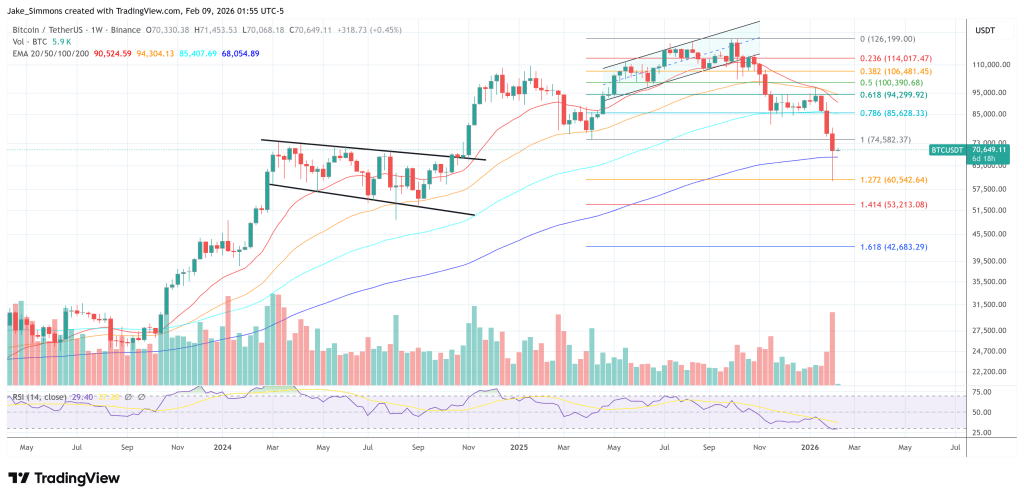
At press time, BTC traded at $70,649.
Bitcoin closed the week above the 200-week EMA, 1-week chart | Source: BTCUSDT on TradingView.com
Featured image created with DALL.E, chart from TradingView.com
Editorial Process for bitcoinist is centered on delivering thoroughly researched, accurate, and unbiased content. We uphold strict sourcing standards, and each page undergoes diligent review by our team of top technology experts and seasoned editors. This process ensures the integrity, relevance, and value of our content for our readers.
Bitcoin’s core security remains intact despite quantum computing advances, with risks limited to legacy coins, timelines stretching decades, and clear paths for non-disruptive upgrades that preserve market stability and decentralization. Coinshares Finds Quantum Computing a Future Design Issue, Not Bitcoin Crisis Long-term security considerations remain central to evaluations of Bitcoin’s durability as a monetary network. […]
Two teenagers were arrested after a violent home invasion in Scottsdale, Arizona, targeting $66 million in cryptocurrency. The Breach and Assault Two California teenagers are in custody following a violent home invasion targeting a massive cryptocurrency fortune, an incident police say was orchestrated by anonymous handlers via the encrypted messaging app Signal. Jackson Sullivan, 17, […]
Saudi Arabia has successfully completed its first end-to-end tokenised property deed transaction, a move described as a global first for a G20 nation in integrating national property law directly into digital settlement infrastructure.
The transaction was executed on droppRWA, a “sovereign-grade” infrastructure provider. The milestone represents a shift toward a “Registry-as-Truth” model, where the national registry and property laws are enforced directly within the settlement layer, rather than being reconciled post-facto.
From days to seconds
The initiative is designed to drastically reduce friction in the real estate market. According to the announcement, the integration has reduced settlement times from days to mere seconds.
Beyond speed, the infrastructure aims to transform Saudi real estate into a liquid, programmable asset class accessible to global capital. Crucially, this is achieved while keeping the control of the national registry “firmly in sovereign hands,” ensuring that digital agility does not compromise regulatory oversight.
Faisal Al Monai, CEO of droppRWA, architected the shift which allows legal ownership and digital settlement to occur simultaneously.
The development marks a significant step in the digitization of real assets, moving beyond experimental pilots to live transactions that respect and enforce the legal nuances of sovereign property rights.
The FDIC agreed to pay Coinbase $188,440 in legal fees and overhaul FOIA policies following a court ruling that found the agency violated federal disclosure law.
The settlement concludes a multi-year legal battle that exposed dozens of “pause letters” the FDIC sent to banks ordering them to halt crypto-related activities.
Under new leadership, the FDIC pledged that it would not categorically withhold all bank supervisory documents.
The FDIC has agreed to pay $188,440 in legal fees and drop its fight to withhold crypto-related “pause letters,” settling a FOIA lawsuit tied to alleged Operation Choke Point 2.0 debanking tactics and closing a case that forced the regulator to release records showing how banks were allegedly pressed to halt or limit crypto activity.
In a joint status report filed Friday in federal court in Washington, D.C., the Federal Deposit Insurance Corporation agreed to pay the full attorney’s fees from History Associates Incorporated, the research firm that filed the records request at Coinbase’s direction, and revise certain FOIA practices.
The FDIC’s appeal-denial letter had acknowledged its “decision to withhold was based upon a determination that the type of records being requested would be exempt, rather than making exemption determinations on a document-by-document basis,” according to the status report.
The records became public after the FDIC’s Office of Inspector General revealed their existence in an October 2023 report, which criticized the agency for sending letters to banks “asking them to pause, or not expand, planned or ongoing crypto-related activities.”
The settlement follows a November court ruling that officially found the FDIC “violated FOIA” by initially categorically withholding the letters and “redacting information in the pause letters that is not subject to Exemption 8 or would not impair any interest protected by Exemption 8.”
Joe Ciccolo, founder and president of BitAML, told Decrypt the ruling shows crypto oversight in the previous administration was shaped as much by “political and reputational considerations” as by traditional safety-and-soundness analysis.
“Shame on the FDIC—they are supposed to exemplify transparency given their mandate to protect consumers and insure the public’s money,” Ciccolo said.
“Operation Choke Point 2.0” refers to alleged coordinated efforts by U.S. bank regulators, including the FDIC, Federal Reserve, and OCC, to restrict crypto firms’ banking access, borrowing its name from an Obama-era program that pressured banks to cut off gun dealers and payday lenders.
When Coinbase sought the letters in November 2023, the FDIC denied the request as exempt “by their very nature,” later saying its decision to withhold was based on record type rather than a “document-by-document” exemption review.
After History Associates sued in June 2024, U.S. District Judge Ana Reyes ordered the FDIC to produce the letters and later warned of a “lack of good-faith effort” in its redactions, directing the agency to make more thoughtful ones.
It took four court orders and six productions for the FDIC to produce all responsive documents.
“The years of litigation were worth it,” Coinbase CLO Paul Grewal posted on X following the settlement. “We successfully uncovered dozens of crypto ‘pause letters’—indisputable proof of OCP2.0 and the coordinated effort to sideline the industry.”
Under the settlement, the FDIC committed to policy changes, including adding language to training materials instructing staff to “liberally construe” FOIA requests and declaring it does not maintain a blanket policy of categorically withholding all bank supervisory documents under FOIA Exemption 8.
Ciccolo said oversight should be “transparent, risk-based, and grounded in clear supervisory standards, not informal pressure conveyed through cryptic ‘pause letters,’” warning that behind-the-scenes regulatory actions erode trust in the supervisory framework.
The parties will file a formal dismissal once the FDIC remits payment. The regulator did not immediately return Decrypt’s request for comment.
Daily Debrief Newsletter
Start every day with the top news stories right now, plus original features, a podcast, videos and more.