White House officials claimed that they had “not received names” in response to requests to Senate Democrats for potential commissioners to two US financial regulatory agencies.
In a Thursday letter to US Senate majority leader John Thune and minority leader Chuck Schumer, White House officials said that they had already solicited names from Senate Democrats for the Securities and Exchange Commission (SEC) and Commodity Futures Trading Commission (CFTC). The leadership panels of both financial agencies are understaffed, with only Republican members nominated and confirmed by the Senate.
The letter came in response to a June 10 request from 12 Senate Democrats over staffing concerns at US federal agencies, including the SEC and CFTC. Although US President Donald Trump has put forward some Democratic names for positions at agencies, including the National Labor Relations Board and International Trade Commission, many lawmakers have expressed concerns about the financial regulators being understaffed with crypto market structure legislation pending.
As of Thursday, the SEC had two vacant Democratic seats with three Republican commissioners, one of whom, Hester Peirce, was expected to leave by November. The CFTC chair and sole commissioner was Republican Michael Selig, who, in his seven months on the job, has been outspoken about defending what he called the agency’s “exclusive jurisdiction” over prediction market companies.
Related: Wyden urges Senate leaders to keep dev protections in crypto bill
“In a sharp break from precedent across Republican and Democratic administrations, you have refused in almost every instance to engage with Senate Democratic leadership in the normal process of identifying Democratic nominees to fill vacancies on independent agencies,” said the Democratic senators in June. “Instead, the White House appears set on leaving the vast majority of these critical positions open indefinitely.”
Trump had not announced any nominations sent to the Senate since June 24. Cointelegraph reached out to a White House spokesperson for comment but did not receive an immediate response.
CFTC chair says agency could write “all the rules” on digital assets without legislation
With the Senate on state work periods until Monday, there have been reports that some lawmakers are continuing to discuss the Digital Asset Market Clarity (CLARITY) Act, with Republicans preparing to vote on the bill in July.
Source: Cynthia Lummis
The digital asset market structure legislation has already faced significant delays since passing the House of Representatives in July 2025, with government shutdowns and debates over ethics provisions in the bill amid Trump’s ties to the crypto industry. While two Senate committees advanced their versions of the bill this year, the legislation still needs some Democratic support to meet the 60-vote threshold in the chamber.
“I do think there’s a little bit of this creep into ethics and other types of extraneous issues and [Democrats are] just derailing this real opportunity to have a bipartisan bill in place,” said Selig in a Wednesday interview with Fox Business, referring to the CLARITY Act. “Otherwise, you end up with regulators like me writing all the rules, and I’m sure all the Democrats would prefer to get something in place that’s bipartisan.”
Magazine: Crypto’s CLARITY Act faces partisan fight over ethics on Senate floor
The joint filing asks regulators to turn Phantom’s March no-action relief into a formal rule covering all non-custodial wallet providers.
The Hyperliquid Policy Center and wallet provider Phantom filed a joint comment with the Commodity Futures Trading Commission on Thursday, arguing the agency’s registration rules for exchanges and brokers should not apply to onchain protocol software or non-custodial wallets, according to HPC’s own post on X.
The filing responds to a request for information the CFTC and SEC issued jointly in mid-June, seeking industry input on rules that hinder financial-technology innovation.
Three Requests
HPC and Phantom laid out three asks. First, confirmation that publishing onchain protocol software alone does not trigger registration as an exchange or clearinghouse. Second, a clear path for firms already registered with the CFTC to run regulated functions, like matching and clearing, on onchain infrastructure. Third, and most concrete, turning the no-action relief the CFTC granted Phantom in March into a formal rule that would extend to other non-custodial wallet providers.
“The Commission’s preexisting rules were built for legacy markets,” HPC and Phantom wrote, arguing that onchain markets let users hold their own funds and trade directly, without the chain of intermediaries that broker-dealer rules assume.
The filing lands under CFTC Chairman Michael Selig, who took office in December and has since approved the first U.S.-regulated bitcoin perpetual futures contract in May and opened the door to more onshore perps trading. CME Group has separately sued the CFTC over that approval, arguing perpetual futures should be classified as swaps.
But elsewhere, another sign of hope appeared in a Wednesday letter from Senator Ron Wyden to Senate leadership that the Oregon Democrat supported the way the earlier legislation handled the legal protections for developers — specifically the section of Clarity known as the Blockchain Regulatory Certainty Act, which would ensure crypto developers wouldn’t be treated under federal regulations as money transmitters if they’re not handling customer assets. The decentralized finance (DeFi) sector has made preserving the BRCA a top aim in the Clarity negotiations.
Though some of the crypto industry’s DC insiders had begun to express private uncertainty about the Clarity Act’s survival, the effort hasn’t yet reached its fatal deadline for getting done before the summer congressional break and the shift of attention to the fall midterm elections.
The Senate calendar includes three remaining weeks in July and the first week of August. However, the process to advance the legislation could take a few days of that time, meaning there’s scant runway left for a 2026 takeoff. And there’s some concern a defense spending bill may also complicate the chamber’s bandwidth.
Also, the U.S. House of Representatives would need to approve the Senate’s version of Clarity before it could become law, so the process would await the action of a House that’s been nearly paralyzed by Republican infighting. And it would then head to the desk of President Donald Trump for a signature to make it law, though the president has refused to sign another popular piece of legislation — the Senate’s bipartisan housing bill — as he insists that Congress needs to prioritize his demands for new voting rules.
US stocks were in the green across the board, helping to erase Wednesday’s downside as US President Donald Trump said that the Iran peace deal was “over.”
“They called a little while ago; they want to make a deal so badly,” Trump subsequently said in comments quoted by trading resource The Kobeissi Letter and others.
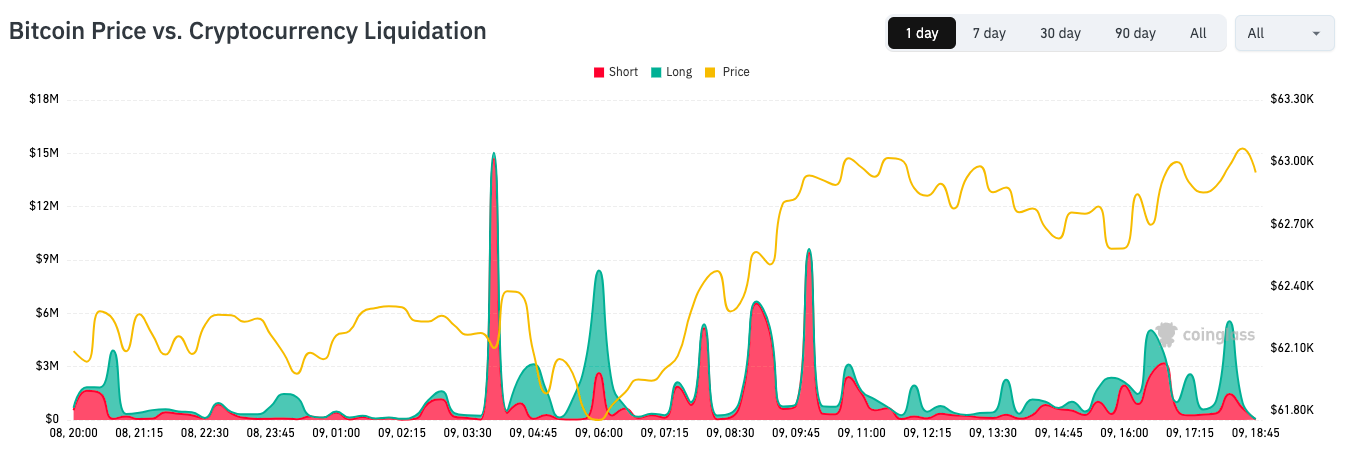
Crypto markets joined the sense of relief, helping push 24-hour short liquidations to nearly $100 million, per data from CoinGlass.
BTC/USD vs. crypto liquidations (screenshot). Source: CoinGlass
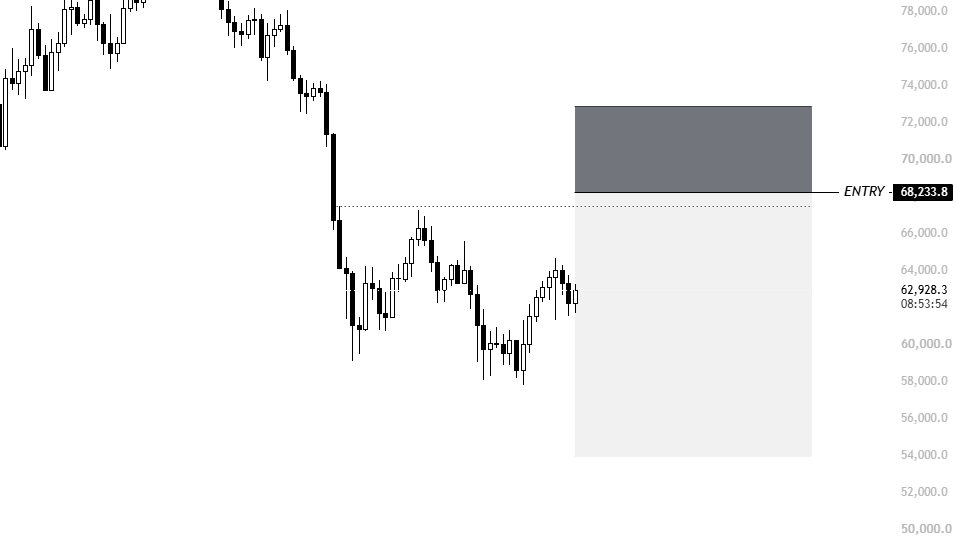
Commenting on the latest BTC price setup, trader Killa described their view as “not bearish at all.”
“In my view, we still have a few more months of choppy PA,” an X post stated, eyeing $68,000 for a potential short entry.
Source: Killa/X
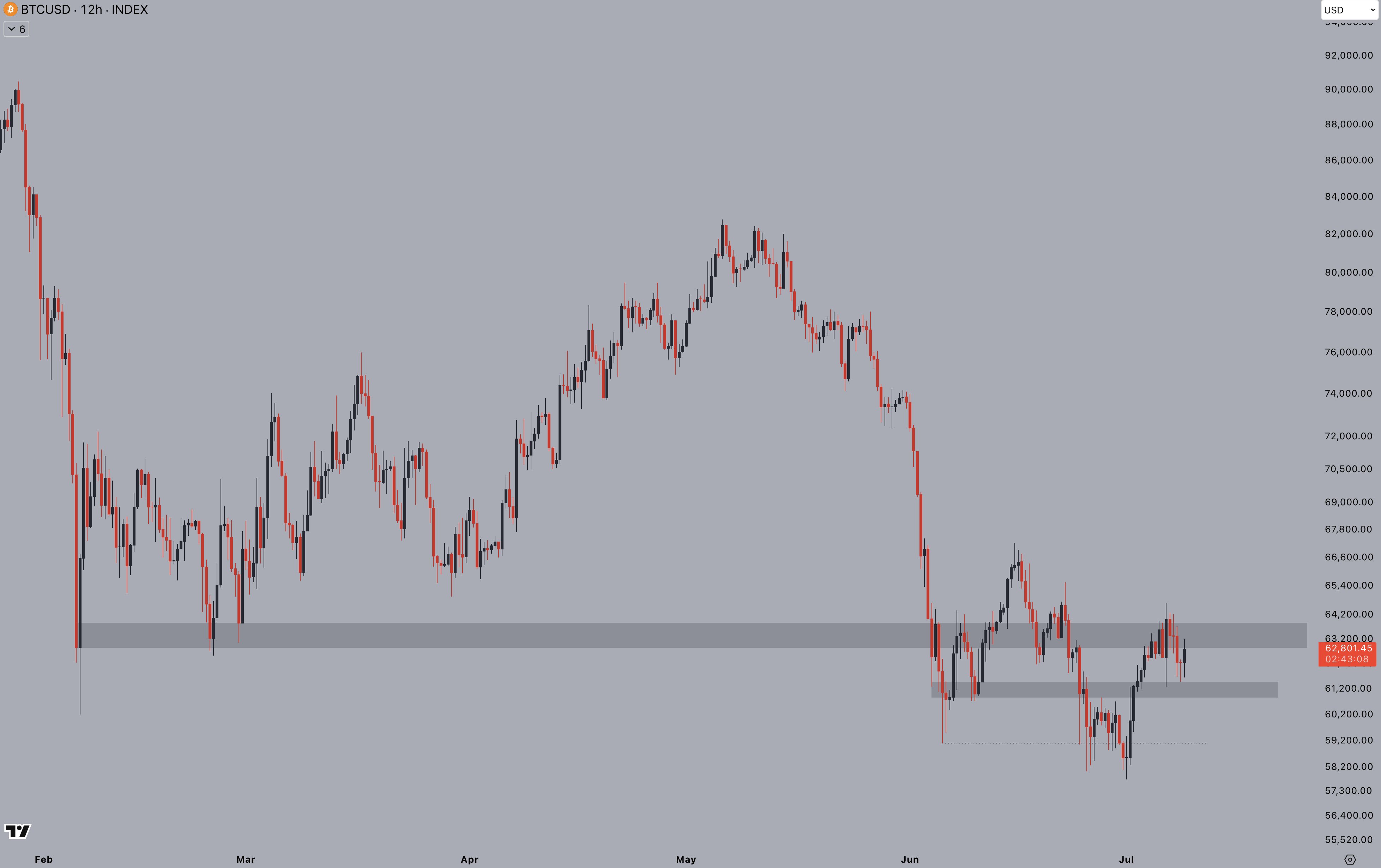
Fellow trader Jelle saw ongoing strength from bulls, with a support reclaim still possible.
“Looks like bulls aren’t giving up on the reclaim just yet,” he told X followers.
“Get back above, and we likely push for 65-70k again. Reject, and sub-60k is back on the menu for $BTC.”
BTC/USD 12-hour chart. Source: Jelle/X
Bitcoin price needs a $64,700 daily close
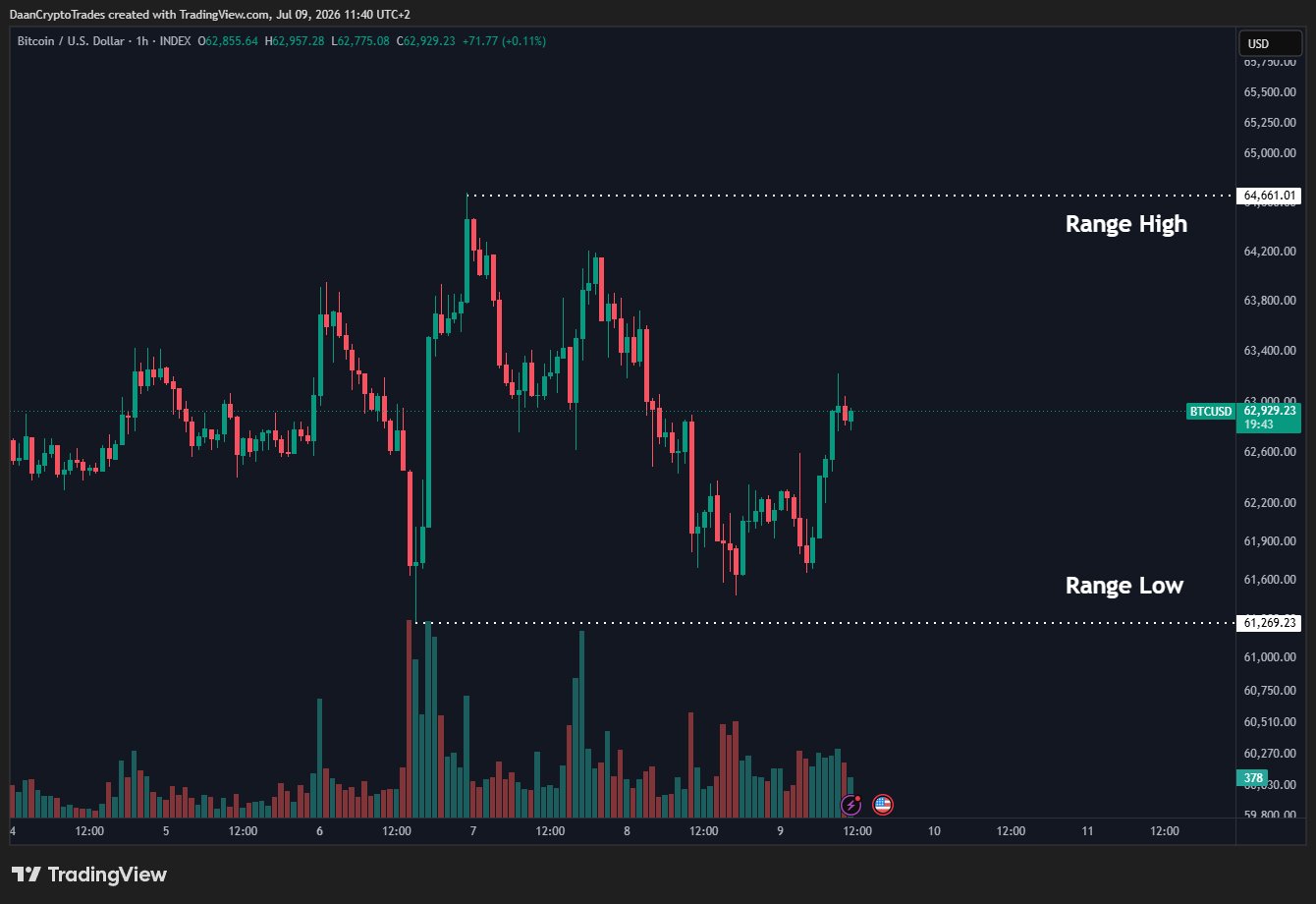
Continuing, trader Daan Crypto Trades emphasized $64,700 for the daily close.
Related: Bitcoin ETFs end ‘most overwhelming’ $2.7B sell-off amid new $85M net outflow
“$BTC is ranging $61.3K-$64.7K range and spent this morning climbing back up after yesterday’s risk-off flush,” his latest X analysis read.
“A daily close above $64.7K flips the story and would make for a larger relief rally across the board. A close under $61.3K opens the road to the lows again and kills the momentum.”
For Ethereum Institutional’s founders, becoming an independent nonprofit rather than remaining within the foundation was a deliberate choice.
“The EF has always been quite vocal about its principle of subtraction,” Dawson said, referring to the organization diving up responsibilities for the network to other organizations . “This is an example of that increasing decentralization, and the number of nodes participating in representing Ethereum.”
Operating outside the foundation also gives the organization greater freedom, Walsh said.
“We feel like we have a lot more autonomy and freedom to work as an independent entity,” he said. “We can get a bit more opinionated, and a bit more aggressive, in terms of being able to support these teams.”
For years, the Ethereum Foundation has walked a careful line in how much influence it exerts over the ecosystem. Its mandate has largely been to coordinate protocol development and steward Ethereum’s technical roadmap, rather than act as a central authority driving business development or adoption. But as the network grew, some in the community pushed for the foundation to take on a more active role in areas like institutional outreach and ecosystem coordination, responsibilities it has increasingly chosen to decentralize instead.
Ethereum Institutional joins a growing network of organizations taking on specialized roles within Ethereum. Last month, EthLabs launched to support ecosystem development, while firms such as Etherealize, launched in 2025, have focused on bringing institutions onchain through commercial products and services.
Average requests rose to 10.3% of shares from 9.7% in Q1, but ranged widely (1.3%–38.1% at Blue Owl’s OTIC), Fitch said. Many requests were follow-ups from investors who were only partly satisfied last quarter. New inflows fell by about 56% on average, so most funds saw net outflows of roughly 3% of the prior quarter’s net asset value.
What’s concerning, for private credit, is that Fitch expects continued redemptions in the months ahead.
“With BDCs capping redemptions at 5% quarterly, unfulfilled requests will lead to persistent elevated redemptions for many firms in the coming quarters,” ratings agency Fitch warned,” the ratings agency said.
Same story, different structures
Bitcoin ETFs are liquid, exchange-traded vehicles, where outflows directly impact the spot price of BTC. Private credit BDCs are the opposite: illiquid, long-duration lending vehicles with built-in quarterly gates.
Still, the fact that investors rushed for exit in both at the same time does point to broader caution around liquidity and risk appetite.
Amid all this, energy markets continue to send risk-off signals, with the U.S. Strategic Petroleum Reserve at its lowest level since 1983. So, if the energy market remains disrupted, the government now has significantly less buffer to flood the market with oil and keep prices lower.
SBI Holdings was the sole investor in the round, which Gauntlet says will fund expansion into stablecoins, tokenization and traditional capital markets infrastructure.
Gauntlet, a DeFi risk management and vault curation firm with $1.42 billion in assets under advisement, closed a $125 million Series C funding round with SBI Holdings, the Japanese financial conglomerate, as the sole investor, Gauntlet said on X Thursday.
The firm, founded by chief executive Tarun Chitra, said the capital will fund “building our infrastructure across traditional capital markets, expanding stablecoin coverage, and accelerating new onchain offerings.” Gauntlet said it aims to provide “quantitative guardrails” as institutions move capital onchain.
Gauntlet was last valued at $1 billion in 2022, when it raised roughly $24 million in a Series B round. Gauntlet did not disclose a post-money valuation for the Series C. The firm currently curates $1.42 billion across chains including Base, BNB Chain and Ethereum, according to DefiLlama.
Chitra said he expects tokenization and vault products to grow DeFi’s market faster than overall stablecoin growth over the next few years. SBI Holdings, a Tokyo-based financial services group with existing crypto and banking ventures, is backing the round as part of a broader push to link traditional finance with digital-asset infrastructure.
Notes from the Ethereum Foundation’s Protocol Security team on running coordinated AI agents against real protocol code, including how we organize the work, what holds up under scrutiny, and what client teams and security researchers can take from it. This post stands on its own; later posts will go deeper on individual clients.
What we’ve been running, and what surprised us
On the Ethereum Foundation’s Protocol Security team, we’ve been running coordinated AI agents against the kinds of systems the network depends on, like systems software, cryptographic code, and contracts that have to be right. The agents found real bugs. One is now public: a remotely-triggerable panic in libp2p’s gossipsub, a core part of the peer-to-peer layer Ethereum consensus clients run on, fixed and disclosed as CVE-2026-34219 with credit to the team.
Agents finding bugs wasn’t the surprise. The surprise was how little of the work went into finding them, and how much went into telling the real bugs from the ones that just looked real.
This post is for client teams and security researchers who want to do the same thing. It covers how we organize the agents, the bar a candidate has to clear before it counts as a finding, and the habits that keep the results trustworthy.
Teams elsewhere are converging on the same recipe. Anthropic’s Frontier Red Team built an agent that writes property-based tests and found real bugs across the Python ecosystem. Cloudflare ran a frontier model through a security-research harness against their own systems. Everyone lands on the same loop: point a capable model at a codebase, let it search, and triage what comes back. So the real question is how to do this without drowning in confident-sounding noise.
One caveat up front: tooling for agent-driven audits moves fast, and any specific setup is out of date in a few weeks. So this post is deliberately about the methods, which are persistent, rather than the tooling. Disclosure is its own topic and will probably be its own post.
An agent pointed at a codebase is a search tool, a lot like a fuzzer. The difference is what comes back. A fuzzer hands you a crash and a stack trace. An agent hands you a lot more, including a write-up (call chain, impact claim, suggested severity) and the artifacts to back it, like a proof-of-concept you can run against the real code.
All of that makes the result easy to read and easy to trust, the running proof-of-concept most of all. So don’t count how many candidates an agent produces. Count how many turn out to be real.
How the work is organized
We run many agents in parallel against one target. They coordinate through the repository itself, with shared state in version control and no central process handing out work. An agent writes down a claim where the others can see it, does the work, and commits.
We got this approach from Anthropic’s writeup on building a C compiler with a fleet of agents, which coordinates the same way. There’s no central coordinator to build or maintain, and less that can go wrong.
The roles are generated by the work that’s discovered:
Recon turns an attack surface into concrete, testable hypotheses. Not “audit the decoder” but “this field is trusted past this point; here’s the property it should keep, the way it might break, and the proof that would settle it.”
Hunting takes one hypothesis, traces the code path, and tries to build a reproducer.
Gap-filling looks at what was accepted and what was rejected, writes the next batch of hypotheses, and tracks coverage so the agents don’t keep going over the same ground.
Validation re-checks each candidate independently, removes duplicates, and decides.
We didn’t invent this pipeline. Cloudflare describes the same stages, recon, parallel hunting, independent validation, deduplication, reporting, and their writeup helped shape ours.
Here’s what a candidate looks like before it counts as a finding:
target: component and entry point an attacker can actually reach
invariant: the property that must hold
mechanism: the specific way it might be made to breaksuccess: observable proof: a panic, a stall, an accepted-invalid input
reproducer: a self-contained artifact that runs against the real code
dedup: a key, so two agents don't chase the same thing
The schema is there for a reason. It forces a specific, testable claim and a clear definition of done. An agent that has to write down an observable proof can’t fall back on “this looks risky.”
Reproducible or it didn’t happen
One rule matters more than any other. A candidate isn’t a finding until there’s a self-contained artifact that reproduces the failure against the real code, and that runs for someone who didn’t write it.
The reproducer doesn’t read the write-up, and it doesn’t care how confident the model sounded. It either runs or it doesn’t.
Most of its value is in the false positives it catches. Three of them come up over and over, and each one is the agent getting a pass for the wrong reason:
A panic that only happens in a debug build. Compile and run it the way the software actually ships, and the value just wraps around. Nothing crashes. It looks like a crash, but it isn’t one.
A reproducer that builds some internal value by hand, one no real input could ever produce, because every path an attacker controls rejects it earlier. The bug only “reproduces” against a function that nothing reachable calls that way.
In formal-verification work, a proof that goes through but doesn’t mean what you wanted. The statement is trivially true regardless of what the code does, or it’s weaker than the property you meant to capture. The verifier is satisfied, but the theorem doesn’t constrain the behavior you actually cared about.
None of this is new. It’s the same thing as a test that passes because it doesn’t actually check anything. What’s new is the volume. An agent writes the useless version as fast as the real one, and just as confidently. So the check has to be automatic. You can’t count on the agent to catch itself.
Signal-to-noise is most of the work
Most candidates are wrong, duplicate, or out of scope. That’s not a problem with the method; that’s how it works. The goal is to reject the wrong ones fast and back the real ones with proof that’s hard to argue with.
Every candidate that survives gets two independent checks. Can a real attacker actually reach it in a normal configuration? And what does it cost the attacker to pull off, compared to what it costs the network if it works? A bug that any single peer can trigger is very different from one that needs special access or a huge amount of resources.
Everything gets checked against a running list of what’s already known, fixed, or rejected. Without that, the agents keep rediscovering the same closed issue and reporting it again and again.
Acceptance rates vary a lot from target to target, and that variation is useful on its own. Run this against mature, heavily audited code and almost nothing survives, which is still worth knowing. “We looked hard and found nothing” is a real result. Run it against less-explored code, or against formally verified code, where a machine-checked proof covers a model and the deployed bytecode is only assumed to match it, and more gets through.
We’re not the only ones who found that the triage is the hard part. Cloudflare’s main takeaway was that a narrow scope beats broad scanning. Anthropic’s property-based-testing agent generated something like a thousand candidate reports, then used ranking and expert review to get down to a top tier that held up about 86 percent of the time. The generation was the easy part. I’m not going to publish our own numbers here; tied to a specific target, they’d say more about the target than about the method.
What the agents are good at, and where they mislead
There’s hype in both directions, so here’s a plain list of what the agents do well and where they mislead.
Good at
Misleading at
Reading the spec and the code together
Call chains that look reachable but aren’t
Stating and checking a real invariant
Gaming the success check (a pass for the wrong reason).
Drafting a reproducer from a one-line idea
Inflating severity to match how dramatic the write-up sounds
Suggesting a root cause before you’ve looked
Bugs that span a sequence of valid steps
The split isn’t even steady from one task to the next. Stanislav Fort, testing a range of models on real vulnerabilities, calls this a jagged frontier, or a model that recovers a full exploit chain on one codebase can fail basic data-flow tracing on another. You can’t assume one good result means the next will hold up, which is another reason every candidate gets checked on its own.
The last row is the important one. A single agent session is good at one-shot reasoning and bad at bugs that span a sequence of steps, where each step is valid and only the order is wrong. For those, the agent isn’t the search tool. Its job is to suggest which sequences are worth running through a stateful test harness. Used that way, it works well. Used as a replacement for the harness, it misses the most expensive bugs there are, the ones that only show up across a sequence.
Keeping it honest
A few habits do most of the work of making agent findings trustworthy, and none of them are complicated.
Provenance on every artifact: what produced it, with what context, against which revision. A finding should be something you can re-run months later.
Determinism where it counts: one environment, one way to build and run, so “reproduces” means the same thing on every machine, not just the one where it was found.
Norms, not scripts: tell agents what matters, the invariants and the bar for a real finding, instead of a numbered procedure. Over-scripted agents break the same way over-specified tests do, they keep following the steps after the steps stop making sense. A study of repository context files found the same thing: the extra requirements lowered task success and raised cost by over 20%, and the authors recommend keeping context to the minimal requirements.
A person makes the final call: agents suggest. They don’t decide what’s real, what’s a duplicate of a known issue, or what gets disclosed and when.
The bottleneck moved
AI didn’t replace the security researcher. It moved the work. The time that used to go into coming up with and chasing down hypotheses now goes into judging them at scale, including building the oracle, running the triage, keeping the list of known issues, and handling disclosure.
The bottleneck didn’t go away. It moved from finding bugs to trusting the results, which is a better place for it, because that’s where human judgment actually matters. But it’s still a bottleneck, and ignoring that is how you end up shipping a wrong “it’s fine.”
The practices that make this work aren’t new. Reproducible failures, real oracles, and careful triage are the same practices that turned fuzzing from a research topic into standard practice over the last fifteen years. The tools are new. The practices aren’t.
How fast the tools keep changing is an open question. Nicholas Carlini, careful and once a skeptic himself, argues the exponential case is worth taking seriously, even while he keeps wide error bars on it. If the generation side climbs that fast, the judgment side has to climb with it, or the gap between what gets produced and what actually gets verified only widens.
For the systems Ethereum depends on, that’s the part that matters. Agents let us cover far more ground than we could by hand. In exchange, they ask for more careful judgment, across a much bigger pile of confident-sounding claims. That’s a trade worth making, as long as you remember that the judgment is the real product.
Bitcoin (BTC) reclaimed the $63,000 mark on Thursday, but traders fear a correction ahead of Friday’s $1.4 billion options expiry on Deribit. The concerns stem from the US government bond yield climbing toward a level that many view as a warning sign. Is the $62,000 support level at risk?
Key takeaways:
Rising US Treasury yields signal debt concerns, negatively pressuring risk assets.
Balanced Bitcoin options put-to-call volumes suggest limited downside from the $62,000 level.
US 10-year Treasury yield (left) vs. Bitcoin/USD (right). Source: TradingView
Bitcoin ETF outflows are not a concern ahead of the Bitcoin options expiry
The 10-year Treasury yield’s approach to 4.6% signals investor anxiety over the expansion of US government debt and prospects for further monetary policy expansion to avert an economic recession. Bitcoin has felt the impact, trading sideways while the Nasdaq-100 Index sits merely 4% below its all-time high.
The AI sector’s bullish momentum keeps pulling capital toward equities. Asian chipmaker SK Hynix oversubscribed IPO in the US helped push the sector higher on Thursday, led by Arm Holdings (ARM) 10% gains, Advanced Micro Devices (AMD) 7% rally and Micron’s 7% intraday gains.
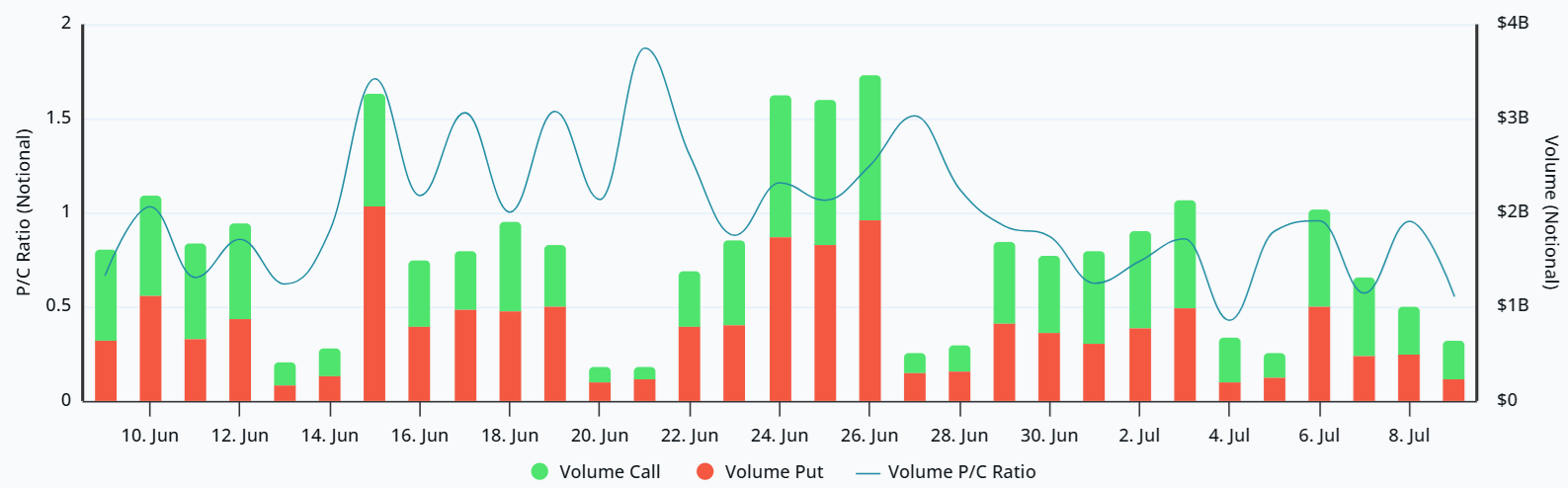
Wednesday brought $85 million in net outflows from spot Bitcoin ETFs, ending a short three-day inflow run. Still, the figure does not confirm a reversal in institutional flows. More importantly, demand for Bitcoin options has stayed balanced between calls (buy) and puts (sell).
Bitcoin options put-to-call volumes ratio at Deribit. Source: Laevitas
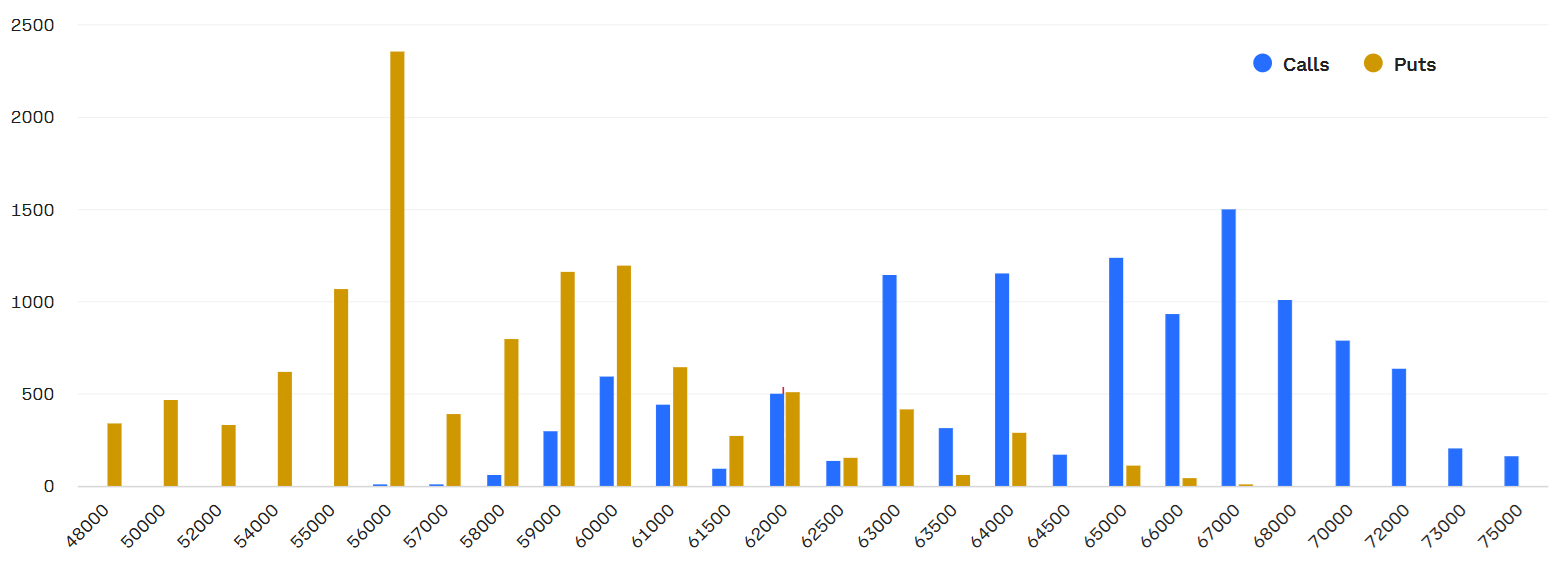
Call options volume has outpaced put instruments over the past four days, reflecting reduced demand for downside movements. However, the upcoming weekly options expiry features an interesting setup as calls up to $62,500 total $137 million, while puts above $61,000 are at $121 million.
Deribit BTC options open interest for July 10, BTC. Source: Deribit
Bitcoin bulls would gain significant ground with a move above $63,500 by the 8:00 AM UTC expiry on Friday, boosting their advantage to $190 million. Bears hold a smaller $100 million edge below $61,000, limiting their incentive without additional catalysts.
Oil price decline could strengthen the demand for risk-on assets
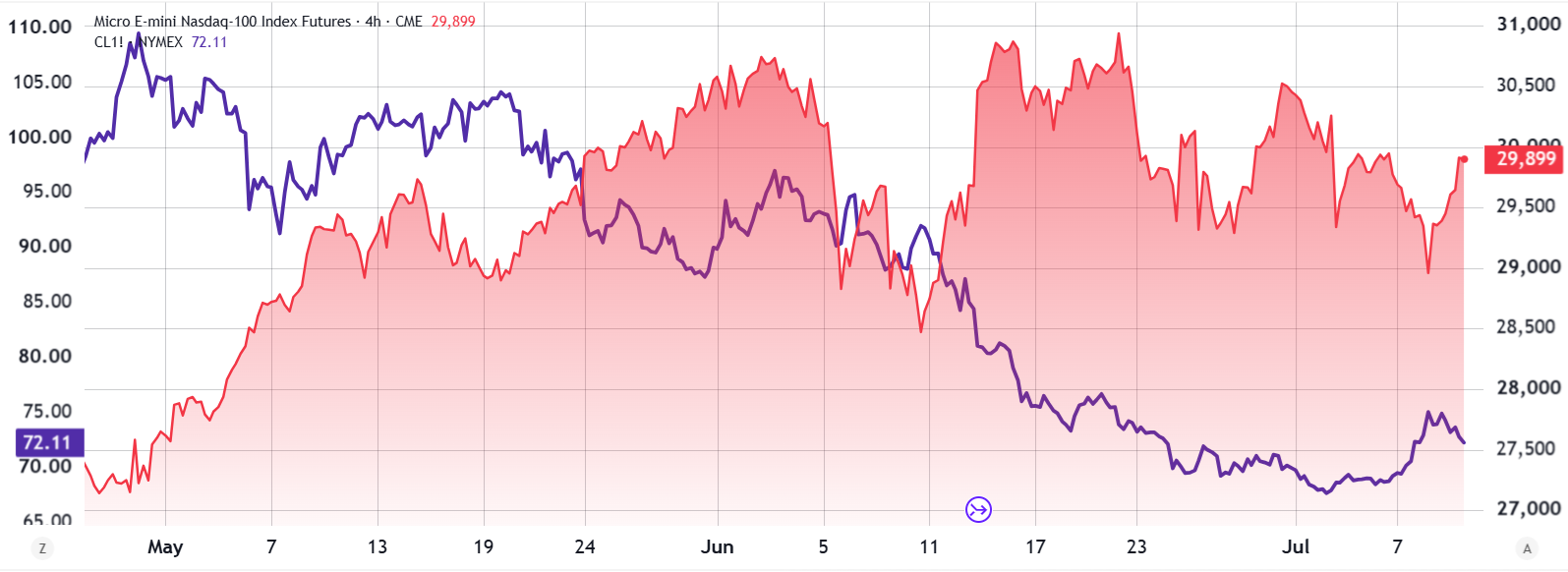
A temporary truce in the Middle East could ease recession fears and shift money from fixed income into risk markets, likely pushing Bitcoin price higher. In contrast, continued strength in the AI sector drains capital from other investments while traders fear large Treasury issuance to cover growing debt.
Related: Bitcoin peels back to $62K as Fed-wary futures traders cut risk: Is the BTC rally over?
Crude WTI oil futures (left) vs. Nasdaq 100 Index futures (right). Source: TradingView
Traders should closely monitor whether Treasury yields will subside over the next week and if an aggravated war in Iran pushes oil prices higher. But with Bitcoin put options buying remaining restrained in recent sessions, the market appears positioned to strengthen the $62,000 support level.
Bitcoin sits in a delicate spot where a successful expiry resolution above $63,500 could provide short-term relief, but sustained upward momentum would require a boost from the macro side. As long as these dynamics persist, the odds favor limited bullish momentum for Bitcoin in the near term.
Members of the UK’s ruling Labour party are considering a total ban on digital asset donations in response to Nigel Farage’s resignation from Parliament and the potential influence crypto billionaires had on his policies.
The Guardian reported Thursday that Labour MPs are looking to overhaul existing rules on donations to political parties and candidates. Specifically, lawmakers have proposed that a moratorium on crypto donations enacted in March be made permanent after it was revealed that the Reform leader personally accepted millions of British pounds in what he called “gifts” from industry figures.
“Amendments to the representation of the people bill which my colleagues and I have tabled are vital safeguards against the wider threat that’s seen [$268 million] come flooding in to build a whole media political complex behind populists in Britain,” said Liam Byrne, MP for Birmingham Hodge Hill and Solihull North and the Labour chair of the business select committee calling for a permanent crypto donation ban. “We simply cannot afford to let our crumbling defenses be undermined any further.”
Source: Liam Byrne
UK lawmakers will reportedly consider amendments to the crypto donation measures next week. Farage announced on Tuesday that he would resign as MP for Clacton in response to reports of the contributions, which included a $6.7 million “gift” from crypto billionaire Christopher Harborne and staff, security, transport and accommodation by George Cottrell, a convicted fraudster involved in a crypto casino.
Farage confirmed in his resignation speech that the UK’s parliamentary standards commissioner was investigating the donations, but said that he did “nothing wrong.”
Related: Bank of England governor denies Farage lobbying swayed CBDC policy: Report
The Reform UK leader’s resignation has automatically triggered a by-election in the area, where he said “the people of Clacton should be the judges of my actions.” However, the major political parties, including Labour, Conservatives, Liberal Democrats and Greens will reportedly not field candidates for the by-election, with UK Prime Minister Keir Starmer calling Farage’s resignation a “desperate stunt.”
Former Manchester mayor on track to be next UK PM
Andy Burnham, a UK Labour lawmaker who recently won a by-election to become an MP representing Makerfield, is expected to be the country’s next prime minister following Starmer’s resignation. On Thursday, the week-long window opened for Labour MPs to nominate candidates for the party’s next leader, who would also become prime minister.
As mayor of Greater Manchester, Burnham advocated for the city to be a “Web3 powerhouse” and supported using digital technology as an economic development tool. If he receives enough support from Labour MPs to win a leadership bid, he could address the crypto donation ban and the Financial Conduct Authority’s oversight of the industry.
Magazine: Crypto industry looks to stablecoins and DeFi revisions in MiCA 2.0