

Crypto exchange-traded funds (ETFs) lost momentum as bitcoin and ether reversed into heavy outflows. XRP funds were flat, while solana ETFs managed a modest inflow in an otherwise cautious session. Crypto ETFs Turn Red as Bitcoin, Ether Slide Back to Outflows Momentum in crypto exchange-traded funds (ETFs) proved short-lived as midweek trading brought a decisive […]
Defunct P2P Crypto Platform Paxful Sentenced to $4M Penalty for Money Laundering, Travel Act Violations

Peer‑to‑peer cryptocurrency trading platform Paxful was sentenced to pay a $4 million criminal penalty after pleading guilty to conspiring in schemes that promoted illegal prostitution and violated the Bank Secrecy Act. Prioritizing Profit Over Compliance Paxful Holdings, a peer-to-peer cryptocurrency trading platform, has been sentenced to pay a $4 million criminal penalty after admitting to […]
Why Risk Prevention Is Insurance’s Future

In this conversation, Anders Sørbo of If Insurance outlines how the insurer is moving beyond traditional coverage models and toward a more proactive, prevention-led approach — powered by increasingly mature technology.
Sørbo, who leads partnerships in the non-mobility area and explores new business opportunities across the Nordics, explains that the shift has been gradual but deliberate. For several years, If has been experimenting with connected technologies and digital solutions designed not just to process claims, but to prevent them from happening in the first place. The difference today, he argues, is maturity. The technology is no longer experimental. It is becoming robust enough to scale for large incumbents.
While it may be too early to claim full-scale transformation, Sørbo notes that early adopters are already showing promising results. Positive effects are visible across customer engagement, retention, and risk reduction. Importantly, customers themselves are driving expectations higher. Policyholders no longer judge insurers solely on smooth claims handling or competitive pricing. Increasingly, they expect help in reducing risk, minimising damage, and lowering their environmental footprint.
Property claims — particularly water-related damage — remain a growing concern across markets. By deploying preventive technologies, insurers can detect issues earlier, reduce losses, and ultimately provide more tangible value to customers. In this sense, prevention becomes a competitive advantage, not just a cost-saving measure.
If is currently scaling its initiatives in Norway and exploring expansion across additional Nordic markets. However, Sørbo acknowledges that market conditions vary significantly. Compared to the Nordics, the UK market presents more aggressive price competition and thinner margins, making experimentation and large-scale rollouts more challenging. Distribution structures also differ, with the Nordics operating through more consolidated, direct-to-consumer models.
Despite these differences, Sørbo believes the underlying logic holds everywhere: giving more back to customers through proactive support is universally valuable. Although AI dominates much of today’s industry conversation, he maintains that IoT and preventive technologies are now sufficiently mature to justify broader experimentation — even in highly competitive markets like the UK.
The broader implication is clear. Insurance is gradually shifting from a reactive industry that compensates for loss, to a proactive partner that helps customers avoid loss altogether. Technology is no longer simply a tool for efficiency; it is becoming a means of redefining the relationship between insurer and insured.
Bitcoin Exchanges Point To “Early Signs” Of Recovery Amid Sentiment Crash

Bitcoin (BTC) market sentiment has begun to recover as exchange traders reconsider selling.
Key points:
-
Bitcoin taker flow finally sees positive values after a month of seller dominance.
-
“Aggressive” sell pressure is fading at current price levels, analysis says.
-
The Crypto Fear & Greed Index hits record lows despite BTC price stabilization.
Bitcoin exchanges eye “early signs of stabilization”
New findings from onchain analytics platform CryptoQuant released on Thursday show net taker flow flipping positive for the first time in a month.
“Bitcoin market sentiment is showing early signs of stabilization, and Binance’s 7-day Net Taker Flow reflects that shift when viewed in proper macro context,” contributor Crazzyblockk summarized in one of its “Quicktake” blog posts.
The metric, expressed as the difference between market buy and market sell orders, has been deep in negative territory since mid-January.
“After reaching nearly -$4.9B in cumulative net selling in early February, Binance’s 7-day taker flow has steadily recovered and flipped positive to around +$0.32B,” Crazzyblockk continued.
“The sentiment ratio has moved from roughly -3% back into positive territory, signaling a clear decline in sell-side aggression.”
The post added that the phenomenon was visible across major exchanges, with Binance nonetheless showing a “stronger shift in net buying pressure than peers.”
The change comes as BTC price action attempts to stabilize around 20% above recent 15-month lows near $59,000.
As Cointelegraph reported, however, market participants see a risk of stagnation below $69,000 — a key resistance level ever since the top of the 2021 Bitcoin bull market.
Crypto sees more “extreme greed” than ever
The split between exchanges, meanwhile, continues to be visible via the Coinbase Premium Index.
Related: BTC traders wait for $50K bottom: Five things to know in Bitcoin this week
This indicator measures the difference in price between Coinbase’s BTC/USD and Binance’s BTC/USDT pairs, and has also been almost entirely “red” since the middle of last month.

A negative Premium implies lower US spot demand compared to Asia, and the latest CryptoQuant data confirms that the status quo remains despite the modest BTC price bounce.
Commenting, trading company QCP Capital described the Premium reduction, implying a “moderation in U.S.-led spot selling pressure.”
QCP tempered enthusiasm as it referenced “extreme fear” signals from crypto market sentiment gauge, the Crypto Fear & Greed Index.
“That said, sentiment remains fragile, with the Crypto Fear & Greed Index still deep in extreme fear territory at 9, which is less ‘all clear’ and more ‘thin ice that happens to be holding,’ it wrote in its latest “Asia Color” market update on Wednesday.
The Index has since dropped to just 5/100, a score which ranks among its lowest ever recorded.
🚨 TODAY: Crypto Fear & Greed Index plunges to 5 Extreme Fear, the lowest level on record. pic.twitter.com/30srOiR5Ak
— Cointelegraph (@Cointelegraph) February 12, 2026
This article does not contain investment advice or recommendations. Every investment and trading move involves risk, and readers should conduct their own research when making a decision. While we strive to provide accurate and timely information, Cointelegraph does not guarantee the accuracy, completeness, or reliability of any information in this article. This article may contain forward-looking statements that are subject to risks and uncertainties. Cointelegraph will not be liable for any loss or damage arising from your reliance on this information.
Will Ex-Ripple CTO Schwartz Develop Bitcoin Again? His Answer Turns Heads

Trusted Editorial content, reviewed by leading industry experts and seasoned editors. Ad Disclosure
David Schwartz, Ripple’s former CTO and one of the original architects of the XRP Ledger, poured cold water on the idea of returning to Bitcoin development this week, calling Bitcoin “largely a technological dead end” in a reply that quickly ricocheted through crypto’s never-ending decentralization debates.
The exchange started as a fight over history and governance. On Feb. 9, X user Bram Kanstein argued that XRP’s early “genesis reset” — often described as treating the 32,750th XRP block as a kind of starting point — illustrates crypto’s centralized tendencies. Kanstein wrote that the milestone “may be thought of as the genesis,” before adding: “Except it is not. The XRP Genesis reset is a prime example of the centralized nature of ‘CrYpTO’.”
Ex-Ripple CTO Schwartz Calls Bitcoin A ‘Tech Dead End’
Schwartz jumped in with a comparison that redirected the argument toward Bitcoin. “Bitcoin had at least two incidents that showed way more centralization than this incident did,” he wrote, “especially since the decision in this incident was not to make any coordinated changes and just live with it.”
That claim drew a follow-up from X user, who floated SegWit as a candidate for what Schwartz meant, an example of coordinated protocol change. The ex-Ripple CTO pushed back on that framing: “I wasn’t because I don’t really think of adding new features as showing centralization,” he replied. “But I think you could make a good argument that it does. The biggest one I was thinking of was the coordinated 2010 rollback.”
The thread’s tone shifted on Feb. 10 when X user Khaled Elawadi asked the question that put Schwartz’s own priorities in the spotlight: since co-creating the XRPL, had he worked on or even considered developing Bitcoin again?
“Not really,” Schwartz answered. Then he went further, sketching an argument that Bitcoin’s dominance owes less to the evolution of its base-layer tech than to social and monetary inertia. “I think bitcoin is largely a technological dead end for the same reason the dollar is,” he wrote. “The technology just doesn’t seem to matter all that much to its success, at least not at the blockchain layer.”
For XRP supporters, Schwartz’s comments served two purposes at once: a defense against charges that XRPL’s early history implies unique centralization, and a reminder that Bitcoin’s “hands-off” mythology also has had real-world exceptions in its early days.
What’s hard to miss is where the ex-Ripple CTO draws the line. Bitcoin’s success can persist even if base-layer technical progress slows, because the network’s strength increasingly behaves like a monetary standard rather than an engineering project. Schwartz is pursuing a different strategy for the XRP Ledger. After stepping down as Ripple CTO, he announced that he would pursue his own projects on the XRP Ledger.
At press time, XRP traded at $1.38.
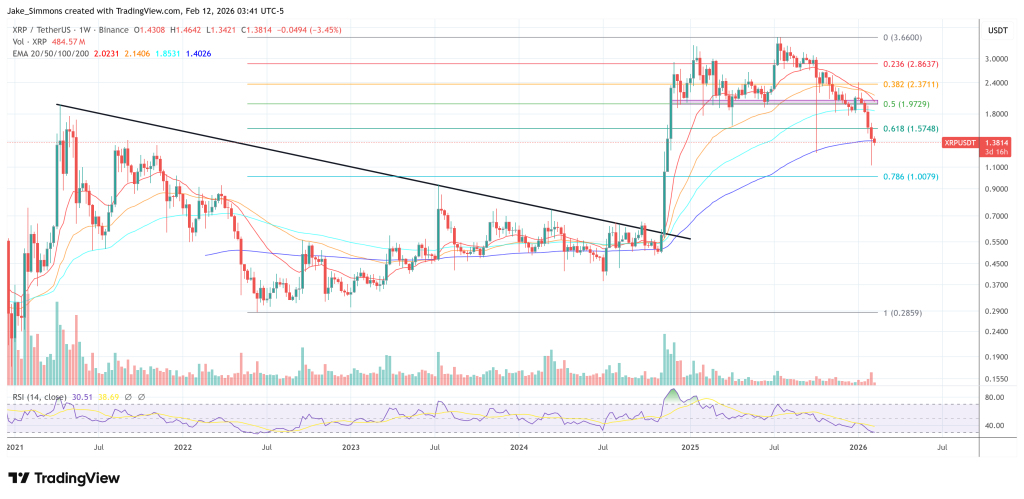
Featured image created with DALL.E, chart form TradingView.com

Editorial Process for bitcoinist is centered on delivering thoroughly researched, accurate, and unbiased content. We uphold strict sourcing standards, and each page undergoes diligent review by our team of top technology experts and seasoned editors. This process ensures the integrity, relevance, and value of our content for our readers.
Bitcoin Will Fall to $50K and Ethereum Will Hit $1,400 Before Rebound: Standard Chartered

In brief
Daily Debrief Newsletter
Start every day with the top news stories right now, plus original features, a podcast, videos and more.
Standard Chartered sees bitcoin (BTC) sliding to $50,000, ether (ETH) to $1,400 before recovery

Investment bank Standard Chartered lowered its short-term and full-year price forecasts for major cryptocurrencies, citing continued downside risk as exchange-traded fund (ETF) outflows and a challenging macro backdrop pressure the market.
The bank now expects bitcoin to fall to around $50,000 in the coming months, with ether potentially bottoming near $1,400.
The world’s largest cryptocurrency was trading around $67,900 at publication time. Ether, the second-largest, was trading around $1,980.
Geoff Kendrick, Standard Chartered’s head of digital assets research, said the selloff in recent weeks could extend as ETF investors, many sitting on losses, are more likely to reduce exposure than “buy the dip.”
Once prices establish a bottom, Kendrick said, he expects a recovery through the rest of 2026. The analyst reduced his year-end target for bitcoin to $100,000 from $150,000, ether to $4,000 from $7,500, solana to $135 from $250, BNB Chain to $1,050 from $1,755 and to $18 from $100.
The crypto market has weakened sharply in early 2026, with major assets like bitcoin sliding significantly from late-2025 highs and the total market cap down sharply over recent weeks. Bitcoin has dropped almost 23% since the start of the year.
The downturn has been marked by heightened volatility, large liquidations of leveraged positions and broad risk-off sentiment, which has seen crypto correlate more closely with weakening equity markets.
Macro pressures such as concerns about global growth and interest-rate outlooks have pushed investors toward traditional havens like gold, while stalled regulatory clarity, particularly in the U.S., and liquidity strains at some institutions have weighed on confidence. Combined, these forces have led to reduced trading revenues for crypto-exposed firms and bearish sentiment across many tokens.
Holdings of bitcoin ETFs have declined by nearly 100,000 BTC from their October 2025 peak, according to Kendrick. The average ETF purchase price is around $90,000, leaving many investors with unrealized losses of roughly 25%.
Macro conditions are also weighing on sentiment. Kendrick noted that while U.S. economic data show signs of softening, markets expect no interest-rate cuts before Kevin Warsh’s first Federal Open Market Committee meeting as Federal Reserve chair in mid-June, limiting near-term support for risk assets.
Despite the expected capitulation, the bank said the current drawdown is less severe than previous cycles. At its worst point in early February, bitcoin was down about 50% from its October 2025 all-time high, and roughly half of supply remained in profit, declines that are sharp but not as extreme as in prior downturns.
Crucially, this cycle has not seen the collapse of major crypto platforms, unlike 2022’s failures of Terra/Luna and FTX. Kendrick said that suggests the asset class is maturing and more resilient.
The analyst left his longer-term projections unchanged, maintaining end-2030 targets of $500,000 for bitcoin and $40,000 for ether, arguing that usage trends and structural drivers remain intact.
The analyst previously reduced his bullish bitcoin forecasts in December.
Read more: Standard Chartered Throws in the Towel on Bullish Bitcoin Forecast
Bull360 Strengthens Its Position With Consistently High Trader Ratings

In a market crowded with platforms competing on leverage, bonuses, and surface-level features, long-term relevance usually comes down to one thing: performance under real conditions. Bull360 has recently begun receiving consistently strong reviews, particularly from traders active across stocks, commodities, and cryptocurrency CFDs.
Rather than relying on promotional claims, the platform’s growing reputation appears tied to practical execution, capital efficiency, and structural stability.
A Multi-Asset Environment That Reflects Modern Trading Behavior
Today’s active traders rarely limit themselves to a single asset class. Equity exposure is often paired with commodities, while crypto positions are balanced against broader market sentiment. Bull360’s unified CFD structure supports this behavior naturally.
The ability to operate across global stocks, indices, commodities, and digital assets within one account has been a recurring highlight in user feedback.
Multi-Asset Capability Rating: 9.3 / 10
Execution That Matches Active Trading Demands
When trading activity increases, execution quality becomes the defining factor. Reviews frequently point to Bull360’s stable infrastructure and responsive order handling, particularly during volatile sessions.
For traders operating during earnings cycles, macro releases, or crypto-driven spikes, reliability matters more than additional features.
Execution Quality Rating: 9.4 / 10
Cost Transparency at Scale
Spread-based pricing remains straightforward, with no complex commission layering. High-frequency and higher-volume traders often emphasize predictability over headline discounts, and Bull360’s cost structure appears aligned with that expectation.
Financing costs for leveraged positions are clearly outlined, reinforcing overall transparency.
Cost Structure Rating: 9.1 / 10
Scalability and Account Structure
A notable aspect of Bull360’s evolution is its ability to accommodate growth. As traders increase capital or activity, the platform’s tiered account model allows for progression without operational disruption.
This continuity is particularly important for traders who prefer to refine strategies rather than migrate platforms.
Scalability Rating: 9.0 / 10
Overall Standing
Bull360’s recent positive reviews reflect a platform that appears to prioritize execution quality, structural margin discipline, and multi-asset flexibility. Rather than competing through noise, it is gaining recognition through consistent performance metrics.
As trading activity continues to intensify globally, platforms capable of supporting both diversification and disciplined leverage use are likely to maintain relevance. Bull360’s ratings suggest it is currently positioned within that category.
Overall Composite Rating: 9.2 / 10
Crypto industry experts at Consensus see Asian institutions pivot toward stablecoins

Hong Kong — Institutional crypto participation across Asia is moving into a more mature phase as regulators establish clear frameworks for stablecoins and exchange-traded funds. Large players now favor market-neutral strategies and regulated vehicles over direct, directional exposure to digital assets.
Vicky Wang, president of Amber Premium, highlighted this shift during a panel discussion at Consensus Hong Kong. She noted that while transaction volumes reached $2.3 trillion by mid-2025, capital allocation remains cautious. “The institutional participation in Asia, I would say it’s real, but at the same time it’s very cautious,” Wang said. She observed that institutions prefer “market neutral and yield strategy” over aggressive directional bets.
Fakhul Miah, managing director of GoMining Institutional, pointed to the recent approval of ETFs and perpetuals in Hong Kong as a major driver for liquidity. He noted that even traditional “mega banks” in Japan are now working on stablecoin solutions. These developments allow traditional capital to enter the space through familiar structures. Miah explained that institutions must pass through “risk committees and operational governance structures,” which historically did not exist for onchain products.
The focus for many Asian institutions has shifted toward real-world asset tokenization and stablecoin settlement. Wendy Sun, chief brand officer at Matrixport, noted that while these topics are popular, there remains a gap in internal treasury adoption. “For the internal treasury-based stablecoin, we are still waiting for the standard to come out,” Sun said. She argued that the behavior of these institutions is becoming more “rule-based and scheduled” rather than pursuing short-term gains.
Wang concluded that the industry’s future rests on the convergence of artificial intelligence and digital assets. “In the future, digital assets would not be a just alternative asset class or an alternative financial system,” Wang said. “It will be the financial layer of the AI.”
Is This Crypto Winter Different? Key Observers Reevaluate Bitcoin

Bitcoin market observers believe that the recent price slump may actually reflect the asset’s wider adoption by institutions, which still don’t see it as a risk-off asset.
It’s been rough out there for crypto in recent months. Since October, when Bitcoin’s price reached a high of over $120,000, BTC has been gradually sliding. In recent weeks, it dropped sharply, down over 25% on the month.
Amid the sell-off, market observers have been looking for explanations. Bitwise chief investment officer Matt Hougan attributed the fall to the notorious four-year cycles that have previously defined crypto market price swings.
Others, including one US Federal Reserve governor, claim that the recent price movements show that institutions are risk-averse and that Bitcoin itself hasn’t reached the status of digital gold — yet.
Bitcoin still seen as risky, “not digital gold”
Institutional interest in Bitcoin and crypto could be one reason for the recent sell-off. While major financial institutions have lots of money to pour into the crypto market, their appetite for risk is much lower than retail investors, and Bitcoin is still broadly seen as a risky asset.
Chris Waller, a governor of the United States Federal Reserve, spoke to this effect at a recent monetary policy conference on Monday. He said that much of the “euphoria” around crypto that accompanied the new administration of President Donald Trump is now fading.
“I think there was a lot of sell-off just because firms that got into it from mainstream finance had to adjust their risk positions.”
These sentiments were echoed by Galaxy Digital CEO Mike Novogratz on Tuesday, who said in an interview with CNBC that the crypto industry has brought in “institutions where people have a different risk tolerance.”
“Retail people don’t get into crypto because they want to make 11% annualized … They get in because they want to make 30 to one, eight to one, 10 to one.”
Crypto asset manager Grayscale noted in a report that recent Bitcoin price action more closely correlates to software stocks with high enterprise values than to historically stable assets like gold. The investment company stated that short-term price movements have not been tightly correlated with gold or other precious metals.

Bloomberg commodity strategist Mike McGlone, also a noted Bitcoin bear, claimed that Bitcoin is still highly speculative. “[Bitcoin] has proven it’s neither digital gold nor leveraged beta,” he said, adding, “It’s a highly speculative [number]-on-the-screen tracking nothing with unlimited competition.”
Grayscale remained more optimistic about Bitcoin’s long-term prospects. “The network will likely continue operating well beyond our lifetimes and the asset may retain its value in real terms … in a wide range of outcomes for the economy and society,” it said.
The company also highlighted the central role institutions will have in the future success of the asset, which it noted was dependent on regulatory clarity, something the US hasn’t yet achieved.
Lack of progress on CLARITY signals risk
The CLARITY Act, which is currently under debate in the US Senate, would overhaul how crypto is regulated in the country, from the agencies that oversee rules for decentralized finance (DeFi).
The bill has stalled for weeks as crypto bigwigs like Coinbase and the bank lobby are at loggerheads over stablecoin interest: a core aspect of the exchange’s business model that banks feel could threaten financial stability.
Related: US crypto market structure bill in limbo as industry pulls support
Failure for Congress to deliver quickly on a crypto market structure bill has added to this insecurity, according to Waller. “The lack of passing of the CLARITY Act I think has kind of put people off on this,” he said.
Novogratz also emphasized the effect the bill could have on markets. He said that both Democrats and Republicans want to pass the bill and that “we need it for spirit back in the crypto market.”
Grayscale underscored the importance of CLARITY and the GENIUS Act in its report, the latter of which passed in July 2025. It stated that “improving regulatory clarity for the crypto industry is a structural trend much bigger than one piece of legislation.”
More favorable regulations will drive an increase in use cases in “stablecoins, tokenized assets, and other applications of public blockchain technology,” which in turn will “drive value to blockchain networks and their native tokens.”
High-level talks to clear the roadblocks on CLARITY are currently underway. On Tuesday, executives from the crypto and banking industries met at the White House for another closed-door meeting.
Ripple legal chief Stuart Alderoty said, “Compromise is in the air. Clear, bipartisan momentum remains behind sensible crypto market structure legislation.”
Meanwhile, analysts debate just how low the Bitcoin bear market can go. Kaiko Research shared a research note with Cointelegraph, which claimed that the $60,000 mark could be a “halfway point.”
“Analysis of on-chain metrics and comparative performance across tokens reveals a market approaching critical technical support levels that will determine whether the four-year cycle framework remains intact,” Kaiko said.
McGlone said that $60,000 is just a “speedbump on the way back down” to $10,000, citing a number of reasons. These include interest in crypto supposedly shifting from digital assets to stablecoins and the likelihood that “cheer-leader and chief, President Trump, will be a lame duck this time next year.”
A lame-duck president who is also pro-crypto may find it difficult to effect the change they want in Congress. It remains to be seen whether crypto will secure the regulatory clarity it wants for institutions to fully jump in.
Magazine: Is China hoarding gold so yuan becomes global reserve instead of USD?
Cointelegraph Features and Cointelegraph Magazine publish long-form journalism, analysis and narrative reporting produced by Cointelegraph’s in-house editorial team and selected external contributors with subject-matter expertise. All articles are edited and reviewed by Cointelegraph editors in line with our editorial standards. Contributions from external writers are commissioned for their experience, research or perspective and do not reflect the views of Cointelegraph as a company unless explicitly stated. Content published in Features and Magazine does not constitute financial, legal or investment advice. Readers should conduct their own research and consult qualified professionals where appropriate. Cointelegraph maintains full editorial independence. The selection, commissioning and publication of Features and Magazine content are not influenced by advertisers, partners or commercial relationships.