Home Blog Page 1029

Galaxy’s Steve Kurz sees ‘great convergence’ driving crypto’s long-term outlook

0

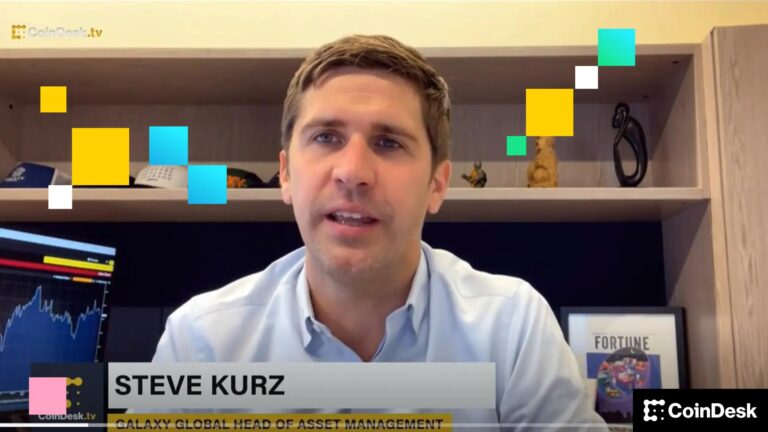
Crypto is no longer just an asset class, it is also an ever-more critical part of financial infrastructure, says Steve Kurz, Galaxy Digital’s (GLXY) global head of asset management and co-head of digital assets

In “The Great Convergence,” the company’s 2026 investment outlook, Kurz sets out a plan that’s pragmatic about what can be done now while staying optimistic about the big picture in the long run.

The defining story of this cycle, he argues, is the asset-to-infrastructure transformation.

“The convergence of traditional financial rails with crypto infrastructure represents a significant and durable market structure evolution for global financial services,” Kurz told CoinDesk in an interview.

Galaxy Digital, a digital asset financial services and investment firm founded in 2018 by Michael Novogratz, functions as a bridge between traditional finance and the expanding cryptocurrency ecosystem. It offers institutional-grade trading, asset management, investment banking, custody, mining and infrastructure services and, increasingly, consumer-facing products.

A market caught in overlapping cycles

Kurz characterizes the current environment as one where “a lot of cycles are sitting on top of each other.”

While crypto token prices have pulled back substantially, he stresses that the levels reached are now below those at which many fundamentally positive developments have occurred. That disconnect makes it “pretty hard not to scratch your head.”

In his view, the dominant force behind recent price weakness has been the liquidity and leverage cycle.

While the October liquidity event and subsequent deleveraging weighed heavily on markets, it differed from 2022, when liquidations exposed structural fragilities in a less developed market architecture.

Today’s pullback is healthier. The ecosystem now includes more sophisticated instruments and better-developed risk-management frameworks. The selloff, he argues, was “a regular wave of deleveraging,” not a systemic breakdown in the back end of the system.

Infrastructure is growing rapidly, and prices usually respond only after tangible increases in activity and adoption, rather than beforehand, he said. When onchain activity and engagement rise again, the story will coalesce around it.

He allows that “there’s always a possibility of a leg down,” but said most of the dramatic selling has probably already occurred. Enough pain has been absorbed that consolidation, range-bound trading or a gradual grind higher are more likely than a V-shaped recovery. His base case is several months of consolidation followed by a firmer move into the second half.

A new regime: crypto on a bigger dashboard

At the center of his thesis: Crypto’s integration into Wall Street’s plumbing. With new connections to traditional finance, crypto is now on a much bigger dashboard of global assets, a position that comes with trade-offs.

Capital now flows across a broader opportunity set, and crypto competes more directly with established assets like gold or emerging themes such as quantum technology. The bar for attracting global capital is higher.

According to Kurz, that’s evidence of maturity. The relationship between crypto and traditional finance is still immature, but is deepening. Public blockchains are increasingly viewed as institutional-grade infrastructure. Stablecoins and tokenization are reshaping payments and market structure. The tentacles of crypto infrastructure are spreading across financial services.

This is what he calls a bull market in crypto plumbing. The infrastructure layer — custody, compliance frameworks, integration with banks and fintechs — is clearly advancing. And while that may not immediately translate into price appreciation in the short term, it is foundationally important for the long-term value of both the technology and the assets built on top of it.

The fusion of asset and technology

Key to the “Great Convergence” is the fusion of crypto as an asset class with crypto as a technology stack. That integration is driving the creation of a larger, more robust onchain economy.

Galaxy remains focused on crypto-native assets and believes the long-term bridge being built between infrastructure and capital markets is highly likely to play out. Kurz is clear: This is not a short-term “buy the dip” trade; it is a multiyear structural shift.

Sentiment, risks, and the bottoming process

Kurz notes that the spread between price, sentiment and underlying business activity has “never been wider.” While market prices have struggled, business activity, particularly on the infrastructure side, remains strong. That divergence gives Galaxy conviction.

He downplays existential fears, such as quantum computing, as immediate threats to crypto’s viability. More broadly, he observes that periods of intense negativity often coincide with market bottoms. At the same time, he identifies a subtler risk: apathy. A loss of relevance in the broader market conversation would be more concerning than volatility itself.

Bitcoin , in his experience, often acts as a “canary in the coal mine.” Historically, it has been adept at sniffing out macro risk moves before other markets react. It’s possible, he suggests, that BTC sensed broader risk-off conditions and absorbed the pain first. That dynamic can work in both directions.

Having “lived with bitcoin enough,” Kurz believes it can be assessed through a cyclical macro lens. Crypto no longer trades in isolation; it is increasingly intertwined with broader liquidity and risk cycles.

Galaxy’s performance and strategic positioning

Against this backdrop, Galaxy sees strong momentum in its core businesses, particularly infrastructure and asset management. As of the end of last year, Galaxy had $12 billion in assets on its platform.

On the infrastructure side, Galaxy is doing more than it was a year ago. It provides technology and payments services to banks and fintech companies, and its ability to integrate services with traditional financial institutions continues to improve.

As for asset management, Galaxy is expanding its offerings, including the introduction of a fintech hedge fund designed for wealth and high-net-worth channels.

The disruption of financial services market structure represents a “Fintech 2.0” moment and creates both public and private-market investment opportunities, according to Kurz.

“Galaxy’s Fintech Fund will focus on the public markets winners and losers of the great convergence, while Galaxy Ventures will continue to invest in early-stage companies around the globe that are building high quality, crypto-enabled financial services businesses.”

Institutional allocators, pensions, sovereign wealth funds and other asset owners often view crypto as cyclical. But many of these allocators are now making fresh capital allocation decisions. Galaxy reports winning business across banks, wealth intermediaries and institutional asset owners, facilitating inward capital flows even during a consolidation phase.

Institutional assets under management (AUM) remains a key focus, and the firm is seeing growing engagement from large clients. The gap between subdued prices and steady institutional interest reinforces Galaxy’s long-term thesis.

Owning the great convergence

Ultimately, Kurz frames Galaxy’s strategy as “owning the whole story of the great convergence,” from crypto rails and onchain infrastructure all the way to public markets and asset management.

The firm is positioning itself across the stack, capturing both the technological integration of crypto into traditional finance and the financialization of crypto assets.

For 2026, the outlook is measured, constructive. Don’t expect a V-shaped recovery. Expect consolidation, maturation, continued infrastructure buildout. Expect crypto to compete on a broader stage for global capital. And expect the narrative to catch up to the activity once it turns.

In Kurz’s view, the plumbing is being laid for a larger, more durable onchain economy. Prices may lag in the near term, but the long-term fusion of asset and technology leaves him structurally bullish on digital assets, and confident in Galaxy’s role at the center of that convergence.

Read more: Deutsche Bank says bitcoin’s selloff signals a loss of conviction, not a broken market


Convr AI® Delves Deeper into AI with New Head of Data and AI Underwriting Solutions

0

Convr AI®, the leading artificial intelligence (AI) company serving commercial insurance organizations with its underwriting workbench is pleased to announce the hiring of Eli O’Donohue as Head of Data and AI Underwriting Solutions.

In this role, O’Donohue will lead business solutions, employing technical sales resources to further strengthen the bridge between Convr’s cutting-edge AI technology and customer requirements for the Convr AI Underwriting Workbench.

With extensive experience in extracting business value from data deposits across commercial P&C enterprises, O’Donohue has a proven track record of customer success driving accelerated time-to-value for a broad array of customers. Most recently, he headed Data Strategy for PCMI in Chicago, Ill. There he supported product strategy, user experience refinement, and data ecosystem growth through strategic data partners.

Prior to his tenure with PCMI, O’Donohue was the Director of Data Solutions for Planck, the Israel-based Insuretech. There he focused on client onboarding, and industry engagement. Earlier in his career, O’Donohue served as the Senior Director of R&D for Carpe Data, driving commercial insurance solutions delivery, advanced risk scoring models, and client support.

O’Donohue’s expertise in commercial Insurance underwriting, AI/ML data products, automation, and program implementation will help Convr’s customers more readily achieve and demonstrate industry-leading growth and efficiency success metrics.

Don’t Panic Over Stablecoin Returns

0

Trusted Editorial content, reviewed by leading industry experts and seasoned editors. Ad Disclosure

Patrick Witt, a senior White House crypto adviser, told reporters that banks should not see stablecoin yield programs as an existential threat.

He argued that banks and crypto firms can both offer similar products to customers and that the controversy over rewards is fixable through compromise.

Reports note he made the comments in a sit-down with Yahoo Finance as lawmakers and industry groups continue talks.

Banks Can Offer Similar Products

Big lenders have options, and some are already moving to use them. According to meetings and follow-ups, several banks are seeking OCC charters and exploring ways to provide stablecoin-style accounts to customers, which undercuts the idea that yield programs automatically steal deposits from traditional banks.

That dynamic helped bring both sides into a recent White House convening, but the talks did not settle the core dispute over whether platforms should be allowed to pay rewards to holders.

Stablecoin Yields Hold Up Legislation

At the center of the fight is the CLARITY Act, a bill meant to draw lines between the SEC and the CFTC while creating a basic asset taxonomy for cryptocurrencies.

Reports say the debate over rewards and interest has become a major hold-up, with senators and industry groups trading proposals and pushbacks as they try to hash out workable language. SEC and CFTC are both part of the tug-of-war over who gets to police different tokens and services.

BTCUSD now trading at $69,818. Chart: TradingView

A Race Against The Calendar

Pressure to finish a deal is rising because lawmakers face an election calendar that could change the political math. US Treasury Secretary Scott Bessent warned that if Democrats win back the House the bipartisan coalition working on the bill could fracture, making rapid progress less likely.

That warning is echoed around Capitol Hill by lobbyists and some industry leaders, who say the current window to pass a compromise is dwindling.

A Narrow Window To Act

The White House has signaled it wants a solution before the fall slog of midterm politics takes hold. White House advisers have urged both sides to find middle ground, saying a functioning framework would unlock large pools of institutional capital now sitting on the sidelines.

Reports have disclosed that these investors are reluctant to deploy funds until the rules are clearer, which is one reason the administration is pressing for movement.

The debate is not only technical; it is political and strategic. Lawmakers will need to balance banks’ worries about deposits with crypto firms’ demand to preserve business models that rely on customer rewards.

For consumers, the immediate effect will depend on how any compromise treats protections, transparency and how rewards are funded.

For markets, the bigger prize is legal certainty — and that prize is getting harder to win as the calendar tightens.

Featured image from Unsplash, chart from TradingView

Editorial Process for bitcoinist is centered on delivering thoroughly researched, accurate, and unbiased content. We uphold strict sourcing standards, and each page undergoes diligent review by our team of top technology experts and seasoned editors. This process ensures the integrity, relevance, and value of our content for our readers.

BlackRock Goldman and CitiGroup lead Wall Street’s crypto hiring spree – DL News

0

The Roundup

  • Wall Street players are hiring for crypto roles.
  • Recruiters say they expect more recruitment in traditional finance.

A version of this article appeared in our The Roundup newsletter on February 13. Sign up here.

Hi. Eric here.

Wall Street is hunting for crypto talent.

BlackRock, Goldman Sachs, Morgan Stanley, and CitiGroup are just some of the traditional finance players who are actively recruiting for candidates with crypto know-how, according to roles advertised on their websites.

But this is just the beginning as the financial heavyweights adopt digital assets like never before, crypto-focused recruiters say.

“When I speak with CEOs from TradFi who are now building digital assets, they consistently say the same thing: Crypto will ultimately be integrated into TradFi, not exist separately,” Sam Wellalage, founder of the recruitment agency WorkInCrypto, told me.

Indeed, Wall Street’s recruitment efforts come in a week where Goldman Sachs has unveiled that it has $2 billion worth of crypto exposure, and BlackRock scooped up an undisclosed amount of Uniswap governance tokens.

At the same time, a slew of financial heavyweights are gearing up to attend the World Liberty Forum, the crypto event organised by the Trump family’s crypto venture, next week.

US President Donald Trump’s pro-crypto policies are often credited for Wall Street’s return to digital assets. His promises to make the country the crypto capital of the world and his championing of light-touch regulations have emboldened banks, investment companies and fintech firms to explore blockchain-based businesses.

It is against this backdrop that several of these firms are now sourcing talent to bolster their digital asset teams.

“Institutional recruitment in 2026 will be about finding digital asset leaders who can operate at the intersection of capital, markets, and regulation — not just crypto enthusiasm,” Wellalage said.

At a time when the total cryptocurrency market has lost $2 trillion, or half, of its value since October, it is encouraging that firms are still looking to strengthen their digital asset teams.

Binance’s co-founder Changpeng Zhao said he didn’t do much to make Trump pardon him. Tim Craig reports on the crypto mogul’s latest comments.

In his latest column, Wolfgang Münchau argues that one of Bitcoin’s biggest problems is that it struggles to find a narrative that fits. Yet, Trump’s pick to lead the Federal Reserve may fix that.

Robinhood has led the wave of fintech firms that have muscled into crypto. While this provides them with plenty of opportunities, it also exposes them to risks, as Robinhood’s fourth quarter earnings showed this week. Mathew Di Salvo reports.

Post of the Week

Coinbase spent millions on its Super Bowl ad, but not everyone was impressed.

Prediction Market Aggregator Stand Launches Counter-Trading Tool

0

The new tool lets users automate bets against consistent losers — instead of trying to copy winners.

Prediction markets are everywhere. But rising participation doesn’t necessarily transform into profits for regular users.

Prediction market aggregator Stand announced today, Feb. 13, that it’s launching a tool to let users automatically take the opposite position of trades across popular platforms — namely from traders that tend to lose. Edward Ridgely, founder of Stand, said in a press release shared with The Defiant that conventional copy‑trading breaks down in prediction markets.

“Many operate multiple wallets and can easily front-run anyone copying their moves. The more interesting edge is in systematically counter-trading the consistent losers,” Ridgely explained.

The new feature on Stand allows counter-bets against systematically bad bettors, and also helps users avoid common pitfalls, such as blindly following traders who perform well in one market but lose their edge in others.

Destined to Lose

It’s worth noting, however, that there’s currently no rigorous research quantifying how profitable either copy‑trading or counter‑trading bots are for users in prediction markets.

What the data does show so far, however, is a clear concentration of profits among a small cohort of systematic participants, leaving the majority of retail traders on the wrong side of outcomes.

About 70 % of traders on Polymarket lose money, according to a December 2025 study by Felix Reichenbach of Technische Universität Berlin and Martin Walther of the German International University.

Fraction of traders with positive total profits over time on Polymarket. Source: SSRN

The researchers analyzed more than 124 million trades and found that only around 30% of accounts ended the period with net gains, meaning 70% of participants were on the losing side.

That gap in profitability has shaped trader behavior. Multiple automated copy‑trading bots like PolyFlash or PolydexLab allow users to mirror the positions of top wallets in real time, usually for subscription fees.

This arms-race-like dynamic has made simple copy-trading almost ineffective, given that the most successful accounts can just front‑run the crowd by reacting to profitable trades faster on-chain.

Prediction Market Mania

Prediction markets exploded in popularity in 2025, kicking off mainstream usage with the U.S. 2024 presidential election. The largest platforms, Polymarket and Kalshi, have pushed into mainstream markets with an accelerating number of high-profile media and sports partnerships with the likes of the NHL, UFC, MLS, as well as Dow Jones, X, and CNBC.

Sports, politics, culture and crypto markets are now attracting hundreds of millions of dollars, underscoring how much capital these platforms are drawing.

Open interest across platforms surged past $1.1 billion earlier this month, while trading volumes also broke new highs, as The Defiant reported earlier.

Stand’s own monthly DEX volumes via its prediction market terminal have been on the rise since it launched in October, reaching $16.44 million in January.

the-defiant
Monthly DEX volumes on Stand. Source: DefiLlama

Feedzai and Neterium Partner to Deliver Real-Time Customer and Transaction Screening

0

WHY THIS MATTERS: This collaboration between Feedzai and Neterium addresses a critical strategic challenge: the industry’s struggle to maintain robust security without sacrificing transaction speed. As global commerce accelerates, fueled by the demand for instant payments, fragmented compliance systems are no longer viable. The unification of Neterium’s specialized screening technology within Feedzai’s platform signals a decisive move toward a holistic, AI-driven architecture for fighting financial crime. This development is significant because it directly tackles the high operational overhead and inefficiency caused by excessive false positives and multiple vendor integrations. For financial institutions, this integrated approach is key to achieving true real-time compliance, ensuring they can meet mounting regulatory pressure and protect their capital while simultaneously delivering the seamless customer experience demanded by modern digital banking.

Feedzai, the leading AI-native RiskOps platform provider for end-to-end financial crime prevention, and Neterium, a RegTech specialising in cutting-edge screening technology, are joining forces in a strategic partnership to deliver a unified, best-in-class offering that meets the market’s growing demand for a holistic view of risk by integrating two highly complementary solutions.

Feedzai is enhancing its Watchlist Screening solution with the newly launched Transaction Screening capabilities, embedding Neterium to deliver smarter, more efficient real-time financial crime prevention through advanced algorithmic matching that reduces false positives and enables real-time compliance.

As financial institutions face increasing regulatory complexity and pressure, this partnership delivers the right solution at the right time, transforming how compliance teams detect, prevent, and respond to financial crime. Building Neterium’s cloud-native screening infrastructure into Feedzai’s financial crime prevention platform creates a comprehensive screening and AML solution that requires fewer integrations, offers greater transparency, and enables faster time-to-value.

“Banks and other financial institutions are telling us that they want fewer integrations, faster deployments, and full insight into all of their compliance activities. Partnering with Neterium gives us precisely that: a single platform that lets our clients fully avoid financial crime without having to deal with various systems. We’re fixing a real problem that every compliance team has to deal with these days,” explained Pedro Barata, Chief Product Officer of Feedzai.

Feedzai’s comprehensive Watchlist Screening solution delivers ultra-low latency and high scalability via API integration so that organizations benefit from:

  • Frictionless Real-Time Processing: Built for the instant payment era, the solution ensures compliance without disrupting user experience, dynamically scaling to handle peak volumes.
  • Smarter, Leaner, More Accurate Operations: AI and holistic matching reduce false positives, allowing analysts to focus on true risks while reducing operational overhead.
  • Always-Current Global Data: Automated, real-time updates to global sanctions and watchlists eliminate manual data management and ensure continuous screening accuracy and compliance.
  • Total Transparency & Audit Readiness: Explanations provide clear, explainable decisioning, end-to-end visibility, and audit-ready reporting to meet global regulatory requirements.
  • Integrated Ecosystem: Feedzai’s Transaction Fraud for Banking and its full AML suite are seamlessly connected, enabling actionable cross-solution insights.

“Our partnership with Feedzai will allow the market to gain access to a single-platform solution solving multiple use cases, starting with sanctions screening. Feedzai strengthens its offering, and Neterium extends its reach, while clients gain a seamless, scalable solution. We are especially proud of the positive impact this collaboration is already delivering for leading financial institutions,” said Florence Vicentini, Chief Commercial Officer of Neterium.

Feedzai Watchlist Screening is available now for comprehensive protection and compliance. To learn more about how smart, holistic matching improves screening accuracy and efficiency, please visit here.

FF NEWS TAKE: This partnership moves the needle by simplifying the convoluted architecture of regulatory technology. The central selling point is not just superior detection, but the elimination of unnecessary integrations, which dramatically improves time-to-value for compliance teams. By embedding cutting-edge screening into an end-to-end RiskOps platform, Feedzai has established a new benchmark for operational efficiency in financial crime prevention. The critical factor to watch now will be the real-world impact: specifically, whether this holistic matching capability delivers the promised ultra-low latency and quantifiable reduction in false positives across high-volume banking environments.

Binance Confirms 3 Arrested In France Executive’s Home Invasion — Details

0

Trusted Editorial content, reviewed by leading industry experts and seasoned editors. Ad Disclosure

According to local reports, the head of Binance France was the victim of a home invasion on Thursday, February 12. In the latest development, three individuals connected to the break-in have been arrested by the French police.

Binance Co-Founder Confirms Break-In And Police Arrests 

In a Friday report, local media outlet RTL revealed that three hooded individuals carrying weapons tried to enter an apartment in Val-de-Marne, a department bordering Paris, the French capital city. The suspects initially broke into another resident’s apartment, demanding directions to the home of the head of Binance France.

According to RTL, the suspects searched the Binance France executive’s apartment and made off with two mobile phones. However, the three individuals were reportedly apprehended during a second home break-in attempt in Hauts-de-Seine, another department bordering Paris.

RTL reported that local law enforcement recovered the stolen mobile phones and a vehicle linking the suspects to the home invasion of the Binance France executive. While no identity was explicitly revealed in the report, it is worth mentioning that David Princay is the president of Binance’s French unit.

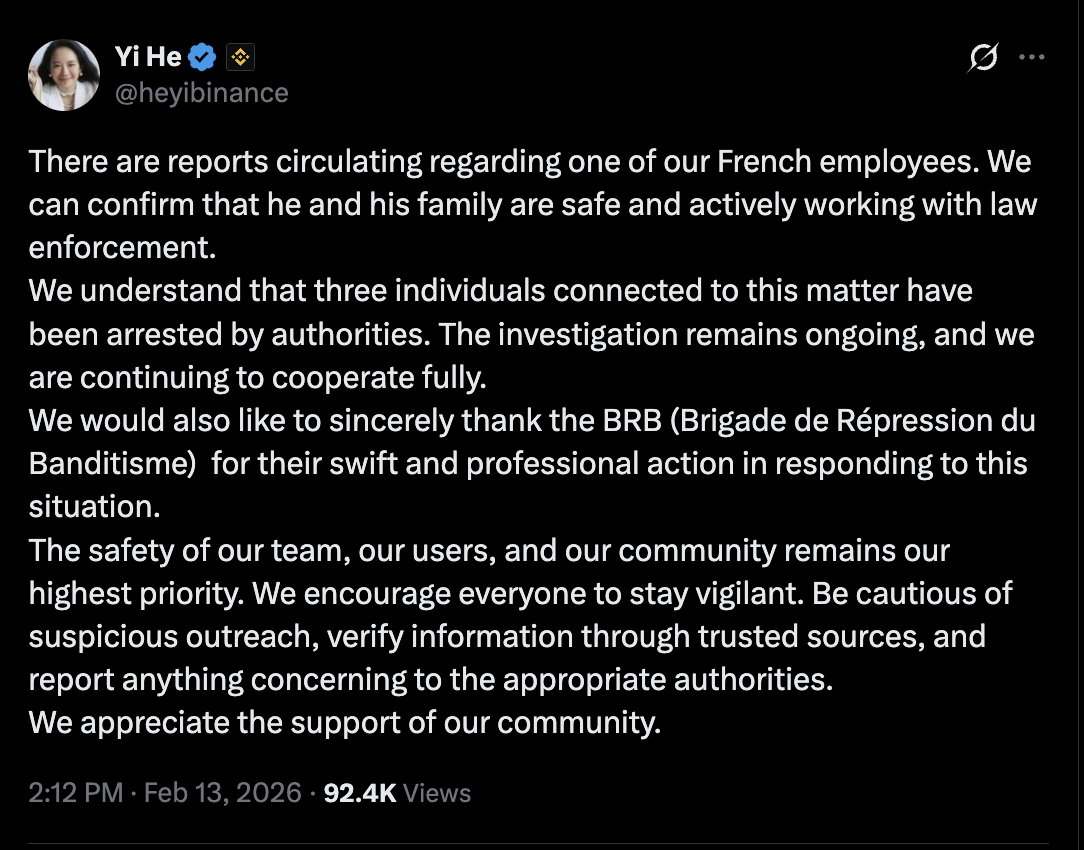
Now, this report has been confirmed by Yi He, the co-founder and chief customer service officer at Binance, who shared on the social media platform X that the executive and his family are safe and actively cooperating with law enforcement. 

Binance

Source: @heyibinance on X

He said on X: 

We understand that three individuals connected to this matter have been arrested by authorities. The investigation remains ongoing, and we are continuing to cooperate fully. We would also like to sincerely thank the BRB (Brigade de Répression du Banditisme)  for their swift and professional action in responding to this situation.

Crypto Wrench Attacks Jump 75% In 2025: CertiK

Wrench attacks refer to physical (often violent) attempts to force cryptocurrency investors to hand over their digital assets. According to blockchain security firm CertiK, this form of attack has seen a significant rise over the past year, seeing a 75% climb to reach 72 confirmed worldwide cases.

In 2025, crypto-wrench attacks accounted for about $40.9 million in confirmed cases, with Europe bearing 40% of all the attacks. France led last year’s numbers, with 19 confirmed cases of wrench attacks in the country 

This wrench attack number seems certain to increase for France this year, as the breach of the Binance executive’s home happened only a few days after local police arrested six people over the abduction of a crypto entrepreneur’s partner and her mother in a crypto-linked ransom attack.

Binance

The price of BTC on the daily timeframe | Source: BTCUSDT chart on TradingView

Featured image from Unsplash, chart from TradingView

Editorial Process for bitcoinist is centered on delivering thoroughly researched, accurate, and unbiased content. We uphold strict sourcing standards, and each page undergoes diligent review by our team of top technology experts and seasoned editors. This process ensures the integrity, relevance, and value of our content for our readers.

bitcoin claws back to $70,000 after $8.7 billion wipeout

0

Bitcoin has clawed its way back above $70,000, recovering from a sharp drop near $60,000 earlier in the month.

The cryptocurrency is up nearly 5% in the last 24-hour period, while the broader CoinDesk 20 (CD20) index rose 6.2% in the same period.

The rebound comes as investors react to a cooler-than-expected U.S. inflation print and signs of renewed risk appetite. The Consumer Price Index for January rose 2.4% year-over-year, just below the forecasted 2.5%.

That gave markets a reason to believe interest rate cuts could arrive sooner than expected, lifting both stocks and cryptocurrencies. Lower interest rates make risk assets more attractive, as the rate of return on risk-free or low-risk investments lowers.

Traders on prediction market Kalshi are currently weighing a 26% chance of a 25 bps rate cut in April, up from 19% earlier in the week. On Polymarket, the odds rose from 13% to 20%.

Still, the rally masks deeper fractures beneath the surface.

The Crypto Fear & Greed Index continues to reflect deep anxiety, hovering near extreme fear levels last seen during the 2022 bear market over the collapse of FTX. The index has been sitting in “extreme fear” since the beginning of the month.

Bitwise analysts noted that $8.7 billion in bitcoin losses were realized in the last week, second only to the fallout from the 3AC collapse.

“Nevertheless, the rotation of supply from weaker hands to conviction investors has historically been associated with market stabilisation phases, though such redistribution requires time to fully unfold,” Bitwise wrote.

Bitcoin treasury firms were sitting on over $21 billion of unrealized losses, an all-time high. Bitcoin’s recovery has seen that figure drop to $16.9 billion.

Thinner trading volumes are supporting the current rally during the weekend and seller exhaustion. The $8.7 billion in realized losses in the last week could be seen as a “textbook capitulation event.”

Yet, the extreme fear gripping the market poses a challenge. As Bitwise research analyst Danny Nelson told CoinDesk, the market’s “main driver right now is fear. Fear that we’ll go lower.”

That fear is seeing investors take any coming rally as a chance to sell. Whether that will keep on materializing or the shift to higher-conviction holders will see the market change directions remains to be seen.

SumUp Launches ‘Solo Lite’ Card Reader to Target Mobile Merchants in the UK

0

SumUp, the global financial technology company, has launched its latest hardware innovation in the UK: the Solo Lite card reader.

The new device is positioned as the company’s “simplest and most durable” reader yet, designed specifically to offer a cost-effective entry point for small businesses and entrepreneurs.

Durability for mobile businesses
Tomer Sabag, chief hardware officer at SumUp

The Solo Lite is engineered with mobility in mind. It features a robust design incorporating a Corning Gorilla Glass screen to withstand daily wear and tear. Crucially for mobile traders like food trucks, coffee carts, and market stall holders, the device boasts a long battery life capable of processing over 1,000 transactions on a single charge.

The reader connects to smartphones via Bluetooth, allowing it to function seamlessly on the go or in-store. It supports all major payment and card types and includes a touchscreen interface that enables customers to tip directly on the screen.

Tomer Sabag, chief hardware officer at SumUp, explained the design philosophy behind the new product: “SumUp takes pride in developing and building our technology in-house. We use merchant feedback to continuously improve all our products… When it came to designing Solo Lite, it was critical that we brought to market a product that wasn’t just affordable but powerful, and could be a day-to-day partner of a merchant.”

Affordability and integration

With a one-time device cost of £25 and a small fee per transaction, SumUp is pitching the Solo Lite as an ideal starter device.

Beyond the hardware, the device integrates with the wider SumUp ecosystem. Merchants can monitor sales, issue refunds, and track business performance via the SumUp app. It also supports next-day payouts, with the option for users to spend their earnings directly via the SumUp Business Account.

For businesses with more complex needs, the reader is compatible with third-party software integrations through SumUp’s API.

The Solo Lite is available now via the SumUp website and is scheduled to roll out across major retailers including Toolstation, Screwfix, Ryman, and Currys in Q2 2026.

ARK Invest Buys $15M Coinbase Shares After Recent Selling

0

ARK Invest has returned to buying shares of Coinbase Global after trimming its position, adding roughly $15 million worth of stock across several of its actively managed exchange-traded funds (ETFs) on Friday.

The Cathie Wood-led asset manager purchased 66,545 Coinbase shares through the ARK Innovation ETF (ARKK), 16,832 shares through Next Generation Internet ETF (ARKW) and 9,477 shares through Fintech Innovation ETF (ARKF), according to the firm’s daily trade disclosures.

The buying activity coincided with a sharp surge in Coinbase stock. Shares closed the trading session at $164.32, up about 16.4% on the day, before edging higher in after-hours trading, according to data from Google Finance. The surge put the firm’s total purchase at roughly $15.2 million.

Alongside Coinbase, ARK also increased its stake in Roblox Corporation, buying shares in ARKK, ARKW and ARKF. Roblox closed near $63.17 on the New York Stock Exchange on Friday.

Coinbase shares surged 16% on Friday. Source: Google Finance

Related: Coinbase unveils crypto wallets designed specifically for AI agents

ARK cuts Coinbase shares across ETFs

Last week, ARK Invest reduced its exposure to Coinbase, selling about $17.4 million in Coinbase stock on Feb. 5 for the first time this year and its first reduction since August 2025.

The exchange then sold another $22 million worth of Coinbase shares across several ETFs on Feb. 6, while increasing its position in digital-asset platform Bullish.

As Cointelegraph reported, Coinbase became the top detractor across several of Cathie Wood’s ARK Invest ETFs in the fourth quarter of 2025, as a broader crypto market pullback pressured performance. Shares of Coinbase fell more sharply than both Bitcoin (BTC) and Ether (ETH) during the quarter.

Related: Coinbase bets on Backstreet Boys nostalgia in return to Super Bowl

Coinbase posts $667 million Q4 loss

Coinbase reported a net loss of $667 million in the fourth quarter of 2025, ending an eight-quarter run of profitability. Earnings per share came in at 66 cents, missing analyst expectations of 92 cents, while net revenue fell 21.5% year-over-year to $1.78 billion. Transaction revenue dropped nearly 37% to $982.7 million, although subscription and services revenue rose more than 13% to $727.4 million.