Home Blog Page 101

CFTC Chair Reiterates Origins in Regulating Agricultural Markets, Despite Crypto and Prediction Markets Push

0

Commodity Futures Trading Commission (CFTC) Chair Michael Selig on Tuesday acknowledged fundamental differences in the traditional commodity markets it has long regulated and its more recent role overseeing aspects of the cryptocurrency and blockchain industry.

He told the American Cotton Shippers Association Annual Convention that considering the agency’s roots in overseeing asset classes that range from corn to hog bellies, the perpetual contracts tied to digital assets weren’t “suitable for all asset classes, especially in products like agriculture.”

“We fully recognize and understand that 24-7 trading and the perpetual model is not a natural fit for traditional commodity markets, like agriculture, that observe limited trading hours and rely on physical delivery,” said Selig.

The CFTC chair’s remarks followed the agency approving perpetual futures contracts tied to the spot price of Bitcoin for prediction markets platform Kalshi and issuing a no-action position for similar products on cryptocurrency exchange Coinbase in May. Kraken also subsequently launched perpetual futures trading for US users through its CFTC-regulated platform Bitnomial.

Related: Crypto lobby urges Congress to pass staking and mining tax bill as is

Selig’s position as sole commissioner at the CFTC, both in claiming that the agency has “exclusive jurisdiction” in overseeing prediction markets and approving crypto perpetual futures, has prompted legal backlash from many companies and state level authorities. Last week, the Chicago Mercantile Exchange (CME) Group sued the agency in the District of Columbia, alleging that the perpetual contract approvals violated the Commodity Exchange Act.

Still no commissioner nominations from Trump

Despite the urging of many US lawmakers, President Donald Trump has made no move to fill out the CFTC’s five-person leadership panel. Selig has been the only Republican commissioner and chair following the departure of Caroline Pham in December 2025.

The US Senate is expected to take up a vote on the Digital Asset Market Clarity (CLARITY) Act in a matter of weeks, which could change the roles of the CFTC and Securities and Exchange Commission in overseeing digital assets.

Magazine: Japanese pension fund tips 1% in crypto, G7 urges action on NK hackers: Asia Express

Cointelegraph is committed to independent, transparent journalism. This news article is produced in accordance with Cointelegraph’s Editorial Policy and aims to provide accurate and timely information. Readers are encouraged to verify information independently.

BNY sees ‘FOMO’ driving asset managers into tokenized funds

0

But Slavin said firms appear reluctant to wait. “Even though the regulations and the rails aren’t fully ready yet, they want to get products out,” he said.

Wall Street believes that blockchain networks could eventually become a new distribution channel for traditional investment products. Tokenized funds could allow investors to hold and transfer fund shares around the clock, potentially reducing settlement times and expanding access to global investors.

One concern emerging for fund issuers, according to Slavin, is that tokenized versions of well-known ETFs are already trading on platforms outside traditional financial markets, often without direct involvement from the fund sponsors themselves.

“There are ETFs, like hundreds of them, that are trading in unregulated markets around the world,” he said.

Because anyone can theoretically create a tokenized representation of a publicly traded fund, issuers face the prospect of products bearing their names circulating beyond their oversight.

“It’s opaque,” he said. “It effectively creates a reputation risk, even though it’s not at all affiliated, frankly, with the asset manager.”

That dynamic has become a growing topic of discussion among BNY’s asset-management clients as they evaluate their own tokenization strategies. Similar to the early days of bitcoin and crypto trading, the technology is evolving faster than the rules governing it.

Ethereum Foundation Lays off 54 Employees as Buterin Reveals 40% Budget Cut

0

The Ethereum Foundation (EF) has laid off 54 employees, roughly 20% of its workforce, as part of a major organizational restructuring.

According to a blog post published Tuesday, the EF will reorganize around five specialized clusters covering protocol, access, user, community and institutional work. The Foundation said the changes are intended to concentrate resources on Ethereum’s long-term technical priorities, including scaling, privacy, security and censorship resistance.

Under the new structure, separate teams will oversee Ethereum’s core protocol, user access tools, community engagement and work with institutions, while management and operations functions remain organized independently.

The announcement came a day after former Ethereum Foundation contributors Ansgar Dietrichs, Barnabé Monnot, Caspar Schwarz-Schilling, Josh Rudolf and Julian Ma announced the launch of Ethlabs, an independent nonprofit research organization.

Backed by BitMine, SharpLink and Ethereum co-founder Joe Lubin, Ethlabs said it will focus on scaling, interoperability and other protocol-level improvements.

Source: EthLabs

Related: Ethereum can quantum-proof accounts for just 7 cents, says Ethereum’s Kohaku lead

Buterin says Ethereum Foundation cutting budget by 40%

In a Tuesday X post, Ethereum co-founder Vitalik Buterin said the Ethereum Foundation is reducing its budget by roughly 40% as it transitions toward a long-term, endowment-based organization. He said the foundation aims to lower annual spending from about 15% of its remaining funds to roughly 5% after 2030, a shift he said necessitated difficult staffing decisions. Buterin’s post said:

The past years have been a challenging era for Ethereum. However, the ecosystem is adapting, both inside the EF and outside.

Buterin said the foundation would continue prioritizing major protocol initiatives while shifting some work outside the EF as Ethereum development becomes more distributed.

Source: Vitalik Buterin

The Ethereum Foundation has also adjusted its treasury strategy in recent months. The organization unstaked 17,000 Ether in late April and another 21,270 ETH in early May after nearly reaching 70,000 ETH staked earlier this year. The foundation also sold 10,000 ETH to BitMine in an over-the-counter transaction on May 1.

Last week, former EF contributor Trenton Van Epps warned that Ethereum’s core development ecosystem could face a “slow-burning funding crisis,” arguing that spending cuts and the expiration of the network’s Client Incentive Program have left some contributors searching for new funding sources.

The warning came amid broader changes at the EF, including co-executive director Hsiao-Wei Wang’s departure and a wave of exits that had already reached an estimated 19 employees and executives this year before Tuesday’s announcement of additional layoffs.

Magazine: Bitcoin decouples from tech stocks, Ether eyes ‘selling wave’: Market Moves

Ethereum Foundation Cuts Budget 40% in Sweeping Restructuring

0

The nonprofit is eliminating 54 roles as Vitalik Buterin warns that the leaner organization will involve “grand sacrifices,” including changes to client development, Devcon and institutional work.

The Ethereum Foundation is reducing its annual budget by roughly 40% and cutting about 20% of its staff as part of a sweeping restructuring intended to turn the nonprofit into a leaner, endowment-based organization.

The organization said in a blog post Tuesday that 54 employees are leaving following a months-long restructuring process. Its remaining work will be organized around five divisions focused on Ethereum’s protocol, access, users, community and institutional adoption.

Ethereum co-founder Vitalik Buterin said on X the cuts reflect a deliberate shift away from the Foundation’s historically high spending rate rather than a simple attempt to eliminate inefficiencies.

“This year, the EF is decreasing its budget by roughly 40%, which entails some difficult decisions,” Buterin wrote in a post on X.

The reductions implement goals established in the Foundation’s treasury management policy last year. The EF is moving away from spending an average of roughly 15% of its remaining funds annually before 2026 and toward a target spending rate of approximately 5% after 2030.

The shift is intended to transform the Foundation into a long-term-oriented endowment capable of supporting Ethereum through extended market downturns without depending on short-term token sales or favorable market conditions.

But Buterin rejected the idea that the reductions could be achieved without meaningful losses.

He praised the departing employees as dedicated engineers, researchers and contributors, some of whom have worked on Ethereum for nearly a decade, and said he would not characterize them as unproductive workers whose absence could be offset by greater efficiency.

“There was much that is lost,” Buterin said, expressing hope that many would continue contributing elsewhere in the Ethereum ecosystem or in the broader world of censorship resistance, open source, privacy and security — principles the EF abbreviates as CROPS.

More Than Cost-Cutting

The layoffs are part of the implementation of the Foundation’s recently introduced EF Mandate⁠, which seeks to narrow the organization’s priorities around areas that it believes only the EF can credibly lead.

“We must be resourced and organized in a way that allows us to focus on the critical work that only EF can, and therefore must, do in the coming years,” the Foundation said.

The departing workers will receive severance equal to the higher of one month’s salary for every year worked at the Foundation or the minimum required in their jurisdiction. The EF is also offering career-transition assistance and grants covering expenses such as coaching.

The cuts follow a wave of turnover at the organization responsible for supporting development of the world’s largest smart-contract blockchain.

At least eight senior leaders and researchers have left the EF this year, prompting calls for a separate, price-focused Ethereum organization⁠.

Former co-executive director Tomasz Stańczak stepped down in February, while Hsiao-Wei Wang resigned as co-executive director and board member⁠ last week after taking a sabbatical. Longtime contributors Josh Stark and Trent Van Epps also announced their departures in April⁠.

Five New Clusters

Under the new structure, the Foundation’s work will be organized around five primary clusters: the protocol layer, access layer, user layer, community layer and institutional layer.

Additional groups will handle operations and directly support the management team.

The protocol cluster will oversee Ethereum’s core technical development, including safely shipping network upgrades, reducing complexity and trusted dependencies, limiting harmful forms of maximal extractable value, and advancing research into post-quantum security, zero-knowledge Ethereum Virtual Machines and privacy at the base layer.

The priorities build on an execution plan published this week by interim executive director Bastian Aue, who committed the Foundation to treating toxic MEV as a structural threat, making privacy a default and paying staff in Ethereum-native assets⁠.

The Foundation stressed that the protocol division is not intended to make Ethereum more marketable or optimize it for short-term commercial goals.

Instead, its mandate is to make Ethereum more difficult to censor, corrupt or capture and more dependable when governments, platforms or financial intermediaries fail users.

Ethereum’s Third Iteration

Despite the reduced budget, Buterin said the Foundation is not scaling back its technical ambitions.

He described the Ethereum “Strawmap” as an effort to replace or substantially improve almost every major component of the protocol, including consensus, proofs, privacy, accounts and state management.

Buterin characterized the roadmap as Ethereum’s third major iteration, following the original proof-of-work network and the proof-of-stake system introduced through the Merge.

Unlike the Merge, however, the transformation is expected to arrive incrementally rather than through a single coordinated upgrade.

At the same time, the Foundation plans to expand its work on Ethereum’s access layer, which covers the interfaces and infrastructure through which users and software agents interact with the network.

“We are not compromising on Ethereum being a Deeply Impressive protocol,” Buterin wrote, arguing that Ethereum should be capable of meeting the challenges posed by quantum computing, artificial intelligence and other major technological shifts.

Some work previously performed within the Foundation will migrate to independent teams in the wider ecosystem. Buterin acknowledged that external contributors will not replace everything lost through the cuts.

Client Model to Shift

One of the most consequential changes will affect Ethereum’s multi-client model.

Ethereum currently relies on several independently developed execution and consensus clients. The model provides redundancy: when a bug affects one minority client, the network can continue operating and finalizing transactions.

Buterin said the EF increasingly expects different clients to focus on specialized needs rather than maintaining multiple near-identical implementations primarily for redundancy.

More components of the protocol may instead depend on AI-assisted formal verification — the mathematical verification of software behavior — as a security strategy.

Smaller Ethereum components, including certain cryptographic libraries, have already used this approach. Buterin said it may eventually allow client teams to implement a large number of Ethereum Improvement Proposals using fewer resources.

The resources saved could then be directed toward specialized client functions and the Foundation’s access-layer priorities.

The strategy could make protocol development more efficient, but it also represents a meaningful change to one of Ethereum’s defining security philosophies. Client diversity has long been presented as protection against catastrophic software failures and the concentration of protocol development in a single implementation.

PSE Is Winding Down

The Foundation’s Privacy and Scaling Explorations unit, known as PSE, will wind down as a standalone group.

PSE has served as an incubator for research and open-source development involving zero-knowledge proofs, privacy, scaling and identity.

Buterin said the change does not necessarily mean fewer people will work on zero-knowledge technology. Instead, researchers and engineers will shift from broad exploration toward implementing ZK-based privacy and scaling directly within Ethereum’s protocol and access layers.

The move reflects the EF’s broader transition from open-ended research toward delivering a more narrowly defined roadmap.

A Smaller Devcon

Devcon, the Ethereum Foundation’s flagship developer conference, is also likely to become smaller, more austere and significantly less expensive to operate.

Buterin said future events will likely run at a much lower deficit and adopt a vision more closely aligned with the Foundation’s mandate.

The EF will also finance fewer large projects outside Ethereum.

Buterin said earlier this year that he planned to fund some public-interest projects personally rather than relying on the Foundation’s treasury. That division is now becoming part of the EF’s formal strategy.

Institutional work will also narrow in scope. Rather than pursuing broad adoption across governments, banks and corporations, the Foundation will focus on producing replicable examples of deployments that strongly preserve censorship resistance, open source, privacy and security.

Those projects may operate at a smaller scale but will be intended to demonstrate how institutions can use Ethereum without abandoning its core principles.

Keeping an Exit Open

The access layer will focus on how people and software agents interact with Ethereum, from reading blockchain data and submitting transactions to delegating authority and exiting applications.

Its guiding principle will be what the Foundation calls the “zero option”: whenever an intermediated path exists, users should also have access to a credible alternative that does not depend on the intermediary.

The cluster will seek to make Ethereum interfaces verifiable, recoverable and understandable, while allowing users to grant agents limited authority that can later be revoked.

The user layer will feed research about real users and organizations into protocol and infrastructure decisions. Its work will include developing user profiles, educational resources, use-case research and methods for evaluating whether Ethereum is meaningfully delivering self-sovereignty.

The Foundation said the group will not turn the EF into a product studio. Instead, it is meant to ensure that technical decisions reflect actual needs and constraints.

The focus on user experience follows an earlier roadmap shift under Stańczak and Wang, when the Foundation narrowed its technical priorities to scaling Ethereum’s Layer 1, increasing blob capacity and improving user experience⁠.

Institutions Without Compromise

The community cluster will shape how the Foundation communicates its mission and builds ties with adjacent movements, including open-source software, privacy advocacy, civil liberties and public-interest technology.

In unusually direct language, the EF said it wants to distinguish itself from “zero-sum financial crypto,” corporate-controlled blockchain projects and nonprofit organizations vulnerable to geopolitical influence.

The institutional cluster will work with banks, insurers, corporations, governments, universities and nonprofits adopting Ethereum and cryptographic technology.

But its reduced mandate will emphasize standards, reference architectures and practical demonstrations that preserve privacy, data portability, verifiable execution and users’ ability to exit an intermediary.

The resulting structure suggests the EF is not rejecting institutional adoption. Rather, it is trying to ensure that adoption does not turn Ethereum into another closed financial network controlled by powerful gatekeepers.

Learning From Bitcoin

In the longer term, Buterin said he favors what he called a “soft lean-and-done” approach to Ethereum development.

Once the Strawmap is completed, Ethereum would largely limit protocol development to security fixes and a smaller number of high-value improvements. New features would face a much higher threshold for inclusion.

The approach is intended to make Ethereum easier to maintain, harder to capture and less dependent on a large permanent development budget.

Buterin said Ethereum should learn less from sprawling software projects containing millions of lines of code and more from Bitcoin, whose base protocol changes slowly and conservatively.

That vision would represent a significant evolution for Ethereum, which has historically differentiated itself from Bitcoin through rapid experimentation and an expansive technical roadmap.

The Foundation is betting that Ethereum can continue evolving aggressively in the near term and then gradually harden into a more stable, self-sustaining protocol.

Funding Scrutiny

The restructuring arrives amid renewed scrutiny of how the EF funds Ethereum’s core development.

Former coordinator Trent Van Epps recently warned of a potential $30 million annual funding gap⁠ affecting client teams, researchers and protocol-coordination groups.

The gap stems partly from the expiration of the Client Incentive Program and the EF’s plan to lower its annual spending rate toward an endowment-style model.

The Foundation’s treasury strategy, which The Defiant described as Ethereum “going Defipunk”⁠, prioritizes permissionless, immutable and audited protocols aligned with its cypherpunk values.

The EF has also deployed portions of its treasury into decentralized finance, including an additional $7.5 million of ETH into Morpho⁠ in March.

Buterin said the reductions do not fully explain every departure, noting that some changes involve reducing the need for future spending rather than cutting existing teams.

Still, his intervention makes clear that the overhaul entails real tradeoffs.

The EF is attempting to finance an ambitious reinvention of Ethereum while sharply reducing its recurring costs — and accepting that some valuable research, projects and institutional knowledge will be lost in the process.

“The past years have been a challenging era for Ethereum,” Buterin said. “However, the ecosystem is adapting, both inside the EF and outside.”

Bitcoin Bulls Fight to Avoid New Lows as Stocks Stay Volatile

0

Bitcoin (BTC) stayed uncertain at Tuesday’s Wall Street open as US stocks responded to an earlier Asia tech sell-off.

Key points:

  • Bitcoin bulls attempt to avoid a deeper drop below local lows amid risk-asset volatility.
  • Multiple factors are blamed for the current weakness and stocks reset, with Micron earnings due on Wednesday.
  • Rolling crypto liquidations pass $1 billion over 24 hours.

BTC price on the edge amid stocks volatility

Data from TradingView showed indecisive BTC price moves on low time frames with $62,500 now a focus.

BTC/USD one-hour chart. Source: Cointelegraph/TradingView

Asia market weakness sparked two dips below the $62,000 mark on the day, with equities seeing major losses. The US reaction was less intense, with the S&P 500 and Nasdaq Composite Index down 1% and 1.3%, respectively, at the time of writing.

S&P 500 one-hour chart. Source: Cointelegraph/TradingView

Discussing the current landscape, trading resource The Kobeissi Letter added expectations over tech giant Micron Technologies’ Q3 earnings guidance to the volatility mix, this due out on Wednesday.

“Speculation over Micron’s earnings is a key factor driving this volatility,” it wrote in a post on X. 

“The stock is now worth over $1.2 trillion and driving a broader momentum-based rally that is largely dependent on sentiment around Micron’s stock.”

Micron Technologies stock one-day chart. Source: Cointelegraph/TradingView

Kobeissi attributed Korea’s market drop to legal concerns over unrealized gains, as well as increased leveraging among traders.

“The result is amplified volatility in both directions, which also explains why the S&P 500 is already up +60 points from its opening low,” it added.

“When you zoom out, the broader AI narrative has only strengthened and market volatility is completely normal after the run we just saw.”

VIX volatility index one-day chart. Source: Cointelegraph/TradingView

Bitcoin fuels major crypto liquidation surge

Still in a narrow range, BTC price action thus surfed patches of nearby liquidity, with both long and short positions paying.

Related: US dollar strength hits highest since May 2025: Five things to know in Bitcoin this week

Data from CoinGlass put 24-hour crypto liquidations at nearly $700 million.

“$65K did indeed not end up holding which quickly moved this down to grab the liquidity below $62K,” trader Daan Crypto Trades commented while analyzing the numbers.

Crypto liquidations (screenshot). Source: CoinGlass

Analytics account CryptoReviewing described the liquidity imbalance between long and short as “ridiculous,” noting that the rolling 24-hour tally had reached up to $1 billion on Tuesday.

“Bulls might enjoy what happens next,” it forecast alongside an X video update. 

Crypto Urges Congress Pass Staking Tax Bill ‘As Introduced’

0

A group of crypto lobbying organizations has urged Congress to pass a bill on crypto staking and mining taxes without changes, saying it would provide clarity on crypto rewards taxes and ensure blockchains “can be secured by Americans in America.”

The Blockchain Association, the Crypto Council for Innovation and The Digital Chamber said in a letter on Sunday to House Ways and Means Committee Chair Jason Smith and its top Democrat, Richard Neal, that the Tax Clarity for Mining and Staking Act should be passed “as introduced.”

“After years of uncertainty about how mining and staking rewards are taxed, the bill provides a durable compromise that innovators can support while addressing concerns raised by some lawmakers,” the group wrote.

The bill seeks to address what the crypto industry has long said is an unfair tax code that views mining and staking rewards as taxable income when received, which the letter argued is a “taxation of phantom income” that can cause liquidity issues.

The bill would allow miners and stakers the choice of paying taxes on crypto rewards either when they receive them or when they sell the assets, which the lobbyists wrote “ensures income is recognized while avoiding immediate taxation before taxpayers can monetize the asset.”

It was introduced earlier this month ahead of a legislative hearing, but has not advanced past the Ways and Means Committee. Democratic Representative Steven Horsford filed an amendment to limit the deferral of crypto reward taxes to five years.

Crypto Council for Innovation CEO Ji Hun Kim posted to X on Monday that Horsford’s amendment would “break” the bill and raise “negligible revenue.”

“We greatly appreciate his engagement, but there have already been significant concessions made in framing this as an election,” he added.

Source: Ji Hun Kim

The bill has seen pushback from the banking lobby, with the American Bankers Association earlier this month saying it would give “a significant advantage over nearly every other way Americans save, invest and earn returns today.”

Related: Illinois governor approves crypto transaction tax despite industry uproar

“When a company pays a dividend, shareholders receive the value of the dividend and pay tax that year,” the ABA said. “The Tax Clarity for Mining and Staking Act, would work very differently — and show clear favoritism for cryptocurrencies over other asset classes.”

The crypto lobby argued that renegotiating any agreed-upon compromise in the bill “would risk reviving the very problems the bill resolves and stalling a bipartisan result that is finally within reach.”

The bill adds to another crypto tax-focused bill before Congress, the so-called PARITY Act, which was introduced in May and directs the Internal Revenue Service to study what exemptions it can give for small crypto transactions.

The crypto industry has called on Congress to exempt small crypto transactions from tax. Kraken said in April that it sent 56 million tax forms to the Internal Revenue Service, where nearly a third were for transactions worth less than $1, while over 75% were for transactions less than $50.

Magazine: Crypto scammers face death, Aussie CGT makes Asian hubs attractive: Asia Express 

The EF’s new structure | Ethereum Foundation Blog

0

Today, the EF is changing shape, concluding a months-long process of reorganization as part of the implementation of the Mandate and the Treasury Management Policy.

We come out of this process with the structure, activities, and people necessary for execution on the critical tasks ahead of us, but also with 54 fewer colleagues, roughly 20% of the EF, many of whom will be finding ways to contribute to Ethereum from outside the EF in the coming weeks.

This post provides a brief introduction to the new structure and details on how we are supporting the people who are leaving.

The new structure

The EF now has five clusters with different domains of work – protocol layer, access layer, user layer, community layer, and institutional layer – as well as a cluster focused on operations and one comprising management and teams directly supporting management work.

Each domain of work requires a different approach, is held accountable for different kinds of results, and has a different internal structure tailored to the work that needs to be done. We will share much more about these in the coming month, so for today we will stick to introducing them at the highest level.

Protocol Layer

The protocol cluster carries the EF’s legacy and responsibility for ensuring that Ethereum delivers on its foundational promise of scaling self-sovereignty. It does so by laying the groundwork for hardening and scaling the Ethereum protocol itself. Its objective is to ensure that the Ethereum protocol continues to enforce the properties which make it worth defending: censorship and capture resistance, open source and openness, privacy and security as non-negotiable protocol guarantees.
The protocol cluster exists to make sure the core protocol continues to advance without compromising on self-sovereignty guarantees. It does not exist to make Ethereum more marketable or focused on short-term interests, or to make it easier to turn into another financial rail controlled by intermediaries. Its work is to make Ethereum harder to corrupt or capture, and easier to rely on when counterparties fail, platforms censor, governments overreach, and intermediaries extract. This means shipping forks safely, reducing unnecessary complexity, minimizing trusted dependencies, defending the transaction pipeline against toxic MEV and privileged orderflow, and accelerating and turning long-horizon research such as post-quantum security, zkEVM, and L1 privacy into protocol changes that preserve and improve self-sovereignty at scale.

Access Layer

The access layer is where Ethereum either serves or fails individuals who need CROPS properties in practice. This cluster’s job is to make self-sovereignty available, legible and survivable across key actions: reading the chain, transacting, proving, delegating, and exiting. These actions must be supported for users, and increasingly for the agents acting on their behalf, who must be able to read current state, history, and related data without depending on intermediaries they can’t verify. They should be able to transact privately and without risk of censorship, with transaction outcomes that are either guaranteed or fail cost-free if conditions are not met. As more of this moves to agents, users have to stay in control, granting bounded authority and revoking it at will, and keeping custody of their own intents rather than exposing them to intermediaries. The interfaces, from silicon to frontend, must be verifiable, understandable and recoverable, regardless of how often someone uses them or how deep their technical knowledge goes.

The principle the cluster applies is the zero option: for every intermediated path, a credible intermediary-free path must exist and stay accessible. Tactically this means identifying where stronger CROPS properties can be applied to current infrastructure, and acknowledging where credible alternatives are necessary because economic incentives favor aggregation, identification and control.

User Layer

The user layer cluster keeps EF work grounded in the users and organizations with vital interests in self-sovereign use of Ethereum, and in extending the tools and norms of such use as widely as possible. It helps the EF understand the capabilities that matter most, the failure modes that are most serious, and the tradeoffs that are acceptable to settle on where necessary.
Its work includes user segments, personas, educational materials, use-case research, and impact evaluation. The goal is not for the EF to become a product studio, but to make sure Protocol and Access Layer decisions are shaped by real current and potential users, real constraints, and real measures of self-sovereignty.

The community cluster owns how the EF shows up in the world, both within and beyond the Ethereum ecosystem. Its job is to make legible what the EF stands for, and how that materially differs from zero-sum financial crypto, from corpo-compromised crypto, and from the bland, status quo-preserving and perversely-incentivized, grant-managing parts of the non-profit world which are vulnerable to use for laundering geopolitical interests. The EF is committed to maximizing its community value by maintaining independence from these and other counterproductive entanglements.

This cluster also builds the EF’s relationships beyond crypto. Self-sovereignty has natural allies in free and open source, secure and local-first software and hardware, in privacy and cryptography research and advocacy, and in civil liberty, decentralized web, and public-interest technology, among other fields. This cluster works to ensure the overlap between Ethereum and those spaces is fruitful, unforced, and high quality.

Institutional Layer

This cluster owns the EF’s work with the institutions that shape institutionally intermediated paths for end-users to interact with Ethereum. This can include financial institutions, whether consumer payments, insurance or otherwise. It can include non-financial enterprises, including manufacturing, social, publishing and many other industries. It can include government applications. It can include universities or other nonprofit groups.

In all cases, our goal is to prioritize creating showcases of effective integration of Ethereum and cryptographic technologies that maximizes CROPS properties and the guarantees that are made available to both institutions and users – such as guaranteeing fair and correct execution, ensuring data portability and more generally practical ability to exit, protecting all actors’ privacy, proving authenticity of data, better detecting or even preventing misbehavior, and more. We believe that many enterprises, governments, and nonprofits will realize that their incentives favor serving users in ways that strengthen self-sovereignty while retaining the guarantees they need in order to create value or fulfill their mission, and that Ethereum and cryptographic technologies can be a part of making this happen. In addition to direct engagement, the institutional cluster will pursue these ends by helping to establish and thoughtfully communicate best practices, standards, reference architectures, and educational materials for institutional adoption.

The institutional cluster also works upstream with academics and allied advocacy organizations around the world to ensure Ethereum is correctly understood in both its current form and potential, and to track and respond to policy and regulatory developments that could affect Ethereum’s commitment to self-sovereign use and its core principles of censorship (and capture) resistance, open source, privacy, and security.

The people leaving

As part of the change to the shape of the EF’s structure, activities, and spending, we are parting ways with 54 of our colleagues today.

These decisions were hard, but they are necessary. We must be resourced and organized in a way that allows us to focus on the critical work that only EF can, and therefore must, do in the coming years, without excessive disruption from short-term market movements.

In order to make sure those who are leaving are set up well for the transition we are offering a package comprising severance and transition support. The severance is the higher of one month’s pay per year worked at the EF and the amount locally mandated by the individual’s jurisdiction. This is the same severance we offered to the colleagues who left the EF in the past few months. The transition support includes help finding a new place to contribute in the ecosystem, plus a small transition grant earmarked to cover individual transition expenses (career coaching and similar).

We are grateful to each of them for the talent, dedication, and time they have contributed to Ethereum at the EF, and look forward to continuing to work alongside those of them who find homes elsewhere in the ecosystem.

What comes next

The EF that emerges from this change is leaner and more focused. We will share more in the coming weeks and months about how our work is changing and how the ecosystem can best engage with the new structure.

Will BTC Price Hold Above $60K for Much Longer?

0

Bitcoin (BTC) has dropped over 8% from its June high near $67,255, putting the $60,000 support level back in focus.

BTC/USD daily chart. Source: TradingView

Key takeaways:

  • The SpaceX-led tech market rout is pushing Bitcoin price toward the $60,000 support.
  • A decisive breakdown below $60,000 may lead the price toward $56,000 or under.

SpaceX Rout Adds Pressure To Bitcoin’s $60K Support

Bitcoin is getting close to retesting $60,000 as SpaceX’s post-IPO rout erases over $600 billion in market value and shakes risk appetite across speculative assets.

The Elon Musk-led company priced its record IPO at $135 per share earlier in June, raising $75 billion at an implied valuation of about $1.77 trillion, based on 13.08 billion shares outstanding.

Investor demand was strong after the listing. SpaceX shares opened near $150 and later climbed to a post-IPO peak of $211.39 on June 16, pushing its implied market capitalization to nearly $2.8 trillion.

SPCX hourly performance chart. Source: TradingView

Shares have dropped roughly 27% from their peak, pulling the stock back toward $150 and erasing much of the debut rally.

Related: Space X IPO: ‘Bad news’ for tech stocks but what about Bitcoin?

The SpaceX rout is part of a wider tech sell-off. Nasdaq 100 futures fell more than 3% on Tuesday, putting the index on track to erase over $1 trillion in market value. Chip stocks also dropped sharply, with Intel, AMD, Micron and SanDisk leading the decline.

Nasdaq 100 daily performance chart. Source: TradingView

Bitcoin typically trades like a liquidity-sensitive risk asset during market stress. When investors cut exposure to expensive tech and speculative growth names, crypto usually faces similar selling pressure.

In a Tuesday post, analyst Nehal said there’s a high probability of Bitcoin falling under $60,000 if it breaks below $62,200, adding:

“For now, it’s still a range game. Real breakout signals come above $65.7K or below $59K.”

Bitcoin head-and-shoulders pattern sets $56,000 target

Bitcoin’s four-hour chart shows a potential head-and-shoulders pattern, adding technical pressure to the ongoing sell-off.

The left shoulder formed near $64,500, followed by a higher peak near $67,000 that created the head. BTC then failed to reclaim that high, forming a lower right shoulder near $65,000 before turning lower again.

BTC/USD four-hour chart. Source: TradingView

The pattern’s neckline sits around the $61,000–$62,000 area, close to Bitcoin’s current support zone. A decisive four-hour close below that range would confirm the bearish setup and increase the risk of a deeper decline.

The measured downside target sits near $55,000–$56,000, based on the distance between the head and the neckline. Multiple BTC analyses in the past have presented similar downside price targets.

Nevertheless, BTC’s bullish structure remains active as long as it holds above $60,000, with the possibility of returning above $81,000 over the next few months.

The SEC delayed tokenizing stocks, and here’s why that’s a relief

0

Before we rush to tokenize U.S. equities, we need compliance systems that understand context, not just checkboxes. Investors like Michael Burry see the danger, so should the rest of us, urges Chamarajnagar.

BTC might need to fall below $53,500 before bottom is in

0

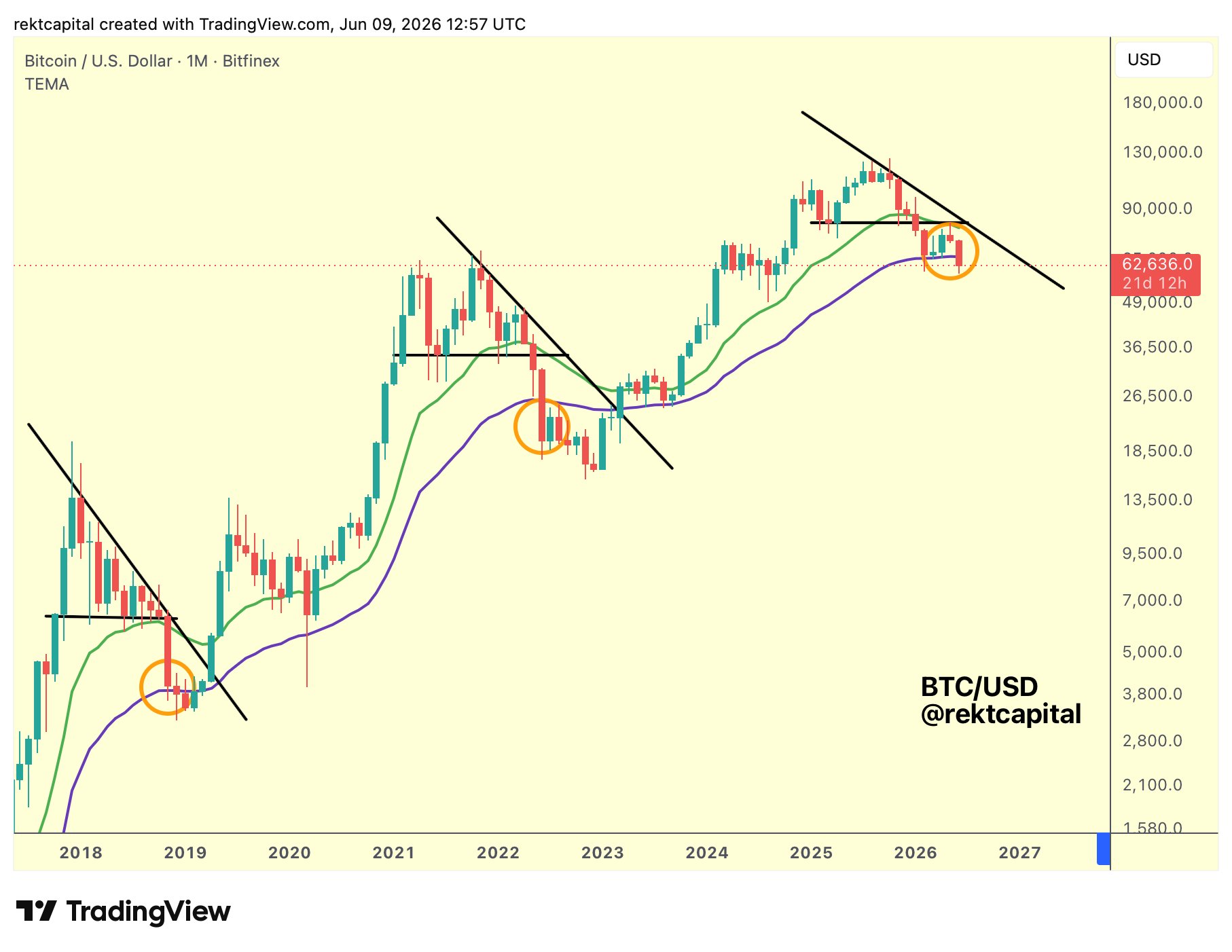
As bitcoin trades near its 200-week moving average, a long-term support indicator currently sitting around $62,400, investors are closely watching whether the level can hold. If the 200WMA breaks, attention is likely to shift to bitcoin’s realized price, currently around $53,457, which has historically acted as the final line of support during major bear markets.

The realized price represents the average on-chain acquisition cost of all bitcoin in circulation and has historically served as a key support level during the depths of bear markets.

In every major bear market cycle, including 2011, 2015, 2018 to 2019, the March 2020 crash, and 2022, bitcoin eventually traded just under its realized price before establishing a cycle bottom. So far, bitcoin has not fallen beneath this level in the current cycle.

From a psychological and sentiment perspective, capitulation tends to occur when investors see the market price fall below their cost basis. Once an asset trades below what investors paid for it, realized losses spread, often leading to panic selling and extreme bearish sentiment. With the realized price near $54,000, it is reasonable to expect increased investor stress if bitcoin falls below that level.