The 1,200-acre Matagorda County site was previously slated for a $7 billion HIF Global e-fuels plant backed by Texas Gov. Greg Abbott before HIF pivoted to power computing instead.
MARA Holdings said Thursday it signed a definitive agreement with HIF to acquire a powered land site of more than 1,200 acres in Matagorda County, Texas, in a post on its official X account. The site will carry up to 1 gigawatt of grid capacity by October 2027 and up to 2 gigawatts by April 2028, subject to approval from Texas grid operator ERCOT.
The deal is not an upfront cash purchase. It is structured as up to $600 million in milestone-based payments tied to regulatory approvals, land access and eventually a signed data-center tenant, according to an SEC filing MARA disclosed, as reported by The Block. MARA shares rose roughly 14% in early trading Thursday on the news, The Block reported.
HIF Global had promoted the site as the first large e-fuels plant in the United States, a roughly $7 billion project backed by Texas Governor Greg Abbott that would split water to make cleaner shipping fuel, BeInCrypto reported. HIF had already secured full permits and grid rights for about 1.8 gigawatts before the deal, and will retain a minority stake in the site once MARA signs a high-performance-computing tenant.
Doubling The Power Pipeline
MARA plans to develop the campus through its existing partnership with Starwood Digital Ventures, which handles design, construction and tenant sourcing. Combined with MARA’s pending Long Ridge Energy gas-plant acquisition, full energization of the Texas site would push the miner’s total power portfolio to roughly 4.8 gigawatts, The Block reported. MARA Chairman and CEO Fred Thiel said sites with access to reliable, scalable power will become increasingly valuable, according to the same report.
The vaults convert Aave’s variable lending rates into fixed yields that wallets, exchanges and payment apps can offer their own users.
Aave Labs launched Stable Vaults on Thursday, infrastructure that lets fintechs, wallets, exchanges and payment providers embed fixed-rate stablecoin yield into their own products, the company said in a blog post.
The vaults convert variable onchain lending rates, drawn from Aave V3 and V4 markets or other ERC-4626 strategies, into a fixed rate a business sets for its end users. Aave Labs handles the rebalancing and cross-chain operations in between, according to the blog post.
Already Live in Aave’s Own App
Stable Vaults are “the smart contract vaults that already power the Aave mobile savings app,” per the post, and are now open for any business to build on. Aave, the largest DeFi lending protocol with $12.80 billion in total value locked, said Chainlink Price Feeds and CCIP can support any Stable Vaults deployment and will power its own app’s production version.
Aave founder and CEO Stani Kulechov said on X the product offers “fixed yield, cross-chain access, multi-strategy allocation, tier-based rates, and more,” and is “now available to businesses looking to offer stablecoin yield to their users.”
What Operators Control
Businesses choose which stablecoins to accept, which yield strategies to use, and what fixed rate to offer each user, according to the blog post. Any yield the underlying strategy earns above the promised rate goes to the vault operator as revenue, letting the product function as an on-chain fixed-income model rather than a pass-through of Aave’s floating rates.
Aave cited possible use cases including a neobank embedding savings powered by Aave markets, a payments company earning on idle settlement balances, and a wallet or exchange adding a one-tap earn feature backed by Savings GHO.
The launch follows Aave’s October acquisition of Stable Finance and a March proposal for a GHO-based savings product, part of a broader push to bring DeFi yield to mainstream consumer apps.
Ripple came close to shutting down rather than fighting the U.S. Securities and Exchange Commission, Chief Executive Brad Garlinghouse said, describing a decision he and co-founder Chris Larsen faced after the agency sued the company in 2020.
Speaking at the University of Kansas School of Business earlier this week, Garlinghouse said the two seriously considered winding Ripple down and distributing its XRP holdings to shareholders. He described that as the easier path, against a government he said had “infinite power and resources.”
Ripple holds a large amount of XRP, and Garlinghouse said the company could have handed it to shareholders on a pro rata basis and dissolved, effectively ending the case by ending the company.
But they chose to fight because shutting down would have cost hundreds of jobs. “I’m glad in retrospect, but that was not obvious at the time,” he said.
The muted response is the pattern now. When Iran first closed the Strait of Hormuz in early March, Brent crude jumped past $100 a barrel for the first time in four years and later peaked near $120, and bitcoin sold off sharply on each escalation.
Part of that is timing. Oil, equities and bonds are closed for the weekend, so bitcoin is the only large market open to price the strikes in real time, and it is treating them as close to a non-event.
The fuller cross-asset reaction, in crude especially, might not show until Monday. Roughly a fifth of the world’s seaborne oil moves through Hormuz, and Brent had already carried a risk premium into the weekend after tanker traffic through the strait stayed below normal.
The real test comes Monday, however, if crude reopens with a sharp gap higher while bitcoin holds its ground. A calmer oil open would say the strait closure is being read as a threat Tehran has made and walked back before.
Offchain Labs co-founder Steven Goldfeder says every Arbitrum-based Layer 2, not just Arbitrum One, will now route a fee cut back to the ARB treasury.
Arbitrum will collect 10% of fees generated on Robinhood Chain and every other Layer 2 built on its technology stack, Offchain Labs co-founder Steven Goldfeder said Wednesday on X. Of that cut, 8% goes to the tokenholder-controlled Arbitrum treasury and 2% funds development, he said.
Goldfeder framed the fee-sharing model as a revenue play tied to enterprise growth.
“As enterprise adoption is heating up, Arbitrum is well positioned to capture revenue,” he wrote, adding that Arbitrum One, the flagship rollup, sends 100% of its own fees to the treasury.
The disclosure clarifies how Arbitrum’s Orbit framework, the toolkit third parties use to launch custom Layer 2 and Layer 3 chains on Arbitrum’s stack, monetizes for ARB holders beyond the base chain.
Robinhood Chain, an Ethereum Layer 2 built on that stack, launched its mainnet July 1, adding tokenized stocks, onchain lending and agentic trading inside Robinhood’s app. The Defiant first reported Robinhood’s partnership with Arbitrum in February 2024.
An 8% treasury cut on external Orbit chains gives ARB a direct claim on fee volume generated outside Arbitrum’s own network, a structural shift from a chain that previously monetized only its own base-layer activity. The arrangement extends to any Orbit-based L2, not Robinhood Chain alone, per Goldfeder’s post.
The disclosure comes as Robinhood Chain sees early bridging activity, with several onchain trackers noting a sharp rise in ETH bridged to the new network in its first days live.
Two of Bitcoin’s most influential figures came out against it on Saturday. Strategy founder Michael Saylor posted that “there are 110 things more dangerous to Bitcoin than spam,” arguing the proposal “turns a spam dispute into a consensus change that would invalidate some currently valid, fee-paying transactions.” The precedent, he wrote, is the real danger.
There are 110 things more dangerous to Bitcoin than spam.
BIP 110 turns a spam dispute into a consensus change that would invalidate some currently valid, fee-paying transactions.
That precedent is the danger. We should save our energy for threats that really matter. $BTC https://t.co/LoSkl9XSo1
— Michael Saylor (@saylor) July 11, 2026
Adam Back, the Blockstream co-founder whose hashcash design is cited in the bitcoin white paper, made a similar case at greater length, addressed to the newcomers backing the proposal.
“Bitcoin respectfully says no to what you want,” he said, adding that their real recourse, if unconvinced, is to group together and fork away, but that “bitcoin won’t be joining it.”
The support data shows what the broader market really thinks. BIP 110 does not rely on the usual path of overwhelming miner approval, but uses a user-activated soft fork, a mechanism in which nodes enforce a rule whether or not miners agree, set to a 55% miner-signaling threshold rather than the traditional 95%.
Backing is absent even at that significantly lower bar.
Miner signaling has never risen above about 1% in any period and stands at zero in the current one, with no major mining pool behind it, according to the BIP 110 signaling monitor.
Among the nodes that store and relay the chain, adoption sits in the low single digits, carried almost entirely by Bitcoin Knots, an alternative to the dominant Bitcoin Core software.
Thai police made two arrests as Interpol’s 97-country sweep logged 5,811 arrests and $293 million in intercepted assets.
A 20-year-old’s cryptocurrency wallet processed more than $122.5 million in suspected romance-scam proceeds over 10 months, Interpol said, after Thai police made two arrests tied to a cross-chain laundering scheme uncovered during a global crackdown.
The case surfaced from Operation First Light 2026, a sweep coordinated by Interpol that led to 5,811 arrests and the interception of $293 million in illicit assets across 97 countries and territories, the organization said in a statement posted to its official X account Thursday. The operation identified more than 142,000 victims worldwide, blocked 31,014 bank accounts, analyzed 152,808 cases and issued 99 Interpol Notices and Diffusions, using its Global Rapid Intervention of Payments mechanism to freeze both fiat and virtual assets.
Cross-Chain Laundering
The Thai case involved operators who funneled scam proceeds into a mix of cryptocurrencies and used cross-chain token swaps, shifting funds between blockchains to obscure the trail, according to Interpol’s report. The 20-year-old suspect’s wallet moved the $122.5 million over 10 months, one of the standout cases from the four-month operation, which ran from mid-January through the end of April.
“Criminal syndicates exploit human psychology to manipulate their targets,” Tomonobu Kaya, who heads Interpol’s financial crime and anti-corruption center, said, adding that no country can stay safe unless all push back together. Romance scams, often called “pig butchering,” typically build trust over weeks before steering victims into fake crypto investments.
The bust adds to a string of recent crypto-linked fraud crackdowns, including $580 million seized from Chinese networks in February and a 24-person fraud sweep in Argentina in May.
To be sure, Interpol has not named the Thai suspects or specified which blockchains the cross-chain swaps ran through, and the full case details remain undisclosed pending prosecution. The organization did not break out how much of the $293 million total was cryptocurrency versus fiat.
Russia’s largest private bank, Alfa-Bank, is reportedly preparing to offer cryptocurrency services as the country continues developing a legal framework for the digital asset market.
Dmitry Vitman, chief operating officer of Alfa-Bank’s corporate and investment banking division, said the bank plans to roll out a suite of crypto servicesonce the relevant digital asset legislation takes effect, Russian publication RBC reported on Wednesday.
The announcement comes as Russia’s largest banks prepare for a regulated crypto market, with Sber, VTB and T-Bank also outlining crypto plans amid progress on the country’s digital asset legislation.
Alfa-Bank begins testing cryptocurrency trading service
According to a separate RBC report, Alfa-Bank has started testing cryptocurrency trading through its Alfa-Investments brokerage app with a limited group of qualified investors.
The test version reportedly included several major cryptocurrencies, including Bitcoin, Ether, Solana, Litecoin, Tether USDt, USDC and Zcash.
The bank said broader access for retail clients could follow after Russia adopts the necessary regulatory framework, with a possible launch targeted for the fourth quarter of 2026.
Cointelegraph contacted Alfa-Bank for comment on the tests but did not receive a response at the time of publication.
Digital asset custodians central to Russia’s crypto framework
As part of its crypto plans, Alfa-Bank said it will first establish its own “digital depository,” a service similar to a digital asset custodian that stores and manages crypto assets.
Vitman said Alfa-Bank plans to create the custodian not only to support its own crypto services but also to provide the services to other companies.
Related: ESMA turns spotlight on crypto custody risks after MiCA transition
The term “digital depository” is a key part of Russia’s proposed crypto legislation, which introduces digital custodians as a new category of regulated market participants.
One of the related bills, “On Digital Currency and Digital Rights,” passed its first reading in the State Duma in April 2026 and is designed to establish rules for crypto operations under Bank of Russia oversight.
Source: Cointelegraph
Anatoly Aksakov, chairman of the State Duma’s Financial Market Committee, said on Wednesday that a package of cryptocurrency bills was ready for its second reading after the committee approved amendments.
Magazine: Has Bitcoin bottomed for this cycle? Analysts say ‘not yet’
The crypto industry has spent years convincing Washington that it deserves a seat at the table. Now, as Congress inches toward passing the CLARITY Act, a long-awaited crypto market structure bill, it seems it finally has one.
The question is no longer whether lawmakers are listening to digital asset advocates, but whether the crypto lobby’s deep pockets and influence in election campaigns will be enough to get the legislation over the line.
That debate comes as Senate negotiators work toward a potential floor vote before Congress breaks for its August recess.
In a June 25 thread on X, Kristin Smith, president of the Solana Policy Institute and former chief executive of the Blockchain Association, argued that crypto’s advocacy operation is “the strongest and most sophisticated it has ever been.”
She pointed to bipartisan negotiations, daily meetings with lawmakers, and what she described as “a political operation supporting champions that’s winning in an overwhelming fashion” to illustrate her point.
Kristin Smith
Source: Kristin Smith
According to a report from consumer advocacy organization Public Citizen, that “political operation” has spent $189 million so far to influence the 2026 midterm elections. Crypto’s opponents see the war chest as an illegitimate attempt to buy influence and votes, while the industry argues it’s a much-needed corrective to the anti-crypto forces that have dominated politics since 2022.
Colin McLaren, the Solana Policy Institute’s head of government relations, told Cointelegraph the industry’s political infrastructure did not emerge overnight.
“Fairshake, Cedar Innovation Foundation, Stand With Crypto, and the Blockchain Association built the political infrastructure that’s moving pro-crypto legislation forward,” he said.
“These groups, alongside the advocacy of companies and projects, created and supported allies in Congress, giving them the resources and cover to legislate and lead without fear of electoral reprisal from the anti-crypto army.”
The tide begins to turn on CLARITY
There are signs that momentum to pass the CLARITY Act is building.
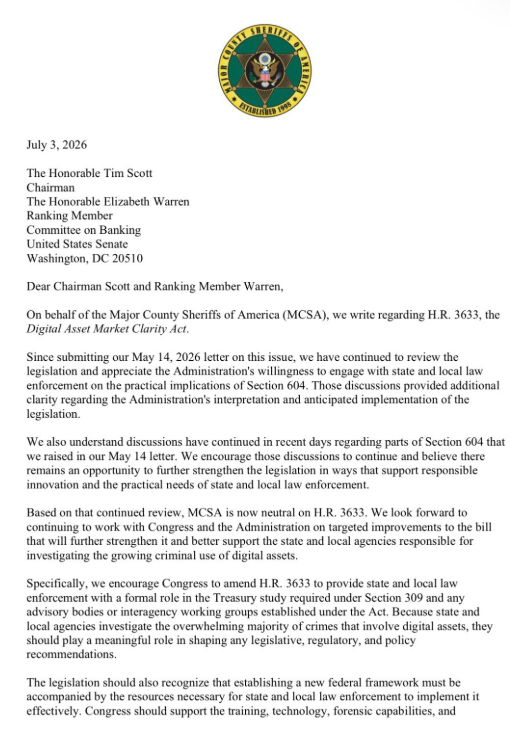
On July 3, the Major County Sheriffs of America (MCSA), a national association representing elected sheriffs from some of the largest counties in the US, announced that it had shifted from opposing the CLARITY Act to a neutral position following discussions over Section 604, also known as the Blockchain Regulatory Certainty Act. As Coinbase chief executive Brian Armstrong commented on X, that development is “huge.”
Earlier that same day, the National Organization of Black Law Enforcement Executives (NOBLE) became the first major law enforcement body to endorse the bill.
But the BRCA, which includes protections for developers decentralized smart contracts, remains a sticking point. Four other attorneys and law enforcement groups representing 70,000 members between them, warned the Acting U.S. Attorney General in late June that the bill’s “broad exemptions could create gaps in oversight and accountability that sophisticated criminal actors may exploit.”
So the race is far from won.
MCSA letter to Senate Banking Leaders. Source: Eleanor Terrett
Related: Senate leaders push for July passage of CLARITY Act
How is the crypto lobby campaigning?
Smith’s comments spotlight how closely the industry’s political organization has become intertwined with its legislative ambitions. No organization better exemplifies that shift than Fairshake, the crypto-backed political action committee (PAC), funded by companies like Coinbase, Ripple and Andreessen Horowitz.
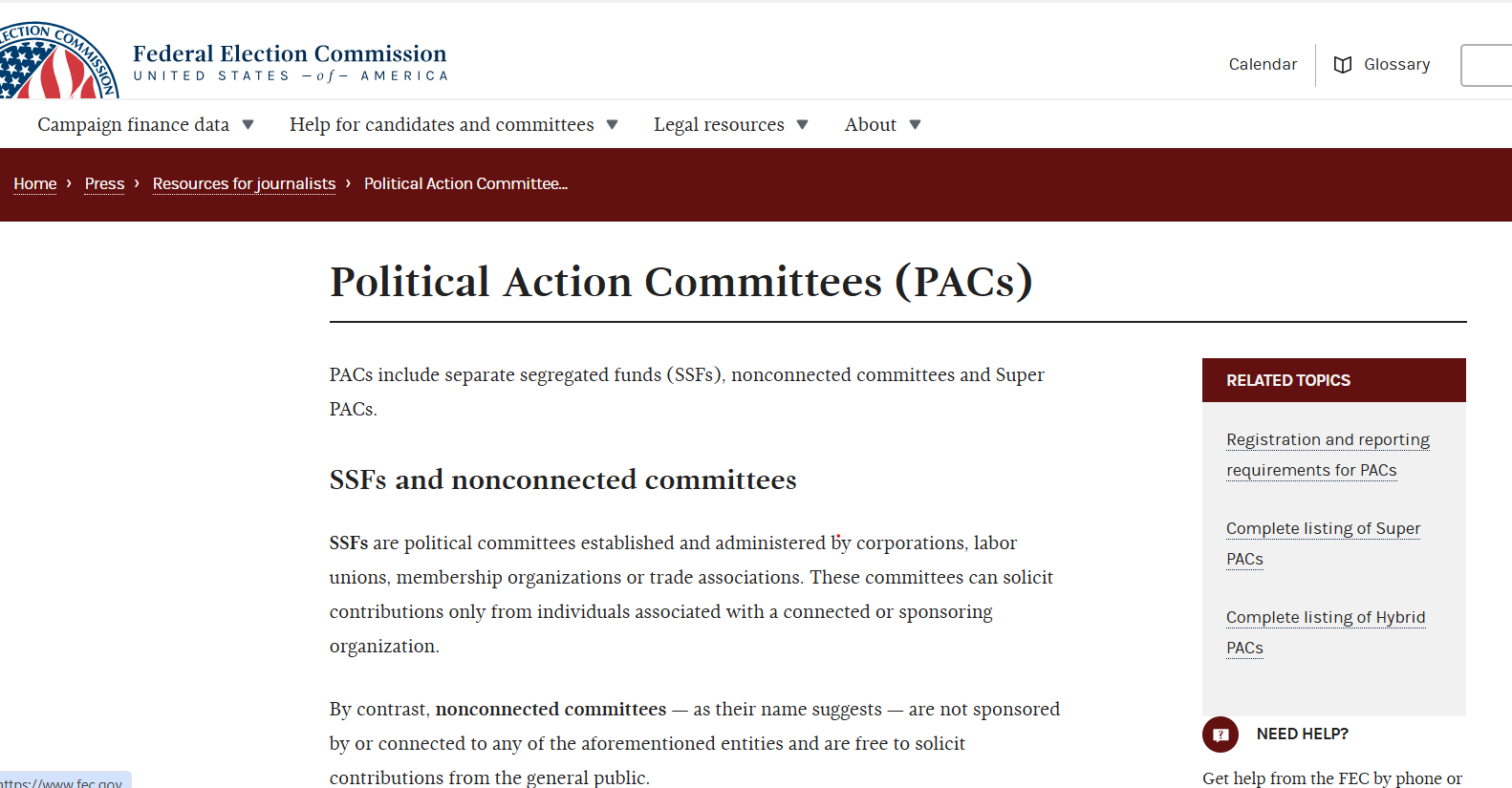
A PAC is an organization that raises and spends money to support or oppose political candidates and causes, and can pool contributions from multiple donors to fund campaign advertising and other political activity, subject to federal election rules.
Political Action Committees (PACs). Source: Federal Election Commission
Throughout the 2026 US congressional primary election cycle, Fairshake and affiliated PACs have spent tens of millions of dollars supporting candidates in various races who are viewed as favorable to digital assets while opposing others seen as hostile to the sector.
In May, affiliated PACs spent more than $20 million supporting candidates in Republican congressional primaries across Georgia, Alabama and Kentucky, including more than $7 million backing Rep. Andy Barr in Kentucky’s Senate primary.
The group later expanded its efforts into Democratic contests, spending millions of dollars in Maryland and New York. Several crypto-backed candidates advanced in these states, further reinforcing Fairshake’s reputation as the industry’s most influential political organization.
McLaren argued that the crypto’s lobby’s willingness to back candidates in competitive races is making a difference.“Adrian Boafo was polling behind the field in Maryland before the crypto industry’s ads ran. He won,” he said.
“In Houston, the industry backed Christian Menefee, a young upstart challenging a sitting incumbent. He won. The industry supports its champions, even when that means taking risks.”
Related: Democrat backed by Ripple co-founder’s PAC wins Colorado primary
Fairshake spokesperson Geoff Vetter told Cointelegraph that election victories are only one measure of success.
“Our goal is to increase the number of members who understand and are willing to act on these issues in good faith,” Vetter told Cointelegraph.
“The difference we make will be creating the largest crypto-literate caucus in history, ready to act on responsible regulation.”
But is Fairshake’s influence overstated?
But how much of Fairshake’s influence stems from election outcomes themselves rather than simply the perception that it can shape them?
In a June 30 analysis published by Brogan Law, journalist Veronica Irwin examined Fairshake’s involvement in 40 decided races during the current election cycle, comparing Federal Election Commission filings with polling data and election results.
While Fairshake-backed candidates won in 38 of those contests, Irwin’s analysis found that many of those races already leaned heavily toward the eventual winner before the PAC entered the picture.
Based on her methodology, only 16 races appeared to be genuinely competitive enough for Fairshake’s spending to have plausibly adjusted the outcome.
How much difference does crypto money really make in elections? Source: Brogan Law
That’s still a considerable impact, and Irwin said her goal was never to argue that Fairshake lacked influence, but to show that its strategy is more sophisticated than many observers assume.
“I was reading a lot of stories that were basically just the press release,” she told Cointelegraph. “That top-line narrative implies they are just buying up all of the elections outright and having these huge, huge wins. That kind of betrays the more complex strategy underlying it.”
Rather than simply trying to swing every race, Irwin said Fairshake has the financial resources to “spray” campaign spending across a much wider range of contests than most PACs could afford.
“They’re in this position where they have so much money that they can pursue these costly strategies,” she said.
Her analysis raises the nuanced possibility that the organization’s greatest political strength may lie not in deciding elections outright, but in cultivating the belief that it can.
Beyond campaign spending
Campaign spending alone does not always move legislation through Congress. The CLARITY Act’s progress also reflects months of negotiations involving lawmakers, industry groups and outside stakeholders.
The MCSA’s shift to a neutral position shows that legislation still depends on coalition-building and compromise, particularly when addressing concerns around financial crime, consumer protection and law enforcement.
“It is a combination of factors,” Ron Tarter, founder of self-custodial, multi-currency cryptocurrency wallet RockWallet and a former attorney, told Cointelegraph. “Adoption is the foundation… Lobbying translates that adoption into direct policy engagement… and campaign spending is the accelerant.”
Irwin also argued that crypto’s political influence comes from more than campaign spending alone. “Crypto occupies this space where it matters a lot to you and me, but to the average voter it isn’t a top-five issue,” she told Cointelegraph.
“That’s the sweet spot where lobbying and election influence can really flex their muscles… It’s pretty easy for a politician to switch to a more pro-crypto perspective without a lot of downside,” she said.
“It’s this one-two punch between lobbying being really effective and the potential to raise a bunch of money if you side with crypto.”
McLaren argued that campaign spending succeeded because it was built on a broader political strategy rather than replacing one.
“Crypto didn’t come to Washington because it wanted to,” he said.
“The industry played defense for years, then decided to meet the threat at the ballot box and build the apparatus to advocate for the clarity needed.”
Magazine: Bitcoin’s quantum dilemma: Bigger blocks or STARK proofs?
Privy pairs Stripe’s Crypto Onramp for the US and EU with its own aggregator covering more than 100 other countries, all funneling into a single wallet.
Privy, the crypto wallet infrastructure provider Stripe acquired in 2025, launched global fiat onramps that let developers add card-based crypto purchases to their apps in a single integration, the company said in a post on its official X account Tuesday.
In the US and EU, Stripe’s own Crypto Onramp product handles payment processing, card, Apple Pay, Google Pay and ACH transactions, identity verification and compliance, according to Privy’s announcement. Outside those two regions, Privy’s own aggregator routes users through “the best available provider” across more than 100 additional countries, with funds landing in the same destination wallet regardless of which rail processed the purchase.
Stripe corroborated the integration on its own account, saying Privy uses Stripe Crypto Onramp “to handle payments, KYC, and compliance in the US and EU, letting your users go from signup to funded wallet without leaving your app.” Stripe’s Crypto Onramp product uses its Link network for what Privy described as minimal identity verification, rather than requiring a separate KYC flow inside the host app.
Building On the Acquisition
The launch is the first major product rollout to surface publicly since Stripe acquired Privy last year, folding the wallet-as-a-service provider into its payments stack. Privy CEO Henri Stern had previously described wallets as a path toward treating crypto accounts like global financial accounts in an interview with The Defiant in January.
The onramp gives app developers built on Privy a single API to onboard users from card payment to a funded wallet across most of the world, rather than integrating separate regional payment providers.