Home Blog Page 980

Hack VC-Backed Nillion to Shut Down Its Chain on Cosmos, Shift Focus to Ethereum

0

The migration comes just months after Cosmos announced it’s stepping back from efforts to turn the Cosmos Hub into a smart contract platform as TVL declines.

NilChain, a privacy-focused blockchain built with the Cosmos SDK by Nillion, is winding down operations on Cosmos as part of broader shifts across the interoperability-focused ecosystem.

In an X announcement on Feb. 17, the team said the network will halt operations on March 23, urging holders of the NIL token to migrate their assets to Ethereum before the shutdown.

NilChain was designed as a network for secure computation. But the chain has seemingly not been able to reach broad usage inside the Cosmos ecosystem.

Leaving Cosmos, however, doesn’t mark an end to Nillion itself, as the company plans to continue operating on Ethereum. Amid the news, nilChain’s native token NIL briefly jumped over 10% on the day to $0.06 and is currently trading around $0.053, per data from CoinGecko.

It remains unclear why the team decided to migrate away from Cosmos. The Nillion team declined The Defiant’s request to comment on the move for this story.

NilChain may not be widely known compared with larger Layer 1 or Layer 2 networks, but Nillion has raised sizable funding. In December 2022, the company closed a roughly $20 million seed round led by Distributed Global, with participation from GSR Markets and HashKey.

It raised another $25 million in October 2024 in a round led by Hack VC, with backing from the Arbitrum Foundation, Worldcoin, Sei, HashKey Capital, and Animoca Brands.

Exodus from Cosmos

The move comes as Cosmos itself reassesses its direction. In July 2025, the Cosmos Hub scrapped plans to add native smart contract support, citing high costs and weak developer demand. Teams that had planned to deploy applications on the Hub were encouraged to build on other Cosmos-based chains instead.

That shift forced a reset for many teams and coincided with a wave of departures. Since mid-2025, several projects have announced exits or wind-downs across the Cosmos ecosystem.

The stablecoin-focused project Noble said earlier in January of this year it would leave Cosmos to launch its own EVM-compatible L1, saying the team wants to “meet users and developers where they already are.” Others have taken different paths with chains like Pryzm and Quasar announcing shutdowns or significant changes.

Some have publicly said they are leaving Cosmos after years of struggling with liquidity, user distribution, and developer traction following the collapse of Terra in 2022. Others, including infrastructure providers, argue the ecosystem still makes sense for teams focused on interoperability rather than consumer DeFi.

TVL, app revenue and fees on Cosmos Hub. Source: DefiLlama

The Cosmos Hub itself has also seen declining activity. Data from DefiLlama shows total value locked on the network falling from about $2.65 million to roughly $131,000 earlier this month, the lowest level on record.

Network fees have also dropped sharply. By January, fees reached an all-time low of around $218,000, with only four of the 11 protocols deployed on the Cosmos Hub generating any revenue.

ATOM, the native token of Cosmos Hub, is down about 4% over the past 24 hours, though it rallied over 18% in the past week, per CoinGecko.

Embedded Card Programmes Gain Momentum as European Firms Move Beyond Banks for Issuing

0

Wallester, the licensed payment institution, has released insights from a recent webinar featuring Visa and GF Money, revealing that European companies are increasingly bypassing traditional banks to launch branded card programmes.

The session highlighted a dramatic shift in the speed of market entry. While launching a card programme was historically a complex, capital-intensive project requiring years of preparation, modern API-driven infrastructure has reduced this timeline significantly. According to Wallester, the industry standard has fallen from 12 months to an average of three to four months, with some programmes launching in as little as 28 days.

The consumerisation of B2B

A key driver of this acceleration is the changing expectation of business users. Linus Olofsson, head of business development (Nordics & Baltics) at Visa, noted that the B2B sector is undergoing “consumerisation”.

“If you are using the smoothest payment solutions as a consumer, you want to do the same when acting on behalf of your business,” said Olofsson. “Small businesses can no longer afford to wait for credit decisions or physical card delivery. Time is money, and they need to move as fast as the consumers they serve.”

Regulatory clarity driving adoption
Edouard Roca, head of business development at Wallester

Edouard Roca, head of business development at Wallester, pointed to European regulatory frameworks like PSD2 as a catalyst. These regulations have created a predictable environment for non-banks to enter the issuing space, removing barriers that previously discouraged enterprises from integrating card capabilities.

Case study: Scaling in the Nordics

David Öhlund, CEO Scandinavia at GF Money, shared how the consumer credit firm transitioned from offering simple credit lines to a unified card programme across Finland, Sweden, and Denmark. By utilising a single API stack, the firm can now offer virtual cards instantly during the application process.

“Within five minutes of completing the application, the customer can access the card and start using it,” said Öhlund. He emphasised that unified infrastructure allows solutions like loyalty schemes to be replicated quickly across different jurisdictions.

Future trends: Flex credentials and SaaS growth

Looking ahead, the webinar identified ERP and SaaS accounting platforms as some of the fastest-growing verticals for embedded finance in 2026.

Visa’s Olofsson also highlighted the shift toward “Flex Credentials”, a solution that allows a single card to toggle dynamically between debit and credit facilities based on the merchant or user preference.

despite the enthusiasm, Olofsson warned against launching without a clear strategy. “There’s nothing worse than issuing cards that are never used,” he noted. “You need to know who you are targeting and how you want the card to become part of their daily behaviour.”

Quantum Scare Or Capital Rotation?

0

Bitcoin’s 46% decline from its October peak near $126,100 to roughly $67,000 has triggered debate over what is driving the pullback. Some market participants have pointed to quantum computing as a looming threat to the network’s cryptographic security. Others argue the explanation lies elsewhere, in shifting capital flows, tightening liquidity and changing miner economics.

On a recent episode of the Unchained podcast hosted by Laura Shin, Bitcoin developer Matt Corallo rejected the idea that quantum fears are behind the downturn. If investors were pricing in imminent quantum risk to Bitcoin’s cryptography, he said, Ether would likely be outperforming rather than falling in tandem.

Bitcoin is down roughly 46% from its all-time high, while Ether has fallen roughly 58% since an early-October market break. Corallo argued that this parallel weakness undercuts the claim that quantum computing is uniquely weighing on Bitcoin. He added that some holders may be looking for a scapegoat to explain weak price action.

The quantum debate has gained visibility as researchers explore post-quantum cryptography and as asset managers update disclosures. Last year, BlackRock amended the registration statement for its iShares Bitcoin ETF to flag quantum computing as a potential risk to the network’s integrity.

Corallo countered that market pricing does not signal urgency. He framed the current environment as one in which Bitcoin is competing for capital against other sectors, especially artificial intelligence. 

Bitcoin mining and AI infrastructure 

AI infrastructure requires large data centers, specialized chips and significant energy capacity. That capital intensity, he suggested, has drawn investor attention and funding that might otherwise have flowed into digital assets.

Mining data reflects these crosscurrents. Bitcoin mining difficulty recently climbed to 144.4 trillion, a 15% increase and the largest percentage jump since 2021, when China’s mining ban disrupted the network before operations stabilized. 

Difficulty adjusts every 2,016 blocks, about every two weeks, to keep block production near a 10-minute average regardless of hashrate changes.

The latest increase follows a 12% decline in difficulty after a drop in total computational power. In October, when bitcoin traded near $126,500, hashrate peaked around 1.1 zettahash per second. As prices slid toward $60,000 in February, hashrate fell to 826 exahash per second. It has since recovered to about 1 zettahash per second as bitcoin rebounded to the high-$60,000 range.

Even with that recovery, miner economics remain tight. Hashprice, a measure of daily revenue per unit of hashrate, sits near multi-year lows around $23.9 per petahash per second. Lower revenues have pressured margins, particularly for operators with higher energy costs. Large-scale miners with access to inexpensive power have continued to expand. The United Arab Emirates, for example, is estimated to hold roughly $344 million in unrealized profit from mining operations.

At the same time, several publicly listed mining firms are reallocating energy and computing resources toward AI and high-performance computing data centers. Bitfarms recently rebranded to remove explicit bitcoin references as it increases its focus on AI infrastructure. 

Activist investor Starboard Value has urged Riot Platforms to expand further into AI data center operations. The shift underscores Corallo’s point that bitcoin now competes directly with other capital-intensive technologies.

Bitcoin is consolidating in ‘extreme fear’

Onchain data suggests the market remains in a compression phase. Analytics firm Glassnode reports that BTC has broken below its “True Market Mean,” a model that tracks the aggregate cost basis of active supply and currently sits near $79,000. 

The firm identifies the Realized Price, around $54,900, as a lower structural boundary. Bitcoin has traded between roughly $60,000 and $70,000 in recent sessions, within that corridor.

Sentiment remains fragile. The Crypto Fear and Greed Index has registered “extreme fear” for weeks. Yet some analysts see valuation support. 

Bitwise’s head of European research, André Dragosch, said bitcoin appears undervalued relative to global money supply growth, gold and exchange-traded product flows. He expects consolidation rather than a rapid recovery, noting that sharp capitulations rarely produce immediate V-shaped rebounds outside crisis events.

Macro data may shape the next move. Traders are watching U.S. core PCE inflation figures for signals on Federal Reserve policy. Higher inflation could support scarce assets in theory, but a hawkish response could strengthen the dollar and pressure risk markets.

At the time of writing, Bitcoin is trading near $67,000. 

AAVE falls 3.3%, leading index lower

0

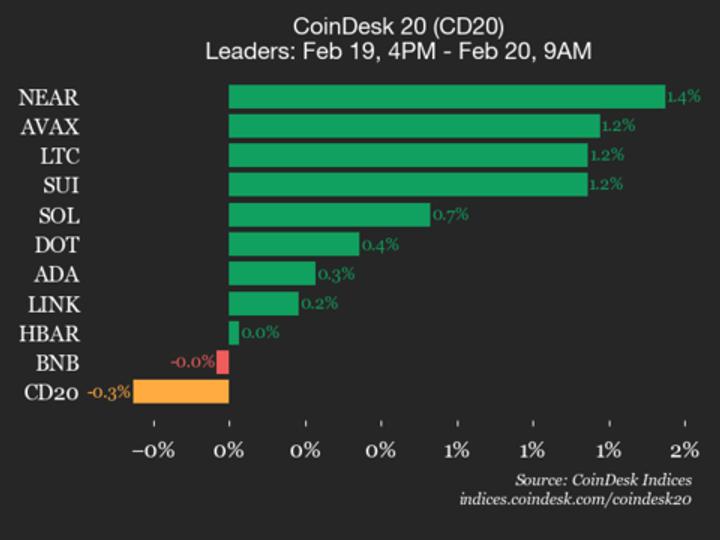
CoinDesk Indices presents its daily market update, highlighting the performance of leaders and laggards in the CoinDesk 20 Index.

The CoinDesk 20 is currently trading at 1924.88, down 0.3% (-6.12) since yesterday’s close.

Nine of the 20 assets are trading higher.

Leaders: NEAR (+1.4%) and AVAX (+1.2%).

Laggards: AAVE (-3.3%) and BCH (-2.1%).

The CoinDesk 20 is a broad-based index traded on multiple platforms in several regions globally.

BTC gains, but quickly retreats as Trump tariffs ruled illegal by Supreme Court

0

The U.S. Supreme Court on Friday struck down President Trump’s tariff regime in a 6-3 decision.

“No President has invoked the statute to impose any tariffs, let alone tariffs of this magnitude and scope,” the court ruling said.

“That ‘lack of historical precedent,’ coupled with the ‘breadth of authority’ that the President now claims, suggests that the tariffs extend beyond the President’s ‘legitimate reach.'”

Bitcoin knee-jerked about 2% higher on the news, rising past the $68,000 level. As has been typical in crypto lately, though, the gain was reversed within minutes, returning to just below $67,000 at the current time.

Crypto’s fleeting gains stood in contrast to what’s appearing more sustainable in stocks, with the Nasdaq rising 0.6% to a session high.

Stagflationary data

Earlier Friday, a batch of U.S. economic data showed signs of stagflationary impulses. The U.S. economy grew only a modest 1.4% in the final three months of 2025, the Commerce Department reported. Alongside core personal consumer expenditure prices rose 3% year-over-year, faster than the hoped for 2.9% and up from 2.8% previously.

On a yearly basis, the economy grew 2.2%, which is the slowest growth since Covid year 2020.

“Today’s economic data delivered a messy message of both hotter than expected inflation, and slower than anticipated growth,” Art Hogan, chief market strategist at B. Riley Wealth, said. “The confusing message from today’s data confirms the current Fed bias to take their time with monetary policy.”

AYU Alternative Investment Network Launches Direct Capital Matching Service

0

WHY THIS MATTERS:

Family offices now control trillions in private capital globally and are becoming increasingly active across venture capital, private equity, private credit, real estate and digital assets. Yet despite their growing influence, the infrastructure connecting family offices with funds and founders remains fragmented and inefficient.

The traditional capital introduction model is heavily relationship-driven, opaque and time-consuming. Family offices are often inundated with unsolicited pitches, while fund managers and founders struggle to identify which investors have genuine mandate alignment. The result is wasted time, poor signal-to-noise ratios and missed opportunities on both sides.

AYU, the global private members’ community for family offices and alternative investment funds, is launching AYU Capital, a matching service connecting funds and founders with verified family office investors.

The offering allows those seeking investment the ability to understand appetite from the rapidly growing family office market, and to be connected with interested investors. It enables family offices to access curated deal flow, including introductions to funds and deal opportunities, whilst remaining anonymous.

Historically, the family office to fund/founder connection has been characterised by inefficiency and floods of unsolicited and unrequited pitches for family offices, leading to unparsable data and frustration. Funds and founders, conversely, waste significant amounts of time and money trying to find and pitch investors. AYU Capital and its AI-driven platform, Cupid, matches opportunities and investors, makes introductions and curates meetings that solve this problem.

For the rapidly growing base of capital held in private family offices worldwide, Cupid builds structured profiles defining the perfect opportunities. Likewise, it finds the perfect investors for funds and deals. Cupid uses its insight to find connections, and generate targeted, high quality introductions. Close to 500 family offices are already being connected to deal flow.

The Cupid platform accepts submissions from the full spectrum of private capital opportunities and alternative funds, including direct investments, hedge funds, venture capital, private equity, private credit, real estate funds and digital assets. In addition, as family offices increasingly co-invest with one another and raise capital for their own projects, Cupid provides a structured environment to facilitate family offices’ own co-investment opportunities. AYU Capital is launching after a year’s trial, during which family offices representing over $500bn have been connected to deals and opportunities. The first successful deal matches and transactions have already been made.

Alexander Fink, principal of Fink Family Office and VC Fund, Empirical Ventures, said: “I’ve been a member for over a year now and the curated connections from AYU, both digital and in person, have been hugely valuable. I’ve met some incredible people there. As we are both a family office investor and a fund manager, it’s the perfect community for us”

Gus Morison, CEO of AYU, commented: “This new service has been developed in response to demand from our members for a platform that prioritises the specific needs of family offices. Other cap intro platforms have put tech and deal flow first, but few understand that there’s no point having the tech and deal flow, if you don’t have people who trust you enough to use it. AYU Capital and Cupid reflect AYU’s people-first and product-second philosophy.”

FF NEWS TAKE:

AYU Capital is positioning itself less as a marketplace and more as a trust-based capital network.

In private markets, access is everything—but so is discretion. The differentiation here is not just AI matching; it’s the pre-existing community layer. If family offices trust the network, the matching engine becomes significantly more powerful.

The broader theme is clear: private capital is professionalising. As family offices behave more like institutional allocators—while retaining their flexibility—they require better infrastructure to filter opportunities efficiently.

Inside Trump’s surreal Mar-a-Lago crypto summit

0

PALM BEACH, Fla. — Attending World Liberty Financial’s forum at Mar-a-Lago felt less like a high-powered summit and more like an intimate gathering — if the guest list included people who control trillions in assets and the future of finance.

Tucked beneath chandeliers and gold-painted trim, the guest list read like a who’s who of the industry’s old guard and rising disruptors. There were no name tags needed. Everyone seemed to know everyone, or at least know someone who did.

The stage at the World Liberty forum. (CoinDesk)

Conversations floated from the future of finance to how it might fix what’s been broken in the past — ambitious visions of tokenized assets, regulatory overhauls, and reimagined capital markets. But just as easily, the talk turned to the upcoming FIFA World Cup tournament and press-on nails, courtesy of a few unexpected names who probably had no business being there, and yet somehow made the whole thing feel even more surreal.

The event was not targeted toward an exclusively U.S. audience; attendees hailed from a number of countries. Several attendees flew from Consensus Hong Kong last week directly to Palm Beach to attend the World Liberty Forum. One attendee said they had flown in on Wednesday morning from ETHDenver, and several others said they would be flying to the Colorado conference following the forum.

‘Punitive finance’

In any other context, the event would seem to be a typical crypto conference; speakers from traditional financial backgrounds explaining how they’re using blockchain or why they’re discussing crypto to a dimly lit room.

However, the backdrop loomed: This was a conference put on by World Liberty Financial, the crypto company launched and owned in part by the family of U.S. President Donald Trump, held at his golf club Mar-a-Lago, with several attendees tied to his business interests. Binance founder Changpeng Zhao, in his first U.S. appearance since receiving a pardon from Trump, was spotted at the event. Goldman Sachs’ David Solomon joked on stage that he was there because his client had requested his presence.

Goldman Sachs CEO David Soloman (CoinDesk)

Goldman Sachs CEO David Soloman (CoinDesk)

Many of the panels themselves were high-level; World Liberty Financial co-founder Alex Witkoff asked U.S. Senator Ashley Moody to walk the audience through her background, or Eric Trump and Donald Trump, Jr. reiterating their past grievances with the banks.

“It was forced and maybe opportunistic but we lived a life that opened our eyes to maybe how corrupt the system was … banks [canceled our accounts] for no reason other than my father was wearing a hat that said ‘Make America Great Again,'” Eric Trump claimed. “We realized how antiquated finance was, how punitive finance was.”

Donald Trump Jr. speaking on stage. (CoinDesk)

Donald Trump Jr. speaking on stage. (CoinDesk)

Amid these sessions, some speakers walked through their arguments for the digital assets sector. Franklin Templeton CEO Jenny Johnson laid out the rationale for the U.S. dollar remaining the global reserve currency, saying the European Union was too uncoordinated for the euro to take the dollar’s place and other currencies just didn’t meet the moment.

“About 50% of trade today is done in dollars, another 30% is in the euros, [but] there’s no single European debt market. They can’t even coordinate around the euro … so that’s not going to be the next reserve,” she said.

China’s renminbi and India’s rupee are contenders, but neither is free-floating, and so that makes it unlikely either of those currencies can take on the role, she said.

“As long as people are still looking for their stablecoin to be backed by the most risk-free currency, it’s going to be the dollar,” she said.

Many of the panels nevertheless only had a passing focus on digital assets themselves. The audience reflected this, with crowds mingling outside the actual room to chat during several panels.

Attendees mingling during lunch at the pool. (CoinDesk)

Attendees mingling during lunch at the pool. (CoinDesk)

It wouldn’t have been a Trump gathering without the biggest real estate moguls in the room — and that’s when tokenization (putting assets on blockchain) became a topic. Hotel billionaire Barry Sternlicht, whose Starwood Capital manages over $125 million in assets under management, said the firm was ready to tokenize real-world assets such as real estate, but continues to be unable to do so given the regularity uncertainty.

Similarly, Kevin O’Leary told listeners that sovereign wealth funds, with whom he speaks regularly, won’t touch crypto because they’re afraid of the regulatory risk that comes with it in the U.S.

Glamour and celebrities

From O’Leary to Goldman Sachs CEO David Solomon to FIFA president Gianni Infantino, if the day’s lineup were ranked by celebrity status, the organizers surely saved the best for last — and probably the least relevant.

Nicki Minaj closed out the event as the final panelist, but the first that caused half the room to take out their phones to snap a picture. Her presence may not make sense in the context of finance or crypto specifically — when moderator Alex Bruesewitz informed her that people gathered to talk about a new innovation in finance, she said she “can like it” — but given her recently developed close relationship with President Donald Trump, it wasn’t entirely surprising to see her support the family’s event.

Artist Nicki Minaj closed out the conference, speaking about clip-on nails. (CoinDesk)

Artist Nicki Minaj closed out the conference, speaking about clip-on nails. (CoinDesk)

The World Liberty Forum wasn’t just a conference, it was the kind of room where fortunes are steered, not pitched, and where the side chatter was just as telling as the main agenda.

Tennessee Judge Blocks State Crackdown on Kalshi Markets

0

A US federal judge in Tennessee temporarily blocked the state from enforcing its gambling laws against prediction markets operator Kalshi’s sports event contracts. 

The ruling, issued by Judge Aleta Trauger of the US District Court for the Middle District of Tennessee on Thursday, allows Kalshi to continue offering sports-related event contracts to users in the state while its lawsuit against Tennessee regulators proceeds.

Trauger found that Kalshi is likely to succeed on the merits of its claim that federal commodities law preempts Tennessee’s attempt to regulate its sports markets as illegal gambling. 

The court concluded that Kalshi’s sports event contracts are “swaps” under the Commodity Exchange Act, over which the law grants the US Commodity Futures Trading Commission (CFTC) exclusive jurisdiction, and held that Tennessee’s enforcement efforts are likely preempted under conflict preemption principles. 

Preliminary injunction, Kalshi. Source: CourtListener

The injunction applies to the identified state officials, while the Tennessee Sports Wagering Council itself was dismissed on sovereign immunity grounds, and Kalshi was ordered to post a $500,000 bond.

Long-running clash with states

The Tennessee case marks another chapter in a broader clash over how to treat event contracts in the United States.

An earlier temporary restraining order from Trauger had already paused enforcement of Tennessee’s cease-and-desist letter, which alleged that Kalshi was operating unlicensed sports wagering, ordered it to stop offering sports event contracts to customers in Tennessee, void those contracts and refund deposits, and threatened fines and further legal action. 

Related: Nevada court hits Polymarket with temporary restraining order, tests CFTC control

Kalshi has similarly gone to federal court in multiple states, including Nevada, New Jersey, and Connecticut, over cease-and-desist actions targeting its event markets, with courts reaching divergent conclusions on whether to grant preliminary relief.

CFTC steps in to defend prediction markets

​The injunction also lands against a shifting federal backdrop, as the CFTC moves to assert primacy over prediction markets.

In a video message on Tuesday, CFTC Chair Michael Selig said the agency had filed a friend-of-the-court brief to defend its “exclusive jurisdiction” over prediction markets, warning state authorities that the commission would meet them in court if they tried to undermine federal oversight of these derivative markets.

AI Eye: IronClaw rivals OpenClaw, Olas launches bots for Polymarket