Home Blog Page 978

U.S. Supreme Court’s decision on Trump’s tariffs may not rock crypto — yet

0

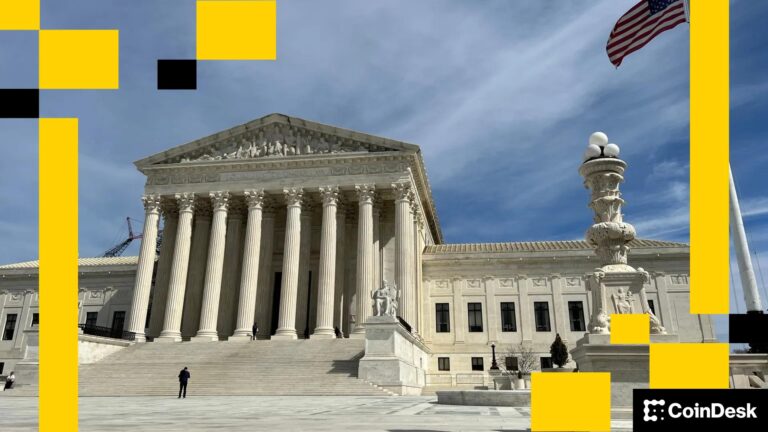
The U.S. Supreme Court has decided that President Donald Trump didn’t have the power to impose tariffs as he did. While the markets have taken the decision in stride, the impact on crypto is likely to be modest — at least for now — as there are political considerations that may influence the industry’s policy trajectory in Washington.

Though Trump’s aggressive and sometimes turbulent pursuit of tariffs under the International Emergency Economic Powers Act is halted, the president has a number of other options to replace them with tariffs available in other legal authorities governing U.S. trade. He said in a Friday press conference after the “deeply disappointing” decision that “there are methods, practices, statutes and authorities, as recognized by the entire court in this terrible decision … that are even stronger than the IEEPA tariffs available to me as president of the United States.”

“Other alternatives will now be used to replace the ones that the court incorrectly rejected,” Trump said, announcing that he’ll order a new 10% global tariff.

In the near term, anything that occupies policymakers in the coming weeks could threaten to steal some of the oxygen from the already dicey U.S. Senate timeline to get the crypto industry’s top goal accomplished: passage of the Digital Asset Market Clarity Act that would govern U.S. crypto market structure.

Senator Bernie Moreno, an Ohio Republican, staunch Trump supporter and a big crypto advocate, posted on social media site X, “SCOTUS’s outrageous ruling handcuffs our fight against unfair trade that has devastated American workers for decades.”

On the other side of the aisle, Senator Elizabeth Warren, the ranking Democrat on the Senate Banking Committee, celebrated the Supreme Court’s 6-3 ruling but suggested it left intact the harm already imposed on consumers. Earlier this month, the Tax Foundation reported an estimated per-household hit of $1,000 last year and $1,300 this year from the tariffs.

“The court has struck down these destructive tariffs, but there is no legal mechanism for consumers and many small businesses to recoup the money they have already paid,” U.S. Senator Elizabeth Warren said in a statement. “Instead, giant corporations with their armies of lawyers and lobbyists can sue for tariff refunds, then just pocket the money for themselves. It’s one more example of how the game is rigged.”

The Cato Institute, however, is holding out hope for refunds of the “tens of billions” in customs duties collected under the tariffs.

“That refund process could be easy, but it appears more likely that more litigation and paperwork will be required — a particularly unfair burden for smaller importers that lack the resources to litigate tariff refund claims yet never did anything wrong,” according to a Friday statement from economists at the libertarian think tank.

The crypto bill impact

Despite the legal resolution, the tariff dispute and its aftermath will likely be front-and-center in this year’s midterm congressional elections, and those races could have a profound effect on the crypto sector.

If Congress hasn’t yet passed a market structure bill by this summer, the industry’s policy efforts will depend on the outcome of those elections, especially if they shift the majority in the House of Representatives or in both chambers of Congress. And even if the crypto industry already has the Clarity Act in hand by then, there are a number of other legislative initiatives at play on taxation and bitcoin reserves.

The Supreme Court’s rebuke of Trump’s illegal tariff regime could provide some boost to Democratic candidates in otherwise close races.

Democrat candidates will seek to convince voters that they’ve been personally harmed by the tariffs, as Warren argued. If enough Democrats win to secure the House majority, they could make it much more difficult for the current crypto policy push to advance without heavy revisions that could impose more constraints on the sector.

Read More: Bitcoin pops then drops as Supreme Court strikes down Trump tariffs

UPDATE (February 20, 2026, 19:26 UTC): Adds Trump’s new tariff announcement.

Prediction markets are bending insider trading rules. But will they break them? – DL News

0

  • Insider trading claims mount as prediction markets become ubiquitous.
  • Experts share how blurred the lines are between having an edge and breaking the law.
  • Bills are already being drafted to address key loopholes.

In 1983, the film Trading Places did far more than just catapult Eddie Murphy’s acting career.

When the billionaire Duke brothers are shown discussing an upcoming crop report, they confirm that their operative, Clarence Beeks, is already working to gather the report before its public release, providing audiences with a clear understanding of a specific type of financial fraud.

Insider trading.

So clear that in 2010, the then-Commodity Futures Trading Commission Chief, Gary Gensler, cited the film when appending new regulations for commodities markets.

“The Duke brothers intended to profit from trades in frozen concentrated orange juice futures contracts using an illicitly obtained and not yet public Department of Agriculture orange crop report,” Gensler told Congress.

“To protect our markets, we have recommended what we call the ‘Eddie Murphy‘ rule to ban insider trading using nonpublic information misappropriated from a government source.”

The Duke brothers’ scheme was clear. Betting on the future should be on an even playing field.

Now, the meteoric rise of prediction markets is forcing a messy rethink of what it actually means to have an inside edge.

“The historical excitement about prediction markets is that they’re going to elicit information,” Andrew Verstein, the co-director of the business law program at the University of California, Los Angeles, told DL News. “It can be that a person is a diligent researcher, or they’ve got their own satellite that looks at crops and makes predictions legally.”

“Or it can be that they have a friend at the Agriculture Department who tells them what’s going to happen with frozen orange juice concentrated futures. That’s not something that data is going to help us see the difference between.”

‘Most corrupt corner of Washington’

Prediction markets such as Kalshi and Polymarket exploded onto the scene in the run-up to the 2024 US Presidential election.

Since then, volumes on both platforms have nearly quintupled, reaching over $25 billion in volume in January, according to data collated by data dashboards on Dune.

There are wagers for everything. Some $30 million is riding on whether Jesus Christ will return by 2027. Bettors have placed another $11 million on the outcome of the Federal Reserve’s next meeting. The largest category in prediction markets is sporting events.

“The fact that one doesn’t have clarity about the underlying governance is super problematic.”

—  Yesha Yadav, associate dean at Vanderbilt Law School

At the same time, digital sleuths are highlighting unusual, ultra-lucky traders in specific markets on these platforms.

Just hours before US special forces captured Venezuelan President Nicolás Maduro, a brand-new Polymarket account bet more than $30,000 on his ouster.

The account’s total payout exceeded $436,000, sparking major concern that they had intimate knowledge of the government’s classified military operation.

“The most corrupt corner of Washington, D.C. may well be the intersection of prediction markets and the federal government — where insider trading and self-dealing are no longer imagined risks but demonstrated dangers,” said New York Representative Ritchie Torres.

Torres and a host of Democrats have all co-sponsored the Public Integrity in Financial Prediction Markets Act of 2026. The bill prohibits elected officials from buying, selling or exchanging prediction market contracts tied to the administration’s policies.

Verstein shares a similar view.

“Government officials have a lot of power,” he said. “They have missiles and police. You don’t want them to be able to deploy that power in order to make their bets pay off.”

While that bill advances, another coalition of prediction market platforms, including Kalshi, Crypto.com, and Robinhood, argues that there is already a ban on precisely this kind of trading.

That’s because prediction markets are regulated by the CFTC, which has, thanks to the Murphy Rule, banned insider trading since 2010.

To date, however, there has been no major insider trading arrest in the US involving prediction markets.

Part of that, some academics argue, boils down to one question.

How is insider trading defined exactly, and when can anyone know when it has actually occurred?

Insider information

Trading on insider information involves using wit and expertise to try to predict an outcome.

Insider trading, however, is a legal term for describing fraud by which you use material nonpublic information — such as a secret USDA crop report — for profit.

Yesha Yadav, a professor of law and associate dean at Vanderbilt Law School, says the distinction between legally trading on insider information and illegal insider trading is becoming increasingly blurred.

“The challenge of prediction markets that we’re facing is that we don’t know when trading on insider information actually becomes insider trading,” Yadav told DL News. “The clarity of legal rules, duties, and understanding the scope of how broadly or narrowly the law reaches in this context is really unclear.”

It’s made even more unclear due to the breadth of markets available on prediction markets.

The Bad Bunny problem

Ahead of the Super Bowl in February, users bet roughly $113 million on what the Puerto Rican pop star Bad Bunny would play as the opening song for this year’s halftime show.

When asked if it would be considered insider trading if one of Bad Bunny’s dancers bet in this market, Kalshi CEO Tarek Mansour hesitated.

“If that’s the position that people are taking, which is essentially, ‘this is nonmaterial, nonpublic information,’” Mansour said, “and that it’s ok to talk about which song is going to be played, it’s ok to divulge certain information beforehand, then it’s totally fair game.”

In sum, it depends.

There’s also a case for insider trading on these markets — at least to an extent.

Polymarket CEO Shayne Coplan and Coinbase CEO Brian Armstrong suggest that insider trading should be encouraged because it can enhance the quality of the information markets provide.

A market with many insiders would, in theory, generate extremely accurate forecasts, they argue.

However, if average users are under the impression that most participants have key insights they don’t, they’re unlikely to be interested in participating.

“The way you make an exchange successful is that you reduce the amount of informed trading so that everyone feels like this is working for them,” Verstein said. “But if you do that, then it becomes less of a future machine. The people who know the future aren’t allowed to trade.”

It’s a delicate balance.

But it’s one that needs clearer attention from authorities, warns Yedev. Especially as these platforms swell in size and scope.

“People are seeing these future probability forecasts being brought into some really important settings,” she said.

“The fact that one doesn’t have clarity about the underlying governance is super problematic.”

Liam Kelly is DL News’ Berlin-based DeFi correspondent. Have a tip? Get in touch at liam@dlnews.com.

Specialized AI detects 92% of real-world DeFi exploits

0

A purpose-built AI security agent detected vulnerabilities in 92% of exploited DeFi smart contracts in a new open-source benchmark.

The study, released Thursday by AI security firm Cecuro, evaluated 90 real-world smart contracts exploited between October 2024 and early 2026, representing $228 million in verified losses. The specialized system flagged vulnerabilities tied to $96.8 million in exploit value, compared with just 34% detection and $7.5 million in coverage from a baseline GPT-5.1-based coding agent.

Both systems ran on the same frontier model. The difference, according to the report, was the application layer: domain-specific methodology, structured review phases and DeFi-focused security heuristics layered on top of the model.

The findings arrive amid growing concern that AI is accelerating crypto crime. Separate research from Anthropic and OpenAI has shown that AI agents can now execute end-to-end exploits on most known vulnerable smart contracts, with exploit capability reportedly doubling roughly every 1.3 months. The average cost of an AI-powered exploit attempt is about $1.22 per contract, sharply lowering the barrier to large-scale scanning.

Previous CoinDesk coverage outlined how bad actors such as North Korea have begun using AI to scale hacking operations and automate parts of the exploit process, underscoring the widening gap between offensive and defensive capabilities.

Cecuro argues that many teams rely on general-purpose AI tools or one-off audits for security, an approach the benchmark suggests may miss high-value, complex vulnerabilities. Several contracts in the dataset had previously undergone professional audits before being exploited.

The benchmark dataset, evaluation framework and baseline agent have been open-sourced on GitHub. The company said it has not released its full security agent due to concerns that similar tooling could be repurposed for offensive use.

WestFax launches AI-powered intelligent document processing platform for healthcare

0


WestFax Comprehend Now Available Across All Service Tiers, Automating Medical Document Classification, Data Extraction and Workflow Routing

WestFax, a provider of HIPAA-compliant cloud fax and healthcare document exchange solutions, today announced the official launch of WestFax Comprehend, an AI-powered Intelligent Document Processing (IDP) platform designed to automate medical document intake, classification, extraction and routing for healthcare organizations.

Now available to customers across all WestFax product tiers, WestFax Comprehend transforms inbound healthcare documents into structured, actionable data without requiring hospitals, clinics or physician groups to replace their existing fax, EHR or document management infrastructure.

Healthcare organizations continue to receive high volumes of unstructured documents including referrals, lab results, prior authorizations and insurance forms. WestFax Comprehend applies artificial intelligence, optical character recognition (OCR) and FHIR-aligned classification models to convert image-based files into searchable PDFs, identify document types and extract key patient and provider data elements for validation and routing.

The platform ingests documents from multiple sources, including cloud fax, secure file transfer, drop folders and cloud storage environments. A centralized intake architecture called Streams consolidates inbound documents into configurable automation workflows. Streams support rule-based routing, urgent request flagging, multi-patient document detection and automated document splitting, enabling healthcare IT teams to manage intake with greater visibility and control.

Built-in Connectors enable integration with electronic health record (EHR) systems and third-party platforms such as Hyland OnBase, Amazon Web Services (AWS) S3, Microsoft Azure Blob Storage, Google Cloud Storage and Dropbox. Organizations may also route processed documents into their own private cloud environments.

“We designed WestFax Comprehend to reduce administrative burden while preserving clinical integrity,” said Barry Clark, President of WestFax. “Healthcare teams rely on stable document infrastructure. Comprehend enhances those workflows with practical AI automation that fits into the systems providers already trust.”

Doug Clayton, Chief AI Officer at WestFax, added, “Intelligent Document Processing in healthcare must prioritize accuracy, compliance and usability. Our focus is measurable workflow efficiency without introducing unnecessary operational risk.”

Key capabilities of WestFax Comprehend include:

  • OCR and searchable PDF conversion
  • FHIR-based document classification with customizable tagging
  • Automated patient and provider data extraction
  • Multi-patient detection and document separation
  • Configurable workflow automation and routing rules
  • Secure cloud storage and EHR integration connectors

Dutch Authorities Call on Polymarket Arm to Cease Activities

0

The prediction market’s Dutch arm, Adventure One, allegedly offered illegal bets, including on elections in the Netherlands.

The Netherlands Gambling Authority said it imposed a penalty on prediction markets platform Polymarket’s Dutch arm, Adventure One, for offering gambling to residents without a license.

In a Tuesday notice, Dutch authorities ordered the Polymarket company to “cease its activities immediately,” or face up to $990,000 in fines. According to authorities, Adventure One was in violation of Dutch law for offering illegal bets, including those on local elections, and the company had not responded to requests to address these activities.

”Prediction markets are on the rise, including in the Netherlands,” said the Netherlands Gambling Authority’s director of licensing and supervision, Ella Seijsener. “These types of companies offer bets that are not permitted in our market under any circumstances, not even by license holders.”